
Market Overview
| Study Period | 2021 - 2031 |
|---|---|
| Forecast Data Period | 2026 - 2031 |
| Base Year Market Size (2025) | USD 1.35 Billion |
| Market Size (2026) | USD 1.42 Billion |
| Market Size (2031) | USD 1.84 Billion |
| Growth Rate (2026 - 2031) | 5.27 % |
| Market Concentration | Medium |
Major Players *Disclaimer: Major Players sorted in no particular order Image © Mordor Intelligence. Reuse requires attribution under CC BY 4.0. | |
Europe Feed Pigments Market Analysis by Mordor Intelligence
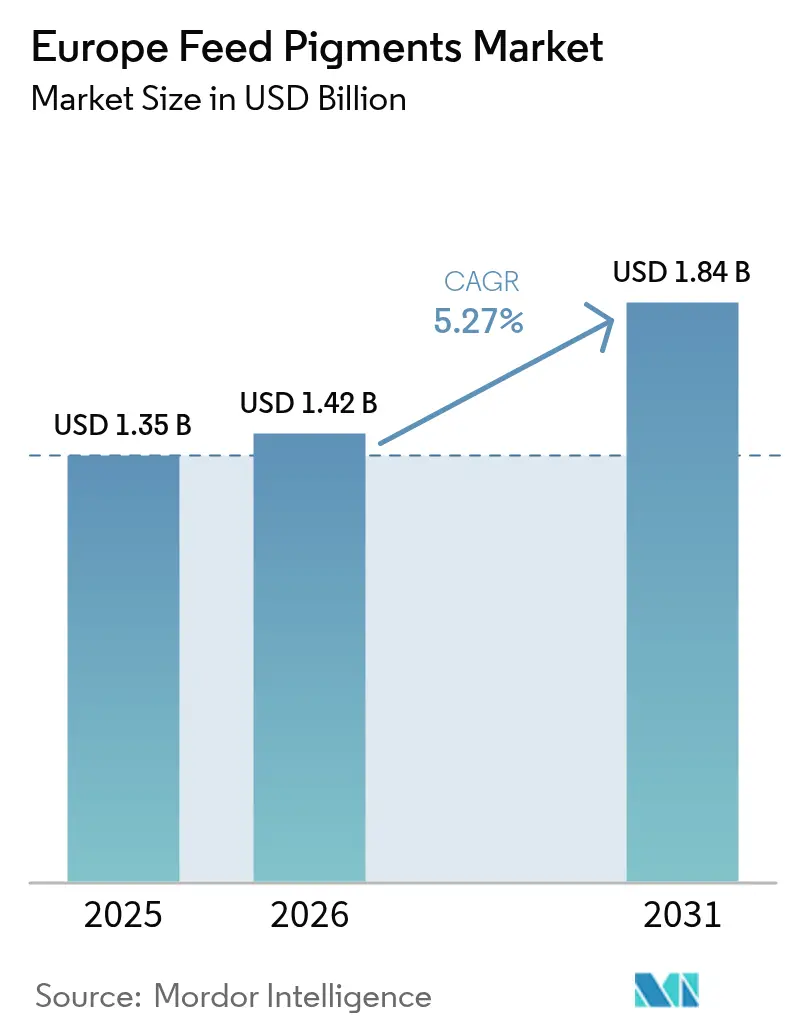
The Europe feed pigments market size was valued at USD 1.35 billion in 2025 and estimated to grow from USD 1.42 billion in 2026 to reach USD 1.84 billion by 2031, at a CAGR of 5.27% during the forecast period (2026-2031). Growth is propelled by retailer demand for vivid yolk and flesh coloration, a regulatory tilt toward natural carotenoids, and expanding aquaculture production. Carotenoids dominate due to their dual role in pigmentation and immune support, while spirulina outpaces all other ingredients as algae cultivation scales up. Poultry integrators continue to represent the bulk of demand, and salmonid producers are modernizing their feed recipes to comply with the European Food Safety Authority's inclusion caps. Germany anchors regional revenue because its large layer flock supports widespread carotenoid use, whereas Russia shows the quickest growth as import-substitution policies stimulate domestic pigment blending.
Key Report Takeaways
- By type, carotenoids captured 61.45% of the Europe feed pigments market share in 2025, while spirulina is projected to grow at a 9.25% CAGR through 2031.
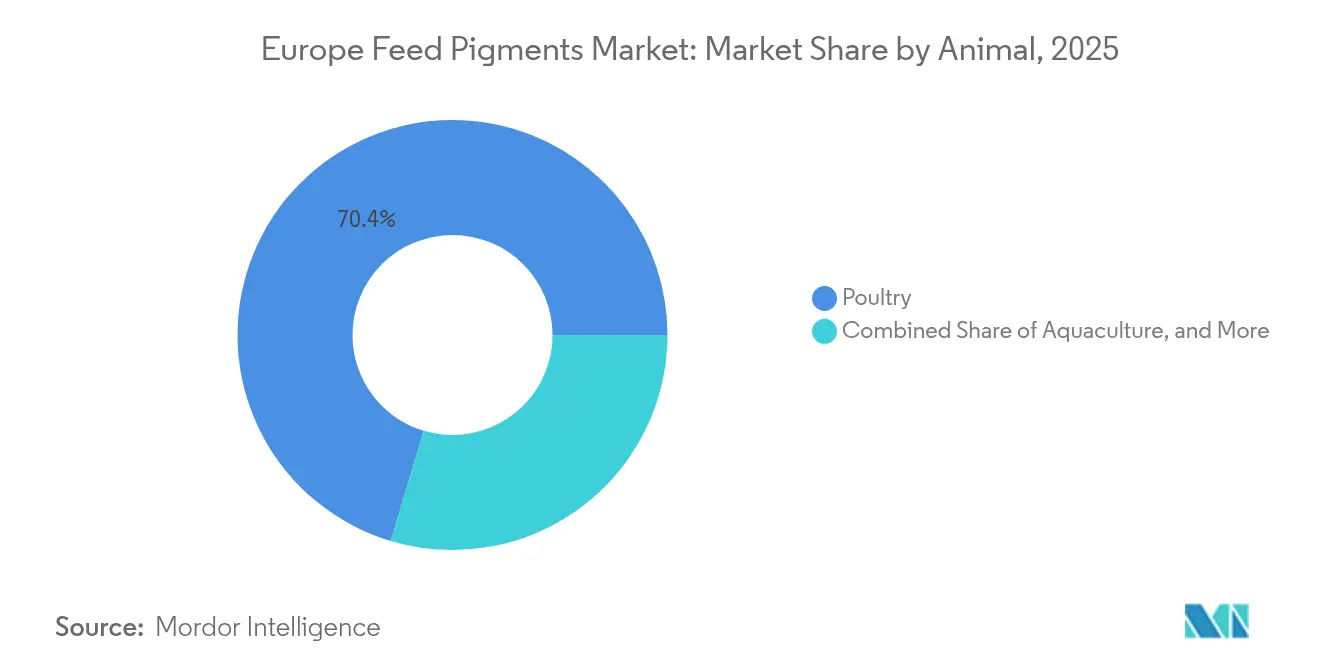
- By animal, poultry applications held 70.36% of the Europe feed pigments market share in 2025, and aquaculture is projected to grow at an 8.05% CAGR through 2031.
- By geography, Germany accounted for 18.32% of the Europe feed pigments market share in 2025, whereas Russia is the fastest-growing region, with a 7.22% CAGR through 2031.
Note: Market size and forecast figures in this report are generated using Mordor Intelligence’s proprietary estimation framework, updated with the latest available data and insights as of 2026.
Europe Feed Pigments Market Trends and Insights
Drivers Impact Analysis*
| Driver | (~) % Impact on CAGR Forecast | Geographic Relevance | Impact Timeline |
|---|---|---|---|
| Rising demand for carotenoid-enriched poultry products | +1.2% | Germany, France, Spain, and United Kingdom | Medium term (2-4 years) |
| Shift toward natural pigment sources | +1.0% | Germany, Spain, France, Italy, and United Kingdom | Long term (≥ 4 years) |
| Technological advances in microencapsulation for stability | +0.6% | Germany, France, and United Kingdom | Medium term (2-4 years) |
| Regulatory easing on algal pigment approvals | +0.5% | Germany, France, Spain, Italy, United Kingdom, and Russia | Short term (≤ 2 years) |
| Consumer preference for clean-label meat and eggs | +0.9% | Germany, France, United Kingdom, and Spain | Medium term (2-4 years) |
| Growth of antibiotic-free feed driving functional pigments | +0.4% | Germany, France, Spain, Italy, and United Kingdom | Long term (≥ 4 years) |
| Source: Mordor Intelligence | |||
Rising Demand for Carotenoid-Enriched Poultry Products
Retailers across Germany, France, and Spain are mandating deeper yolk colors to signal freshness and nutritional density, with supermarket chains specifying Roche scores of 14 or higher for premium egg lines. This visual benchmark translates directly into lutein and zeaxanthin inclusion rates of 20 to 30 milligrams per kilogram of layer feed, which is projected to increase carotenoid demand by an 8% year-over-year in 2024. DSM-Firmenich's trial data, published in 2024, showed that apocarotenoid-ester formulations achieved 46.2% deposition efficiency in egg yolks, compared with 31.9% for canthaxanthin [1]. This enabled formulators to reduce inclusion rates while maintaining target color scores and lowering feed costs by 3%. Consumer surveys in Germany indicate that 68% of shoppers associate darker yolks with higher omega-3 content, even though yolk color is unrelated to fatty-acid profile, creating a perception gap that drives premiumization strategies across the egg value chain.
Shift Toward Natural Pigment Sources
The European Union's de facto ban on synthetic azo dyes, including Red 2G, has accelerated adoption of plant- and algae-derived pigments, with spirulina and paprika oleoresin capturing share from chemically synthesized alternatives. Spirulina's phycocyanin and carotenoid content make it a dual-function ingredient for aquaculture, providing both blue-green hues for ornamental fish and red-orange tones for salmonids when combined with astaxanthin. The European Food Safety Authority (EFSA) fast-tracked approvals for several algal extracts in 2024, reducing the regulatory timeline from 18 months to under 12 months for dossiers with robust safety data. This has emboldened ingredient suppliers to invest in European cultivation capacity. Spain's paprika-growing regions experienced a 12% decline in yield in 2024 due to drought and elevated summer temperatures, which tightened the oleoresin supply and pushed spot prices up 18% year-over-year. This, in turn, prompted poultry integrators in France and Italy to lock in forward contracts or reformulate with synthetic canthaxanthin blends.
Technological Advances in Microencapsulation for Stability
Microencapsulation technology has emerged as a critical enabler for pigment bioavailability, with patented beadlet formulations protecting carotenoids from oxidative degradation during feed pelleting and storage. DSM-Firmenich's Carophyll beadlets utilize a lipid-matrix coating that maintains 95% pigment potency after six months of ambient storage, compared with 70% retention for uncoated powders, thereby reducing the need for over-formulation and lowering raw material waste. Kemin's ORO GLO product line incorporates a proprietary encapsulation process that increases lutein deposition in egg yolks by approximately 25% compared to standard marigold extracts, enabling layer operations to achieve Roche 14 scores with 15% lower inclusion rates and reducing feed costs by an estimated USD 0.02 per dozen eggs. Germany and France lead the adoption due to their concentration of large-scale compound-feed producers, which possess the capital and technical expertise to validate encapsulated ingredients through controlled feeding trials.
Regulatory Easing on Algal Pigment Approvals
The European Food Safety Authority (EFSA) has streamlined its approval pathway for algae-derived additives, reducing dossier review times by one-third since 2024. This reflects the agency's recognition that spirulina and Haematococcus extracts pose a lower toxicological risk profile than novel synthetic compounds. EW Nutrition GmbH secured approval for a lutein-rich Tagetes extract for turkeys in October 2024, with a maximum inclusion of 80 milligrams per kilogram, which is double the limit for broilers. This approval opens a differentiated segment for producers targeting skin pigmentation in heavy tom lines. Long-term supply certainty for integrators planning multi-year genetics programs, as per the European Food Safety Authority (EFSA). Russia has adopted a parallel fast-track process for feed additives that mirrors Europe Union approvals, reducing the lag time for ingredient availability in the Russian market from 24 months to under 12 months and supporting the country's pigment consumption as domestic aquafeed mills ramp up production.
Restraints Impact Analysis*
| Restraint | (~) % Impact on CAGR Forecast | Geographic Relevance | Impact Timeline |
|---|---|---|---|
| Volatile raw-material costs | -0.8% | Germany, France, Spain, Italy, and United Kingdom | Short term (≤ 2 years) |
| Stringent maximum inclusion limits by European Food Safety Authority (EFSA) | -0.5% | Germany, France, Spain, Italy, United Kingdom, and Russia | Long term (≥ 4 years) |
| Slow farmer adoption in Central and Eastern Europe | -0.3% | Russia, and Rest of Europe | Medium term (2-4 years) |
| Supply constraints of natural pigment biomass | -0.4% | Spain, France, and Italy | Short term (≤ 2 years) |
| Source: Mordor Intelligence | |||
Volatile Raw-Material Costs
Natural astaxanthin derived from Haematococcus algae was traded between USD 6,000 and USD 7,150 per kilogram in 2024, roughly six times the cost of synthetic astaxanthin at USD 1,000 per kilogram, creating margin pressure for aquafeed mills that market premium, all-natural salmon diets [2]. Marigold oleoresin prices surged 18% year-over-year in 2024, driven by reduced harvests in India and Mexico, the two largest exporters, as well as a tightening European paprika supply following Spain's 12% yield decline due to drought. Aquaculture operators in Norway and Scotland have responded by blending natural and synthetic astaxanthin at ratios of 30:70 or 40:60, preserving the label claims of containing natural pigments while managing input costs, though this strategy risks consumer backlash if ingredient transparency becomes a competitive battleground.
Stringent Maximum Inclusion limits by European Food Safety Authority (EFSA)
European Food Safety Authority (EFSA) enforces maximum inclusion caps for several carotenoids, most notably a 25-milligram-per-kilogram limit for canthaxanthin in layer and broiler diets and a 100-parts-per-million ceiling for astaxanthin in salmonid feeds, which constrain formulators' ability to achieve target pigmentation scores in high-performance genetics. BioMar's technical guidance, published in 2024, recommends a 50-parts-per-million astaxanthin inclusion to optimize flesh-color retention economics. The guidance notes that exceeding 80 parts per million delivers diminishing returns on SalmoFan scores while increasing feed costs by USD 0.15 per kilogram. These regulatory ceilings create a structural demand ceiling for high-potency pigments, redirecting innovation toward bioavailability enhancement and encapsulation rather than higher-dose applications.
*Our forecasts treat driver/restraint impacts as directional, not additive. The impact forecasts reflect baseline growth, mix effects, and variable interactions.
Segment Analysis
By Type: Carotenoids Anchor Market, Spirulina Gains Aquaculture Traction
Carotenoids captured 61.45% of the Europe feed pigments market size in 2025, underpinned by their versatility across poultry, aquaculture, and swine applications, where lutein, zeaxanthin, astaxanthin, and canthaxanthin serve both pigmentation and immune-support functions. Curcumin remains a niche segment, primarily deployed in organic poultry systems, where turmeric's antioxidant properties complement its mild yellow pigmentation. Although the Europe Food Safety Authority (EFSA) has not issued specific inclusion guidelines, formulators rely on Generally Recognized as Safe (GRAS) precedents from the food sector. Caramel colorants capture a minimal share in feed applications, primarily used in specialty pet-food formulations where the visual appeal to human purchasers outweighs the ingredient's negligible nutritional contribution.
Spirulina is projected to grow at a 9.25% CAGR through 2031, driven by European aquaculture's pivot toward algae-derived pigments that align with clean-label positioning and the Europe Food Safety Authority (EFSA) streamlined approval pathway for botanical extracts. Spirulina's dual functionality as a protein source and pigment positions it for incremental share gains in aquaculture, particularly as Norwegian and Scottish salmon farms seek to differentiate from Chilean competitors that rely on synthetic astaxanthin, though European cultivation capacity remains below 2,000 metric tons annually and forces mills to import dried biomass from Asia at a 25 to 30% cost premium .


By Animal: Poultry Dominates, Aquaculture Expands Fastest
Poultry applications held 70.36% of the Europe feed pigments market size in 2025, reflecting the sector's scale and the direct link between yolk color and consumer purchasing decisions in Germany, France, and Spain, where retailers specify Roche scores of 14 or higher for premium egg lines. Swine applications capture a single-digit share, concentrated in Spain and Italy, where producers use paprika oleoresin to enhance cured-ham color and appeal to premium export markets, though this remains a low-volume niche relative to poultry and aquaculture. Ruminant pigment use is negligible, as beef and dairy products derive color from endogenous myoglobin and beta-carotene metabolism rather than dietary supplementation, leaving carotenoids relevant only in specialty veal operations targeting pale-pink flesh for Continental European buyers.
Aquaculture is set to grow at an 8.05% CAGR through 2031, propelled by rising European salmon and trout production and the need to meet retailer color specifications under Europe Food Safety Authority (EFSA) 100-parts-per-million astaxanthin cap, which has forced mills to optimize blended carotenoid strategies pairing astaxanthin with canthaxanthin or lutein. Russia's 50,000 metric tons aquafeed plant, which opened in 2024, signals the country's intention to scale domestic salmon farming. Pigment inclusion rates remain 20 to 30% below Norwegian benchmarks due to limited technical support and a fragmented distribution network.
Geography Analysis
Germany accounted for 18.32% of the revenue in 2025, anchored by its 50-million-layer flock and consumer willingness to pay premiums for Roche-scale 14 yolks, which translate into lutein and zeaxanthin inclusion rates of 20 to 30 milligrams per kilogram in layer diets. The country's large-scale compound-feed producers, including Deutsche Tiernahrung Cremer and Agravis Raiffeisen, have adopted microencapsulated carotenoids that maintain 95% potency after six months of ambient storage, thereby reducing over-formulation waste and lowering raw material costs by an estimated 3%. Italy accounts for a significant share, supported by its aquaculture sector and niche demand for paprika in cured-ham production. The United Kingdom holds a significant share, with ForFarmers' June 2025 launch of an organic paprika yolk colorant targeting free-range producers supplying Waitrose and Marks and Spencer.
Russia is forecast to deliver the fastest growth, with a 7.22% CAGR through 2031, propelled by new aquafeed capacity and import-substitution policies that favor domestic pigment blending. Adoption rates remain 20 to 30% below Western European benchmarks due to limited technical support and a fragmented distribution network. The country's 50,000 metric tons aquafeed plant, which opened in 2024, signals intent to scale domestic salmon farming, yet pigment inclusion rates lag Norwegian standards, creating a latent opportunity for ingredient suppliers willing to invest in local technical service teams.
Poland, Romania, and smaller markets contribute a significant share in 2025 but grow at below-average rates due to slower adoption of natural pigments and a historical focus on least-cost feed formulations. Poland's egg sector remains 70% reliant on synthetic canthaxanthin, compared with 40% in Germany, because Polish retailers have not imposed the same Roche-score specifications as their Western counterparts. This adoption gap constrains near-term growth but represents a structural opportunity as retail consolidation and export-market access drive quality standardization across Central and Eastern Europe over the next five years.
Regulatory Landscape
Feed pigments in Europe are regulated under the EU feed additive framework in Regulation (EC) No 1831/2003, where pigments are treated as sensory additives (colourants) that require authorization before being placed on the market. EFSA (through its FEEDAP Panel) conducts the safety and efficacy assessment, and authorizations are granted for specific species and conditions of use. This creates a compliance-driven market in which product labeling, inclusion directions, and species claims must match the authorization.
Regulatory activity also affects how quickly new pigment portfolios reach formulators, particularly for carotenoids and algae-derived inputs. In May 2026, the European Commission renewed the authorization of beta-carotene as a nutritional feed additive for all animal species via Commission Implementing Regulation (EU) 2026/1148. The measure included transitional provisions allowing products labeled before 18 December 2026 to remain on the market until stocks are exhausted, reinforcing continuity for widely used carotenoid inputs while keeping suppliers focused on dossier updates, renewals, and documented manufacturing methods.
Competitive Landscape
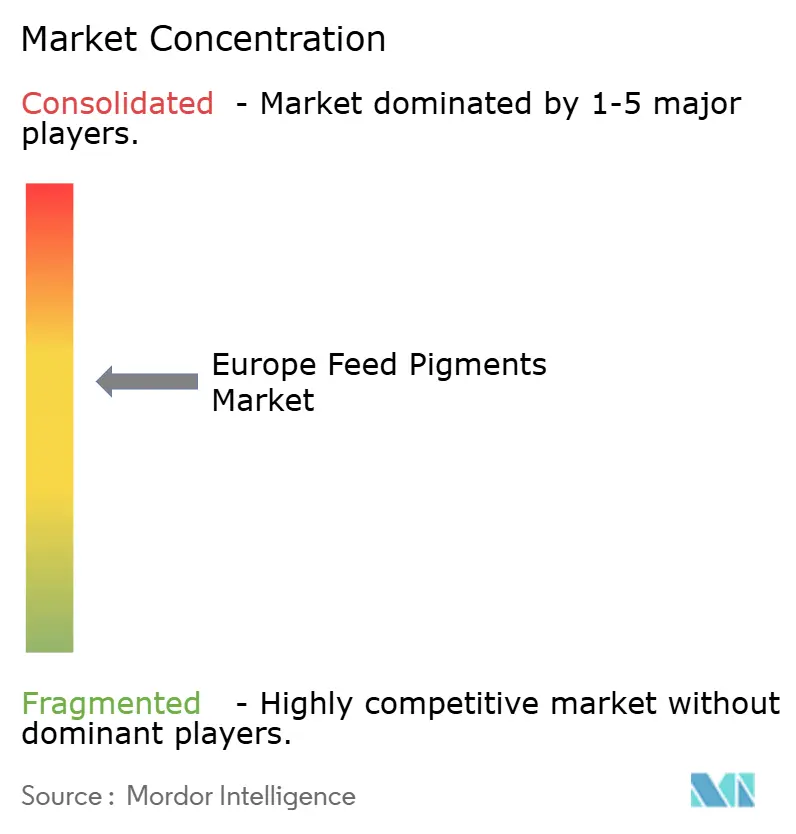
The Europe feed pigments market demonstrates moderate concentration, with leading players holding the largest market share in 2024. This leaves opportunities for regional specialists and botanical-extract suppliers to target niche segments. Technology plays a critical role, with advancements such as microencapsulation patents enabling suppliers to enhance bioavailability and shelf stability. For instance, DSM-Firmenich's lipid-matrix beadlets retain 95% of their pigment potency after six months, compared to 70% for uncoated powders, thereby reducing over-formulation waste and lowering raw material costs by around 3%.
Major players in the European feed pigment market prioritize product innovation, focusing on bio-based and fermentation-derived pigments to align with European Union sustainability requirements. Significant investments are directed toward encapsulation and stabilization technologies to improve pigment effectiveness during feed processing. Strategic collaborations with aquaculture and poultry integrators enable the co-development of tailored solutions. Additionally, companies are expanding regional manufacturing capabilities to strengthen supply chains and reduce dependence on imports. Efforts also include participation in regulatory advocacy and certification initiatives to accelerate the approval of natural alternatives and enhance consumer confidence in pigment-based animal products.
Opportunities in the market include the cultivation of spirulina within Europe, where current annual production remains below 2,000 metric tons. This shortfall forces aquafeed mills to import dried biomass from Asia at a 25–30% cost premium, presenting an opportunity for vertically integrated players willing to invest in photobioreactor infrastructure. A notable example is EW Nutrition GmbH's October 2024 approval by the European Food Safety Authority (EFSA) for a lutein-rich Tagetes extract for turkeys, allowing for the inclusion of up to 80 milligrams per kilogram. This highlights how expertise in regulatory dossiers can unlock differentiated market segments. Smaller players, such as Nutrex and Impextraco, leverage regional distribution networks and technical services to compete by offering formulation support, targeting mid-sized integrators that lack in-house nutrition expertise.
Europe Feed Pigments Industry Leaders
-
DSM-Firmenich AG
-
BASF SE
-
Kemin Industries Inc.
-
EW Nutrition GmbH
-
Nutrex N.V.
- *Disclaimer: Major Players sorted in no particular order
Market Opportunities and Future Outlook
A near-term opportunity is centered on scaling compliant, traceable natural pigment supply within Europe, where spirulina cultivation remains below 2,000 metric tons annually and aquafeed mills import dried biomass from Asia at a 25-30% cost premium. This gap supports investment cases for European algae cultivation and for downstream standardization, including consistent pigment potency, microbial specifications, and practical feed-mill handling. The need is most immediate for poultry and salmonid recipes that must meet retailer color requirements while staying within EFSA inclusion caps.
Regulatory continuity for core carotenoids, alongside growth in regional premix and additive infrastructure, also strengthens routes to market for pigment blends and stabilized formulations. The May 2026 renewal of beta-carotene authorization under Commission Implementing Regulation (EU) 2026/1148 reduces uncertainty around a foundational carotenoid used across species. Capacity moves such as Vilomix Group starting investment in a 35,000-40,000 tonnes-per-year premix factory in Poland (February 2026) and Innovad commissioning a second packaging line at its Essen, Belgium site (June 2026) can support higher-throughput blending and packaging for pigment-containing premixes. At the formulation level, retailer-driven yolk targets (Roche score 14 or higher in parts of Western Europe) and supplier adoption of microencapsulation create room for higher-stability, lower-inclusion pigment systems that reduce over-formulation losses during pelleting and storage.
Recent Industry Developments
- May 2026: The European Commission renewed the authorization of beta-carotene as a nutritional feed additive for all animal species through Commission Implementing Regulation (EU) 2026/1148. The measure also set transition rules, allowing products labeled before 18 December 2026 under prior requirements to remain on the market until stocks are exhausted, supporting continuity in carotenoid-based formulations used in pigment strategies.
- October 2025: BASF launched Lutavit A/D3 1000/200 NXT, a microencapsulated vitamin A and D3 formulation produced at its Ludwigshafen, Germany site. The launch highlights continued investment in encapsulation and European manufacturing capabilities that overlap with stability needs for sensitive additives used alongside pigments in premixes and compound feeds.
- September 2024: DSM-Firmenich announced EU authorization for HiPhorius, its next-generation phytase, for poultry, swine, and fin fish. While not a pigment, the authorization reflects the same EU regulatory gatekeeping that pigment suppliers must navigate and supports broader feed reformulation activity in poultry and aquaculture where pigment programs are implemented.
Research Methodology Framework and Report Scope
Market Definition and Coverage
For this methodology, the Europe feed pigments market includes pigment additives used in animal feed to improve the visible color of products such as egg yolk, poultry skin, and farmed fish flesh, and it covers both natural and synthetic pigment sources where applicable.
Scope exclusions: We exclude food-grade colorants, pet food-specific coloring additives, and pigments used mainly in human nutraceuticals or cosmetics.
Segmentation Overview
- By Type
- Carotenoids
- Curcumin
- Caramel
- Spirulina
- Others
- By Animal
- Poultry
- Swine
- Ruminant
- Aquaculture
- By Geography
- Germany
- Spain
- France
- Italy
- United Kingdom
- Russia
- Rest of Europe
Data Sources, Market Sizing, and Validation
Desk Research
Desk research starts by mapping how pigments are regulated, produced, and consumed across major European feed and livestock systems, and then the market is narrowed to feed-use pigments only. We use public and official sources such as European Commission and EFSA materials on feed additives, Eurostat livestock and trade series, FAO production statistics, and selected national agriculture ministry releases where livestock and aquaculture output is tracked.
To translate these signals into a usable sizing structure, we also review company filings and investor presentations, association websites for feed and aquaculture, and reputable press coverage for capacity changes and product positioning. When needed, paid subscriptions are used in a limited way for company financials and patent databases to understand ingredient innovation and to sanity check supplier activity. The sources listed here are illustrative, and many other public references were used to collect data, validate assumptions, and close small information gaps.
Primary Interviews and Surveys
Primary work focuses on validating what drives pigment demand in Europe, including inclusion rates in feed formulations, typical use cases by species, and how pricing moves with product form and sourcing. We speak with a mix of ingredient suppliers, premix blenders, feed mills, and downstream livestock and aquaculture stakeholders across key European markets so that desk assumptions can be corrected where real-world adoption differs.
Distribution of primary research fieldwork respondents
| Company type | Respondent position |
|---|---|
| Top tier: 29% | CXOs: 13% |
| Mid tier: 55% | Functional/Unit leaders: 35% |
| Smaller Players: 16% | Managers: 52% |
Market-Sizing & Forecasting
Sizing begins with a top-down build where livestock and aquaculture output is reconstructed by country and then translated into a feed-demand pool, followed by typical pigment inclusion rates for the relevant species. That structure is then converted to value using average selling prices that reflect product mix (for example, carotenoids versus other pigment types), natural versus synthetic split, and the share sold through premix channels.
To keep the totals realistic, we corroborate the model with selective bottom-up approximations, such as supplier and distributor channel checks and sampled price times volume calculations for high-usage applications like layers, broilers, and salmonids. Key inputs used in the model include poultry egg output trends, aquaculture volume growth, compound feed production indicators, the mix shift toward natural pigments under EU acceptance and retailer preferences, and observed price movements by pigment form. Where data is patchy for smaller countries, gaps are handled by using proxy adoption rates from comparable markets and then adjusting them after expert feedback.
For forecasting, scenario analysis is used around two variables that move the market most, animal production outlook and pigment mix shift, and then the yearly path is smoothed using short-run trend behavior from recent periods. Assumptions are rechecked with expert consensus so the final forecast stays practical for decision-making.
Data Validation & Update Cycle
Validation is done by triangulating the model output against independent signals, such as trade flows for pigment ingredients, feed production direction, and country-level livestock output changes. Large variances are flagged, and then the assumptions behind inclusion rates, pricing, and country shares are reviewed in more than one analyst pass before sign-off.
The report is refreshed annually, and interim updates are made when material events occur, such as major regulatory changes, supply disruptions, or notable capacity expansions. Before delivery, we do a fresh final review so the latest public releases and interview learnings are reflected in the numbers.
Mordor Intelligence's Europe Feed Pigments Market Sizing Compared With Other Published Estimates
It is normal to see different market values published for Europe feed pigments because analysts can define the included pigment types and animal segments differently, and then apply different pricing approaches, which changes the totals.
Differences also show up when one study uses a newer base year or uses currency conversion at a different point in time. In practice, the spread is usually driven by whether the estimate counts only carotenoid-based pigments versus a wider pigment basket, how natural versus synthetic pricing is averaged, and whether country-level feed demand is linked back to livestock output before value is applied. The table reflects this, and the core split is kept tied to species-level feed usage and EU feed additive relevance, which is applied the same way across countries by Mordor Intelligence.
Benchmark comparison
| Source | Market Size | Gaps in Research Methodology |
|---|---|---|
| Mordor Intelligence | USD 1.35 B (2025) | |
| Trade Publisher A | USD 0.58 B (2024) | This figure aligns to feed carotenoids only, so it omits non-carotenoid pigments and can also undercount value where premix markups and application mix are not fully captured. |
| Industry Research Firm B | USD 0.31 B (2036) | The estimate appears to use a narrower definition and a long-dated endpoint, and the low level suggests limited country-level demand build-up and pricing that may not reflect current European pigment mix. |
Across the three figures, the biggest driver is scope, since a carotenoid-only view will be smaller than a full feed pigment basket, even before pricing and channel assumptions are applied. When base years and currency timing also differ, the spread widens, which is why we keep the model anchored to clear demand indicators and repeatable price and mix steps.
Key Questions Answered in the Report
What is the projected value of the Europe feed pigments market by 2031?
The market is forecast to reach USD 1.84 billion by 2031.
Which ingredient type leads demand across Europe?
Carotenoids held 61.45% of 2025 revenue, making them the dominant pigment group.
Why is spirulina growing faster than other pigment sources?
Spirulina aligns with clean-label trends and delivers dual protein and pigment benefits, supporting a 9.25% CAGR through 2031.
Which animal segment shows the fastest pigment adoption?
Aquaculture is advancing at an 8.05% CAGR as salmon farms tailor carotenoid blends to meet retailer flesh-color standards.