
Europe Disaster Restoration Services Market Size and Share
Market Overview
| Study Period | 2020 - 2031 |
|---|---|
| Forecast Data Period | 2026 - 2031 |
| Base Year Market Size (2025) | USD 6.87 Billion |
| Market Size (2026) | USD 7.19 Billion |
| Market Size (2031) | USD 9.31 Billion |
| Growth Rate (2026 - 2031) | 5.30 % |
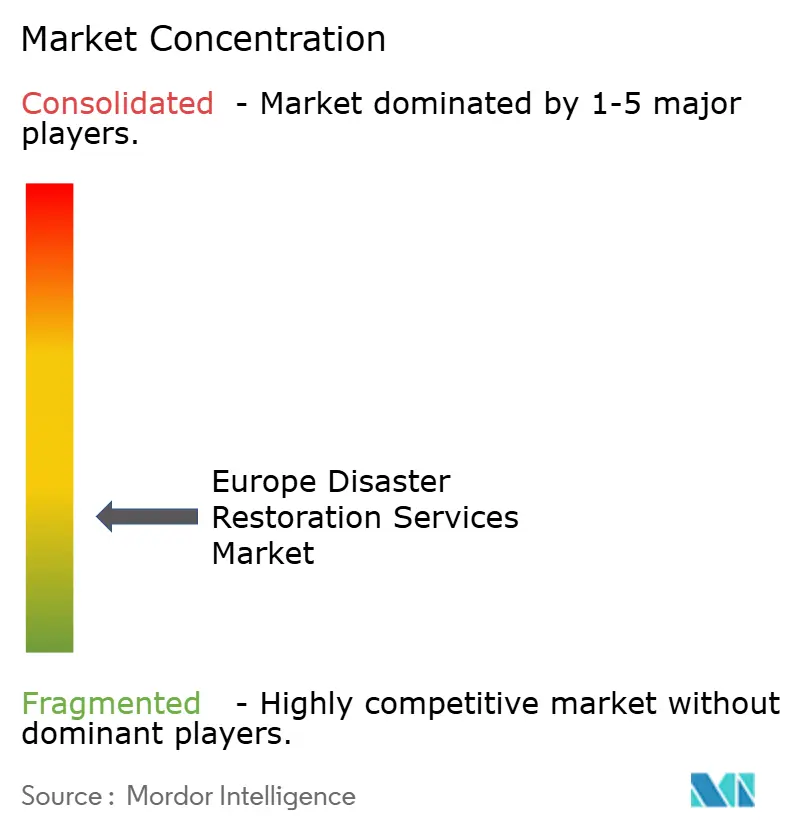
| Market Concentration | Low |
Major Players *Disclaimer: Major Players sorted in no particular order Image © Mordor Intelligence. Reuse requires attribution under CC BY 4.0. | |
Europe Disaster Restoration Services Market Analysis by Mordor Intelligence
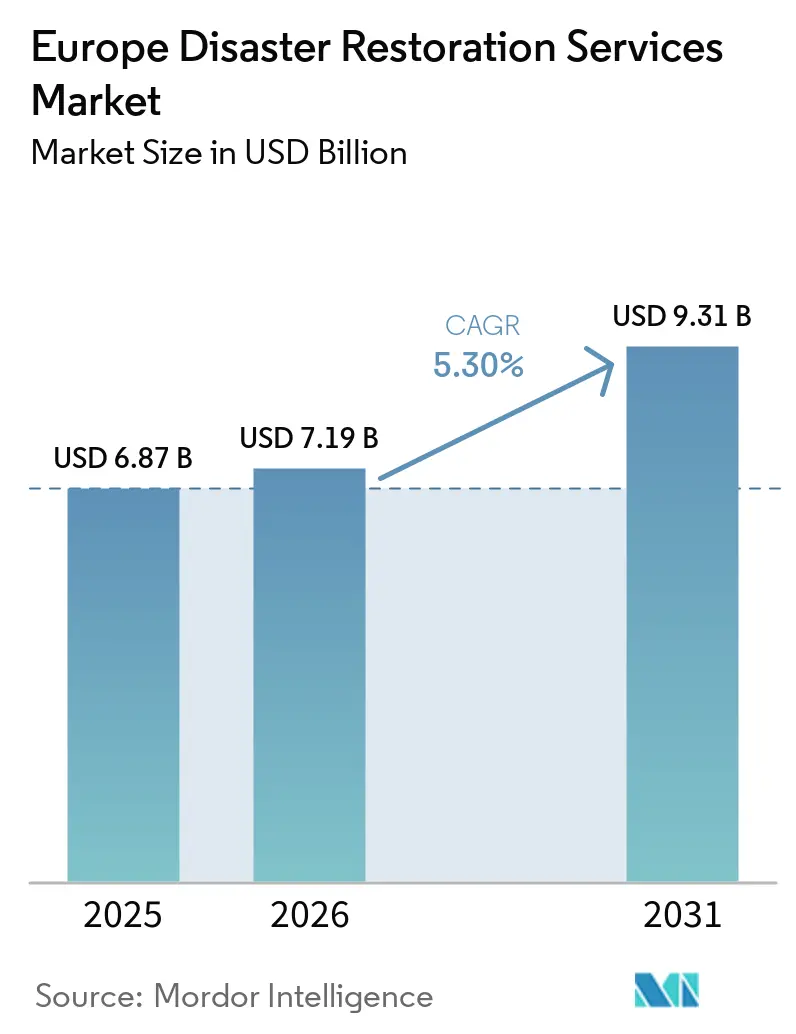
The Europe Disaster Restoration Services Market size is projected to expand from USD 6.87 billion in 2025 and USD 7.19 billion in 2026 to USD 9.31 billion by 2031, registering a CAGR of 5.30% between 2026 and 2031.
The Europe disaster restoration services market covers professional response, drying, cleanup, decontamination, and structural reinstatement after water, fire, storm, mold, biohazard, and related damage events. Extreme weather is widening the need for rapid restoration capacity across several countries at the same time. Aging buildings and water networks also create a continuing flow of water-related claims that are not dependent on a single weather event. Insurance remains the main route through which property damage becomes contracted restoration work, while public recovery funding adds another source of demand after severe disasters. Larger operators are strengthening their position through insurer relationships, technical certification, digital claims handling, and cross-border response networks. Skilled labor shortages, input-cost pressure, and gaps in catastrophe insurance coverage can limit the scale and value of work that reaches professional contractors. These conditions also increase the value of established supplier panels and dependable response capacity. These conditions increase the competitive advantage of providers with rapid-response capacity, multi-hazard capabilities, and established insurer/public-sector relationships. Growth opportunities remain tied to prevention-linked services, sustainable reinstatement, and coordinated responses to multi-country events.
Key Report Takeaways
- By service type, water damage restoration accounted for 32.6% of the Europe disaster restoration services market share in 2025, while the others (contents restoration, pack-out, cleaning, storage, etc.) service segment is projected to be the fastest-growing, with a 6.90% CAGR through 2031.
- By application, commercial and industrial properties accounted for 53.3% of the Europe disaster restoration services market size in 2025, while residential properties are projected to be the fastest-growing application segment, with a 5.50% CAGR through 2031.
- By customer/payor type, insurance-funded work accounted for 51.9% of market revenue in 2025, while public-sector and government-funded work is projected to be the fastest-growing payor segment, with a 5.60% CAGR through 2031.
- By geography, Germany accounted for 24.2% of market revenue in 2025, while the rest of Europe is projected to be the fastest-growing geographic market, with a 5.42% CAGR through 2031.
Note: Market size and forecast figures in this report are generated using Mordor Intelligence’s proprietary estimation framework, updated with the latest available data and insights as of January 2026.
Europe Disaster Restoration Services Market Trends and Insights
Drivers Impact Analysis*
| Driver | (~) % Impact on CAGR Forecast | Geographic Relevance | Impact Timeline |
|---|---|---|---|
| More Frequent and Severe Extreme Weather | +1.8% | Pan-European, most acute in Southern and Central Europe | Short term (≤ 2 years) |
| Aging Buildings and Water Infrastructure | +1.4% | Pan-European core, particularly Italy, Romania, Bulgaria, and Ireland | Medium term (2-4 years) |
| Insurance-Backed Professional Restoration Demand | +1.2% | Northwestern Europe, expanding into Southern Europe | Medium term (2-4 years) |
| Public Resilience and Critical-Infrastructure Recovery Spending | +0.8% | EU-wide, strongest in post-disaster zones in Spain, Italy, and Central Europe | Medium term (2-4 years) |
| Sensor-Led Prevention and Higher-Value Response Contracts | +0.5% | Germany, the United Kingdom, the Netherlands, and the Nordic countries | Long term (≥ 4 years) |
| Capacity for Multi-Country Catastrophe Events | +0.3% | Pan-European, especially during concurrent large events | Long term (≥ 4 years) |
| Source: Mordor Intelligence | |||
More Frequent and Severe Extreme Weather
Europe’s faster rate of warming is increasing the need for professional restoration after floods, fires, droughts, and severe storms. At least 95% of Europe had above-average annual temperatures in 2025, while wildfires burned a record 1.034 million hectares, and 70% of European rivers had below-average annual flows. Heatwaves, droughts, and floods affecting 25% of EU regions in summer 2025 caused at least USD 46.5 billion in short-term losses, and their effects were projected to reach USD 136.5 billion by 2029[1]S. Usman, M. Parker, and M. Vallat, “Dry-Roasted NUTS: Early Estimates of the Regional Impact of 2025 Extreme Weather,” University of Mannheim and European Central Bank, uni-mannheim.de.. Climate-related economic losses across the EU averaged USD 48.6 billion a year from 2020 to 2024, compared with USD 9.3 billion in the 1980s. Wildfires in populated areas of Germany, the Netherlands, and the United Kingdom are extending restoration needs beyond established flood and fire locations. The Europe disaster restoration services market can therefore draw demand from a wider set of property risks and locations. Operators that can mobilize safely after several types of weather events can address work that local single-service providers may not be able to handle.
Aging Buildings and Water Infrastructure
Aging buildings and water infrastructure create regular restoration demand from leaks, plumbing failures, sewer backups, and indoor moisture damage. Italy reported that more than 60% of municipal pipes were installed more than 30 years ago, and distribution losses reached 42%. European water providers invested USD 39.6 billion annually in infrastructure during 2025, which was 17.5% higher than in 2021, but the replacement needs remained substantial. A 2026 scientific study estimated annual water-damage repair costs in Swedish residential buildings at USD 946 million using 2025 conversion rates. Aging-related failures impose recurring workloads for restoration contractors. This condition is present across both urban and regional building stock. The Europe disaster restoration services market benefits because water damage often requires specialized drying, cleanup, and reinstatement, even when the original cause is a localized leak. This driver supports steady work across residential and commercial properties throughout the forecast period.
Insurance-Backed Demand for Professional Restoration
Insurance funding turns property damage into professionally scoped work and remains central to revenue quality for restoration contractors. Only 17% of European had insurance for natural-catastrophe property damage in 2025, showing that the protection gap remained wide. Less than 20% of climate-related economic losses from 1980 to 2024 were privately insured, while insured coverage of hydrological losses was close to 15%. The low level of coverage limits the immediate pool of funded work but also leaves room for a deeper insured restoration channel as property coverage improves. Insurers and loss adjusters increasingly use approved contractor panels to control claims costs and shorten repair times. This practice supports larger providers that offer certification, reliable reporting, and integrated claims workflows. The Europe disaster restoration services market is consequently shaped by insurer purchasing decisions as well as by the volume of property damage. Firms that maintain trusted insurer relationships have more regular access to complex and higher-value assignments.
Public Resilience Spending and Critical-Infrastructure Recovery
Public recovery funding is creating a larger and more organized demand channel after major disasters. The European Union mobilized USD 1.7 billion through the EU Solidarity Fund and RESTORE resources for Spain after the late-2024 Valencia DANA floods. In May 2025, the European Commission proposed USD 303 million for flood recovery in Austria, Czechia, Poland, and Slovakia. Cohesion Policy allocated USD 19.4 billion for climate adaptation and disaster-risk management in the 2021 to 2027 program period. Government recovery projects can involve critical infrastructure, temporary accommodation, cleanup, and reinstatement work. These contracts can have longer procurement cycles and higher compliance requirements than private claims. Public-sector recovery programs, therefore, provide an additional addressable demand channel for qualified restoration contractors.
Restraints Impact Analysis*
| Restraint | (~) % Impact on CAGR Forecast | Geographic Relevance | Impact Timeline |
|---|---|---|---|
| Skilled-Labor Shortages and Certification Bottlenecks | -1.2% | Pan-European, most acute in Germany, the United Kingdom, the Netherlands, and post-disaster Spain | Short term (≤ 2 years) |
| Volatile Materials, Energy, and Specialist-Equipment Costs | -0.9% | Pan-European, concentrated in energy-intensive input categories | Medium term (2-4 years) |
| Uneven Catastrophe Insurance Take-Up and Protection Gaps | -0.6% | Southern and Eastern Europe, including Greece, Romania, Bulgaria, and Italy | Long term (≥ 4 years) |
| Restoration-Resource Scarcity During Concurrent Events | -0.3% | Pan-European, triggered by simultaneous multi-country disasters | Short term (≤ 2 years) |
| Source: Mordor Intelligence | |||
Skilled-Labor Shortages and Certification Bottlenecks
A shortage of trained restoration workers can restrict response capacity when large claims occur at the same time. Labor shortages continued to limit the ability of construction and related subsectors to meet demand in 2025. The share of construction workers aged 50 and older is rising across EU countries, increasing the need to replace experienced workers. Construction has remained on the EU list of shortage occupations for many years, and green and digital requirements add new skill needs. The issue is more difficult in restoration because work may require qualifications in drying, mold remediation, asbestos handling, and structural reinstatement. Shortages increase the risk of delayed projects and greater dependence on subcontractors. They are especially acute after major events, when the same trades are needed for both repair and reconstruction. The Europe disaster restoration services market needs a larger and more qualified workforce to convert post-disaster demand into completed revenue.[2]European Construction Observatory, “2025 Analytical Report on Skills in Construction,” European Construction Observatory, ebc-construction.eu.
Volatile Materials, Energy, and Specialist-Equipment Costs
Higher material, energy, and equipment costs can reduce margins on restoration jobs with fixed or insurer-agreed rates. The United Kingdom government data published in March 2025 showed an 11.5% rise in imported sawn or planed wood prices during the prior twelve months and an 8.1% rise in electric water-heater prices. Drying, decontamination, and controlled-environment remediation require energy and specialist equipment. Cost pressure can make job pricing more difficult for contractors. Insurers may renegotiate schedules of rates annually or less often, creating a timing gap when input costs rise more quickly. The Europe disaster restoration services market is exposed when contractors cannot pass higher costs through to customers. Supplier diversification and equipment management are therefore important for preserving margins.
*Our forecasts treat driver/restraint impacts as directional, not additive. The impact forecasts reflect baseline growth, mix effects, and variable interactions.
Segment Analysis
By Service Type: Water Damage Restoration Led the Service Mix
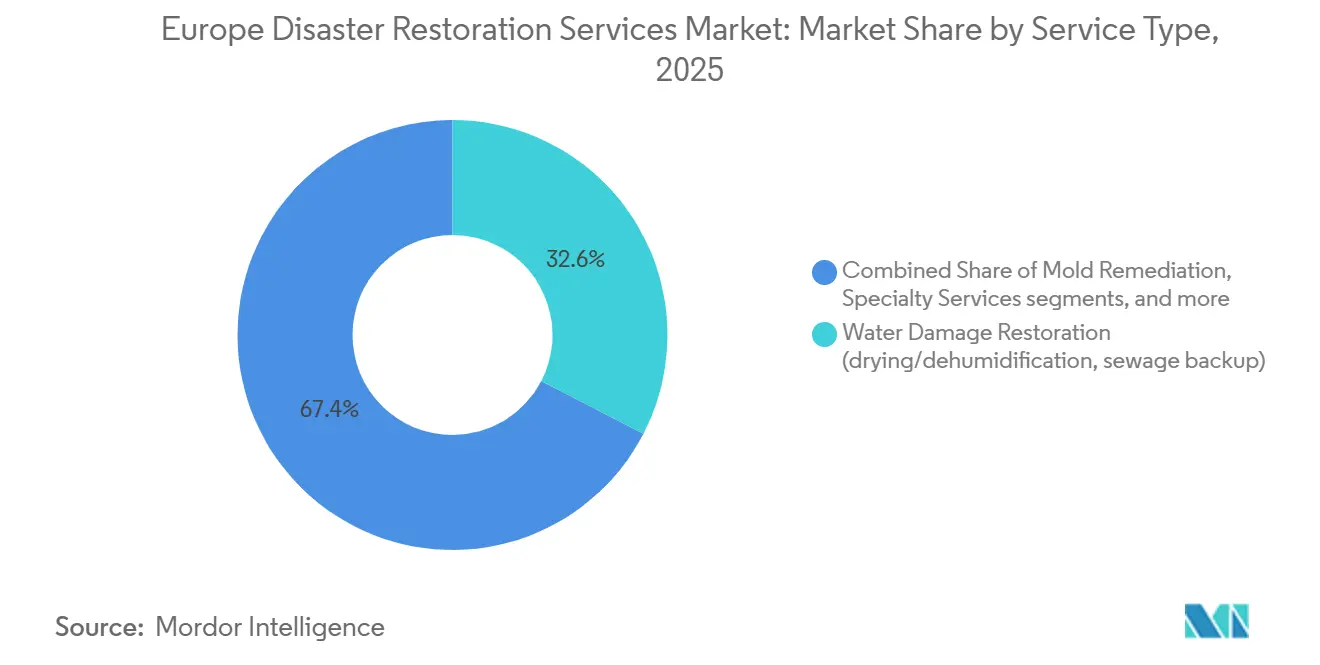
Water damage restoration held 32.6% of the Europe disaster restoration services market share in 2025. Its position reflects plumbing failures, sewer backups, flood damage, and moisture problems across aging buildings. Significant leaks can require drying, decontamination, cleaning, and structural reinstatement. The large water-damage segment reflects the frequency of plumbing failures, sewer backups, flooding, and moisture-related losses across European properties.[3]A. Auld and D. Langhorn, “Projecting Future Flood Losses to Commercial Assets in Europe: The Role of Precautionary Measures,” doi.org.
Fire and smoke damage restoration formed one of the largest service pools, supported by the severe 2025 EU wildfire season. Mold remediation gains demand when water damage is not fully resolved, and moisture is trapped in older buildings. The Others category, including contents restoration, pack-out, cleaning, and storage, was the fastest-growing service type, registering a 6.90% CAGR through 2031. Insurers can authorize contents salvage instead of replacement to control claim costs. BELFOR’s RED ALERT® program illustrates how emergency frameworks can give insured clients priority access during a major event.



By Application: Commercial and Industrial Properties Held the Largest Share
Commercial and industrial applications accounted for 53.3% of the Europe disaster restoration services market share in 2025. Commercial properties have higher exposure values, tighter downtime requirements, and more complex reinstatement needs. A 2025 research preprint found that commercial properties represented 28% to 50% of flood-damage claims across major European events despite forming a smaller part of the building stock. Insurer and loss-adjuster procurement structures favor certified providers with reliable reporting, technical depth, and digital workflows.
Residential applications emerged as the fastest-growing application, registering a 5.50% CAGR through 2031. Rising insurance penetration in Central and Eastern Europe supports residential demand. Escape-of-water events in multi-family buildings create a continuing need for local emergency response. Residential jobs are more geographically dispersed and less concentrated among large contractors. The Europe disaster restoration services industry combines higher-value commercial projects with a wide base of residential work.
By Customer/Payor Type: Insurance Funding Remained the Main Revenue Channel
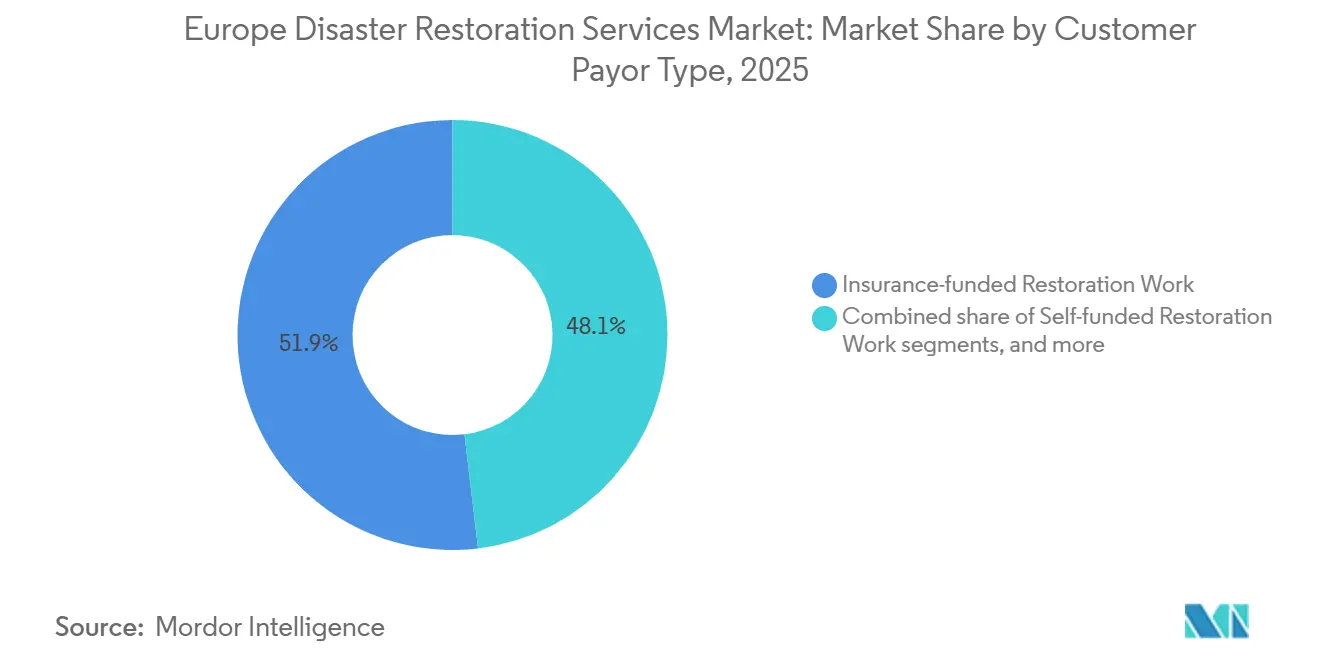
Insurance-funded work accounted for 51.9% of the Europe disaster restoration services market in 2025. This channel is the main foundation for professionally managed restoration assignments. Insurers set service standards, direct work through approved panels, and often control contractor selection. The 17% natural-catastrophe coverage rate among European respondents in 2025 shows how much potential repair demand remains outside insurance funding. Self-funded and direct-pay work serves property owners who are uninsured, underinsured, or below their policy deductible. It can be more price-sensitive and can carry lower average claim values.
Public-sector and government-funded work was the fastest-growing payer category, registering a 5.60% CAGR through 2031. Government-led disaster response programs, municipal reconstruction budgets, and national and EU-level recovery funding following floods, storms, wildfires, and other large-scale disasters support this segment. Spain’s response to the 2024 Valencia DANA highlights the scale of this opportunity, with the government committing more than USD 18 billion through three Royal Decrees covering emergency assistance, infrastructure repair, housing, and economic recovery. Publicly funded projects often involve restoration of government buildings, schools, healthcare facilities, transport infrastructure, utilities, and other community assets, creating demand for firms capable of rapid mobilization and large-scale project execution. Restoration providers that combine established insurer relationships with public-sector tendering capabilities, emergency-response capacity, and reconstruction expertise can therefore access both traditional insurance-funded assignments and the growing government-funded restoration channel.
Geography Analysis
Germany held 24.2% of the Europe disaster restoration services market share in 2025. Its position reflects a large insured property base, recurring flood and storm exposure, and established contractor and insurer relationships. The United Kingdom was one of the national markets because of its mature insurer-preferred-supplier model and older residential buildings. Storm Amy in October 2025 caused flooding and property damage in the United Kingdom, Ireland, Scandinavia, and the Netherlands.
Italy and Spain are substantial demand centers because both countries faced USD 13 billion in summer 2025 extreme-weather losses. Italy combines residential claims with public recovery work, including USD 425 million committed through the EU Solidarity Fund for Emilia-Romagna and Tuscany floods. Spain’s recovery pipeline was strengthened by USD 1.8 billion in full government financing for municipal infrastructure reinstatement after the DANA disaster. Greece and Romania face greater constraints from their insurance protection gaps. Fewer than 5% of natural-catastrophe losses in Greece have been insured since 1980, which limits the professionally funded repair pool.
The Rest of Europe was the fastest-growing geography, registering a 5.42% CAGR through 2031. Rising insurance penetration in Poland and the Czech Republic supports the Europe disaster restoration services market in the cluster. Nordic consolidation is reinforcing the ability of providers to serve larger and more complex assignments, including Acurum Group’s four acquisitions in Denmark in September 2025.
Competitive Landscape
The Europe disaster restoration services market is fragmented within individual countries, but it is becoming more concentrated at a pan-European level. BELFOR Holdings and Polygon Group have leading cross-border positions because they operate multi-country networks. BELFOR uses its RED ALERT® emergency response framework to provide insured clients with priority access during major events. National providers such as ServiceMaster Restore UK, Rainbow Restoration UK, and Rentokil Initial plc compete through local density and insurer relationships.
Digital operations are more important because insurers need faster assessments, clearer records, and lower leakage claims. Providers are using remote monitoring, digital claims workflows, and technology-assisted damage assessment to support these needs. BELFOR Europe received ISO 27001:2022 certification in April 2026, covering data-handling systems used across European subsidiaries. BELFOR UK also took delivery of 84 MAXUS vehicles in July 2026 to support nationwide mobile response and catastrophe-surge work. Fleet modernization and ISO 27001 certification strengthen operational resilience and information-security credentials, both of which can support large insurer and corporate contracts.
Acquisitions are another route through which regional providers are expanding coverage and specialist capabilities. Acurum Group entered Denmark in September 2025 through 4 acquisitions. Polygon also acquired Tehokuivaus Oy in 2025 to strengthen its Finnish position. These deals support a gradual shift from local standalone firms toward larger regional platforms.
Europe Disaster Restoration Services Industry Leaders
BELFOR Holdings, Inc.
Polygon Group
ServiceMaster Restore UK
Rainbow Restoration UK
Rentokil Initial plc
- *Disclaimer: Major Players sorted in no particular order

Recent Industry Developments
- July 2026: BELFOR UK received 84 new MAXUS vehicles as part of a fleet modernization program managed through its partnership with Novuna Vehicle Solutions. The converted vans are designed specifically for BELFOR's restoration and reinstatement operations, supporting nationwide response capacity and operational resilience during periods of peak demand.
- April 2026: BELFOR Europe received ISO 27001:2022 certification from TÜV Rheinland, confirming that its information security management system meets the international standard. The certified structures, processes, and central systems also benefit BELFOR subsidiaries operating within BELFOR Europe's shared infrastructure.
- September 2025: Acurum Group entered the Danish market through the acquisition of four companies - Renovo, Pro Skadeservice, ØSTERGAARD Bygge & Indeklimateknik, and Sydkystens Brolægning & Kloak, establishing a local platform for property well-being, damage restoration, building consultancy, and related services.


Europe Disaster Restoration Services Market Report Scope
The Europe Disaster Restoration Services Market Report is Segmented by Service Type (Water Damage Restoration, Fire and Smoke Damage Restoration, and More), by Application (Residential and Commercial & Industrial), by Customer/Payor Type (Insurance-funded Restoration Work, and More), and by Geography (Germany, United Kingdom, and More). The Report Offers Market Size and Forecast in Terms of Value (USD) for all the Above Segments.
| Water Damage Restoration (drying/dehumidification, sewage backup) |
| Fire & Smoke Damage Restoration |
| Mold Remediation |
| Storm / Catastrophe Restoration (wind, hail, flood response, large-loss) |
| Biohazard & Trauma Cleanup (crime scene, unattended death, infectious cleanup) |
| Specialty Services |
| Others (contents restoration, pack-out, cleaning, storage, etc.) |
| Residential |
| Commercial & Industrial |
| Insurance-funded Restoration Work |
| Self-funded / Direct-pay Restoration Work |
| Public-sector / Government-funded Restoration Work |
| Germany |
| United Kingdom |
| France |
| Italy |
| Spain |
| Greece |
| Romania |
| Rest of Europe (Switzerland, Portugal, Austria, Belgium, Netherlands, Poland, Czech Republic, Hungary, Sweden, Norway, Denmark, Finland, Ireland, Croatia, Slovenia, Bulgaria, Slovakia, Serbia, etc.) |
| By Service Type | Water Damage Restoration (drying/dehumidification, sewage backup) |
| Fire & Smoke Damage Restoration | |
| Mold Remediation | |
| Storm / Catastrophe Restoration (wind, hail, flood response, large-loss) | |
| Biohazard & Trauma Cleanup (crime scene, unattended death, infectious cleanup) | |
| Specialty Services | |
| Others (contents restoration, pack-out, cleaning, storage, etc.) | |
| By Application | Residential |
| Commercial & Industrial | |
| By Customer/Payor Type | Insurance-funded Restoration Work |
| Self-funded / Direct-pay Restoration Work | |
| Public-sector / Government-funded Restoration Work | |
| By Geography | Germany |
| United Kingdom | |
| France | |
| Italy | |
| Spain | |
| Greece | |
| Romania | |
| Rest of Europe (Switzerland, Portugal, Austria, Belgium, Netherlands, Poland, Czech Republic, Hungary, Sweden, Norway, Denmark, Finland, Ireland, Croatia, Slovenia, Bulgaria, Slovakia, Serbia, etc.) |


Key Questions Answered in the Report
What is driving demand for disaster restoration services in Europe?
Severe weather, aging buildings and water systems, insurance-backed claims, and public recovery spending support demand.
Which service type led European disaster restoration services in 2025?
Water damage restoration led with a 32.6% share, driven by frequent flooding, leaks, and weather-related property damage across Europe.
Which application had the largest share in 2025?
Commercial and industrial applications led with a 53.3% share, supported by restoration demand across offices, facilities, warehouses, and industrial properties.
Why do insurers matter to restoration providers?
Insurance-funded work held 51.9% of revenue in 2025 and gives providers access to structured claims assignments.
Which European geography is expected to grow fastest through 2031?
The Rest of Europe cluster is expected to grow fastest, registering a 5.42% CAGR from 2026 to 2031, supported by insurance growth and more frequent weather losses.
What constraints affect restoration providers in Europe?
Skilled labor shortages, rising input costs, uneven insurance coverage, and resource scarcity during concurrent disasters can restrict delivery.
Page last updated on:





