
Europe Data Center Real Estate Market Size and Share
Market Overview
| Study Period | 2020 - 2031 |
|---|---|
| Forecast Data Period | 2026 - 2031 |
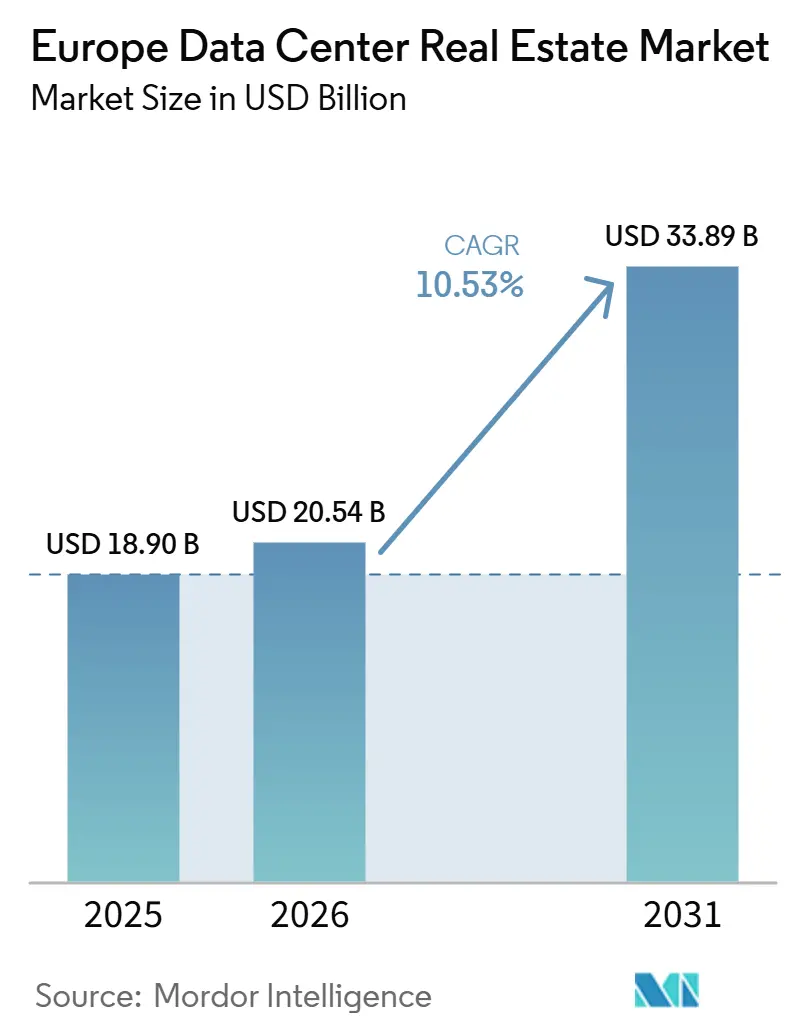
| Base Year Market Size (2025) | USD 18.90 Billion |
| Market Size (2026) | USD 20.54 Billion |
| Market Size (2031) | USD 33.89 Billion |
| Growth Rate (2026 - 2031) | 10.53% CAGR |
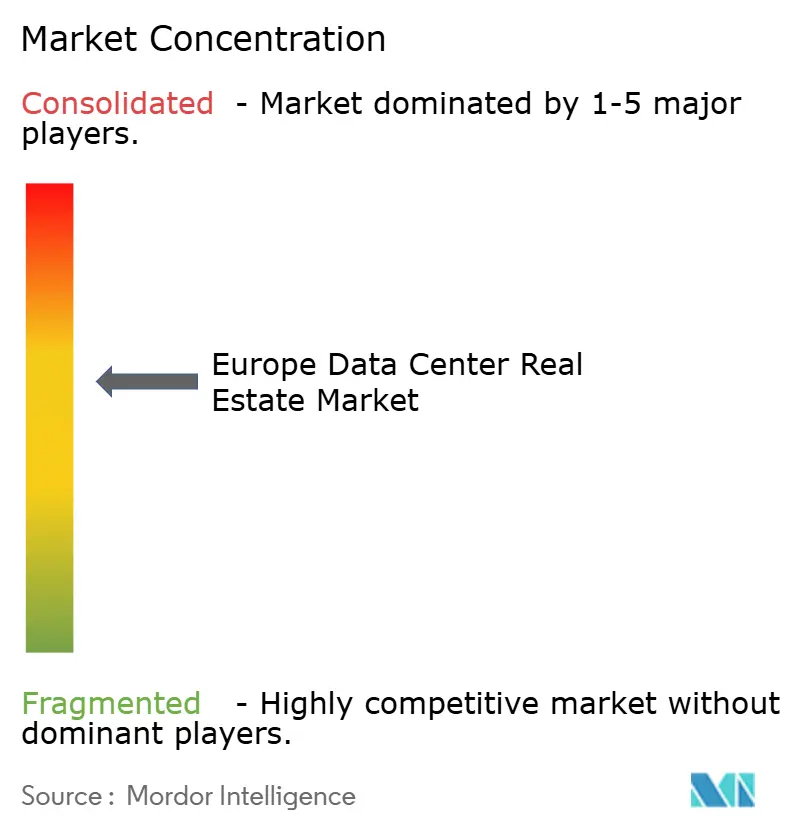
| Market Concentration | Medium |
Major Players *Disclaimer: Major Players sorted in no particular order Image © Mordor Intelligence. Reuse requires attribution under CC BY 4.0. | |
Europe Data Center Real Estate Market Analysis by Mordor Intelligence
The Europe Data Center Real Estate Market size is projected to expand from USD 18.90 billion in 2025 and USD 20.54 billion in 2026 to USD 33.89 billion by 2031, registering a CAGR of 10.53% between 2026 to 2031.
Growth is supported by the European Commission’s AI Continent Action Plan, which aims to triple EU data center processing capacity within 5 to 7 years and mobilize EUR 200 billion (USD 220 billion) in public and private investment[1]European Commission, “AI Continent Action Plan,” European Commission, digital-strategy.ec.europa.eu. The Europe data center real estate market is also benefiting from a stronger policy push for sovereign hosting, and France’s April 2026 decision to place the Health Data Hub with Scaleway shows how public and regulated workloads are moving toward local, compliant facilities. Power demand is rising at the same time, with ENTSO-E projecting that European data center electricity demand will increase by more than 50% between 2025 and 2030, while long-term renewable power contracts are improving cost visibility for operators. The main brake on expansion remains grid access, because the International Energy Agency said connection queues in core hubs can stretch to 7 to 10 years, which slows delivery even when capital and tenant demand are already in place. This is pushing the Europe data center real estate market toward a two-track pattern where core hubs remain essential for connectivity, while Nordic and secondary continental locations gain ground through better power access, renewable supply, and available land.
Key Report Takeaways
- By property type, colocation led with a 50.2% of the Europe data center real estate market share in 2025, while edge data center properties are forecast to expand at a 13.80% CAGR through 2031.
- By ownership, leased assets held 79.80% of the Europe data center real estate market size in 2025, and the same segment is projected to grow at an 11.10% CAGR through 2031.
- By enterprise size, large enterprises accounted for 69.40% of demand in 2025, while small and medium enterprises recorded the highest projected CAGR at 12.20% through 2031.
- By end user, information technology and telecom accounted for 44.80% of the Europe data center real estate market in 2025, while healthcare is advancing at a 12.90% CAGR through 2031.
- By geography, the United Kingdom held 24.60% of the market in 2025, while Germany is expected to grow at the fastest CAGR of 11.90% through 2031.
Note: Market size and forecast figures in this report are generated using Mordor Intelligence’s proprietary estimation framework, updated with the latest available data and insights as of January 2026.
Europe Data Center Real Estate Market Trends and Insights
Drivers Impact Analysis*
| Drivers | (~) % Impact on CAGR Forecast | Geographic Relevance | Impact Timeline |
|---|---|---|---|
| Hyperscale Cloud Expansion Across FLAP-D Hubs | +2.8% | FLAP-D markets with spillover to Madrid, Milan, and Warsaw | Short term (≤ 2 years) |
| AI Workloads Accelerate High-Density Development | +2.4% | FLAP-D and secondary European hubs | Short term (≤ 2 years) |
| Data Sovereignty Policies Raise In-Country Hosting Demand | +1.5% | Pan-European with early emphasis in Germany and France | Medium term (2-4 years) |
| Grid-Ready Secondary Markets Draw New Investment | +1.2% | Poland, Sweden, Italy, and Portugal | Medium term (2-4 years) |
| Renewable Power Agreements Improve Long-Term Economics | +1.0% | Nordics, Iberia, and the United Kingdom | Long term (≥ 4 years) |
| Submarine Cable Connectivity Improves Location Appeal | +0.5% | Spain, Italy, the United Kingdom, and the Netherlands | Medium term (2-4 years) |
| Source: Mordor Intelligence | |||
Hyperscale Cloud Expansion Across FLAP-D Hubs Drives Capacity Growth
The FLAP-D corridor remains the operating core of the Europe data center real estate market because interconnection density, tenant depth, and enterprise traffic are still strongest in those locations. The European Commission’s 2025 AI Continent Action Plan reinforced that position by calling for a major increase in processing capacity across the region, which supports continuing large-scale development in the most established nodes. The European Data Centre Association also argued in 2025 that faster infrastructure investment is needed to strengthen Europe’s digital sovereignty, which aligns with continued capital concentration in core hubs[2] European Data Centre Association, “The European Data Centre Association Calls for Acceleration of Data Centre Investment to Strengthen Europe’s Digital Sovereignty,” EUDCA, eudca.org. At the same time, grid delays in major clusters are forcing some demand to spill into nearby secondary cities, because connection queues can already run for 7 to 10 years in the main hubs. Equinix’s October 2025 commitment to invest GBP 3.9 billion (USD 4.9 billion) in a large Hertfordshire site shows that operators still want scale around the core connectivity backbone, even as they seek additional power outside it.
AI Workloads Accelerate High-Density Data Center Development
AI is changing the physical design of the Europe data center real estate market because rack densities for AI-ready facilities are now far above those used in conventional colocation halls. ENTSO-E said in April 2026 that European data center electricity demand will grow by more than 50% between 2025 and 2030, which means future facilities need more than extra floor area and must also secure much heavier power and cooling support. That shift is raising construction intensity per MW and narrowing the field of developers to those that can manage thermal design, power sourcing, and large capital commitments. Nscale’s decision to place an NVIDIA GB300 NVL72 deployment at Start Campus in Sines showed that AI infrastructure demand is no longer limited to the legacy Western European hubs and can now support large projects in southern locations as well. OpenAI’s July 2025 move into Norway under the Stargate initiative also underlined how AI workloads are creating new geographic pull factors wherever renewable power and large-scale capacity can be assembled quickly.
Data Sovereignty Policies Increase In-Country Hosting Demand
Data sovereignty is becoming a durable support for the Europe data center real estate market because regulated users face stronger pressure to keep sensitive workloads inside local or European legal frameworks. GDPR, NIS2, and the European Health Data Space, together, make external routing more difficult for public services and regulated sectors. The European Commission’s digital policy direction is also encouraging more domestic processing capacity and more resilient regional infrastructure. Scaleway’s selection in April 2026 for France’s Health Data Hub is a clear example of how compliance requirements are moving large, long-duration workloads into sovereign cloud and local hosting environments. This pattern gives the Europe data center real estate market a steady stream of demand from healthcare, public administration, and other tenants that cannot easily place critical data outside the EU jurisdiction.
Grid-Ready Secondary Markets Draw New Investment
Grid-ready secondary markets are attracting new investment because power availability has become a more decisive site-selection factor than legacy hub density in several parts of Europe. The Europe data center real estate market is seeing this shift as long connection queues in core FLAP-D locations push developers toward countries where land, renewable power, and permitting conditions are more supportive. The Nordics are gaining from this trend, and atNorth’s June 2026 land acquisition in Haugaland, Norway, with plans for 300MW to 350MW of campus capacity across the region, shows how operators are building for large future workloads outside the traditional core. Sweden is also moving up in the location mix, with EdgeConneX confirming in July 2026 plans for a gigawatt-scale campus in Skellefteå intended to run primarily on renewable energy. Southern Europe is part of the same pattern, as operators expand in Italy, Portugal, and Spain to capture available power, stronger cable connectivity, and more room for hyperscale development. This is widening the map of the Europe data center real estate market, because secondary locations are no longer serving only edge demand and are now competing for full-scale AI and hyperscale deployments.
Restraints Impact Analysis*
| Restraint | (~) % Impact on CAGR Forecast | Geographic Relevance | Impact Timeline |
|---|---|---|---|
| Grid Congestion and Power Delivery Delays Restrict New Developments | -2.1% | Netherlands, Ireland, Germany, and the United Kingdom | Short term (≤ 2 years) |
| Permitting Challenges and Community Opposition Slow Project Approvals | -1.3% | United Kingdom, Germany, Ireland, and France | Medium term (2-4 years) |
| High-Voltage Equipment Shortages Delay Data Center Construction | -0.8% | Pan-European with greater pressure in Germany and the Netherlands | Short term (≤ 2 years) |
| Water Scarcity and Cooling Regulations Increase Operating Constraints | -0.5% | Southern and Central Europe | Long term (≥ 4 years) |
| Source: Mordor Intelligence | |||
Grid Congestion and Power Delivery Delays Restrict New Developments
Grid access has become the clearest constraint on the Europe data center real estate market because power connection queues in major hubs can stretch far beyond normal construction timelines. The International Energy Agency also said Europe’s installed data center capacity may rise by only 70% by 2030, despite a project pipeline pointing to 130% growth, suggesting many planned projects may never reach commissioning under current power conditions. Reuters reported in February 2026 that Amazon had paused planned European projects in some locations because of missing grid connections and network congestion, making those sites unfeasible. This turns existing powered land into a premium asset and widens the gap between incumbent operators and later entrants. It also means the Europe data center real estate market can show strong tenant demand and strong capital availability at the same time that delivery schedules keep slipping.
Permitting Challenges and Community Opposition Slow Project Approvals
Permitting has become a second major friction point for the Europe data center real estate market, especially in mature locations where land, power, and public acceptance are all under pressure. Local objections focus on visual impact, environmental impacts, water use, security concerns, and the gap between large land take and limited local job creation. This makes stakeholder engagement and legal preparation more important, well before construction begins. When that planning risk sits alongside long power lead times, the value of already-permitted, grid-ready land rises sharply in established markets. The result is that the Europe data center real estate market increasingly favors developers that can absorb long approval cycles and manage public scrutiny over multiple years.
*Our forecasts treat driver/restraint impacts as directional, not additive. The impact forecasts reflect baseline growth, mix effects, and variable interactions.
Segment Analysis
By Property Type: Colocation Anchors, Edge Scales Beyond the Core
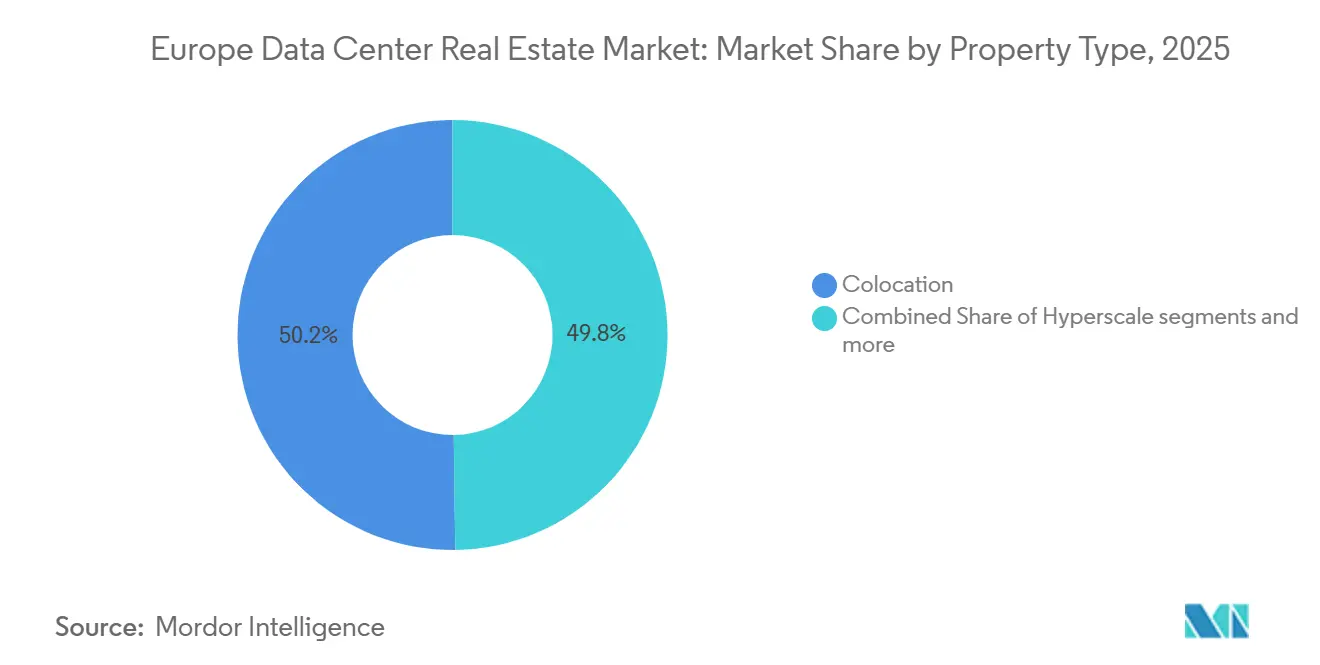
Colocation held 50.20% of the Europe data center real estate market in 2025, confirming that carrier-neutral facilities remain the primary platform for enterprise and service provider demand. The segment remains strongest in the core hubs, where interconnection depth and tenant ecosystems support steady occupancy and long customer relationships. Hyperscale properties are also expanding through large build-to-suit structures that match anchor tenants with dedicated capacity blocks. Edge data center properties are the fastest-growing property type, with the Europe data center real estate market projected to record a 13.80% CAGR for that segment through 2031.
Edge growth reflects rising demand for AI inference, content delivery, and industrial workloads that require compute closer to users and devices, rather than relying solely on large metro campuses. This is creating new cluster logic around cable landing points, exchange nodes, and regional cities that had limited digital infrastructure a few years ago. AtlasEdge’s USD 1.39 billion financing package in 2026 shows how operators are funding distributed expansion across Germany, Austria, and Iberia to capture that spread-out demand pattern[3]AtlasEdge, “AtlasEdge Secures Milestone EUR 1.2 Billion Financing Facility,” AtlasEdge, atlasedge.com. The Europe data center real estate market is therefore moving toward a portfolio mix in which colocation remains the earnings base, hyperscale adds scale, and edge broadens geographic reach, with higher compliance and operating complexity.



By Ownership: Leased Infrastructure Entrenches as the Enterprise Standard
Leased assets held 79.80% of the Europe data center real estate market share in 2025, and that same segment is expected to grow at an 11.10% CAGR through 2031. This shows that leasing is not only the dominant operating model in the current base but also the preferred structure for future expansion. Enterprises favor leased capacity because it preserves capital flexibility at a time when AI infrastructure costs, power needs, and upgrade cycles remain difficult to budget with precision. Institutional investors also prefer long-duration income streams from creditworthy tenants rather than taking on the daily complexity of operating facilities themselves.
Owner-occupied facilities accounted for the remaining 20.2% of demand in 2025 and remained concentrated in financial institutions, telecom carriers, and certain public-sector settings with stringent control requirements. Even where sovereign compute programs are growing, operator-managed build-to-suit structures are often more practical than traditional self-owned campuses. This keeps the long-term balance tilted toward external operators with scale, engineering depth, and access to committed power. The Europe data center real estate market is therefore becoming more landlord-operator led. At the same time, ownership by end users remains limited to cases where control requirements clearly outweigh cost and flexibility concerns.
By Enterprise Size: Large Enterprises Lead, Small and Medium Enterprises Accelerate Through Managed Models
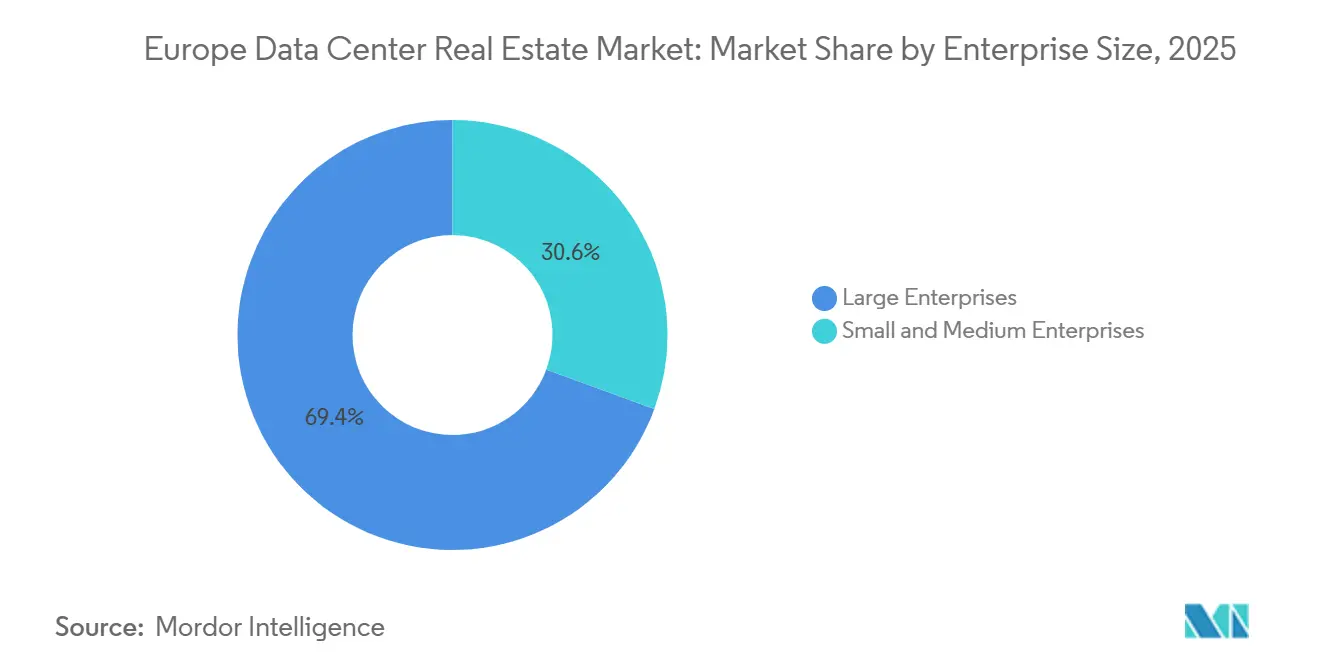
Large enterprises accounted for 69.40% of demand in 2025, making them the main customer base for the Europe data center real estate market. Their scale reflects heavy infrastructure needs across telecommunications, finance, media, and manufacturing. At the same time, small and medium enterprises are forecast to grow faster, with a 12.20% CAGR through 2031. This faster pace comes from cloud migration, digital commerce growth, and a compliance burden that makes self-managed infrastructure harder to justify for smaller organizations.
The SME opportunity is concentrated in managed colocation and edge models that suit sub-MW deployments and flexible tenancy terms. Portus Data Centers’ focus on carrier-neutral edge locations in Hamburg, Munich, and Luxembourg aligns with that pattern and shows how regional demand can be aggregated through smaller footprints. Larger enterprises, by contrast, are moving toward more flexible scale-out colocation arrangements that can absorb sudden AI-related demand without locking them into rigid long-term space commitments. The Europe data center real estate market is therefore expanding through two different customer logics, with large tenants driving volume and smaller firms lifting growth through managed and distributed hosting formats.
By End-Users: Information Technology and Telecom Dominates While Healthcare Drives Tenancy Stability
Information technology and telecom accounted for 44.80% of demand in 2025, making them the largest end-user group in the Europe data center real estate market. Their lead comes from cloud service providers, content delivery networks, and telecommunications carriers that require large and recurring colocation volumes across major exchange points. Healthcare is the fastest-growing end-user segment, with a 12.90% CAGR through 2031. In this case, growth is being driven by regulation as much as by digitalization, because healthcare data must increasingly reside in secure, sovereign environments.
Scaleway’s selection in April 2026 to host France’s Health Data Hub shows how healthcare contracts can create durable, multi-year occupancy and stronger tenancy stability than many short-cycle commercial workloads. Banking, financial services, and insurance remain another large user group because low-latency connectivity and reliability still matter for trading and transaction systems. Government demand is smaller in share terms but strategically important, especially where national digital sovereignty programs shape procurement. The Europe data center real estate market, therefore, continues to lean on information technology and telecom for scale, while healthcare and public-sector hosting strengthen the long-duration and compliance-led side of the tenant mix.
Geography Analysis
The United Kingdom held 24.60% of the Europe data center real estate market share in 2025, which kept it in the largest country position in the region. London remains the anchor because its exchange density, submarine cable connectivity, and financial services demand continue to give it the deepest concentration of data center activity. Equinix’s October 2025 acquisition of an 85-acre Hertfordshire site with USD 4.9 billion in planned investment shows how strongly operators still back the United Kingdom pipeline. The country’s growth path is still constrained by power and planning friction, so the United Kingdom combines very strong demand conditions with meaningful delivery risk.
Germany is the fastest-growing country in the Europe data center real estate market, with a projected 11.9% CAGR through 2031. Frankfurt remains central because it anchors financial exchange traffic and attracts sovereign and enterprise workloads that prefer German jurisdiction. Yondr’s 40MW Frankfurt facility reached full operation in July 2025, which shows that major projects are still being delivered even as constraints tighten. Germany's sustainability rules are shaping facility specifications more directly than in many neighboring markets. France and Italy are both attracting renewed interest as operators seek additional scale beyond the most saturated hubs, especially where governments are supportive, and power availability is better aligned with large future campuses.
The Rest of Europe is moving onto a different site-selection logic, where grid access and renewable power increasingly matter more than legacy ecosystem depth. The Nordics are becoming more visible in the Europe data center real estate market because hydroelectric supply, cooler climates, and available land support lower-carbon and AI-ready deployments. North’s June 2026 land acquisition in Haugaland, Norway, and its plan for 300MW to 350MW of regional campus capacity show that the cluster is being built for long-term expansion rather than only niche edge demand. Poland, Portugal, and Spain are also moving up the regional hierarchy as operators search for renewable energy supply, cable access, and development conditions that can support new large-scale campuses.
Competitive Landscape
The European data center real estate market shows moderate concentration at the top, with Equinix, Digital Realty, NTT DATA GROUP CORPORATION, Data4, and Vantage Data Centers forming the leading operator group. Those companies benefit from existing campuses, long customer relationships, engineering depth, and a much better position in the contest for powered land. The most important competitive move is no longer just site acquisition; operators now need to secure power equipment, renewable energy supply, and municipal support simultaneously. This makes scale more valuable and gives large incumbents a clear advantage in complex development environments.
Equinix’s February 2026 commitment of up to USD 700 million to Hanley Energy’s manufacturing facility in Ireland is a strong example of that shift, because it extends competition into the power equipment chain rather than only the land market. AtlasEdge’s USD 1.39 billion is another example and shows how regional operators are using large capital pools to build distributed footprints outside the most saturated metros. Pure DC’s USD 2.7 billion financing package in May 2026 also points to strong lender support for hyperscale-led development strategies across Europe and the Middle East. These moves show that competition is increasingly shaped by capital access, supply chain security, and development execution rather than only by existing rack inventory. They also show why smaller entrants can struggle to keep pace even when demand conditions appear attractive.
There is still room in the Europe data center real estate market for specialists that target underserved secondary cities, sovereign-compliant hosting, or edge-oriented demand pockets. That white space is attracting regional operators such as AtlasEdge, NorthC, and Penta Infra, which can expand through smaller sites and more localized customer mixes. Compliance certifications are also creating a premium submarket for healthcare and public workloads, where competition depends on trust and regulatory fit as much as on pure facility scale. At the same time, thermal design, liquid-cooling readiness, and the ability to support AI densities are becoming increasingly important differentiators in the next wave of facilities. This leaves the Europe data center real estate market with a leading group that is strong and getting stronger, but not so dominant that targeted challengers cannot still build defensible positions in selected countries and city niches.
Europe Data Center Real Estate Industry Leaders
Equinix, Inc.
Digital Realty Trust, Inc.
NTT DATA GROUP CORPORATION
Colt Data Centre Services
Vantage Data Centers
- *Disclaimer: Major Players sorted in no particular order

Recent Industry Developments
- May 2026: Pure DC secured USD 2.7 billion in financing to accelerate expansion across Europe and the Middle East, including investments in FLAP-D infill sites and AI-scale campuses; the deal reflects strong institutional lender confidence in the hyperscale-focused development model.
- April 2026: Scaleway was designated as the future host of France's Health Data Hub (HDB) following a 350-criterion selection process covering safety, resilience, and strategic sovereignty; the production cutover of the main SNDS health database is targeted for end-2026 to early 2027, establishing sovereign-compliant data center services as a high-value government procurement category.
- February 2026: Equinix committed up to USD 700 million to support the construction of Hanley Energy's advanced manufacturing facility in Dundalk, Ireland, securing specialized power equipment supply for its high-performance data centers and AI-driven workloads across a 5-to-10-year period.


Europe Data Center Real Estate Market Report Scope
| Colocation |
| Hyperscale |
| Edge Data Center Properties |
| Modular Data Center Properties |
| Others (Wholesale, Retail and Enterprise) |
| Leased |
| Owner Occupied |
| Large Enterprises |
| Small and Medium Enterprises |
| Information Technology and Telecom |
| Banking, Financial Services, and Insurance |
| Government and Public Sector |
| Healthcare |
| Other End Users |
| United Kingdom |
| Germany |
| France |
| Italy |
| Rest of Europe |
| By Property Type | Colocation |
| Hyperscale | |
| Edge Data Center Properties | |
| Modular Data Center Properties | |
| Others (Wholesale, Retail and Enterprise) | |
| By Ownership | Leased |
| Owner Occupied | |
| By Enterprise Size | Large Enterprises |
| Small and Medium Enterprises | |
| By End-Users | Information Technology and Telecom |
| Banking, Financial Services, and Insurance | |
| Government and Public Sector | |
| Healthcare | |
| Other End Users | |
| By Country | United Kingdom |
| Germany | |
| France | |
| Italy | |
| Rest of Europe |


Key Questions Answered in the Report
How large is Europe data center real estate in 2031?
The Europe data center real estate market is projected to reach USD 33.89 billion by 2031, up from USD 18.90 billion in 2025, at a 10.53% CAGR from 2026 to 2031.
Which property type leads current demand across Europe?
Colocation led property-type demand with a 50.20% share in 2025, while edge data center properties are growing the fastest at a 13.80% CAGR through 2031.
Why are AI workloads changing facility design in Europe?
AI deployments require much higher rack density, heavier power delivery, and more advanced cooling, while ENTSO-E expects European data center electricity demand to rise by more than 50% between 2025 and 2030.
Which country is leading and which is growing fastest?
The United Kingdom held the largest share at 24.60% in 2025, while Germany is forecast to expand at the fastest CAGR of 11.90% through 2031.
Page last updated on:






