
Europe Containerized Rail Freight Transport Market Size and Share
Market Overview
| Study Period | 2020 - 2031 |
|---|---|
| Forecast Data Period | 2026 - 2031 |
| Base Year Market Size (2025) | USD 12.76 Billion |
| Market Size (2026) | USD 13.41 Billion |
| Market Size (2031) | USD 16.96 Billion |
| Growth Rate (2026 - 2031) | 4.81 % |
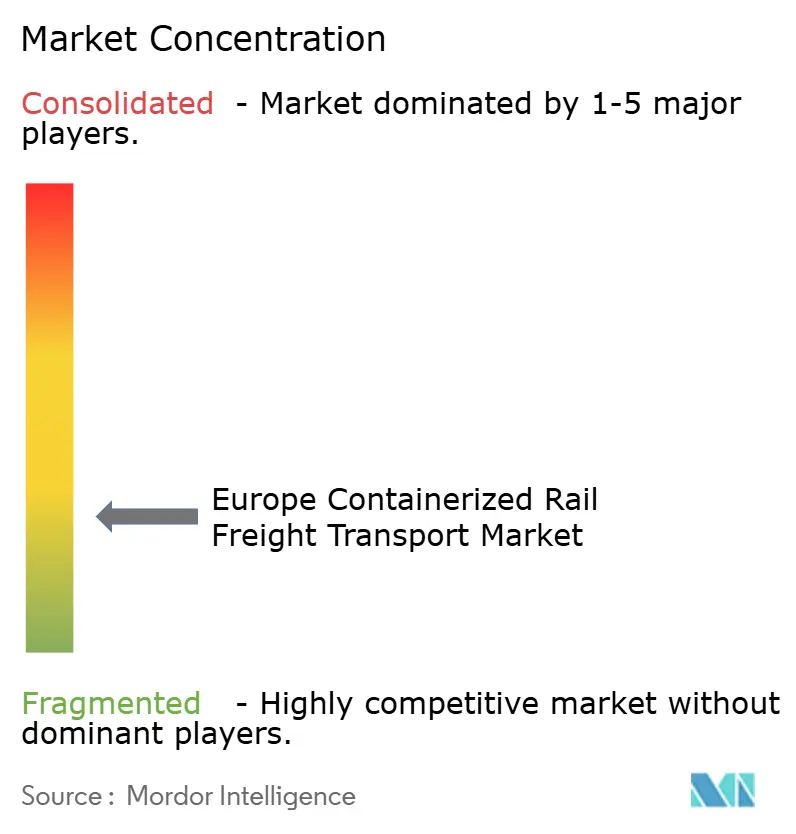
| Market Concentration | Low |
Major Players *Disclaimer: Major Players sorted in no particular order Image © Mordor Intelligence. Reuse requires attribution under CC BY 4.0. | |
Europe Containerized Rail Freight Transport Market Analysis by Mordor Intelligence
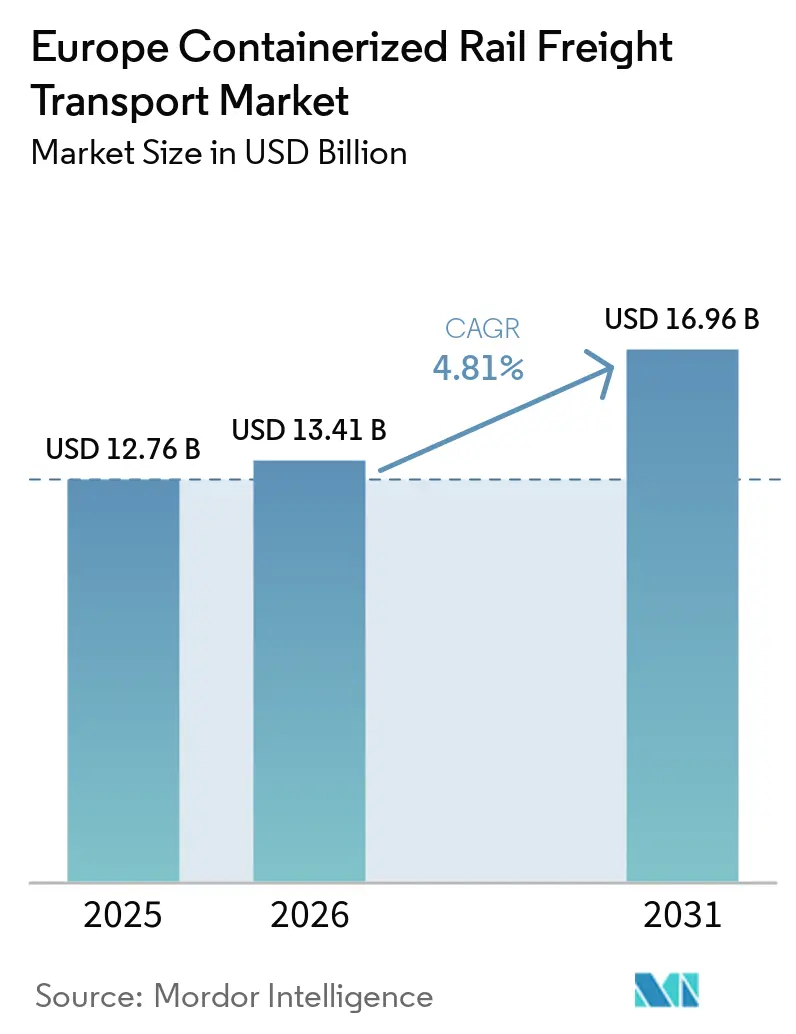
The Europe containerized rail freight transport market size was valued at USD 12.76 billion in 2025, and is projected to expand from USD 13.41 billion in 2026 to USD 16.96 billion in 2031, registering a CAGR of 4.81% between 2026 and 2031.
European transport policy continues to favor a larger role for rail in long-distance freight, while investment in terminals is improving access to inland corridors. The most attractive routes in the Europe containerized rail freight transport market combine dependable train paths, port connections, and customers that can commit stable container volumes. Industrial decarbonization requirements are also making rail more relevant to shippers that need documented reductions in transport emissions. Network closures and limited capacity remain constraints, so operators are placing greater value on rerouting options, service frequency, and coordinated terminal and track investment. The European containerized rail freight market, therefore, offers opportunities in high-frequency intermodal services, domestic consolidation, specialized temperature-controlled freight, and coordinated terminal-to-corridor operations across the wider European logistics network.
Key Report Takeaways
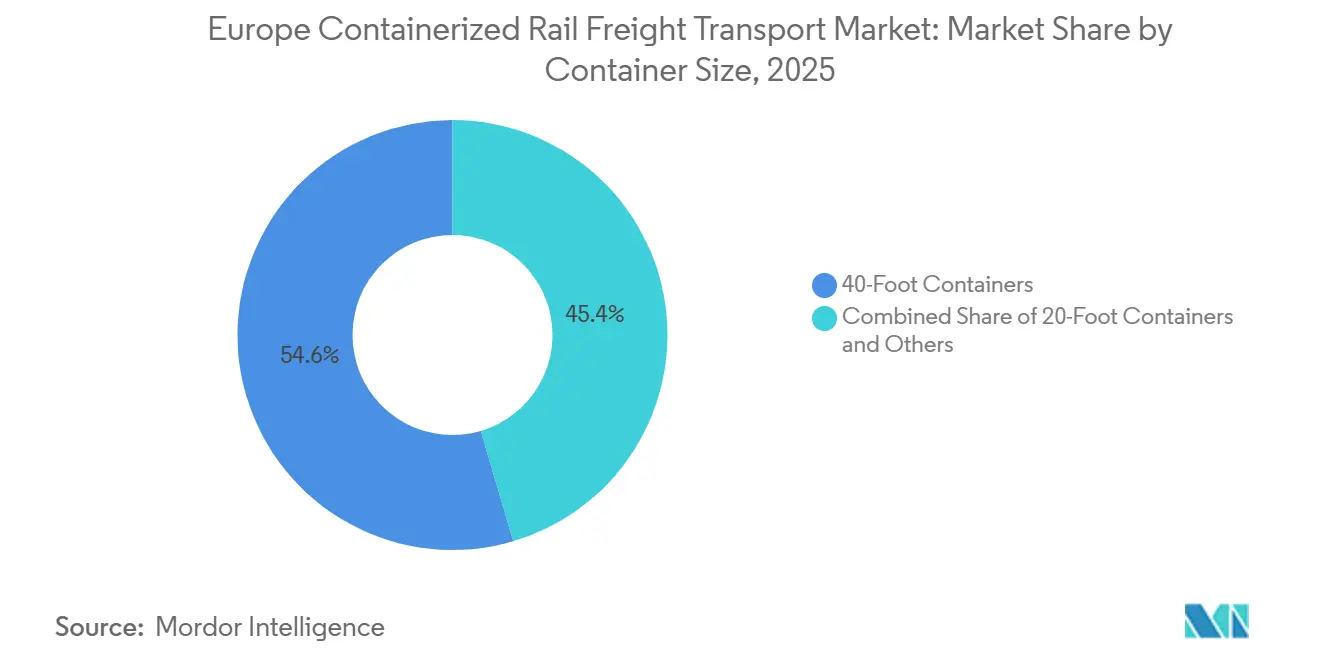
- By container size, 40-foot containers held 54.56% of the Europe containerized rail freight transport market share in 2025 and are forecast to grow at a 6.80% CAGR through 2031.
- By container type, general containers accounted for 82.65% of the Europe containerized rail freight transport market size in 2025, while refrigerated containers are forecast to expand at a 7.94% CAGR through 2031.
- By shipment flow, international and cross-border shipments represented 64.56% of the Europe containerized rail freight transport market share in 2025, while domestic shipments are forecast to grow at a 5.71% CAGR through 2031.
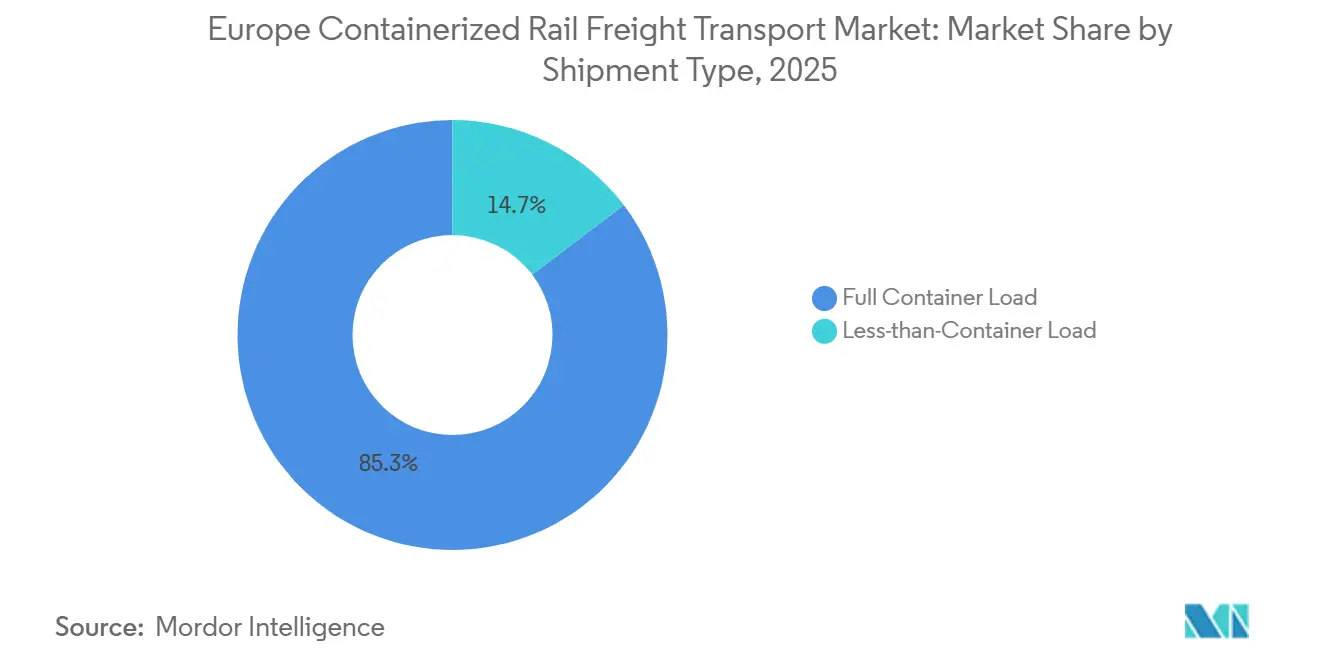
- By shipment type, full container load shipments held 85.34% of the Europe containerized rail freight transport market size in 2025, while less-than-container load shipments are forecast to grow at a 6.18% CAGR through 2031.
- By cargo type, manufacturing and automotive cargo held 31.31% share in the Europe containerized rail freight transport market in 2025, while healthcare and pharmaceuticals are forecast to grow at a 7.81% CAGR through 2031.
- By country, Germany held 30.25% share in the Europe containerized rail freight transport market in 2025, while Poland is forecast to grow at a 5.46% CAGR through 2031.
Note: Market size and forecast figures in this report are generated using Mordor Intelligence’s proprietary estimation framework, updated with the latest available data and insights as of January 2026.
Europe Containerized Rail Freight Transport Market Trends and Insights
Drivers Impact Analysis*
| Driver | (~) % Impact on CAGR Forecast | Geographic Relevance | Impact Timeline |
|---|---|---|---|
| EU Road-To-Rail Modal-Shift Policies | +1.0% | EU-wide, with stronger effects in Germany, France, and Belgium | Long term (≥ 4 years) |
| Intermodal Terminal And Inland Hub Expansion | +0.8% | Poland, Germany, Belgium, the Netherlands, and France | Medium term (2-4 years) |
| Industrial Shipper Decarbonization Requirements | +0.7% | Germany, the Netherlands, Belgium, Italy, and Sweden | Medium term (2-4 years) |
| Port-To-Inland Container Corridor Growth | +0.6% | The Netherlands, Belgium, Germany, Poland, and the United Kingdom | Medium term (2-4 years) |
| Service Reconfiguration During Network Disruptions | +0.4% | Germany, Switzerland, Austria, the Alpine region, and France | Short term (≤ 2 years) |
| E-Commerce And Contract Logistics Rail Demand | +0.5% | Germany, Poland, France, and the Nordic countries | Medium term (2-4 years) |
| Source: Mordor Intelligence | |||
EU Road-To-Rail Modal-Shift Policies
The European Union has set a target to move 30% of road freight traveling more than 300 km to rail or waterborne transport by 2030. The target is set to rise above 50% by 2050, which supports long-term planning for intermodal capacity and terminal access. The revised framework for railway infrastructure capacity is intended to bring capacity planning under a single instrument across the European network. This could improve train-path allocation for intermodal operators that compete with passenger services on busy routes. The Community of European Railway and Infrastructure Companies has also warned that rules allowing longer and heavier cross-border trucks could weaken the intended modal shift on shorter routes[1]Community of European Railway and Infrastructure Companies, “Railways Warn Of Reverse Modal Shift As EU Transport Ministers Reach Agreement On Longer, Heavier Trucks,” CER, cer.be. This policy tension matters because rail investment decisions are made over long asset lives. At the same time, road rules can alter the economics of individual routes much faster, and the practical outcome will depend on consistent infrastructure funding, predictable capacity rules, and shipper confidence that rail services can meet their operating needs.
Expansion Of Intermodal Terminals And Inland Hubs
Terminal capacity remains a central limitation on the Europe containerized rail freight transport market because handling capacity determines whether rail can match shipper schedules. Euroterminal Sławkow started expanding from 285,000 to 530,000 TEUs under a PLN 180 million (USD 48.5 million) investment agreement signed in May 2025. The terminal links the Broad Gauge Line from Ukraine and Central Asia with European standard-gauge networks. Its position gives Poland a larger role in east-west container flows and in transshipment planning. New terminals can attract cargo only when nearby rail sections provide dependable paths and adequate train length. An investment that upgrades handling equipment without parallel track improvements can move congestion from the terminal gate to the adjoining corridor. This makes coordinated planning important for access tracks, train paths, crane availability, road connections, and storage areas, and terminal owners and infrastructure managers need to align their investment schedules if added handling capacity is to translate into dependable end-to-end rail service.
Decarbonization Requirements From Industrial Shippers
Large shippers are giving more attention to transport emissions when they renew logistics contracts and select long-haul modes. A 2025 study prepared for Europe’s Rail Joint Undertaking found that greater rail-freight integration could reduce carbon dioxide emissions and energy use across major European corridors[2]Europe’s Rail Joint Undertaking, “Net-Zero Logistics: The Contribution Of Rail Transport,” Europe’s Rail Joint Undertaking, rail-research.europa.eu. This supports the use of rail on corridors where lower emissions can be demonstrated through clear operating data. Shipper requirements can turn into predictable rail demand when service performance is strong. The European containerized rail freight market can benefit when operators provide verifiable emissions records and dependable handling for industrial loads. Customers also need rail providers to show that lower-emission transport does not create new uncertainty around lead times, damage, or equipment availability, which gives operators an incentive to combine emissions reporting with clear operating standards and long-term service commitments.
Growth Of Port-To-Inland Container Corridors
European ports generate a significant share of containerized rail demand because inland distribution choices are often made when vessels arrive. In February 2026, the UK Government and Network Rail agreed on long-term control of Barking Eurohub in east London. The plan includes GBP 15 million (USD 19.3 million) in investment and supports the return of regular cross-Channel rail freight. OBB Rail Cargo Group also expanded its network in early 2026 with the Duisburg-Rotterdam TransFER service, which operates 3 weekly round-trip. Port-linked block services can be planned around vessel arrivals, which improves the ability to offer regular departures and container availability. Their value is strongest when rail schedules, terminal handling windows, customs activity, and inland delivery arrangements are managed as one operating chain, creating a more stable service proposition than ad hoc road movements and strengthening rail’s role in hinterland distribution.
Restraints Impact Analysis*
| Restraint | (~) % Impact on CAGR Forecast | Geographic Relevance | Impact Timeline |
|---|---|---|---|
| Network Capacity Constraints And Passenger-Traffic Competition | -0.6% | Germany, Austria, Switzerland, Alpine corridors, France, and Italy | Short term (≤ 2 years) |
| Cross-Border Technical And Administrative Fragmentation | -0.5% | EU-wide, especially the eastern and western European border zones | Long term (≥ 4 years) |
| Unreliable Train Paths And Diversion-Cost Exposure | -0.4% | Germany’s Rhine Valley, Alpine routes, and the Italian Simplon axis | Short term (≤ 2 years) |
| Loading-Unit Rotation And Equipment Imbalance | -0.3% | Eastbound and westbound flow imbalances in Central and Eastern Europe | Medium term (2-4 years) |
| Source: Mordor Intelligence | |||
Network Capacity Constraints And Passenger-Traffic Competition
Passenger and freight services share many high-traffic European lines, which limits dependable capacity for containers. Planned renewals on core German routes can reduce available freight paths during closure periods. Kombiverkehr reported lower transport volumes and sales in 2025, citing infrastructure disruption and calling for constructive dialogue and compensation[3]Kombiverkehr, “General Overhaul: Vital Need For Constructive Dialogue And Compensation Payments,” Kombiverkehr, kombiverkehr.de. Freight operators face longer routes, equipment repositioning, and customer penalty clauses when diversions are necessary. They do not have a comparable cost-recovery model for these disruptions. Unreliable train paths and diversion costs, therefore, make some routes less attractive to shippers even where nominal rail capacity exists. This can lead customers to keep rail only for less time-sensitive loads or to return critical volumes to road. At the same time, a stronger compensation framework and better planning between infrastructure managers and freight operators would reduce this uncertainty and support more durable customer commitments.
Cross-Border Technical And Administrative Fragmentation
Cross-border flows still face friction from different gauge systems, electrification, signaling, customs processes, and border inspections. The European Commission’s assessment of the former rail freight corridor framework found that separate capacity management was inefficient and cross-border cooperation was ineffective. The new EU capacity framework is intended to address this problem through more integrated rules. At eastern borders, containers can require transshipment between 1,520 mm broad gauge and 1,435 mm standard gauge. Uneven trade flows also leave equipment in the wrong location, raising costs for container rotation and wagon use. These constraints are likely to remain more acute on routes involving non-EU geographies, even as western intra-EU routes become more aligned. The result is a more uneven operating environment in which the same container can face very different timing, documentation, and equipment requirements across a single journey, requiring operators to reflect that complexity in service design and in the commitments they make to customers.
*Our forecasts treat driver/restraint impacts as directional, not additive. The impact forecasts reflect baseline growth, mix effects, and variable interactions.
Segment Analysis
By Container Size: 40-Foot Volumes Reshape Inland Terminal Economics
The 40-Foot segment held 54.56% of the Europe containerized rail freight transport market share in 2025 and is projected to grow at a 6.80% CAGR through 2031. Its position reflects alignment between common maritime equipment and the handling systems used at inland terminals, and high-cube and 40-Foot compatible equipment is particularly important for consumer goods and port hinterland freight. OBB Rail Cargo Group’s Wels-Hamburg/Bremerhaven TransFER service, introduced in 2026, accommodates containers from 20 feet to 45 feet. This flexibility lets operators serve several cargo types without changing the train’s basic operating model. It also supports connections between Austrian production areas and North Sea ports.
The 20-Foot format remains relevant for dense cargo such as industrial chemicals, raw materials, and selected automotive parts. Its lower tare weight can support higher payload use within axle-load limits, while other sizes include 45-Foot pallet-wide units that are common in consumer goods and e-commerce distribution. Terminals that can handle several container sizes have a broader customer base and less dependence on one cargo category. TEN-T technical parameters support standardized handling of international container dimensions on principal routes. The Europe containerized rail freight transport market size for this segment will depend on whether terminal equipment and corridor capacity advance together.



By Container Type: Reefer Demand Opens A Premium Niche
General containers accounted for 82.65% of the Europe containerized rail freight transport market size in 2025. Dry freight supports the regular block-train operations used for FMCG, industrial goods, and automotive components, and these movements benefit from repeatable routes, stable equipment pools, and high container turnover. General containers also fit the established operating model of large rail freight operators and port-to-inland services. Their scale gives operators a base load that supports frequent departures. The segment remains central to revenue because it covers the largest range of everyday containerized cargo.
Refrigerated containers are projected to grow at a 7.94% CAGR through 2031, making them the fastest-growing container type. Their growth is linked to pharmaceutical logistics, food safety requirements, and retailer demand for traceable cold chains. At the same time, temperature-sensitive cargo requires reliable power continuity, documented handling, and minimal disruption at terminals. Rail operators that meet these requirements can serve freight that is less suited to standard dry-container processes. The segment can command higher revenue per TEU than general freight because of its handling and monitoring requirements. Its growth also creates demand for reefer-capable terminals and compatible wagon capacity.
By Shipment Flow: Cross-Border Volumes Anchor The Market, Domestic Corridors Show Speed
International and cross-border shipments represented 64.56% of the Europe containerized rail freight transport market share in 2025. Rail is generally more competitive than road as transport distance increases, especially on routes above 300 km, and cross-border block trains connect manufacturing centers with North Sea ports, Mediterranean gateways, and logistics hubs in Central and Eastern Europe. These routes benefit from established schedules and larger anchor customers. The scale of these movements supports regular service frequency and more efficient use of locomotives and wagons. Cross-border traffic, therefore, remains the main foundation for the Europe containerized rail freight transport market.
Domestic shipments are projected to grow at a 5.71% CAGR through 2031. France’s Ulysse Fret program committed EUR 4 billion (USD 4.65 billion) through 2032 to modernize freight infrastructure and supported 10 new combined transport services in 2025. National schemes can improve last-mile access and lower the barriers that previously limited domestic container rail, while Italy’s rail and maritime freight incentives also support national modal-shift efforts. Domestic growth will depend on terminal proximity to distribution centers and predictable local collection and delivery services.
By Shipment Type: FCL Remains Dominant, But LCL Captures The Growth Story
Full container load shipments accounted for 85.34% share in the Europe containerized rail freight transport market in 2025. Large industrial and automotive shippers can fill wagons regularly, which makes block-train planning easier. At the same time, full-load operations can reduce terminal dwell time and support end-to-end slot commitments. They remain important for operators whose networks were designed around high-volume routes and stable customer contracts. The format provides a dependable utilization base for rail assets and terminals. Its large role shows the continuing importance of scale in rail economics.
Less-than-container load shipments are projected to expand at a 6.18% CAGR through 2031. Logistics providers can consolidate smaller consignments into regular intermodal services for e-commerce, pharmaceuticals, and FMCG customers, which broadens access to rail for shippers that cannot commit to a full container or block train. Consolidation requires reliable cutoffs, sorting processes, and connected first-mile and last-mile transport. Those added activities can raise revenue per container, although they also require stronger operating control. The Europe containerized rail freight transport market will benefit when LCL products become routine rather than limited to isolated corridors.
By Cargo Type: Automotive Leads Volume, Pharma Rail Emerges As A High-Value Niche
Manufacturing and automotive cargo held 31.31% share in the Europe containerized rail freight transport market in 2025. European automotive supply chains use block trains to connect production sites, component suppliers, and port gateways. DB Cargo expanded Automotive RailNet with 60 Laeffer's 560.4 railcars in spring 2026. The company reported that its battery logistics activities handle 700,000 units annually alongside vehicle flows. These flows provide stable volume, although they are exposed to competitive tendering and industrial production cycles.
Healthcare and pharmaceuticals are projected to grow at a 7.81% CAGR through 2031. Pharmaceutical shippers need temperature control, verified custody, and consistent delivery performance, which makes documented rail services more relevant on suitable electrified corridors. Growth in biologics and pressure on road reefer capacity can strengthen this transition. Healthcare cargo can generate higher revenue per container than routine industrial freight. The segment’s expansion could improve the value mix of the Europe containerized rail freight transport market even when total container volumes grow steadily.
Geography Analysis
Germany accounted for 30.25% share in the Europe containerized rail freight transport market in 2025. Its industrial base, extensive terminal network, and central position on north-south and east-west corridors support this role. Rail freight revenue per train-km in Germany rose 24% between 2020 and 2024. The increase reflected pricing conditions and higher costs associated with disruption, while the United Kingdom recorded 5% growth in intermodal rail traffic in 2024-25, and third-quarter 2025 volumes rose 4%. The Barking Eurohub agreement strengthens the prospect of regular cross-Channel container rail connections. France added 10 combined transport services in 2025 and continued the Ulysse Fret program. The program carries an EUR 4 billion (USD 4.65 billion) investment commitment through 2032.
Poland is projected to be the fastest-growing geography at a 5.46% CAGR through 2031. Its terminal investments support a larger role as a logistics hub between eastern and western corridors. At the same time, Italy benefits from its position on the Rhine-Alpine network and its links to Mediterranean gateways. Belgium and the Netherlands remain essential port gateways because Antwerp and Rotterdam serve as primary origins for continental container distribution.
The Lineas and FS Logistix Modalink joint venture announced a plan to begin managing the Antwerp Mainhub terminal in September 2025. The Nordics are smaller in volume but have geographic conditions that can favor rail over long road alternatives[4]Lineas, “Modalink, A Joint Venture Of Lineas And FS Logistix, To Manage Antwerp Mainhub Terminal,” Lineas, newsroom.lineas.net. Austria, Switzerland, the Czech Republic, Hungary, and the Baltic states form an important transit area for Alpine and east-west routes. At the same time, Austrian rail freight revenue per train-km rose 36% between 2020 and 2024. These transit markets gain when cross-border capacity and terminal coordination improve.
Competitive Landscape
The Europe containerized rail freight transport market is fragmented at the national level and across Europe as a whole. DB Cargo AG, OBB Rail Cargo Group, SNCF Group, Rail Logistics Europe, PKP CARGO, and FS Logistix have a broad network scale and established relationships with infrastructure managers. Private specialists such as Hupac, Kombiverkehr, and METRANS compete through service frequency, corridor design, and terminal reach. At the same time, the absence of a single pan-European operator leaves room for regional networks and cross-border partnerships. Competitive outcomes increasingly depend on delivered reliability rather than published capacity, which favors operators that can keep containers moving when a key route faces disruption.
DB Cargo has been adjusting its operating model under restructuring requirements linked to its commercial viability plan. Its 2025 annual report described workforce changes, the sale and leaseback of 6,000 wagons to GATX Rail Europe, and the planned disposal of a minority interest in maritime combined transport. Hupac increased service frequency on selected German-Italian routes during early 2026 to reduce customer exposure to delays, and OBB Rail Cargo Group added services connecting Wels with Hamburg and Bremerhaven, Duisburg with Rotterdam, Salzburg with Offenbach, and Duisburg with Curtici. These moves show that route coverage and service design remain important competitive tools.
CMA CGM completed its acquisition of Freightliner’s UK intermodal rail business in January 2026. The transaction brought 2,000 wagons and 10 terminals into a maritime-to-inland logistics platform. Lineas and FS Logistix formed Modalink to manage the Antwerp Mainhub terminal and associated last-mile services. Opportunities remain in domestic LCL consolidation and pharmaceutical cold-chain rail, where specialized handling can support premium service.
Europe Containerized Rail Freight Transport Industry Leaders
DB Cargo AG
METRANS a.s.
Hupac Intermodal SA
Kombiverkehr GmbH & Co KG
OBB Rail Cargo Group
- *Disclaimer: Major Players sorted in no particular order

Recent Industry Developments
- February 2026: The UK Government and Network Rail agreed to take long-term control of the Barking Eurohub site in east London, with GBP 15 million (USD 19.3 million), in planned investment. The deal supports the return of regular containerized rail freight through the Channel Tunnel and reconnects UK intermodal networks with continental services.
- January 2026: CMA CGM Group completed the acquisition of Freightliner’s UK intermodal rail business, taking control of 2,000 wagons, 10 terminals, and one of the United Kingdom’s largest electrified locomotive fleets. The transaction integrates the United Kingdom’s leading containerized rail operator into CMA CGM’s global maritime-to-inland logistics network. Freightliner’s international branches in Poland, Germany, and the Netherlands remain outside the CMA CGM transaction and continue under previous ownership.
- September 2025: Lineas and FS Logistix created Modalink, a joint venture to manage the Antwerp Mainhub rail terminal handling 1.5 million tonnes and 2,500 trains annually, plus associated last-mile intermodal services. FS Logistix acquired a 30% stake in Antwerp Mainhub through the venture, while Lineas transferred commercial responsibility for the Antwerp-Milan route to FS Logistix under a traction contract.
- May 2025: Poland signed an investment agreement for the first phase of Euroterminal Sławkow’s expansion at PLN 180 million (USD 48.5 million), targeting completion by 2027. The expansion will increase annual capacity from 285,000 to 530,000 TEUs at the EU’s only terminal directly connected to the Broad Gauge Railway Line from Ukraine and Central Asia.


Europe Containerized Rail Freight Transport Market Report Scope
| 20-Foot Containers |
| 40-Foot Containers |
| Other Container Sizes |
| General Container |
| Refrigerated Containers |
| Domestic |
| International / Cross-Border |
| Full Container Load (FCL) |
| Less-than-Container Load (LCL) |
| FMCG and Retail |
| Manufacturing and Automotive |
| Healthcare and Pharmaceuticals |
| Electronics and Electrical Equipment |
| Industrial Chemicals and Raw Materials |
| Others |
| United Kingdom |
| Germany |
| France |
| Spain |
| Italy |
| Belgium |
| Netherlands |
| Poland |
| NORDICS (Denmark, Finland, Iceland, Norway, and Sweden) |
| Rest of Europe |
| By Container Size | 20-Foot Containers |
| 40-Foot Containers | |
| Other Container Sizes | |
| By Container Type | General Container |
| Refrigerated Containers | |
| By Shipment Flow | Domestic |
| International / Cross-Border | |
| By Shipment Type | Full Container Load (FCL) |
| Less-than-Container Load (LCL) | |
| By Cargo Type | FMCG and Retail |
| Manufacturing and Automotive | |
| Healthcare and Pharmaceuticals | |
| Electronics and Electrical Equipment | |
| Industrial Chemicals and Raw Materials | |
| Others | |
| By Country | United Kingdom |
| Germany | |
| France | |
| Spain | |
| Italy | |
| Belgium | |
| Netherlands | |
| Poland | |
| NORDICS (Denmark, Finland, Iceland, Norway, and Sweden) | |
| Rest of Europe |


Key Questions Answered in the Report
What is driving demand for containerized rail freight in Europe?
Policy support for modal shift, terminal investment, port connections, and shipper decarbonization requirements supports demand. However, dependable train paths and coordinated infrastructure work remain essential for converting interest into regular bookings.
How large is Europe’s containerized rail freight sector?
The sector is estimated at USD 13.41 billion in 2026 and is forecast to reach USD 16.96 billion by 2031, reflecting a 4.81% CAGR during the 2026-2031 forecast period.
Which container format leads European rail freight?
40-Foot containers led with 54.56% share in 2025 and are projected to grow at a 6.80% CAGR through 2031, supported by maritime compatibility and wider inland-terminal handling capability.
Which container type segment is growing fastest on European rail?
Refrigerated containers are projected to grow at a 7.94% CAGR, reflecting the need for documented handling and dependable temperature-controlled operations.
Why is Poland important for containerized rail freight?
Poland is forecast to grow at a 5.46% CAGR through 2031, supported by terminal investment, broad-gauge connections, and its role between eastern and western European corridors.
What is limiting containerized rail services in Europe?
Network closures, freight competition with passenger traffic, and cross-border technical and administrative friction remain key limitations, while equipment imbalances can increase the cost of returning empty containers and wagons.
Page last updated on:





