
Europe Built To Rent Residential Market Size and Share
Market Overview
| Study Period | 2020 - 2031 |
|---|---|
| Forecast Data Period | 2026 - 2031 |
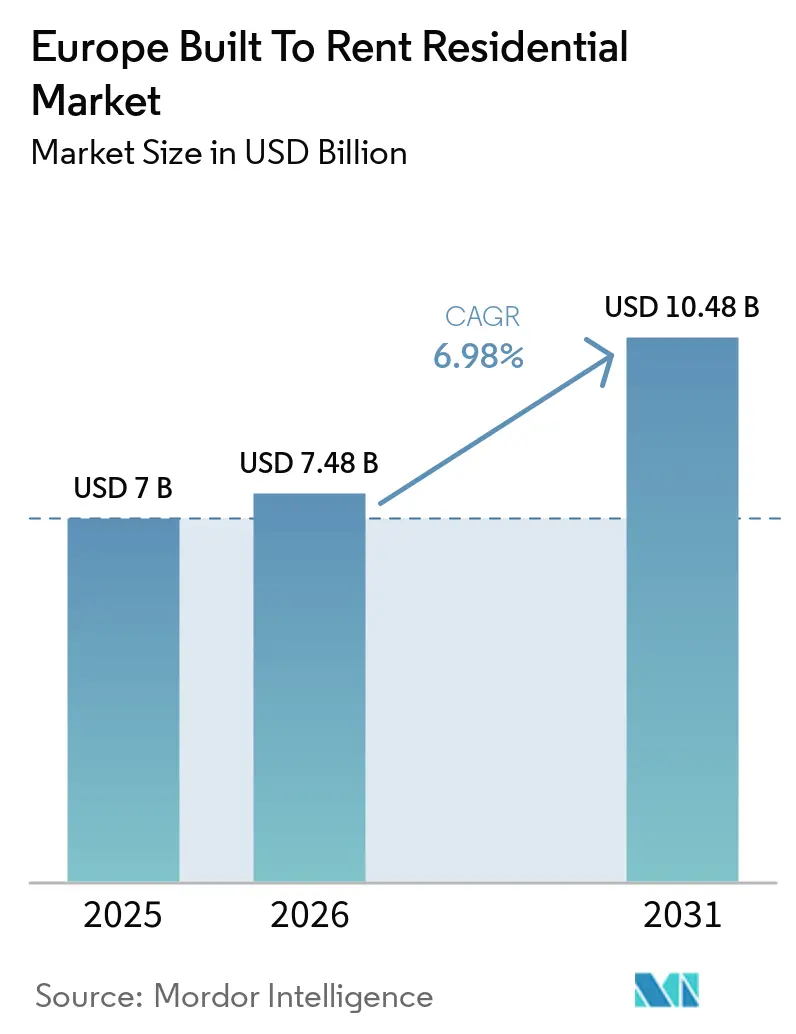
| Base Year Market Size (2025) | USD 7 Billion |
| Market Size (2026) | USD 7.48 Billion |
| Market Size (2031) | USD 10.48 Billion |
| Growth Rate (2026 - 2031) | 6.98 % |
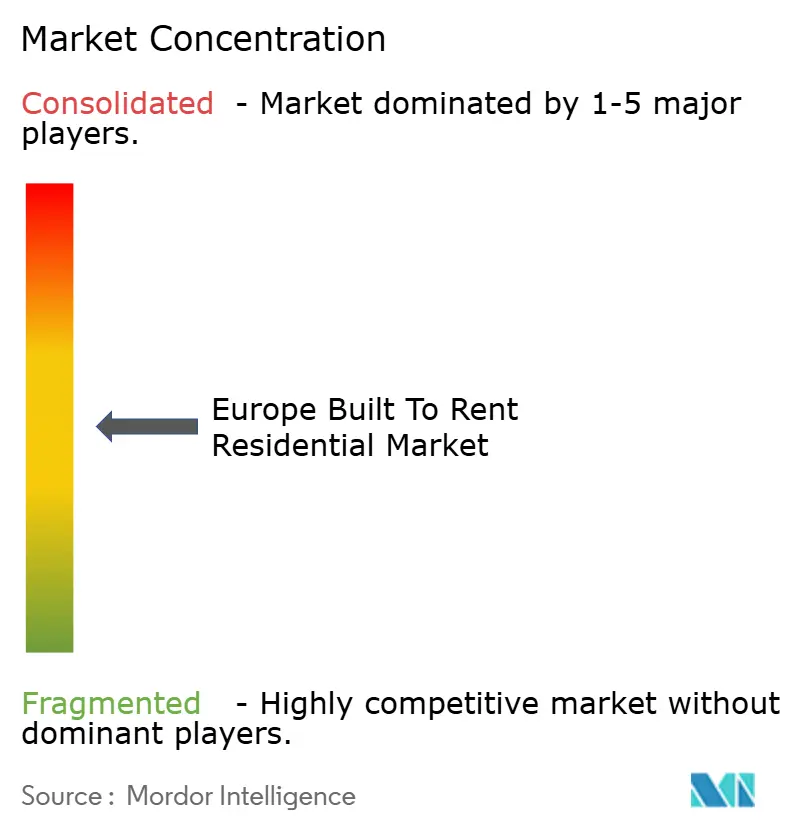
| Market Concentration | Medium |
Major Players *Disclaimer: Major Players sorted in no particular order Image © Mordor Intelligence. Reuse requires attribution under CC BY 4.0. | |
Europe Built To Rent Residential Market Analysis by Mordor Intelligence
The Europe Built To Rent Residential Market size was valued at USD 7 billion in 2025 and is estimated to grow from USD 7.48 billion in 2026 to reach USD 10.48 billion by 2031, at a CAGR of 6.98% during the forecast period (2026-2031).
Housing shortages, reduced access to homeownership, and continued institutional interest are supporting professionally managed rental housing across the region. The Europe built to rent residential market is also being shaped by a wider range of formats, including apartment communities, rental houses, and suburban single-family homes. Operators are directing capital toward established assets when development costs or approval delays make new construction less viable. Public land, affordable housing programs, and energy-efficient refurbishment are creating routes to add supply in selected cities. Rent controls, building standards, and financing conditions remain uneven across countries, which makes local operating knowledge important for cross-border investment.
Key Report Takeaways
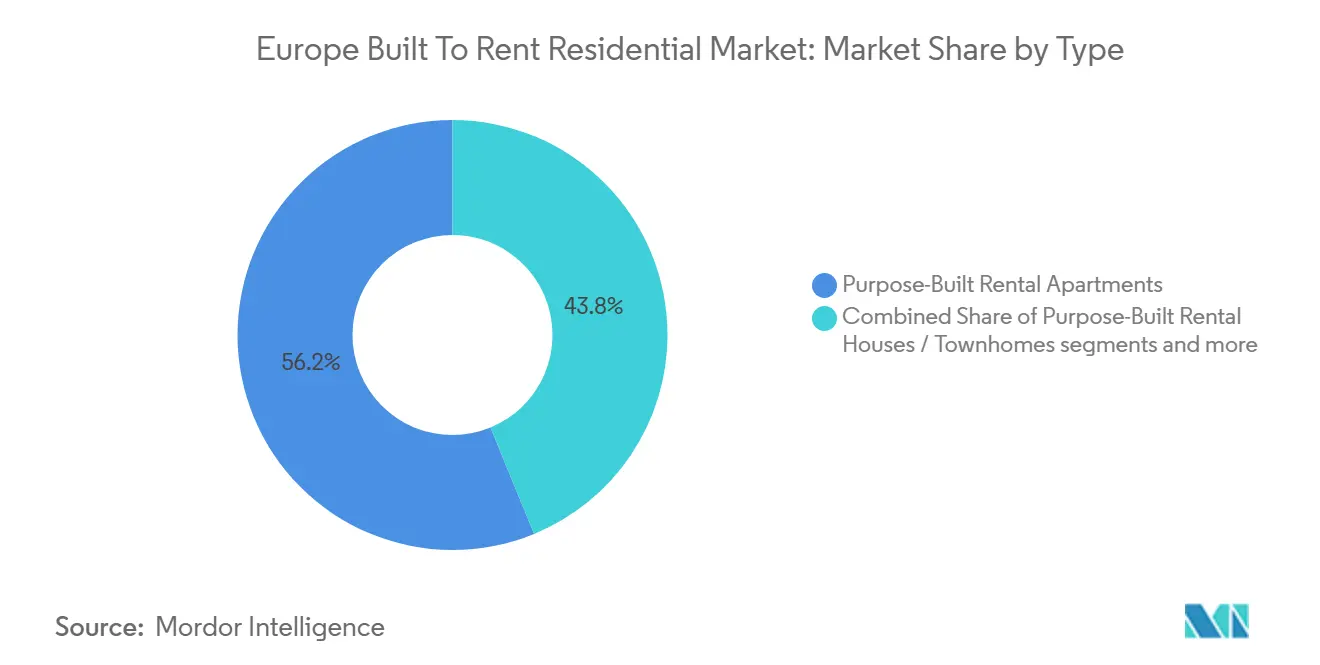
- By type, purpose-built rental apartments held 56.2% of the Europe built to rent residential market share in 2025, while single-family built to rent / built to rent communities are forecast to grow at an 8.2% CAGR through 2031.
- By management model, third-party operators held 63.8% of the Europe built to rent residential market share in 2025, while hybrid management is forecast to grow at a 7.9% CAGR through 2031.
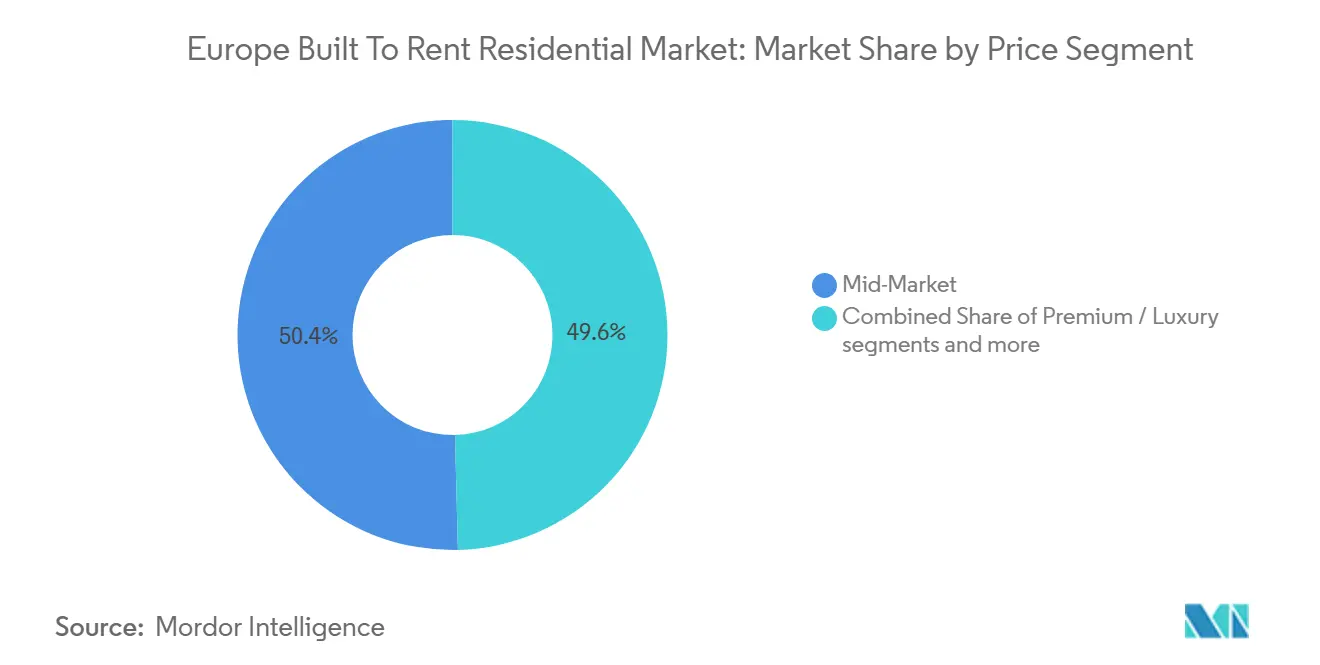
- By price segment, mid-market housing held 50.4% of the Europe built to rent residential market size in 2025, while affordable & workforce housing are forecast to grow at an 8.4% CAGR through 2031.
- By geography, the United Kingdom held 49.9% of the Europe built to rent residential market size in 2025, while Spain is forecast to grow at an 8.6% CAGR through 2031.
Note: Market size and forecast figures in this report are generated using Mordor Intelligence’s proprietary estimation framework, updated with the latest available data and insights as of January 2026.
Europe Built To Rent Residential Market Trends and Insights
Drivers Impact Analysis*
| Drivers | (~) % Impact on CAGR Forecast | Geographic Relevance | Impact Timeline |
|---|---|---|---|
| Urban Rental Housing Shortages Drive Built to Rent Demand | +2.3% | Europe, with stronger relevance in the United Kingdom, Germany, France, and Spain | Short term (≤ 2 years) |
| Institutional Capital Increases Investment in Residential Assets | +1.7% | United Kingdom, Germany, Spain, France, and the Netherlands | Medium term (2-4 years) |
| Mortgage Affordability Challenges Extend Rental Demand | +1.2% | Europe, with stronger relevance in the United Kingdom, Spain, Portugal, and Ireland | Short term (≤ 2 years) |
| Single-Family Rental Communities Expand Built to Rent Supply | +0.8% | United Kingdom, Ireland, and France | Medium term (2-4 years) |
| Energy Retrofit Projects Create Value-Add Built to Rent Opportunities | +0.4% | Germany, the Netherlands, the Nordics, France, and Italy | Long term (≥ 4 years) |
| Resident Data Analytics Improve Operating Efficiency and Asset Performance | +0.3% | United Kingdom, Germany, the Netherlands, and wider Europe | Medium term (2-4 years) |
| Source: Mordor Intelligence | |||
Urban Rental Housing Shortages Drive Build to Rent Demand
Housing supply constraints are creating a durable base of tenant demand for the Europe built to rent residential market. Housing completions in Europe declined 5.5% in 2025 from 2024, while permitting activity remained weak. France had 2.8 million pending social housing applications, Germany required at least 400,000 new homes each year, and the Netherlands needed nearly 1 million additional dwellings by 2031[1]Housing Europe, “The State of Housing in the EU 2025,” Housing Europe, stateofhousing.eu.. These shortages are most visible in affordable and mid-priced housing, where professionally managed rental homes can serve households that do not qualify for social housing. The European Union and the European Investment Bank announced a 2025 plan to invest USD 10.8 billion over 2 years in housing, renovation, and research[2]European Parliament, “Housing Crisis, Why Prices Are Rising and What the EU Is Doing About It,” European Parliament, europarl.europa.eu.. Scarce supply makes completed and occupied assets more valuable to investors because they offer an immediate operating platform in markets where development pipelines are constrained.
Institutional Capital Increases Investment in Residential Assets
Long-term investors are directing more capital toward rental housing, which supports the Europe built to rent residential market. Greystar closed its Greystar Equity Partners Europe II fund with more than USD 2.9 billion in commitments in 2025, supporting rental housing and purpose-built student accommodation expansion[3]Greystar, “Greystar Closes Europe’s Largest Residential Fund,” Greystar, greystar.com.. ABP Pension Fund and Greystar invested USD 568.1 million in 779 affordable and mid-market rental homes in Utrecht during September 2025. More than two-thirds of the Utrecht homes were offered at regulated rents below USD 1,404 per month, which links institutional capital to a broader affordability objective. Institutional investors typically favor assets that provide stable income, standardized operations, and clear performance data. This preference is strengthening larger platforms that can source projects, manage resident services, and operate portfolios across several cities.
Mortgage Affordability Challenges Extend Rental Demand
Homeownership has become less accessible in many European cities, increasing the pool of long-term renters. The European Commission reported in 2025 that mortgage borrowing capacity had declined in nearly every European Union country after interest rate normalization. Between 2010 and the first quarter of 2025, average rental prices in the European Union rose 27.8%, with larger increases in Estonia, Lithuania, and Ireland. In Bulgaria, Ireland, Poland, Portugal, and Spain, renting a standard 2-room urban apartment consumed more than 80% of median wages in many locations. These conditions keep rental demand high, although they also limit how much rent operators can raise without affecting occupancy. Europe built to rent residential market benefits when households remain renters for longer, but value creation depends on matching rent levels to local income capacity.
Single-Family Rental Communities Expand Build to Rent Supply
Single-family rental communities are extending the Europe built to rent residential market beyond dense urban apartment projects. Greystar announced a garden-style strategy in July 2026 that targets up to 20,000 rental homes across suburban and edge-of-city United Kingdom locations by 2029. The strategy started with a site in Waterbeach, Cambridgeshire, and construction is expected to begin in the first quarter of 2027. CBRE Investment Management and Moda Living also launched Single Family Housing Partners with initial capital of USD 512 million and a target portfolio value of USD 2.6 billion. This format can access lower-cost suburban land and meet demand for homes with more space. It also provides an alternative pipeline where central-city apartment schemes face high land costs or more difficult planning conditions.
Restraints Impact Analysis*
| Restraints | (~) % Impact on CAGR Forecast | Geographic Relevance | Impact Timeline |
|---|---|---|---|
| High Interest Rates and Development Financing Costs Reduce Project Viability | -1.8% | Europe, with stronger relevance in the United Kingdom and Germany | Short term (≤ 2 years) |
| Planning, Permitting, and Building Safety Delays Slow Project Delivery | -0.9% | United Kingdom, Germany, and Spain | Medium term (2-4 years) |
| Diverse Rent Control Regulations Increase Cross-Border Investment Complexity | -0.6% | Germany, France, and Spain | Medium term (2-4 years) |
| Energy Performance Certificate Compliance and Retrofit Requirements Increase Development Expenses | -0.4% | Netherlands, Belgium, France, the United Kingdom, and wider Europe | Long term (≥ 4 years) |
| Source: Mordor Intelligence | |||
High Interest Rates and Development Financing Costs Reduce Project Viability
Development financing costs continue to limit new supply in the Europe built to rent residential market. Higher debt costs and construction inflation have made some German projects difficult to justify, particularly outside the largest cities. In the United Kingdom, operating leakage, which is the gap between gross rental income and net rental income, widened from 25% to more than 30%. This reduces the yield available to a developer after property operating expenses. Investors may respond by purchasing completed portfolios or using forward-funding structures instead of taking full development risk. That choice supports transaction activity but can restrict the pace at which new rental homes reach the market.
Planning, Permitting, and Building Safety Delays Slow Project Delivery
Long approval processes can prevent rental housing from reaching areas with the greatest need. Building permit issuance in Germany remained at multi-year lows, adding to the mismatch between household demand and available homes. In the United Kingdom, higher-risk residential projects face added building safety review requirements, which can extend development timetables. Delays increase holding costs and can change the financing assumptions that supported a scheme when it was first approved. They also increase the appeal of completed assets that can generate income without a development period. The German government’s 2026 housing plans included a specialized construction investment fund that combines private capital with public guarantees through Kreditanstalt für Wiederaufbau.
*Our forecasts treat driver/restraint impacts as directional, not additive. The impact forecasts reflect baseline growth, mix effects, and variable interactions.
Segment Analysis
By Type: Purpose-Built Rental Apartments Provide Scale While Single-Family Built to Rent / Built to Rent Communities Grow Faster
Purpose-built rental apartments held 56.2% of the Europe built to rent residential market share in 2025. Their leading position reflects the concentration of institutional development in large urban centers, where apartment buildings can support professional leasing, maintenance, and resident-service teams. The format provides unit density that helps managers spread staffing and operating costs across a larger base of homes. It also suits forward-funding agreements because projects are generally standardized and can be delivered in defined phases. The Europe built to rent residential industry has used these projects to establish recognizable operating platforms in major cities. Apartment-led communities remain important where renters value proximity to jobs, transport, and urban services.
Single-family built to rent / built to rent communities are forecast to grow at an 8.2% CAGR from 2026 to 2031. These communities address households seeking additional living space without the cost of ownership. They can be built in suburban locations where land costs are lower than in central apartment districts. Greystar’s 2026 garden-style housing plan shows how a large operator is applying this format at scale in the United Kingdom. The model requires careful local management because homes are more dispersed than apartment units. Rental houses and townhomes can also fit markets such as the Netherlands and Nordic countries, where lower-density home types are part of established housing patterns.



By Management Model: Third-Party Operators Lead While Hybrid Management Grows Faster
Third-party operators held 63.8% of the Europe built to rent residential market share in 2025. Many institutional owners choose this model because it separates property ownership from the specialized work of leasing, resident support, maintenance, and building operations. A dedicated manager can apply common processes across several assets, which supports consistent service and cost monitoring. Greystar managed more than 91,000 build to rent homes and purpose-built student accommodation beds across 8 countries, with USD 20.5 billion in assets, in 2025. Vonovia SE managed 531,000 residential units and invested USD 2.2 billion in portfolio maintenance and construction during 2025. These examples show why scale and established operating capability are important in the Europe built to rent residential industry.
Hybrid management is forecast to grow at a 7.9% CAGR from 2026 to 2031. It combines direct oversight of key activities with outside support for functions such as facilities management or leasing. Owners can retain closer access to resident and asset performance information without building every operational capability internally. This can improve oversight where a portfolio has reached enough scale to support a dedicated management team. The approach also allows investors to adapt the mix of in-house and external services as a portfolio grows. Effective implementation depends on reliable property data, well-defined responsibilities, and managers who can respond quickly to tenant needs.
By Price Segment: Mid-Market Housing Leads Demand While Affordable & Workforce Housing Gain Momentum
Mid-market housing accounted for 50.4% of the Europe built to rent residential market size in 2025. This segment serves households whose incomes are above social-housing thresholds but below the level needed for sustained premium rents. It therefore reaches a broad share of urban workers and families facing high purchase prices. Mid-market properties can offer predictable income when locations, rent levels, and unit sizes are aligned with local household earnings. ABP and Greystar’s Utrecht investment included affordable and mid-market homes, with more than two-thirds of the homes offered at regulated rents below USD 1,404 per month. This model illustrates how capital can be directed toward the middle of the rental price range.
Affordable & workforce housing is forecast to grow at an 8.4% CAGR from 2026 to 2031. The segment is supported by severe supply shortages and by public-private structures that can lower land or financing barriers. Government participation can make projects feasible where market rents alone do not cover development and operating costs. The segment also aligns with public policy efforts to expand access to secure housing. However, energy upgrades and other compliance requirements can be difficult to absorb when rent growth is restricted. Successful schemes will need disciplined cost control, long-term funding, and rules that allow operators to preserve housing quality.
Geography Analysis
The United Kingdom held 49.9% of the Europe built to rent residential market size in 2025. Its lead reflects a mature institutional rental framework and a large base of completed and planned projects. The United Kingdom had more than 127,000 completed build to rent homes in 2025, with more than 50,000 under construction and 110,000 in planning. The Renters’ Rights Act 2025 replaced no-fault evictions with a revised tenancy framework, which may encourage smaller landlords to reconsider their positions. Scotland exempted professionally managed build to rent and mid-market rent developments from rent controls in April 2026, creating a distinct policy position for these schemes. The European-built residential rental market in the United Kingdom remains attractive because it combines scale, operating experience, and a relatively deep pool of institutional capital.
Germany remained a major residential investment destination, but its supply constraints and development costs limited project activity. Vonovia SE’s 2025 investment in maintenance and new construction shows the capital needed to keep large rental portfolios operating and compliant. France also has substantial rental needs, with 2.8 million people on social housing waiting lists. Italy remains an earlier-stage institutional market, with activity concentrated in Milan and other large urban locations. These countries offer long-term demand, but rent rules, building standards, permitting processes, and local cost structures vary widely. Operators entering these markets need city-level development, pricing, and compliance plans rather than a uniform European approach.
Spain is forecast to grow at an 8.6% CAGR from 2026 to 2031, the fastest rate among the named geographies. The country combines rapid urban demand with limited formal rental supply, creating room for professionally managed housing. PATRIZIA and Urbania launched Sustainable Communities Spain in May 2025, committing more than USD 140.4 million to sustainable and affordable housing in major Spanish metropolitan areas. The Netherlands is also receiving investment in new rental housing, illustrated by the ABP and Greystar Utrecht program. The Nordics, Poland, and other Central and Eastern European countries broaden the geographic opportunity set for the Europe built to rent residential market. Their appeal depends on the depth of rental demand, the availability of sites, and the predictability of local rules.
Competitive Landscape
The Europe built to rent residential market is moderately concentrated, with large pan-European operators, national landlords, investment managers, and smaller specialized developers. Greystar Europe, Vonovia SE, Heimstaden Bostad AB, PATRIZIA SE, and CBRE Investment Management have established operational scale or institutional capital relationships. Scale matters because it supports resident services, financing access, data collection, and standardized asset management. Greystar’s 2025 fund close added more than USD 2.9 billion of commitments to its European residential strategy. Vonovia SE’s 531,000-unit portfolio provides a different form of scale rooted in large residential ownership and portfolio maintenance. Competition is therefore strongest among platforms that can combine capital deployment with established operating systems.
Companies are using partnerships and targeted acquisitions to extend their position in specific formats and cities. CBRE Investment Management and Moda Living completed the seed acquisition for Single Family Housing Partners in July 2026, with USD 512 million of initial capital and a USD 2.6 billion portfolio value target. Greystar acquired the 904-home Elephant Park build to rent portfolio in London in July 2026. PATRIZIA completed 2 forward deals for 237 rental apartments in the Stuttgart area in December 2025. These moves show a preference for platform growth, ready-to-operate assets, and locations with clear renter demand.
Smaller operators can compete through site selection, neighborhood partnerships, amenity design, and strong local execution. Get Living, Quintain Limited, and Moda Living have used urban regeneration projects to secure development opportunities. Energy performance is becoming an additional basis of competition because tenants, regulators, and investors are placing more value on efficient buildings. The revised Energy Performance of Buildings Directive requires member states to reduce average primary energy use in residential building stock by 16% from the 2020 baseline by 2030. Owners who improve buildings ahead of requirements may have a stronger position in leasing and investment markets. The competitive structure remains mixed across Europe because many national and city markets retain local ownership, development, and regulatory characteristics.
Europe Built To Rent Residential Industry Leaders
Vonovia SE
LEG Immobilien SE
Heimstaden Bostad AB
TAG Immobilien AG
Grand City Properties S.A.
- *Disclaimer: Major Players sorted in no particular order

Recent Industry Developments
- July 2026: CBRE Investment Management and Moda Living completed the seed acquisition for the United Kingdom Single Family Housing Partners platform, backed by an initial USD 512 million in capital and targeting growth to USD 2.6 billion in portfolio value. The platform addresses the structurally undersupplied United Kingdom family rental market and expands the institutional single-family rental category.
- July 2026: Greystar acquired the 904-home Elephant Park build to rent portfolio in Elephant and Castle, London, from CPP Investments and Lendlease, funded through Greystar Equity Partners Europe II.
- July 2026: Greystar launched its garden-style rental housing strategy targeting up to 20,000 suburban build to rent homes across the United Kingdom over 4 years. It acquired the first site at Waterbeach, Cambridgeshire, and construction is expected to begin in the first quarter of 2027.


Europe Built To Rent Residential Market Report Scope
| Multifamily Built to Rent |
| Single-Family Built to Rent / Built to Rent Communities |
| Purpose-Built Rental Apartments |
| Purpose-Built Rental Houses / Townhomes |
| In-house Operator |
| Third-party Operator |
| Hybrid Management |
| Premium / Luxury |
| Mid-Market |
| Affordable & Workforce Housing |
| United Kingdom |
| Germany |
| France |
| Italy |
| Spain |
| Rest of Europe |
| By Type | Multifamily Built to Rent |
| Single-Family Built to Rent / Built to Rent Communities | |
| Purpose-Built Rental Apartments | |
| Purpose-Built Rental Houses / Townhomes | |
| By Management Model | In-house Operator |
| Third-party Operator | |
| Hybrid Management | |
| By Price Segment | Premium / Luxury |
| Mid-Market | |
| Affordable & Workforce Housing | |
| By Country | United Kingdom |
| Germany | |
| France | |
| Italy | |
| Spain | |
| Rest of Europe |


Key Questions Answered in the Report
What is the 2026 value of the Europe built to rent residential market?
The market is estimated at USD 7.48 billion in 2026 and is forecast to reach USD 10.48 billion by 2031.
What is driving demand for build to rent homes in Europe?
Housing shortages, weaker mortgage affordability, and demand for professionally managed rental homes are key factors.
Which built to rent format is the largest in Europe?
Purpose-built rental apartments were the largest type, with a 56.2% share in 2025.
Which housing format is growing fastest?
Single-family built to rent communities are projected to grow at an 8.2% CAGR through 2031.
Which country leads European build to rent activity?
The United Kingdom led with a 49.9% share in 2025, supported by a mature institutional rental framework.
Which country is forecast to grow the fastest through 2031?
Spain is forecast to grow at an 8.6% CAGR, supported by urban rental demand and affordable housing initiatives.
Page last updated on:





