
Europe Automotive Telematics Market Size and Share
Market Overview
| Study Period | 2020 - 2031 |
|---|---|
| Forecast Data Period | 2026 - 2031 |
| Base Year Market Size (2025) | USD 17.12 Billion |
| Market Size (2026) | USD 19.64 Billion |
| Market Size (2031) | USD 39.09 Billion |
| Growth Rate (2026 - 2031) | 14.76 % |
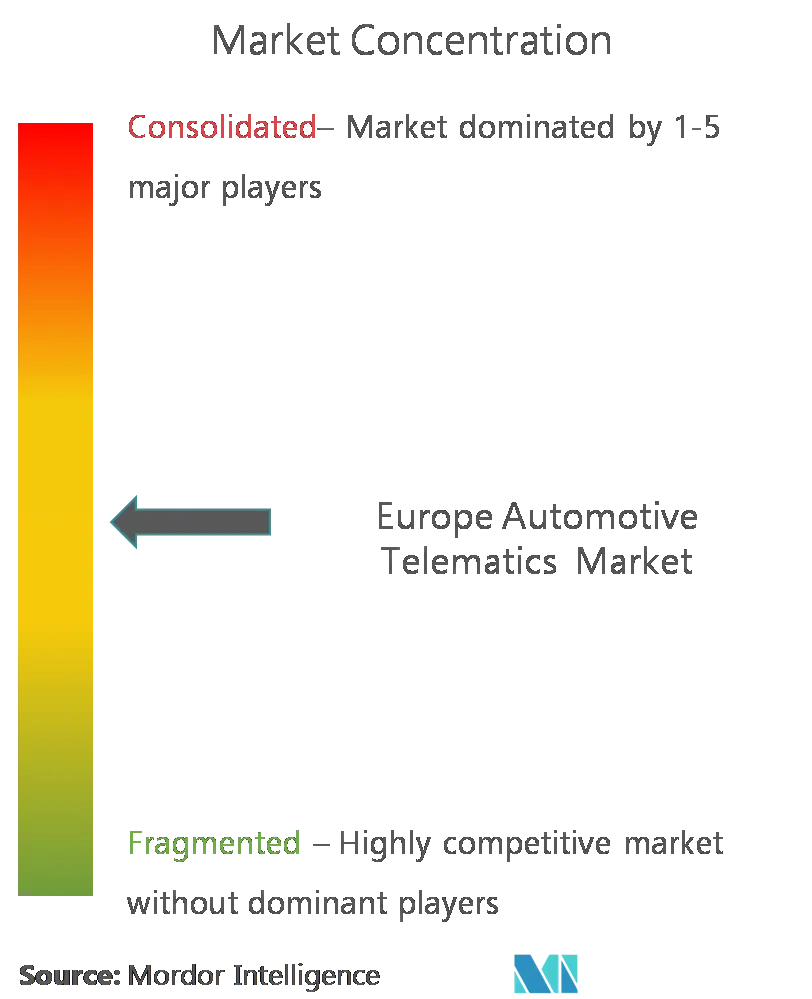
| Market Concentration | Low |
Major Players
*Disclaimer: Major Players sorted in no particular order Image © Mordor Intelligence. Reuse requires attribution under CC BY 4.0. |
|
Europe Automotive Telematics Market Analysis by Mordor Intelligence
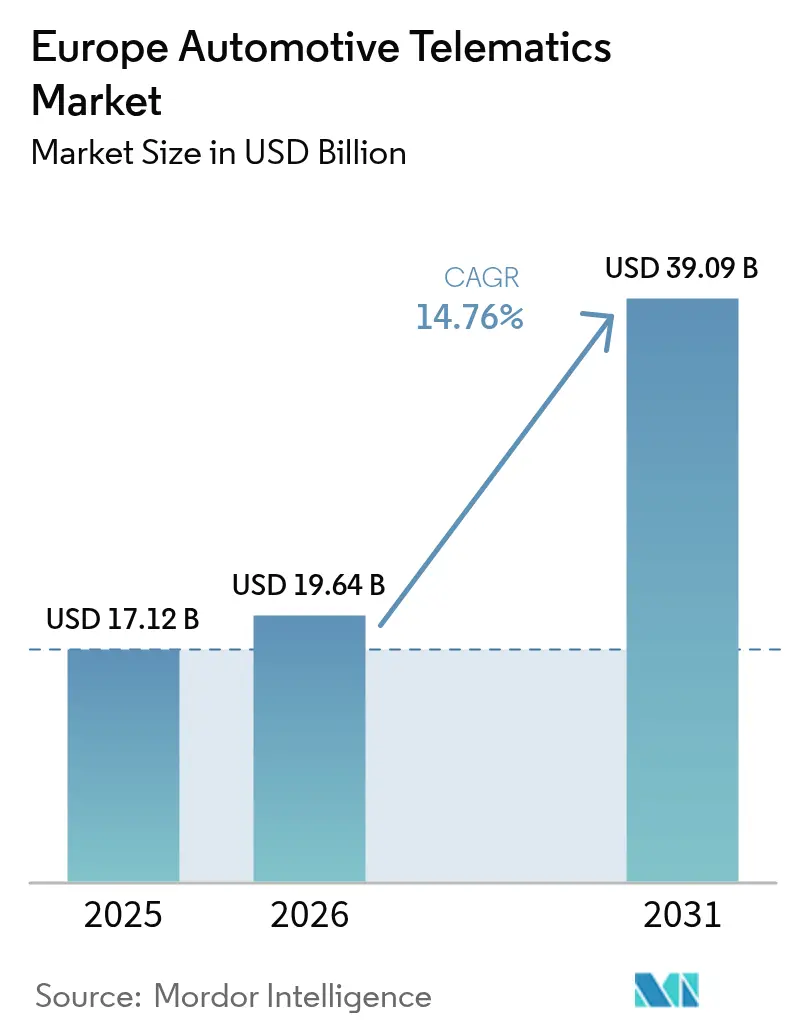
Europe automotive telematics market size in 2026 is estimated at USD 19.64 billion, growing from 2025 value of USD 17.12 billion with 2031 projections showing USD 39.09 billion, growing at 14.76% CAGR over 2026-2031. Momentum is shifting from connectivity as an optional differentiator to connectivity as a regulatory baseline and a recurring-revenue catalyst. The European Commission’s eCall mandate guarantees factory-fitted modems in new vehicles, turning every car into a data-producing node. Fleet operators are layering telematics into sustainability scorecards as low-emission zones proliferate, while insurers accelerate usage-based pricing that aligns premiums with real-time driving behavior. Germany’s automakers anchor platform scale, yet the United Kingdom is scaling faster thanks to a mature insurance-telematics ecosystem and post-Brexit test-bed flexibility. On the service front, fleet-management modules remain the revenue workhorse, but V2X and over-the-air (OTA) updates are rising sharply as software-defined vehicles become the strategic focus. Competitive intensity is increasing as Tier 1s, telecom carriers, and cloud vendors converge on data monetization opportunities that extend beyond simple asset tracking.
Key Report Takeaways
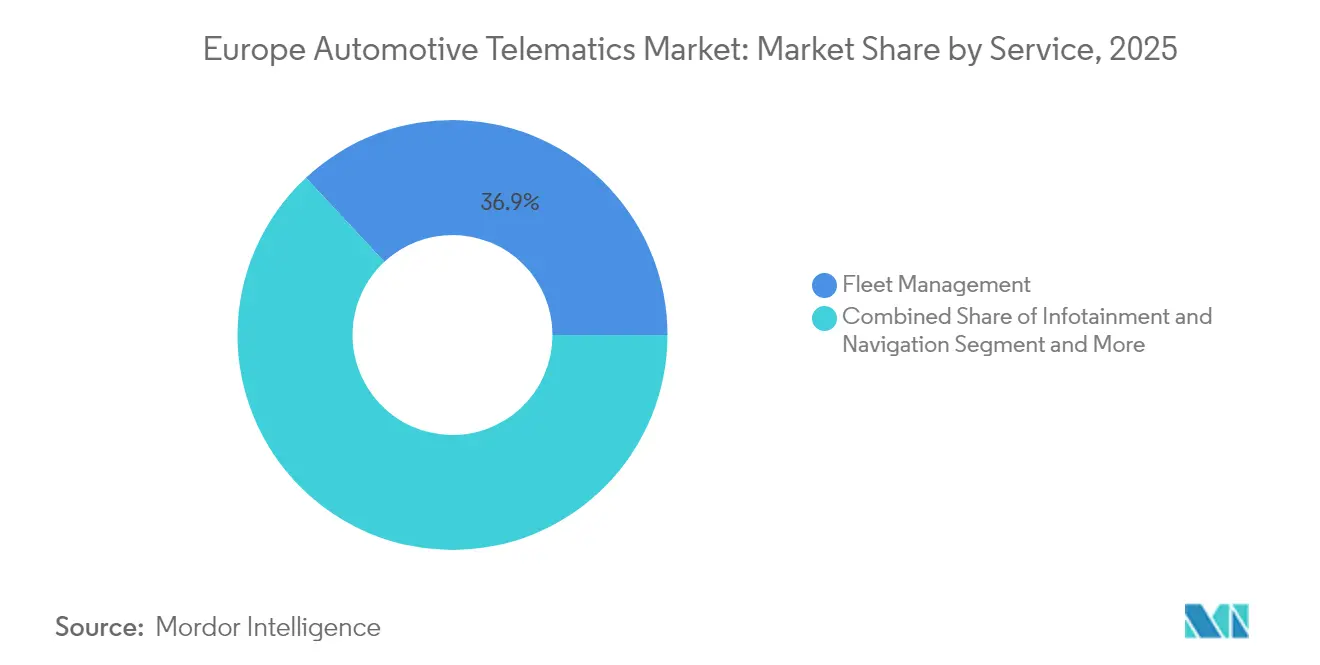
- By service, fleet management held 36.94% of the Europe automotive telematics market share in 2025, while V2X and OTA updates are projected to expand at a 16.95% CAGR through 2031.
- By sales channel, OEM-fitted systems controlled 79.71% share of the Europe automotive telematics market size in 2025; the aftermarket is the fastest-growing channel at 16.48% CAGR.
- By connectivity solution, embedded telematics accounted for 54.05% of the Europe automotive telematics market share in 2025, whereas integrated-smartphone architectures are advancing at a 16.89% CAGR.
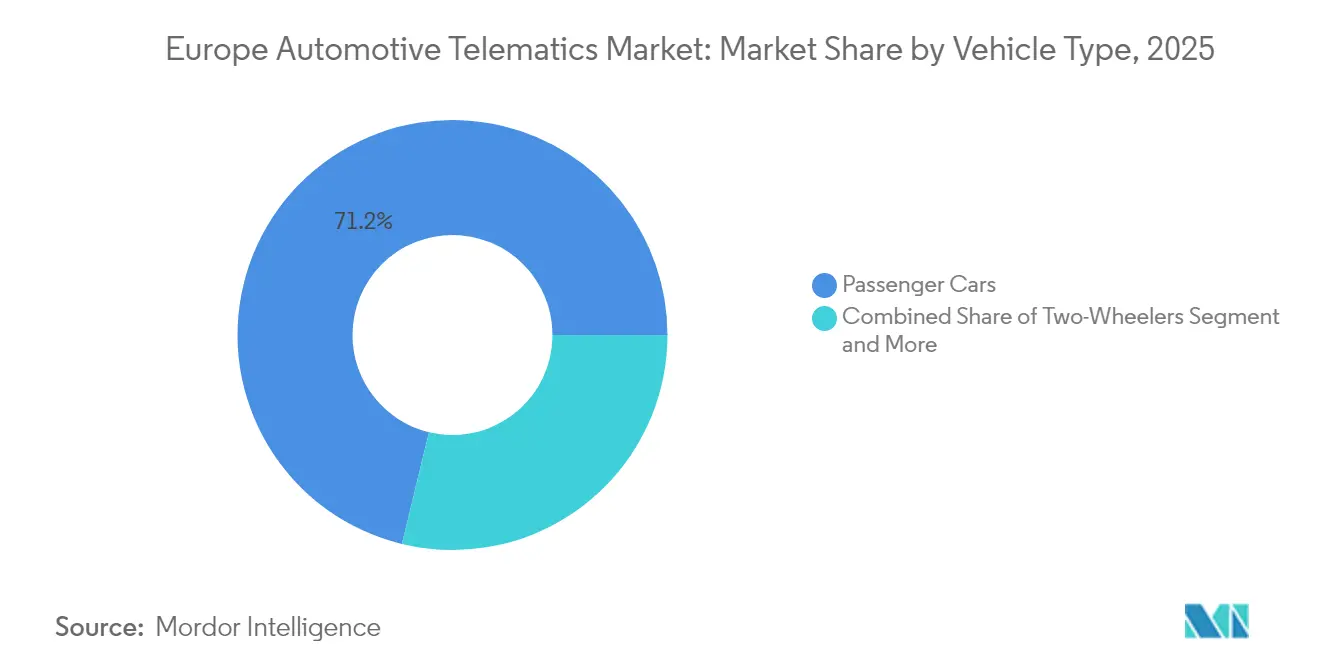
- By vehicle type, passenger cars generated 71.22% of 2025 revenue, but light commercial vehicles are forecast to post a 16.55% CAGR to 2031.
- By end-user, fleet operators commanded 54.16 of % demand in 2025; insurance and leasing firms are the fastest-growing cohort at 17.09% CAGR.
- By country, Germany led with 41.02% revenue share in 2025, while the United Kingdom is projected to grow at 15.42% CAGR to 2031.
Note: Market size and forecast figures in this report are generated using Mordor Intelligence’s proprietary estimation framework, updated with the latest available data and insights as of 2026.
Europe Automotive Telematics Market Trends and Insights
Drivers Impact Analysis*
| Driver | (~) % Impact on CAGR Forecast | Geographic Relevance | Impact Timeline |
|---|---|---|---|
| Fleet-Management Digitization Wave | +2.8% | Germany, France, United Kingdom, Benelux, Poland | Medium term (2-4 years) |
| 5G and V2X Rollout Across Europe | +2.4% | Germany, France, United Kingdom, Nordic region | Long term (≥ 4 years) |
| EU eCall and Safety-Mandate Tailwinds | +2.1% | EU27, United Kingdom, Norway, Switzerland | Short term (≤ 2 years) |
| OEM Push for Software-Defined Revenue | +2.3% | Germany, France, United Kingdom, Sweden | Medium term (2-4 years) |
| Infotainment and Navigation Demand Surge | +1.9% | Germany, United Kingdom, France, Italy, Spain | Medium term (2-4 years) |
| ESG-Linked CO₂ Reporting Requirements | +1.6% | EU27, United Kingdom city low-emission zones | Short term (≤ 2 years) |
| Source: Mordor Intelligence | |||
Fleet-Management Digitization Wave
European fleets are increasingly adopting telematics for route optimization, driver scorecarding, and predictive maintenance. These efforts aim to combat fuel theft, minimize downtime, and enhance customer satisfaction. Deployments reveal that predictive maintenance can significantly reduce unplanned stoppages. Additionally, geofencing streamlines proof-of-delivery workflows, helping to accelerate invoicing cycles and improve operational efficiency. A recent survey from a prominent fleet-management platform highlighted that a substantial portion of European fleet managers intend to broaden their telematics usage in the near future. Their motivations include addressing stricter emission regulations and achieving better visibility into the return on investment for electric vehicles. The trend of platform consolidation is becoming more evident, as demonstrated by a technology vendor acquiring a mobility unit to integrate hardware, connectivity, and software into a single contract. This approach simplifies integration processes and significantly reduces the total cost of ownership for fleet buyers, making it a more attractive option for businesses.
5G and V2X Rollout Across Europe
The Connecting Europe Facility has allocated significant funding to equip thousands of kilometers of highways with roadside units. This effort is designed to enable cooperative adaptive cruise control and platooning, which can lead to notable reductions in truck fuel consumption. Key corridors, such as Germany's autobahn and France's A10, are at the forefront of C-V2X implementation. Original Equipment Manufacturers are proactively embedding advanced chipsets from Qualcomm and NXP into upcoming vehicle models to align with anticipated regulatory requirements. In addition to improving safety, the integration of 5G technology, with its low latency capabilities, supports innovative applications like remote-driven shuttle pilots and dynamic speed-limit broadcasts. These advancements further reinforce the rationale for sustained investments in infrastructure development.
OEM Push for Software-Defined Revenue
Automakers are transitioning from one-off feature bundling toward recurring software subscriptions delivered through OTA pipelines. Premium brands already monetize incremental horsepower, advanced parking, and remote climate control as annual or monthly services [1]"eSync announces Arm as eSync Alliance Charter Member" eSync Alliance, esyncalliance.org. This strategy hinges on a secure, bi-directional telematics channel that supports entitlement management, billing, and rapid feature activation. Early deployments suggest predictive maintenance can reduce warranty claims, and recurring digital revenue provides a margin buffer as hardware profits erode in an electrifying market.
EU eCall and Safety-Mandate Tailwinds
The European Union requires all new passenger cars and light commercial vehicles to be equipped with an automatic emergency call module. This regulation has resulted in a significant portion of new vehicles being equipped with the system[2]“eCall Implementation Report 2024,”, European Commission, ec.europa.eu. The hardware that supports eCall also serves as the foundation for advanced services, including stolen-vehicle recovery, remote diagnostics, and subscription-based navigation. As consumers increasingly embrace constant connectivity, they have become more willing to share data, enabling insurers and fleet managers to access real-time driving telemetry. The regulation has further influenced advanced driver-assistance systems, as components such as GNSS receivers and crash sensors from eCall are now utilized across various digital features. After Brexit, the United Kingdom implemented a similar mandate, ensuring regulatory consistency across major European markets.
Restraints Impact Analysis*
| Restraint | (~) % Impact on CAGR Forecast | Geographic Relevance | Impact Timeline |
|---|---|---|---|
| GDPR Compliance Cost Inflation | -1.2% | EU27, United Kingdom, EEA | Short term (≤ 2 years) |
| 2G/3G Sunset Retrofit Burden | -1.1% | Germany, Netherlands, United Kingdom, Nordic region | Short term (≤ 2 years) |
| High Embedded-Hardware BOM in Small Cars | -0.9% | Southern and Eastern Europe | Medium term (2-4 years) |
| Fragmented OEM Data Schemas | -0.7% | Pan-European mixed-brand fleet operators | Long term (≥ 4 years) |
| Source: Mordor Intelligence | |||
GDPR Compliance Cost Inflation
Telematics providers are required to incorporate consent dashboards, implement encryption during data storage and transmission, and maintain extensive audit logs for an extended period, as mandated by the General Data Protection Regulation (GDPR). These legal and technical requirements significantly increase program costs, creating challenges for smaller aftermarket players that often lack the resources or dedicated teams to ensure compliance. Additionally, GDPR complicates and lengthens the commercialization process, as privacy-impact assessments must be conducted before launching any new analytic or monetization initiative. Companies that achieve recognized certifications, such as ISO 27001, and implement real-time consent management systems can appeal to enterprise fleets that prioritize risk mitigation. However, these firms face higher operational costs, which may drive cost-conscious customers to opt for alternatives with less stringent compliance measures.
2G/3G Sunset Retrofit Burden
Mobile network operators across Europe are discontinuing older 2G and 3G bands, rendering legacy telematics units non-functional. A significant number of commercial vehicles require hardware replacements, with costs varying depending on the unit and installation requirements. Smaller fleet operators often delay these upgrades, prioritizing them only when equipment fails inspections or compliance deadlines become unavoidable. The disposal of outdated telematics systems further exacerbates e-waste concerns, adding environmental compliance challenges to an already expensive and resource-intensive retrofit process.
*Our forecasts treat driver/restraint impacts as directional, not additive. The impact forecasts reflect baseline growth, mix effects, and variable interactions.
Segment Analysis
By Service: Performance Anchors and Software Upside
Fleet management accounted for 36.94% of 2025 service revenue and remains the backbone of the Europe automotive telematics market. The value proposition is concrete: real-time tracking reduces fuel theft, driver coaching prevents accidents, and route optimization shortens delivery windows, collectively enhancing fleet productivity and customer satisfaction. Diagnostics and prognostics are next in line, enabling fleets to transition from reactive to condition-based maintenance, thereby reducing downtime. Safety and security modules benefit from the eCall installed base, yet margins compress as the features become standard.
V2X and OTA services, although smaller today, are the fastest-growing categories, with a 16.95% CAGR. OTA updates enable automakers to introduce new features and security patches throughout a vehicle’s life, thereby reducing recall costs and generating recurring revenue. V2X enables cooperative driving and intersection warnings, positioning vehicles as nodes within a larger transportation network. Insurance telematics growth is concentrated in high-penetration markets such as the UK and Italy, where usage-based policies reward safe driving with lower premiums. As services evolve, the Europe automotive telematics market size for OTA modules is expected to surpass that of legacy safety features, underscoring a shift in platform from tracking to continuous software delivery.



By Sales Channel Type: Factory Control and Retrofit Agility
OEM-installed telematics represented 79.71% of total 2025 deployments, driven by regulatory mandates and automakers’ need to control data footprints. Factory systems integrate deeply with the CAN bus, enabling remote diagnostics and secure OTA firmware updates. This tight integration also safeguards data ownership, a prerequisite for subscription-based service models.
The aftermarket is expanding at 16.48% CAGR, addressing fleets with pre-2018 vehicles and appealing to cost-sensitive consumers who seek insurance discounts without buying new cars. Plug-and-play OBD-II dongles and hard-wired trackers cost roughly one-third of OEM solutions and can be upgraded more quickly. With the phase-out of 2G/3G networks, many legacy aftermarket devices are becoming obsolete, leading to a growing preference for 4G/5G-compatible units. Over time, the market is expected to reach a balance, with original equipment manufacturers dominating a significant share while the aftermarket segment continues to cater to retrofit needs. This trend underscores the interplay between regulatory requirements and the demand for adaptable solutions within the European automotive telematics market.
By Connectivity Solution: Embedded Reliability Meets Smartphone Economics
Embedded telematics held 54.05% share in 2025, favored for independence from driver smartphones and for deeper system integration that enables remote immobilization and secure OTA patches. The European automotive telematics market share for embedded units also benefits from looming cybersecurity certification proposals that will likely favor hardware-root-of-trust architectures.a
Integrated-smartphone approaches are gaining at a 16.89% CAGR as budget models and emerging-market variants offload navigation and voice-assistant workloads to consumer devices, saving EUR 100-200 per car in compute and antenna costs. Hybrid designs are emerging, in which core telematics remains embedded while infotainment applications mirror from smartphones, creating a blended stack that balances OEM control with consumer familiarity. Tethered solutions serve niche use cases, including rental, ride-sharing, and teen-driver monitoring, but face usage friction and limited functionality. As 5G networks mature, embedded and smartphone strategies will co-exist. Still, embedded hardware is likely to remain the backbone for mission-critical safety and regulatory compliance in the European automotive telematics market.
By Vehicle Type: Passenger-Car Volume and LCV Momentum
Passenger cars dominated the market, accounting for 71.22% of the revenue in 2025. Strong growth in vehicle registrations, along with a significant adoption of infotainment subscriptions, drives this trend. Buyers prioritize navigation and safety features, making sport utility and multi-purpose vehicles the most popular choices for family travel. On the other hand, urban commuters, who are more cost-conscious, prefer hatchbacks and sedans. These vehicle types often rely on smartphone mirroring solutions as a cost-effective alternative to subscription-based services.
Light commercial vehicles (LCVs) are growing at the fastest rate, with a 16.55% CAGR, driven by e-commerce growth and last-mile delivery operators that require real-time routing and geofenced proof of delivery. Heavy trucks, although fewer in number, command higher per-unit spending due to tachograph mandates and fuel-optimization returns. Two-wheelers remain under 10% penetration, yet insurer initiatives in Italy and France suggest a latent market for usage-based products that reward safe riding. The accelerating adoption of LCVs will continue to pull overall growth in the European automotive telematics market size as parcel volumes rise and urban logistics tighten delivery windows.
By End-User: Operational Scale and Risk-Pricing Innovation
Fleet operators contributed 54.16% of 2025 demand, leveraging enterprise telematics to integrate warehouse management, just-in-time inventory, and multi-modal load balancing. Large logistics groups utilize predictive diagnostics to minimize downtime and enhance asset utilization in an environment of driver shortages and volatile fuel prices.
Insurance and leasing firms are the growth leaders, with a 17.09% CAGR, driven by usage-based underwriting that aligns risk with actual driving data rather than demographic averages. European insurers report 15%-20% lower claim frequency among telematics policyholders, justifying premium discounts that attract younger and urban drivers. Private consumers generate lower revenue per vehicle due to subscription attrition when free trials expire. Yet, mobility providers—such as car-sharing and ride-pool fleets—cannot operate without telematics that enable keyless entry and per-minute billing. Regulatory initiatives to establish a Mobility Data Space could standardize access to anonymized data, amplifying network effects and sustaining high-growth end-user segments within the European automotive telematics market.
Geography Analysis
Germany’s scale advantage in production and supplier ecosystems underpins its 41.02% share of the European automotive telematics market. Volkswagen's Cariad platform, developed in-house, is designed to unify data across its various brands within a specific timeframe. This initiative aims to create a streamlined channel for over-the-air (OTA) updates and in-car payment systems, enhancing operational efficiency and user experience. BMW has reported significant growth in its software and services revenue, driven by the increasing adoption of its ConnectedDrive subscriptions, which continue to gain momentum in the market. Meanwhile, Daimler Truck's Fleetboard connects a substantial number of vehicles, integrating telematics with proprietary safety systems to provide comprehensive and vertically integrated fleet management solutions.
The United Kingdom is advancing at 15.42% CAGR, propelled by a mature insurance-telematics ecosystem and a regulatory sandbox that accelerates connected and autonomous vehicle trials. Admiral Group’s LittleBox program monitors a significant number of vehicles, providing substantial premium reductions to encourage safe driving habits. The expansion of London’s Ultra Low Emission Zone has heightened the need for real-time emissions tracking. This development has driven increased demand for retrofit telematics solutions, particularly among urban delivery and service fleets aiming to comply with stricter emission standards.
France, Italy, and Spain collectively bolster growth through emission-zone enforcement and insurer innovation. Stellantis offers a unified telematics cockpit for its extensive commercial-vehicle range, and Generali’s flexible-use policies resonate with low-mileage urban motorists. Spain’s courier leaders deploy telematics to navigate pedestrianized city centers, while Italy pioneers motorcycle telematics to curb elevated accident rates. Eastern Europe is catching up as EU funds support 5G corridors, positioning Poland as a logistics hub that demands real-time proof-of-delivery feeds. Russia’s adoption remains subdued, but local giants such as Yandex are building home-grown platforms to partially offset import constraints.
Regulatory Landscape
EU-level safety, cybersecurity, and data-access rules increasingly define baseline telematics content in new vehicles. The eCall mandate keeps cellular connectivity embedded in new passenger cars and light commercial vehicles, while the EU General Safety Regulation framework (Regulation (EU) 2019/2144) aligns with UNECE requirements such as UN R155 (Cyber Security Management System type-approval) and UN R156 (Software Update Management System), pushing OEMs and Tier 1s to harden telematics backends for secure remote services and OTA delivery.
Competition and data-sharing rules then shape how vehicle data gets commercialized. The EU Data Act (applicable from 2025) sets expectations for user access and sharing of connected-vehicle data with authorized third parties via technology-neutral means, reinforcing the shift toward API-based data access. In March 2026, Commission Delegated Regulation (EU) 2026/699 updated the framework under Regulation (EU) 2018/858 for secure, standardized access to OBD information and repair and maintenance data for independent operators, tightening cybersecurity expectations (including alignment to recognized information-security schemes such as ISO 27001 or TISAX) while sustaining third-party participation.
Value Chain Analysis
The value chain spans semiconductor and module suppliers (cellular modems, GNSS, sensors, secure elements), telematics control unit (TCU) and in-vehicle software integration by Tier 1s, connectivity from mobile network operators, and cloud and data platforms that deliver fleet management, insurance scoring, diagnostics, and OTA services. Assembly and integration are centered across European automotive clusters, notably Germany and Central/Eastern Europe, but critical connectivity components remain heavily import-dependent, leaving OEM and Tier 1 production schedules exposed when 4G/5G-grade parts tighten.
Downstream, distribution and monetization are increasingly organized around OEM data ecosystems and platform partners rather than standalone hardware installs. Data-as-a-service models are reinforced by the EU Data Act and by OEM-led data entities and partnerships, including Stellantis Mobilisights collaborations (for example, enabling hardware-free access via partners such as Samsara in 2025) and direct fleet-data integration arrangements such as Targa Telematics with Volkswagen Group Info Services AG (2025) and Mobilisights with OCTO (2025). The eCall evolution to packet-switched (4G/5G) connectivity from 1 January 2026, supported by updates such as EN 16072:2025, further refreshes architecture requirements across TCUs, certification workflows, and emergency-call interoperability.
Competitive Landscape
Moderate competitive concentration characterizes the market: the leading suppliers—Continental, Bosch, TomTom, Geotab, and Verizon Connect—command a significant share of the revenue. Tier 1 suppliers are capitalizing on their hardware presence, bundling telematics with ADAS sensors, which further strengthens their relationships with OEMs. Geotab, a pure-play platform, has distinguished itself with its advanced cloud analytics, which aggregate data from mixed-brand fleets. This capability has enabled them to secure contracts with major players in the automotive industry. Meanwhile, telecom giants like Vodafone Automotive and Orange Business Services are leveraging their network ownership to offer bundled connectivity and telematics solutions on a large scale. At the same time, cloud hyperscalers are gaining traction with their turnkey data lakes, aligning with the evolving strategies of software-defined vehicles.
Continental's CAEdge platform is at the forefront of edge computing innovation, enabling the local processing of sensor fusion, which significantly reduces cloud expenses and minimizes latency [3]“CAEdge Platform Launch,”, Continental AG, continental-press.com. To address data residency requirements and enhance service speed, Verizon Connect has established a data center in Europe, catering to the needs of regional clients.
The focus of differentiation is shifting from hardware to advanced software algorithms. These algorithms drive innovations such as digital twins, predict component failures, and create secure data marketplaces. Providers with recognized certifications and clear compliance with data protection regulations are not only securing enterprise and government contracts but are also building a strong regulatory advantage. Emerging opportunities are evident in areas such as two-wheeler insurance telematics and car-sharing fleets. These sectors, which demand precise billing and automated damage detection, present significant growth potential for agile providers capable of scaling quickly and outperforming established competitors.
Europe Automotive Telematics Industry Leaders
-
Robert Bosch GmbH
-
Continental AG
-
Vodafone Automotive
-
TomTom International BV.
-
Octo Group S.p.A
- *Disclaimer: Major Players sorted in no particular order

Market Opportunities and Future Outlook
OEM-native, hardware-free data access is a clear commercialization lane, particularly for mixed-brand fleets and insurers looking to reduce deployment and installation friction. Recent market activity reflects the shift from device-led rollouts to API-led onboarding, with Geotab announcing OEM telematics integrations for Hyundai vehicles across more than 40 European markets in March 2026 and adding Polestar vehicles to its OEM telematics network in May 2026. OCTO also partnered with Volkswagen Group Info Services AG in March 2026 to integrate data from multiple Volkswagen Group brands for fleet and insurance use cases. Together, these initiatives broaden addressable vehicles within existing fleets.
Regulatory and infrastructure transitions also create whitespace in upgrades and new service layers. The mandated move toward packet-switched eCall for new vehicle types from 1 January 2026, supported by Commission Delegated Regulation (EU) 2025/1871 test and compliance provisions, accelerates 4G/5G telematics refresh cycles and brings forward demand for updated TCUs and back-end service readiness. At the same time, European CAM programs emphasize 5G Standalone capability as an enabling layer for advanced connected-mobility services, while the 5GAA roadmap frames an industry timeline for broader 5G-V2X deployment across 2026-2029, keeping V2X and OTA update services central to product plans for OEMs, Tier 1s, and cloud telematics platforms.
Recent Industry Developments
- April 2026: Robert Bosch GmbH expanded its strategic partnership with Qualcomm Technologies to jointly develop ADAS solutions, building on a milestone of delivering more than 10 million vehicle computers based on Snapdragon Cockpit Platforms. The collaboration strengthens the compute and connectivity stack that underpins telematics-enabled software functions delivered through connected architectures.
- March 2026: Octo Group S.p.A partnered with Volkswagen Group Info Services AG for direct fleet data integration across Volkswagen Group brands including Volkswagen, Audi, Skoda, SEAT, and Cupra. The arrangement supports insurance and fleet telematics programs with OEM-sourced data flows, reducing dependence on aftermarket hardware while operating within GDPR requirements.
- January 2026: TomTom announced that CARIAD, Volkswagen Group's software unit, will use TomTom Orbis Maps as a core mapping component for automated driving systems. This reinforces the role of high-definition map content and continuous data updates as part of the connected vehicle telematics and software delivery ecosystem.


Research Methodology Framework and Report Scope
Market Definition and Coverage
For this study, the Europe automotive telematics market covers hardware, software, connectivity, and related service revenues that enable connected functions in vehicles, including navigation, safety, remote diagnostics, fleet tracking, and usage based programs.
Scope exclusions: This sizing does not count unrelated connected car electronics that do not provide telematics services or subscriptions.
Segmentation Overview
-
By Service
- Infotainment and Navigation
- Fleet Management
- Safety and Security
- Diagnostics and Prognostics
- Insurance Telematics
- V2X and OTA Updates
-
By Sales Channel Type
- OEM-fitted
- Aftermarket
-
By Connectivity Solution
- Embedded
- Integrated-smartphone
- Tethered / Portable
-
By Vehicle Type
- Two-Wheelers
-
Passenger Cars
- Hatchbacks
- Sedans
- Sports Utility Vehicles
- Multi Purpose Vehicles
- Light Commercial Vehicles
- Medium and Heavy Commercial Vehicles
-
By End-User
- Private Consumers
- Fleet Operators
- Insurance and Leasing Firms
- Car-Sharing and Mobility Providers
-
By Country
- Germany
- United Kingdom
- France
- Italy
- Spain
- Russia
- Rest of Europe
Data Sources, Market Sizing, and Validation
Desk Research
Desk research started with mapping the Europe vehicle parc and the connectivity base, since telematics revenue links to what gets installed and activated on the road. Public sources such as the European Automobile Manufacturers Association (ACEA), Eurostat, the European Commission transport and digital policy pages, and national vehicle registration bodies were used to anchor vehicle parc direction, sales split, and cross-country differences.
Next, we reviewed technical and demand signals from ETSI and UNECE regulation notes, alongside non paywalled papers and journals on connected vehicle readiness and V2X readiness. This was supported with company filings, investor presentations, industry association updates, and reputable press coverage to track product rollout timing and pricing direction. In a few cases, paid subscription access to company financials and patent databases helped validate the business mix and the pace of feature additions. The sources listed here are illustrative and not exhaustive, and additional public documents were also checked to collect data, validate assumptions, and clarify open questions.
Primary Interviews and Surveys
Primary work focused on confirming what is actually monetized in Europe, since many connected functions are bundled for an initial period and only later convert into paid plans. We spoke with OEM facing teams, aftermarket solution providers, fleet operators, and insurance and leasing stakeholders across major European countries to test assumptions on attach rates, subscription take up, service mix, and how average selling price moves as bundles end.
Distribution of primary research fieldwork respondents
| Company type | Respondent position |
|---|---|
| Top tier: 31% | CXOs: 16% |
| Mid tier: 51% | Functional/Unit leaders: 32% |
| Smaller Players: 18% | Managers: 52% |
Market-Sizing & Forecasting
Sizing was built using a top-down demand pool approach, where vehicle parc and new registrations by country are reconstructed and then filtered through telematics penetration by vehicle type and fitment mode (OEM-fitted versus aftermarket). Once the installed base is set, service activation and paid conversion are applied to estimate revenue, which is then cross checked against selective bottom-up approximations like sampled average subscription price times active units and channel checks on aftermarket device volumes.
Key inputs used in the model include connected car penetration rates, telematics subscription duration and renewal behavior, fleet size indicators, average monthly fees by service category, and the split of embedded versus smartphone based connectivity. For the forecast, we used scenario analysis so adoption can flex with regulatory and safety requirements, new vehicle launch cycles, and the pace of V2X and OTA feature packaging. Where bottom-up data was incomplete for smaller countries or niche services, gaps were handled by applying peer country proxies based on vehicle mix and income level, followed by rechecks with interview feedback.
Data Validation & Update Cycle
Outputs are validated by comparing modeled revenues against independent signals such as vehicle sales direction, reported connected services traction in public disclosures, and observed pricing bands in Europe. Outliers are flagged, and the assumptions are reopened when results conflict with multiple signals, after which respondents are re-contacted for the specific gap.
Before sign-off, the full model goes through a multi step analyst review that checks unit consistency, country roll ups, and year over year reasonability. Reports are refreshed annually, and interim updates are made when material events occur such as major regulation changes or sharp shifts in vehicle production. Right before delivery, a final pass is completed so clients receive the latest updated view.
Mordor Intelligence's Europe Automotive Telematics Market Size Versus Other Published Estimates
Published market sizes for Europe automotive telematics can look far apart, even when the growth story is similar, because firms often count different revenue items and apply different activation and pricing assumptions. Currency timing, treatment of bundled trials, and the year chosen for the headline number also move the value.
Service coverage is usually the biggest driver, since some estimates add broader connected infotainment hardware or wider connected vehicle services that are not priced as telematics. Differences also come from how penetration is estimated (new sales only versus parc based), how aftermarket units are counted, and whether pricing is assumed to rise quickly or stay flat as OEMs bundle services longer.
Benchmark comparison
| Source | Market Size | Gaps in Research Methodology |
|---|---|---|
| Mordor Intelligence | USD 19.64 B (2026) | |
| Regional Consultancy A | USD 16.46 B (2024) | Uses an earlier base year and applies a narrower service mix that emphasizes core tracking and safety services, with limited visibility on paid conversion after bundled periods and less inclusion of OTA and V2X related services. |
| Trade Journal B | USD 35.59 B (2030) | Reports a later year value and often uses a more aggressive adoption curve, while bundling treatment and currency translation timing are not clearly stated, which can lift the comparable total versus a like for like year. |
The table shows that the spread is largely explained by year alignment and what revenue is being counted, and then by how fast paid activations are assumed to ramp. Under Mordor Intelligence's scope, revenue is tied to telematics functions delivered through OEM-fitted and aftermarket channels, and the model separates bundled access from paid subscriptions before totals are rolled up by country.


Key Questions Answered in the Report
How fast is the Europe automotive telematics market expected to grow to 2031?
It is projected to expand at a 14.76% CAGR, rising from USD 17.12 billion in 2025 to USD 39.09 billion by 2031.
Which country currently generates the highest telematics revenue in Europe?
Germany leads with 41.02% of 2025 regional revenue, driven by large OEM platforms and dense Tier 1 supplier networks.
Why are light commercial vehicles adopting telematics so quickly?
Last-mile delivery growth demands real-time routing and proof-of-delivery functions, propelling LCV telematics at a 16.55% CAGR.
What is driving the surge in OTA update services?
Automakers view OTA updates as the backbone of software-defined revenues, enabling continuous feature delivery without dealership visits.
Page last updated on:





