
Europe AIOps For Telecom Networks Market Size and Share
Market Overview
| Study Period | 2020 - 2031 |
|---|---|
| Forecast Data Period | 2026 - 2031 |
| Base Year Market Size (2025) | USD 1.28 Billion |
| Market Size (2026) | USD 1.45 Billion |
| Market Size (2031) | USD 2.76 Billion |
| Growth Rate (2026 - 2031) | 13.74 % |
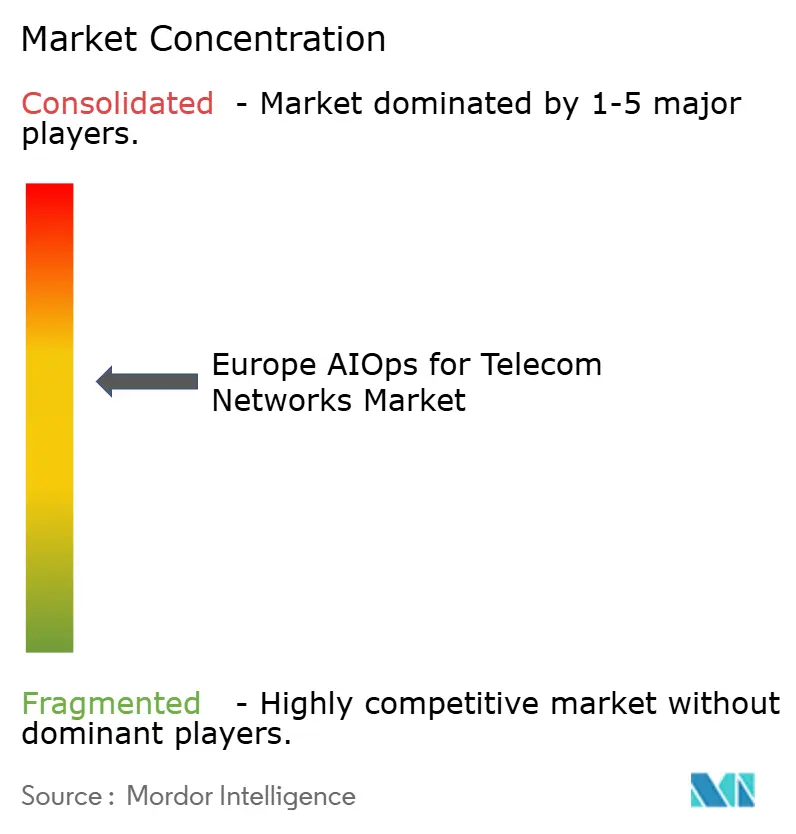
| Market Concentration | Medium |
Major Players *Disclaimer: Major Players sorted in no particular order Image © Mordor Intelligence. Reuse requires attribution under CC BY 4.0. | |
Europe AIOps For Telecom Networks Market Analysis by Mordor Intelligence
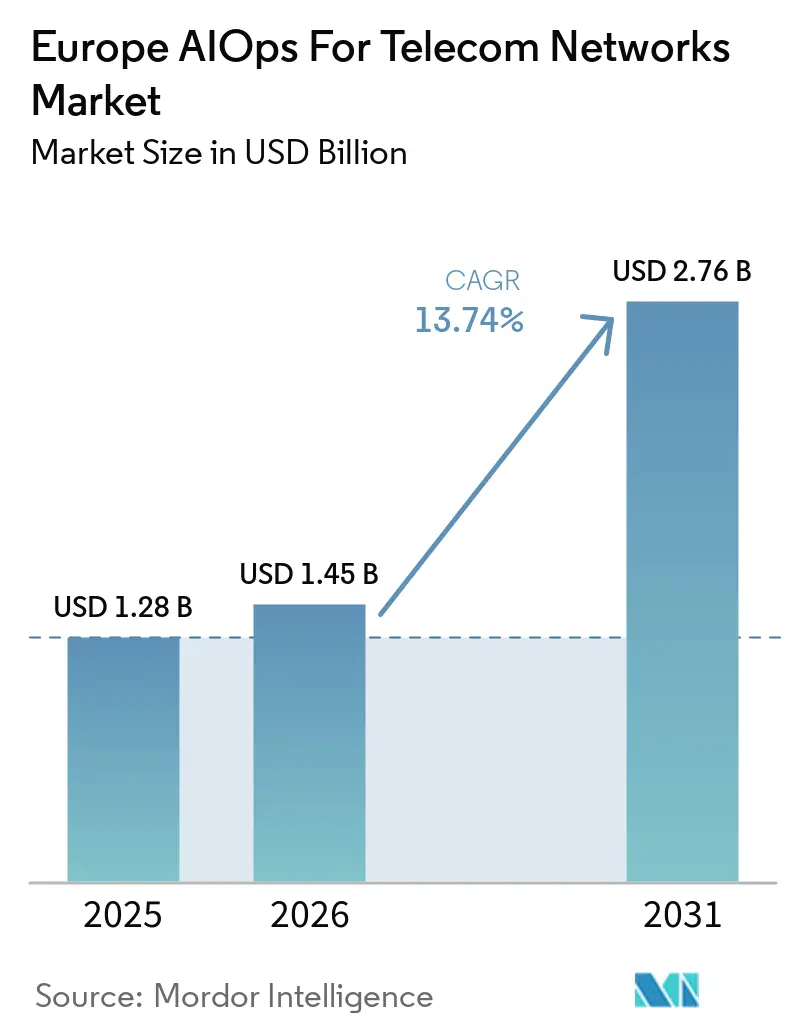
The Europe AIOps for Telecom Networks Market size was valued at USD 1.28 billion in 2025 and is estimated to grow from USD 1.45 billion in 2026 to reach USD 2.76 billion by 2031, at a CAGR of 13.74% during the forecast period (2026-2031). The Europe AIOps for telecom networks market is moving beyond rule-based event correlation toward systems that can diagnose and remediate faults across several network domains. Operators are using these capabilities as 5G networks add more vendors, interfaces, and telemetry streams to daily operations. Investment is also supported by the need to reduce operational costs and shorten the time needed to resolve major network events. TM Forum reported in June 2026 that 75% of surveyed operators planned to increase investment in autonomous networks during 2026, while 20% expected to reach Level 4 autonomy or higher by 2027. The European AIOps for telecom networks market also faces integration and compliance demands that can slow smaller operators, even as automation creates a stronger case for investment across complex European network environments.
Key Report Takeaways
- By offering, platforms held 64.88% of the Europe AIOps for telecom networks market in 2025, while services are projected to expand at a 16.08% CAGR through 2031.
- By deployment model, on-premises accounted for 58.25% of the Europe AIOps for telecom networks market in 2025, while cloud-based deployments are projected to expand at a 17.21% CAGR through 2031.
- By organization size, large enterprises held 78.02% of the European AIOps for telecom networks market in 2025, while small and medium-sized enterprises are expected to expand at a 16.56% CAGR through 2031.
- By application, network performance management held 25.20% of the Europe AIOps for telecom networks market in 2025, while fault and incident management is projected to expand at a 16.40% CAGR through 2031.
- By end-user, mobile network operators held 49.31% of the European AIOps for telecom networks market in 2025, while integrated communication service providers are expected to expand at a 15.29% CAGR through 2031.
- By country, Germany held 22.66% of the Europe AIOps for telecom networks market in 2025, while the United Kingdom is projected to expand at a 14.79% CAGR through 2031.
Note: Market size and forecast figures in this report are generated using Mordor Intelligence’s proprietary estimation framework, updated with the latest available data and insights as of January 2026.
Europe AIOps For Telecom Networks Market Trends and Insights
Drivers Impact Analysis*
| Driver | (~) % Impact on CAGR Forecast | Geographic Relevance | Impact Timeline |
|---|---|---|---|
| 5G and Multi-Vendor Network Complexity | +3.8% | Global, with concentrated early impact in Germany, United Kingdom, and France | Short term (≤ 2 years) |
| Pressure to Reduce Network Operations Costs and Resolution Time | +3.2% | Global, with early gains in Germany, Netherlands, and Nordic operators | Short term (≤ 2 years) |
| Demand for Predictive Network Assurance and Customer Experience Management | +2.5% | Asia-Pacific core, with spillover to Europe and acceleration in the United Kingdom and Spain | Medium term (2-4 years) |
| Expansion of Autonomous Network and Closed-Loop Standards | +1.8% | Global, with European operators leading autonomous network level progress through TM Forum frameworks | Medium term (2-4 years) |
| Telemetry-to-Action Gaps in Disaggregated Open RAN | +1.2% | North America and Europe, including Open RAN trials in Germany and the United Kingdom | Medium term (2-4 years) |
| Energy-Aware Closed-Loop Network Optimization | +0.9% | Europe, with early activity in Germany, the United Kingdom, and France | Long term (≥ 4 years) |
| Source: Mordor Intelligence | |||
5G and Multi-Vendor Network Complexity Accelerates Platform Adoption
The Europe AIOps for telecom networks market is benefiting from 5G standalone deployments, which increase the number of system operators to be managed. A metropolitan 5G radio access network can use separate vendors for radio, distributed, centralized, and core network functions. Each system produces telemetry with different schemas, update cycles, and operational priorities. Older operations support systems were designed for more centralized and single-vendor environments. AIOps platforms can correlate these data streams across network domains and help operators identify related events sooner. O-RAN Alliance specifications, including the E2 interface and xApp framework, provide integration points for third-party applications, although commercial Open RAN deployments still require substantial systems integration for closed-loop control.[1]
Pressure to Reduce Network Operations Costs and Mean Time to Resolution
European telecom operators are prioritizing lower network operating costs as revenue per user remains constrained and 5G expenses rise. Deutsche Telekom launched its RAN Guardian Agent in Germany in November 2025 to support major event management. The company reported that the system reduced major event management time from hours to 1 minute. It also triggered more than 100 remediation actions during Christmas market events in its first production month. These operating outcomes explain that the European AIOps for telecom networks market is attracting attention from operators seeking to reduce manual intervention. NIS2 reporting requirements also underscore the value of prompt fault detection, as affected operators must provide an early warning within 24 hours and a final report within 72 hours.
Demand for Predictive Network Assurance and Customer Experience Management Reshapes Buying Criteria
The European AIOps for telecom networks market is shifting from reactive fault identification toward predictive service assurance. Operators increasingly seek systems that connect radio, transport, core, and application performance with subscriber experience indicators. This approach supports intervention before service degradation becomes apparent to customers. Platforms that explain the relationship between network conditions and subscriber outcomes are likely to receive more attention than tools that only flag anomalies. These requirements are influencing the way vendors prioritize assurance capabilities and customer experience functions.
Expansion of Autonomous Network and Closed-Loop Standards Establishes Demand
TM Forum's autonomous network framework gives operators a common basis for assessing automation maturity. Its assessment validation service had issued nearly 100 certificates to 17 communications service providers after its 2025 launch. The certifications covered Level 2, Level 3, and Level 4 maturity against the open digital architecture standards. At Level 4, systems can make and execute defined operational decisions without individual human approvals.[2] The Europe AIOps for telecom networks market, therefore, favors vendors that support TM Forum Open APIs and O-RAN interfaces as operators formalize their automation road maps.
Restraints Impact Analysis*
| Restraint | (~) % Impact on CAGR Forecast | Geographic Relevance | Impact Timeline |
|---|---|---|---|
| Legacy OSS Data Silos and Integration Complexity | -2.1% | Global, with acute effects in Southern and Eastern Europe because of the older infrastructure | Short term (≤ 2 years) |
| Cybersecurity, Privacy, and AI Governance Requirements | -1.6% | Europe, because of the EU AI Act and NIS2 obligations | Medium term (2-4 years) |
| Model Drift Across Vendor-Specific Network States | -1.0% | Global, Asia-Pacific core, with spillover to the Middle East and Africa | Medium term (2-4 years) |
| Human Accountability for Autonomous Remediation | -0.7% | Global, particularly among regulated essential-service operators | Long term (≥ 4 years) |
| Source: Mordor Intelligence | |||
Legacy OSS Data Silos and Integration Complexity Constrain Cross-Domain AI Effectiveness
Data availability remains a fundamental challenge for the European AIOps market for telecom networks. Many European operators use vendor-specific and domain-isolated management systems developed over 10 to 20 years. These systems were not designed to share telemetry across radio, transport, core, and service layers. Preparing data for AI requires ingestion, normalization, and federation before models can provide dependable results. Incomplete or fragmented telemetry can increase false alarms and observability costs, weakening the operational case for deployment. This burden is greater for mid-sized operators that do not have the integration budgets available to Tier-1 peers, creating a clear difference in adoption capacity.
Cybersecurity, Privacy, and AI Governance Requirements Create Compliance Overhead
The European regulatory environment imposes several overlapping requirements on telecom AIOps systems. The EU AI Act became fully applicable in August 2026 and requires risk classification for AI systems used in critical digital infrastructure. High-risk obligations under Annex III were extended to December 2, 2027, under the AI Digital Omnibus. NIS2 also applies cybersecurity risk management, incident reporting, and accountability requirements to essential electronic communications services. ENISA published technical implementation guidance for NIS2 in June 2025. These rules can lengthen procurement and documentation processes for tools that execute remediation actions without individual approval. Smaller operators and new vendors may face the greatest deployment delays because they have less compliance capacity.[3]
*Our forecasts treat driver/restraint impacts as directional, not additive. The impact forecasts reflect baseline growth, mix effects, and variable interactions.
Segment Analysis
By Offering: Services Adoption Challenges Platform Revenue Dominance
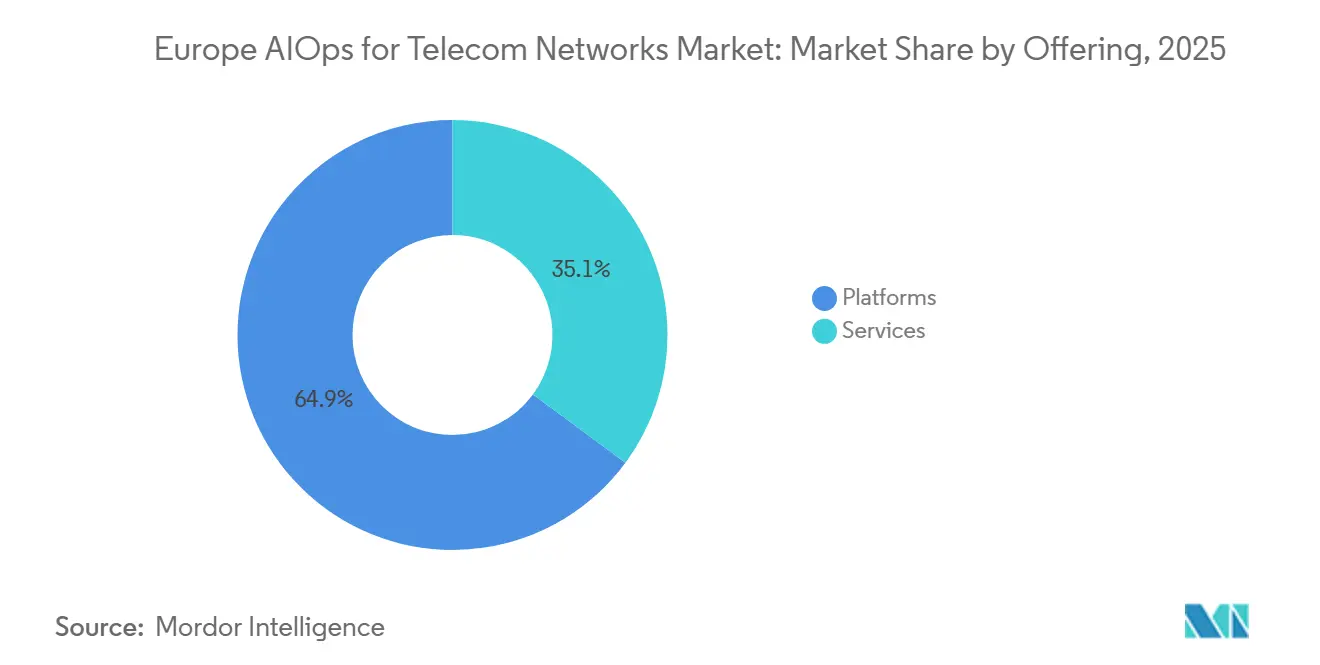
Platforms held 64.88% of the European AIOps for telecom networks market in 2025. Large Tier-1 operators had embedded platform licenses in their operations support systems for several years. These agreements established platforms as core infrastructure for assurance and automation workloads. Services are projected to expand at a 16.08% CAGR through 2031. This rate indicates a stronger demand for managed services, professional services, and systems integration. Regional operators often prefer contracts that transfer implementation responsibility to an experienced provider.
The Europe AIOps for telecom networks market is seeing this preference most clearly in Southern and Eastern Europe. Many operators in these markets have limited in-house AI engineering resources and must manage legacy operations systems at the same time. Outcome-based delivery can reduce the risks associated with a major platform implementation and provide operators with access to specialized integration support. It can also connect implementation work with defined operational outcomes, rather than leaving the operator to assemble separate tools and services. Nokia introduced Autonomous Network Fabric in 2025 and expanded cloud delivery options with Google Cloud.[4] It shows that vendors are combining software platforms with operational services rather than presenting them as separate choices. For the European AIOps for telecom networks market, this delivery approach can make adoption practical where operators need technical support alongside automation software.
By Deployment Model: Cloud Delivery Gains Ground on On-Premises Incumbency
On-Premises deployments accounted for 58.25% of the Europe AIOps for telecom networks market size in 2025. Data sovereignty requirements have supported this position among European Tier-1 operators. Certain closed-loop radio functions also require very low latency, which public cloud endpoints may not consistently provide. Cloud-Based deployments are projected to expand at a 17.21% CAGR through 2031. The fastest progress is occurring in non-real-time network analytics, planning, customer experience, and energy management functions.
Public cloud environments provide scalable computing resources and prebuilt AI tools for these less time-sensitive use cases. Nokia scheduled its Assurance Center as a software-as-a-service offering on Google Cloud Marketplace for September 2026. Ericsson launched Agentic rApp as a Service on AWS Marketplace in February 2026. Both offerings show that established telecom suppliers view cloud delivery as an important route for new deployments. At the same time, EU AI Act obligations and NIS2 data-residency expectations are supporting hybrid and sovereign cloud designs. These designs allow workloads to operate closer to network data while retaining some benefits of cloud deployment. This balance matters in the European AIOps for telecom networks market because real-time control requirements vary significantly across network functions and operator environments.
By Organization Size: Smaller Operators Broaden the Addressable Base
Large Enterprises accounted for 78.02% of revenue in 2025. Tier-1 mobile operators and national incumbents had the budget and engineering capacity for complex deployments. Small and Medium-Sized Enterprises are expected to expand at a 16.56% CAGR through 2031. Software-as-a-service and managed service models reduce the barriers to entry for regional carriers and wholesale operators. The change expands the European AIOps for telecom networks market beyond the largest communications providers.
API-first architectures and low-code configuration tools can make deployments more accessible for smaller operators. Per-use commercial models can also avoid the long implementation programs associated with earlier Tier-1 projects. Emerging neutral host providers often begin with leaner cloud-native architectures. These environments can be more suitable for automation from the start because their systems have fewer inherent integration constraints. The Europe AIOps for telecom networks market can therefore draw demand from operators that need usable operational automation without having to build a large internal AI team.
By Application: Fault Management Narrows the Gap With Performance Monitoring
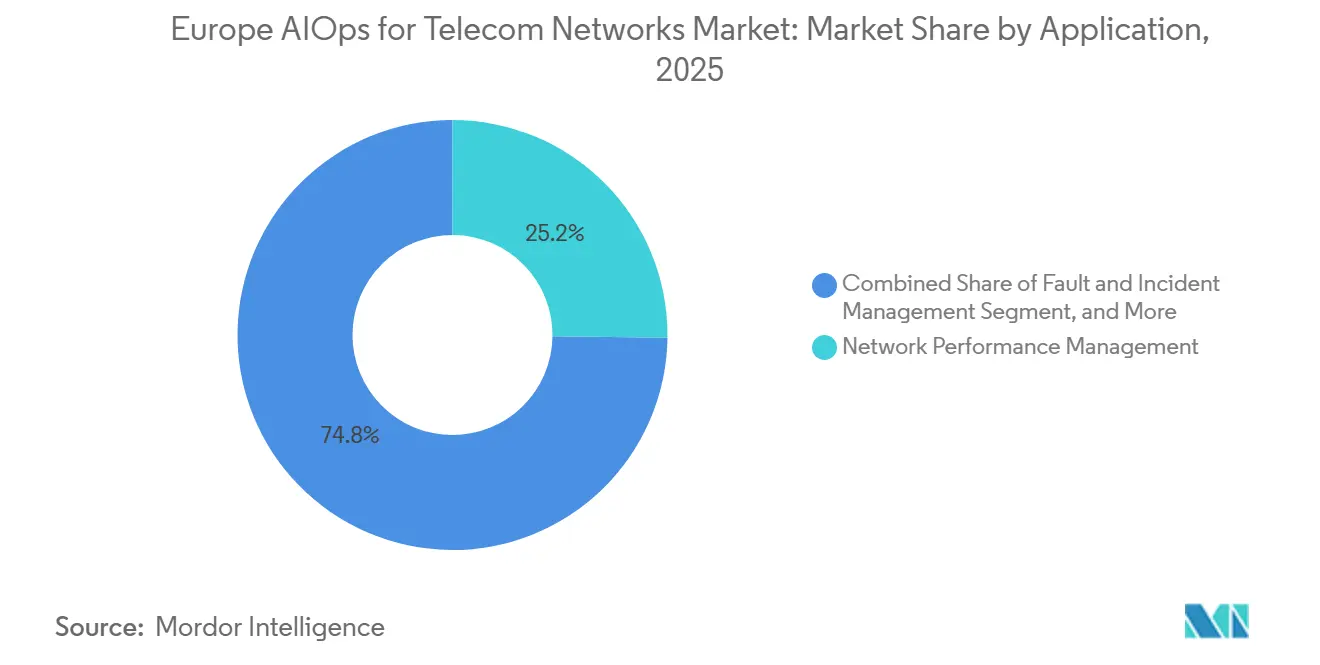
Network Performance Management accounted for 25.20% of revenue in 2025. This application benefited from established monitoring tools across 4G and early 5G networks. Fault and Incident Management is projected to expand at a 16.40% CAGR through 2031. Operators are placing more value on systems that can fix defined issues rather than only report them. The Europe AIOps for telecom networks market is therefore extending from visibility toward closed-loop operations.
Nokia stated that its closed-loop systems resolved 40% of incidents automatically. TM Forum's Catalyst C26.0.995 demonstrator reported more than 90% accuracy in alarm auto-diagnosis and fault localization. It also reported a 25% reduction in mean time to repair. Customer Experience Management is gaining relevance as operators relate assurance data to subscriber retention and service-quality commitments. Network Security Management, Infrastructure Management, and Application Performance Analysis remain smaller but expanding applications. Energy optimization and slice assurance are also emerging as distinct spending areas as energy requirements grow in importance. This wider use pattern means the European AIOps for telecom networks market is serving more stages of the operational lifecycle, not only traditional performance monitoring.

By End-User: Integrated Providers Increase Cross-Domain Demand
Mobile Network Operators held 49.31% revenue share in 2025. Their early 5G investments and larger network scale required more continuous assurance and automation. Fixed and Broadband Operators are also increasing their requirements as fiber programs add active infrastructure across the United Kingdom, France, Germany, and Spain. Integrated Communication Service Providers are expected to expand at a 15.29% CAGR through 2031. Their converged fixed and mobile networks create data across more operating domains.
The resulting operational complexity makes cross-domain correlation more important for integrated providers. ServiceNow and Vodafone Business began a 5-year collaboration in April 2025, covering AI-powered service management. ServiceNow also expanded its work with Google Cloud for autonomous enterprise operations during 2026. These initiatives target unified service assurance, service operations, and network inventory processes. Neutral host providers and satellite-terrestrial hybrid operators represent a smaller emerging group. Their relevance should increase as private 5G networks extend into campuses and industrial sites. These end users broaden the European AIOps for telecom networks market beyond conventional national mobile networks and introduce additional service-assurance needs.
Geography Analysis
Germany held 22.66% of regional revenue in 2025. Its Tier-1 operators have advanced deployments of AI-based diagnostic and remediation tools. The country also has a dense enterprise 5G base that produces substantial telemetry requiring ongoing assurance. Deutsche Telekom and Google Cloud announced MINDR in February 2026 for diagnostics and operations across radio, transport, and core domains. The system was built on Deutsche Telekom's earlier RAN Guardian Agent deployment. Deutsche Telekom stated that RAN Guardian reduced major event management time from hours to 1 minute.
The United Kingdom is projected to expand at a 14.79% CAGR through 2031. Fiber rollout, Open RAN trials, and enterprise technology budgets are supporting demand for network assurance. These conditions create more multi-vendor data that operators must interpret quickly. The Europe AIOps for telecom networks market in the United Kingdom also benefits from the financial case for AI-assisted network rollout.
Spain, Italy, and the rest of Europe remain at earlier stages of adoption but contribute to regional demand. Italy is developing alongside fiber investment and greater use of cloud-native BSS and OSS systems. Nordic markets, the Netherlands, Poland, and Central and Eastern Europe are becoming more relevant as Open RAN expands. New spectrum allocations and tower-sharing agreements support disaggregated architectures in several of these markets. National cybersecurity frameworks and NIS2 implementation can favor providers with local regulatory knowledge.
Competitive Landscape
The European AIOps for telecom networks market is moderately concentrated at the platform level. Nokia, Ericsson, Amdocs, and Netcracker Technology have established advantages because of their existing OSS relationships. Incumbents are repositioning AIOps tools to support multi-agent orchestration and closed-loop operations. Their stated focus is alignment with TM Forum Autonomous Network Level 3 and Level 4 objectives. This positioning helps vendors link automation features with operator maturity plans.
Nokia and Google Cloud expanded their partnership in June 2026 to embed Gemini-powered agents into Nokia Assurance Center. The program included 6 agents for event triage, anomaly reasoning, KPI selection, root cause analysis, action recommendations, and dashboards. Ericsson introduced Agentic rApp as a Service in February 2026 to support network optimization. Amdocs launched CES26 and its aOS Cognitive Core at MWC 2026. These actions show competition centered on cloud-delivered agentic functions layered over established network platforms.
Mid-sized operators in Southern, Central, and Eastern Europe remain targets for lighter SaaS offerings. These operators may seek shorter deployment cycles and lower integration requirements than Tier-1 buyers. RADCOM, MyCom OSI, and Comarch have regional operator relationships that support this position. Dynatrace and ServiceNow also expanded their collaboration in October 2025 to support autonomous IT operations. Their presence extends cross-industry observability capabilities into telecom-adjacent service operations. TM Forum and O-RAN standards reduce proprietary barriers by defining common control-loop and interface requirements.
Europe AIOps For Telecom Networks Industry Leaders
-
Nokia Corporation
-
Telefonaktiebolaget LM Ericsson
-
Amdocs Limited
-
Netcracker Technology Corporation
-
Comarch S.A.
- *Disclaimer: Major Players sorted in no particular order
Recent Industry Developments
- June 2026: Nokia and Google Cloud announced an expanded partnership to embed Google's Gemini models into Nokia Assurance Center. The initiative included 6 specialized AI agents for network operations. Nokia scheduled the SaaS offering for Google Cloud Marketplace in September 2026, with 2 initial agents and 4 additional agents planned through 2027.
- March 2026: Amdocs unveiled CES26, an agent-driven BSS-OSS-network suite powered by the aOS Cognitive Core, at MWC 2026 in Barcelona. The company also announced the commercial launch of Vodafone Germany's multi-year transformation, including autonomous operations capabilities. Amdocs positioned aOS to integrate with existing OSS stacks across more than 100 communications service providers.
- February 2026: Deutsche Telekom and Google Cloud announced MINDR, a multi-agent AI system for autonomous diagnostics and operations across radio, transport, and core domains. MINDR extended the RAN Guardian Agent, which had reduced major event management time from hours to 1 minute after its November 2025 launch in Germany.
- February 2026: Wind River and Vodafone announced a collaboration for AI-RAN operations in Open RAN networks at MWC Barcelona. The solution ingests more than 70 TB of network data each week across radio and cloud layers. It is intended to identify deviations and guide remediation before customer experience is affected.
Europe AIOps For Telecom Networks Market Report Scope
The Europe AIOps for telecom networks market revenue is generated through platform licensing and subscriptions, AI/analytics software usage, consulting and system integration, deployment, managed services, maintenance, and support provided to mobile network operators, fixed and broadband operators, integrated communication service providers, and other telecom end users across large enterprises and small and medium-sized enterprises in the region.
The Europe AIOps for telecom networks market report is segmented by offering (platforms and services), deployment model (on-premises and cloud-based), organization size (large enterprises, and small and medium-sized enterprises), application (network performance management, fault and incident management, network security management, customer experience management, infrastructure management, application performance analysis, and other applications), end-user (mobile network operators, fixed and broadband operators, integrated communication service providers, and other end-users), and country (United Kingdom, Germany, France, Spain, Italy, and rest of Europe). The market forecasts are provided in terms of value (USD).
| Platforms |
| Services |
| On-Premises |
| Cloud-Based |
| Large Enterprises |
| Small and Medium-Sized Enterprises |
| Network Performance Management |
| Fault and Incident Management |
| Network Security Management |
| Customer Experience Management |
| Infrastructure Management |
| Application Performance Analysis |
| Other Applications |
| Mobile Network Operators |
| Fixed and Broadband Operators |
| Integrated Communication Service Providers |
| Other End-Users |
| United Kingdom |
| Germany |
| France |
| Spain |
| Italy |
| Rest of Europe |
| By Offering | Platforms |
| Services | |
| By Deployment Model | On-Premises |
| Cloud-Based | |
| By Organization Size | Large Enterprises |
| Small and Medium-Sized Enterprises | |
| By Application | Network Performance Management |
| Fault and Incident Management | |
| Network Security Management | |
| Customer Experience Management | |
| Infrastructure Management | |
| Application Performance Analysis | |
| Other Applications | |
| By End-User | Mobile Network Operators |
| Fixed and Broadband Operators | |
| Integrated Communication Service Providers | |
| Other End-Users | |
| By Country | United Kingdom |
| Germany | |
| France | |
| Spain | |
| Italy | |
| Rest of Europe |
Key Questions Answered in the Report
What is the size of the Europe AIOps for telecom networks market?
The market size is estimated at USD 1.45 billion in 2026 and is projected to reach USD 2.76 billion by 2031, at a 13.74% CAGR.
What is driving AIOps adoption among European telecom operators?
5G complexity, multi-vendor data, lower operations costs, and faster fault resolution are supporting adoption.
Which offering is expanding fastest in Europe?
Services is projected to expand at a 16.08% CAGR through 2031, ahead of Platforms.
Which deployment model has the highest projected rate?
Cloud-Based deployment is projected to expand at a 17.21% CAGR through 2031.
Which application is expected to expand fastest?
Fault and Incident Management is projected to expand at a 16.40% CAGR through 2031.
Which country leads European demand?
Germany held 22.66% revenue share in 2025, while the United Kingdom is projected to expand at a 14.79% CAGR.