
Market Overview
| Study Period | 2020 - 2031 |
|---|---|
| Forecast Data Period | 2026 - 2031 |
| Historical Data Period | 2020 - 2024 |
| Market Size (2026) | USD 2.63 Billion |
| Market Size (2031) | USD 3.54 Billion |
| Growth Rate (2026 - 2031) | 6.12 % |
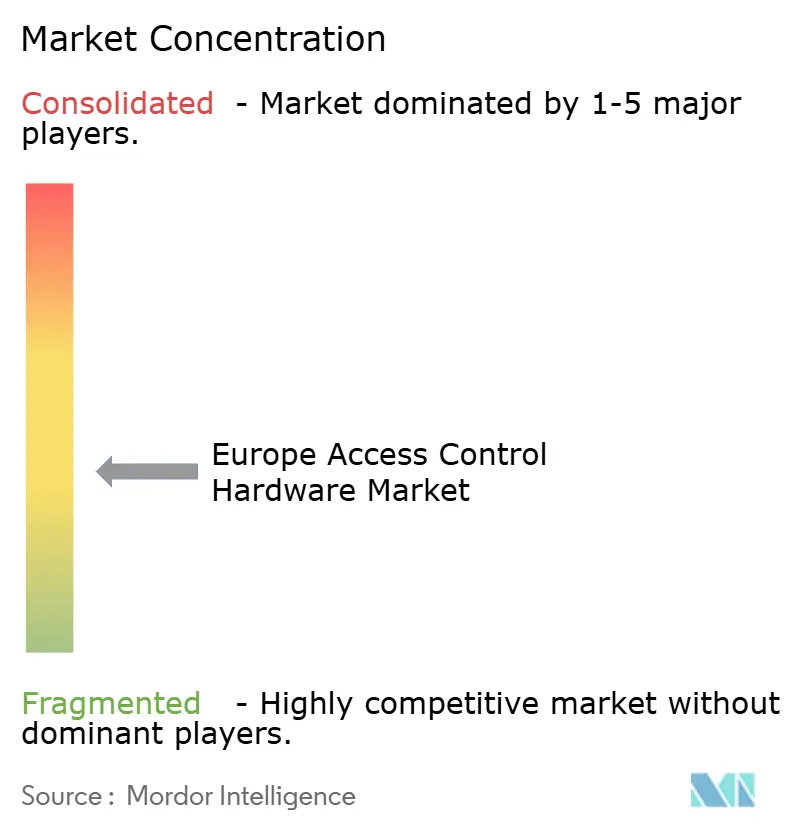
| Market Concentration | Medium |
Major Players *Disclaimer: Major Players sorted in no particular order Image © Mordor Intelligence. Reuse requires attribution under CC BY 4.0. | |
Europe Access Control Hardware Market Analysis by Mordor Intelligence
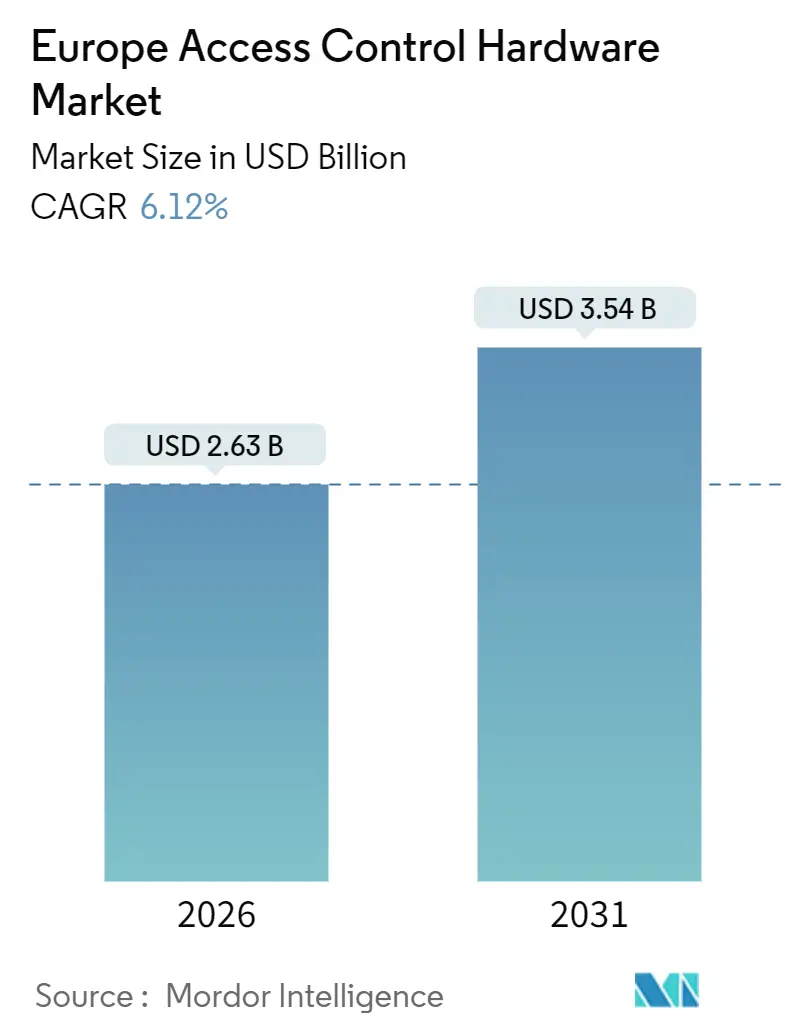
The Europe Access Control Hardware Market size is estimated at USD 2.63 billion in 2026, and is expected to reach USD 3.54 billion by 2031, at a CAGR of 6.12% during the forecast period (2026-2031).
Electronic and smart locks remain the anchor category, yet rapid gains in biometric readers and cloud-native controllers are steadily shifting revenue mixes. Adoption accelerators include the Energy Performance of Buildings Directive 2024/1275, which compels building automation roll-outs, and the widening preference for mobile credentials that remove plastic card provisioning. Germany’s federal modernization stimulus, Spain’s national renovation wave, and record investments in counter-terrorism infrastructure add further momentum. Competitive rivalry is sharpening as incumbents acquire digital specialists and challengers deploy subscription-based Access Control as a Service offerings, while lingering semiconductor shortages and legacy retrofit complexities temper near-term upside.
Key Report Takeaways
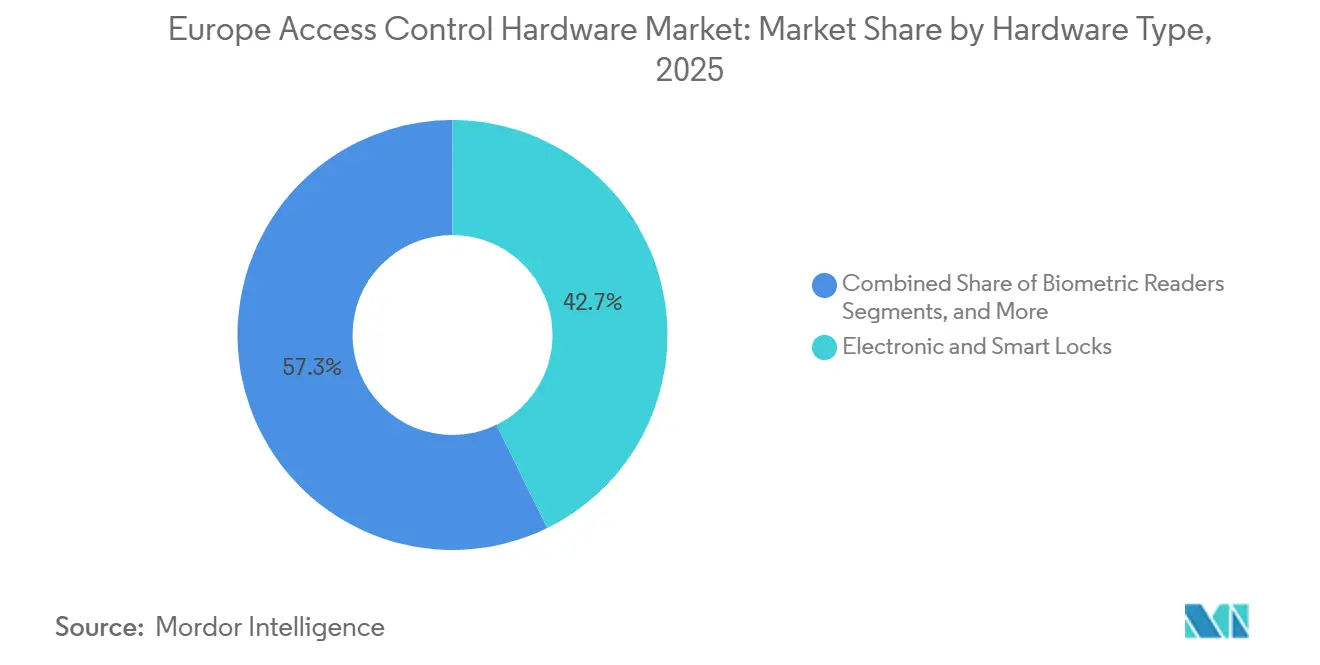
- By hardware type, electronic and smart locks led with 42.73% revenue share in 2025; biometric readers are expanding at an 8.03% CAGR through 2031.
- By authentication technology, RFID and NFC held 37.53% share of the Europe access control hardware market size in 2025, while Bluetooth Low Energy is advancing at a 7.67% CAGR through 2031.
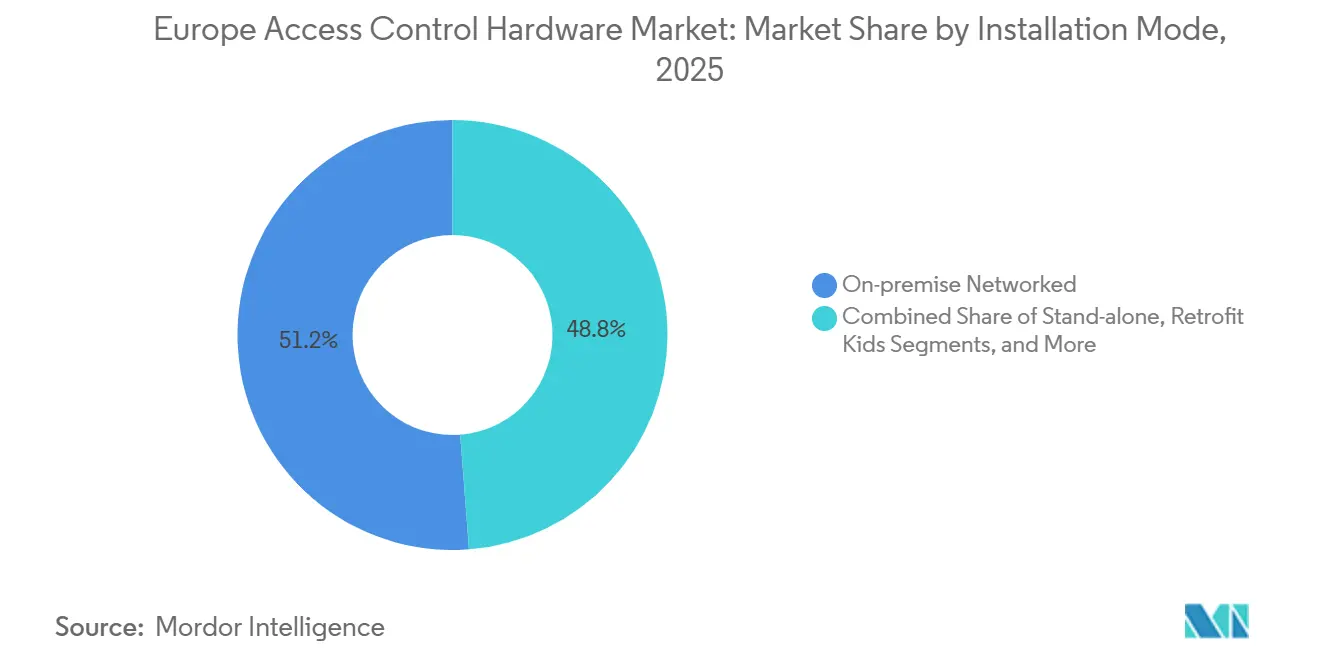
- By installation mode, on-premise networked systems retained 51.22% share in 2025; cloud Access Control as a Service platforms post the highest projected 8.55% CAGR to 2031.
- By end-user vertical, commercial offices accounted for 29.31% share of the Europe access control hardware market in 2025, whereas healthcare is forecast to grow at 7.17% CAGR.
- By geography, Germany commanded 25.86% revenue share in 2025; Spain is the fastest-growing country with a 6.93% CAGR through 2031.
Note: Market size and forecast figures in this report are generated using Mordor Intelligence’s proprietary estimation framework, updated with the latest available data and insights as of January 2026.
Market Trends and Insights
Drivers Impact Analysis of Europe Access Control Hardware Market*
| Driver | (~)% Impact on CAGR Forecast | Geographic Relevance | Impact Timeline |
|---|---|---|---|
| Growing Adoption Amid Rising Crime and Terrorism Threats | +1.2% | United Kingdom, France, Germany | Short term (≤ 2 years) |
| Rapid Shift to Mobile-Credential and Cloud-Native Systems | +1.8% | Germany, United Kingdom, Spain | Medium term (2-4 years) |
| EU Green-Building Retrofits Driving Smart-Lock Demand | +1.5% | Spain, Germany, France, Italy | Long term (≥ 4 years) |
| GDPR-Driven Need for Privacy-Preserving Hardware | +0.9% | European Union (all member states) | Medium term (2-4 years) |
| Digital ID/eIDAS 2.0 Enabling Biometric Access Use-Cases | +0.7% | Germany, France, Spain, Italy | Long term (≥ 4 years) |
| Edge-AI Readers Lowering TCO and Latency | +0.6% | Germany, United Kingdom, France | Medium term (2-4 years) |
| Source: Mordor Intelligence | |||
Rapid Shift to Mobile-Credential and Cloud-Native Systems
Wireless deployments overtook wired installations for the first time in 2025, with mobile credentials hitting 17%, triple their 2023 level. By 2027, nine in ten enterprises are expected to satisfy multi-factor authentication requirements through native cloud platforms that trim total cost of ownership by 40%. Europe’s 30% 5G penetration, coupled with RedCap connectivity, lets battery-powered locks export real-time logs while consuming under 1 watt.[1]GSMA, “Mobile Economy Europe 2025,” GSMA.com Subscription models that convert capital expenses into operating budgets are boosting adoption across small and medium-sized enterprises, while sustainability goals are accelerating the retirement of PVC cards that generate 2.5 kilograms of waste per 1,000 credentials.
EU Green-Building Retrofits Driving Smart-Lock Demand
Directive 2024/1275 obligates automation and control systems in non-residential facilities with HVAC capacity above 290 kilowatts by 2029, positioning interoperable locks as compliance enablers. Spain intends to refurbish 1.2 million structures by 2030, embedding networked access control within its digital readiness index. Germany earmarked EUR 2.5 billion (USD 2.75 billion) for public-sector modernizations that pair electronic locks with occupancy-driven HVAC scheduling. Complementary incentives such as Italy’s 65% Superbonus credit and the United Kingdom’s Public Sector Decarbonisation Scheme (GBP 1.8 billion, USD 2.27 billion) sustain demand for IP-enabled hardware that feeds energy dashboards.
GDPR-Driven Need for Privacy-Preserving Hardware
Enforcement actions involving biometric data rose 22% in 2024, pushing healthcare and public agencies toward readers that store templates on-device under match-on-card architectures.[2]European Data Protection Board, “GDPR Enforcement Tracker 2024,” EDPB.europa.eu NXP’s SE051 and SE052 secure elements, certified to Common Criteria EAL6+ and FIPS 140-3 Level 3, perform local matching and keep vectors off the network. The eIDAS 2.0 framework obliges every member state to issue digital identity wallets by 2026, fueling demand for panels that ingest cryptographic credentials via NFC. Hospitals increasingly deploy multimodal biometrics that fuse iris recognition with PIN entry, satisfying audit-trail requirements while maintaining sub-200-millisecond latency.
Growing Adoption Amid Rising Crime and Terrorism Threats
The United Kingdom dedicated GBP 3 billion (USD 3.78 billion) to counter-terrorism upgrades, prioritizing secure entry at transportation hubs and energy plants. France’s protracted Vigipirate alert, combined with Eurostat’s report of 5.3 million offenses in Germany, is steering budgets toward IP-connected panels with tamper-evident housings. Commercial offices retrofit mechanical cylinders with electronic locks that integrate video feeds, creating forensic logs that insurers reward with 15-20% premium cuts. Government and defense agencies, which accounted for 18% of shipments in 2025, now specify NATO SDIP-27-compliant encryption as standard.
Restraints Impact Analysis of Europe Access Control Hardware Market*
| Restraint | (~)% Impact on CAGR Forecast | Geographic Relevance | Impact Timeline |
|---|---|---|---|
| High Upfront Capex for Multi-Factor, Cyber-Secure Systems | -1.1% | Germany, France, United Kingdom | Short term (≤ 2 years) |
| Legacy-System Integration Complexity Across EU Property Stock | -0.9% | Italy, Spain, France | Medium term (2-4 years) |
| Supply-Chain Chip Shortages Causing Hardware Lead-Times | -0.6% | European Union (all member states) | Short term (≤ 2 years) |
| Energy-Price Spikes Raising Total Cost of Ownership | -0.5% | Germany, United Kingdom, Spain | Medium term (2-4 years) |
| Source: Mordor Intelligence | |||
High Upfront Capex for Multi-Factor, Cyber-Secure Systems
Multi-factor panels that bundle secure elements and encrypted modules cost 60-80% more than single-factor readers, straining small business budgets.[3]Schneider Electric, “EcoStruxure Building Case Studies 2024,” SE.com Cloud ACaaS platforms can lower five-year costs by 40%, yet entrance fees of USD 150-250 per door still deter multisite roll-outs. Biometric readers certified to EAL6+ cost more than USD 800 per unit, compared with USD 120 for basic RFID alternatives, extending payback periods beyond three years. Elevated power tariffs of EUR 0.15-0.20 per kWh (USD 0.16-0.22) inflate operating costs over the decade, as energy accounts for up to 70% of system life-cycle expenses.
Legacy-System Integration Complexity Across EU Property Stock
Three in four European commercial buildings predate 2000 and lack the structured cabling or IP backbones required for modern controllers, forcing costly retrofits that run 30-40% above greenfield equivalents. Masonry walls in historic Italian and Spanish assets attenuate RF signals, prompting the addition of mesh repeaters at a cost of USD 200-300 per node. Proprietary Wiegand protocols necessitate parallel infrastructure during phase-outs, effectively doubling hardware outlays until migration completes. Vendor lock-in challenges persist, with switch-overs to open architectures costing mid-sized facilities USD 50,000-150,000 due to credential re-enrollment labor.
*Our forecasts treat driver/restraint impacts as directional, not additive. The impact forecasts reflect baseline growth, mix effects, and variable interactions.
Europe Access Control Hardware Market Segment Analysis
By Hardware Type:
Electronic Locks Dominate While Biometrics AccelerateElectronic and smart locks held 42.73% of the Europe access control hardware market share in 2025, supported by ease of installation in retrofit apartments and commercial suites. Biometric readers, although smaller in base, are projected to register an 8.03% CAGR through 2031 as GDPR-compliant healthcare and public facilities adopt iris and fingerprint systems that keep templates on-device. Card readers persist in legacy estates, yet sustainability requirements and digital wallet roll-outs are eroding their relevance. Controllers now embed edge processors that complete matching in under 200 milliseconds, mitigating bandwidth use and data privacy risks. By 2029, NFC-enabled panels capable of ingesting eIDAS credentials are expected to displace 60% of non-compliant units still operating in the field.
Second-generation smart locks also integrate occupancy sensors to optimize HVAC systems. This cross-link between security and energy savings bolsters business cases in public retrofits funded by Germany’s Federal Building Modernization Program. Equally, modular designs that accept plug-in BLE or Wi-Fi radios let facility managers adopt new credentials without swapping entire units, lengthening asset obsolescence cycles. Price competition heats as challengers introduce stand-alone smart cylinders for under USD 120, contrasted with USD 800 plus for multimodal biometric stations certified to EAL6+. Edge-computing upgrades nevertheless command premiums among defense users following NATO SDIP-27 encryption mandates.



By Authentication Technology:
BLE Challenges RFID IncumbencyRFID and NFC maintained a 37.53% revenue stake in 2025, leveraging entrenched card ecosystems and solid 10-meter read ranges favored in logistics yards. Bluetooth Low Energy, however, is projected to log a 7.67% CAGR as smartphone-based credentials shrink provisioning costs and let administrators revoke access within seconds. Wi-Fi and IP readers serve organizations seeking unified network management, but their 3-5 watt draw clashes with Directive 2024/1275 energy benchmarks. Multimodal biometrics merge iris and vein scans for high-security applications, and uptake is bolstered by the 22% rise in GDPR enforcement cases involving centralized biometric storage.
Recent firmware enables BLE locks to drop consumption below 1 watt, aided by Europe’s 30% 5G penetration, which supports low-power RedCap uplinks. Although RFID dominates at transportation nodes, BLE’s rising share in commercial offices and apartments signals a decisive shift toward plastic-free credentials. Ultra-wideband positioning emerges as a hybrid solution for sub-meter precision when RFID read ranges fall short, especially in warehouses that need real-time asset tracing.
By Installation Mode:
Cloud Growth Outpaces On-Premise PreferencesOn-premises networked systems still account for 51.22% of shipments due to air-gap strategies at critical infrastructure and defense sites. Nevertheless, cloud ACaaS options are forecast to record an 8.55% CAGR, the swiftest among installation modes, as enterprises chase subscription models that sidestep upfront controller purchases and enable remote firmware pushes. Stand-alone smart locks cater to small retailers, but the lack of centralized logs limits adoption in SOX-governed or ISO 27001-audited domains. Retrofit kits, often battery-powered cylinders, gain popularity amid Spain’s renovation drive, where 1.2 million buildings seek cost-effective digital upgrades by 2030.
Hybrid topologies that pair local controllers with cloud dashboards are gaining favor because they preserve offline resiliency while granting remote analytics. Gartner expects 90% of organizations to implement MFA via native cloud platforms by 2027, resulting in 40% lower total costs than token servers. Even conservative utilities are now piloting cloud consoles that export only audit metadata, keeping credential stores on-site to minimize attack surfaces.
By End-User Vertical:
Healthcare Surges Ahead of Commercial OfficesCommercial offices generated 29.31% of 2025 shipments, buoyed by flexible work models that rely on smartphone credentials for hot-desking and visitor flows. Healthcare is anticipated to expand at a 7.17% CAGR through 2031, the fastest among verticals, driven by eIDAS-aligned mandates for securing pharmaceutical vaults and patient databases with multimodal biometrics. Residential multi-dwelling units upgrade to BLE locks integrated with property-management software, enabling one-time codes for deliveries without physical keys. Government and defense sectors demand EAL6+ certified readers and encrypted comms, capturing 18% of unit volumes last year.
Transportation and logistics nodes deploy vehicle-mounted RFID gates with 10-meter reach, though ultra-wideband pilots promise centimeter-level positioning for cargo tracking. Insurers now discount premiums for commercial landlords that implement IP locks combined with video verification, reinforcing buy-in across Europe access control hardware market stakeholders seeking operational and financial efficiencies.
Geography Analysis
Germany and United Kingdom Access Control Hardware Market
Germany generated 25.86% of regional revenue in 2025, propelled by EUR 2.5 billion (USD 2.75 billion) in federal modernization grants that bundle electronic locks with energy dashboards. The country’s high cybercrime rate drives the adoption of encrypted audit panels, and small businesses gravitate toward cloud services to avoid capital burdens. The United Kingdom’s GBP 3 billion (USD 3.78 billion) counter-terrorism funding has fast-tracked biometric retrofits in rail hubs and government suites, while the GBP 1.8 billion (USD 2.27 billion) Public Sector Decarbonisation Scheme finances locks that feed occupancy data into heating management systems.
Europe Access Control Hardware Market
France, under continuous Vigipirate alert, channels both public and private spending into multi-factor upgrades for high-security zones. Spain stands out with a 6.93% CAGR to 2031 as its ambition to refurbish 1.2 million buildings unlocks mass deployment of retrofit kits that reuse existing door hardware. Italy’s heritage building stock poses radio-frequency challenges, yet the 65% Superbonus tax credit keeps residential adoption buoyant.
Broader European Markets
Across the five leading markets, eIDAS 2.0 is driving demand for NFC-ready panels capable of validating state-issued digital identities. Germany and the United Kingdom already top the Europe access control hardware market in mobile-credential penetration at 17%, underscoring rapid technological convergence across disparate regulatory and economic contexts.
Regulatory Landscape
Europe access control hardware is shaped by converging building, privacy, and cybersecurity rules that increasingly treat connected readers, controllers, and smart locks as products with digital elements. At the system level, the EN 60839 family (notably EN 60839-11-1 and EN 60839-11-2) remains a core technical reference for electronic access control system requirements and application guidance. Separately, the Energy Performance of Buildings Directive 2024/1275 supports building automation deployments where interoperable access devices can feed occupancy and audit data into energy management.
Cybersecurity requirements are tightening across both operator and product layers. NIS2 (Directive (EU) 2022/2555) and Implementing Regulation (EU) 2024/2690 reinforce risk-management expectations for entities, including topic-specific access control policies within broader network and information security governance. For manufacturers, the Cyber Resilience Act (Regulation (EU) 2024/2847) introduces horizontal security-by-design and lifecycle requirements for products with digital elements, with compliance duties applying by December 11, 2027. ENISA-backed EUCC cybersecurity certification (updated in December 2025) also offers a voluntary path that procurement teams can use as an assurance signal for higher-assurance deployments.
Value Chain Analysis
The value chain spans upstream electronic components and mechanical subassemblies to OEM device manufacturing, followed by downstream distribution, installation, and lifecycle services. Key inputs include microcontrollers and secure elements for credential processing, RF components for RFID/NFC and BLE, and electromechanical parts such as magnets and motors for smart locks. Hardware delivery schedules are influenced by chip lead-times and the availability of security-grade components. On the manufacturing side, vendors increasingly pair hardware with embedded firmware, secure update mechanisms, and cryptographic identity handling to align with GDPR-driven privacy requirements and the Cyber Resilience Act (Regulation (EU) 2024/2847) obligations for products with digital elements.
In midstream activities, European specialists and incumbents assemble readers, controllers, and locks and route them through distributors, security installers, and system integrators that manage retrofit complexity across older building stock. Companies such as STid (RFID/NFC/Bluetooth) and Vauban Systems (integrated physical access control) illustrate the role of regional suppliers in delivering interoperable devices and integration tooling. Cloud-native controller architectures also shift more value toward software provisioning, credential lifecycle management, and remote firmware maintenance, delivered via integrators and ACaaS platforms. Downstream, enterprise and public-sector buyers increasingly request security assurance artifacts, including alignment with EUCC/Common Criteria practices, alongside documentation that supports NIS2-oriented risk management and audit trails.
Competitive Landscape
The European access control hardware industry shows moderate concentration: Dormakaba, Allegion, Honeywell, and Johnson Controls collectively held roughly a 45-50% share in 2025. ASSA ABLOY’s USD 4.3 billion takeover of Spectrum Brands Hardware and Home Improvement in October 2024 broadened its smart-lock range and accelerated the diffusion of mobile credentials. Dormakaba’s Bluetooth-ready Kaba evolo cylinder and Allegion’s cloud-integrated Schlage Control line illustrate incumbent strategies to fuse hardware with SaaS platforms.
NXP’s SE051 and SE052 secure elements underpin biometric readers from multiple OEMs, enabling match-on-card processing that satisfies GDPR data-minimization rules. Honeywell and Johnson Controls push edge-computing panels that slash power draw by 25%, aiming to curb ownership costs elevated by stubborn European electricity prices.
Disruptors such as Brivo and Genetec tilt toward subscription pricing and API-first ecosystems, bypassing conventional distributor networks. Their cloud-native stance resonates with commercial real estate and residential portfolios seeking centralized policy engines. As eIDAS 2.0 mandates NFC wallet acceptance by 2026, vendors must retrofit 60% of the installed base, intensifying the race to deliver modular, field-upgradeable readers that protect end-user investments.
Europe Access Control Hardware Industry Leaders
ASSA ABLOY AB
Dormakaba Holding AG
Allegion Plc
Honeywell International Inc.
Johnson Controls International plc
- *Disclaimer: Major Players sorted in no particular order
Europe Access Control Hardware Market Companies Covered in this Report
- ASSA ABLOY AB
- Dormakaba Holding AG
- Allegion plc
- Honeywell International Inc.
- Johnson Controls International plc
- Robert Bosch GmbH (Bosch Security Systems)
- Schneider Electric SE
- Axis Communications AB
- Nedap N.V.
- Identiv Inc.
- IDEMIA Group SAS
- NEC Corporation
- Suprema Inc.
- SALTO Systems S.L.
- Paxton Access Ltd.
- Genetec Inc.
- Gallagher Group Ltd.
- Brivo Inc.
- HID Global Corporation
- Axis Communications AB

Market Opportunities and Future Outlook
Security-by-design and high-assurance compliance create a clear whitespace for differentiated hardware that reduces rip-and-replace in regulated sites. In France, HID Global introduced the M1 Transparent Gateway (February 2026) to support ANSSI transparent architecture requirements while preserving existing PACS infrastructure. This highlights demand for gateway and controller-layer products that retrofit stronger cryptographic separation and policy enforcement into installed bases. In parallel, Genetec secured ANSSI recognition for its Synergis access control system (June 2026), reinforcing the procurement value of nationally recognized qualification in critical infrastructure and government-linked projects.
Digital identity, mobile credentials, and durability-focused retrofit programs add further opportunity pockets across Europe’s fragmented property stock. With eIDAS 2.0 pushing member-state digital identity wallets by 2026, vendors face growing demand for NFC-ready readers and controllers that can validate cryptographic credentials. CEN-CENELEC’s February 2026 workshop on Cyber Resilience Act standards for identity management systems also signals active standardization work that vendors can translate into compliant device roadmaps. On the hardware side, Salto Systems expanded its portfolio with heavy-duty XS4 Original+ and XS4 One S smart locks (June 2026) featuring EN 16867 attack-resistance positioning, targeting transport, education, and high-traffic commercial retrofit use cases where durability and forced-entry resistance are key selection drivers alongside cybersecurity and privacy requirements.
Recent Industry Developments in Europe Access Control Hardware Market
- June 2026: dormakaba acquired Airsphere GmbH, a German software specialist in passenger management systems and eGates with applications in airport and critical infrastructure environments. The deal strengthens dormakaba’s ability to bundle access control hardware with software layers used at high-throughput, security-sensitive entry points, expanding its addressable footprint beyond doors into transport checkpoints.
- March 2026: dormakaba acquired the remaining shares of any2any GmbH, a German company focused on mobile wallet credential software for access control. This adds wallet-centric credentialing capability that complements NFC/BLE hardware roadmaps and supports faster migration away from plastic cards across commercial and public-sector deployments.
- October 2024: ASSA ABLOY completed its acquisition of Spectrum Brands Hardware and Home Improvement for USD 4.3 billion. The transaction broadened ASSA ABLOY’s lock and smart-lock portfolio depth, improving scale in core door hardware categories that feed European retrofit demand and channel distribution.


Europe Access Control Hardware Market Report Scope and Research Methodology
Market Definition and Coverage
This market covers physical access control hardware sold and installed across Europe, including door controllers, readers, and electronic locks that manage who can enter a building or secured area.
Scope exclusions: We exclude access control software, video surveillance products, and ongoing monitoring services, and we count installation labor only when it is bundled with hardware revenues.
Segments Covered in This Report
- By Hardware Type
- Card/Proximity Readers
- Biometric Readers
- Electronic and Smart Locks
- Controllers and Panels
- By Authentication Technology
- RFID/NFC
- Bluetooth Low Energy (BLE)
- Wi-Fi/IP
- Multimodal Biometrics
- By Installation Mode
- On-premise Networked
- Stand-alone
- Cloud/ACaaS
- Retrofit Kids
- By End-User Vertical
- Commercial Offices
- Residential and Multi-Dwelling
- Government and Defense
- Healthcare
- Transportation and Logistics
- By Country
- United Kingdom
- Germany
- France
- Italy
- Spain
Data Sources, Market Sizing, and Validation
Desk Research
Desk research was used to set the boundary for what qualifies as access control hardware revenue in Europe and to build a clean country view before interviews began. We relied on public sources such as Eurostat construction activity and housing indicators, EU trade statistics for relevant hardware categories, and standards and guidance published by bodies such as ENISA and ISO/IEC that influence product design and adoption.
To convert these signals into a practical market model, we also reviewed manufacturer and distributor websites, product catalogs, technical datasheets, and public financial disclosures such as annual reports and investor presentations. Patent databases were checked to understand where innovation is concentrated (for example, biometric readers and mobile credential capable devices), and a news and financials subscription was used to spot major facility upgrades, tender wins, and supply chain pricing shifts that can move yearly revenues. The sources listed are illustrative, and many other public and paid sources were also reviewed to collect data, validate assumptions, and clarify open questions.
Primary Interviews and Surveys
Primary work focused on validating pricing and shipment mixes by hardware type, and on understanding which buying cycles matter most across commercial buildings, government sites, healthcare facilities, and residential upgrades. We spoke with a balanced set of stakeholders, including manufacturers, channel partners, installers, consultants, and enterprise security or facilities teams across the major European markets to confirm adoption patterns and replace any weak desk assumptions with field evidence.
Distribution of primary research fieldwork respondents
| Company type | Respondent position |
|---|---|
| Top tier: 31% | CXOs: 12% |
| Mid tier: 47% | Functional/Unit leaders: 40% |
| Smaller Players: 22% | Managers: 48% |
Market-Sizing & Forecasting
Sizing starts with a top-down build where construction and renovation activity, commercial floor space additions, and public infrastructure upgrade cycles are translated into an addressable door and entry point pool, which is then converted into hardware demand using adoption and replacement rates. The model is further anchored using country level checks for installed base renewal, tender activity for large sites, and typical device counts per facility type.
To keep totals realistic, we corroborate results with selective bottom-up approximations such as sampling average selling prices by device category, reviewing distributor and installer throughput, and cross-checking supplier revenue disclosures that are clearly attributable to European access control hardware. Key inputs used (illustrative) include unit pricing by reader, controller, and lock type, retrofit share versus new build share, penetration of mobile or biometric capable devices in new projects, replacement cycles for legacy readers and panels, and pricing drift tied to electronics component availability. Forecasts are produced using scenario analysis, where adoption and pricing variables are stepped through base, conservative, and aggressive cases, and then aligned to what primary respondents view as most likely for the next planning cycle. Where bottom-up signals are incomplete, gaps are handled through country proxies and documented ratio assumptions, which are then stress-tested in validation.
Data Validation & Update Cycle
Outputs are triangulated against independent market signals such as construction spending direction, public procurement activity for secured facilities, and the implied installed base refresh needed to support observed replacement cycles. We then run variance checks across countries and hardware categories to flag any outliers in price, penetration, or growth, followed by an internal multi-step analyst review before sign-off.
If a material gap is detected, respondents are re-contacted to confirm whether it is driven by a one-time project, a channel stocking effect, or a real demand shift. Reports are refreshed annually, and interim updates are made when major regulation, supply shocks, or public investment changes materially affect assumptions. Before delivery, a final review pass is completed so clients receive the most current view available.
Mordor Intelligence's Europe Access Control Hardware Market Size Versus Other Published Estimates
Published market sizes for Europe access control hardware often differ because the included product boundary and the timing of pricing assumptions are not uniform across publications, and then the difference compounds through the forecast period.
Tender award signals and country level replacement-cycle checks are the two evidence points that keep Mordor Intelligence tied to a hardware-only revenue pool, instead of drifting into software subscriptions or broader security equipment bundles that inflate totals.
Benchmark comparison
| Source | Market Size | Gaps in Research Methodology |
|---|---|---|
| Mordor Intelligence | USD 2.63 B (2026) | |
| Trade Journal B | USD 3.10 B (2026) | Often blends access control hardware with adjacent door automation and building security electronics, and uses list price style ASPs with limited adjustment for installer and distributor discounting. |
| Industry Association C | USD 2.20 B (2026) | May rely on member-reported shipments that undercount non-member brands and private-label channel volumes, and can miss retrofit demand that flows through fragmented local installers. |
The spread in the table is mostly explained by what gets counted as access control hardware and how pricing is normalized for Europe across countries and channels. By tying demand to observable buying events and replacement behavior, and then pressure-testing ASP and mix assumptions with field feedback, the final number remains traceable to clear variables and repeatable steps for each country roll-up.


Key Questions Answered in the Report
What is the current value of the Europe access control hardware market?
It was valued at USD 2.63 billion in 2026 and is forecast to reach USD 3.54 billion by 2031 at a 6.12% CAGR.
Which country leads spending on access control hardware in Europe?
Germany generated 25.86% of regional revenue in 2025, backed by a USD 2.75 billion federal modernization fund.
Which hardware category is expanding the fastest?
Biometric readers are projected to grow at an 8.03% CAGR through 2031, outpacing locks and card readers.
How fast is cloud-based Access Control as a Service growing?
Cloud ACaaS platforms are expected to post an 8.55% CAGR between 2026 and 2031.
Why are Bluetooth Low Energy credentials gaining share?
BLE eliminates plastic card costs, supports instant revocation, and meets energy-efficiency goals due to sub-1 watt consumption.
What regulatory changes influence hardware upgrades?
The Energy Performance of Buildings Directive 2024/1275 and eIDAS 2.0 digital identity wallets are accelerating NFC- and automation-ready reader deployments.
Page last updated on:





