
Europe 5G Technology Market Size and Share
Market Overview
| Study Period | 2020 - 2031 |
|---|---|
| Forecast Data Period | 2026 - 2031 |
| Base Year Market Size (2025) | USD 41.90 Billion |
| Market Size (2026) | USD 48.25 Billion |
| Market Size (2031) | USD 99.18 Billion |
| Growth Rate (2026 - 2031) | 15.50 % |
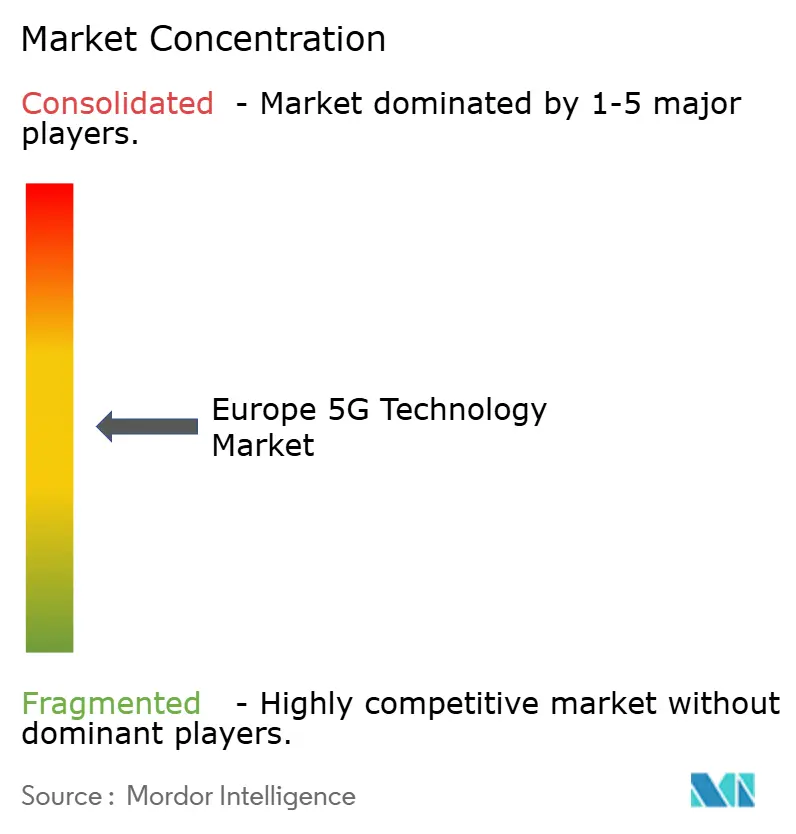
| Market Concentration | Medium |
Major Players *Disclaimer: Major Players sorted in no particular order Image © Mordor Intelligence. Reuse requires attribution under CC BY 4.0. | |
Europe 5G Technology Market Analysis by Mordor Intelligence
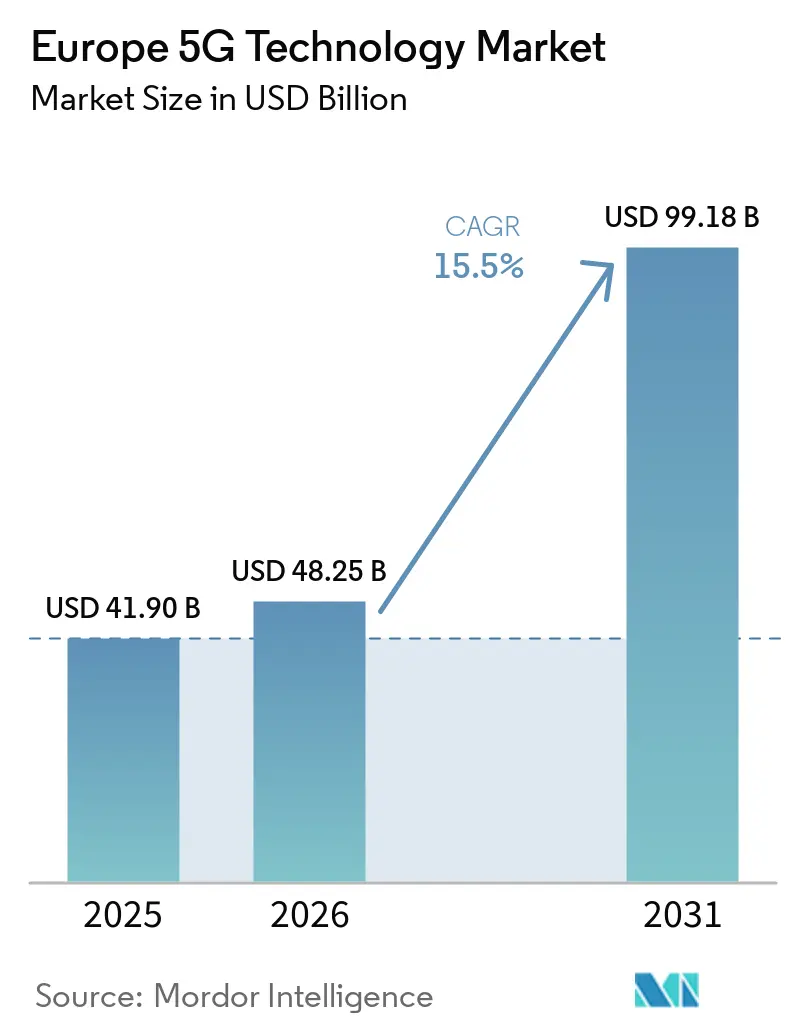
The Europe 5G Technology Market size is expected to increase from USD 41.90 billion in 2025 to USD 48.25 billion in 2026 and reach USD 99.18 billion by 2031, growing at a CAGR of 15.5% over 2026-2031. The European 5G technology market is moving from broad-coverage deployments toward services that depend on standalone architecture, cloud-native core software, and more responsive radio networks. This change is shifting procurement from radio equipment alone toward software, integration, managed operations, and enterprise connectivity. Operators must still balance the cost of denser networks against limited returns from advanced 5G services, especially where standalone usage remains low. Private networks, fixed wireless access, network slicing, and hybrid spectrum configurations create opportunities for operators to link network capabilities to specific customer needs. The Europe 5G technology market also faces a funding gap that may slow dense deployment, even as policy measures seek to improve spectrum coordination and cross-border authorization across European Union member states.
Key Report Takeaways
- By component, hardware held 44.85% of the Europe 5G Technology Market share in 2025, while services are projected to expand at a 17.41% CAGR through 2031.
- By spectrum band, sub-6 GHz accounted for 66.48% of the Europe 5G technology market size in 2025, while hybrid (sub-6 GHz and mmWave) configurations are projected to expand at a 17.98% CAGR through 2031.
- By application, enhanced mobile broadband (eMBB) held a 36.89% share of the European 5G technology market in 2025, while URLLC is projected to expand at a 17.95% CAGR through 2031.
- By end-user industry, the consumer segment held 39.55% of the Europe 5G technology market in 2025, while manufacturing is projected to expand at an 18.44% CAGR through 2031.
- By network architecture, non-standalone (NSA) networks held 71.76% of the European 5G technology market in 2025, while standalone (SA) networks are projected to expand at a 19.51% CAGR through 2031.
- By country, Germany held 20.31% of the European 5G technology market in 2025, while France is projected to expand at a 16.68% CAGR through 2031.
Note: Market size and forecast figures in this report are generated using Mordor Intelligence’s proprietary estimation framework, updated with the latest available data and insights as of January 2026.
Europe 5G Technology Market Trends and Insights
Drivers Impact Analysis*
| Driver | (~) % Impact on CAGR Forecast | Geographic Relevance | Impact Timeline |
|---|---|---|---|
| Ongoing 5G Standalone Network Rollouts Across Major European Economies | +3.2% | Germany, United Kingdom, France, Spain, with spillover to Benelux and the Nordics | Short term (≤ 2 years) to Medium term (2-4 years) |
| Rising Private 5G Demand in Industrial Manufacturing Clusters | +2.4% | Germany, France, United Kingdom, Italy, Portugal | Medium term (2-4 years) |
| Expanding Fixed Wireless Access Adoption in Underserved European Broadband Markets | +1.8% | European Union-wide, concentrated in rural Germany, France, and the Netherlands | Short term (≤ 2 years) to Long term (≥ 4 years) |
| Open RAN and Virtualized Network Adoption to Improve Vendor Flexibility | +1.5% | Germany, United Kingdom, France | Medium term (2-4 years) |
| Network Slicing Requirements From Enterprise and Public Sector Use Cases | +1.2% | European Union-wide, concentrated in Germany, France, and Spain | Medium term (2-4 years) to Long term (≥ 4 years) |
| Cross-Border Spectrum Harmonization Supporting Pan-European Deployment Efficiency | +1.0% | European Union-wide, especially cross-border transport corridors | Long term (≥ 4 years) |
| Source: Mordor Intelligence | |||
Ongoing 5G Standalone Network Rollouts Across Major European Economies
VodafoneThree committed GBP 11 billion (USD 14.85 billion) to a 10-year network investment plan, including GBP 2 billion (USD 2.7 billion) in supply agreements with Ericsson and Nokia for more than 17,000 United Kingdom sites. The September 2025 agreements placed standalone deployment at the center of a plan intended to extend 5G standalone coverage to more than 99% of the United Kingdom population by 2034.[1]VodafoneThree, “VodafoneThree Signs Multibillion Pound Investment Deals,” VodafoneThree, vodafonethree.com The European 5G technology market benefits when large operators move from limited trials to repeatable national programs with common technical standards, established suppliers, long-term commitments, and a clear route from initial network coverage to widely available standalone capability. Standalone networks provide the technical base for network slicing, private connectivity, and enterprise service packages that use dedicated performance characteristics rather than standard best-effort mobile access. Those capabilities matter because basic mobile coverage alone gives operators limited scope to differentiate their offerings or to explain why a customer should pay for an advanced service. The European Commission proposed the Digital Networks Act on January 21, 2026, with measures covering spectrum management and cross-border authorizations.[2]European Commission, “Supporting Digital Connectivity With Simpler Rules, Digital Networks Act Proposal,” European Commission, commission.europa.eu
Rising Private 5G Demand in Industrial Manufacturing Clusters
Private 5G moved from isolated testing to operational deployment during 2025 and 2026, particularly in industrial settings that require predictable wireless performance across large, active production sites. Siemens expanded its industrial private 5G offer to 15 countries in April 2026, adding Belgium, Finland, France, Norway, Poland, and the United Kingdom. This wider availability supports companies that want to apply a common network design across multiple facilities rather than designing a separate solution for each location. The European 5G technology market gains recurring demand when private systems support automation, machine vision, mobile robots, and connected business systems that must work within the same operational environment, including sites with varied equipment, production stages, and safety requirements. 3GPP Release 16 defined URLLC capabilities for demanding use cases that require near-1 ms latency and high reliability under controlled conditions. These requirements explain that manufacturing sites may replace or supplement fixed industrial connections with private cellular networks when mobile equipment, sensors, and production processes require consistent performance. Replicable deployment plans can reduce the effort needed to introduce private 5G at midsize industrial sites and make cross-site deployment more practical.
Expanding Fixed Wireless Access Adoption in Underserved European Broadband Markets
Europe had 108 commercially launched 5G fixed wireless access networks across European Union member states in June 2026. This deployment base gives the European 5G technology market a route into locations where fiber construction remains difficult to justify because installation costs and local demand do not support a conventional wired rollout.[3]Global Mobile Suppliers Association, “FWA Market, June 2026,” Global Mobile Suppliers Association, gsacom.com KPN launched 5G Internet at Home in the Netherlands in July 2026, offering unlimited data and speeds up to 1,000 Mbit/s through Wi-Fi 7 customer premises equipment. Fixed wireless access can serve as a broadband alternative in rural communities and as a premium service where rapid installation is valuable for households or smaller business sites. It also broadens the commercial use of 5G capacity beyond mobile subscriptions, allowing operators to use network assets for a defined fixed-access offering.
Open RAN and Virtualized Network Adoption to Improve Vendor Flexibility
Samsung became Vodafone's primary Open RAN partner for Germany in October 2025 under a 5-year program. The program placed the first site in Hannover and targeted Wismar for full Open RAN city coverage by Spring 2026.[4]Samsung Global Newsroom, “Samsung Selected by Vodafone To Provide Virtualized RAN and Open RAN Solutions in Germany and Other European Countries,” Samsung, news.samsung.com Samsung and Vodafone also completed a European commercial call in 2026 using Samsung's virtualized RAN and Intel Xeon 6 system-on-chip technology. The Europe 5G technology market can see more vendor choice as radio functions shift toward software-based platforms that can be deployed and managed through a more open set of interfaces and connected with a broader range of supporting technology providers. This can reduce entry barriers for vendors without a traditional proprietary radio portfolio and help operators avoid relying on a single established equipment architecture. It also increases pressure on established suppliers to strengthen software-defined network road maps while maintaining the performance and support expected from national network deployments. Lower compute requirements may improve the cost case for virtualized radio deployments in locations where earlier virtualized approaches faced difficult equipment economics.
Restraints Impact Analysis*
| Restraint | (~) % Impact on CAGR Forecast | Geographic Relevance | Impact Timeline |
|---|---|---|---|
| High Capital Intensity of Dense Mid-Band and mmWave Infrastructure | -1.8% | European Union-wide, most acute in Southern and Eastern Europe | Short term (≤ 2 years) to Medium term (2-4 years) |
| Slow Enterprise Monetization of Advanced 5G Use Cases | -1.2% | European Union-wide | Short term (≤ 2 years) |
| Spectrum Fragmentation and Varying National Licensing Conditions | -0.9% | European Union-wide, most acute in cross-border deployment zones | Medium term (2-4 years) |
| Elevated Energy Use and Site-Level Sustainability Pressures | -0.7% | European Union-wide, most acute in Western Europe and Nordic countries | Medium term (2-4 years) |
| Source: Mordor Intelligence | |||
High Capital Intensity of Dense Mid-Band and mmWave Infrastructure
GSMA Intelligence estimated that Europe requires EUR 475 billion (USD 536.8 billion) in mobile investment from 2026 to 2036. It estimated an operator-accessible pool of EUR 270 billion (USD 305.1 billion), leaving over EUR 200 billion (USD 233.19 billion). GSMA Nearly half of the required spending relates to 5G along major transport routes, where coverage continuity and capacity demand require more extensive network infrastructure. Dense mid-band and mmWave networks need closer site spacing and specialized radio equipment than broad sub-6 GHz macro coverage, adding both deployment and site-related costs. This requirement makes the investment burden particularly difficult in markets with weaker network economics and in areas where high-capacity traffic demand is not yet proven. Operators may keep non-standalone networks in service longer when capital is constrained and prioritize only the sites with the clearest return. That decision can delay the software and services spending associated with full standalone capabilities and slow the transition from basic coverage to advanced service delivery.
Slow Enterprise Monetization of Advanced 5G Use Cases
The share of 5G standalone connections remained low in Europe during 2025, creating a gap between available infrastructure and regular commercial use across consumer and enterprise services. Some operators offered standalone access within existing plans rather than selling it as a distinct premium service with defined performance commitments. This approach can build familiarity with the technology, but provides limited revenue differentiation and gives customers little reason to change their service choices. Network slicing requires end-to-end standalone capability and clear service packages for sectors such as health care, automotive, and logistics that need dependable network behavior. The European 5G technology market depends on operators demonstrating measurable operational or commercial benefits for these users, rather than presenting standalone access solely as a technical upgrade. Without that link, enterprises can delay adoption even where technical capability is available, and operators can continue to face pressure on the funds available for future network investment.
*Our forecasts treat driver/restraint impacts as directional, not additive. The impact forecasts reflect baseline growth, mix effects, and variable interactions.
Segment Analysis
By Component: Services Are Reshaping the Revenue Mix
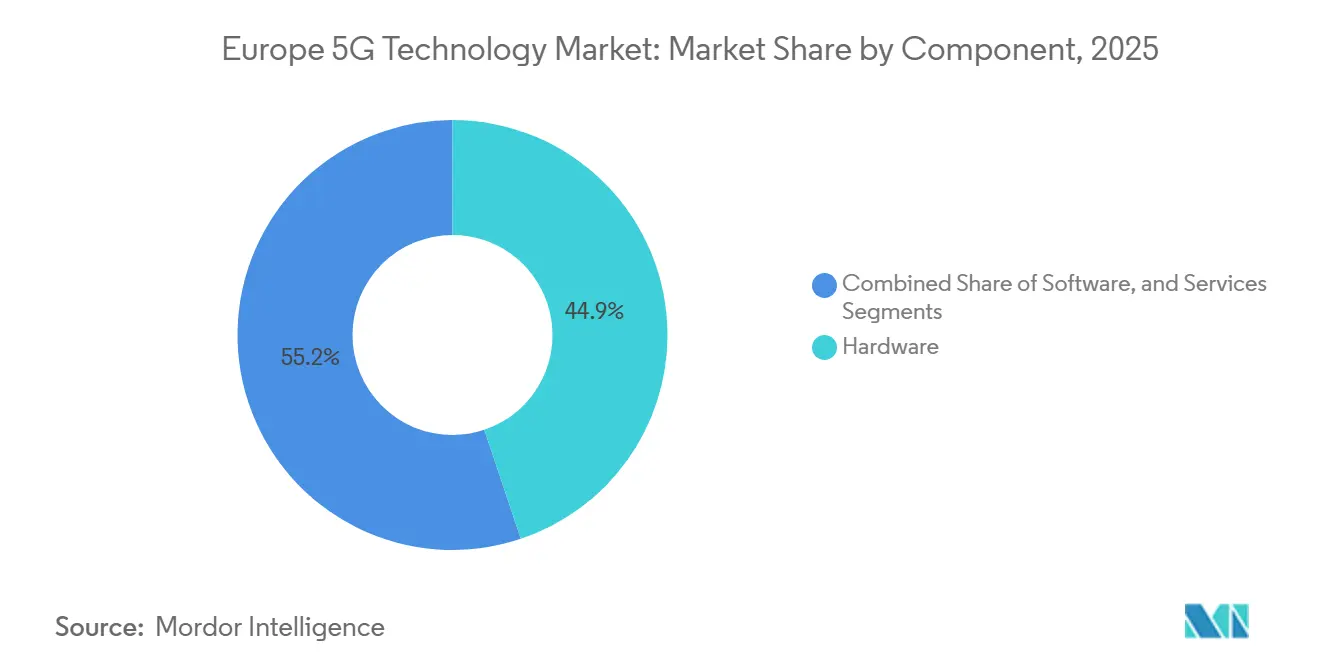
Hardware accounted for 44.85% of the European 5G technology market share in 2025, while services are projected to expand at a 17.41% CAGR through 2031. Hardware demand remains centered on massive MIMO radio units, base stations, and remote radio heads that form the physical access layer of 5G deployment. These assets support sub-6 GHz densification programs across European operator networks and provide the equipment needed to add capacity in high-traffic areas, where demand increases as consumer data use, fixed wireless access, and enterprise traffic share the same radio infrastructure. Hardware also remains necessary when operators extend coverage, upgrade sites, or install specialized equipment for enterprise locations. Europe’s 5G technology sector, therefore, retains a large equipment base even as the composition of spending begins to change.
Services are expected to gain importance as cloud-native deployment, managed radio operations, and network-as-a-service arrangements become more common across multi-year network programs. These activities create recurring engagements that extend beyond the original equipment purchase and encompass design, integration, optimization, support, and operational management. Open RAN supports this shift because software can replace some proprietary hardware functions and requires closer coordination between multiple suppliers. Software also supports orchestration, virtual network functions, operations support systems, and business support systems that connect network performance with commercial delivery as operators replace legacy core processes and manage public networks alongside enterprise deployments. The Europe 5G technology market, therefore, has a broader mix of hardware, software, and services requirements than in the initial phase of 5G coverage deployment.



By Spectrum Band: Sub-6 GHz Anchors Coverage While Hybrid Networks Gain Ground
Sub-6 GHz accounted for 66.48% of the European 5G technology market in 2025, reflecting its role as the primary capacity layer in operator portfolios. Band n78 has been a central part of this coverage and capacity strategy because it can serve a wide range of locations with a consistent network design. Its balance of reach and capacity makes it suitable for broad deployment across urban, suburban, and many rural areas. Operators can use this band to expand 5G availability without relying on the dense site grids and specialized equipment needed for higher frequencies. It remains the practical base for most nationwide 5G network plans and for later additions of more targeted capacity, allowing operators to prioritize broad availability before committing major resources to localized high-frequency infrastructure.
Hybrid (sub-6 GHz and mmWave) configurations are projected to expand at a 17.98% CAGR through 2031. These configurations add mmWave capacity where traffic is concentrated at venues, enterprise campuses, and broadcast locations that need higher local throughput. Nokia and EOLO deployed Europe’s first 5G standalone mmWave network in Italy in December 2024. The European 5G technology market can use hybrid networks in which dependable sub-6 GHz coverage must coexist with very high local capacity at specific sites. European harmonization of the 26 GHz band provides a spectrum basis for these targeted deployments and gives operators a common reference for equipment planning.
By Application: URLLC Outpaces Consumer-Facing Use Cases
Enhanced mobile broadband accounted for 36.89% of the total share in 2025. Consumer mobile data use and 5G home broadband services supported this position across the established public mobile network base. Enhanced mobile broadband remains important because it serves the largest group of regular 5G users and carries much of the recurring traffic on operator networks. It also provides the traffic foundation for operators expanding fixed wireless access offers in areas that need an alternative to wired broadband. These consumer uses support demand for network capacity even when advanced enterprise services are still developing and remain less widely monetized, giving operators a continuing reason to optimize coverage, capacity, and home broadband performance.
URLLC is projected to expand at a 17.95% CAGR through 2031, driven by requirements in manufacturing, logistics, public safety, and health care. The service is relevant where applications require near-1 ms latency and very high reliability that conventional mobile services may not provide. These technical needs apply to activities such as machine control, connected safety systems, sensitive operational communications, and other tasks where delayed data can disrupt operations. These uses require operators and customers to consider service performance as part of the network design rather than only as a feature of the access connection. Europe’s 5G technology sector can use operational deployments as a model for future health care and industrial network designs, especially where service reliability must be built into the network plan.
By End-User Industry: Manufacturing Drives the Enterprise 5G Buildout
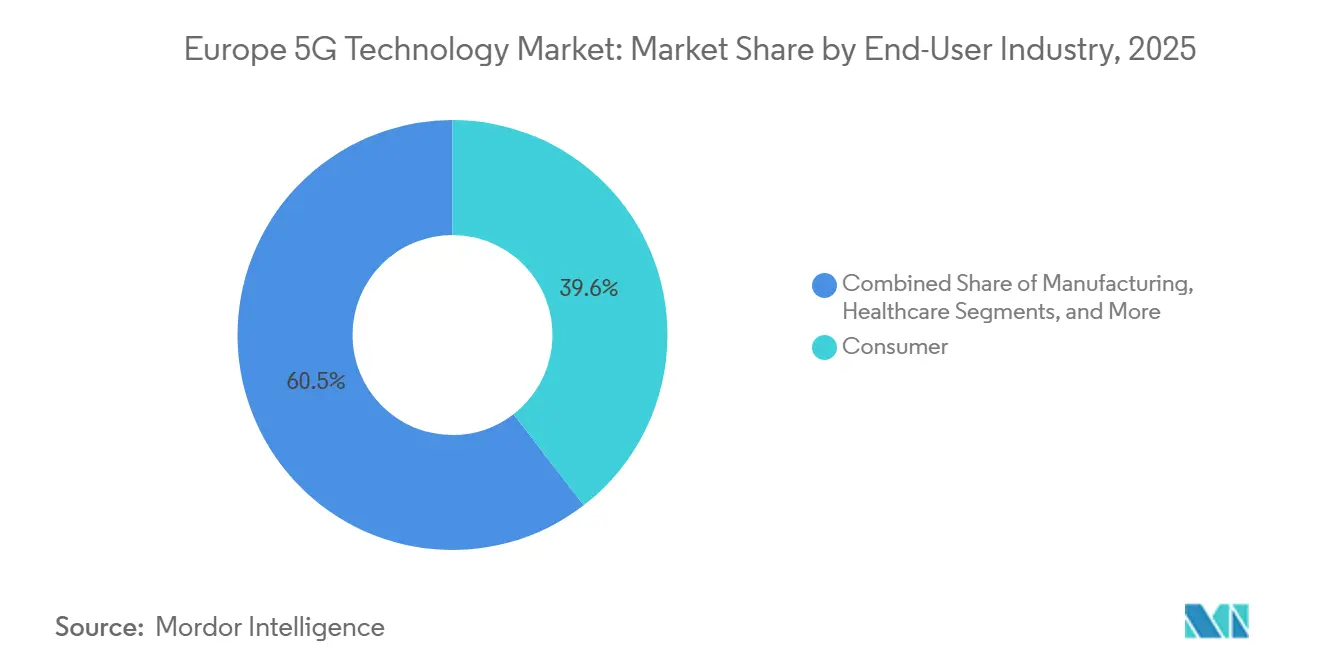
The consumer segment held 39.55% of the total share in 2025, supported by a large retail mobile subscriber base. Consumer services remain the largest source of routine 5G traffic because public networks continue to carry smartphone data, home broadband, and other everyday connectivity uses. They include services delivered through national mobile networks rather than dedicated enterprise systems. This base helps operators support the early economics of broad network coverage and maintains demand for regular capacity upgrades. It also provides a platform on which operators can introduce more specialized offerings as their standalone networks and service packages mature, creating a path from mass consumer connectivity to services tailored to individual operational requirements.
Manufacturing is projected to expand at an 18.44% CAGR through 2031. Steel, aerospace, cement, and food processing sites can use private 5G for automation, robotics, machine vision, and connected operational systems across complex production environments. These uses can reduce handover failures for autonomous guided vehicles and support more consistent inspection processes where uninterrupted connectivity affects output. The 2027 next-generation eCall mandate creates a separate procurement need for automotive-grade 5G modules in new vehicles. Health care, energy and utilities, media and entertainment, public safety, and defense also require reliable connectivity for specific applications with defined service conditions. The European 5G technology market can therefore draw demand from both consumer networks and operational deployments with clearer performance requirements.
By Network Architecture: Standalone Adoption Signals a Structural Investment Shift
Non-standalone networks held 71.76% share in 2025, reflecting the installed base of 5G New Radio equipment connected to existing 4G cores. This approach allowed operators to quickly introduce 5G coverage while retaining core functions already deployed for earlier mobile services. It also allowed them to use existing core network assets during early deployment and limit the initial scale of change. However, non-standalone design limits network slicing and the deterministic latency expected for more demanding applications. It remains important because many current devices and connections continue to use this architecture while operators complete their transition plans, manage core network replacement work, and prepare compatible service packages for a broader set of users.
Standalone networks are projected to expand at a 19.51% CAGR through 2031, the fastest rate among the reported segmentation types. A standalone network replaces 4G core functions with cloud-native 5G core software and provides a different basis for managing services across the network. This supports the full set of 5G capabilities, including network slicing, lower-latency services, and more tailored enterprise offerings. GSA confirmed 40 live 5G standalone networks in EMEA in December 2025. MasOrange and Ericsson agreed in 2025 to deploy a unified 5G standalone core across MasOrange brands, supporting multiple network slices and individualized services. Europe’s 5G technology sector is therefore shifting spending toward the core, integration, software, and operational work needed for standalone deployment.
Geography Analysis
Germany accounted for 20.31% of the European 5G technology market in 2025. Its position reflects industrial private 5G activity, dense mid-band radio networks, and a large-scale Open RAN deployment environment that brings together public network and enterprise demand. Deutsche Telekom reported capital expenditure of EUR 16.86 billion (USD 18.2 billion) in 2025, including EUR 4.9 billion (USD 5.3 billion) directed to Germany. Vodafone Germany selected Samsung for a large-scale Open RAN program, with Wismar targeted for full Open RAN city coverage by Spring 2026. This combination of capital investment, industrial use cases, and supplier activity gives Germany a central role in the Europe 5G technology market.
France is projected to expand at a 16.68% CAGR through 2031. Policy support for research and development and active 5G-Advanced capability development support its position, while Spain has a significant deployment base through its Digital Spain 2026 agenda. Telefonica reported 5G standalone coverage across 94% of its population and 5,700 municipalities, while MasOrange activated 5G-Advanced capabilities in 2026. Italy added a hybrid network reference point when Nokia and EOLO deployed a 5G standalone mmWave network in December 2024. These countries show different routes to adoption, combining national coverage programs, advanced mobile capabilities, and focused high-frequency deployments.
The rest of Europe includes markets with different rollout conditions and commercial priorities. Proximus launched Belgium’s first 5G standalone service in April 2026, while KPN has offered 5G Internet at Home in the Netherlands since July 2026, with unlimited data and speeds up to 1,000 Mbit/s. Poland’s 3.5 GHz auction, completed in October 2023, enabled wider mid-band deployment, while Russia follows a separate path under vendor-access restrictions and relies on alternative vendor ecosystems. The varied conditions across these markets mean that coverage, spectrum access, vendor availability, and fixed broadband economics continue to shape local deployment choices. Operators in these locations may prioritize different combinations of public mobile coverage, fixed wireless access, and enterprise connectivity as their national conditions change.
Competitive Landscape
The Europe 5G technology market has moderate concentration in the radio access network supply. Ericsson and Nokia remain central to major public network deployments, while Open RAN-focused providers, cloud-native core vendors, and Asian equipment suppliers are widening their presence in selected network layers where operators seek alternatives to traditional end-to-end equipment arrangements. VodafoneThree used dual-vendor awards across more than 17,000 United Kingdom sites to diversify its supply while expanding standalone coverage. Samsung’s virtualized RAN work with Vodafone in Germany shows that the suppliers are competing through software-based network architectures and alternative approaches to radio deployment. Qualcomm introduced the X105 5G Modem-RF in March 2026 as a 3GPP Release 19-ready modem, setting a commercial reference point for 5G-Advanced devices.
The European 5G technology market offers opportunities in mid-tier enterprise private networks, mmWave fixed wireless access, and network slicing for enterprise services that need performance tailored to specific operations. Deutsche Telekom reported up to 65% energy savings in its 5G core network through its demand-driven Zero Bits, Zero Watts architecture with Mavenir and hardware partners, underscoring that the energy performance can influence supplier selection for core renewal. Nokia and AWS demonstrated agentic artificial intelligence-powered network slicing at MWC26, with Orange among early operators exploring intent-based slicing and more automated network management. These moves place network management, service design, operating efficiency, and enterprise requirements alongside radio performance in competitive decisions, rather than treating radio capacity as the only basis for supplier selection.
Ericsson extended its partnership with Virgin Media O2 in March 2026 as the primary radio access network vendor through a 5-year agreement. The agreement covers mid-band spectrum optimization, network slicing, and 5G-Advanced readiness, reinforcing the role of long-term managed relationships in incumbent supplier strategies. Established vendors retain an advantage in large public deployments because operators value integration capability, network support, proven delivery, and existing asset relationships. Newer providers can compete where operators seek greater vendor flexibility, lower compute requirements, or cloud-native functionality within specific network layers. Europe’s 5G technology sector remains concentrated in large radio deployments but is more open in the core, software, and private network layers.
Europe 5G Technology Industry Leaders
Telefonaktiebolaget LM Ericsson (Ericsson)
Nokia Corporation
Mavenir plc
Samsung Electronics Co., Ltd.
Qualcomm Incorporated
- *Disclaimer: Major Players sorted in no particular order

Recent Industry Developments
- June 2026: GSA confirmed 108 commercially launched 5G FWA networks across EU member states, with Europe retaining its lead globally as 542 operators invested in LTE or 5G FWA across 180 countries.
- March 2026: Ericsson extended its partnership with Virgin Media O2 as the primary RAN vendor in a 5-year deal, focusing on 5G mid-band spectrum optimization, network slicing, and 5G-Advanced readiness.
- March 2026: Qualcomm announced the X105 5G Modem-RF, the world’s first 3GPP Release 19-ready modem, supporting satellite connectivity over 5G, enhanced download speeds, and NB-IoT failover for in-building coverage continuity.
- February 2026: Deutsche Telekom reported up to 65% energy savings in its 5G core network through a Zero Bits, Zero Watts demand-driven architecture validated with Mavenir and hardware partners, with wider rollout and artificial intelligence-enhanced prediction planned.


Europe 5G Technology Market Report Scope
The Europe 5G technology market revenue is generated through the sale of 5G network hardware, software licenses and subscriptions, network deployment and integration, managed and professional services, maintenance, and other 5G connectivity solutions supporting eMBB, FWA, mMTC, and URLLC applications across consumer, manufacturing, healthcare, automotive, energy and utilities, media and entertainment, and public safety and defense sectors.
The Europe 5G technology market report is segmented by component (hardware, software, and services), spectrum band (sub-6 GHz, mmWave, and hybrid (sub-6GHz and mmWave)), application (enhanced mobile broadband (eMBB), fixed wireless access (FWA), massive machine-type communications (mMTC), and ultra-reliable low-latency communications (URLLC)), end-user industry (consumer, manufacturing, healthcare, automotive, energy and utilities, media and entertainment, and public safety and defense), network architecture (stand-alone (SA) and non-stand-alone (NSA)), and country (Germany, United Kingdom, France, Italy, Spain, Russia, and rest of Europe). The market forecasts are provided in terms of value (USD).
| Hardware |
| Software |
| Services |
| Sub-6 GHz |
| mmWave |
| Hybrid (Sub-6 GHz and mmWave) |
| Enhanced Mobile Broadband (eMBB) |
| Fixed Wireless Access (FWA) |
| Massive Machine-Type Communications (mMTC) |
| Ultra-Reliable Low-Latency Communications (URLLC) |
| Consumer |
| Manufacturing |
| Healthcare |
| Automotive |
| Energy and Utilities |
| Media and Entertainment |
| Public Safety and Defense |
| Stand-Alone (SA) |
| Non-Stand-Alone (NSA) |
| Germany |
| United Kingdom |
| France |
| Italy |
| Spain |
| Russia |
| Rest of Europe |
| By Component | Hardware |
| Software | |
| Services | |
| By Spectrum Band | Sub-6 GHz |
| mmWave | |
| Hybrid (Sub-6 GHz and mmWave) | |
| By Application | Enhanced Mobile Broadband (eMBB) |
| Fixed Wireless Access (FWA) | |
| Massive Machine-Type Communications (mMTC) | |
| Ultra-Reliable Low-Latency Communications (URLLC) | |
| By End-User Industry | Consumer |
| Manufacturing | |
| Healthcare | |
| Automotive | |
| Energy and Utilities | |
| Media and Entertainment | |
| Public Safety and Defense | |
| By Network Architecture | Stand-Alone (SA) |
| Non-Stand-Alone (NSA) | |
| By Country | Germany |
| United Kingdom | |
| France | |
| Italy | |
| Spain | |
| Russia | |
| Rest of Europe |


Key Questions Answered in the Report
What is the size of the Europe 5G technology market?
The Europe 5G technology market is projected at USD 48.25 billion in 2026 and is expected to reach USD 99.18 billion by 2031, at a 15.50% CAGR. These figures reflect the transition from early network coverage deployment toward broader standalone, software, and enterprise connectivity requirements. They also show that demand extends beyond public mobile coverage into the network systems needed to deliver more specialized services, including standalone core software, radio upgrades, service integration, managed operations, and enterprise connectivity. The forecast period also includes the continued use of non-standalone networks, because the move to full standalone architecture requires operators to replace core functions and develop commercially usable service packages for distinct customer needs and deployment settings.
What is driving 5G standalone adoption in Europe?
Operators are deploying standalone networks to enable network slicing, private connectivity, cloud-native cores, and more tailored enterprise services. These capabilities are intended to support services that need more predictable performance than standard public mobile connections. National programs and regulatory efforts to coordinate spectrum and authorizations can also support deployment planning.
Which component is expanding fastest in Europe's 5G technology sector?
Services are projected to expand at a 17.41% CAGR through 2031, supported by managed operations, cloud-native deployment, and network-as-a-service models. The shift reflects the larger role of integration, orchestration, optimization, and ongoing operational support in network programs. Equipment remains important, but services are becoming more relevant when networks involve several suppliers and software platforms.
Which spectrum approach is gaining momentum for high-capacity uses?
Hybrid sub-6 GHz and mmWave configurations are projected to expand at a 17.98% CAGR through 2031 for venues, campuses, and other dense locations. This approach combines broad mid-band coverage with higher local capacity where traffic demand is concentrated. It is particularly suited to locations where users need strong performance within a limited physical area.
Which end-user sector is projected to expand fastest?
Manufacturing is projected to expand at an 18.44% CAGR through 2031 as private 5G supports automation, robotics, machine vision, and connected operational systems. The need for dependable wireless performance across active production sites supports this application. These requirements distinguish industrial deployments from general consumer mobile connectivity.
Which country leads Europe's 5G technology sector?
Germany held 20.31% share in 2025, supported by industrial deployment, mid-band network density, and large Open RAN programs. Its investment base also includes major operator spending and supplier activity linked to public and private network deployment. France is projected to record the fastest country expansion at a 16.68% CAGR through 2031.
Page last updated on:





