
Europe 5G Services Market Size and Share
Market Overview
| Study Period | 2020 - 2031 |
|---|---|
| Forecast Data Period | 2026 - 2031 |
| Base Year Market Size (2025) | USD 21.66 Billion |
| Market Size (2026) | USD 26.12 Billion |
| Market Size (2031) | USD 63.41 Billion |
| Growth Rate (2026 - 2031) | 19.41 % |
| Market Concentration | Medium |
Major Players *Disclaimer: Major Players sorted in no particular order Image © Mordor Intelligence. Reuse requires attribution under CC BY 4.0. | |
Europe 5G Services Market Analysis by Mordor Intelligence
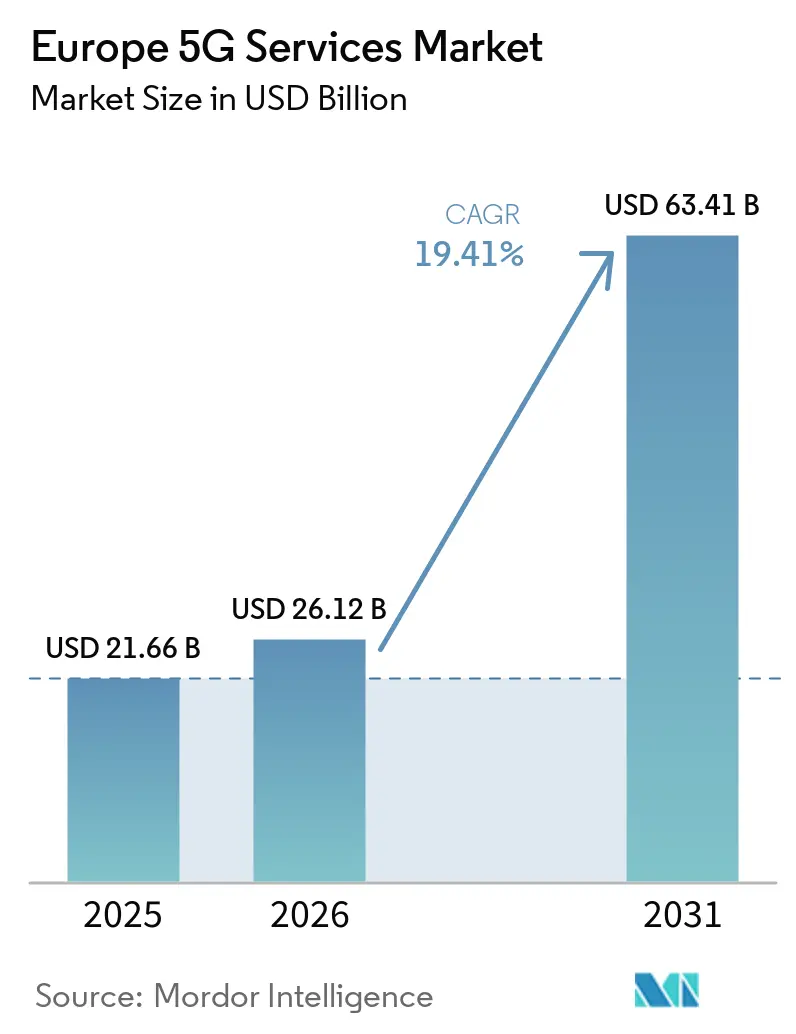
The Europe 5G Services Market size was valued at USD 21.66 billion in 2025 and is estimated to grow from USD 26.12 billion in 2026 to reach USD 63.41 billion by 2031, at a CAGR of 19.41% during the forecast period (2026-2031).
Basic 5G coverage across the Europe 5G Services market reached 96.8% of EU households in 2026, while standalone 5G represented only 20.9% of EU mobile base stations. This gap leaves operators with broad coverage but limited capacity to sell low-latency, sliced, and service-level-assured services to businesses. The Europe 5G Services market is moving from coverage expansion toward network depth, private connectivity, and cloud-based core functions that support work at customer sites. Operators are seeking more enterprise revenue as consumer broadband pricing remains competitive and as existing network capacity needs stronger commercial returns. Spectrum rules, capital requirements, and national licensing differences continue to shape the pace of investment, the reach of higher-capacity bands, and the ability to offer regional services across Europe, while also affecting when operators can move customers from basic connectivity to services with defined availability, throughput, latency, and local processing, and how consistently standalone networks, spectrum access, enterprise demand, and practical service deployment develop across national markets.
Key Report Takeaways
- By service type, enhanced mobile broadband held 62.72% of Europe 5G Services market share in 2025, while massive machine-type communications is projected to expand at a 19.85% CAGR through 2031.
- By network architecture, non-standalone 5G accounted for 97.67% of Europe 5G Services market revenue in 2025, while standalone 5G is expected to expand at a 20.32% CAGR through 2031.
- By frequency band, mid band held 50.42% of revenue in 2025, while millimeter-wave is projected to expand at a 21.03% CAGR through 2031.
- By end-user industry, IT and telecom captured 29.61% of revenue in 2025, while manufacturing, energy, and utilities is projected to expand at a 20.31% CAGR through 2031.
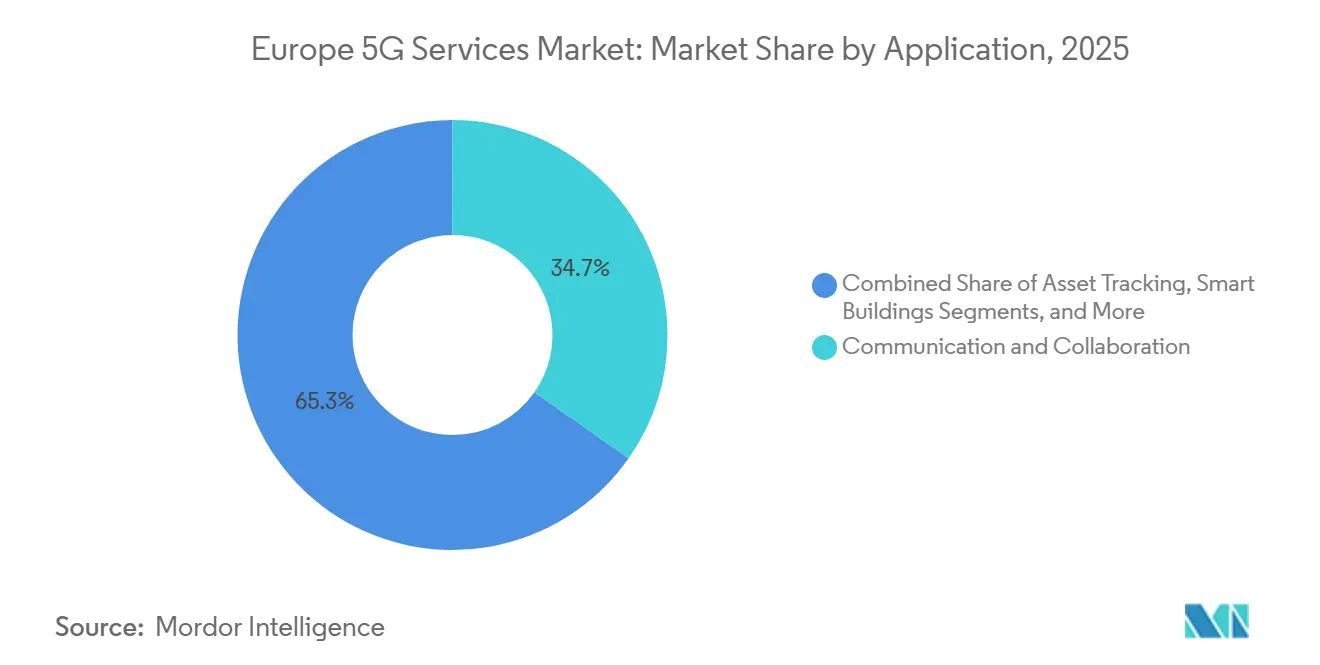
- By application, communication and collaboration held 34.72% of revenue in 2025, while Industry 4.0 is expected to expand at a 19.63% CAGR through 2031.
- By geography, Germany accounted for 24.63% of revenue in 2025, while Rest of Europe is projected to expand at a 20.59% CAGR through 2031.
Note: Market size and forecast figures in this report are generated using Mordor Intelligence’s proprietary estimation framework, updated with the latest available data and insights as of January 2026.
Europe 5G Services Market Trends and Insights
Drivers Impact Analysis*
| Driver | (~) % Impact on CAGR Forecast | Geographic Relevance | Impact Timeline |
|---|---|---|---|
| Mobile Data Traffic and eMBB Demand | +4.2% | EU-wide, led by Germany, UK, France | Short term (≤ 2 years) |
| Enterprise Digital Transformation and Industry 4.0 | +3.8% | Germany, France, Italy, Nordics, with spillover to Rest of Europe | Medium term (2-4 years) |
| Spectrum Release and Digital Infrastructure Programs | +3.2% | National, with early gains in Germany, Italy, UK | Medium term (2-4 years) |
| Network Slicing and SLA-Tier Monetization | +2.8% | Germany, UK, France, with emerging activity in Rest of Europe | Medium term (2-4 years) |
| Fixed Wireless Access in Underserved Areas | +2.5% | Rest of Europe, Italy, UK, Netherlands, Portugal | Medium term (2-4 years) |
| Cross-Border Industrial 5G and Edge Cloud Ecosystems | +1.8% | EU-wide, with early activity in Germany, Spain, France | Long term (≥ 4 years) |
| Source: Mordor Intelligence | |||
Mobile Data Traffic and eMBB Demand
EU mobile subscribers spent 44.5% of their time connected to 5G networks in Q2 2025, compared with 32.8% in Q2 2024.[1]GSMA, “Mobile Investment Needs in Europe,” GSMA, gsma.com The higher share of time spent on 5G points to deeper network use rather than subscriber additions alone. Enhanced mobile broadband remained the main revenue base for the Europe 5G Services market because video, cloud access, and unified communications require sustained capacity. GSMA expects 5G to account for 88% of EU mobile connections, or 530 million connections, by 2030, compared with 43% at the end of 2025. Vodafone Germany introduced standardized network-slicing tariffs in August 2025, linking differentiated connectivity to defined service terms. This approach gives operators a route to offer premium broadband services without separating them from the established eMBB base.
Enterprise Digital Transformation and Industry 4.0
Private 5G campus networks moved beyond trials at European manufacturing and industrial locations. Germany’s DECT-2020 NR local spectrum framework supported more than 200 private campus networks in automotive and chemical facilities. This licensing model shows how local spectrum access can shorten deployment decisions for industrial users. Airbus deployed private 5G networks across 5 production facilities in France, Germany, and Spain, and had delivered 7,000 SIM cards by late 2025. The Europe 5G Services market benefits as digital twins, automated guided vehicles, and predictive quality-control systems become operational tools. Manufacturing sites need reliable wireless coverage across equipment, workers, and mobile assets, which favors dedicated network services over basic mobile plans.
Spectrum Release and Digital Infrastructure Programs
National spectrum decisions determine the capacity and timing of new 5G services. Italy published terms in August 2026 for its 26 GHz auction, covering 5 national lots and 42 regional and provincial lots. The stated reserve price was EUR 180.08 million, or USD 198.09 million, and the framework supports long-term mmWave and fixed wireless access investment. The UK completed its 26 GHz and 40 GHz assignment in October 2025, providing EE, O2, and VodafoneThree with 800 MHz and 1 GHz, respectively. Germany instead extended selected spectrum rights for 5 years with added coverage obligations in March 2025. These approaches support continuity, but differing national processes make regional product planning more complex for the Europe 5G Services market.
Network Slicing and SLA-Tier Monetization
Standalone networks enable operators to define service quality for specific enterprise uses. This is important for factories, transport operators, public agencies, and businesses that need guaranteed network performance. Orange selected Ericsson in June 2025 to automate standalone network slicing across European affiliates after Belgian trial.[2]European Commission, “Orange Selects Ericsson to Lead 5G Network Slicing Orchestration Across Europe,” European Commission, digital-strategy.ec.europa.eu Vodafone Germany’s Campus Flex offers placed dedicated and shared slices into standardized commercial packages. The Europe 5G Services market can use these offerings to move from generic data plans toward contracts defined by latency, throughput, and availability. Wider use depends on standalone coverage, enterprise integration skills, and customer confidence in the commercial value of service guarantees.
Restraints Impact Analysis*
| Restraint | (~) % Impact on CAGR Forecast | Geographic Relevance | Impact Timeline |
|---|---|---|---|
| High Deployment Costs and Long ROI Horizons | -2.5% | EU-wide, with greatest pressure on smaller operators | Long term (≥ 4 years) |
| Fragmented Spectrum Policy and Licensing Conditions | -1.8% | National, most acute in Central and Eastern Europe | Medium term (2-4 years) |
| Cybersecurity, Privacy, and Critical Infrastructure Exposure | -1.2% | EU-wide, concentrated in critical infrastructure sectors | Medium term (2-4 years) |
| Standalone-Core Skills and Legacy Network Integration Complexity | -0.8% | EU-wide | Long term (≥ 4 years) |
| Source: Mordor Intelligence | |||
High Deployment Costs and Long ROI Horizons
European operators face a funding gap between current deployments and the infrastructure needed for broader standalone coverage. EU operators planned nearly EUR 20 billion, or USD 22 billion, in mobile capital expenditure during 2025. GSMA estimated EUR 106 billion, or USD 116.6 billion, in spending across 2025-2030, before additional requirements for standalone rollout and resilience. Germany’s telecommunications companies invested EUR 15.3 billion, or USD 16.8 billion, in physical infrastructure during 2025. Consumer eMBB revenues remain exposed to price competition, while many enterprise standalone services have not yet reached broad scale. This timing difference can delay returns and can limit smaller operators’ ability to invest at the pace required by the Europe 5G Services market.
Fragmented Spectrum Policy and Licensing Conditions
More than 1 in 5 European operators had 5G population coverage below 70% in Q3 2025, according to GSMA. Mid-band coverage across EU households reached 74.8% in 2026, compared with 96.8% basic 5G coverage. The difference is material because mid band supports the capacity needed for higher-value services. BEREC raised concerns in July 2025 that greater centralization of spectrum oversight could add delays and administrative burdens. Operators need long-term clarity when they evaluate standalone builds and cross-border industrial deployments. National licensing differences therefore remain a restraint on the Europe 5G Services market even where consumer coverage is already extensive.
*Our forecasts treat driver/restraint impacts as directional, not additive. The impact forecasts reflect baseline growth, mix effects, and variable interactions.
Segment Analysis
By Service Type: eMBB Holds the Revenue Base While mMTC Broadens Usage
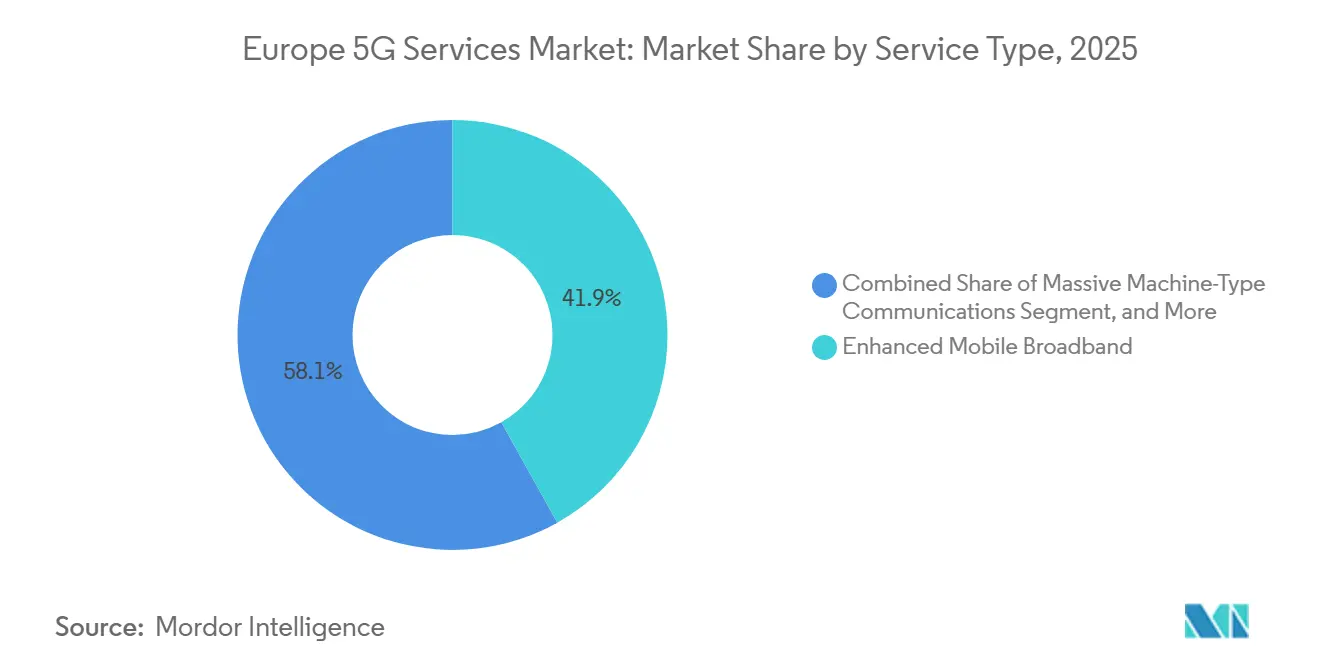
Enhanced mobile broadband held 62.72% of service type revenue in 2025. Consumer video, mobile cloud access, and enterprise communication tools continued to provide most revenue because they use persistent network capacity throughout the day. Fixed wireless access reinforced this position by bringing broadband to homes and businesses that did not have suitable fixed connections. Europe had 108 commercially launched 5G fixed wireless access networks across the EU, demonstrating the role of this service beyond mobile handsets.[3]Ericsson, “Fixed Wireless Access Outlook,” Ericsson Mobility Report, ericsson.com Ultra-reliable low-latency communications remained smaller commercially, but public safety, broadcasting, and automotive testing already used its defined performance features.
Massive machine-type communications is projected to expand at a 19.85% CAGR from 2026 to 2031. Its applications include sensor networks, logistics trackers, smart meters, and agricultural monitoring platforms, which require connections for many distributed devices rather than a few high-data users. Germany is expected to have 107 million 5G connections by 2030, creating a large installed base for machine communications. Fixed wireless access can also monetize network capacity that has already been deployed, particularly in rural municipalities and locations outside fiber footprints. These uses reduce reliance on consumer handset revenues and provide the Europe 5G Services market with several service paths that respond to different connectivity needs.



By Network Architecture: Non-Standalone Dominance Precedes Standalone Services
Non-standalone 5G accounted for 97.67% of the Europe 5G Services market size by network architecture revenue in 2025. These networks used existing 4G core infrastructure while providing wider coverage and faster connections, which made them suitable for the early commercial phase of 5G. The approach did not fully support low latency, network slicing, and edge functions that many enterprise customers require. Standalone base stations accounted for 20.9% of EU mobile base stations in 2026. Comparable standalone shares were 36.2% in the United States and 34.8% in China, so broad availability in Europe did not necessarily give customers access to advanced standalone services.
Standalone 5G is projected to expand at a 20.32% CAGR from 2026 to 2031. Orange selected Ericsson’s Service Orchestration and Assurance platform for automated slicing across European affiliates in June 2025, following trials in Belgium. O2 Telefónica moved production-scale 5G core functions to AWS Outposts in its German data center during March 2026, using Nokia’s 5G core technology. These deployments place standalone systems in commercial network environments rather than isolated tests. The architecture supports services that need defined performance, local processing, and tighter links between connectivity and cloud operations.
By Frequency Band: Mid Band Supports Coverage While mmWave Targets Dense Locations
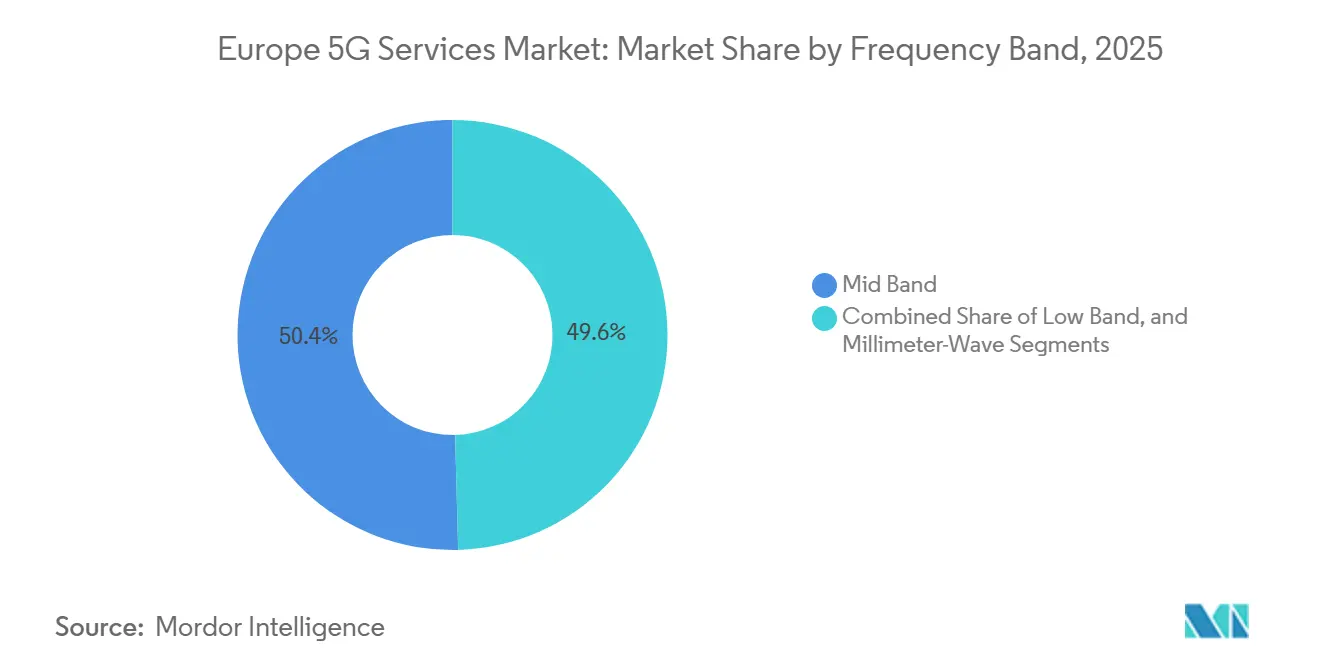
Mid band held 50.42% of frequency band revenue in 2025. The 3.4-3.8 GHz range balances coverage and capacity more effectively than low band or millimeter-wave alone, making it the primary operating layer for many commercial networks. Mid-band coverage reached 74.8% of EU households in 2026, below the 96.8% basic 5G coverage rate. The remaining coverage gap limits access to higher-capacity services outside densely populated areas. France had more than 75,000 active 5G antennas by May 2026, and Orange added 4,159 active sites between May 2025 and May 2026.
Millimeter-wave is projected to expand at a 21.03% CAGR from 2026 to 2031. Italy’s August 2026 26 GHz framework covered national, regional, and provincial lots, providing a longer investment horizon for 5G and fixed wireless access. The UK assigned 26 GHz and 40 GHz spectrum to EE, O2, and VodafoneThree in October 2025. Millimeter-wave supports high-density urban zones, stadiums, transport hubs, and industrial campuses where users value very low latency and high throughput. Low band remains important for rural and indoor coverage, while the full band mix lets operators align network resources with different service needs.
By End-User Industry: IT and Telecom Leads While Industrial Users Accelerate
IT and telecom held 29.61% of end-user revenue in 2025. The sector uses 5G itself and resells managed connectivity to business customers, giving incumbent providers a direct way to commercialize network capabilities. Government, defense, education, and public organizations added early demand through mission-critical communications and smart-city programs. Healthcare providers explored connected ambulances, remote diagnostics, and augmented-reality assistance, while financial services used guaranteed connections for point-of-sale tools and latency-sensitive locations. These needs maintained IT and telecom leadership across the Europe 5G Services market and offered examples that operators can use when selling into other verticals.
Manufacturing, energy, and utilities is projected to expand at a 20.31% CAGR from 2026 to 2031. Industrial customers increasingly treat connectivity as a production input, with applications spanning remote assets, field operations, automation, and equipment data. Airbus used private 5G across 5 European facilities and planned further deployments in Germany and France. Retail, media, and e-commerce users are deploying connected supply-chain systems, digital signage, and high-throughput venue services, while automotive and transportation users are testing vehicle-to-everything communication. This breadth increases the number of commercial settings for private and managed 5G and raises the value of dependable standalone coverage at industrial locations.
By Application: Communication Services Lead While Industry 4.0 Gains Scale
Communication and collaboration held 34.72% of application revenue in 2025. Enterprise unified communications, mobile workforce tools, and high-definition video conferencing formed the main use cases and benefited from wider 5G availability. Asset tracking also expanded in logistics and cold-chain operations, where real-time location data and IoT sensors support supply-chain visibility. Municipalities deployed connected traffic, environmental monitoring, and public safety applications as part of their digital programs. The Connecting Europe Facility supported 5G corridors spanning 9,000 km across 22 cross-border sections, which strengthened the case for network-enabled communication services.
Industry 4.0 is expected to expand at a 19.63% CAGR from 2026 to 2031. Private networks provide connectivity for automation, while edge infrastructure processes selected workloads closer to production equipment. Deutsche Telekom, Orange, Telefónica, TIM, and Vodafone demonstrated the European Edge Continuum in February 2026. Predictive maintenance, digital twin synchronization, and guided vehicle control are key industrial uses, while public safety agencies are assessing 5G mission-critical services as an alternative to legacy systems. Healthcare organizations continue to test connected ambulances and remote monitoring, making predictable network performance a central condition for application adoption.
Geography Analysis
Germany held 24.63% of Europe 5G Services market share in 2025, making it the region’s largest national revenue base. Deutsche Telekom covered more than 99% of German households with 5G by October 2025, and its network covered 87% of the country’s land area. Telecommunications companies invested EUR 15.3 billion, or USD 16.8 billion, in physical infrastructure during 2025, indicating continued commitment to network expansion even as operators assess the returns from advanced services. Germany’s local spectrum rules supported more than 200 industrial campus networks, giving factories and other sites a route to deploy dedicated wireless systems. Deutsche Telekom intends to add 16,000 square kilometers of 5G land-area coverage by 2030, which would extend the network beyond the most densely populated parts of the country.[4]Deutsche Telekom, “Das Telekom-Netz 2026 Das Überall-Netz im Mobilfunk,” Deutsche Telekom, telekom.com
The United Kingdom held the region’s second-largest geographic revenue position in 2025. VodafoneThree’s GBP 11 billion, or USD 14.1 billion, investment program targets 99% standalone 5G population coverage by 2030 and signals an emphasis on a nationwide standalone network. The October 2025 assignment of 26 GHz and 40 GHz spectrum gives EE, O2, and VodafoneThree a foundation for dense urban services. These bands can support capacity in central business districts, transport locations, venues, and other places where many users connect at once. The United Kingdom’s market position therefore depends on both wide population coverage and the ability to commercialize high-capacity services in major urban areas.
France strengthened network competition through 2025 and 2026. The country recorded 75,337 active 5G antenna installations by May 2026, while Orange added 4,159 active sites between May 2025 and May 2026. France had 32.9 million 5G SIM cards at the end of 2025, and all 4 major operators launched standalone services between 2024 and 2025. Italy’s 5G coverage exceeded 95% of the population in 2026, and its standalone coverage reached 70% of the population according to the supplied evidence. TIM and Fastweb+Vodafone agreed in January 2026 on a RAN-sharing model for municipalities with fewer than 35,000 residents, with rollout responsibilities divided across 10 regions for each operator.
A separate March 2026 agreement covered the joint construction and management of up to 6,000 passive tower sites, helping the operators address deployment costs in underserved Italian areas. Spain is also increasing its connection base through Telefónica’s network, and it is expected to reach 60 million 5G connections by 2030. Rest of Europe is projected to expand at a 20.59% CAGR from 2026 to 2031. This group includes the Nordic countries, Benelux, Switzerland, Poland, Romania, Czech Republic, and Portugal, which have different levels of fixed infrastructure, spectrum readiness, and service adoption. EU member states committed to 1,934 Digital Decade measures valued at EUR 289.3 billion, or USD 318.2 billion, by 2026, including EUR 205.9 billion from public budgets.
These funds are reaching eastern and southern markets where coverage gaps have been more persistent and where improved infrastructure can support further adoption. Denmark, the Netherlands, Sweden, and Cyprus each recorded 5G availability above 90% in Q1 2026. Russia follows a separate investment path because geopolitical restrictions limit equipment-vendor choice and cross-border commercial engagement. The Europe 5G Services market therefore combines mature, high-investment national markets with smaller countries that are increasing coverage, improving spectrum access, and developing services for local enterprise needs.
Competitive Landscape
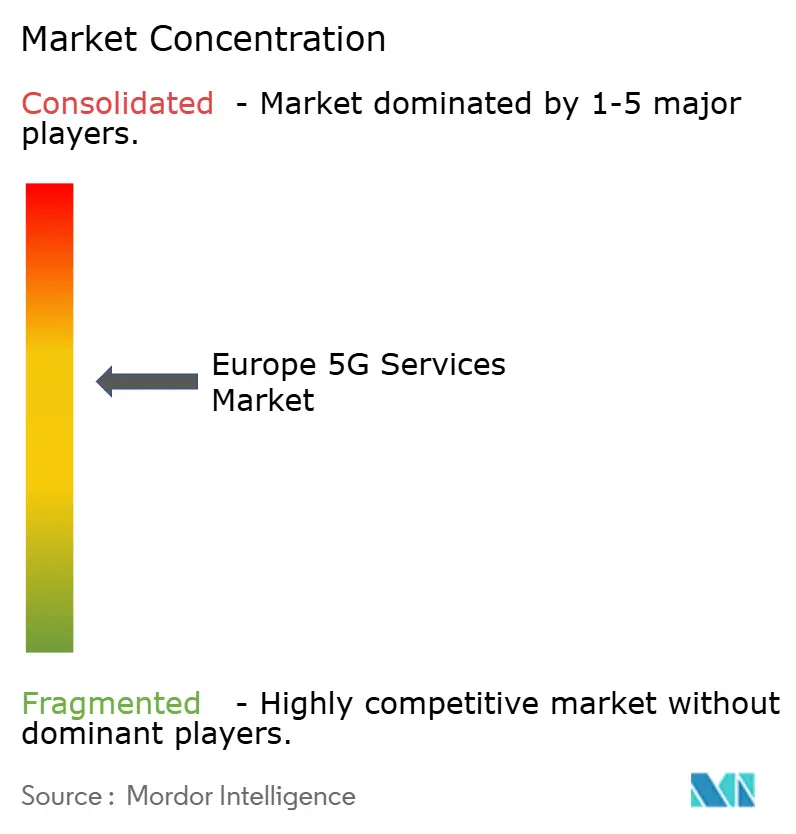
The Europe 5G Services market is moderately concentrated at the operator level, where Deutsche Telekom, Vodafone Group, Orange, Telefónica, and BT Group set important coverage, pricing, and enterprise-service benchmarks. These groups have the scale to finance standalone core systems, expand radio networks, and negotiate with equipment and cloud providers across more than one country. They also compete with national operators that rely on focused pricing, infrastructure sharing, or selected customer segments to develop their positions. The 5 largest operators demonstrated the European Edge Continuum in February 2026, a federated edge environment that lets enterprise applications work across their combined networks. The project was developed through the IPCEI-CIS program and provides a single entry point for enterprise application deployment across participating networks.
This form of cooperation does not remove competition among the operators. It gives them a shared platform layer while they continue to compete on commercial terms, customer relationships, coverage quality, and their ability to support enterprise workloads. The Europe 5G Services market also has room for system integrators, cloud-native application providers, and managed-service companies that can help customers use the federated network environment. The equipment layer is becoming more diverse as operators adopt Open RAN and virtualized radio technology. Vodafone selected Samsung as a primary Open RAN partner in October 2025, with a 5-year program covering thousands of German sites and planned expansion to other European markets.
Orange expanded its Samsung vRAN and Open RAN collaboration in 2026, while Deutsche Telekom requested quotations for 30,000 Open RAN sites outside Germany in January 2026. These moves broaden the supplier base and reduce reliance on a small group of traditional equipment vendors. They also create opportunities for software providers, integration partners, and network-management specialists that can operate multivendor environments. ETSI specifications and 3GPP standardization work provide common technical requirements for these deployments, which is important when operators combine equipment from different providers. Cloud providers are also competing to host and manage core-network functions for European operators.
O2 Telefónica placed production-scale 5G core functions on AWS Outposts in its German data center in March 2026, combining Nokia software with cloud infrastructure.[5]Amazon Web Services, “O2 Telefónica Brings 5G Cloud Core to Own Data Center with Nokia and AWS Outposts,” Amazon Web Services, press.aboutamazon.com The arrangement shows how operators can introduce cloud technology inside their own data-center environments while keeping core functions close to the network. Cellnex’s neutral-host tower model gives smaller operators a way to add density without taking on the full cost of new passive infrastructure. Telia and Telenor compete in Scandinavian markets through IoT, maritime connectivity, and network resilience suited to local operating conditions. Network slicing remains a commercial area of focus because it lets operators define service performance for enterprise contracts. These supplier, cloud, and operator strategies give the Europe 5G Services market a wider competitive field than a review of mobile operators alone would suggest, since customers can choose services that combine network access, managed operations, local processing, application support, and infrastructure sharing according to their operating requirements, and because the Europe 5G Services market increasingly depends on coordination between operators, equipment suppliers, cloud providers, and enterprise technology partners
Europe 5G Services Industry Leaders
Deutsche Telekom AG
Vodafone Group Plc
Orange S.A.
Telefónica, S.A.
BT Group plc
- *Disclaimer: Major Players sorted in no particular order

Recent Industry Developments
- August 2026: Italy's Ministry of Enterprises and Made in Italy published the auction notice for the lower 26 GHz spectrum band, covering 5 national lots and 42 regional and provincial lots. The combined reserve price is approximately EUR 180.08 million, or USD 198.09 million. The auction framework provides for 15-year usage rights, with extension possibilities under the applicable regulatory framework, establishing a long-term regulatory foundation for 5G and FWA investment in Italy.
- March 2026: TIM and Fastweb+Vodafone signed a non-binding agreement for the joint construction and management of up to 6,000 new passive tower infrastructure sites across Italy, with both operators serving as anchor tenants. The project is designed to improve operational efficiency and align costs with the European average while accelerating 5G rollout in Italy.
- March 2026: O2 Telefónica became the first telecommunications operator worldwide to migrate production-scale 5G core network functions to AWS Outposts deployed within its own data center in Germany, using Nokia's 5G core technology on AWS infrastructure. The deployment strengthens network resilience and flexibility and supports Telefónica's transition toward a hybrid cloud-native network architecture.
- February 2026: Deutsche Telekom, Orange, Telefónica, TIM, and Vodafone demonstrated the European Edge Continuum at Mobile World Congress 2026. The live federated edge cloud connected the five operators and incorporated platform components developed under the EU IPCEI-CIS program. The federation enables enterprise applications to be deployed across the operators' combined network footprint through a single entry point.


Europe 5G Services Market Report Scope
The Europe 5G Services Market Report is Segmented by Service Type (Enhanced Mobile Broadband, Ultra-Reliable Low-Latency Communications, Massive Machine-Type Communications, Fixed Wireless Access), Network Architecture (Non-Standalone 5G, Standalone 5G), Frequency Band (Low Band, Mid Band, Millimeter-Wave), End-User Industry (IT and Telecom, Automotive, Mobility and Transportation, Manufacturing, Energy and Utilities, Healthcare and Life Sciences, Banking, Financial Services, Insurance and RegTech, Retail, Media and E-Commerce, Government, Defense, Education and Public Sector, Other Industries), Application (Communication and Collaboration, Asset Tracking, Smart Cities, Smart Buildings, Autonomous Vehicles and Vehicle-to-Everything, Smart Healthcare, Industry 4.0, Smart Utilities, Immersive Media and Gaming, Public Safety and Mission-Critical Communications), and Geography (Germany, UK, France, Italy, Spain, Russia, Rest of Europe). The Market Forecasts are Provided in Terms of Value (USD).
| Enhanced Mobile Broadband |
| Ultra-Reliable Low-Latency Communications |
| Massive Machine-Type Communications |
| Fixed Wireless Access |
| Non-Standalone 5G |
| Standalone 5G |
| Low Band |
| Mid Band |
| Millimeter-Wave |
| IT and Telecom |
| Automotive, Mobility and Transportation |
| Manufacturing, Energy and Utilities |
| Healthcare and Life Sciences |
| Banking, Financial Services, Insurance and RegTech |
| Retail, Media and E-Commerce |
| Government, Defense, Education and Public Sector |
| Other End-User Industries |
| Communication and Collaboration |
| Asset Tracking |
| Smart Cities |
| Smart Buildings |
| Autonomous Vehicles and Vehicle-to-Everything |
| Smart Healthcare |
| Industry 4.0 |
| Smart Utilities |
| Immersive Media and Gaming |
| Public Safety and Mission-Critical Communications |
| Germany |
| United Kingdom |
| France |
| Italy |
| Spain |
| Russia |
| Rest of Europe |
| By Service Type | Enhanced Mobile Broadband |
| Ultra-Reliable Low-Latency Communications | |
| Massive Machine-Type Communications | |
| Fixed Wireless Access | |
| By Network Architecture | Non-Standalone 5G |
| Standalone 5G | |
| By Frequency Band | Low Band |
| Mid Band | |
| Millimeter-Wave | |
| By End-User Industry | IT and Telecom |
| Automotive, Mobility and Transportation | |
| Manufacturing, Energy and Utilities | |
| Healthcare and Life Sciences | |
| Banking, Financial Services, Insurance and RegTech | |
| Retail, Media and E-Commerce | |
| Government, Defense, Education and Public Sector | |
| Other End-User Industries | |
| By Application | Communication and Collaboration |
| Asset Tracking | |
| Smart Cities | |
| Smart Buildings | |
| Autonomous Vehicles and Vehicle-to-Everything | |
| Smart Healthcare | |
| Industry 4.0 | |
| Smart Utilities | |
| Immersive Media and Gaming | |
| Public Safety and Mission-Critical Communications | |
| By Geography | Germany |
| United Kingdom | |
| France | |
| Italy | |
| Spain | |
| Russia | |
| Rest of Europe |


Key Questions Answered in the Report
What is the size of the Europe 5G Services market?
The Europe 5G Services market is projected at USD 26.12 billion in 2026 and is forecast to reach USD 63.41 billion by 2031, at a 19.41% CAGR. Its outlook depends on standalone deployment and enterprise service adoption.
Which 5G service type has the largest revenue base in Europe?
Enhanced mobile broadband held 62.72% of service type revenue in 2025, supported by consumer and enterprise connectivity use. Fixed wireless access also extends this service to addresses outside fiber coverage.
Why is standalone 5G important for European operators?
Standalone 5G supports network slicing, low-latency services, edge computing, and private connectivity for enterprise users. It is expected to expand at a 20.32% CAGR through 2031.
Which end users are expected to adopt 5G services fastest?
Manufacturing, energy, and utilities is projected to expand at a 20.31% CAGR through 2031, supported by industrial automation use cases. Private networks are relevant to connected assets and production processes.
Which geography is expected to expand fastest through 2031?
Rest of Europe is projected to expand at a 20.59% CAGR, supported by infrastructure programs and improving 5G adoption. The group includes Nordic, Benelux, and Central and Eastern European countries.
What limits wider 5G deployment across Europe?
High investment requirements, long return periods, and fragmented national spectrum rules limit the speed of deployment. These issues can delay high-capacity services and cross-border planning.
Page last updated on:





