
Ethylene Dichloride Market Size and Share
Market Overview
| Study Period | 2021 - 2031 |
|---|---|
| Market Size (2026) | USD 23.11 Billion |
| Market Size (2031) | USD 27.21 Billion |
| Growth Rate (2026 - 2031) | 3.32 % |
| Fastest Growing Market | Asia-Pacific |
| Largest Market | Asia-Pacific |
| Market Concentration | Medium |
Major Players *Disclaimer: Major Players sorted in no particular order Image © Mordor Intelligence. Reuse requires attribution under CC BY 4.0. | |
Ethylene Dichloride Market Analysis by Mordor Intelligence
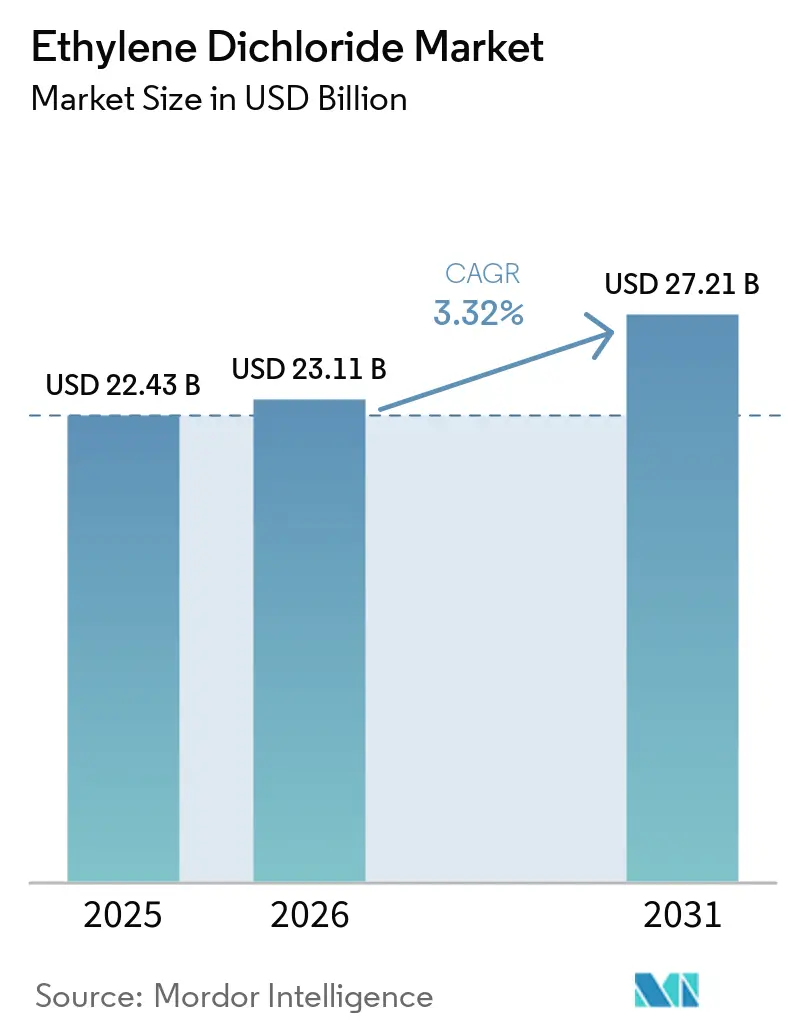
The Ethylene Dichloride market size was estimated at USD 22.43 billion in 2025 and is estimated to grow from USD 23.11 billion in 2026 to USD 27.21 billion by 2031, at a CAGR of 3.32% during the forecast period (2026-2031). Ethylene dichloride is primarily an intermediate in vinyl chloride monomer (VCM) production, so demand follows consumption of polyvinyl chloride (PVC) in construction, automotive, packaging, and healthcare applications. Construction spending in emerging economies supports demand for PVC pipes, conduits, and profiles through public utility programs, not just housing activity. Chlorinated solvents represent a second source of demand outside the VCM chain, particularly in pharmaceutical manufacturing and electronics cleaning, where high-purity materials are required. Producers with integrated chlor-alkali, EDC, VCM, and PVC operations manage feedstock, logistics, and product flows more effectively than standalone merchant suppliers. New integrated projects in the United States, the Middle East, and Southeast Asia are shifting regional supply positions and reducing the role of spot trade in the ethylene dichloride market.
Key Report Takeaways
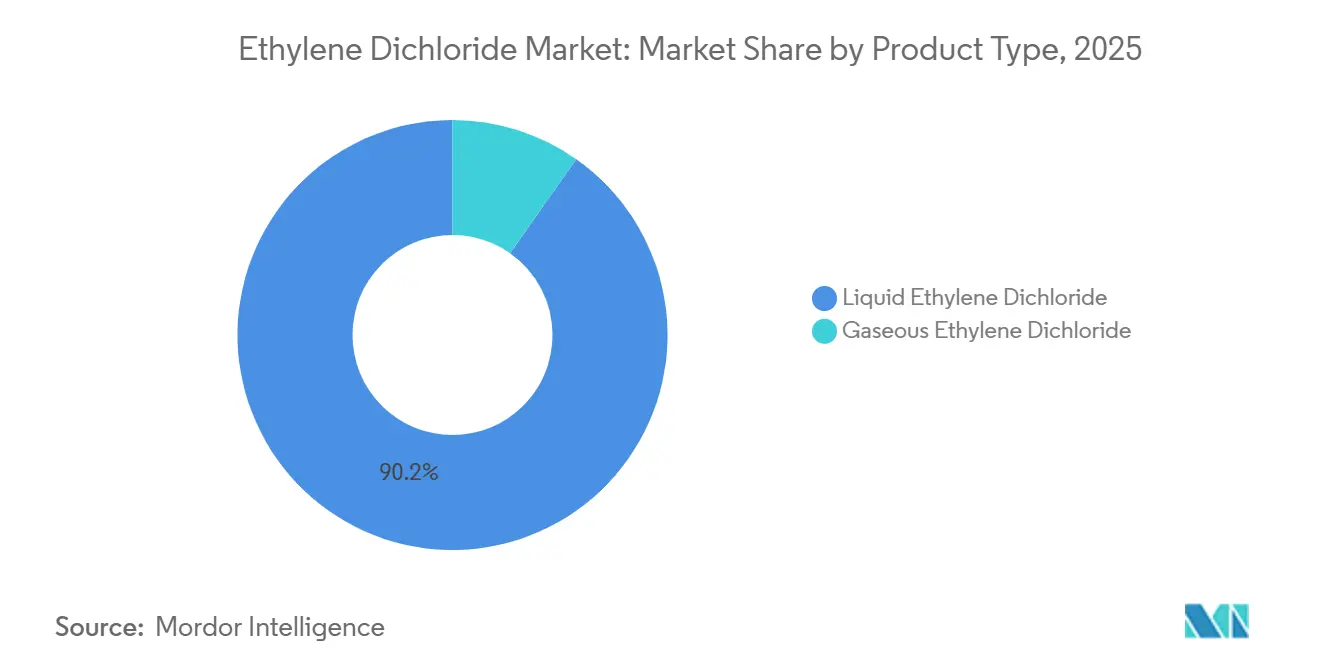
- By product type, Liquid Ethylene Dichloride (EDC) held 90.23% of global revenue in 2025 and is projected to grow at a 3.67% CAGR through 2031.
- By application, VCM production accounted for 80.12% of global revenue in 2025, while chlorinated solvents are forecast to grow at a 4.15% CAGR through 2031.
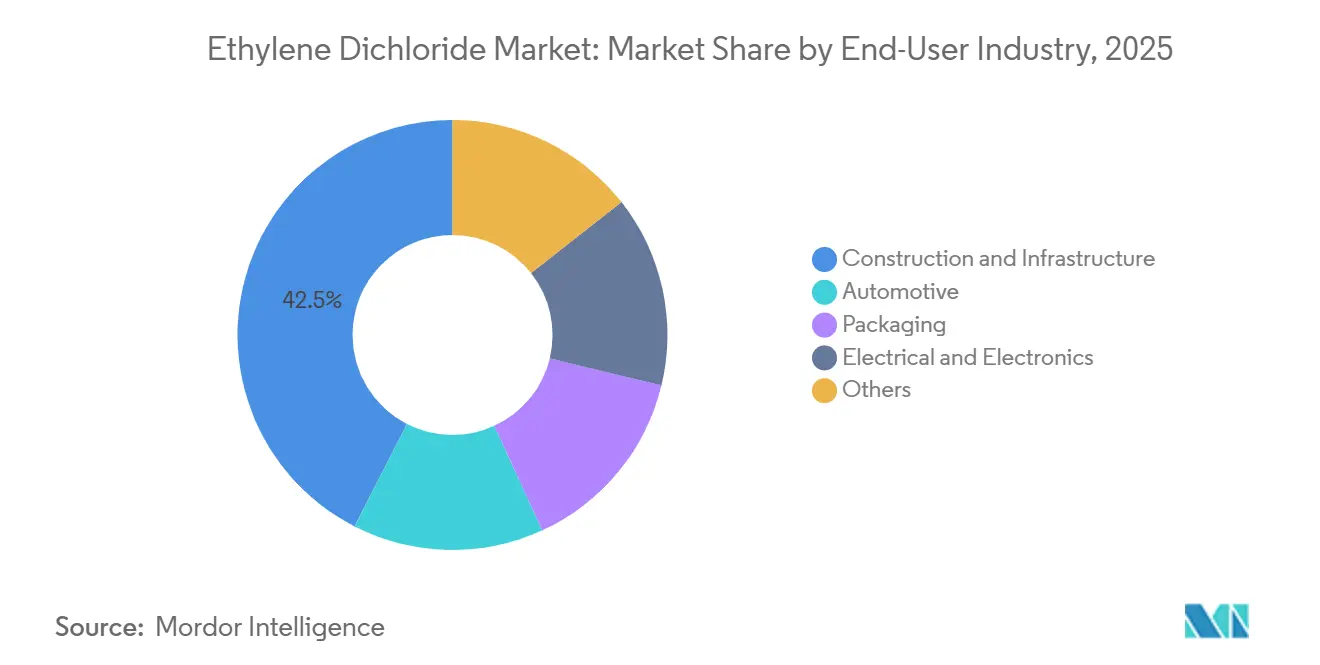
- By end-user industry, construction and infrastructure held 42.47% of global revenue in 2025, while automotive applications are forecast to expand at a 4.23% CAGR through 2031.
- By geography, Asia-Pacific accounted for 44.16% of global revenue in 2025 and is projected to grow at a 3.88% CAGR through 2031.
Note: Market size and forecast figures in this report are generated using Mordor Intelligence’s proprietary estimation framework, updated with the latest available data and insights as of January 2026.
Market Trends and Insights
Drivers Impact Analysis of Ethylene Dichloride Market*
| Drivers | (~) % Impact on CAGR Forecast | Geographic Relevance | Impact Timeline |
|---|---|---|---|
| PVC Demand from Construction, Infrastructure, and Utilities | +0.8% | Global; concentrated in APAC, South America, the Middle East, and Africa (MEA) | Long term (≥ 4 years) |
| PVC Demand from Automotive Lightweighting and Electrification | +0.4% | APAC core; spillover to Europe and North America | Medium term (2-4 years) |
| Asia-Pacific Industrialization and Integrated Vinyl-Chain Expansion | +0.7% | Asia-Pacific; secondary spillover to the Middle East | Long term (≥ 4 years) |
| Packaging and Healthcare Demand for PVC-Based Products | +0.3% | Global; concentrated in APAC and Europe | Medium term (2-4 years) |
| Integrated Chlor-Alkali, EDC, VCM, and PVC Capacity Optimization | +0.5% | Global; new capacity concentrated in the Middle East and Africa (MEA) and Southeast Asia | Long term (≥ 4 years) |
| Closed-Loop HCl Recycling and Heat Integration Improving EDC Economics | +0.3% | Global; significant uptake in ethylene-route-dominant regions | Medium term (2-4 years) |
| Source: Mordor Intelligence | |||
PVC Demand from Construction, Infrastructure, and Utilities
Construction and utility networks consume substantial EDC through the PVC value chain. Rigid PVC is used in pressure pipes, drainage systems, electrical conduit, and window profiles, keeping demand tied to basic infrastructure needs. Public spending on water management, drainage, and grid expansion in South and Southeast Asia supports multi-year PVC procurement. These projects differ from private housing demand, as they are backed by public capital allocations and essential service requirements. PVC pipe and conduit also support maintenance and replacement work, broadening their demand base beyond new construction. This makes the ethylene dichloride market responsive to the pace of municipal investment and infrastructure delivery rather than to a single construction cycle.
PVC Demand from Automotive Lightweighting and Electrification
Vehicle electrification increases demand for insulated wiring and interior materials that use PVC. Battery-electric vehicles require more complex wiring systems, including high-voltage harnesses with insulation across larger cable assemblies. This demand passes upstream through the VCM and PVC chain to the ethylene dichloride market. PVC synthetic leather also supports interior applications in high-volume vehicle production. Automotive manufacturers require materials that meet thermal, mechanical, and processing specifications while addressing lower-emission procurement requirements.
Asia-Pacific Industrialization and Integrated Vinyl-Chain Expansion
Asia-Pacific is adding chlor-alkali and vinyl-chain capacity as its domestic consumption base expands. Chandra Asri's CA-EDC project in Cilegon was 72% complete as of July 2026 and is designed to produce 500,000 tons per year of EDC and 827,000 tons per year of liquid caustic soda. The project aims to reduce Indonesia's reliance on imported EDC and establish an integrated supply position within the regional chain. Danantara Indonesia and the Indonesia Investment Authority supported the project through a partnership with Chandra Asri Group in March 2026. New capacity brings EDC production closer to downstream PVC manufacturing and reduces exposure to long-distance supply routes[1]Danantara Indonesia, “Danantara Indonesia, Indonesia Investment Authority, and Chandra Asri Group Partner to Boost Chemical Industry and Drive Economic Growth,” Press Release, danantaraindonesia.co.id.
Integrated Chlor-Alkali, EDC, Vinyl Chloride Monomer (VCM), and PVC Capacity Optimization
Integrated plants connect chlorine, ethylene, EDC, VCM, and PVC operations into a single production system, reducing exposure to external feedstock purchases and logistics costs between intermediate steps. Shintech announced a USD 3.4 billion expansion at Plaquemine, Louisiana, including a second ethylene unit, a fourth VCM plant, and additional chlor-alkali capacity. The project includes 625,000 tons per year of ethylene, 500,000 tons per year of VCM, and 310,000 tons per year of caustic soda capacity, with completion targeted by end of 2030. These investments reinforce the US Gulf Coast as an integrated production location for the ethylene dichloride market and place greater pressure on standalone EDC operations that lack captive feedstock or downstream demand.
Restraints Impact Analysis of Ethylene Dichloride Market*
| Restraints | (~) % Impact on CAGR Forecast | Geographic Relevance | Impact Timeline |
|---|---|---|---|
| Environmental and Occupational Restrictions on Chlorinated Hydrocarbons | -0.5% | North America and the EU; spillover to APAC | Medium term (2-4 years) |
| Ethylene and Chlorine Feedstock Price Volatility | -0.4% | Global; most acute in non-integrated merchant segments | Short term (≤ 2 years) |
| Energy Intensity and Carbon-Cost Exposure in Chlor-vinyls Operations | -0.3% | EU and North America with carbon pricing; emerging in APAC | Long term (≥ 4 years) |
| Chlorine-Imbalance, Plant-Outage, and Hazardous-Logistics Risk | -0.2% | Global; acute in import-dependent South Asia and Southeast Asia (SEA) | Short term (≤ 2 years) |
| Source: Mordor Intelligence | |||
Environmental and Occupational Restrictions on Chlorinated Hydrocarbons
Regulatory scrutiny of chlorinated compounds is raising operating and compliance requirements for producers. The US Environmental Protection Agency (EPA) finalized its risk evaluation for 1,1-dichloroethane in June 2025 and found an unreasonable risk to human health, initiating a rulemaking process under the Toxic Substances Control Act. This action concerns a related chemical rather than Ethylene Dichloride (EDC), but it reflects the broader attention being applied to chlorinated hydrocarbon exposure pathways. The EPA and the Occupational Safety and Health Administration (OSHA) also established a chemical-safety coordination arrangement that increases focus on workplace handling and risk management. In Europe, the Registration, Evaluation, Authorization and Restriction of Chemicals (REACH) framework continues to shape documentation and market-access requirements for chemical intermediates. Larger integrated sites are generally better positioned to fund enclosed handling systems, vapor controls, and other improvements needed to support reliable operation in the EDC market[2]European Commission, “REACH Regulation (EC) No 1907/2006,” EUR-Lex, eur-lex.europa.eu.
Ethylene and Chlorine Feedstock Price Volatility
EDC production depends on both ethylene and chlorine, and their cost movements do not always align. Ethylene prices are affected by broader olefin market conditions, including cracker margins, energy costs, and feedstock availability. Chlorine has limited flexibility in storage and transport, so chlor-alkali operating rates must remain closely tied to downstream chlorine demand. This creates periods when merchant production faces cost pressures even when PVC demand remains stable. Long-term supply arrangements can reduce exposure to short-term price changes, but annual contract negotiations still affect purchasing costs and producer margins. Integrated operations can use their own chlorine and downstream vinyl capacity more effectively, making feedstock control an important factor in the EDC market.
*Our forecasts treat driver/restraint impacts as directional, not additive. The impact forecasts reflect baseline growth, mix effects, and variable interactions.
Ethylene Dichloride Market Segment Analysis
By Product Type:
Liquid Form Underpins Vinyl Chain Feedstock EconomicsLiquid EDC held 90.23% of the ethylene dichloride market share in 2025, reflecting its central role in commercial VCM production. Large VCM pyrolysis furnaces are designed for continuous liquid feed, and their operating design limits the practical role of gaseous material at scale. The ethylene dichloride market size for liquid EDC is projected to grow at a 3.67% CAGR through 2031. New integrated projects are being designed around liquid-phase feed systems, giving this format a lasting infrastructure advantage. Liquid handling systems are already embedded in the logistics and storage arrangements of large vinyl complexes. This alignment between plant design and supply logistics makes liquid EDC difficult to replace in most high-volume applications.
A heat-integrated VCM process study published in 2026 reported a 15.5% reduction in net external energy demand compared with the baseline configuration. The reported gains were linked to heat integration in liquid-phase processing arrangements, supporting plant-level efforts to lower energy demand while maintaining established liquid-feed operations. Gaseous EDC retains a role in selected specialty solvent and adhesive applications, where high-purity supply and handling requirements differ from those of bulk VCM production. Its smaller addressable base limits its influence on the overall product mix. Each new VCM plant built for liquid feed strengthens the installed infrastructure that supports liquid EDC demand in the ethylene dichloride industry.



By Application:
VCM Production Anchors, Solvents Lead the Growth PivotVCM production accounted for 80.12% of global application revenue in 2025, making it the dominant use of EDC. The ethylene dichloride market remains closely linked to PVC output because VCM is the immediate precursor to PVC. Chlorinated solvents are forecast to grow at a CAGR of 4.15% through 2031, supported by demand from pharmaceutical active ingredient synthesis, electronics cleaning, precision metal degreasing, and agrochemical production. These applications offer producers a route to serve end uses beyond the primary VCM chain, though they require appropriate purification, specification control, and handling capabilities.
Ethylene amines use ethylene dichloride (EDC) as an intermediate for water-treatment chemicals, corrosion inhibitors, and agricultural chemicals, providing an additional outlet for integrated producers seeking to reduce dependence on VCM-related demand. The other applications category includes refrigerant synthesis, specialty polymer intermediates, and laboratory-grade solvents. These uses are smaller in output but can provide demand that is less tied to construction and automotive activity. Solvent demand is increasingly associated with pharmaceutical and electronics manufacturing locations in Asia. Producers that can supply both VCM-grade and solvent-grade products can use the same regional infrastructure while serving different customer requirements. This application mix gives the ethylene dichloride industry a limited but useful source of diversification from the primary vinyl chain.
By End-User Industry:
Construction Anchors Demand, Automotive Leads the Growth FrontierConstruction and infrastructure accounted for 42.47% of global revenue by end user in 2025, the largest end-user share in the ethylene dichloride market. Polyvinyl chloride (PVC) demand comes from pressure pipes, drainage systems, window profiles, cable conduit, and roofing products used in both new projects and repair work. The automotive segment is forecast to grow at a 4.23% CAGR through 2031, supported by higher use of PVC insulation in wiring harnesses, synthetic leather in interiors, and protective coatings. Construction retains broad demand because water networks, drainage systems, power systems, and buildings all use PVC. The ethylene dichloride market size linked to construction is therefore supported by both public infrastructure spending and private construction activity.
Packaging demand includes food-grade film, rigid packaging, and pharmaceutical blister packs. PVC's clarity, barrier performance, and thermoformability remain relevant in applications where cost and processing performance are important. Electrical and electronics users consume PVC for cable insulation and conduit in data centers, renewable energy installations, and grid modernization projects, connecting EDC demand to broader investments in power and digital infrastructure. The other end-user category includes irrigation tubing, consumer goods, and footwear, which provide additional output outside major industrial sectors. Vehicle electrification does not eliminate PVC demand because it adds electrical insulation and interior-material requirements that offset some of the reduced use in conventional vehicle systems.
Geography Analysis
APAC Ethylene Dichloride Market
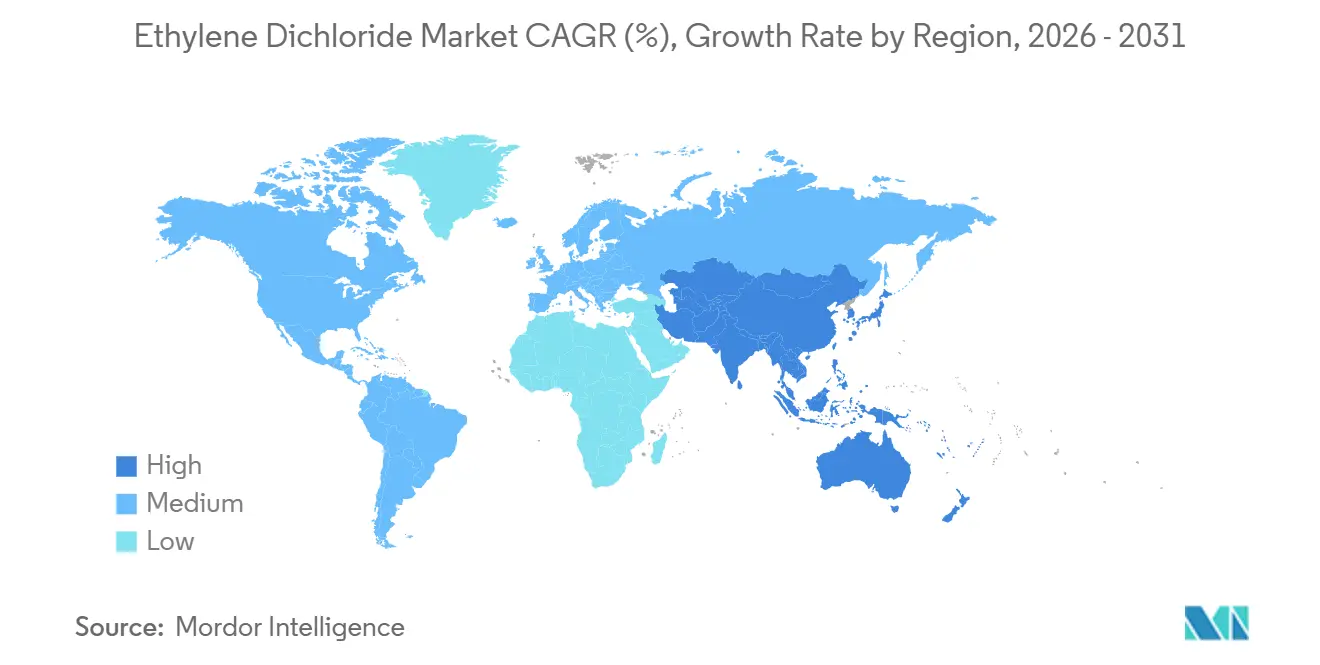
Asia-Pacific accounted for 44.16% of the ethylene dichloride (EDC) market share in 2025 and is forecast to grow at a 3.88% CAGR through 2031. The region combines large PVC consumption with new investment in integrated chlor-alkali and vinyl-chain capacity. Indonesia is developing an EDC supply base through the CA-EDC project in Cilegon, aimed at reducing reliance on imported materials. Thailand has also added capacity through AGC Vinythai's expanded chlor-alkali facility, which supports PVC production in Southeast Asia. Regional producers are improving supply links between chlorine production, EDC, VCM, and downstream PVC conversion. This combination of local demand and integrated capacity supports a more self-contained regional EDC market.
North America and Europe Ethylene Dichloride Market
North America remains an important export source, as integrated complexes in Texas and Louisiana benefit from access to ethane-based feedstock. Shintech's announced expansion in Louisiana adds capacity across ethylene, VCM, and chlor-alkali operations, strengthening its integrated position. In December 2025, Westlake announced the rationalization of certain North American chlorovinyl and styrene assets, including 910 million pounds per year of VCM capacity. This action concentrates activity in more efficient facilities and addresses excess capacity in the region. Europe faces a more challenging operating environment, as energy costs, carbon exposure, and chemical compliance requirements weigh on marginal assets. Westlake Vinnolit completed its acquisition of the Wilhelmshaven PVC and VCM plants in June 2026 for USD 109 million, illustrating how established operators are using distressed-asset transactions to retain integrated production positions.
South America and MEA Ethylene Dichloride Market
South America has a substantial PVC demand base, with Brazil remaining central to regional vinyl consumption. In November 2025, Olin announced a long-term EDC supply partnership with Braskem, directing supply into a structured commercial relationship rather than the spot market. This arrangement provides Braskem with more stable access to raw materials while reducing Olin's exposure to merchant selling. The Middle East and Africa are smaller regional markets but have significant construction-related PVC demand driven by housing and infrastructure programs. The region is also receiving investment in integrated chemical production, which could alter its future position in trade flows. Supply reliability remains important for buyers that depend on imported EDC, making diversification of supply routes a continuing priority in the EDC market.

Competitive Landscape
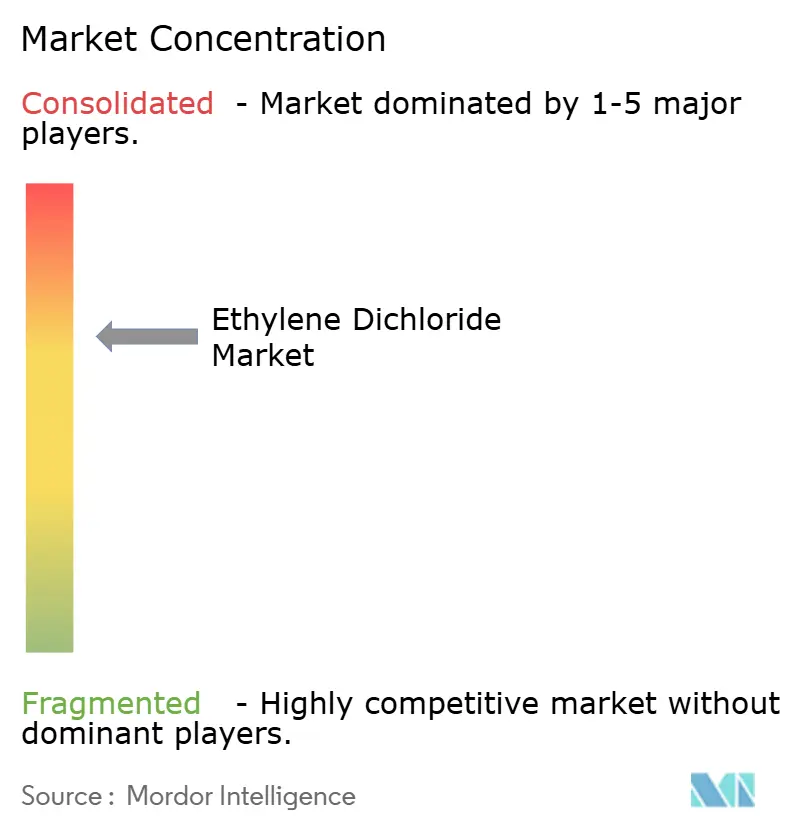
The Ethylene Dichloride (EDC) market is moderately consolidated among producers that combine chlor-alkali, EDC, Vinyl Chloride Monomer (VCM), and Polyvinyl Chloride (PVC) operations. Feedstock access, integrated logistics, and scale determine the relative position of these companies. Merchant sales are becoming less central as producers direct material into affiliated downstream operations or long-term customer arrangements. Olin ended its Blue Water Alliance joint venture with Mitsui in September 2025 as part of its strategic plan and subsequently announced a supply partnership with Braskem. These actions reflect a preference for structured value-chain relationships over open-market spot sales. Integrated producers can deploy chlorine and EDC across linked assets, helping them manage chlorine balance and storage constraints.
Consolidation is also reshaping the competitive structure in Europe. Westlake Vinnolit completed the acquisition of the Vynova Wilhelmshaven PVC and VCM site in June 2026, adding 380,000 tons per year of PVC capacity and 400,000 tons per year of VCM capacity. The site includes a deep-water logistics dock, which strengthens Westlake's manufacturing and distribution position in Europe. In 2025, INEOS Inovyn agreed to acquire the United Kingdom's only EDC production asset from administration, bringing the Runcorn chlor-alkali and EDC chain under a single operator. These transactions indicate that larger integrated companies are absorbing assets that can be operated within broader production systems.
Specialty-grade EDC for pharmaceutical solvents, ethylene amines, and agrochemical intermediates remains an opportunity for producers with suitable purification and handling capabilities. These applications differ from commodity VCM-grade requirements and can provide additional outlets for integrated plants. Operators without captive ethylene or downstream product demand remain more exposed to feedstock costs and product price movements. Technology also affects the operating cost gap between new and older facilities. AGC Vinythai commissioned an expanded chlor-alkali plant in Thailand in February 2026, equipped with e-BiTAC electrolyzers supplied by Thyssenkrupp Nucera. The installation supports lower-energy chlor-alkali production and forms part of AGC Vinythai's broader capacity expansion. Investment is therefore moving toward efficient, compliant, and integrated sites that can serve the EDC market through multiple linked product channels.
Ethylene Dichloride Industry Leaders
Occidental Chemical Corporation
Westlake Corporation
Formosa Plastics Corporation
INEOS
Olin Corporation
- *Disclaimer: Major Players sorted in no particular order
Ethylene Dichloride Market Companies Covered in this Report
- Asahimas Chemical Company
- Chandra Asri Group
- Egyptian Petrochemicals Company
- Formosa Plastics Corporation
- Hanwha Solutions Corporation
- INEOS
- KOYO KAIUN Co., Ltd.
- Occidental Chemical Corporation
- Olin Corporation
- SABIC
- Shin-Etsu Chemical Co., Ltd.
- Tosoh Corporation
- Vynova Group
- Westlake Corporation
- Xinjiang Zhongtai Chemical Co., Ltd.

Recent Industry Developments in Ethylene Dichloride Market
- June 2026: Westlake Corporation's German subsidiary acquired the Vynova Wilhelmshaven PVC and VCM production site for USD 109 million through insolvency proceedings, adding 380,000 tons/year of PVC capacity and 400,000 tons/year of VCM capacity to its European manufacturing footprint, along with a deep-water logistics dock.
- March 2026: Shintech, the US subsidiary of Shin-Etsu Chemical, announced a USD 3.4 billion integrated expansion at its Plaquemine, Louisiana complex, including a second ethylene unit with 625,000 tons/year capacity, a fourth VCM plant with 500,000 tons/year capacity, and additional chlor-alkali capacity with 310,000 tons/year of caustic soda, with all phases targeted for completion by the end of 2030.


Global Ethylene Dichloride Market Report Scope
Ethylene dichloride (EDC) is a clear, colorless, oily liquid with a sweet, chloroform-like odor. It is a toxic and flammable synthetic compound primarily used to produce vinyl chloride, which is used to manufacture PVC plastic products.
The ethylene dichloride market is segmented by product type, application, end-user industry, and geography. By product type, the market is segmented into liquid ethylene dichloride and gaseous ethylene dichloride. By application, the market is segmented into vinyl chloride monomer (VCM) production, ethylene amines, chlorinated solvents, and others. By end-user industry, the market is segmented into construction and infrastructure, automotive, packaging, electrical and electronics, and others. The report also covers market size and forecasts for the ethylene dichloride across 15 countries in major regions. The market sizes and forecasts are provided in terms of value (USD).
| Liquid Ethylene Dichloride |
| Gaseous Ethylene Dichloride |
| Vinyl Chloride Monomer (VCM) Production |
| Ethylene Amines |
| Chlorinated Solvents |
| Others |
| Construction and Infrastructure |
| Automotive |
| Packaging |
| Electrical and Electronics |
| Others |
| Asia-Pacific | China |
| India | |
| Japan | |
| South Korea | |
| ASEAN Countries | |
| Rest of Asia-Pacific | |
| North America | United States |
| Canada | |
| Mexico | |
| Europe | Germany |
| United Kingdom | |
| France | |
| Italy | |
| NORDIC Countries | |
| Rest of Europe | |
| South America | Brazil |
| Argentina | |
| Rest of South America | |
| Middle East and Africa | Saudi Arabia |
| South Africa | |
| Rest of Middle East and Africa |
| By Product Type | Liquid Ethylene Dichloride | |
| Gaseous Ethylene Dichloride | ||
| By Application | Vinyl Chloride Monomer (VCM) Production | |
| Ethylene Amines | ||
| Chlorinated Solvents | ||
| Others | ||
| By End-User Industry | Construction and Infrastructure | |
| Automotive | ||
| Packaging | ||
| Electrical and Electronics | ||
| Others | ||
| By Geography | Asia-Pacific | China |
| India | ||
| Japan | ||
| South Korea | ||
| ASEAN Countries | ||
| Rest of Asia-Pacific | ||
| North America | United States | |
| Canada | ||
| Mexico | ||
| Europe | Germany | |
| United Kingdom | ||
| France | ||
| Italy | ||
| NORDIC Countries | ||
| Rest of Europe | ||
| South America | Brazil | |
| Argentina | ||
| Rest of South America | ||
| Middle East and Africa | Saudi Arabia | |
| South Africa | ||
| Rest of Middle East and Africa | ||


Key Questions Answered in the Report
What is current market size of Ethylene Dichloride Market?
The Ethylene Dichloride market size was estimated at USD 22.43 billion in 2025 and is estimated to grow from USD 23.11 billion in 2026 to USD 27.21 billion by 2031, at a CAGR of 3.32% during the forecast period (2026-2031).
Which product form has the largest role in the Ethylene Dichloride market?
Liquid EDC held 90.23% of global revenue in 2025 because large VCM plants are designed for continuous liquid-feed operations.
Which application is growing fastest for ethylene dichloride?
Chlorinated solvents are forecast to grow at a 4.15% CAGR through 2031, supported by pharmaceutical, electronics, and chemical processing uses.
Which end-user sector is expected to expand fastest?
Automotive applications are forecast to grow at a 4.23% CAGR through 2031 because electric vehicles require more PVC-insulated wiring and interior materials.
Page last updated on:





