
Equipment Finance Market Size and Share
Market Overview
| Study Period | 2020 - 2031 |
|---|---|
| Market Size (2026) | USD 1.60 Trillion |
| Market Size (2031) | USD 2.10 Trillion |
| Growth Rate (2026 - 2031) | 5.60 % |
| Fastest Growing Market | Asia-Pacific |
| Largest Market | North America |
| Market Concentration | Low |
Major Players *Disclaimer: Major Players sorted in no particular order Image © Mordor Intelligence. Reuse requires attribution under CC BY 4.0. | |
Equipment Finance Market Analysis by Mordor Intelligence
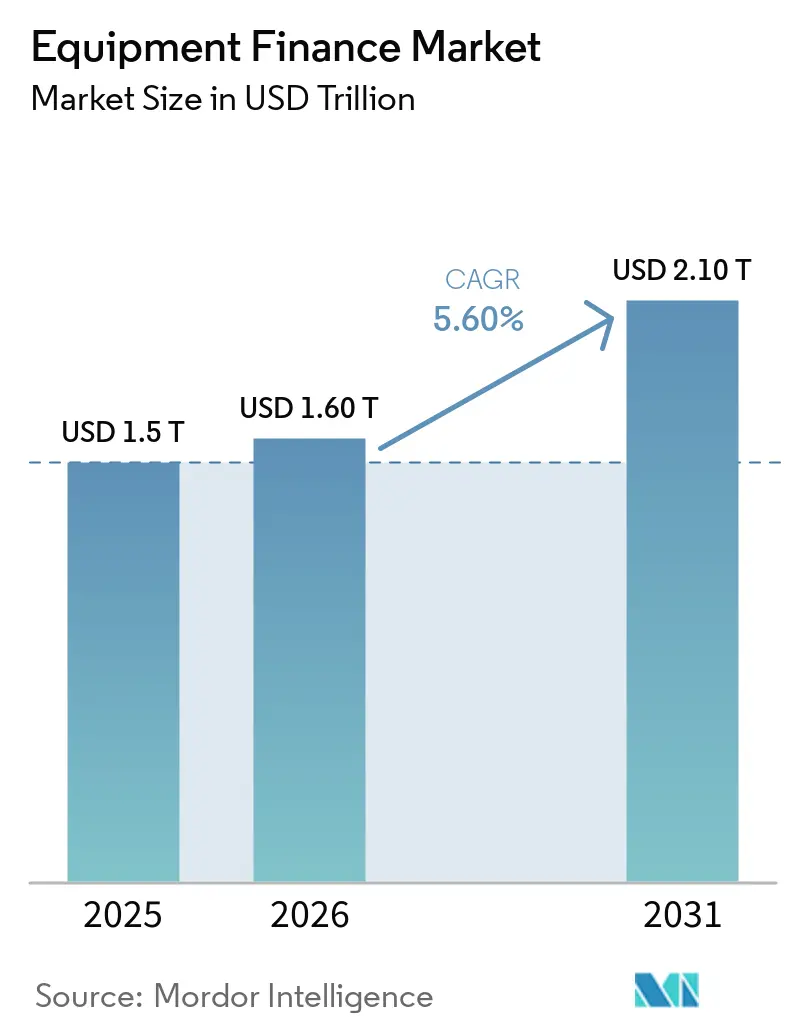
The Equipment Finance Market size is expected to increase from USD 1.5 trillion in 2025 to USD 1.60 trillion in 2026 and reach USD 2.10 trillion by 2031, growing at a CAGR of 5.60% over 2026-2031.
Demand is being supported by investment in artificial intelligence infrastructure, manufacturing capacity, energy systems, and replacement equipment. Financing providers are responding by placing greater weight on flexible lease structures, faster approval processes, and manufacturer-supported programs that can address the differing needs of large enterprises, mid-sized borrowers, dealers, and specialized asset users. Banks retain a large role because of their funding capacity and established commercial relationships, while independents and captives are competing for transactions that require greater speed or sector knowledge. Higher funding costs and uncertainty over asset values continue to limit pricing flexibility, particularly for operating leases and technology equipment, where the expected resale value and the timing of replacement remain central to the provider’s return on each transaction. The equipment finance market is therefore growing through a mix of large capital projects and recurring replacement needs across business equipment categories.
Key Report Takeaways
- By financing products, equipment loans, and title-finance products captured 47.6% of the equipment finance market share in 2025, while operating leases are projected to grow at 7.4% CAGR through 2031.
- By asset type, industrial, manufacturing, and materials-handling equipment captured 17.4% of the equipment finance market share in 2025, while IT, telecommunications, and office equipment are projected to grow at 9.2% CAGR through 2031.
- By end-user industry, manufacturing accounted for 21.7% of the equipment finance market size in 2025, while information and communications technology is projected to grow at 9.4% CAGR through 2031.
- By provider type, banks and bank-affiliated providers captured 56.2% of the equipment finance market size in 2025, while independent equipment finance companies are projected to grow at 7.2% CAGR through 2031.
- By geography, North America captured 39.8% of the equipment finance market in 2025, while Asia-Pacific is projected to grow at 7.1% CAGR through 2031.
Note: Market size and forecast figures in this report are generated using Mordor Intelligence’s proprietary estimation framework, updated with the latest available data and insights as of January 2026.
Global Equipment Finance Market Trends and Insights
Drivers Impact Analysis*
| Driver | (~) % Impact on CAGR Forecast | Geographic Relevance | Impact Timeline |
|---|---|---|---|
| Asset-Light Capital Allocation and Working-Capital Preservation | +1.2% | Global, most pronounced in North America and Western Europe | Medium term (2-4 years) |
| Equipment Replacement, Modernization, and Capital Investment | +1.5% | Global, AI-driven surge in North America, infrastructure-led in Asia-Pacific | Short term (≤ 2 years) |
| SME and Mid-Market Access to Asset-Backed Financing | +0.8% | Asia-Pacific core, with spillover to Europe and South America | Medium term (2-4 years) |
| OEM, Dealer, and Vendor-Supported Financing Programs | +0.9% | Global, with captive intensification in North America and the Asia-Pacific | Medium term (2-4 years) |
| Digitalization of Equipment Finance Origination and Underwriting | +0.6% | North America and Europe, with rapid uptake in the Asia-Pacific | Medium term (2-4 years) |
| Flexible Leasing and Usage-Based Equipment Models | +0.7% | Global, with the fastest behavioural shift in Europe | Long term (≥ 4 years) |
| Source: Mordor Intelligence | |||
Asset-Light Capital Allocation and Working-Capital Preservation
Businesses are reassessing whether equipment ownership remains the best use of available capital, a decision that is shaping demand across the equipment finance market. A BNP Paribas Leasing Solutions survey of more than 1,000 leaders across 11 European countries found that 95% believed equipment became outdated faster than 5 years ago. The same survey found that 60% considered capital tied up in assets a challenge, while only 17% still viewed ownership as central to competitiveness[1]BNP Paribas Leasing Solutions, “The European Business Equipment Outlook 2026,” BNP Paribas Leasing Solutions, leasingsolutions.bnpparibas.. Leasing and usage-based models can preserve liquidity for hiring, inventory, software, and other operating needs, allowing a business to align cash outflows with the revenue or cost savings expected from the equipment during its useful period. The equipment finance market benefits when finance teams compare the operating and financial effects of leasing against direct purchases, including the expected useful life of the asset, the effect on available credit capacity, the need for scheduled upgrades, and the practical role the equipment plays in daily operations. IFRS 16 and ASC 842 have also made lease classification a more deliberate financing decision for many borrowers, since finance teams must consider the accounting presentation, reporting effects, contractual terms, and practical operating needs of each equipment arrangement.
Growth in Equipment Replacement, Modernization, and Capital Investment
Artificial intelligence infrastructure is supporting a rapid increase in demand for financed technology and related physical assets. The Equipment Leasing and Finance Foundation recorded USD 14.3 billion in seasonally adjusted new business volume in July 2026, which it attributed to artificial intelligence-related investment[2]Equipment Leasing and Finance Association, “CapEx Finance Index July 2026,” Equipment Leasing and Finance Association, elfaonline.org.. The financing need extends beyond servers and networking equipment because data center projects also require power, cooling, construction, and materials-handling assets, bringing equipment manufacturers, dealers, banks, captives, and independent providers into the same investment cycle even though their financed assets serve different technical functions. This broad asset requirement links digital investment to several parts of the equipment finance market. Replacement cycles are becoming more important where equipment performance, energy use, or technology compatibility can affect business operations, because retaining an older asset can increase maintenance requirements, limit capacity, or reduce compatibility with newer production and digital systems.
Expanding SME and Mid-Market Access to Asset-Backed Financing
Public and private financing programs are widening access to equipment funding for small and mid-sized enterprises. The European Investment Fund and KfW supported the abcfinance Group in a transaction covering a EUR 500 million (USD 540 million) portfolio of more than 18,000 lease contracts. The transaction was designed to release more than EUR 380 million (USD 410.4 million) in new financing for vehicles, machinery, and equipment. Grenke AG and KfW launched their fourth joint global loan program in February 2026, providing EUR 200 million (USD 216 million) for SME investment in digitalization, climate protection, and infrastructure. The OECD reported that leasing activity increased in 15 of 24 reporting countries during 2024[3]OECD, “Financing SMEs and Entrepreneurs 2026,” OECD Publishing, oecd.org.. These programs can support specialist lenders that serve borrowers outside traditional bank channels, especially when a smaller business needs an asset-specific structure, a shorter decision process, or financing that preserves its existing working-capital facilities.
OEM, Dealer, and Vendor-Supported Financing Programs
Captive finance programs remain important because they connect equipment sales, dealer relationships, and funding options at the point of purchase. Caterpillar Financial Services reported USD 991 million in second-quarter 2026 revenue, compared with USD 899 million in the second quarter of 2025. ELFA reported that captive activity rose 94.1% in July 2026, representing the largest monthly movement among provider types. The BNP Paribas and CNH Capital joint venture shows how lenders and manufacturers are developing usage-based programs that cover more of the equipment lifecycle. CNH Industrial Capital priced USD 600 million in notes during June 2026 to fund dealer and customer financing in agricultural and construction equipment[4]CHG-MERIDIAN, “CHG-MERIDIAN Exceeds USD 3 Billion in Lease Origination in 2025,” CHG-MERIDIAN, einpresswire.com.. These arrangements help manufacturers support sales while giving customers a financing route tailored to the asset, its expected use, the dealer relationship, and the maintenance or replacement needs that can arise during the term of the agreement.
Restraints Impact Analysis*
| Restraint | (~) % Impact on CAGR Forecast | Geographic Relevance | Impact Timeline |
|---|---|---|---|
| Interest-Rate Volatility and Funding-Cost Pressure | -1.5% | Global, most acute in North America and Europe | Medium term (2-4 years) |
| Credit Risk and Economic Cyclicality | -0.8% | Global, with greater exposure in economies facing tariff and trade uncertainty | Medium term (2-4 years) |
| Residual-Value and Equipment Obsolescence Risk | -0.6% | Global, most acute in IT, telecommunications, and commercial vehicle segments | Long term (≥ 4 years) |
| Regulatory, Tax, and Asset-Recovery Complexity | -0.5% | Europe and North America, with spillover to cross-border Asia-Pacific transactions | Long term (≥ 4 years) |
| Source: Mordor Intelligence | |||
Interest-Rate Volatility and Funding-Cost Pressure
Interest rates remain the most immediate constraint on equipment finance profitability. Prime was 7.5% in mid-2026, compared with 3.25% in early 2022, keeping equipment borrowing costs well above earlier levels. ELFA identified the cost of funds as a principal risk for the second half of 2026. Independent providers rely on bank revolvers, warehouse lines, forward-flow buyers, and asset-backed securities markets for funding. Those sources can become more expensive or less available when bank balance sheets tighten, requiring independent providers to manage their liquidity, pricing, credit terms, and portfolio sales with greater care, even when underlying equipment demand remains healthy. ELFA reported a 1.8% delinquency rate and a 0.46% loss rate in July 2026, but stable credit performance does not remove the pressure created by higher funding costs
Residual-Value and Equipment Obsolescence Risk
Rapid technology changes can weaken the residual-value assumptions used in lease pricing. BNP Paribas Leasing Solutions found that 87% of surveyed business leaders considered end-of-life equipment management difficult. It also found that 68% said end-of-life management influenced their acquisition decisions. Server and networking assets supporting artificial intelligence workloads may require replacement within 18 to 24 months in some categories. Operating leases with fair-market-value purchase options can leave the lessor with remarketing exposure if secondary values decline. This risk requires providers to align equipment terms, maintenance provisions, and disposal plans with the expected pace of technical change, rather than relying only on historical resale patterns that may no longer reflect the value of quickly advancing technology assets.
*Our forecasts treat driver/restraint impacts as directional, not additive. The impact forecasts reflect baseline growth, mix effects, and variable interactions.
Segment Analysis
By Financing Product: Operating Leases Gain Ground Through Flexible Asset Use
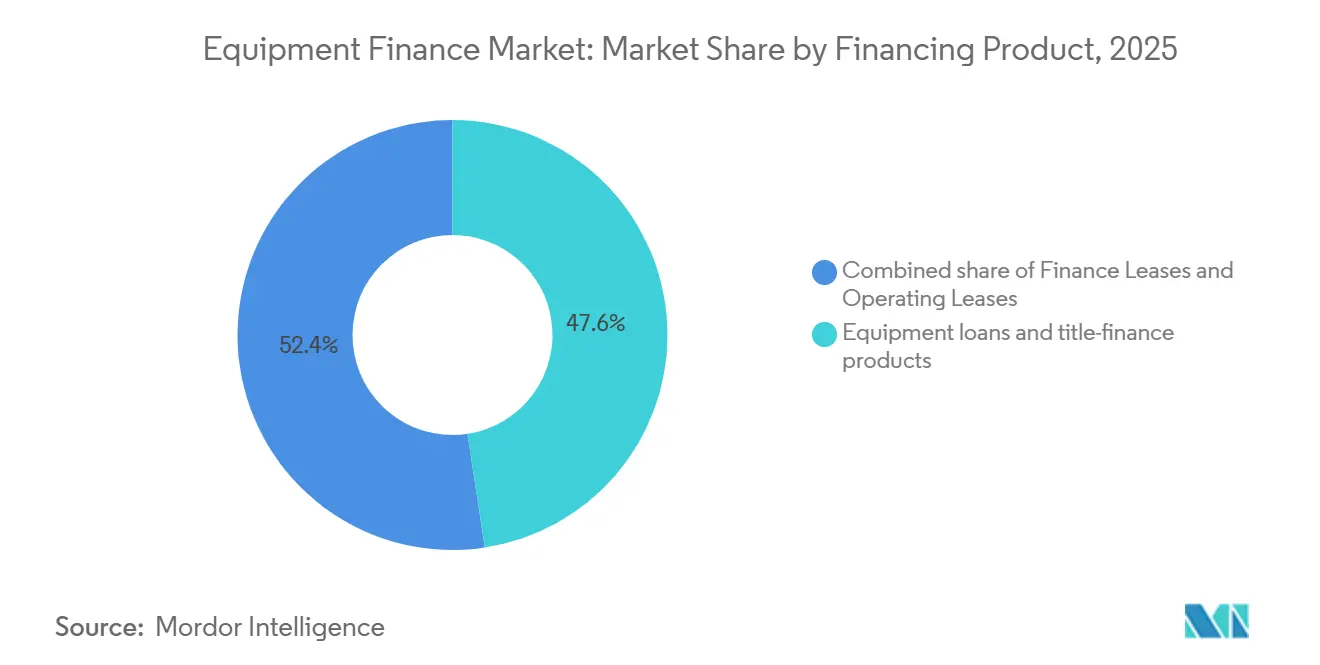
Equipment loans and title-finance products held 47.6% of the equipment finance market in 2025. Larger and capital-intensive businesses continue to use these structures when ownership and long-term control of an asset are important. Loan structures can also align with tax planning for businesses that have sufficient taxable income and a clear preference for keeping the equipment on their books, particularly when the asset is expected to remain productive for a long period. Finance leases remain relevant where borrowers seek ownership economics through a lease agreement. The equipment finance industry, therefore, continues to include financing structures that meet different balance-sheet and operating requirements.
Operating leases are projected to grow at a 7.4% CAGR through 2031, the fastest rate among financing products. Businesses use operating leases when they want flexibility, as equipment changes or usage levels vary. This structure can be especially useful for assets that are likely to become outdated before the end of a conventional ownership period, because it gives the customer a defined process for returning, renewing, or replacing equipment as operational requirements change. The United Kingdom Finance and Leasing Association reported GBP 877 million (USD 1.11 billion) in operating lease new business during June 2026 and GBP 2.44 billion (USD 3.10 billion) during the first half of 2026. The equipment finance market can gain from this shift as customers increasingly choose access to equipment over outright ownership, particularly when they need to protect liquidity, avoid committing to an asset with an uncertain future value, or retain the ability to adjust equipment capacity as business conditions change.


By Asset Type: IT and Telecommunications Equipment Accelerates With Digital Investment
Industrial, manufacturing, and materials-handling equipment held 17.4% of the equipment finance market in 2025, giving this category a leading position within the equipment finance market. This category is supported by factory modernization, automation, and investment in domestic production capacity. It also serves a broad customer base across industrial production, warehousing, construction support, and materials movement, which helps maintain demand even when investment conditions differ between individual industrial sectors or end-user locations. Construction and earthmoving equipment remains a major part of financed asset portfolios because of long equipment lives and large transaction sizes, while the need for maintenance, periodic replacement, utilization planning, and site-specific deployment creates a continuing role for lenders that understand the commercial use of these assets. Agricultural, healthcare, energy, and mining equipment add distinct financing needs based on their operating cycles and asset characteristics.
IT, telecommunications, and office equipment are projected to grow at a 9.2% CAGR through 2031 in the equipment finance market. The United Kingdom Finance and Leasing Association reported that IT equipment finance rose 21% year over year in June 2026. CHG-MERIDIAN reported a managed technology portfolio of EUR 12.59 billion (USD 14.73 billion) in 2025, after 7% year-over-year growth. Its 2025 lease originations reached EUR 3.12 billion (USD 3.16 billion), with 10% growth linked to technology investment and artificial intelligence applications. Faster hardware refresh cycles make leasing a practical option for cloud operators and enterprise technology teams that need to preserve flexibility, avoid holding aging equipment for too long, and plan replacement decisions around system performance and capacity needs.
By End-User Industry: Manufacturing Anchors Demand While ICT Leads Growth
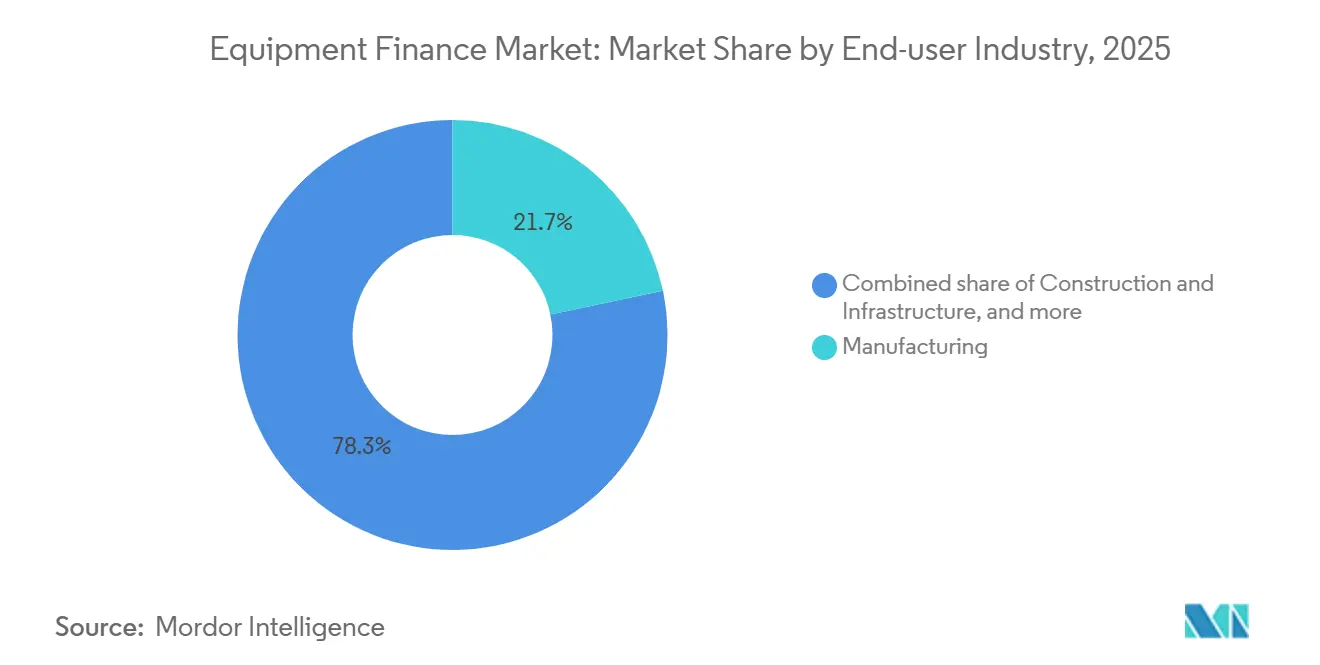
Manufacturing held 21.7% of the equipment finance market in 2025. Production machinery, robotics, materials-handling systems, and process equipment all require financing that can match long operating lives, installation needs, expected output, and the cash flow profile of a production facility that depends on the equipment. Manufacturing onshoring is also creating large-ticket opportunities in the United States. ELFA has identified manufacturing onshoring alongside energy transition and artificial intelligence data centers as equipment funding opportunities. Construction, transportation, logistics, and utilities also require assets that are commonly financed through loans and finance leases.
Information and communications technology is projected to grow at a 9.4% CAGR through 2031. The growth rate exceeds the overall equipment finance market CAGR because technology infrastructure requires both initial investment and frequent replacement, and because the equipment must often be expanded alongside related systems for storage, networking, power, cooling, security, and data processing as digital workloads become more demanding. ELFA forecast USD 137.3 billion in the United States equipment finance new business volume for 2026 after the July increase in artificial intelligence-related investment. Small-ticket volume reached USD 6.4 billion in July 2026 as cloud and enterprise operators financed equipment across distributed networks. Retail, wholesale, and e-commerce businesses also support demand through automated warehousing and last-mile delivery equipment, where investment decisions are shaped by order volumes, fulfillment speed, labor availability, and the need to manage distribution costs.
By Provider Type: Independent Providers Grow Faster Than Banks
Banks and bank-affiliated providers held 56.2% of the equipment finance market in 2025. Their position reflects funding advantages, broad client relationships, and the ability to offer equipment funding with other commercial banking services. ELFA noted that bank mergers may lead some institutions to reduce or exit equipment finance activities. This can lead banks to act more often as portfolio buyers from captives and independents. Captive companies also have a strong position because their dealer and manufacturer relationships place finance options alongside equipment sales, enabling the provider to support transactions at the same point where customers consider the asset, its price, and its operating requirements.
Independent equipment finance companies are projected to grow at a 7.2% CAGR through 2031in the equipment finance market. Their operating models can support mid-market transactions where borrowers value speed, specialized underwriting, and flexible structures, especially when the asset is specialized, the customer operates in a focused sector, or the borrower needs a financing approach that differs from standardized commercial bank terms. Digital origination systems can improve their ability to process small and mid-sized applications. Private funding is becoming more relevant as providers seek alternatives to traditional bank sources, although the cost, availability, and terms of this funding can vary with investor appetite and conditions in the wider credit environment. The equipment finance industry is therefore seeing stronger competition among banks, captives, and specialist independent firms.
Geography Analysis
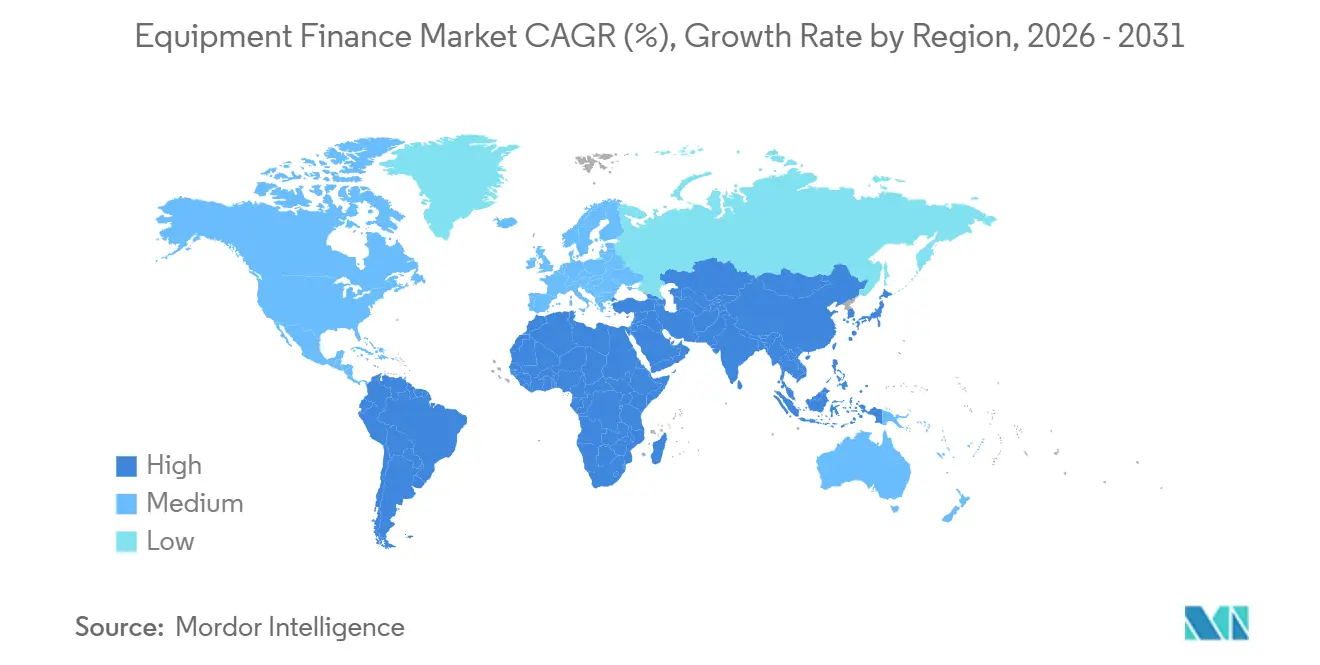
North America held 39.8% of the equipment finance market in 2025 and remained the largest regional contributor. ELFA forecast USD 137.3 billion in new United States equipment finance business volume for 2026, following the July increase in artificial intelligence-related investment. New business volume through July 2026 was 16.8% higher than in the corresponding period of 2025. The region benefits from established bank, captive, and securitization channels that can serve a wide range of assets and borrower profiles, from small-ticket technology equipment to large industrial, construction, transportation, and energy-related transactions with longer documentation and funding requirements. Canada contributes through energy, mining, and construction equipment needs. Mexico benefits from manufacturing activity connected to nearshoring, which can create demand for production equipment, logistics assets, and related financing structures that support the movement of industrial activity within the North American region. Elevated funding costs remain a concern because prime stayed at 7.5% in mid-2026.
Europe represents a substantial part of global leasing activity and remains an important contributor to the equipment finance market. The United Kingdom, Germany, Japan, the United States, and China accounted for more than 73% of global leasing activity. Germany recorded EUR 83.12 billion (USD 91.4 billion) in new leasing finance during 2025, an increase of 3.2%. The German leasing penetration rate reached 26.6% in 2025. The United Kingdom reported 15% year-over-year growth in asset finance new business during June 2026, including 17% growth in plant and machinery and 21% growth in IT equipment. European Investment Fund programs and KfW partnerships are also supporting SME equipment access by helping providers extend financing capacity to businesses investing in productive assets, digital tools, environmental upgrades, and infrastructure-related equipment.
Asia-Pacific is projected to grow at a 7.1% CAGR through 2031, making it the fastest-growing regional segment. India’s National Infrastructure Pipeline targets more than USD 1.4 trillion in investment through 2030. China’s leasing sector is shifting toward asset-based financing under regulatory changes, which may place more focus on the underlying equipment, its use, and its value rather than on structures that resemble general credit, while also changing the approach of larger leasing groups operating across the region. Chinese leasing groups are also expanding into Vietnam, Indonesia, and the Philippines. Japan provides established leasing capacity, while South Korea, Australia, and Singapore add regional scale through mature financial systems and diverse equipment needs, giving the region a mix of developed leasing markets and rapidly expanding investment destinations. South America, the Middle East, and Africa offer further potential but face currency, interest-rate, and cross-border financing constraints.

Competitive Landscape
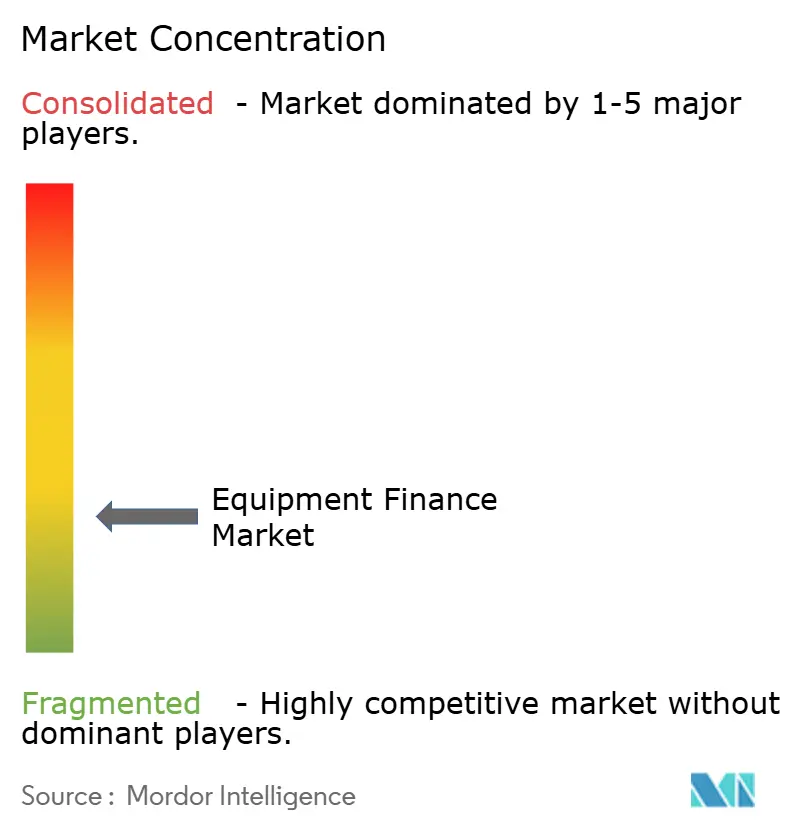
The equipment finance market is fragmented, with competition distributed across banks, bank-affiliated finance companies, independent lessors, specialty captives, and digital financing platforms. Banks maintain advantages through funding access and established business relationships, while manufacturer captives benefit from direct integration with dealers and equipment sales channels. Independent and specialty providers compete through customized financing structures, faster decision-making, asset expertise, and specialized customer service. Digital platforms are further increasing competition by streamlining application intake, underwriting, servicing, and portfolio monitoring. The market remains open to providers that can combine competitive funding, efficient technology, asset-specific expertise, and disciplined assessment of borrower credit quality and equipment residual values.
BNP Paribas Leasing Solutions expanded its European position through the April 2026 acquisition of Mercedes-Benz’s leasing business. The acquisition added a premium-asset leasing portfolio and expanded BNP Paribas’ consumer finance reach. Its CNH Capital partnership also supports usage-based equipment financing through an original equipment manufacturer channel. Caterpillar Financial Services reported USD 991 million in second-quarter 2026 revenue and continued strong retail new business volume. CNH Industrial Capital’s USD 600 million note issuance in June 2026 showed how captive providers are using capital markets to support customer and dealer finance programs. These actions show that provider strategies combine portfolio expansion, manufacturer relationships, and diversified funding.
Cross-border financing remains difficult where asset security and recovery practices vary across jurisdictions. This is particularly relevant in Asia-Pacific and the Middle East, where lenders may face higher transaction costs and more complex recovery procedures. The equipment finance market has room for providers that can standardize documentation, asset monitoring, and servicing across borders, since customers operating in more than 1 country may need consistent contractual processes even when local rules, equipment registration systems, tax treatments, and recovery procedures remain different. Higher funding costs may also reshape pricing competition between banks, captives, and independents, as each provider type balances its own cost of capital, customer relationships, asset specialization, and ability to offer financing terms that remain commercially viable. Artificial intelligence tools can support faster decisions, but they do not eliminate the need for asset expertise and credit discipline, because a financing provider must still understand the condition, expected use, residual-value profile, resale options, maintenance requirements, and legal ownership position associated with each asset category.
Equipment Finance Industry Leaders
BNP Paribas Leasing Solutions
Sumitomo Mitsui Finance and Leasing Co., Ltd.
DLL Group
Societe Generale Equipment Finance
Wells Fargo Equipment Finance
- *Disclaimer: Major Players sorted in no particular order

Recent Industry Developments
- July 2026: ELFA raised its full-year 2026 United States equipment finance new business forecast to USD 137.3 billion following a record monthly volume of USD 14.3 billion in July, driven by artificial intelligence-related investment.
- June 2026: CNH Industrial Capital LLC priced USD 600 million in notes to fund dealer and customer financing programs for agricultural and construction equipment across North America.
- April 2026: BNP Paribas completed the acquisition of Mercedes-Benz’s leasing business, expanding its European equipment and vehicle finance platform.
- February 2026: KfW and Grenke AG launched their fourth joint global loan program, committing EUR 200 million (USD 234 million) to lease financing for digitalization, climate protection, and infrastructure investment in Germany.


Global Equipment Finance Market Report Scope
| Equipment loans and Title-Finance Products |
| Finance Leases |
| Operating Leases |
| Industrial, Manufacturing and Materials-Handling Equipment |
| Construction and Earthmoving Equipment |
| Marine, Rail and Intermodal Equipment |
| Aviation Equipment |
| Information Technology, Telecommunications, and Office Equipment |
| Healthcare and Medical Equipment |
| Agricultural Equipment |
| Energy, Power and Utilities Equipment |
| Mining and Oilfield Equipment |
| Other Equipment |
| Manufacturing |
| Construction and Infrastructure |
| Transportation and Logistics |
| Aviation and Aerospace |
| Energy and Utilities |
| Oil and Gas |
| Mining |
| Healthcare and Life Sciences |
| Agriculture |
| Information and Communications Technology |
| Retail, Wholesale, and E-Commerce |
| Government and Public Sector |
| Hospitality and Foodservice |
| Other End-User Industries |
| Banks and Bank-Affiliated Equipment Finance Providers |
| Captive Equipment Finance Companies |
| Independent Equipment Finance Companies |
| North America | United States |
| Canada | |
| Mexico | |
| South America | Brazil |
| Argentina | |
| Rest of South America | |
| Europe | United Kingdom |
| Germany | |
| France | |
| Italy | |
| Spain | |
| Rest of Europe | |
| Asia-Pacific | China |
| Japan | |
| India | |
| South Korea | |
| Australia | |
| Indonesia | |
| Thailand | |
| Malaysia | |
| Singapore | |
| Vietnam | |
| Rest of Asia-Pacific | |
| Middle East and Africa | Saudi Arabia |
| United Arab Emirates | |
| Turkey | |
| South Africa | |
| Egypt | |
| Rest of Middle East and Africa |
| By Financing Product | Equipment loans and Title-Finance Products | |
| Finance Leases | ||
| Operating Leases | ||
| By Asset Type | Industrial, Manufacturing and Materials-Handling Equipment | |
| Construction and Earthmoving Equipment | ||
| Marine, Rail and Intermodal Equipment | ||
| Aviation Equipment | ||
| Information Technology, Telecommunications, and Office Equipment | ||
| Healthcare and Medical Equipment | ||
| Agricultural Equipment | ||
| Energy, Power and Utilities Equipment | ||
| Mining and Oilfield Equipment | ||
| Other Equipment | ||
| By End-User Industry | Manufacturing | |
| Construction and Infrastructure | ||
| Transportation and Logistics | ||
| Aviation and Aerospace | ||
| Energy and Utilities | ||
| Oil and Gas | ||
| Mining | ||
| Healthcare and Life Sciences | ||
| Agriculture | ||
| Information and Communications Technology | ||
| Retail, Wholesale, and E-Commerce | ||
| Government and Public Sector | ||
| Hospitality and Foodservice | ||
| Other End-User Industries | ||
| By Equipment Finance Provider Type | Banks and Bank-Affiliated Equipment Finance Providers | |
| Captive Equipment Finance Companies | ||
| Independent Equipment Finance Companies | ||
| By Geography | North America | United States |
| Canada | ||
| Mexico | ||
| South America | Brazil | |
| Argentina | ||
| Rest of South America | ||
| Europe | United Kingdom | |
| Germany | ||
| France | ||
| Italy | ||
| Spain | ||
| Rest of Europe | ||
| Asia-Pacific | China | |
| Japan | ||
| India | ||
| South Korea | ||
| Australia | ||
| Indonesia | ||
| Thailand | ||
| Malaysia | ||
| Singapore | ||
| Vietnam | ||
| Rest of Asia-Pacific | ||
| Middle East and Africa | Saudi Arabia | |
| United Arab Emirates | ||
| Turkey | ||
| South Africa | ||
| Egypt | ||
| Rest of Middle East and Africa | ||


Key Questions Answered in the Report
What is driving equipment finance demand through 2031?
Artificial intelligence infrastructure, equipment replacement, manufacturing investment, and flexible leasing structures are supporting demand through 2031.
Which financing product is growing fastest?
Operating leases are projected to grow at a 7.4% CAGR through 2031 as businesses seek more flexibility in equipment use.
Which asset category has the highest projected growth?
IT, telecommunications, and office equipment is projected to grow at a 9.2% CAGR through 2031.
Which end-user sector is expanding fastest?
Information and communications technology is projected to grow at a 9.4% CAGR through 2031, supported by artificial intelligence infrastructure spending.
Which region is growing fastest?
Asia-Pacific is projected to grow at a 7.1% CAGR through 2031, supported by infrastructure investment and expanding leasing activity.
What is the main risk for equipment financing providers?
Higher interest rates and funding costs remain a major concern, even as reported credit metrics remained stable in July 2026.
Page last updated on:





