
Environmental Insurance Market Size and Share
Market Overview
| Study Period | 2020 - 2031 |
|---|---|
| Market Size (2026) | USD 3.44 Billion |
| Market Size (2031) | USD 4.85 Billion |
| Growth Rate (2026 - 2031) | 7.10 % |
| Fastest Growing Market | Asia-Pacific |
| Largest Market | North America |
| Market Concentration | High |
Major Players
*Disclaimer: Major Players sorted in no particular order Image © Mordor Intelligence. Reuse requires attribution under CC BY 4.0. |
|
Environmental Insurance Market Analysis by Mordor Intelligence
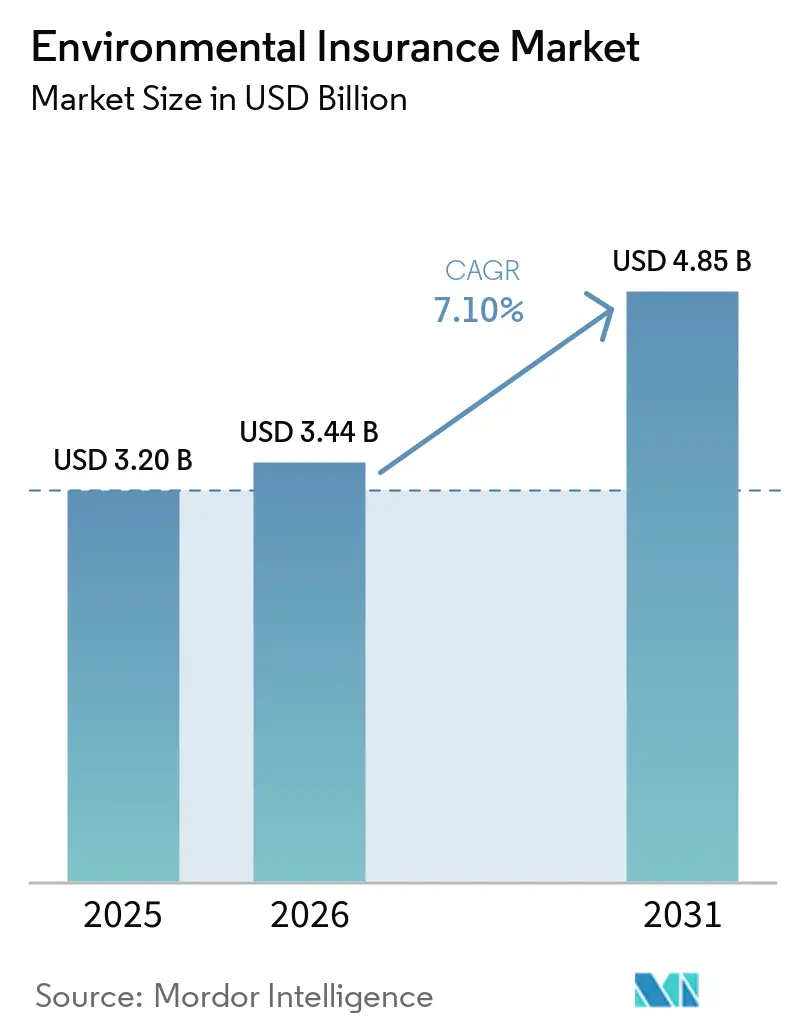
The Environmental Insurance Market size is expected to increase from USD 3.20 billion in 2025 to USD 3.44 billion in 2026 and reach USD 4.85 billion by 2031, growing at a CAGR of 7.10% over 2026-2031.
The environmental insurance market is expanding because environmental liabilities are becoming harder to absorb through standard commercial property and casualty policies. The environmental insurance market has therefore become relevant to buyers whose conventional policies contain pollution exclusions. Insurance buyers purchase specialized environmental policies, which limit current premium volume but leave considerable demand unconverted. Regulation, pollution-related liabilities, and lender requirements are bringing insurance earlier into project financing and transaction planning. The environmental insurance market is also facing a more difficult underwriting environment as PFAS, remediation inflation, and large court awards affect pricing and reserves. Carriers are responding through combined coverage forms, earlier claims involvement, layered programs, and technology-supported underwriting.
Key Report Takeaways
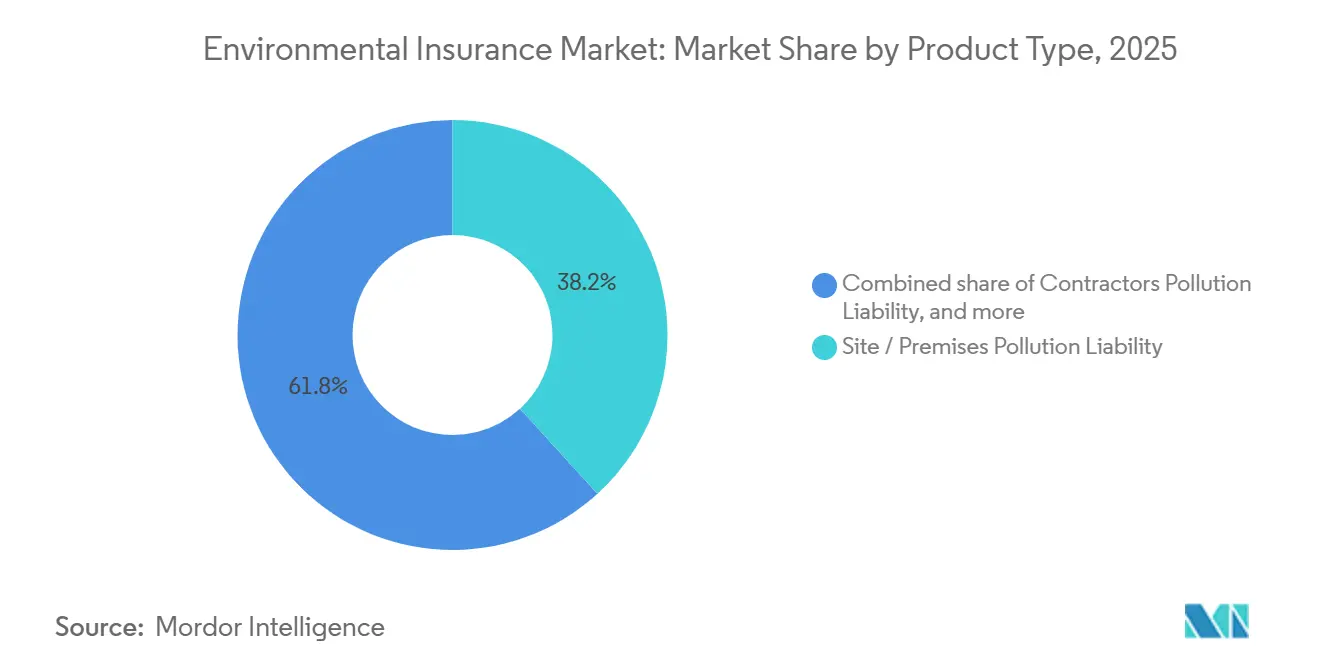
- By product type, site/premises pollution liability captured 38.2% of the environmental insurance market share in 2025, while combined/package environmental is projected to grow at 11.2% CAGR through 2031.
- By risk occasion, operational premises and ongoing activities accounted for 46.3% of the environmental insurance market share in 2025, while statutory financial responsibility and licence conditions are forecast to grow at 10.8% CAGR through 2031.
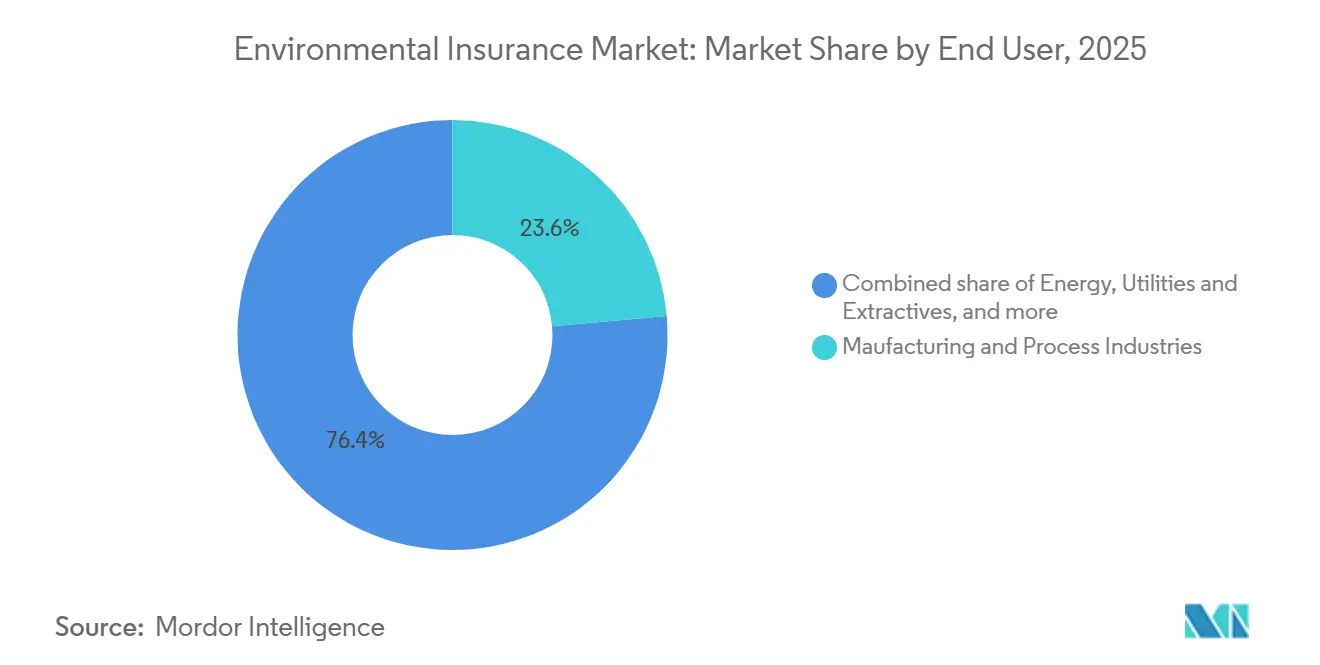
- By end user, manufacturing and process industries held 23.6% of the environmental insurance market share in 2025, while construction, contracting, and engineering are projected to grow at 9.8% CAGR through 2031.
- By geography, North America held 68.7% of the environmental insurance market share in 2025, while Asia-Pacific is projected to expand at 12.0% CAGR through 2031.
Note: Market size and forecast figures in this report are generated using Mordor Intelligence’s proprietary estimation framework, updated with the latest available data and insights as of January 2026.
Global Environmental Insurance Market Trends and Insights
Drivers Impact Analysis*
| Driver | (~) % Impact on CAGR Forecast | Geographic Relevance | Impact Timeline |
|---|---|---|---|
| Stricter Environmental Liability and Cleanup Requirements | +1.4% | Global, with concentrated near-term impact in North America and Europe | Short term (≤ 2 years) |
| Expansion of Brownfield Redevelopment, Real Estate Transactions, and Environmental M&A Due Diligence | +1.2% | North America and Europe core, with Asia-Pacific spillover as industrial M&A scales | Medium term (2-4 years) |
| Growing Industrial, Energy, Waste, and Infrastructure Pollution Exposures | +1.0% | Global, strongest in North America, China, India, and Southeast Asia | Medium term (2-4 years) |
| Extreme Weather Increasing the Risk of Pollution Releases and Environmental Losses | +0.8% | North America and Asia-Pacific core, expanding to South America and MEA | Medium term (2-4 years) |
| Growing Environmental Risks from Emerging Contaminants | +0.7% | North America and Europe, with early signals in East Asia | Long term (≥ 4 years) |
| Contractual and Lender Insurance Requirements in Construction and Infrastructure Projects | +0.5% | North America and Europe, growing in the Gulf states and Southeast Asia | Short term (≤ 2 years) |
| Source: Mordor Intelligence | |||
Stricter Environmental Liability and Cleanup Requirements
Environmental liability rules are a consistent source of demand for pollution liability cover. The environmental insurance market benefits when compliance obligations require demonstrable financial assurance. The European Commission evaluated the Environmental Liability Directive in July 2026 and reaffirmed the polluter-pays principle for preventive and remedial environmental damage. The directive requires financial assurance from operators conducting hazardous Annex III activities. China adopted its Ecological Environment Code in March 2026, and Article 169 formally encourages environmental pollution liability insurance while extending joint-and-several civil liability to environmental technical service providers. Hubei issued environmental pollution liability insurance management measures in May 2025, and Shanghai issued a risk-control services standard in July 2025. In the United States, 40 CFR 280.97 requires underground storage tank owners and operators to maintain insurance-backed financial responsibility at federally specified minimum limits[1]U.S. Environmental Protection Agency, “Insurance for UST Financial Responsibility,” U.S. Environmental Protection Agency, epa.gov.
Expansion of Brownfield Redevelopment, Real Estate Transactions, and Environmental M&A Due Diligence
Environmental insurance is increasingly used to support transactions rather than only to manage post-closing risk. The environmental insurance market is becoming part of the transaction process when buyers seek certainty around known contamination. BC Environmental Insurance found that transactions involving insurers at the letter-of-intent stage closed up to 27% faster than transactions where coverage was arranged after due diligence. In June 2026, Gowling WLG advised Imperial Oil on the sale of a 7.5-million-square-foot former refinery and petroleum operations site in Montreal East[2]Canada - Gowling WLG Advises Imperial Oil On Landmark Montreal East Brownfield Redevelopment Transaction. Environmental insurance was a closing condition and a regulatory-engagement tool in that brownfield redevelopment. AXA XL and Ryan Transaction Risk expanded transactional environmental impairment liability and remediation cost-overrun offerings during 2025 and 2026.
Growing Industrial, Energy, Waste, and Infrastructure Pollution Exposures
Infrastructure, energy, logistics, and data-center construction are increasing the need for contractor and owner-controlled pollution liability placements. The environmental insurance market is responding to exposures from expanding industrial activity and complex project sites. New construction starts in 2026 are growing in infrastructure, energy, artificial intelligence, institutional, and healthcare projects. Data centers can introduce dielectric fluids, coolants, and battery chemicals on constrained urban sites, exposures that standard general liability pollution exclusions may not cover. A June 2026 chemical-plant explosion in Washington State and the resulting Columbia River spill increased manufacturing-sector inquiries for dedicated pollution coverage. The environmental insurance market has more than USD 500 million of the United States capacity for site pollution and contractors' pollution liability, with London markets lifting capacity to USD 700 million per risk[3]Environmental Market Forecast 2025-26 "assets.aon.com". This capacity provides room for additional demand without immediate supply-side rationing.
Extreme Weather Increasing the Risk of Pollution Releases and Environmental Losses
Extreme weather is creating pollution events that differ from conventional property losses. The environmental insurance market is relevant when weather events release pollutants that standard property cover does not address. Natural disasters caused USD 260 billion in total losses during 2025, including USD 41 billion of insured losses from the Palisades and Eaton fires[4]2026 Climate and Catastrophe Insight, aon.com. Fire events can cause PFAS contamination through fire-retardant chemicals, ash runoff, and soil volatilization. Storms can also mobilize contaminants from storage infrastructure and contaminated soils into waterways and communities. Organizations with sound compliance records may still face environmental claims when severe weather exposes containment failures. The environmental insurance market, therefore, serves buyers outside the traditionally high-hazard sectors as climate events broaden the range of affected exposures.
Restraints Impact Analysis*
| Restraint | (~) % Impact on CAGR Forecast | Geographic Relevance | Impact Timeline |
|---|---|---|---|
| PFAS Exclusions and Uncertainty Around Long-Tail Environmental Liabilities | -0.8% | North America predominantly, with Europe and Asia-Pacific affected as PFAS regulation extends | Long term (≥ 4 years) |
| Rising Remediation and Cleanup Costs Creating Pricing and Reserve Uncertainty | -0.7% | Global, most acute in North America and Western Europe | Medium term (2-4 years) |
| Limited Capacity and Restrictive Underwriting for High-Hazard and Legacy-Contamination Risks | -0.5% | North America, Europe, and the Asia-Pacific industrial markets | Medium term (2-4 years) |
| Fragmented Global Environmental Regulations and Inconsistent Pollution Liability Frameworks | -0.4% | South America, Southeast Asia, MEA, and multinational buyers | Long term (≥ 4 years) |
| Source: Mordor Intelligence | |||
PFAS Exclusions and Uncertainty Around Long-Tail Environmental Liabilities
Per- and polyfluoroalkyl substances are disrupting environmental insurance underwriting because their liabilities can persist for extended periods and may trigger claims across multiple policy years. The environmental insurance market must balance demand for coverage against uncertainty over long-tail contamination costs. PFAS exclusions have become increasingly common in liability insurance policies, particularly as insurers seek to limit exposure to potentially significant and difficult-to-model contamination liabilities. The EPA established maximum contaminant levels for PFOA and PFOS at 4.0 parts per trillion each under its drinking-water regulations. Major settlements include up to USD 10.3 billion for 3M in its nationwide public-water-supplier settlement, USD 1.185 billion for DuPont, Chemours, and Corteva in separate litigation, and a USD 875 million settlement with the State of New Jersey involving DuPont, Chemours, and Corteva. In August 2026, New Jersey also received court approval for separate PFAS settlements with DuPont-related entities and 3M valued at approximately USD 2.5 billion combined, including more than USD 2 billion from the DuPont-related entities.
Rising Remediation and Cleanup Costs Creating Pricing and Reserve Uncertainty
Rising cleanup costs are putting pressure on pricing models built around earlier remediation economics. The environmental insurance market is affected when remediation estimates change after policy limits and pricing have been set. Complex contaminated sites can exceed USD 1 million in response costs. WTW reported that rising remediation costs and multi-coverage claims are prompting carriers to engage earlier in the claims cycle. Aon recorded USD 31.3 billion across 135 nuclear verdicts, an increase of 116%, and these cases add to social-inflation pressure in pollution-adjacent claims. Two carriers that entered site pollution liability during the earlier soft market have exited or materially reduced their appetite. ASTM E2137 calls for remediation cost estimates to be updated as site information, regulation, or cleanup technology changes. Carriers use policy conditions to support these updates, while policyholders may resist changes to costs and limits.
*Our forecasts treat driver/restraint impacts as directional, not additive. The impact forecasts reflect baseline growth, mix effects, and variable interactions.
Segment Analysis
By Product Type: Site Liability Anchors the Market as Package Lines Accelerate
Site/premises pollution liability held 38.2% of the environmental insurance market share in 2025 and remained the largest product category. The coverage supports fixed industrial assets, real estate portfolios, and legacy contamination management. Combined/package environmental is forecast to grow at an 11.2% CAGR from 2026 through 2031, the fastest rate in this segmentation. AXA XL introduced its Environmental Combined Form in March 2026 for United States mid-market manufacturing and distribution clients. The product pairs general liability and pollution cover and offers up to USD 25 million in excess limits for selected classes. The environmental insurance market size is also supported by growing demand for integrated coverage across complex commercial exposures.
Markel Canada introduced two integrated environmental solutions in April 2026 for manufacturers and environmental service firms. Those policies combine general liability, pollution, and professional liability under one form. Contractors' pollution liability continues to record high placement volumes, supported by more than 30 active insurers and soft-to-stable rates. Transactional and remediation cost-cap products are gaining use in M&A and brownfield redevelopment, with transactional PLL terms of 6-12 years and premiums of 0.5%-3% of limit. Storage tank pollution coverage remains supported by underground storage tank financial-responsibility rules, while contingent, transportation, and non-owned disposal cover face closer review of waste manifests and chain-of-custody records.


By Risk Occasion: Operational Premises Dominates While Statutory Lines Drive the Fastest Growth
Operational premises and ongoing activities accounted for 46.3% of the environmental insurance market share in 2025, the largest share by risk occasion. The segment reflects the large number of manufacturing plants, energy facilities, waste processors, and commercial sites with daily pollution exposures. Statutory financial responsibility and licence conditions are forecast to grow at 10.8% CAGR from 2026 through 2031, the fastest rate in this segmentation. Financial assurance mandates are converting discretionary buyers into mandatory buyers in energy, waste, and industrial activities. Contracting and project operations are expanding with construction and infrastructure spending. Mergers, acquisitions, and property transfer cover is gaining premium density as deal counsel uses environmental cover as a closing condition instead of relying only on indemnities.
Closure, post-closure, and active remediation address an important coverage need at legacy sites moving toward regulatory closure. These sites can require ongoing monitoring, financial assurance, and coverage for post-closure liabilities over extended periods. Site pollution liability and general liability policies may not address those obligations cleanly. Regulatory requirements for post-closure financial assurance can increase demand for dedicated coverage. The environmental insurance market size is supported by these regulatory and remediation requirements, which broaden the pool of industrial operators seeking dedicated environmental coverage.
By End User: Manufacturing Leads as Construction Accelerates at the Fastest Rate
Manufacturing and process industries held 23.6% of the environmental insurance market share in 2025, the largest end-user share. The sector has dense on-site contamination exposures, multi-jurisdiction compliance duties, and liabilities from earlier operations. Construction, contracting, and engineering are forecast to grow at a 9.8% CAGR from 2026 through 2031. New construction starts in 2026 are growing in infrastructure, energy, artificial intelligence, institutional, and healthcare projects. These project categories have higher pollution liability exposure than residential and commercial construction, where starts are expected to remain flat.
Energy, utilities, and extractives face greater regulatory exposure as monitoring technology and environmental disclosure requirements broaden the evidence available for enforcement. Real estate, property owners, and developers are becoming more important buyers as lenders standardize environmental cover in brownfield acquisition debt. Waste, water, and environmental services providers can face PFAS exposure while performing remediation, even though many policies exclude or limit that risk. Novacore introduced remediation cost-cap and pollution legal liability products in July 2026 to address capacity gaps in these areas. Public and institutional buyers, transportation and logistics, and other commercial occupancies remain less penetrated than manufacturing and energy. Simpler coverage forms could support conversion as regulatory scrutiny reaches a broader set of buyers. The environmental insurance market size is expected to benefit as coverage expands across these underpenetrated end-user groups.
Geography Analysis
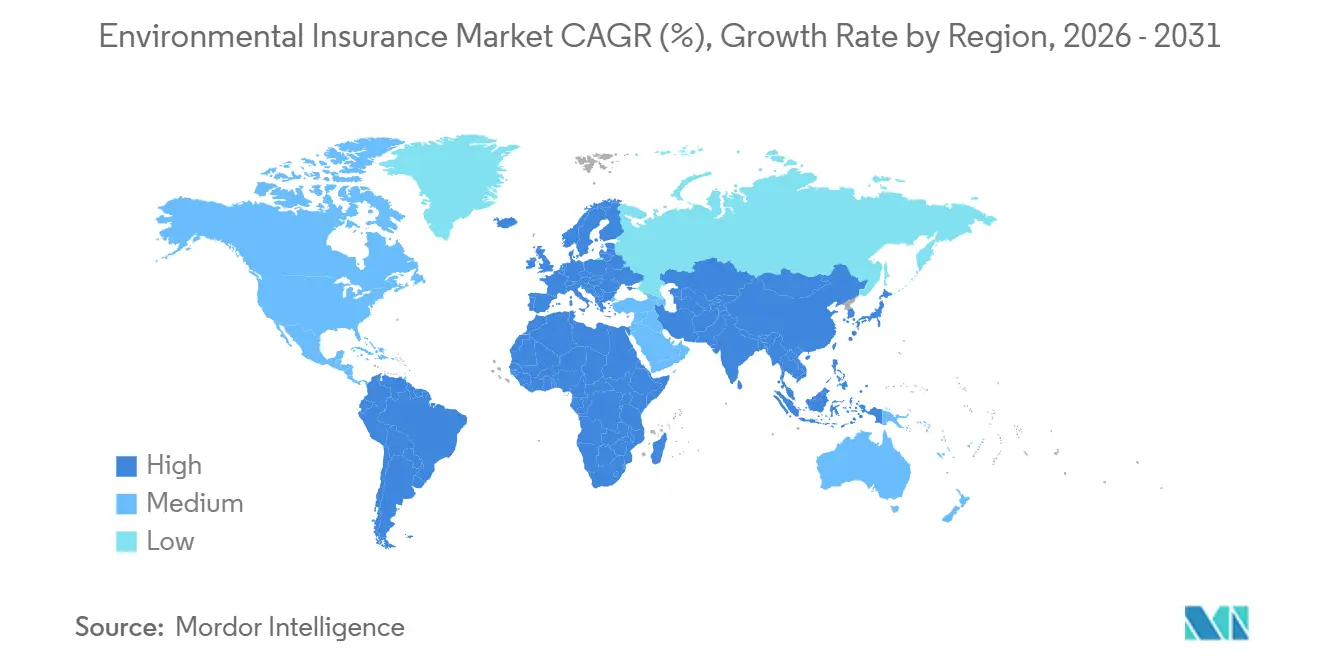
North America held 68.7% of the environmental insurance market share in 2025, the largest regional position. CERCLA can hold current property owners responsible for remediating historic contamination created by earlier operators, including in cases where fault is not established. The 7.5-million-square-foot Montreal East brownfield transaction in June 2026 used environmental insurance as a deal component and lender condition. Great American Insurance Group plans to launch its contractor's site environmental product in Mexico during 2026. Domestic United States site-pollution and contractors' pollution liability limits exceed USD 500 million, rising to USD 700 million with London capacity.
Europe is the second-largest regional environmental insurance market. The environmental insurance market size in the region is supported by a common regulatory baseline for environmental remediation. Germany, France, the United Kingdom, and Italy account for most regional premium volume. The European Commission's July 2026 evaluation confirmed the Environmental Liability Directive's role in setting common minimum remediation standards. The directive provides a regulatory floor for the financial-assurance obligations of Annex III operators. Combined general liability and pollution products are expected to launch in Europe in 2026, following the United States mid-market model. South America remains an early-stage market, with Brazil offering the greatest latent demand from industrial and agribusiness activities.
Asia-Pacific is forecast to grow at a 12.0% CAGR from 2026 through 2031, the fastest rate among regions. China is strengthening the environmental liability framework through Article 169 of the Ecological Environment Code, Hubei provincial measures, and Shanghai risk-control standards. A 2026 peer-reviewed study found that China's environmental liability insurance policy reduced ESG greenwashing by supporting green innovation and limiting managerial short-termism. India's non-life insurance sector grew 14.1% in fiscal year 2026, while the Insurance for All by 2047 initiative is supporting broader non-life penetration. Southeast Asian countries, including Vietnam, Indonesia, and the Philippines, recorded 15-20% insurance premium growth in 2026, and environmental liability is a growing sub-category. Saudi Arabia and the United Arab Emirates are the most active markets in the Middle East and Africa, where major petrochemical and infrastructure projects increasingly include contractors' pollution liability requirements.

Competitive Landscape
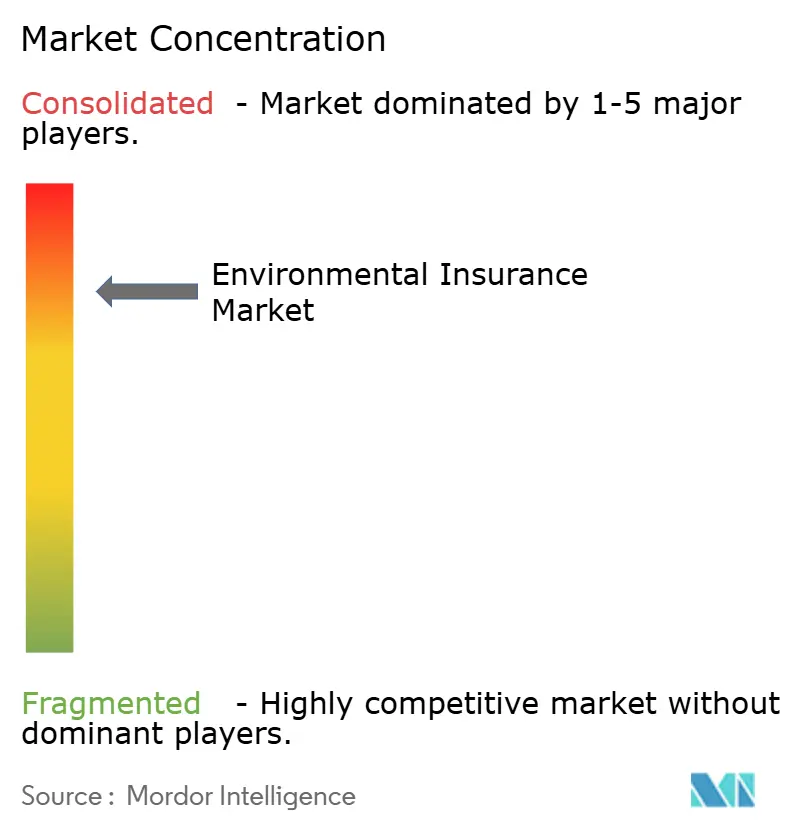
The environmental insurance market is concentrated in large-account business and fragmented across mid-market and specialty business. AIG, Chubb, Zurich Insurance Group, AXA XL, and Allianz Commercial are major participants in complex risks because of their capital, claims capability, and broker relationships. Zurich agreed in March 2026 to acquire Beazley for GBP 8.1 billion, equivalent to USD 10.8 billion, subject to regulatory approval. The transaction would expand Zurich’s specialty capabilities, including its Lloyd’s market expertise. Larger carriers retain an advantage in mandated placements because energy, chemical, and manufacturing programs require a proven underwriting record and sufficient capital.
Competition is also increasing among MGA platforms serving mid-market and specialty risks. Sands Point Risk acquired Launch Environmental Underwriters in May 2026, creating an environmental practice with more than USD 250 million in combined gross written premium. Novacore launched its Environmental segment in July 2026 with remediation cost-cap and pollution legal liability products. RT Specialty expanded its environmental casualty platform as carriers reduced their site pollution liability appetite. These platforms are focusing on capacity gaps in energy, infrastructure, construction, chemical, M&A, and industrial risks. The environmental insurance market has further opportunities in coverage for PFAS remediation contractors and combined forms for smaller buyers.
Technology is becoming a more visible competitive tool in underwriting and portfolio management. AIG and McGill and Partners also announced a March 2026 collaboration for near-real-time analysis of exposure, limit deployment, and modeled risk output. AXA XL, Great American Insurance Group, and Markel Canada are using combined-form products to reduce the need for separate coverage placements.
Environmental Insurance Industry Leaders
-
AIG
-
Chubb Limited
-
Zurich Insurance Group
-
AXA XL
-
Allianz Commercial
- *Disclaimer: Major Players sorted in no particular order

Recent Industry Developments
- July 2026: Novacore, an independent specialty insurance provider, launched its Environmental segment, introducing a re-engineered Environmental Remediation Cost Cap product and a Pollution Legal Liability product. The launch directly targets capacity gaps created by 2 major carriers’ exit from site environmental liability, when PFAS-driven claims are increasing demand for those product types.
- May 2026: Sands Point Risk acquired Launch Environmental Underwriters, crossing USD 250 million in combined gross written premium and establishing a dedicated environmental practice focused on energy, infrastructure, construction, chemical, M&A, and industrial risks. The transaction is the largest in Sands Point’s history and is funded by private equity capital backing the MGA’s specialty-consolidation strategy.
- March 2026: AXA XL launched its Environmental Combined Form for the United States mid-market manufacturing, distribution, and contracting clients. The policy pairs general liability and pollution cover, with USD 1 million primary limits per occurrence and up to USD 25 million in excess limits for selected classes.
- March 2026: Zurich Insurance Group agreed to acquire Beazley for GBP 8.1 billion, equivalent to USD 10.8 billion. The transaction would expand Zurich’s specialty insurance capabilities, including environmental lines, cyber, marine, and aviation, subject to regulatory approval.


Global Environmental Insurance Market Report Scope
| Site / Premises Pollution Liability |
| Contractors Pollution Liability |
| Combined / Package Environmental |
| Storage Tank Pollution |
| Transactional and Remediation-Cost |
| Contingent, Transportation and Non-Owned Disposal |
| Operational Premises and Ongoing Activities |
| Contracting and Project Operations |
| Mergers, Acquisitions and Property Transfer |
| Statutory Financial Responsibility and Licence Conditions |
| Closure, Post-closure and Active Remediation |
| Manufacturing and Process Industries |
| Energy, Utilities and Extractives |
| Construction, Contracting and Engineering |
| Real Estate, Property Owners and Developers |
| Waste, Water and Environmental Services |
| Transportation and Logistics |
| Public and Institutional |
| Other Commercial Occupancies |
| North America | United States |
| Canada | |
| Mexico | |
| South America | Brazil |
| Argentina | |
| Rest of South America | |
| Europe | United Kingdom |
| Germany | |
| France | |
| Italy | |
| Spain | |
| Rest of Europe | |
| Asia-Pacific | China |
| Japan | |
| India | |
| South Korea | |
| Australia | |
| Indonesia | |
| Thailand | |
| Malaysia | |
| Singapore | |
| Vietnam | |
| Rest of Asia-Pacific | |
| Middle East and Africa | Saudi Arabia |
| United Arab Emirates | |
| Turkey | |
| South Africa | |
| Egypt | |
| Rest of Middle East and Africa |
| By Product Type | Site / Premises Pollution Liability | |
| Contractors Pollution Liability | ||
| Combined / Package Environmental | ||
| Storage Tank Pollution | ||
| Transactional and Remediation-Cost | ||
| Contingent, Transportation and Non-Owned Disposal | ||
| By Risk Occasion | Operational Premises and Ongoing Activities | |
| Contracting and Project Operations | ||
| Mergers, Acquisitions and Property Transfer | ||
| Statutory Financial Responsibility and Licence Conditions | ||
| Closure, Post-closure and Active Remediation | ||
| By End User | Manufacturing and Process Industries | |
| Energy, Utilities and Extractives | ||
| Construction, Contracting and Engineering | ||
| Real Estate, Property Owners and Developers | ||
| Waste, Water and Environmental Services | ||
| Transportation and Logistics | ||
| Public and Institutional | ||
| Other Commercial Occupancies | ||
| By Geography | North America | United States |
| Canada | ||
| Mexico | ||
| South America | Brazil | |
| Argentina | ||
| Rest of South America | ||
| Europe | United Kingdom | |
| Germany | ||
| France | ||
| Italy | ||
| Spain | ||
| Rest of Europe | ||
| Asia-Pacific | China | |
| Japan | ||
| India | ||
| South Korea | ||
| Australia | ||
| Indonesia | ||
| Thailand | ||
| Malaysia | ||
| Singapore | ||
| Vietnam | ||
| Rest of Asia-Pacific | ||
| Middle East and Africa | Saudi Arabia | |
| United Arab Emirates | ||
| Turkey | ||
| South Africa | ||
| Egypt | ||
| Rest of Middle East and Africa | ||


Key Questions Answered in the Report
What is the projected growth rate for environmental insurance?
The environmental insurance market is forecast to grow at a 7.1% CAGR from 2026 through 2031, reaching USD 4.9 billion by 2031.
Which environmental insurance product has the largest premium base?
Site/Premises Pollution Liability was the largest product category, with 38.2% of premiums in 2025.
Which buyer group is growing fastest?
Construction, Contracting, and Engineering is forecast to grow at a 9.8% CAGR from 2026 through 2031.
Why are PFAS risks affecting coverage availability?
Broad PFAS exclusions and strict remediation thresholds make long-tail cleanup costs harder for carriers to estimate and price.
Which region is expected to grow fastest?
Asia-Pacific is projected to grow at a 12.0% CAGR from 2026 through 2031 as regulatory frameworks develop and industrial exposure rises.
How do combined environmental policies help buyers?
Combined policies place general liability, pollution, and sometimes professional liability under a single form, helping reduce placement gaps.
Page last updated on:





