
Enterprise Information Archiving Market Size and Share
Market Overview
| Study Period | 2020 - 2031 |
|---|---|
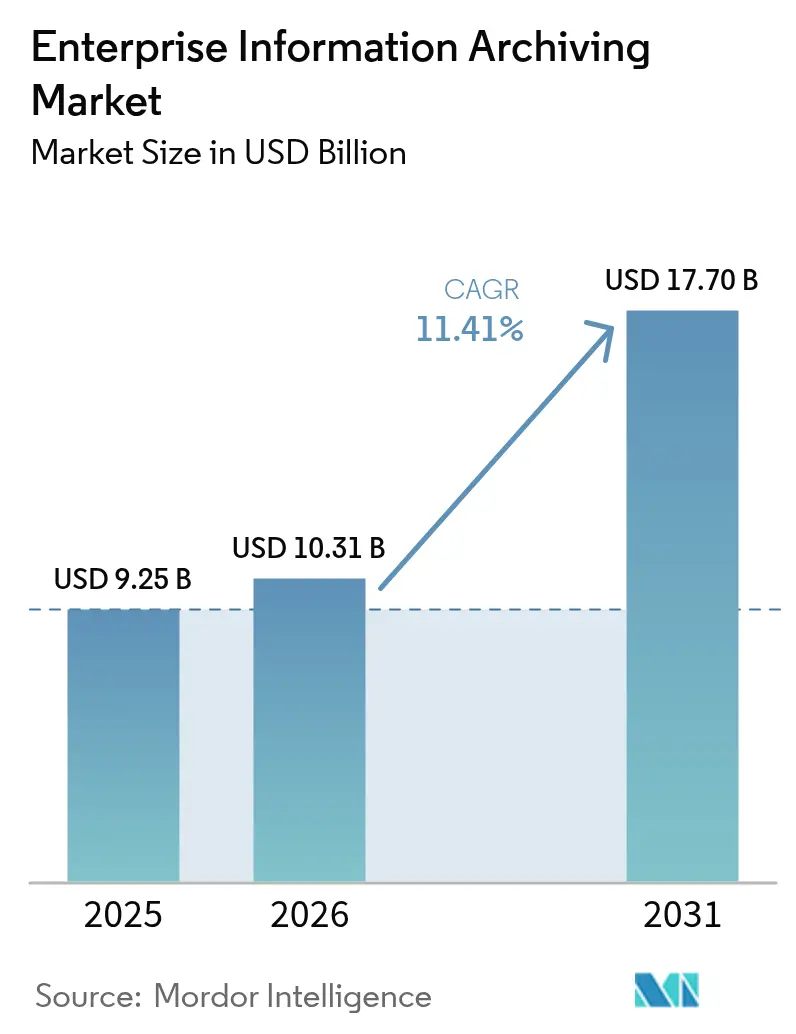
| Market Size (2026) | USD 10.31 Billion |
| Market Size (2031) | USD 17.7 Billion |
| Growth Rate (2026 - 2031) | 11.41 % |
| Fastest Growing Market | Asia Pacific |
| Largest Market | North America |
| Market Concentration | Medium |
Major Players *Disclaimer: Major Players sorted in no particular order Image © Mordor Intelligence. Reuse requires attribution under CC BY 4.0. | |
Enterprise Information Archiving Market Analysis by Mordor Intelligence
The enterprise information archiving market size is expected to grow from USD 9.25 billion in 2025 to USD 10.31 billion in 2026 and is forecast to reach USD 17.7 billion by 2031 at 11.41% CAGR over 2026-2031. This expansion stems from stricter global record-keeping mandates, escalating e-discovery exposure, and a decisive shift toward cloud-native retention platforms. Vendors are weaving artificial intelligence into core capture, classification, and search functions to lower compliance costs and turn archives into insight engines. Intensifying demand for immutable object storage, mounting litigation penalties tied to disappearing messages, and the need to train generative-AI models on well-governed historical data further accelerate adoption. Competitive dynamics favor suppliers that can integrate multichannel capture at scale while satisfying divergent sovereignty rules across regions.
Key Report Takeaways
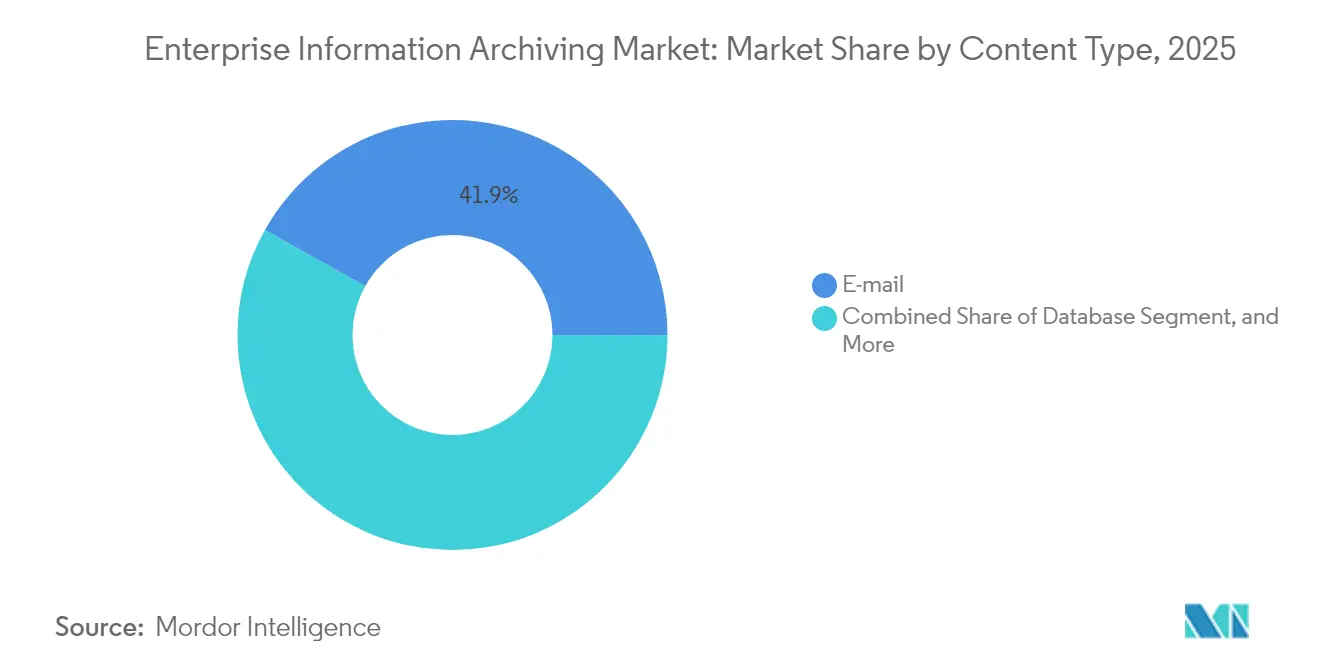
- By content type, email preserved 41.88% of the Application Performance Management market share in 2025, whereas database archiving is advancing at a 14.92% CAGR through 2031.
- By services, system integration accounted for 36.10% of the Enterprise Information Archiving Market market share in 2025, while consulting services recorded the sharpest growth at 12.23% CAGR to 2031.
- By deployment mode, cloud implementations commanded 70.56% of the enterprise information archiving market size in 2025, and on-premise deployments are expanding at a 14.38% CAGR through 2031.
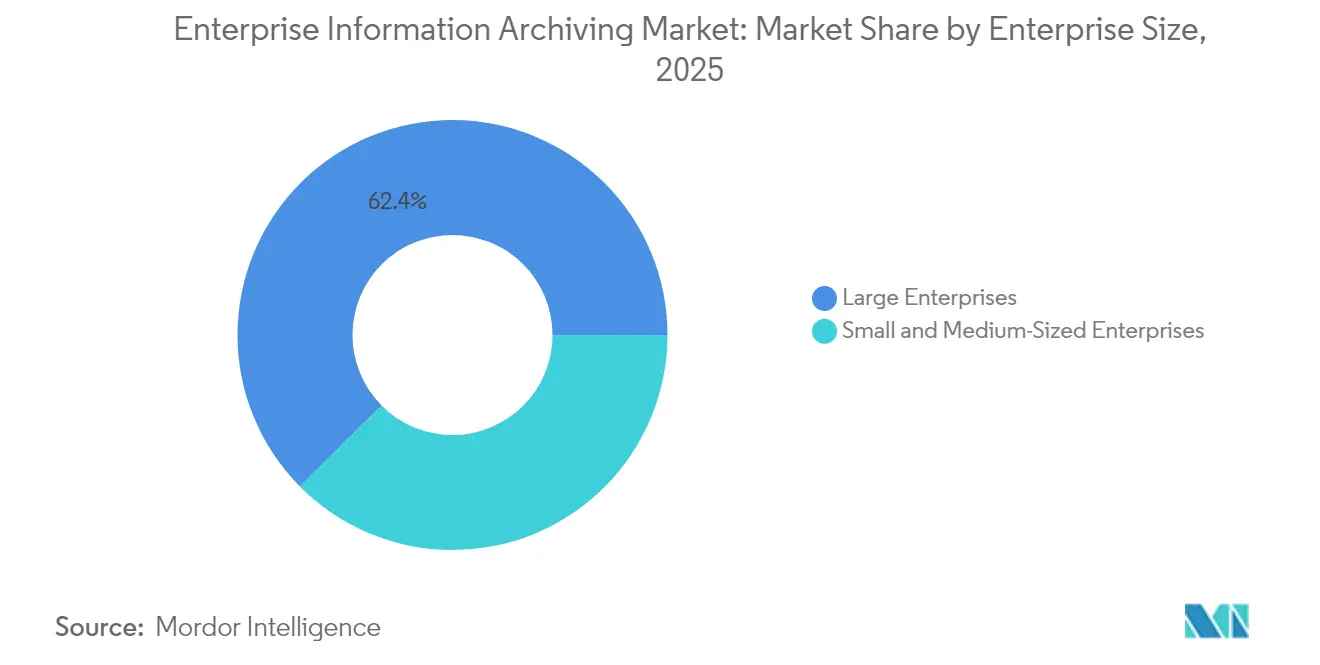
- By enterprise size, large enterprises controlled 62.44% of the Enterprise Information Archiving Market market share in 2025, yet small and medium enterprises are on track for a 13.31% CAGR to 2031.
- By end-user industry, banking, financial services, and insurance contributed 28.74% of the Enterprise Information Archiving Market market share in 2025, whereas government and defense registered the fastest 13.72% CAGR between 2026 and 2031.
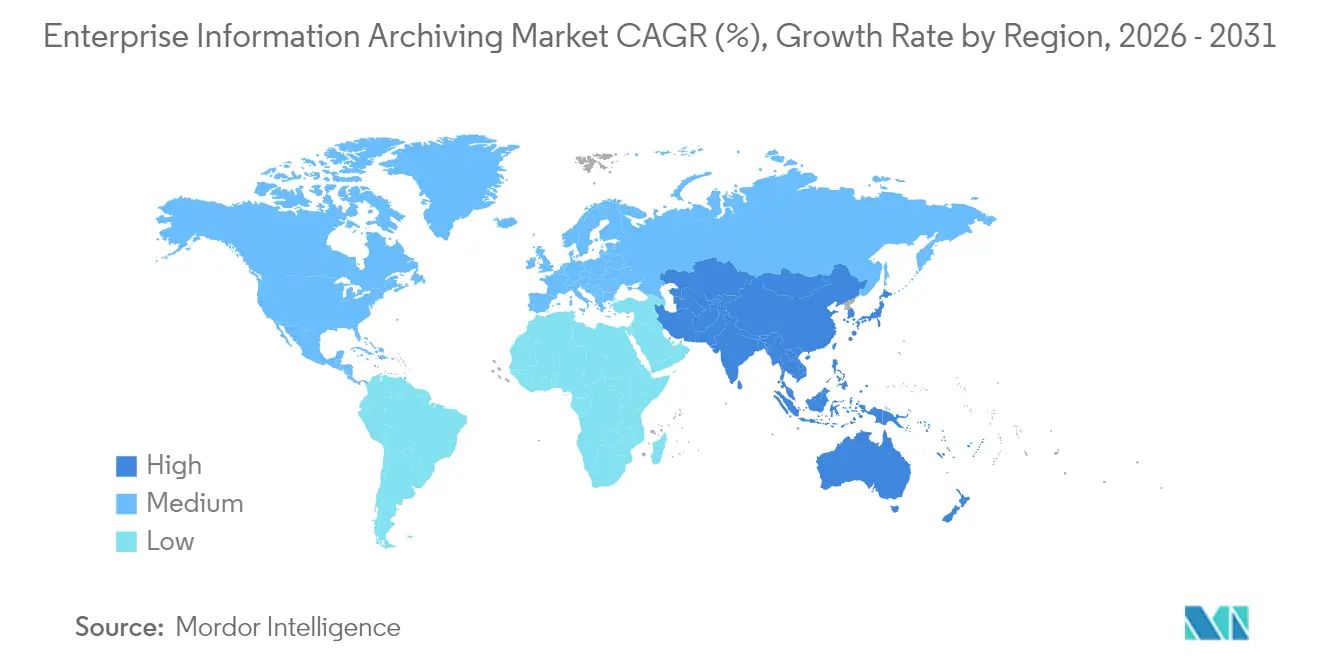
- By geography, North America led with 38.15% of the Enterprise Information Archiving Market market share in 2025; Asia-Pacific is poised for a 13.61% CAGR through 2031.
Note: Market size and forecast figures in this report are generated using Mordor Intelligence’s proprietary estimation framework, updated with the latest available data and insights as of 2026.
Market Trends and Insights
Drivers Impact Analysis of Enterprise Information Archiving Market*
| Driver | (~) % Impact on CAGR Forecast | Geographic Relevance | Impact Timeline |
|---|---|---|---|
| Growing volume of compliance-mandated data | +2.8% | North America, European Union, global spillover | Medium term (2-4 years) |
| Shift from CAPEX to OPEX via cloud archiving | +2.1% | North America, Asia-Pacific, worldwide adoption | Short term (≤ 2 years) |
| Surge in e-discovery litigation costs | +1.9% | North America, European Union, expanding to Asia-Pacific | Medium term (2-4 years) |
| Rise of collaboration apps | +1.7% | Developed markets globally | Short term (≤ 2 years) |
| Generative-AI-ready archives | +1.4% | North America, European Union, Asia-Pacific spillover | Long term (≥ 4 years) |
| Demand for immutable WORM storage | +1.1% | Financial hubs worldwide | Medium term (2-4 years) |
| Source: Mordor Intelligence | |||
Growing Volume of Compliance-Mandated Data
Financial, healthcare, and public-sector regulators are broadening retention rules to cover chat, social, and ephemeral messages. The U.S. SEC, FTC, and DOJ now require preservation of Slack, Teams, and WhatsApp messages, heightening urgency for unified capture platforms.[1] Hospitals must treat all patient communications as protected health information under HIPAA, demanding tamper-evident storage across portals, text, and video. In Europe, GDPR’s data minimization clause pushes firms to combine granular classification with automated disposal. Collectively, these mandates enlarge archive footprints and force investment in scalable, policy-driven repositories able to span structured and unstructured sources.
Shift From CAPEX to OPEX via Cloud Archiving
Cloud-native platforms replace hardware refresh cycles with elastic, pay-as-you-go models. Case studies show enterprises cutting USD 40 million in five-year costs after retiring legacy tape libraries and migrating to Archive360 on Azure Blob tiers. Smaller firms gain enterprise-grade retention without capital budgets, fostering democratization of compliance tooling. Hyperscaler marketplaces bundle archive licenses with productivity suites, Microsoft 365 retention labels, and Purview e-discovery, for example, further simplifying procurement. Low-cost cold tiers such as AWS Glacier Deep Archive push storage prices under USD 1 per terabyte monthly, sustaining OPEX momentum.
Surge in E-Discovery Litigation Costs
Legal departments spend more as discovery demands encompass chat threads, voice recordings, reactions, and emojis. Real-time capture prevents spoliation of disappearing content and enables early case assessment at scale. North American courts increasingly penalize incomplete chat preservation, prompting investments in AI-driven culling and smart sampling to shrink review volumes. Vendors respond with integrated legal-hold automation that can suspend deletion instantly across Teams and Slack through APIs, reducing risk while controlling attorney hours.
Rise of Collaboration Apps (Teams, Slack, Zoom)
Billions of daily Teams and Slack messages scatter regulated data outside email silos. Financial dealers must archive emoticons, edits, and GIFs under FINRA rules. Government-grade solutions stitch together chat, file shares, and meeting transcripts into a single timeline, supplying context for audits. Enterprises favor vendors that normalize metadata across channels and provide federated search, ensuring consistent retention schedules despite platform proliferation.
Restraints Impact Analysis of Enterprise Information Archiving Market*
| Restraint | (~) % Impact on CAGR Forecast | Geographic Relevance | Impact Timeline |
|---|---|---|---|
| Reliance on legacy on-premises email archives | -1.8% | Global, especially mature markets | Medium term (2-4 years) |
| Budget constraints for SMEs | -1.2% | Emerging markets worldwide | Short term (≤ 2 years) |
| Complex data-sovereignty regulations | -0.9% | European Union, Asia-Pacific, global influence | Long term (≥ 4 years) |
| Shadow-IT and “chat-ops” sprawl | -0.7% | Technology-centric organizations globally | Medium term (2-4 years) |
| Source: Mordor Intelligence | |||
Reliance on Legacy On-Premises Email Archives
Many enterprises still run Veritas Enterprise Vault or Dell SourceOne, accumulating sunk costs and petabytes of stubbed messages. Migrating holdings to cloud buckets without breaching chain-of-custody requirements is complex, often leading to prolonged hybrid estates. Older systems lack APIs for modern analytics, forcing expensive workarounds for e-discovery. Scarcity of technicians skilled in vintage platforms inflates project timelines and keeps capital locked in outdated hardware.
Budget Constraints for SMEs
Regulatory obligations apply to small businesses, yet compliance talent and tooling remain expensive. Subscription plans help, but usage-based search, export, and legal-hold fees can still outstrip tight budgets. SMEs often rely on managed service providers, adding margin layers that dilute savings. These cost pressures delay full-spectrum archiving, leaving gaps in chat or social media capture that heighten litigation exposure.
*Our forecasts treat driver/restraint impacts as directional, not additive. The impact forecasts reflect baseline growth, mix effects, and variable interactions.
Enterprise Information Archiving Market Segment Analysis
By Content Type:
Email Continues to Lead While Databases SurgeEmail retained 41.88% of 2025 revenue, anchoring the enterprise information archiving market through well-established capture policies and regulator familiarity. The enterprise information archiving market size for databases, however, is expected to expand at a 14.92% CAGR as firms recognize that structured records feed analytics and AI pipelines. In parallel, instant-messaging archives benefit from collaboration app ubiquity, while web and social media collections meet public-sector transparency mandates.
Structured data preservation attracts investment in tiered storage, query acceleration, and policy-driven masking that secures personal identifiers. Integrated platforms now route tables, logs, and time-series streams into the same governance fabric as chat or voice files. Advanced classification detects sensitive columns on ingestion and assigns retention codes automatically, shrinking manual oversight burdens.

By Services:
Integration Dominates, Consulting ClimbsSystem integration captured 36.10% of 2025 spending as enterprises knit together multichannel capture, identity management, and legal-hold orchestration. Implementers map retention rules across dozens of jurisdictions and embed journaling connectors into Teams, Slack, and Zoom. The enterprise information archiving market size tied to consulting is projected to grow 12.23% annually as firms seek specialized guidance on privacy-by-design architectures and AI-driven classification.
Service providers extend beyond lift-and-shift migrations to deliver automation scripts, policy blueprints, and analytics dashboards. Training and support remain necessary for change management, but vendors increasingly automate routine tuning through machine-learning models that optimize archive tier selection and deduplication schedules.
By Deployment Mode:
Cloud Rules, On-Premises PersistsCloud archives owned 70.56% of 2025 revenue thanks to elastic economics and turnkey compliance certifications. Yet on-premise deployments will outpace overall growth at 14.38% CAGR, reflecting defense agencies and capital-markets desks that cannot export data because of sovereignty or latency constraints. Hybrid designs emerge, allowing sensitive datasets to stay local while bulk analytics run in the cloud.
Providers answer with region-locked storage nodes and customer-managed encryption keys. Some offer software-defined appliances mirroring cloud APIs so firms can shift workloads without rewriting applications. This flexibility sustains investment in both models, preventing a one-directional migration narrative.
By Enterprise Size:
SME Adoption AcceleratesLarge corporations controlled 62.44% of 2025 spend through sprawling global footprints and multichannel compliance needs. The enterprise information archiving market share among SMEs is smaller but expanding rapidly at a 13.31% CAGR. Consumption-based pricing lowers entry barriers while pre-built regulatory templates minimize configuration. Vendors target this cohort with wizard-driven deployments and managed discovery add-ons, letting lean IT teams outsource complexity.
SMEs increasingly view archives as data lakes for customer insight, not just compliance vaults. AI modules surface sentiment trends and product feedback embedded in chat logs, providing commercial value that offsets ongoing subscription fees.
By End-User Industry:
Financial Services Lead; Government RisesBanks, insurers, and broker-dealers contributed 28.74% of 2025 revenue owing to Rule 17a-4 and MiFID II mandates that prescribe precise retention windows and write-once storage. Government and defense are projected to grow 13.72% annually as agencies modernize electronic records programs and pursue cloud-smart directives. Healthcare organizations adopt chat capture to safeguard telehealth transcripts under HIPAA, while manufacturing firms archive IoT telemetry for warranty analytics and quality audits.
Sector-specific solutions embed regulatory taxonomies such as NIST controls for defense or CFR Title 21 requirements for life sciences, reducing customization time. Horizontal vendors partner with domain experts to pre-load rule packs and automate submission workflows, broadening vertical reach without building bespoke codebases.
Geography Analysis
North America Enterprise Information Archiving Market
North America accounted for 38.15% of the enterprise information archiving market in 2025, sustained by SEC and FINRA record-keeping enforcement, plus HIPAA and DOJ preservation directives. Financial institutions invest heavily in chat journaling and predictive analytics to avoid multi-million-dollar fines. Federal cloud-first policies spur agencies to migrate electronic records into FedRAMP-authorized repositories, keeping public-sector demand robust. Canada follows with provincial privacy statutes aligning with GDPR principles, reinforcing pan-regional compliance spending.
Europe Enterprise Information Archiving Market
Europe maintains a substantial share thanks to GDPR, eIDAS, and industry-specific obligations. Multinational firms deploy localized clusters to honor data-residency rules while centralizing search across jurisdictions. Germany spearheads manufacturing use cases that combine IoT telemetry with process-control logs, whereas the United Kingdom emphasizes financial conduct oversight post-Brexit. Vendors that certify against both EU and U.K. frameworks secure a competitive advantage.
APAC Enterprise Information Archiving Market
Asia-Pacific represents the fastest-growing territory at 13.61% CAGR. China enforces data-localization laws that favor domestic cloud regions, while India’s Digital Personal Data Protection Act accelerates adoption among multinationals needing regional segregation. Japan and South Korea champion AI-enabled classification, and Singapore positions itself as a compliance hub for Southeast Asian financial flows. Local channel partners and sovereign cloud options are becoming decisive differentiators.
Mordor Intelligence provides coverage of the enterprise information archiving market across other key regional markets, including North America, each with their regulatory frameworks and demand patterns.
Regulatory Landscape
Enterprise information archiving demand is anchored in retention and producibility requirements for regulated communications and records. In the United States, SEC Exchange Act Rule 17a-4 (and related broker-dealer recordkeeping obligations) and FINRA Rule 4511 drive requirements for preserving business records, including electronic communications such as text and instant messages, with controls that support immutability via WORM or audit-trail-based alternatives and rapid production in a reasonably usable format.
In Europe, the eIDAS framework is increasingly relevant for long-term integrity and proof-of-origin, with the European Commission adopting Commission Implementing Regulation (EU) 2025/2532 in December 2025 to set reference standards for qualified electronic archiving services. Cybersecurity governance also shapes logging and evidence retention practices, with ENISA publishing technical implementation guidance in June 2025 for cybersecurity risk management measures aligned to NIS2, reinforcing the need for tamper-evident logging and defensible evidence lifecycle management across enterprises.
Value Chain Analysis
The enterprise information archiving value chain starts with data generation across enterprise systems (email, collaboration apps, business applications, endpoints, and line-of-business databases), followed by capture and ingestion through connectors, journaling/APIs, and policy engines. Core platform providers supply indexing, classification, retention/legal hold, e-discovery export, and supervisory review, while storage and infrastructure layers increasingly rely on immutable object storage and low-cost cold tiers to separate fast discovery from deep preservation. Hyperscalers and productivity ecosystems also shape procurement and deployment patterns, particularly where archiving is packaged alongside broader information governance and e-discovery capabilities.
Downstream, systems integrators, managed service providers, and legal services partners implement migrations from legacy repositories, map retention schedules across jurisdictions, and validate chain-of-custody for defensible production. Compliance expectations in financial services (SEC Rule 17a-4 and FINRA Rule 4511) influence audit trails, surveillance workflows, and third-party attestations, which increases demand for certified deployments (for example, FedRAMP-aligned options in the public sector) and partner-led delivery to support hybrid estates and sovereignty requirements.
Competitive Landscape
Competitive intensity is rising as traditional archive vendors, cloud hyperscalers, and niche compliance specialists converge. Microsoft integrates Purview retention with Teams capture, while Veritas, now under Cohesity ownership following the USD 7 billion deal, broadens multicloud analytics, jointly servicing more than 12,000 customers. Archive360 leverages Azure infrastructure to migrate legacy stubs at a petabyte scale, claiming USD 40 million in customer savings over five years. Smarsh and SteelEye tailor FINRA-centric surveillance modules, embedding voice transcription and lexicon-based alerting.
Emerging disruptors emphasize open APIs and microservices that connect to new channels within days rather than months. Providers differentiate through AI modules that automate sensitivity labeling, PII redaction, and predictive legal-hold scopes. Certification depth—FedRAMP High, SOC 2 Type II, and ISO 27001 remains a key buying criterion, especially for public-sector and healthcare deals. Partnerships with global systems integrators expand reach into regulated verticals, while regional resellers address sovereign-cloud mandates.
Strategic moves in 2024–2025 include Preservica’s launch of an AI-enabled digital-preservation service, Sharp Archive’s Asian distribution tie-up, and Datasite’s acquisition of Sealk to infuse M&A search capabilities into its platform. These transactions demonstrate a pivot from pure storage toward value-added analytics and workflow automation, underscoring the market’s evolution from compliance repository to intelligence layer.
Enterprise Information Archiving Industry Leaders
-
Barracuda Networks, Inc
-
Google LLC
-
Microsoft Corporation
-
ZL Tech
-
Veritas Technologies LLC
- *Disclaimer: Major Players sorted in no particular order

Enterprise Information Archiving Market Companies Covered in this Report
- Amazon Web Services, Inc.
- Archive360, Inc.
- Barracuda Networks, Inc.
- CommVault Systems, Inc.
- Dell Technologies Inc.
- Google LLC (Alphabet Inc.)
- Global Relay Communications Inc.
- Hitachi Vantara LLC
- HubStor Inc. (a Cloudian company)
- International Business Machines Corporation
- Micro Focus International plc
- Microsoft Corporation
- Mimecast Services Limited
- Proofpoint, Inc.
- Quest Software Inc.
- Smarsh Inc.
- Veritas Technologies LLC
- ZL Technologies, Inc.
- Cohesity, Inc.
- OpenText Corporation
Market Opportunities and Future Outlook
Data-sovereignty-driven archiving is a visible whitespace where enterprises need regional control without losing centralized discovery and legal hold. Product moves in 2026 reflect this buying pattern, including the May 2026 launch of Enterprise Vault as a standalone business unit of Cloud Software Group, with Enterprise Vault Complete positioned around data residency and control. In July 2026, Microsoft announced General Availability of file-level archiving within Microsoft 365 Archive to enable colder storage while maintaining discoverability for individual SharePoint files. Together, these changes point to opportunities for vendors and integrators to deliver region-locked storage, customer-managed keys, and consistent policy enforcement across Microsoft 365, collaboration apps, and third-party repositories.
A second opportunity area is AI-ready governance layered on top of archives, where enterprises want classification, sensitivity labeling, and retention enforcement to support compliant use of historical data for analytics and AI workloads. In March 2026, Archive360 and Enterprise Vision Technologies announced a partnership to automate retention compliance using enterprise data and AI governance, while Proofpoint introduced the Nuclei Discovery and Archive Suite targeting cloud-native governance for smaller organizations. This activity supports demand for tools that reduce review effort through better metadata normalization, cross-repository search, and defensible deletion, particularly as regulators scrutinize modern communications capture and firms expand beyond email into chat and collaboration content.
Recent Industry Developments in Enterprise Information Archiving Market
- July 2026: Microsoft announced General Availability of file-level archiving within Microsoft 365 Archive, enabling cold storage while keeping individual SharePoint files discoverable. This expands native archiving options for Microsoft-centric organizations and raises the competitive bar for third-party platforms that differentiate on multi-source capture, advanced governance, and cross-tenant e-discovery workflows.
- April 2025: ZL Technologies partnered with Carahsoft Technology Corp. to bring its unstructured data management and governance platform to the public sector through procurement vehicles such as SEWP V and ITES-SW2. The tie-up strengthens route-to-market access for regulated government buyers that prioritize compliant search, retention, and records controls alongside simplified contracting.
- September 2024: Datasite acquired Paris-based Sealk to add AI-powered M&A search capabilities to its portfolio. The deal underscores the shift from basic preservation toward analytics and discovery-driven use cases, where faster identification of relevant information increases the value of well-governed archives.
Enterprise Information Archiving Market Report Scope and Research Methodology
Market Definition and Coverage
We size enterprise information archiving as the revenues earned from software and related services that capture, index, store, and retrieve enterprise records and communications for retention, compliance, and eDiscovery across key business systems.
Scope exclusions: This sizing excludes generic backup and recovery, pure storage hardware, and general content collaboration tools when they are not used for policy-driven archiving.
Segments Covered in This Report
- By Content Type
- Database
- Social Media
- Instant Messaging
- Web
- Mobile Communication
- File and EFSS
- By Services
- Consulting
- System Integration
- Training, Support and Maintenance
- By Deployment Mode
- On-Premise
- Cloud
- By Enterprise Size
- Small and Medium-Sized Enterprises
- Large Enterprises
- By End-User Industry
- Government and Defense
- Banking, Financial Services and Insurance
- Healthcare and Pharmaceutical
- Retail and E-commerce
- Manufacturing
- Telecommunications
- Education
- By Geography
- North America
- United States
- Canada
- Mexico
- South America
- Brazil
- Argentina
- Rest of South America
- Europe
- Germany
- United Kingdom
- France
- Italy
- Spain
- Netherlands
- Russia
- Rest of Europe
- Asia-Pacific
- China
- Japan
- India
- South Korea
- Australia
- Southeast Asia
- Rest of Asia-Pacific
- Middle East and Africa
- Middle East
- Israel
- Saudi Arabia
- United Arab Emirates
- Turkey
- Rest of Middle East
- Africa
- South Africa
- Egypt
- Rest of Africa
- Middle East
- North America
Data Sources, Market Sizing, and Validation
Desk Research
Desk research set the guardrails for what should be counted and what should not, especially around retention obligations and eDiscovery triggers. We reviewed public standards and guidance, such as NIST publications on digital records and security, SEC and FINRA recordkeeping rules, and GDPR-related guidance from EU bodies for retention and access rights.
We also used non-paywalled sources such as OECD digital economy indicators, ITU connectivity and usage statistics, and peer-reviewed papers on email, file, and collaboration data growth to sense-check demand drivers. Company filings, earnings transcripts, and investor presentations helped interpret revenue mix between archiving software and services. For extra confirmation on company financials, news, patent activity, and cross-border shipment signals where relevant, we used a few paid database subscriptions under permitted use cases. The sources mentioned here are illustrative, and many other public documents and datasets were reviewed for data collection, validation, and clarification.
Primary Interviews and Surveys
Primary work focused on validating what customers actually buy for long-term retention and search, and how pricing is structured across cloud subscriptions, term licenses, and services. We spoke with solution providers, channel partners, compliance stakeholders, and enterprise IT leaders across APAC, EMEA, and the Americas, and then used their inputs to tighten adoption assumptions and update average contract values by content workload.
Distribution of primary research fieldwork respondents
| Company type | Respondent position | Region |
|---|---|---|
| Top tier: 35% | CXOs: 14% | APAC: 43% |
| Mid tier: 45% | Functional/Unit leaders: 35% | EMEA: 37% |
| Smaller Players: 20% | Managers: 51% | Americas: 20% |
Market-Sizing & Forecasting
Our core model starts from a top-down demand build using retention and compliance needs that can be observed, and then converts that demand pool into spend using realistic adoption and pricing ranges. Since archiving is usually purchased to manage fast-growing content, key inputs included enterprise email and collaboration usage intensity, typical regulatory retention windows in regulated industries, cloud migration pace for enterprise applications, and the split between software subscription fees and services for implementation and migrations.
After that, results were corroborated with selective bottom-up approximations using a supplier and channel view, such as sampled contract values for common archiving workloads, service attach rates, and revenue mix clues from public financial disclosures. Where a company did not disclose a clean archiving number, we handled gaps by using product mix statements, customer references, and analyst-validated splits, which were then tested again in follow-up calls.
Forecasts were built using scenario analysis, where growth rates were tied to a small set of explainable drivers, including regulatory scrutiny, eDiscovery activity, ransomware-related retention hardening, and the shifting share of cloud deployment. The final path was chosen only after experts aligned on what an average adoption curve looks like for each region and how price per user or per workload tends to move over time.
Data Validation & Update Cycle
We cross-checked model outputs against independent signals, such as public compliance timelines, enterprise IT spending direction, and disclosed performance of archiving-related offerings, and then the variances were traced back to one or two assumptions at a time. Outliers were reviewed in more than one analyst pass, and we re-contacted respondents when a key variable moved outside the expected range.
Reports are refreshed annually, and interim updates are done when a material event changes pricing, deployment preference, or buying cycles. Before delivery, a final review is completed so clients receive the most current view that can be reproduced from clearly stated steps and inputs.
Mordor Intelligence's Enterprise Information Archiving Market Size Versus Other Published Estimates
Published market values for enterprise information archiving can look far apart, even when they talk about similar buyers, because each source may count different revenue buckets and apply different pricing logic. The gaps usually come from scope choices, like whether adjacent content management or security tools are included, and from how cloud subscriptions and services are treated over time.
The main differences tend to show up in three places, which are definition, conversion, and refresh. Some estimates fold in broader enterprise content management, backup, or compliance tooling, while other models count only archiving tied to policy-based retention and fast retrieval. Different teams also project price changes differently, especially when subscription bundles and storage-based pricing are involved, and currency timing can shift the USD number for global totals. The table points to how these choices can move the 2026 value, where software and services are counted only when they are directly tied to archiving workloads in the model applied by Mordor Intelligence.
Benchmark comparison
| Source | Market Size | Gaps in Research Methodology |
|---|---|---|
| Mordor Intelligence | USD 10.31 B (2026) | |
| Global Consultancy A | USD 11.80 B (2026) | Often expands scope to include broader information governance and content management tooling, which can pull in spend not directly tied to retention-focused archiving, and may use higher cloud bundle allocation to archiving. |
| Trade Journal B | USD 9.60 B (2026) | Typically relies on narrower vendor-reported revenue and a conservative service attach assumption, which can undercount migration, implementation, and managed services that accompany archiving deployments. |
Overall, the spread is mainly explained by what is counted as archiving revenue and how subscription bundles and services are allocated, followed by how frequently assumptions are refreshed. Our approach stays traceable to a defined archiving workload, and the checks used for adoption and pricing are simple enough to be repeated with the same inputs in future updates.
Key Questions Answered in the Report
How large is the enterprise information archiving market in 2026?
It is valued at USD 10.31 billion, with a forecast to reach USD 17.7 billion by 2031 on an 11.41% CAGR.
Which region leads adoption of archiving solutions?
North America holds 38.15% share thanks to mature financial and healthcare regulations.
What content type dominates archived volumes today?
Email remains dominant with 41.88% of 2025 revenue, although database archiving is growing fastest at a 14.92% CAGR.
Why are SMEs accelerating their use of archiving platforms?
Subscription-based, cloud-native tools remove upfront hardware costs and simplify compliance, driving a 13.31% CAGR among SMEs.