
Energy Efficient Building Market Size and Share
Market Overview
| Study Period | 2021 - 2031 |
|---|---|
| Market Size (2026) | USD 40.58 Billion |
| Market Size (2031) | USD 70.11 Billion |
| Growth Rate (2026 - 2031) | 11.56 % |
| Fastest Growing Market | Asia-Pacific |
| Largest Market | North America |
| Market Concentration | Medium |
Major Players *Disclaimer: Major Players sorted in no particular order Image © Mordor Intelligence. Reuse requires attribution under CC BY 4.0. | |
Energy Efficient Building Market Analysis by Mordor Intelligence
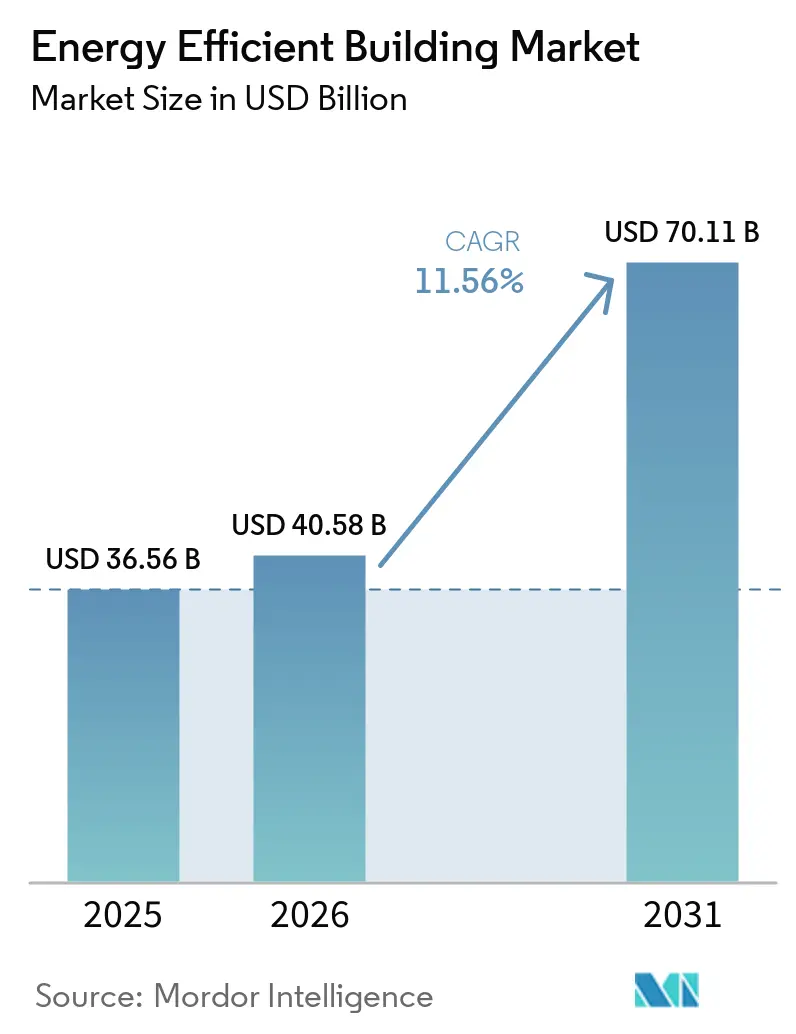
The Energy Efficient Building Market size is expected to grow from USD 36.56 billion in 2025 to USD 40.58 billion in 2026 and is forecast to reach USD 70.11 billion by 2031 at 11.56% CAGR over 2026-2031. The market covers building automation systems, energy management software, HVAC equipment, ventilation, lighting technologies, and high-performance insulation used in new construction and retrofit projects. Regulatory requirements are becoming more consistent across major construction regions, which is strengthening demand for equipment, controls, and compliance services. Building owners are also treating energy performance as a financial issue because energy costs, disclosure needs, and grid programs affect operating decisions. The energy efficient building market is therefore expanding through both mandated upgrades and investments that improve building operations. Software and service providers are gaining importance because owners increasingly need verified results after systems are installed.
Key Report Takeaways
- By building type, commercial buildings held 41.5% of the energy efficient building market share in 2025, while residential buildings are forecast to grow at a 12.7% CAGR through 2031.
- By component type, Energy Management Systems held 30.6% of the energy efficient building market share in 2025 and are forecast to expand at a 13.5% CAGR through 2031.
- By technology, hardware held 45.7% of the energy efficient building market share in 2025, while software is forecast to grow at a 13.7% CAGR through 2031.
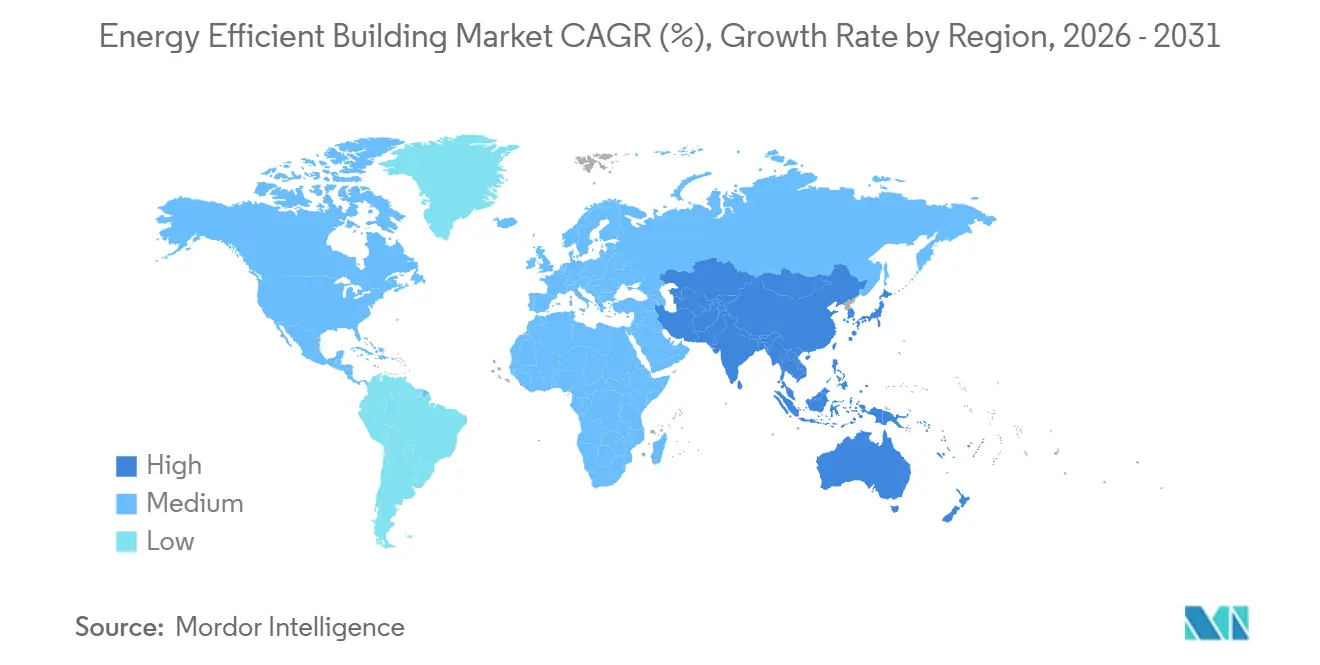
- By geography, North America held 32.3% of the energy efficient building market share in 2025, while Asia-Pacific is forecast to grow at a 14.1% CAGR through 2031.
Note: Market size and forecast figures in this report are generated using Mordor Intelligence’s proprietary estimation framework, updated with the latest available data and insights as of January 2026.
Global Energy Efficient Building Market Trends and Insights
Drivers Impact Analysis*
| Driver | (~) % Impact on CAGR Forecast | Geographic Relevance | Impact Timeline |
|---|---|---|---|
| Stricter Building Energy Codes and Performance Standards | +2.40% | Global, with enforcement peaks in North America and EU | Medium term (2–4 years) |
| Rising Energy Prices and Demand-Cost Exposure | +2.00% | Global, highest in Europe and APAC | Short term (≤ 2 years) |
| Corporate Decarbonization and Green-Building Certification Requirements | +2.20% | Global; most acute in EU, North America, and Japan | Medium term (2–4 years) |
| Public Incentives for Energy-Efficient Retrofits and Electrification | +1.40% | North America and EU core; spill-over to APAC | Short to medium term (≤ 3 years) |
| AI-Enabled Fault Detection from Existing Building Data | +1.20% | Global, with early adoption in North America and APAC | Medium term (2–4 years) |
| Grid-Interactive Buildings for Flexibility Revenue | +0.90% | North America, EU, and APAC grid-stressed markets | Long term (≥ 4 years) |
| Source: Mordor Intelligence | |||
Stricter Building Energy Codes and Performance Standards
The 2027 International Energy Conservation Code is final, with publication targeted for December 1, 2026. Its residential provisions reduce Energy Rating Index thresholds by 1 point in every climate zone. The code also requires duct systems to be located in conditioned space. These provisions increase the use of insulation, air-sealing products, and mechanical ventilation recovery systems in projects that adopt the code. The revised EU Energy Performance of Buildings Directive requires member states to establish minimum energy performance standards for non-residential buildings. The energy-efficient building market benefits when these rules turn performance targets into procurement requirements.
China’s 15th Five-Year Plan requires all new urban buildings to implement green building standards and supports building-integrated photovoltaics[1]State Council of the People’s Republic of China, “Notice on Issuing the 15th Five-Year Plan Carbon Peaking Action Plan,” State Council of the People’s Republic of China, gov.cn.. India is advancing mandatory star ratings for large commercial and residential buildings. These changes bring code cycles in major construction regions closer together. A common direction across North America, Europe, China, and India supports continued specifications for efficient equipment and controls. New construction creates an early demand base, while tightening thresholds also encourage upgrades to buildings that no longer meet local requirements. The energy efficient building market gains breadth as compliance needs extend across building envelopes, mechanical systems, and energy monitoring.
Rising Energy Prices and Demand-Cost Exposure
Energy costs are changing the financial case for building upgrades. Commercial buildings participating in demand-response programs can receive USD 8,000 to USD 45,000 in annual revenue for modest curtailable loads and 20 to 50 dispatch hours[2]U.S. Department of Energy, “Emerging Demand Flexibility Options for Reducing Energy Costs,” U.S. Department of Energy, energy.gov.. This revenue supplements the savings from lower energy use. It is especially relevant to real estate owners with several sites and centralized operating teams. Grid-interactive buildings can also receive USD 80 to USD 225 per kilowatt of capacity each season. These returns make controls, automation, and energy management systems more relevant to finance teams.
Energy price volatility has become as important as average energy prices for investment decisions. Buildings exposed to time-of-use tariffs and capacity charges have a different operating risk than buildings with flat tariffs. This difference can change which assets receive retrofit funding first. OpenADR gateways allow buildings to automate demand-response actions without relying on manual intervention. Energy management systems can reduce electricity billing costs by 7% to 27%, depending on asset type and available metering detail. The energy-efficient building market has a wider opportunity where utility incentives and corporate emissions commitments support the same project.
Corporate Decarbonization and Green Building Certification Requirements
LEED v5 became mandatory for new BD+C, ID+C, and O+M registrations from July 1, 2026. The framework assigns 50% of available points to decarbonization topics, including operational carbon, embodied carbon, refrigerants, and transportation. It also requires carbon, climate resilience, and human impact assessments. These requirements increase the need for building data, verified performance, and ongoing operational management. The energy-efficient building market is supported because certification increasingly requires evidence beyond design-stage commitments. Building owners need systems that can document energy performance through a building’s operating life.
BREEAM New Construction Version 7 applies to newly registered projects from January 27, 2026. It requires Whole Life Carbon assessments for projects seeking Excellent or Outstanding ratings. BREEAM had more than 2.9 million registered buildings in 100 countries, while LEED surpassed 200,000 certified projects globally by the end of 2025. The post-occupancy focus in both frameworks supports longer service contracts for controls and energy management providers. Certification can also support access to sustainable finance and higher-quality property positioning. This makes the energy-efficient building market relevant to owners seeking compliance, operational verification, and better financing conditions.
AI-Enabled Fault Detection from Existing Building Data
HVAC and air-handling systems account for 30% to 60% of building energy use[3]Institute of Electrical and Electronics Engineers, “Knowledge Graph-Enhanced Control and Diagnosis in Smart Building Energy Systems,” IEEE, doi.org.. Sensor drift, coil fouling, and refrigerant leakage can reduce performance without creating a visible alarm in conventional building management systems. Fault detection platforms use existing sensor streams to identify these problems earlier. This approach can avoid the capital cost of replacing equipment before its normal cycle. It also helps operators prioritize maintenance actions that affect energy consumption and occupant conditions. The energy-efficient building market is gaining from these tools because they connect routine operations with measurable efficiency improvement.
Multi-agent fault detection and diagnosis systems reported 93.1% diagnostic accuracy and average energy savings of 12.5% across validated multi-building deployments lasting 12 months. These systems combine AI agents, building ontologies, and diagnosis rules. A 2026 study reported 94% reproducibility for semantic validation methods using clustering and language-model interpretation of maintenance records[4]E3S Web of Conferences, “Generative AI for Building HVAC Diagnostics, A Reproducible Semantic Validation Framework,” E3S Web of Conferences, e3s-conferences.org.. Auditable diagnosis matters when energy performance contracts require third-party verification of savings. Owners can use existing building data to improve performance without waiting for a full physical retrofit. The energy efficient building market is therefore seeing more demand for software that converts operating data into defensible maintenance decisions.
Restraints Impact Analysis*
| Restraint | (~) % Impact on CAGR Forecast | Geographic Relevance | Impact Timeline |
|---|---|---|---|
| High Upfront Cost and Long Retrofit Payback Periods | -1.70% | Global; most constraining in emerging APAC and South America | Medium term (2–4 years) |
| Split Incentives Between Building Owners and Tenants | -0.80% | Global; highest friction in Europe and North America rental markets | Long term (≥ 4 years) |
| Interoperability Gaps Across Legacy Building Systems | -0.70% | Global; most acute in older building stocks in Europe and North America | Medium term (2–4 years) |
| Shortage of Skilled Building-Controls Integrators | -0.50% | North America and Europe; emerging in APAC | Short to medium term (≤ 3 years) |
| Source: Mordor Intelligence | |||
High Upfront Cost and Long Retrofit Payback Periods
Capital availability remains a primary barrier to comprehensive retrofits in commercial and industrial buildings. These projects require spending before operating savings can be realized. Older facilities may need several legacy systems to be replaced or integrated at once. This raises project complexity and makes phased investment harder. The energy-efficient building market is affected when owners postpone upgrades despite recognizing the operating need. Financing conditions are often decisive for projects involving HVAC, controls, building envelopes, and energy management systems together.
The U.S. Section 179D deduction is unavailable for projects that begin construction after June 30, 2026. The deduction had required a 25% or greater reduction in energy use intensity against an ASHRAE 90.1 baseline. Its removal reduces a cost offset for qualifying commercial projects. Energy Savings Performance Contracts can shift upfront risk to a contractor in exchange for guaranteed savings. These contracts are useful to federal and institutional owners, but they depend on mature ESCO markets and creditworthy counterparties. The energy-efficient building market will remain constrained in regions where these financing structures are limited.
Split Incentives Between Building Owners and Tenants
Split incentives occur when building owners pay for upgrades while tenants receive lower utility bills. This issue affects both commercial and residential rental properties. It can delay measures that would otherwise reduce energy use and improve building performance. The challenge is built into many standard lease structures. It is most persistent where owners cannot recover investment costs or share verified savings. The energy-efficient building market faces a slower retrofit cycle when the party making the investment does not receive a clear financial return.
A 2025 peer-reviewed study of Germany’s rental housing found differences in energy performance between owner-occupied and rented buildings that reflected this incentive structure. The EU’s revised Energy Performance of Buildings Directive asks member states to develop approaches that distribute renovation costs and benefits more fairly between owners and tenants. Green leases can align incentives through shared carbon targets and transparent energy data. Their use is growing among institutional owners that need post-occupancy performance verification. Wider adoption will depend on standard lease terms and reliable data-sharing arrangements. The energy-efficient building market benefits when verified savings can be shared between owners and occupants.
*Our forecasts treat driver/restraint impacts as directional, not additive. The impact forecasts reflect baseline growth, mix effects, and variable interactions.
Segment Analysis
By Building Type: Commercial Demand Is Led by Cost Exposure and Compliance Requirements
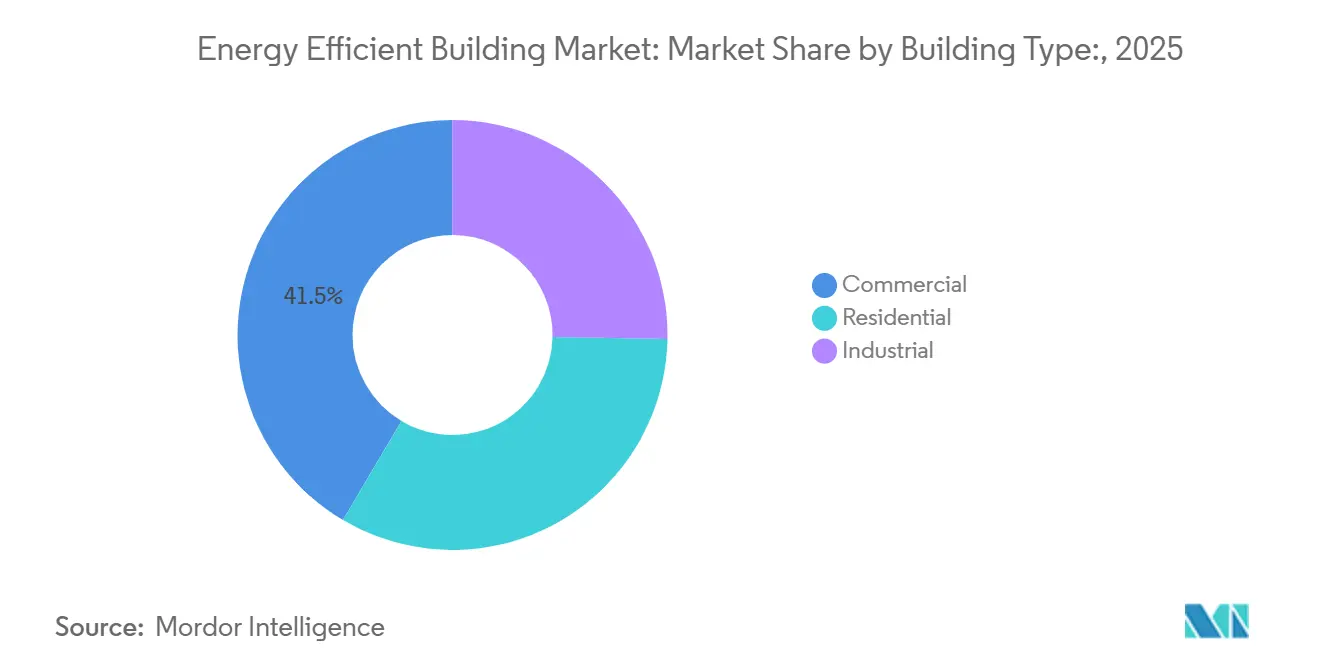
Commercial buildings held 41.5% of the energy-efficient building market share in 2025. Office, retail, and healthcare buildings face concentrated energy costs and growing disclosure requirements. The segment also faces direct compliance pressure from minimum performance standards for non-residential buildings. LEED v5 and BREEAM Version 7 increase the importance of measurable building performance in commercial project planning. Commercial owners commonly manage multiple assets, which supports centralized energy management and repeatable retrofit programs. The energy-efficient building market size for commercial buildings is supported by spending on controls, HVAC upgrades, lighting, ventilation, and monitoring systems.
Industrial buildings have different retrofit priorities. Process heat integration, compressed-air efficiency, and rooftop solar are important improvement areas. Energy Savings Performance Contracts are gaining use where industrial owners have constrained capital budgets. These contracts can provide a route to investment when the contractor guarantees savings outcomes. Industrial projects often require closer coordination between energy upgrades and operating schedules. This can extend implementation timelines, but it also supports demand for commissioning and managed services. The energy efficient building industry benefits when performance contracts reduce the initial financial barrier to broader facility upgrades.
Residential buildings are forecast to grow at a 12.7% CAGR through 2031. Mandatory code cycles, electrification incentives, and ultra-low-energy housing requirements support this growth. China’s 15th Five-Year Plan promotes ultra-low-energy building construction, and its T/CABEE 107-2025 standard took effect in August 2025. The standard raises requirements for insulation, air sealing, and mechanical ventilation. India’s proposed large-building star-rating system could increase demand for glazing, insulation, and HVAC equipment in Tier 1 and Tier 2 cities. Residential demand gives the energy efficient building market a larger new-construction base, rather than relying solely on commercial retrofits.



By Component Type: Energy Management Systems Combine Scale With the Fastest Growth
Energy Management Systems held 30.6% of the energy efficient building market share in 2025. They are also forecast to grow at a 13.5% CAGR through 2031. This combination reflects the move from single equipment purchases to continuous operating optimization. EMS platforms collect and interpret building data across sites. They can support energy reporting, fault detection, demand response, and compliance documentation. The energy efficient building market size for EMS benefits from the recurring nature of software and cloud-based service revenue.
An EMS can be deployed across multiple sites without the same capital scaling required for equipment replacement. This can lower the total cost of ownership for owners with large portfolios. It also creates a consistent source of operational data for performance verification. Johnson Controls introduced Metasys 16.0 in June 2026 with air and water sequences aligned with ASHRAE Guideline 36 and a stated potential for up to 30% energy savings. Standards alignment can reduce uncertainty during customer evaluation and procurement. The energy-efficient building market is increasingly shaped by systems that link engineering guidance with operational control.
Ventilation systems are receiving more attention because of indoor air-quality requirements and the use of heat-recovery ventilation in ultra-low-energy homes. Lighting technologies are largely based on LED and connected systems. Their replacement cycle is mature, but connected lighting can add occupancy data and demand-response functions. Building controls, sensors, metering, glazing, and insulation also benefit from the pipeline created by building codes. ISO 50001 and ASHRAE 90.1 continue to influence specifications in commercial and industrial projects. These components remain necessary even when software platforms manage more of the operating decision process.
By Technology: Hardware Retains the Largest Base While Software Expands Faster
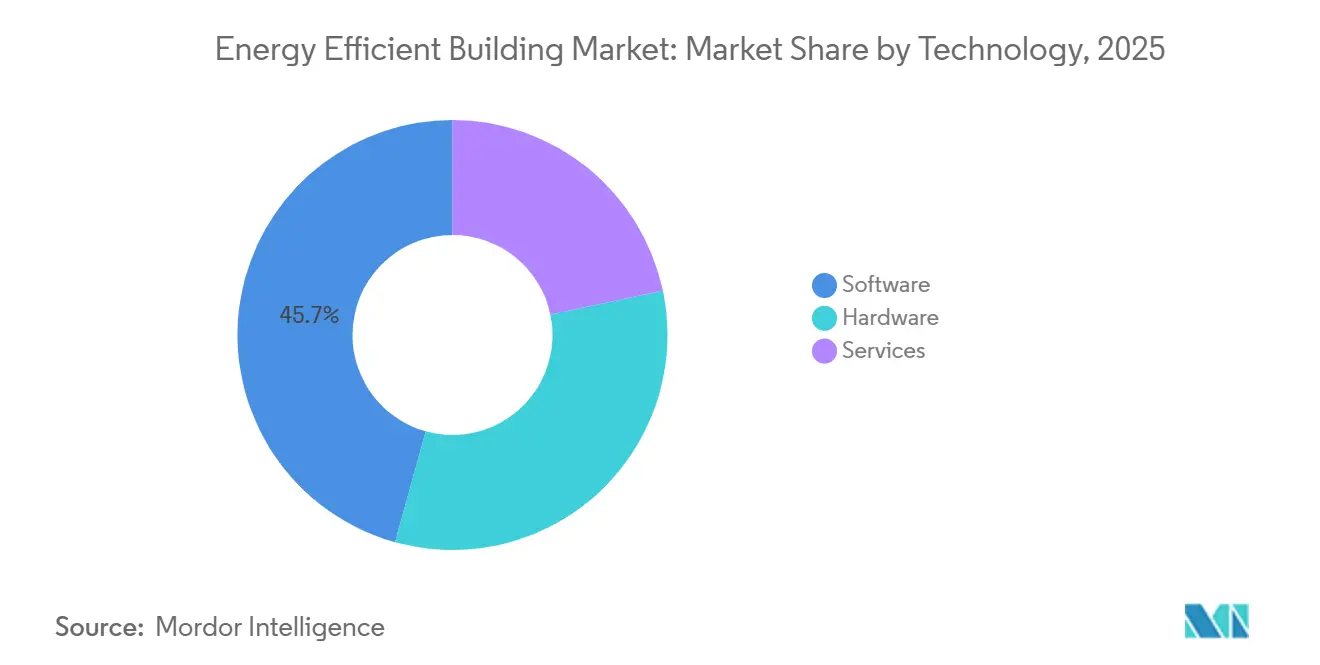
Hardware held 45.7% of the energy-efficient building market share in 2025. It includes HVAC equipment, ventilation systems, lighting fixtures, insulation panels, and building automation controllers. Physical system upgrades remain essential for many efficiency projects. New construction also requires physical equipment and building envelope materials from the start. Mechanical equipment in commercial and institutional buildings typically has a 15 to 25-year replacement cycle. The energy-efficient building market size for hardware is supported as equipment installed in the early 2000s reaches replacement age.
Hardware demand is not limited to replacing worn equipment. Building owners may also replace components to meet new codes or connect systems to a modern management platform. In many older buildings, the installed base uses BACnet, Modbus, or LonWorks devices. These legacy systems can create integration challenges with newer analytics platforms. The need to connect physical equipment with software increases the role of controllers, gateways, and commissioning services. Hardware suppliers are also developing integrated offerings that combine equipment, connectivity, and performance support. This keeps physical systems central to the energy efficient building market despite faster growth in software.
Software is forecast to grow at a 13.7% CAGR through 2031. AI-enabled energy management platforms, digital twin interfaces, and cloud-based analytics are moving from pilots into broader operational use. Johnson Controls stated that automated device onboarding through OpenBlue can reduce implementation time by up to 95% in complex campus settings. Services cover commissioning, performance contracting, monitoring, and managed operations. They are important because operators often prefer guaranteed outcomes to standalone equipment purchases. The energy efficient building industry is seeing stronger demand for service models that sustain savings after installation.
Geography Analysis
North America held 32.3% of the energy-efficient building market share in 2025. The United States has a large commercial building base undergoing EMS and lighting upgrades. It also has a mature ESCO ecosystem that supports performance contracts in federal, institutional, and municipal buildings. Corporate net-zero commitments add to demand for LEED and ENERGY STAR-aligned projects. Canada adds provincial energy-code activity and an older commercial building stock that requires envelope and HVAC upgrades. Mexico is gaining relevance as manufacturing investment increases commercial construction activity.
The Section 179D sunset after June 30, 2026, may bring forward some construction starts before eligibility ends. This can create a near-term increase in public-sector performance-contract activity. Europe is the second-largest regional market, supported by the EPBD’s minimum performance standards for non-residential buildings. Germany and France are the largest national markets in the region. Poland has an under-retrofitted commercial and residential building stock that attracts investment interest. Italy and Spain are benefiting from renovation programs and national incentives, while Russia’s role in the European green building ecosystem has declined since 2022.
Asia-Pacific is forecast to grow at a 14.1% CAGR through 2031. China requires green building standards for new urban construction and supports building-integrated photovoltaics. India’s proposed BEE star-rating framework for large buildings could expand compliance-led retrofit and specification activity. Japan and South Korea contribute steady spending on advanced HVAC and smart controls. Indonesia, Vietnam, and Thailand are gaining importance as urbanization increases. South America is led by Brazil and Chile, while financing gaps and split incentives remain constraints. Saudi Arabia and the United Arab Emirates support growth in the Middle East and Africa through national decarbonization agendas, with South Africa and Morocco acting as regional adoption hubs.

Competitive Landscape
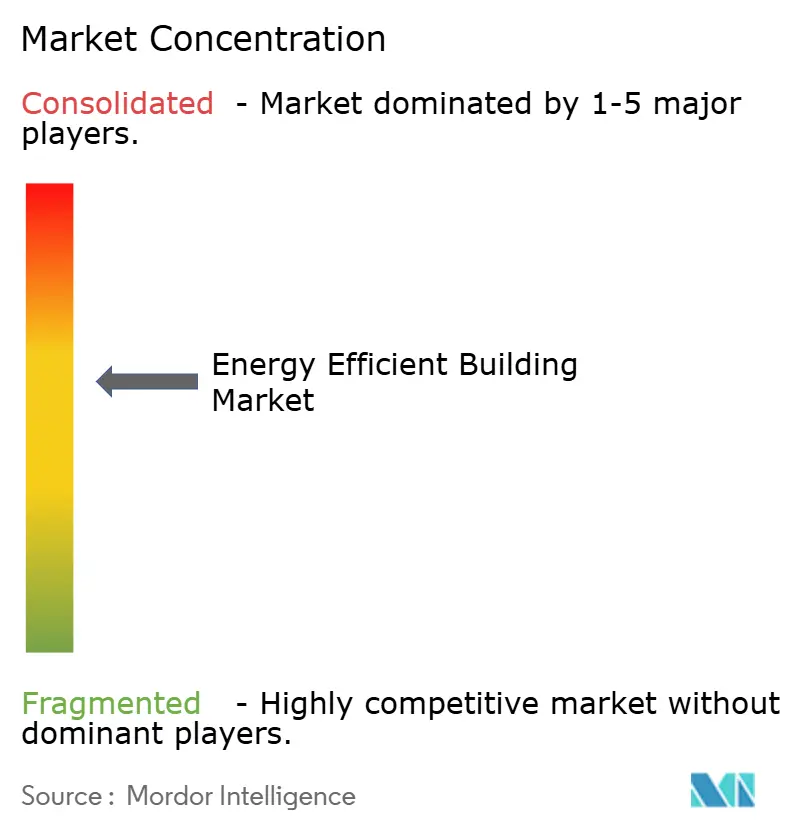
The energy efficient building market is moderately concentrated in system integration and building management platforms. Johnson Controls, Honeywell, Siemens, Schneider Electric, and Trane Technologies have major installed bases in building management systems and HVAC equipment. Competition is much more fragmented below the platform level. Regional controls contractors, ESCOs, insulation manufacturers, and software companies compete for project-level business. This structure gives large companies advantages in installed equipment, service coverage, and customer relationships. Smaller firms can still compete by serving specialized software, controls, or performance-contracting needs.
AI-focused acquisitions have become an important competitive response. Trane Technologies completed its acquisition of BrainBox AI in January 2025, bringing an autonomous HVAC optimization platform into its portfolio. Carrier acquired 75F in July 2026 to add cloud-native, wireless building automation and AI capabilities. Johnson Controls integrated Nantum AI technology into OpenBlue in April 2026. These moves show how established equipment providers are seeking control of the analytics layer. Johnson Controls also launched Metasys 16.0 in June 2026, aligning air and water sequences with ASHRAE Guideline 36.
Demand flexibility and building energy management remain areas with room for wider adoption. Fewer than 5% of technically eligible commercial buildings are enrolled in virtual power plant or grid-interactive programs. Software-first operators and emerging ESCO models can address this gap, especially for smaller building owners that face complex integration requirements. Kingspan partnered with Zestec Renewable Energy in May 2026 to combine solar roofing with funded power purchase agreements. The arrangement removes upfront capital requirements for commercial refurbishment customers. ISO 50001 requirements in procurement can favor suppliers that have the systems and certifications needed to support large operators. The energy efficient building market remains competitive because platform incumbents and specialist providers address different parts of the value chain.
Energy Efficient Building Industry Leaders
Johnson Controls
Schneider Electric SE
Siemens AG
Honeywell International Inc.
Trane Technologies plc
- *Disclaimer: Major Players sorted in no particular order

Recent Industry Developments
- August 2026: Johnson Controls unveiled expanded AI capabilities within its OpenBlue platform, including an agentic AI assistant that automates building operations and an Energy & Comfort Intelligence module built on Nantum AI technology. A deployment at DATEV reduced airside energy use by nearly 10% with no occupant comfort complaints, and automated device onboarding was reported to cut implementation time by up to 95% across complex multi-building campuses.
- August 2026: Daikin Industries acquired Dynamic Data Centers Solutions, a San Diego-based specialist in AI data center cooling systems, through its Daikin Applied Americas subsidiary. The deal extends Daikin’s portfolio from large-scale commercial air conditioning into individual server cooling.
- June 2026: Johnson Controls launched Metasys 16.0, delivering air and water control sequences aligned with ASHRAE Guideline 36 for up to 30% energy savings, IEC 62443-4-2 Security Level 2 cybersecurity, and support for up to 1,300 IP devices, the platform is targeted at data centers, healthcare, advanced manufacturing, and higher education facilities.
- March 2026: Signify launched the next-generation Interact Building suite, enabling centralized, real-time monitoring, automation, and optimization of lighting for professional indoor spaces, alongside a program targeting cumulative energy savings of 60 TWh for customers and a 35% reduction in portfolio CO₂ emission intensity.


Global Energy Efficient Building Market Report Scope
An energy-efficient building is designed, constructed, and operated to minimize energy consumption while providing occupants with a comfortable, healthy, and functional environment.
The Energy Efficient Building Market is segmented by building type, component type, technology, and geography. By building type, the market is segmented into residential, commercial, and industrial. By component type, the market is segmented into ventilation systems, lighting technologies, energy management systems, building controls, and others. By technology, the market is segmented into hardware, software, and services. The report also covers the market size and forecasts for the global energy efficient building market across 26 countries in key regions. For each segment, the market sizing and forecasts have been provided on the basis of value (USD).
| Residential |
| Commercial |
| Industrial |
| Ventilation Systems |
| Lighting Technologies |
| Energy Management Systems |
| Building Controls |
| Others |
| Hardware |
| Software |
| Services |
| North America | United States |
| Canada | |
| Mexico | |
| Europe | Germany |
| France | |
| Italy | |
| Spain | |
| United Kingdom | |
| Poland | |
| Russia | |
| Rest of Europe | |
| Asia-Pacific | China |
| India | |
| Japan | |
| South Korea | |
| Australia | |
| Indonesia | |
| Vietnam | |
| Thailand | |
| Rest of Asia-Pacific | |
| South America | Brazil |
| Argentina | |
| Chile | |
| Rest of South America | |
| Middle East and Africa | Saudi Arabia |
| United Arab Emirates | |
| Egypt | |
| South Africa | |
| Morocco | |
| Rest of Middle East and Africa |
| By Building Type | Residential | |
| Commercial | ||
| Industrial | ||
| By Component Type | Ventilation Systems | |
| Lighting Technologies | ||
| Energy Management Systems | ||
| Building Controls | ||
| Others | ||
| By Technology | Hardware | |
| Software | ||
| Services | ||
| By Geography | North America | United States |
| Canada | ||
| Mexico | ||
| Europe | Germany | |
| France | ||
| Italy | ||
| Spain | ||
| United Kingdom | ||
| Poland | ||
| Russia | ||
| Rest of Europe | ||
| Asia-Pacific | China | |
| India | ||
| Japan | ||
| South Korea | ||
| Australia | ||
| Indonesia | ||
| Vietnam | ||
| Thailand | ||
| Rest of Asia-Pacific | ||
| South America | Brazil | |
| Argentina | ||
| Chile | ||
| Rest of South America | ||
| Middle East and Africa | Saudi Arabia | |
| United Arab Emirates | ||
| Egypt | ||
| South Africa | ||
| Morocco | ||
| Rest of Middle East and Africa | ||


Key Questions Answered in the Report
How large is the energy efficient building market in 2026?
The energy efficient building market size stands at USD 40.58 billion in 2026 and is forecast to reach USD 70.11 billion by 2031.
What is driving demand for energy-efficient buildings?
Tighter building codes, higher exposure to demand charges, certification requirements, and more accessible operating data are supporting demand.
Which building type leads energy-efficient building spending?
Commercial buildings held 41.5% share in 2025, supported by energy-cost exposure and compliance obligations.
Which component is growing fastest?
Energy Management Systems are forecast to grow at a 13.5% CAGR through 2031 and held 30.6% share in 2025.
Why is building management software expanding faster than hardware?
Software supports continuous optimization, fault detection, reporting, and portfolio-level operation without proportional equipment spending.
Which region is growing fastest for efficient building solutions?
Asia-Pacific is forecast to expand at a 14.1% CAGR through 2031, supported by construction activity and regulatory measures in China and India.
Page last updated on:


 Your data is secure and never sold or shared.


