
Embedded Wealth Management Market Size and Share
Market Overview
| Study Period | 2020 - 2031 |
|---|---|
| Market Size (2026) | USD 1.5 Trillion |
| Market Size (2031) | USD 2.20 Trillion |
| Growth Rate (2026 - 2031) | 8.10 % |
| Fastest Growing Market | South America |
| Largest Market | Asia-Pacific |
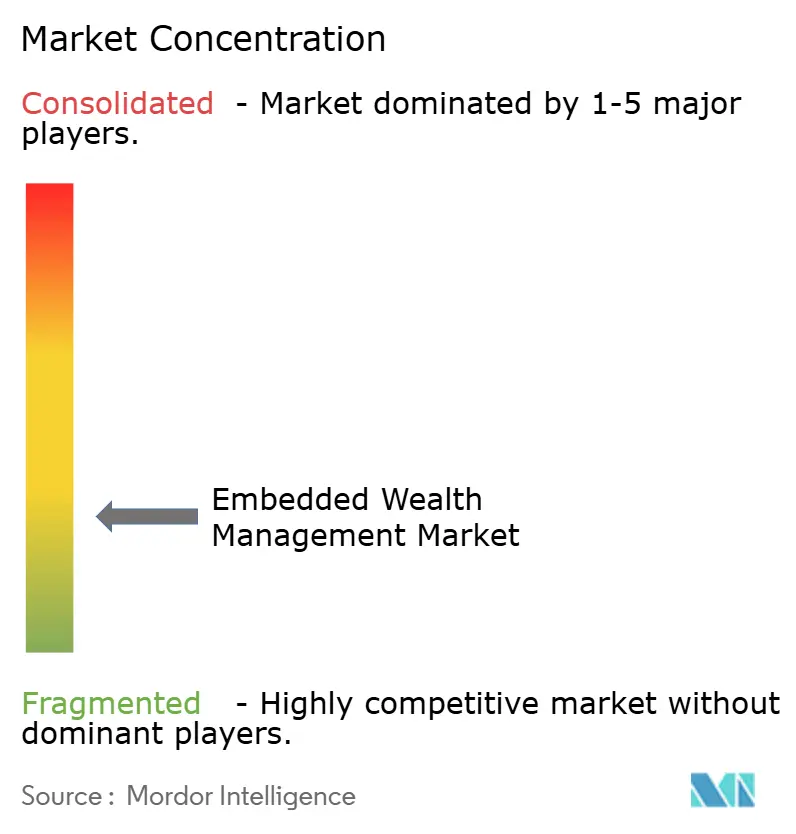
| Market Concentration | Low |
Major Players *Disclaimer: Major Players sorted in no particular order Image © Mordor Intelligence. Reuse requires attribution under CC BY 4.0. | |
Embedded Wealth Management Market Analysis by Mordor Intelligence
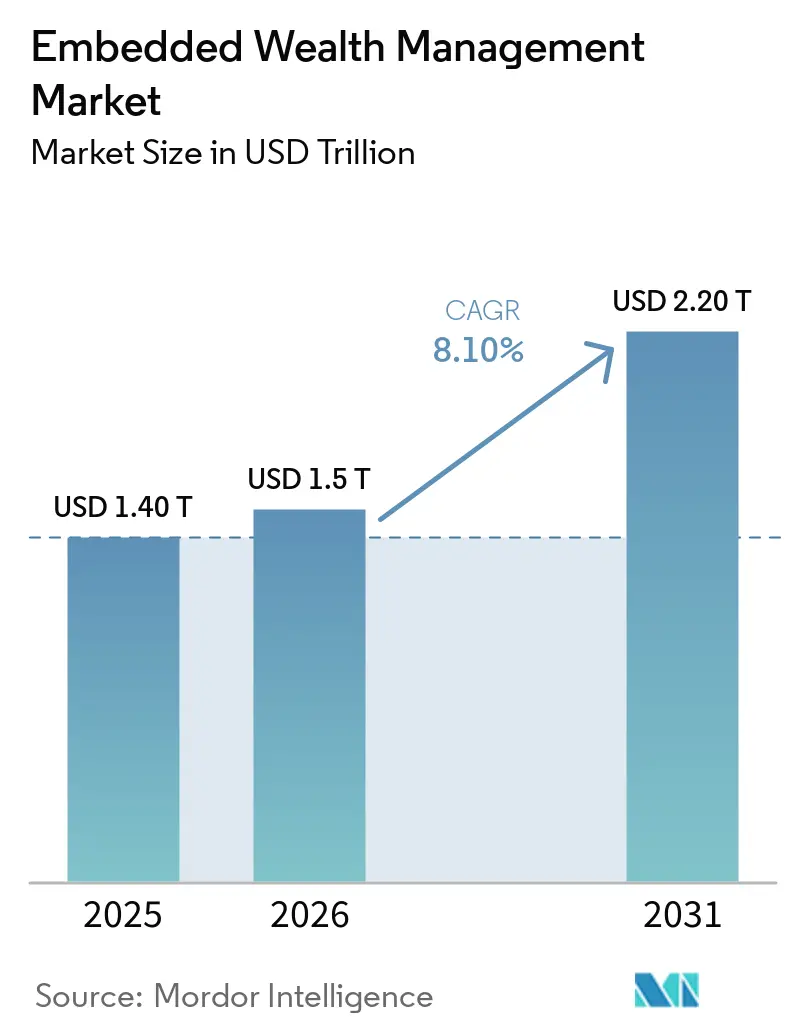
The Embedded Wealth Management Market size was valued at USD 1.40 trillion in 2025 and is estimated to grow from USD 1.5 trillion in 2026 to reach USD 2.20 trillion by 2031, at a CAGR of 8.10% during the forecast period (2026-2031).
The embedded wealth management market is moving investment products into payroll applications, super-apps, digital banking interfaces, and e-commerce wallets, where consumers and small businesses already manage routine financial activity. This distribution model gives host platforms access to established user relationships and can reduce the need for separate customer acquisition. Wealth providers are responding by supplying products, custody, brokerage, and compliance capabilities through third-party digital channels rather than relying only on captive applications. Competition is therefore centered on the ability to combine reliable technology, regulatory controls, and a user experience that supports first-time investors. The embedded wealth management market also has opportunities in payroll and business software, where retirement and investment services can be placed within existing work and cash-management processes.
Key Report Takeaways
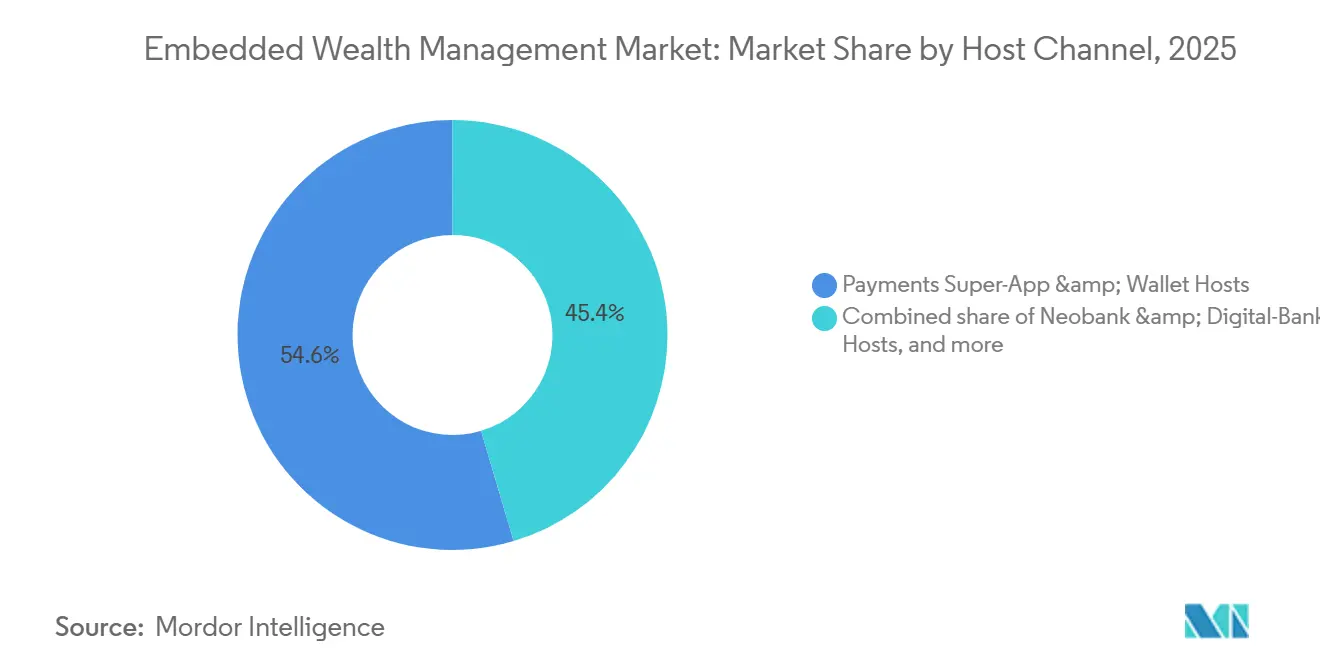
- By host channel, payments super-apps and wallet hosts captured 54.6% of the embedded wealth management market share in 2025, while neobanks and digital banks are projected to grow at a 13.5% CAGR through 2031.
- By product sleeve, cash-equivalent regulated funds captured 36.7% of the embedded wealth management market share in 2025, while discretionary and automated portfolios are projected to grow at a 13.1% CAGR through 2031.
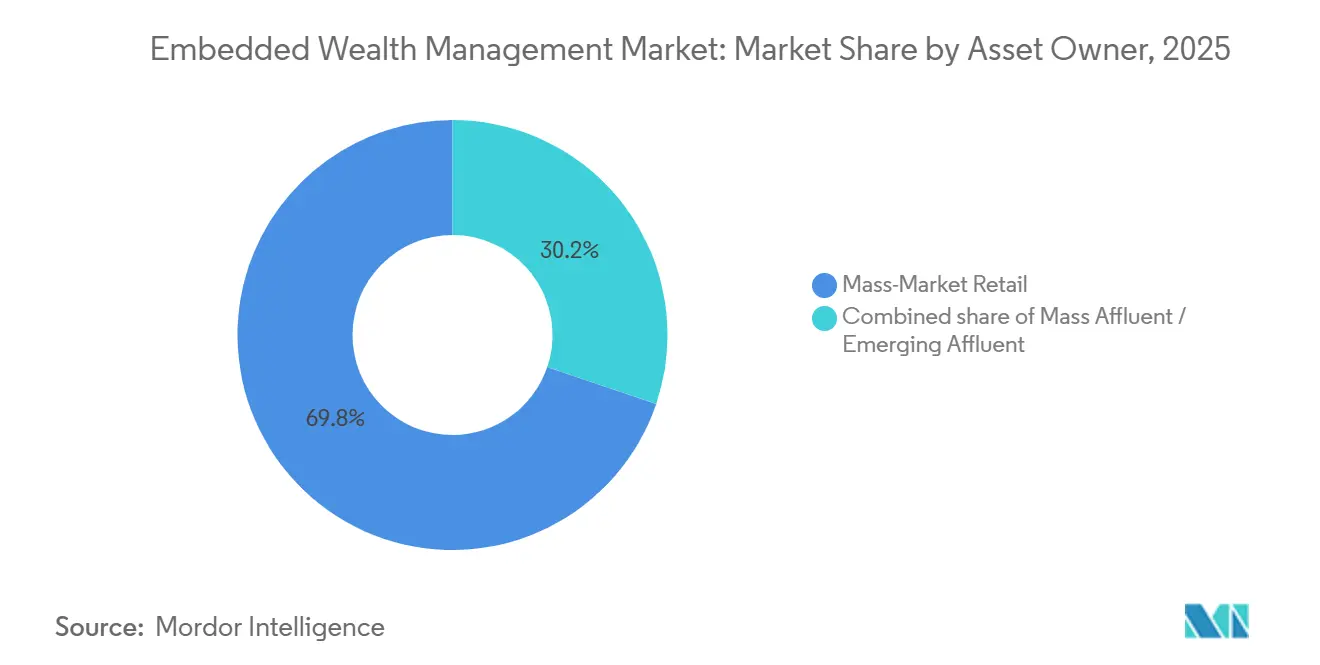
- By asset owner, mass-market retail captured 69.8% of the embedded wealth management market share in 2025, while micro-business and sole-trader treasury is projected to grow at a 15.6% CAGR through 2031.
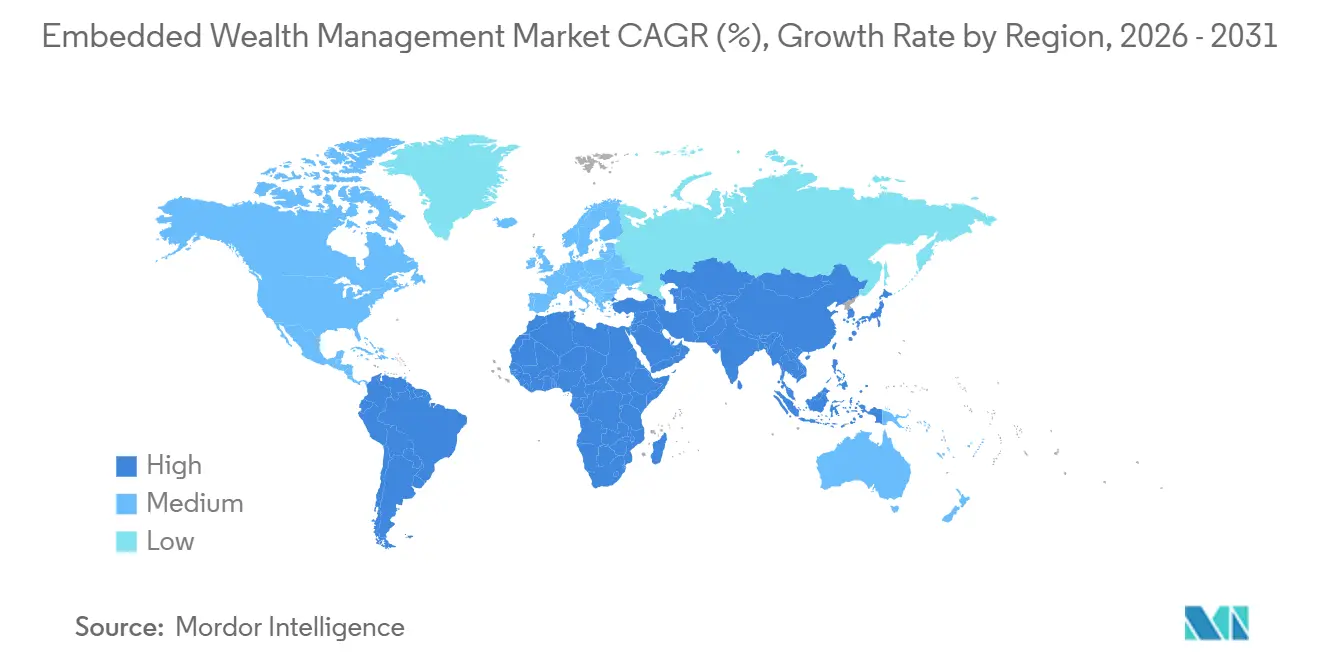
- By geography, Asia-Pacific captured 55.2% of the embedded wealth management market share in 2025, while South America is projected to grow at a 14.3% CAGR through 2031.
Note: Market size and forecast figures in this report are generated using Mordor Intelligence’s proprietary estimation framework, updated with the latest available data and insights as of January 2026.
Global Embedded Wealth Management Market Trends and Insights
Drivers Impact Analysis*
| Driver | (~) % Impact on CAGR Forecast | Geographic Relevance | Impact Timeline |
|---|---|---|---|
| Expansion of Wealth Management Distribution Through Non-Financial Platforms | +2.1% | Global | Short term (≤ 2 years) |
| Adoption of API-Based Investment and Wealth Management Infrastructure | +1.5% | Global, strongest in North America & EU | Medium term (2–4 years) |
| Demand for Frictionless and Personalized Embedded Investment Solutions | +1.2% | Asia-Pacific core, spill-over to North America | Short term (≤ 2 years) |
| Integration of Automated Investment and Advisory Capabilities Into Embedded Journeys | +1.0% | Global | Medium term (2–4 years) |
| Expansion of Embedded Wealth Management Across Payroll, Banking, Super-Apps and Vertical Platforms | +0.8% | North America & EU | Medium term (2–4 years) |
| Platform Incentives to Monetize Customers Through Embedded Wealth Products | +0.6% | Global | Short term (≤ 2 years) |
| Source: Mordor Intelligence | |||
Distribution Through Non-Financial Platforms and Platform Monetization
The embedded wealth management market is being shaped by investment offerings inside channels that were not traditionally used for wealth distribution. Workplace plans, digital banking applications, payroll tools, and partner ecosystems can become a customer’s first point of contact with investing. A platform with a large active user base can present investment products without building a separate customer acquisition channel. This can improve the economics of distribution for a host platform while increasing pressure on advisor-led models. Alipay has used goal-based fund recommendations with Vanguard, Grab Invest has offered micro-investing through Fullerton and UOB Asset Management, and Paytm has provided retail brokerage, showing how this model can operate at scale. Host platforms can also earn from embedded products while using white-label partnerships to provide institutional product access instead of developing all investment capabilities internally.
API-Based Investment Infrastructure and Platform Expansion
API-based brokerage infrastructure has reduced the time needed to launch embedded investment services. DriveWealth, Upvest, and WealthKernel provide modular capabilities covering trade execution, custody, settlement, tax wrappers, and compliance reporting for neobanks and consumer applications[1]WealthKernel, “WealthKernel Announces Strategic Expansion into US Equities Trading,” WealthKernel, wealthkernel.com. The embedded wealth management market can therefore attract platforms that do not hold their own broker-dealer licenses. Execution services face pricing pressure as they become more widely available across provider platforms. Compliance tools for know-your-customer checks, anti-money-laundering controls, suitability, and cross-border reporting are becoming more important points of differentiation. DriveWealth introduced its Lending Rate API in March 2026 to show 30-day average lending rates for 800 securities, while Upvest’s service supports MiFIR Article 26 reporting, local tax wrappers, and financial transaction tax requirements.
Frictionless and Personalized Embedded Investment Solutions
Personalized investment experiences have become more important as platforms seek to make investing easier for customers who may not use a financial advisor. Behavioral information available within payment and banking applications can support goal-based recommendations, automated rebalancing, and prompts within familiar digital screens. GXS Bank expanded GXS Invest in May 2026 with a dynamically managed multi-asset fund from Lion Global Investors and no platform fees or lock-in period[2]GXS Bank, “GXS Bank Expands Its Retail Banking Services with the Launch of GXS Invest,” GXS Bank, gxs.com.sg. The service was available from SGD 10 (USD 7.4) and extended access to products that may otherwise require a separate investment relationship. Lion Global Investors managed SGD 74.5 billion (USD 55.2 billion) in assets in the example provided for the partnership. The embedded wealth management market can benefit when investing appears within routine payment activity instead of requiring consumers to leave an established platform and complete a separate brokerage onboarding process.
Automated Investment and Advisory Capabilities
Automated portfolio tools can move idle cash balances into managed products through applications that users already access. KakaoBank launched the Stock Home feature in 2026 through Kakao Pay Securities for 27.63 million customers[3]https://finance.biggo.com/news/ea343105-b309-4d20-9a3e-015c93845770. The feature combines domestic and international equity trading, exchange-traded funds, and structured savings within the banking application. Automated investing can establish an investment relationship with customers who previously had only a payment or deposit relationship. The approach can also support recurring portfolio management and more personalized recommendations as customer activity develops. As platforms broaden investment choices, they may extend beyond equities and money-market funds toward semi-liquid alternatives and other products that require stronger suitability controls.
Restraints Impact Analysis*
| Restraint | (~) % Impact on CAGR Forecast | Geographic Relevance | Impact Timeline |
|---|---|---|---|
| Multi-Jurisdictional Licensing and Regulatory Compliance Requirements | -1.0% | Global, highest in EU & North America | Long term (≥ 4 years) |
| Data Privacy, Cybersecurity and Digital-Identity Risks | -0.8% | Global | Medium term (2–4 years) |
| Integration Complexity With Legacy Wealth and Financial Infrastructure | -0.6% | North America & EU | Long term (≥ 4 years) |
| Limited Investor Trust and Financial Literacy Within Non-Traditional Distribution Channels | -0.4% | MEA, South America | Medium term (2–4 years) |
| Source: Mordor Intelligence | |||
Licensing, Compliance, and Investor Trust Requirements
Licensing, suitability, and investment-advice rules remain a major constraint on international expansion in the embedded wealth management market. In the United States, the Office of the Comptroller of the Currency, Federal Deposit Insurance Corporation, Financial Crimes Enforcement Network, and state money-transmission regulators can impose separate obligations on embedded finance partnerships. Federal Deposit Insurance Corporation enforcement records from 2024 showed that more than 25% of formal enforcement actions targeted sponsor banks in embedded-finance arrangements. In the United Kingdom, the Financial Conduct Authority Consumer Duty places responsibility across the customer journey and requires firms to avoid foreseeable harm while supporting financial objectives. The Financial Conduct Authority’s April 2026 open-finance roadmap proposes consent-based data sharing for investments, pensions, and insurance, which could create opportunities but also introduce additional compliance needs. Financial literacy and trust can also limit adoption where customers are offered investment services through channels that have historically focused on payments, payroll, or commerce.
Data Privacy, Digital Identity, and Legacy-System Integration Risks
Embedded wealth services combine behavioral, transaction, and financial information across the host platform, technology provider, and custodian. This structure creates more points where data access, identity verification, and reconciliation controls need to work correctly. The Consumer Financial Protection Bureau’s Personal Financial Data Rights Rule introduced phased requirements beginning in 2026 and continuing through 2030 for data governance and third-party access controls in the United States. Digital identity standards used by gig-work applications or e-commerce wallets may not meet the requirements used by regulated brokerages. The 2024 Synapse collapse left more than 100,000 customers unable to access funds and exposed the effect that ledger and reconciliation failures can have on middleware-dependent structures. Legacy wealth systems can add further difficulty because established institutions must connect older records, reporting tools, and controls to newer API-based services without weakening operational oversight.
*Our forecasts treat driver/restraint impacts as directional, not additive. The impact forecasts reflect baseline growth, mix effects, and variable interactions.
Segment Analysis
By Host Channel: Payments Scale Leads While Neobanks Expand Faster
Payments super-apps and wallet hosts captured 54.6% of the total embedded wealth management market in 2025 because they serve large user bases across China, Southeast Asia, and Latin America. Users of these platforms commonly start with liquid, lower-risk products because they can move idle balances while retaining access to funds. Cash-equivalent and money-market products fit this use case and can reduce hesitation around a first investment. Incumbent bank and credit-union applications hold an adjacent position because they have established trust and licensed banking relationships. Their investment interfaces can still lag neobank services in user experience, which can reduce conversion from product viewing to a first transaction. Commerce, telecommunications, and other non-financial platforms remain early contributors, particularly in emerging economies where mobile wallets have already achieved broad payment use.
The embedded wealth management market size for neobank and digital-bank hosts is projected to grow at a 13.5% CAGR through 2031. These hosts combine consumer-focused design with direct banking licenses, reducing the need for the regulatory intermediary layer that payment-only platforms may require. Shinhan Financial Group introduced Shinhan Super SOL in South Korea in 2026, bringing deposits, stock investing through Shinhan SOL LINK, cards, and life insurance into one platform. GXS Bank expanded its investing service to 5 curated funds in 2026, showing that a digital bank can provide product access that was often associated with private banking. Neobanks are adding investing as part of broader financial platforms instead of treating it as a separate feature. This approach may allow them to deepen customer relationships more quickly than traditional channels that depend on branches or standalone advisor services.


By Product Sleeve: Cash-Equivalent Funds Build Entry, Automated Portfolios Build Depth
Cash-equivalent regulated funds captured 36.7% of the embedded wealth management market size in 2025. Their position reflects their role as a liquid and capital-stable entry product for people using an investment service for the first time. GXS Invest began in July 2025 with the Fullerton SGD Cash Fund before expanding its available fund range. Pooled risk funds can be suitable for platforms that use automated suitability processes because diversified structures can be easier to present than individual securities. Direct securities serve users who have developed a stronger investing habit and want more control over trading decisions. These offerings require additional execution, reporting, and customer-support capabilities from the platform and its infrastructure partners.
The embedded wealth management market size for discretionary and automated portfolios is projected to grow at a 13.1% CAGR through 2031. Continuous rebalancing and personalized recommendations can support recurring fee income and make the platform relationship more durable. A user with a managed portfolio develops an investment history that can help a platform tailor future recommendations. Tax efficiency can also encourage sustained adoption of managed services where relevant account structures are available. The United Kingdom has Individual Savings Accounts, India has National Pension System-linked payroll accounts, and the United States has 401(k) structures that can support such product design. Other licensed wrappers are also expanding, where platforms identify tax management as a reason for mass-market users to keep investing over longer periods.
By Asset Owner: Mass-Market Retail Provides Scale and Micro-Businesses Add Demand
Mass-market retail investors captured 69.8% of the total value in the embedded wealth management market in 2025. Embedded platforms can reach individuals who hold a banking relationship but have not used professional investment management. The mass-affluent and emerging-affluent groups are a related opportunity because they have more complex needs and greater interest in personalized goal-based services. Platforms can begin with money-market products and later introduce savings goals, pooled funds, and managed portfolios as customer balances grow. This sequence can support the movement of users from initial investment activity toward higher asset levels. It also makes the host platform an increasingly important distribution point for wealth products.
Micro-business and sole-trader treasury is projected to grow at a 15.6% CAGR through 2031 in the embedded wealth management market. Small businesses and freelancers have often been outside retail advisory coverage and outside corporate treasury service models because of account size and operating requirements. Payroll and enterprise-resource-planning embedded services can place retirement and investment tools inside software used for regular business administration. Vestwell was selected by Intuit in May 2026 as the exclusive QuickBooks 401(k) partner for millions of small and mid-market customers. KB Kookmin Bank also introduced an AI-based corporate finance platform in 2026 for South Korea’s 7 million small merchants, integrating lending and treasury services with business operating platforms. The segment reflects employer retirement incentives in the United States, API-based small-business financial tools, and demand from businesses that historically lacked structured investment access.
Geography Analysis
Asia-Pacific captured 55.2% of the embedded wealth management market share in 2025. The region combines large super-app user bases, digital banking licensing frameworks, and established consumer use of embedded financial services. Alipay and WeChat placed fund recommendations, money-market products, and systematic investing within daily payment activity in China. Southeast Asian and South Korean providers have adapted this structure with local products and regulatory approaches. GXS Bank expanded GXS Invest in Singapore during May 2026 through Lion Global Investors, giving users access to a physical gold-backed fund and a multi-asset fund from SGD 10 (USD 7.4). TNG eWallet in Malaysia partnered with CIMB to integrate ASB Financing with existing ASNB investment management, adapting embedded services to Islamic finance requirements.
South America is projected to grow at a 14.3% CAGR through 2031 in the embedded wealth management market. Brazil’s Pix instant-payment system has created a mobile-first financial structure that can support investment products within commonly used applications. DriveWealth supported the August 2026 launch of IOL Privé, a digital wealth service for high-net-worth customers across Latin America through IOL Group’s 2 million-customer base in Argentina and Uruguay. Demand for international diversification is relevant in Argentina because capital volatility has encouraged interest in United States dollar-denominated assets. North America also has substantial activity through payroll-based retirement products. Paylocity launched Paylocity Retirement in June 2026 using Vestwell technology, placing 401(k) administration within its human capital management software.
Europe depends strongly on regulatory readiness because open-finance rules and MiFID II suitability requirements shape how services can scale. The Financial Conduct Authority published its open-finance roadmap in April 2026, proposing consent-based data sharing across investments, pensions, insurance, savings, credit, and debt management. The roadmap builds on open-banking infrastructure that includes 145 active third-party providers and 17 million active users in the United Kingdom. WealthKernel, operating as Alpaca Europe after Alpaca’s United Kingdom expansion, offers API-based investing, custody, fractional shares, and regulatory reporting for regional providers. Germany, the United Kingdom, and France are important centers for this activity. The United Kingdom Data (Use and Access) Act received government approval in May 2025 and established a basis for wider Smart Data schemes.

Competitive Landscape
The embedded wealth management market is fragmented. FNZ Group, Envestnet, SS&C Technologies, and Broadridge Financial Solutions compete with API-focused providers including DriveWealth, Upvest, AlpacaDB, and WealthKernel. TIFIN, Additiv, and InvestCloud also provide artificial intelligence and digital wealth capabilities. Clients increasingly combine specialized brokerage, custody, compliance, and user-interface components instead of selecting one complete vendor platform. This model can reduce any single provider’s negotiating power while increasing the value of infrastructure that is difficult to replace. Providers with credible regulatory controls and established custody connections can maintain durable customer relationships even as execution services become more standardized.
FNZ raised USD 450 million in September 2026 from La Caisse, CPP Investments, Generation Investment Management, and Motive Partners. The company paired the funding with disposals of FNZ Bank Germany, IFSAM Luxembourg, and a Swiss core banking platform. The moves focused its operations on wealth management technology rather than a wider financial infrastructure portfolio. FNZ manages USD 2.5 trillion in assets for more than 30 million end customers through its technology platform. FIS also launched its Embedded Banking Platform in September 2026, enabling United States banks to offer accounts and investment capabilities in enterprise resource planning and accounting software. The platform keeps accounts on the bank’s balance sheet while third-party software manages the user experience.
Payroll platforms and retirement products are an area with several entrants and no dominant provider. Bambu Global in Southeast Asia and Fincite in Germany focus on embedded advisory infrastructure for regional institutions that need integrated wealth technology without the cost of developing it internally. AI-driven advisory is moving beyond rule-based robo-advice toward portfolio management that responds to behavioral information within the host platform. Envestnet’s goal-based planning intellectual property and TIFIN’s wealth intelligence capabilities illustrate the importance of technology alongside compliance and custody. InvestSuite filed with the Financial Conduct Authority as a regulated firm in February 2025, allowing it to serve European financial institutions under local authorization. The embedded wealth management industry is likely to reward firms that can offer compliance readiness, modular technology, and practical deployment support for host platforms.
Embedded Wealth Management Industry Leaders
FNZ Group Ltd.
Envestnet, Inc.
InvestCloud, Inc.
DriveWealth LLC
Apex Fintech Solutions Inc.
- *Disclaimer: Major Players sorted in no particular order

Recent Industry Developments
- September 2026: FNZ Group raised USD 450 million in new equity funding from La Caisse, CPP Investments, Generation Investment Management, and Motive Partners. The capital supports FNZ's technology transformation and profitable-growth strategy across its platform, which manages USD 2.5 trillion in assets for over 30 million end customers. FNZ simultaneously launched FNZ Select, a premium service tier offering enhanced service levels and advanced capabilities to large financial institution clients.
- September 2026: FIS launched the FIS Embedded Banking Platform, enabling United States banks to offer accounts, card issuing, accounts receivable and payable, and expense management directly inside the ERP and accounting software that commercial clients use daily. Pilot banks include Cogent Bank, Commercial Bank of California, and M&T Bank, with accounts and payments planned for Q4 2026. By keeping accounts on the bank's own balance sheet, the platform preserves regulatory clarity while allowing third-party software to manage the user experience.
- August 2026: DriveWealth powered the launch of IOL Privé, a premium digital-first wealth management offering from IOL Group targeting high-net-worth investors across Latin America. IOL Privé combines DriveWealth's embedded brokerage infrastructure with dedicated wealth advisory and access to United States investment accounts through a single digital experience, expanding DriveWealth's presence in South America to serve growing demand for international investment diversification.
- July 2026: Kakao Pay Securities launched "Stock Home" within KakaoBank's investment tab, enabling KakaoBank's 27.63 million users to trade domestic and international equities, ETFs, and ETNs without leaving the banking application. The integration includes real-time charting, community features, and a structured "26-Week ETF Savings" product, accelerating KakaoBank's transformation from a payments-focused neobank into a comprehensive wealth management platform.


Global Embedded Wealth Management Market Report Scope
| Incumbent Bank & Credit-Union Contextual App |
| Neobank & Digital-Bank Hosts |
| Payments Super-App & Wallet Hosts |
| Commerce, Telecom & Other Non-Financial Hosts |
| Cash-Equivalent Regulated Funds |
| Pooled Risk Funds |
| Direct Market Securities |
| Discretionary / Automated Portfolios |
| Other Licensed Wrappers |
| Mass-Market Retail |
| Mass Affluent / Emerging Affluent |
| Micro-Business / Sole-Trader Treasury |
| North America | United States |
| Canada | |
| Mexico | |
| South America | Brazil |
| Argentina | |
| Rest of South America | |
| Europe | United Kingdom |
| Germany | |
| France | |
| Italy | |
| Spain | |
| Rest of Europe | |
| Asia-Pacific | China |
| Japan | |
| India | |
| South Korea | |
| Australia | |
| Indonesia | |
| Thailand | |
| Malaysia | |
| Singapore | |
| Vietnam | |
| Rest of Asia-Pacific | |
| Middle East and Africa | Saudi Arabia |
| United Arab Emirates | |
| Turkey | |
| South Africa | |
| Egypt | |
| Rest of Middle East and Africa |
| By Host Channel | Incumbent Bank & Credit-Union Contextual App | |
| Neobank & Digital-Bank Hosts | ||
| Payments Super-App & Wallet Hosts | ||
| Commerce, Telecom & Other Non-Financial Hosts | ||
| By Product Sleeve | Cash-Equivalent Regulated Funds | |
| Pooled Risk Funds | ||
| Direct Market Securities | ||
| Discretionary / Automated Portfolios | ||
| Other Licensed Wrappers | ||
| By Asset Owner | Mass-Market Retail | |
| Mass Affluent / Emerging Affluent | ||
| Micro-Business / Sole-Trader Treasury | ||
| By Geography | North America | United States |
| Canada | ||
| Mexico | ||
| South America | Brazil | |
| Argentina | ||
| Rest of South America | ||
| Europe | United Kingdom | |
| Germany | ||
| France | ||
| Italy | ||
| Spain | ||
| Rest of Europe | ||
| Asia-Pacific | China | |
| Japan | ||
| India | ||
| South Korea | ||
| Australia | ||
| Indonesia | ||
| Thailand | ||
| Malaysia | ||
| Singapore | ||
| Vietnam | ||
| Rest of Asia-Pacific | ||
| Middle East and Africa | Saudi Arabia | |
| United Arab Emirates | ||
| Turkey | ||
| South Africa | ||
| Egypt | ||
| Rest of Middle East and Africa | ||


Key Questions Answered in the Report
What is the projected value of embedded wealth management by 2031?
The embedded wealth management market is forecast to reach USD 2.2 trillion by 2031 from USD 1.5 trillion in 2026, at an 8.1% CAGR.
Which host channel leads embedded investing services?
Payments super-apps and wallet hosts led with 54.6% share in 2025, supported by large established user bases.
Which embedded wealth product category is growing fastest?
Discretionary and automated portfolios are expected to record the fastest product-sleeve growth at a 13.1% CAGR through 2031.
Why are neobanks important for embedded investing?
Neobanks combine direct banking licenses with digital user experiences and are projected to grow at a 13.5% CAGR through 2031.
Which region is growing fastest for embedded wealth services?
South America is forecast to grow at a 14.3% CAGR through 2031, supported by Brazil’s mobile-first payments architecture and digital wealth activity.
What is limiting wider adoption of embedded wealth services?
Licensing, suitability, privacy, identity verification, and legacy-system integration requirements remain significant constraints.
Page last updated on:





