
Electronic Thermal Management Materials Market Size and Share
Market Overview
| Study Period | 2021 - 2031 |
|---|---|
| Market Size (2026) | USD 5.13 Billion |
| Market Size (2031) | USD 6.98 Billion |
| Growth Rate (2026 - 2031) | 6.36 % |
| Fastest Growing Market | Asia-Pacific |
| Largest Market | Asia-Pacific |
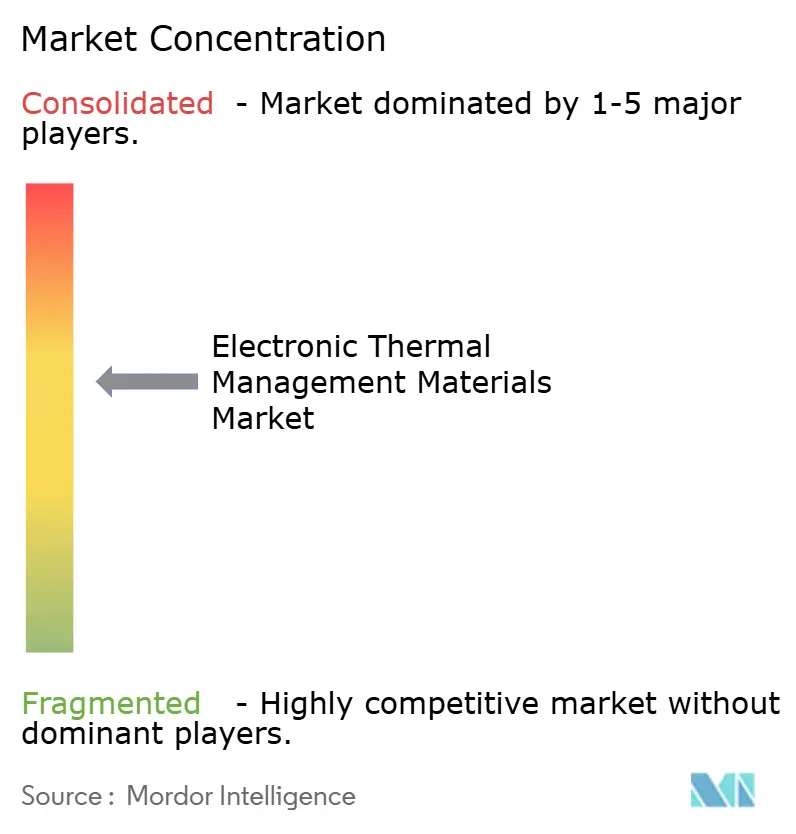
| Market Concentration | Medium |
Major Players *Disclaimer: Major Players sorted in no particular order Image © Mordor Intelligence. Reuse requires attribution under CC BY 4.0. | |
Electronic Thermal Management Materials Market Analysis by Mordor Intelligence
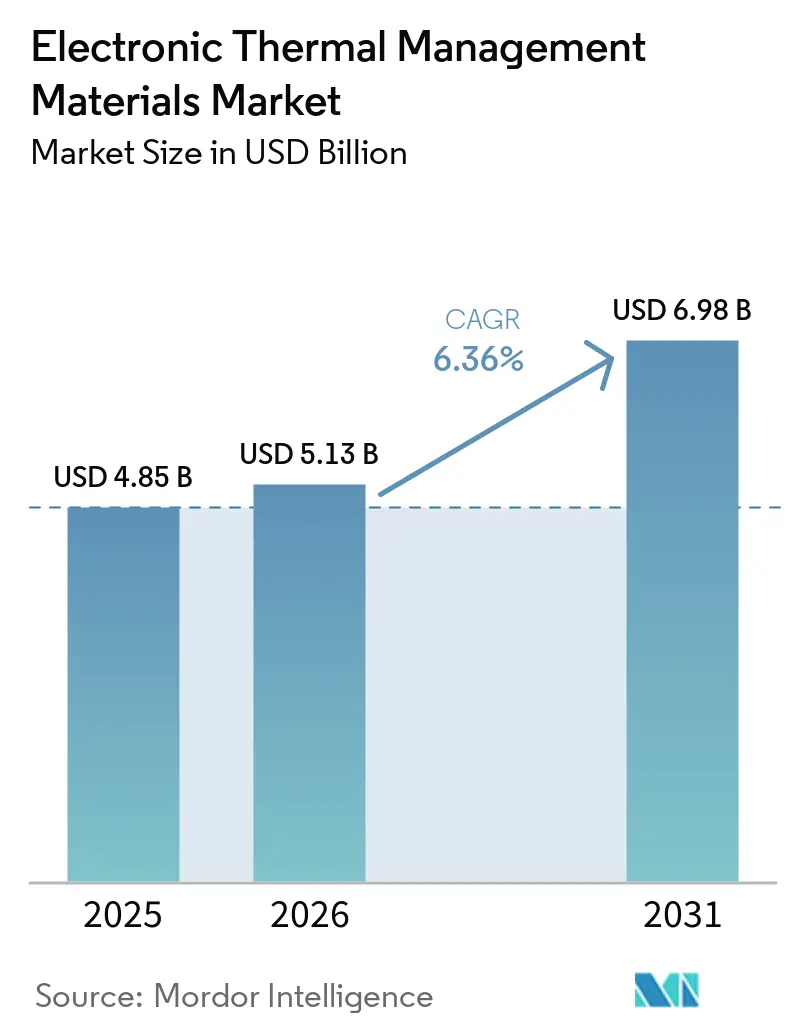
The electronic thermal management materials market size was estimated at USD 4.85 billion in 2025 and is estimated to grow from USD 5.13 billion in 2026 to USD 6.98 billion by 2031, at a CAGR of 6.36% during the forecast period (2026-2031). Rising chip power density is increasing demand for materials that transfer heat between the die, heat spreader, heat sink, and other package layers. AI accelerator packages approach or exceed 1,000 W of thermal design power, which limits conventional air cooling and increases demand for advanced thermal interface materials. The shift toward 2.5D and 3D integrated circuit (3D-IC) packages integrates chiplets, high-bandwidth memory (HBM) stacks, interposers, and substrates into the same assembly, creating variable hotspots and complex thermal conditions. Suppliers compete on materials that maintain low thermal resistance across temperature changes, rather than thermal conductivity alone. Extended qualification cycles and volatility in silicone and specialty polymer inputs are key considerations for buyers in the electronic thermal management materials market.
Key Report Takeaways
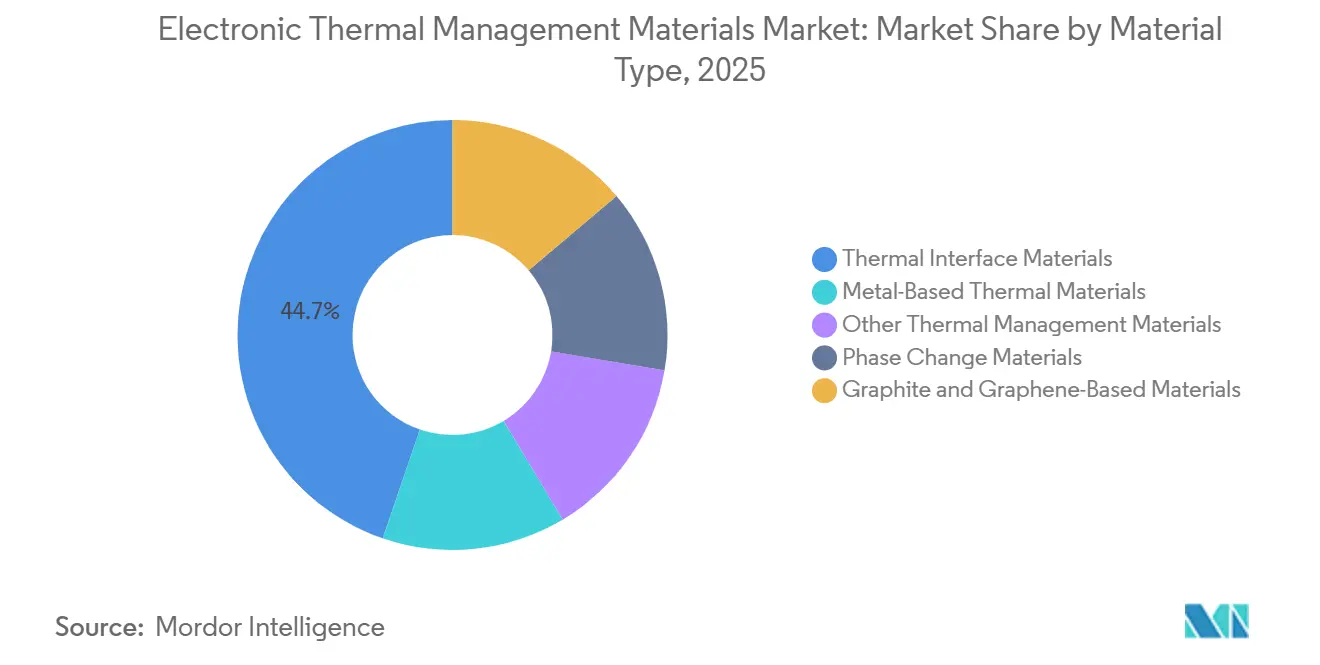
- By material type, thermal interface materials held 44.74% of the total in 2025, while phase change materials are forecast to grow at an 8.34% CAGR through 2031.
- By form factor, sheet Thermal Interface Materials (TIMs) held 37.25% of the total in 2025, while paste is forecast to grow at a 7.12% CAGR through 2031.
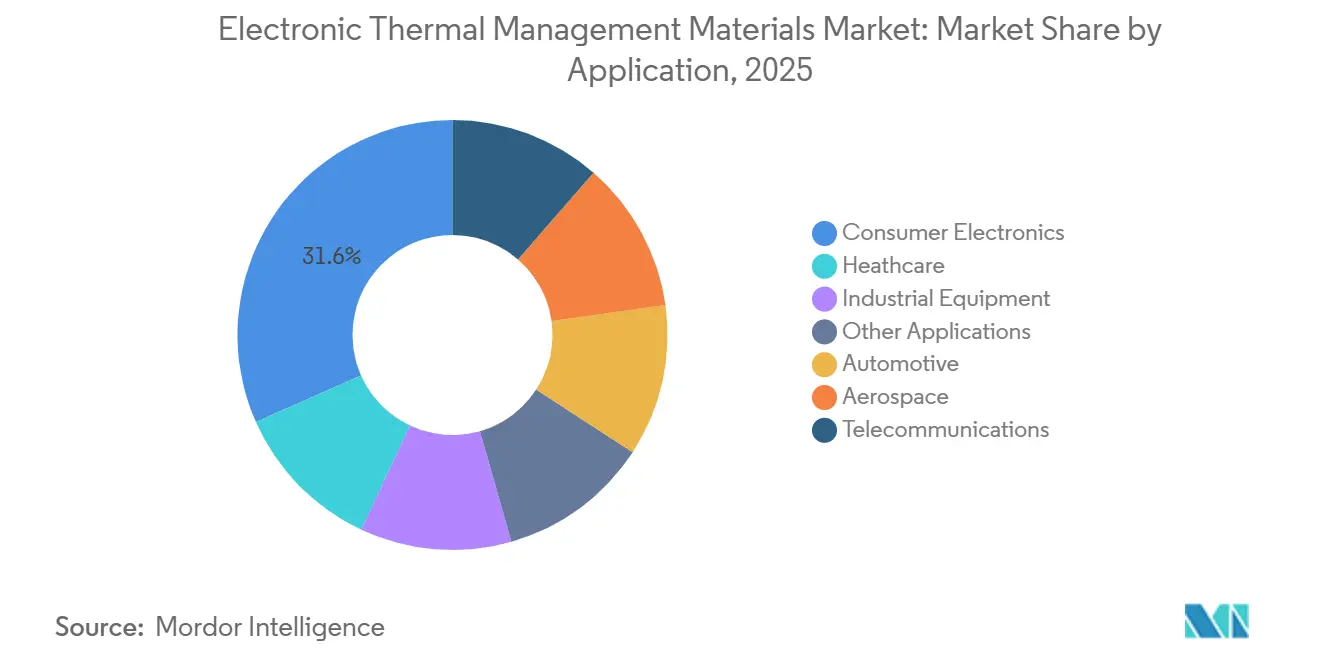
- By application, consumer electronics held 31.63% of the total in 2025, while automotive is forecast to grow at a 7.78% CAGR through 2031.
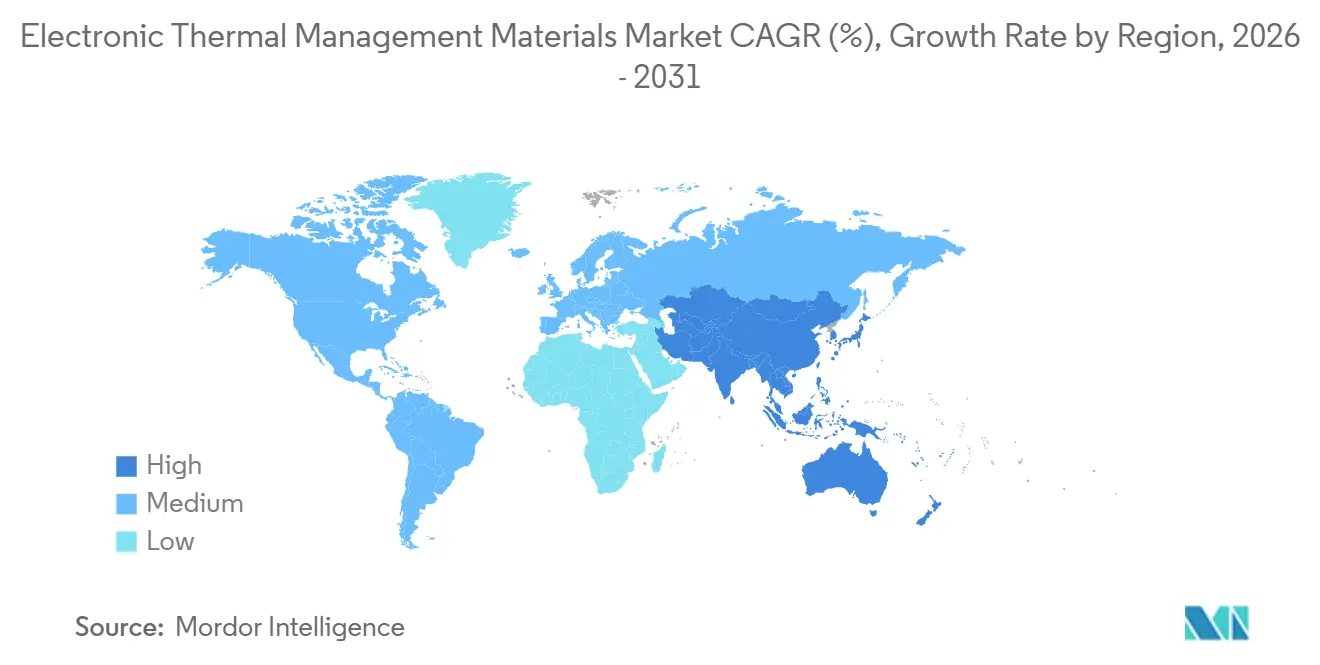
- By geography, Asia-Pacific held 41.39% of revenue in 2025 and is forecast to expand at a 7.63% CAGR through 2031.
Note: Market size and forecast figures in this report are generated using Mordor Intelligence’s proprietary estimation framework, updated with the latest available data and insights as of January 2026.
Market Trends and Insights
Drivers Impact Analysis of Electronic Thermal Management Materials Market*
| Drivers | (~) % Impact on CAGR Forecast | Geographic Relevance | Impact Timeline |
|---|---|---|---|
| AI-Enabled Computing and Rising Chip Power Density | +2.0% | Global, concentrated in North America for chip design and Asia-Pacific for manufacturing and packaging | Short term (≤ 2 years) |
| Electrification of Vehicles and High-Voltage Power Electronics | +1.6% | Asia-Pacific and North America, with emerging demand in Europe | Medium term (2-4 years) |
| Semiconductor Packaging Complexity and Advanced Interconnects | +1.0% | Asia-Pacific core markets, including Taiwan, South Korea, and Japan, with spillover to North America | Medium term (2-4 years) |
| 5G, Edge Infrastructure and High-Density Data Centers | +0.8% | Asia-Pacific core markets, with spillover to the Middle East, Africa, and Latin America | Medium term (2-4 years) |
| Thermal-Material Qualification Embedded in OEM Design Wins | +0.5% | North America and Europe, where many OEM headquarters are located | Long term (≥ 4 years) |
| Source: Mordor Intelligence | |||
AI-Enabled Computing and Rising Chip Power Density
AI workloads are changing thermal design requirements across the electronics supply chain. AI accelerator packages approach or exceed 1,000 W of thermal design power, limiting the use of conventional air cooling. This is increasing the use of liquid metals, indium foils, and silver-filled gels across die-to-lid interfaces. Each interface must manage localized heat loads while maintaining low thermal resistance. SK hynix introduced iHBM in May 2026, incorporating cooling elements into the D2D PHY area, and reported a 30% reduction in thermal resistance[1]“SK hynix Unveils ‘iHBM’ Thermal Solution to Boost AI Performance,” SK hynix Newsroom, news.skhynix.com. The electronic thermal management materials market requires formulations that maintain low resistance under changing operating conditions and package loads.
Electrification of Vehicles and High-Voltage Power Electronics
Electric vehicle (EV) battery packs, onboard chargers, and power inverters require multiple layers of thermal interface material. Silicon carbide (SiC) and gallium nitride (GaN) devices operate at higher junction temperatures, increasing thermal requirements across the drivetrain stack. Cell-to-pack and cell-to-chassis architectures eliminate the module layer and extend automotive-grade qualification requirements to the battery cell-to-chassis interface. SAE International research published in 2025 found that specified phase change materials can extend EV battery operation without active cooling by up to 80% across consecutive Worldwide Harmonized Light Vehicles Test Procedure (WLTP) drive cycles. A 2025 review found that carbon-based nano-additives increased the thermal conductivity of phase change material by 40-120%, while low-temperature processing reduced material costs by 20-35% compared with earlier laboratory formulations. Henkel launched Bergquist TGF 2030APS and Loctite TLB 9270APS in May 2026 for cell-to-pack and cell-to-chassis applications.
Semiconductor Packaging Complexity and Advanced Interconnects
Chiplet-based heterogeneous integration places materials with different coefficients of thermal expansion in close proximity. Thermal materials, therefore, affect assembly yield and field reliability. Improved power delivery supports compute efficiency, while localized heat requires interface materials or supplementary cooling structures. High-bandwidth memory (HBM) assemblies, chiplet packages, and interposers can incorporate multiple thermal interfaces. JEDEC JESD22 qualification standards and IPC Association Connecting Electronics Industries material frameworks guide formulations, as hybrid bonding and fine-pitch processes have narrow contamination tolerances.
5G, Edge Infrastructure and High-Density Data Centers
5G mmWave networks and AI-capable edge nodes require materials that remain stable during continuous operation. Base station radios and dense edge nodes operate at higher power levels and for longer periods than consumer devices. Pump-out resistance and stable thermal resistance affect material selection. Optical transceiver modules in data center interconnect hardware also require contamination control around photonic components. Tungsten-copper composites and molybdenum-copper alloys are used in 5G heat sinks and RF front-end modules, where thermal conductivity and expansion matching are required. These applications extend the electronic thermal management materials market from device-level cooling to infrastructure hardware with long service lives.
Restraints Impact Analysis of Electronic Thermal Management Materials Market*
| Restraints | (~) % Impact on CAGR Forecast | Geographic Relevance | Impact Timeline |
|---|---|---|---|
| Qualification Cycles and Reliability Testing Costs | -0.5% | Global, with the greatest burden in North America and Europe, for automotive and aerospace programs | Medium term (2-4 years) |
| Filler, Silicone, and Specialty Polymer Cost Volatility | -0.4% | Asia-Pacific core markets, with spillover to North America and Europe | Short term (≤ 2 years) |
| Thermal Expansion Mismatch and Long-Term Pump-Out Risk | -0.3% | Global, concentrated at advanced packaging sites in the Asia-Pacific | Long term (≥ 4 years) |
| Source: Mordor Intelligence | |||
Qualification Cycles and Reliability Testing Costs
A new thermal interface material for automotive or aerospace programs may require 18-36 months of thermomechanical reliability testing. JESD22 thermal cycling protocols require verification across 250-1,000 cycles at extreme temperatures before program approval. Testing accounts for a significant share of qualification time and cost. After qualification, established suppliers can retain their position throughout a platform’s production life. New formulations may require requalification, extending adoption timelines. This can delay material innovation by two or three design generations and lengthen the R&D payback period. Smaller suppliers face higher costs when qualifying products for automotive-grade and data center applications, particularly when IATF 16949 and application-specific JEDEC or IPC (Association Connecting Electronics Industries) approvals are required.
Filler, Silicone, and Specialty Polymer Cost Volatility
Silicone is the primary carrier matrix in many thermal interface material categories. Its pricing is sensitive to dimethylcyclosiloxane costs, which depend on the prices of methanol and silicon metal feedstocks. Dow implemented a 5-10% increase in silicone prices in Greater China in April 2025 and a further 10-20% increase in its Consumer Solutions division in December 2025. AI data centers and EV manufacturing also consume silicon, increasing pressure on the input supply. This creates cost challenges for formulators without upstream silicone integration. The electronic thermal management materials market may face margin pressure when input costs rise faster than qualified product prices. Thermal expansion mismatch and long-term pump-out risks also affect reliability, particularly in advanced packaging, where material movement can affect interface performance.
*Our forecasts treat driver/restraint impacts as directional, not additive. The impact forecasts reflect baseline growth, mix effects, and variable interactions.
Electronic Thermal Management Materials Market Segment Analysis
By Material Type:
Thermal Interface Materials Anchor Demand, Phase Change Materials Lead GrowthThermal interface materials accounted for 44.74% of the electronic thermal management materials market in 2025. They are used between the die and heat spreader, the heat spreader and heat sink, and the battery cell and cooling structure. After platform-specific original equipment manufacturer (OEM) validation, a formulation typically remains in production throughout the program lifecycle. Phase change materials are forecast to grow at a CAGR of 8.34% from 2026 to 2031, supported by their ability to conform to irregular surfaces during thermal cycling. This supports their use in EV battery modules, onboard chargers, and AI accelerator assemblies.
Graphite- and graphene-based materials are gaining adoption in consumer electronics and 5G radio units because they distribute heat laterally with limited z-axis thickness. Carbon-based nano-additives improve phase change material conductivity by 40-120%, while lower-temperature processing reduces costs by 20-35% compared with earlier formulations. Metal-based materials, including indium foils and sintered silver alternatives, are used in TIM1 applications for three-dimensional integrated circuit (3D-IC) and HBM packages. Registration, Evaluation, Authorization and Restriction of Chemicals (REACH) compliance requirements limit formulation options for lead- and bismuth-bearing alloys in Europe. Other materials include specialty films, coatings, and structural thermal adhesives for aerospace and medical electronics, where long-term certification supports higher unit values.



By Form Factor:
Sheets Account for Higher Demand, While Paste Supports Precision ApplicationsSheet TIMs accounted for 37.25% of the electronic thermal management materials market in 2025. Their compatibility with automated pick-and-place lines supports large-scale manufacturing of consumer electronics and telecommunications products. Predictable bond-line thickness and ease of handling can improve manufacturing-line yields. Paste is forecast to register a CAGR of 7.12% from 2026 to 2031 because it fills sub-millimeter gaps and conforms to nonplanar surfaces. It is suitable for packages using chiplets, HBM stacks, and 2.5D interposers.
Henkel launched Bergquist TGF 10000 in December 2025, offering a conductivity of 10 W/m·K in a liquid gap-filler format[2]“Henkel Launches Bergquist TGF 10000 Thermal Gap Filler,” Henkel AG & Co. KGaA, henkel.com. The product serves AI data centers and high-power automotive applications, where conventional materials provide limited thermal resistance headroom. Liquid TIMs, including gap fillers and gels, suit complex three-dimensional geometries and robotic dispensing. These characteristics support their use in EV onboard charger and power inverter assemblies. Conductive films, pads, and adhesives are used where heat transfer and mechanical attachment are required.
By Application:
Consumer Electronics Account for the Largest Share, Automotive Records the Fastest GrowthConsumer electronics accounted for 31.63% of the electronic thermal management materials market in 2025. Smartphones, laptops, and wearables use multiple interface layers, graphite spreaders, and phase change pads. Material value per device remains lower than in EVs and data center systems. The automotive segment is forecast to grow at a CAGR of 7.78% from 2026 to 2031. Power electronics, structural battery architectures, and higher-power Advanced Driver Assistance Systems (ADAS) computing systems support the electronic thermal management materials market size for automotive applications.
Telecommunications demand benefits from network densification and the continuous duty cycles of base station electronics. Outdoor deployments require pump-out resistance and limited thermal resistance drift over 10-15 years. Aerospace applications have high material value per unit due to Military Specification (MIL-SPEC) qualification and long-term reliability requirements. Healthcare electronics require improved heat management as device miniaturization increases heat flux. Industrial equipment, including motor drives and power conversion systems, also supports demand as manufacturing facilities electrify.
Geography Analysis
APAC Electronic Thermal Management Materials Market
Asia-Pacific accounted for 41.39% of the electronic thermal management materials market in 2025 and is projected to grow at a CAGR of 7.63% through 2031. The region includes consumer electronics production in China, EV battery assembly in South Korea and Japan, and the expansion of hyperscale data center capacity. In 2025, Taiwan consumed USD 21.7 billion in semiconductor materials, followed by China at USD 15.6 billion and South Korea at USD 11.2 billion. Advanced packaging supports demand for thermal interface materials (TIMs), phase-change materials, and graphite spreaders, as high-bandwidth memory (HBM) assemblies, chiplets, and interposers require multiple thermal layers. India, Vietnam, Thailand, and Indonesia also support demand through investments in assembly and testing and through domestic EV production.
North America and Europe Electronic Thermal Management Materials Market
North America held the second-largest position in the electronic thermal management materials market. The United States semiconductor sector designs AI accelerators, and the thermal specifications of these accelerators influence material development across the global supply chain. Hyperscale operators committed significant infrastructure capital in 2025 and 2026, while AI-capable racks require liquid cooling systems and interface materials at multiple heat-transfer points. Canada supports demand through high-performance computing infrastructure, while Mexico serves as a secondary hub for automotive-grade gap fillers and potting materials. In Europe, Germany’s EV powertrain suppliers and battery requirements support thermal material development across specified temperature ranges.
South America and MEA Electronic Thermal Management Materials Market
South America presents an emerging market opportunity, as data center investments in Brazil support digital demand across Latin America. Argentina’s role in the lithium triangle could support regional EV battery assembly over the medium term. The Middle East and Africa market is supported by Saudi Arabia’s Vision 2030 digital infrastructure program and industrial electronics activity in South Africa. Gulf Cooperation Council governments are deploying AI-capable infrastructure, which could generate localized demand for thermal materials after hyperscale facilities become operational. Near-term demand remains limited, while long-term growth depends on ongoing infrastructure commitments.

Competitive Landscape
The electronic thermal management materials market is moderately consolidated. 3M, Henkel, Dow, Shin-Etsu Chemical, Parker Hannifin's Chomerics division, and Honeywell International offer diversified portfolios, established qualification relationships, and access to silicone and polymer feedstocks. Fujipoly, Indium Corporation, and Momentive serve the advanced packaging, defense electronics, and medical device thermal management markets. Suppliers pursue early inclusion in OEM specifications to secure supply relationships throughout a program's lifecycle.
From early 2025 to July 2026, Henkel launched products for EV gap fillers, AI data-center optical transceivers, autonomous-vehicle advanced driver-assistance systems (ADAS), and industrial potting applications. In July 2026, the company launched the Bergquist Gap Filler TGF 6500LVO, a low-volatility silicone gap filler for EV power-conversion electronics. The formulation excludes D4, D5, and D6 siloxanes to address REACH compliance requirements in OEM qualification decisions. In October 2024, Dow partnered with Carbice to commercialize aligned carbon nanotube thermal interface materials (TIMs) for semiconductor, mobility, and industrial applications. Carbon nanotube materials, graphene composites, and liquid-metal TIMs support AI accelerator applications where conventional silicone systems have performance limitations.
In June 2025, Parker Hannifin agreed to acquire Curtis Instruments for USD 1 billion, expanding its electrification platform into motion control for industrial and vehicle electrification applications. The transaction expanded its capabilities and OEM engagement beyond materials supply. International Automotive Task Force (IATF) 16949 and ISO 9001 requirements favor suppliers with documented quality management systems. These requirements can delay commercialization for material innovators without anchor-customer support for pilot programs. Buyers often require different materials for battery, power electronics, package, and cooling interfaces.
Electronic Thermal Management Materials Industry Leaders
Henkel AG & Co. KGaA
3M
Dow
PARKER HANNIFIN CORP
Shin-Etsu Chemical Co., Ltd.
- *Disclaimer: Major Players sorted in no particular order
Electronic Thermal Management Materials Market Companies Covered in this Report
- 3M
- AI Technology, Inc.
- Boyd
- Dow
- DuPont
- Fujipoly America Corp.
- H.B. Fuller Company
- Henkel AG & Co. KGaA
- Honeywell International Inc.
- Indium Corporation
- Master Bond
- Momentive
- Panasonic Industry
- PARKER HANNIFIN CORP
- Shin-Etsu Chemical Co., Ltd.
- Wacker Chemie AG

Recent Industry Developments in Electronic Thermal Management Materials Market
- July 2026: Henkel launched Bergquist Gap Filler TGF 6500LVO, a two-component, low-volatile silicone thermal gap filler with 6.5 W/m·K thermal conductivity. It supports EV power-conversion electronics, including ADAS and ECU applications, operates up to 150°C, and excludes D4, D5, and D6 siloxanes to ensure REACH compliance
- May 2026: SK hynix announced iHBM, which integrates cooling elements into the die-to-die (D2D) physical layer (PHY) of HBM packages. Using wafer-level Mass Reflow Molded Underfill (MR-MUF) technology, it reduces thermal resistance by 30% and targets HBM5 deployment in high-performance computing (HPC) data centers for AI.


Global Electronic Thermal Management Materials Market Report Scope
Electronic thermal management materials are specialized substances that absorb, transfer, and dissipate excess heat in electronic devices. They conduct heat away from sensitive components, such as computer chips, preventing overheating, performance slowdowns, and potential device failure.
The electronic thermal management materials market is segmented by material type, form factor, application, and geography. By material type, the market is segmented into thermal interface materials, phase change materials, graphite and graphene-based materials, metal-based thermal materials, and other thermal management materials. By form factor, the market is segmented into sheet, paste, liquid, and others. By application, the market is segmented into consumer electronics, automotive, aerospace, telecommunications, healthcare, industrial equipment, and other applications. The report also covers market size and forecasts for electronic thermal management materials across 15 countries in major regions. The market sizes and forecasts are provided in terms of value (USD).
| Thermal Interface Materials |
| Phase Change Materials |
| Graphite and Graphene-Based Materials |
| Metal-Based Thermal Materials |
| Other Thermal Management Materials |
| Sheet |
| Paste |
| Liquid |
| Others |
| Consumer Electronics |
| Automotive |
| Aerospace |
| Telecommunications |
| Healthcare |
| Industrial Equipment |
| Other Applications |
| Asia-Pacific | China |
| India | |
| Japan | |
| South Korea | |
| ASEAN Countries | |
| Rest of Asia-Pacific | |
| North America | United States |
| Canada | |
| Mexico | |
| Europe | Germany |
| United Kingdom | |
| France | |
| Italy | |
| NORDIC Countries | |
| Rest of Europe | |
| South America | Brazil |
| Argentina | |
| Rest of South America | |
| Middle East and Africa | Saudi Arabia |
| South Africa | |
| Rest of Middle East and Africa |
| By Material Type | Thermal Interface Materials | |
| Phase Change Materials | ||
| Graphite and Graphene-Based Materials | ||
| Metal-Based Thermal Materials | ||
| Other Thermal Management Materials | ||
| By Form Factor | Sheet | |
| Paste | ||
| Liquid | ||
| Others | ||
| By Application | Consumer Electronics | |
| Automotive | ||
| Aerospace | ||
| Telecommunications | ||
| Healthcare | ||
| Industrial Equipment | ||
| Other Applications | ||
| By Geography | Asia-Pacific | China |
| India | ||
| Japan | ||
| South Korea | ||
| ASEAN Countries | ||
| Rest of Asia-Pacific | ||
| North America | United States | |
| Canada | ||
| Mexico | ||
| Europe | Germany | |
| United Kingdom | ||
| France | ||
| Italy | ||
| NORDIC Countries | ||
| Rest of Europe | ||
| South America | Brazil | |
| Argentina | ||
| Rest of South America | ||
| Middle East and Africa | Saudi Arabia | |
| South Africa | ||
| Rest of Middle East and Africa | ||


Key Questions Answered in the Report
What is current market size of Electronic Thermal Management Materials Market?
The electronic thermal management materials market size was estimated at USD 4.85 billion in 2025 and is estimated to grow from USD 5.13 billion in 2026 to USD 6.98 billion by 2031, at a CAGR of 6.36% during the forecast period (2026-2031).
Which application is expanding fastest?
Automotive is forecast to grow at a 7.78% CAGR through 2031. Electric Vehicle (EV) batteries, power electronics, and Advanced Driver-Assistance Systems (ADAS) need more thermal management materials.
Which region leads to global demand?
Asia-Pacific led with a 41.39% share in 2025 and is forecast to grow at a 7.63% CAGR through 2031. Regional electronics production and packaging activity support this position.
What limits the adoption of new thermal interface materials?
Automotive and aerospace qualifications can take 18-36 months. Price changes for silicone and specialty polymers can also pressure formulation costs.
Page last updated on:





