
Electronic Seal Services Market Size and Share
Market Overview
| Study Period | 2020 - 2031 |
|---|---|
| Market Size (2026) | USD 0.68 Billion |
| Market Size (2031) | USD 1.68 Billion |
| Growth Rate (2026 - 2031) | 19.83 % |
| Fastest Growing Market | Asia-Pacific |
| Largest Market | North America |
| Market Concentration | Medium |
Major Players *Disclaimer: Major Players sorted in no particular order Image © Mordor Intelligence. Reuse requires attribution under CC BY 4.0. | |
Electronic Seal Services Market Analysis by Mordor Intelligence
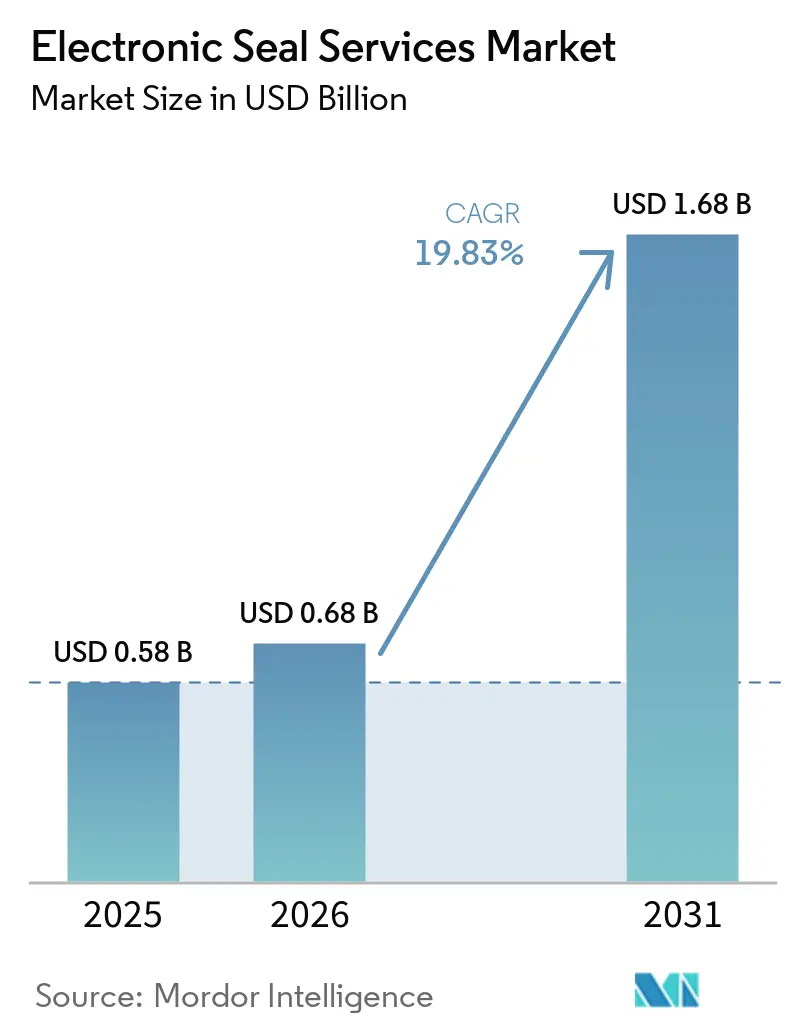
The electronic seal services market size was valued at USD 0.58 billion in 2025 and estimated to grow from USD 0.68 billion in 2026 to reach USD 1.68 billion by 2031, at a CAGR of 19.83% during the forecast period (2026-2031). Electronic seals authenticate the legal entity that issues a document, while electronic signatures bind an individual to it. This difference makes seals suitable for automated, high-volume document workflows that need proof of an organization’s origin and control. Companies are placing seal capabilities within enterprise resource planning, customer relationship management, and document management systems instead of treating them as a separate compliance tool. The Electronic seal services market is supported by eIDAS 2.0, wider document automation, and trust-service rules in non-EU jurisdictions that draw on the eIDAS reference model. Regulatory deadlines and automated workflows are also shifting vendor competition toward platforms that combine identity verification, cryptographic controls, integration, and long-term document preservation.
Key Report Takeaways
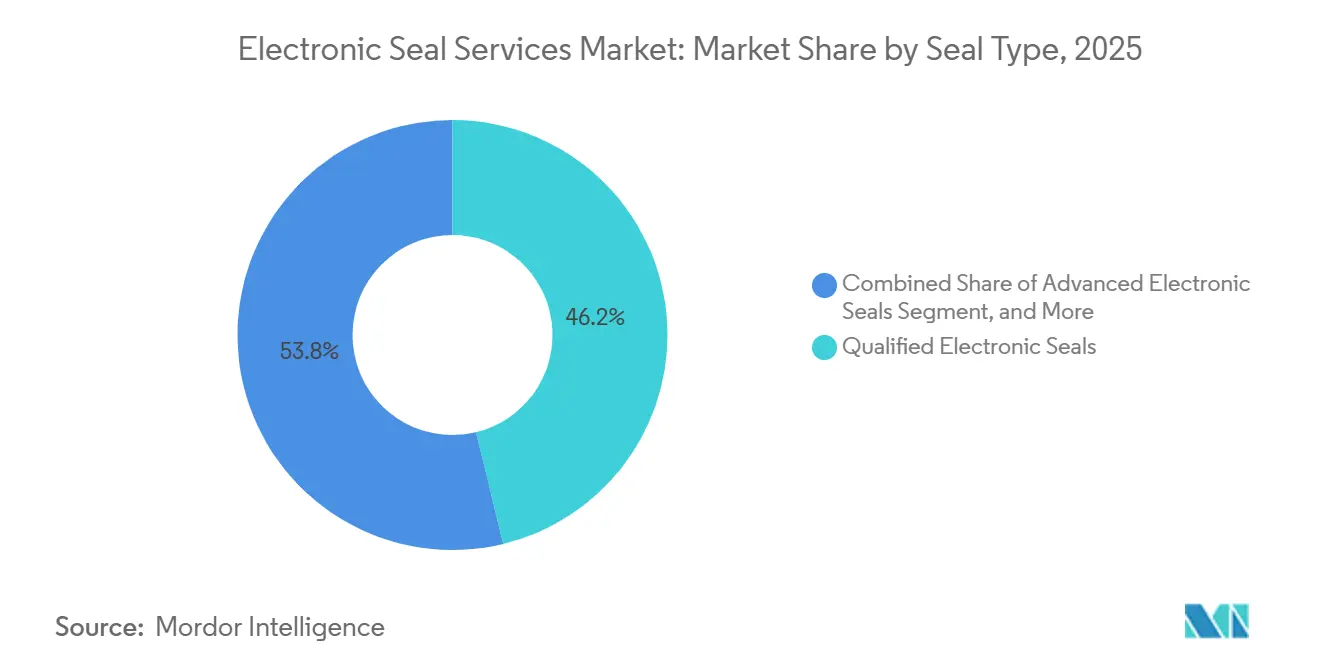
- By seal type, qualified electronic Seals held 46.21% of the electronic seal services market share in 2025, while Advanced Electronic Seals are projected to expand at a 23.84% CAGR through 2031.
- By deployment, cloud held 66.81% of the electronic seal services market share in 2025 and is expected to expand at a 25.37% CAGR through 2031.
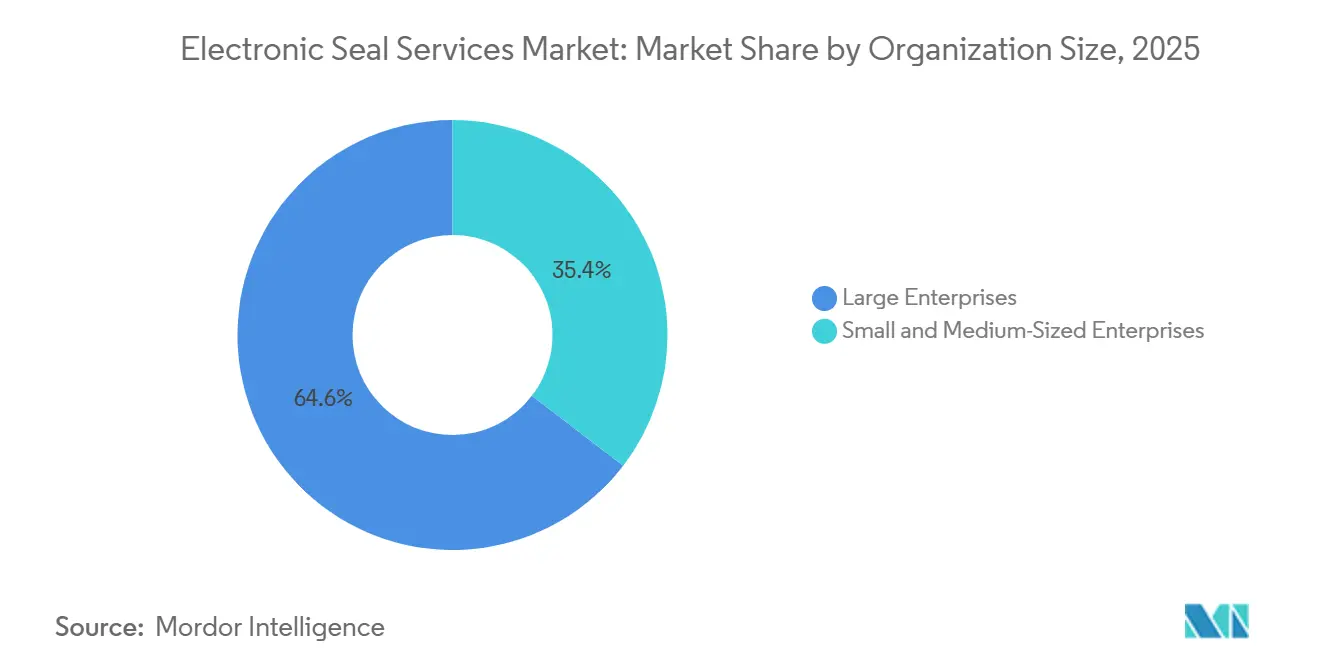
- By organization size, large enterprises held 64.59% of revenue in 2025, while small and medium-sized enterprises are projected to grow at a 26.41% CAGR through 2031.
- By end user, BFSI accounted for 34.53% of demand in 2025, while the healthcare and life sciences industry is expected to grow at a 24.82% CAGR through 2031.
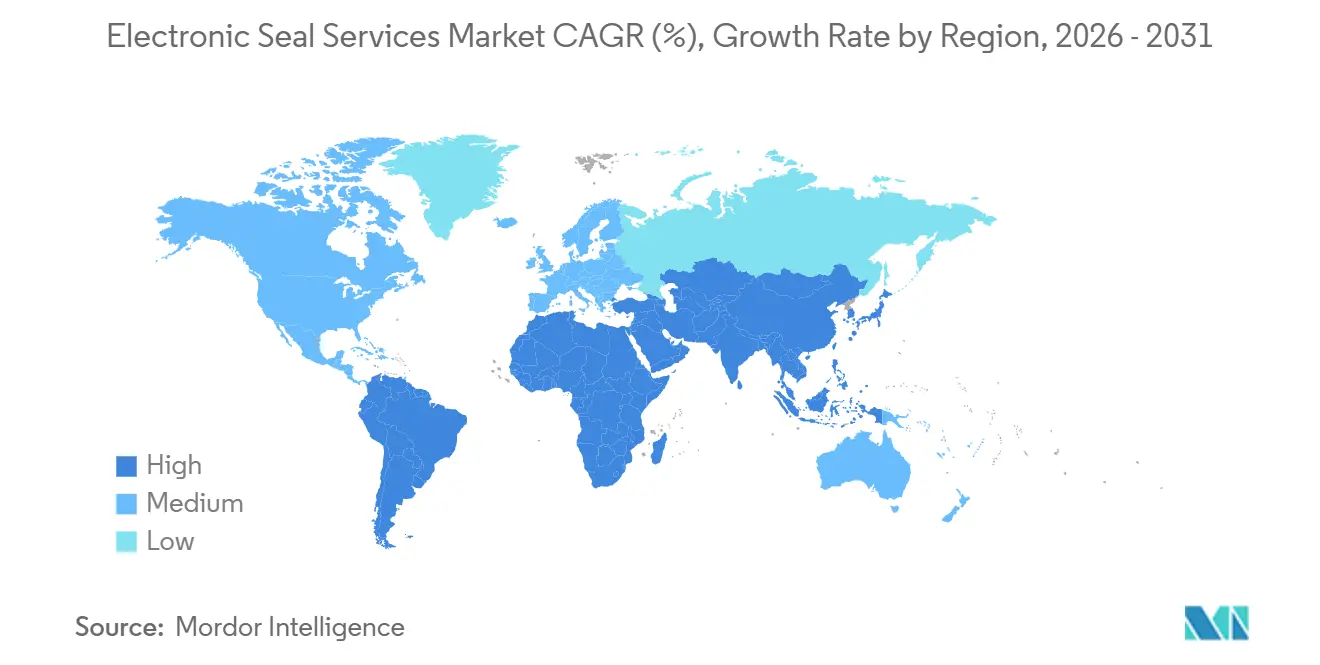
- By geography, North America held 34.72% of revenue in the electronic seal services market in 2025, while Asia-Pacific is projected to expand at a 24.91% CAGR through 2031.
Note: Market size and forecast figures in this report are generated using Mordor Intelligence’s proprietary estimation framework, updated with the latest available data and insights as of January 2026.
Global Electronic Seal Services Market Trends and Insights
Drivers Impact Analysis*
| DRIVER | (~) % IMPACT ON CAGR FORECAST | GEOGRAPHIC RELEVANCE | IMPACT TIMELINE |
|---|---|---|---|
| Expansion of Cross-Border Digital Trust Frameworks | +4.2% | Global, concentrated in EU member states with spillover to MENA and APAC | Medium term (2-4 years) |
| Accelerating Paperless Document Workflows | +3.6% | Global, with early gains in North America, Western Europe, Japan, Singapore, and India | Short term (≤ 2 years) |
| Growth of Automated High-Volume Document Processing | +3.1% | North America and the EU core, with spillover to APAC and the Middle East | Short term (≤ 2 years) |
| Increasing Demand for Tamper-Evident Corporate Records | +2.5% | Global, strongest in BFSI and government across regions | Medium term (2-4 years) |
| Digital Product-Registry and Traceability Mandates | +1.9% | EU, with early gains in Germany, France, and Italy | Medium term (2-4 years) |
| API-First Integration With ERP, CRM, and Document Systems | +1.6% | Global, with highest penetration among large enterprises in North America and Europe | Short term (≤ 2 years) |
| Source: Mordor Intelligence | |||
Expansion of Cross-Border Digital Trust Frameworks
Regulation (EU) 2024/1183, known as eIDAS 2.0, created a central driver of demand for the electronic seal services market. The framework became fully applicable in May 2026 and provides for the mutual recognition of qualified electronic seals across the EU’s 27 member states. It also treats remote qualified seal creation device management as a distinct trust service, which requires providers to meet the related qualification conditions. These changes allow multinational users to pursue a more consistent seal approach across European operations rather than procure separate national solutions. Namirial reported on May 22, 2026, that it had completed its eIDAS 2.0 compliance process in Italy, France, and Spain, including Conformity Assessment Reports for remote-qualified seal creation device management.[1] The framework’s influence also extends beyond Europe because jurisdictions in MENA, APAC, and South America are considering eIDAS as a reference point for their own digital trust rules.
Accelerating Paperless Document Workflows
Paperless operations are taking electronic seals beyond their original compliance use in the electronic seal services market. Organizations increasingly automate document capture, routing, approval, and archive processes within the same systems that handle sealing. This places an organizational seal at the point where a document is finalized or transferred between systems. It also permits a company to apply a tamper-evident corporate credential without interrupting the underlying workflow. Seals applied after AI-generated document creation can create a provenance chain that distinguishes authorized corporate output from later manipulation. This need is becoming relevant in pharmaceutical, financial services, and legal settings where documents require clear organizational ownership and a durable record of change. In these settings, seal controls can sit alongside the document-routing tools already used to prepare, approve, retain, and distribute records, which reduces the need to establish a separate signing process for every document category.
Growth of Automated High-Volume Document Processing
High-volume document processing is widening the use case for the Electronic seal services market. GMO GlobalSign reported that its Digital Signing Service exceeded 6 million signing events in a single month in 2025, with electronic seals accounting for 75% of those events. This volume reflects the value of identity-backed organizational sealing in automated processing rather than individual approval alone. Poland’s KSeF National e-Invoice System requires qualified seal authentication for most small and medium-sized enterprise invoice submissions by April 2026, making cloud-sealed invoicing a compliance process rather than an optional add-on. API-based integration lets organizations seal invoice batches through their existing enterprise systems, avoiding a separate manual signing step. As automated tools handle document intake, classification, and routing, qualified sealing can be integrated into a single, uninterrupted processing pipeline. The model is especially relevant for recurring invoices, product registry filings, and other corporate outputs where the issuing entity must be clear at scale, while the underlying documents still move through normal enterprise applications.
Increasing Demand for Tamper-Evident Corporate Records
Generative AI has altered the document integrity risk facing many organizations in the Electronic seal services market. Faster production of realistic documents can increase concerns about fraudulent invoices, altered regulatory submissions, and unclear ownership of corporate records. DigiCert stated in March 2026 that its document trust tools were designed to help organizations address digital document security and AI-related fraud.[2] For audit reports, securities filings, and pharmaceutical batch records, a qualified seal can establish the responsible organization and protect the document’s integrity. The C2PA standard provides an additional provenance layer for digital assets by recording information about origin and modification. DigiCert’s April 2026 Content Trust Manager extended cryptographic credentials from PDFs to images and video, showing that the use of trusted provenance is moving beyond document-only workflows. This broadens the context for corporate sealing because an organization may increasingly need proof of origin in multiple formats, not only in a completed PDF or a formal transaction record.
Restraints Impact Analysis*
| RESTRAINT | (~) % IMPACT ON CAGR FORECAST | GEOGRAPHIC RELEVANCE | IMPACT TIMELINE |
|---|---|---|---|
| Uneven Legal Recognition Across Jurisdictions | -2.4% | Global, most acute outside the EU, particularly in North America, South America, Southeast Asia, and Sub-Saharan Africa | Long term (≥ 4 years) |
| Qualification, Identity-Proofing, and QSCD Cost Burden | -1.8% | Global, with a greater effect on SMEs in price-sensitive markets in South America, Southeast Asia, and Africa | Medium term (2-4 years) |
| Fragmented National Trust-List and Interoperability Operations | -1.3% | EU cross-border corridors and APAC jurisdictions building national trust frameworks | Medium term (2-4 years) |
| Key-Rotation and Long-Term Validation Complexity | -0.7% | Global, with the highest operational burden in BFSI and government users with large certificate portfolios | Long term (≥ 4 years) |
| Source: Mordor Intelligence | |||
Uneven Legal Recognition Across Jurisdictions
Uneven legal recognition remains a material constraint on the electronic seal services market. Qualified electronic seals have a defined standing under the EU framework, but many other jurisdictions do not provide the same default presumption of data integrity. A multinational organization can therefore need parallel processes, using digital seals for EU-regulated transactions and wet-ink or notarized methods for other transactions. National differences can also affect identity-proofing and provider onboarding within the EU. This creates uncertainty for companies that need a single process across several markets. Until cross-border equivalence arrangements become more predictable, organizations with significant non-EU operations may delay wider deployment of qualified seals. Procurement teams must weigh the benefits of a common process against the residual need for local alternatives, and this can slow a decision even where the technical integration has already been completed.
Qualification, Identity-Proofing, and QSCD Cost Burden
Qualified seal adoption requires organization-level identity proofing and a certificate from a qualified trust service provider. The input cost range for a physical qualified seal creation device is EUR 80 to EUR 250 (USD 86 to USD 268) for initial issuance, plus EUR 50 to EUR 150 (USD 54 to USD 161) each year. Remote qualified seal creation device subscriptions begin at EUR 15 to EUR 40 (USD 16 to USD 43) per user each month. These costs can accumulate when a small or medium-sized enterprise operates multiple legal entities across several countries. Fresh identity verification at national providers may add further time and cost. This creates a gap between lower-cost advanced seals and qualified seals, particularly where regulated transactions require the legal presumption offered by the qualified tier. It also means that the cost question is not limited to certificate pricing, because onboarding effort, annual renewal, and the number of legal entities all influence the total operating burden for smaller users.
*Our forecasts treat driver/restraint impacts as directional, not additive. The impact forecasts reflect baseline growth, mix effects, and variable interactions.
Segment Analysis
By Seal Type: Regulatory Requirements Support Qualified Seals
Qualified electronic seals captured 46.21% of the electronic seal services market in 2025. Their position reflects mandatory use in PSD2-regulated payment flows, EU EPREL product registry submissions, and cross-border invoicing requirements. Recognition across all 27 EU member states under Article 35 of eIDAS makes this the standard tier for regulated European workflows. Qualified seals are particularly relevant where an enterprise needs the highest legal assurance for the legal entity behind a document. BFSI, government, and pharmaceutical users have strong reasons to use this level because their documents are subject to detailed controls. The qualified tier also supports workflows that require identity verification, certificate control, and long-term validation within a single operating model.
Advanced electronic seals are projected to grow at a CAGR of 23.84% from 2026 to 2031, ahead of the overall rate. Their appeal lies in a lower-friction option for enterprise resource planning-integrated invoice automation and for AI-generated content provenance. Accepted formats, including XAdES, PAdES, and CAdES, support use across several cross-border document formats. Basic or Simple Electronic Seals continue to serve entry-level bulk-labeling needs and retain a smaller, stable position. Organizations that encounter the legal limits of basic seals may move to advanced seals before deciding whether a qualified status is necessary. The electronic seal services market, therefore, retains a tiered choice between simplicity, integration, and legal assurance.

By Deployment: Cloud Combines Leading Scale With Fast Growth
Cloud deployment held 66.81% of the electronic seal services market in 2025 and is projected to grow at a 25.37% CAGR through 2031. This combination reflects the operational benefits of API-driven sealing compared with hardware-bound qualified seal creation device models. GMO GlobalSign’s report of more than 6 million monthly signing events in 2025, with seals representing 75%, illustrates the volume that a hosted service can support.[3] In Poland, the KSeF requirement supports the use of API-connected systems for automated invoice sealing without card readers. Subscription delivery can also reduce users' need to manage dedicated local hardware. For these reasons, cloud systems are becoming central to repeatable document processing across many organizations.
On-premises deployment remains relevant for users in central government, defense, and financial market infrastructure who face data-residency limits with cloud-based key management. These organizations may need close control over cryptographic keys and may prefer an environment that keeps key material within internal systems. Hybrid models address this need by linking on-premises key storage with cloud orchestration. This configuration can support air-gapped key control while allowing seals to operate within cloud-hosted enterprise resource planning workflows. The electronic seal services market can therefore accommodate diverse operating requirements rather than relying on a single deployment model. The persistence of these alternatives reflects the continuing importance of security controls and procurement rules in sensitive use cases.
By Organization Size: Large Enterprises Lead, While SMEs Grow Faster
Large enterprises held 64.59% of the electronic seal services market in 2025. Their leading position is linked to extensive compliance obligations, the ability to complete onboarding for qualified trust service providers, and budgets for system integration. Deployments are concentrated in BFSI, pharmaceuticals, and industrial manufacturing, where high document volumes can justify programmatic sealing. Large organizations also tend to manage regulatory filings, batch invoices, and audit certificates through established enterprise systems. Those systems provide a practical base for integrating an organizational seal into ordinary document production. The scale of these workflows makes the seal a recurring operational control rather than a tool used only for unusual transactions.
Small and medium-sized enterprises are projected to record the highest organization-size CAGR at 26.41% from 2026 to 2031. Poland’s KSeF requirement for qualified seal authentication on most invoice submissions by April 2026 is bringing cloud-based qualified sealing into small-business compliance. Cloud-native provider pricing starting at EUR 15 (USD 16) per user per month reduces the initial expense that previously limited qualified seals to larger budgets. The remaining cost of organization identity proofing still affects adoption decisions for some smaller businesses. Even so, mandated invoicing creates a clear use case and a deadline for implementation. This helps explain why SMEs are expected to outpace the wider electronic seal services market during the forecast period.
By End User: BFSI Provides Demand, Healthcare and Life Sciences Gains Pace
BFSI accounted for 34.53% of the electronic seal services market in 2025. Demand is supported by PSD2 requirements for Qualified Electronic Seal Certificates in open-banking application programming interface communications, anti-money-laundering audit trails, and securities documentation. Payment institutions use seals to authenticate the organization behind communications sent to Open Banking endpoints. GlobalSign’s guidance identifies the Qualified Electronic Seal Certificate as part of the onboarding process for payment service providers. This compliance-based use gives the segment a steady demand base that does not depend only on discretionary technology spending. BFSI users also value nonrepudiation and clear organizational accountability for high-value records.
The healthcare and life sciences industry is projected to grow at a 24.82% CAGR from 2026 to 2031. The US Centers for Medicare and Medicaid Services published a final rule in March 2026 that established standards for healthcare claims-attachment transactions under X12N 275 and HL7. The rule took effect on May 26, 2026, and requires digital signatures for sender authentication, document integrity, and nonrepudiation. CMS estimated annual savings of up to USD 782 million for covered entities. Healthcare organizations can also encounter distinct federal requirements for claims data and for records governed by FDA 21 CFR Part 11. Government and public administration, along with IT and telecommunication, make up the remaining demand base.
Geography Analysis
North America held 34.72% of the electronic seal services market in 2025. The region benefits from a concentration of digital trust vendors, including DocuSign, DigiCert, and Entrust, as well as a legal environment shaped by the ESIGN Act, UETA, and sector-specific requirements. The CMS claims-attachment rule created a US healthcare adoption event for HIPAA-regulated entities when it took effect on May 26, 2026. The rule is separate from eIDAS alignment and supports a local compliance case for trusted digital records. CMS estimated that the standards could generate annual savings of up to USD 782 million for covered entities. Canada contributes to demand through federal digital government activity, while the US financial requirements are extending to securities registration and derivatives reporting workflows.
Asia-Pacific is expected to expand at a 24.91% CAGR from 2026 to 2031, the highest regional rate in the Electronic seal services market. The region combines several national adoption paths rather than a single common framework. Japan’s national e-seal framework entered full operation in spring 2026, and WingArc 1st and Cybertrust launched the Trustee e-Seal on June 30, 2026. India held the largest number of active Legal Entity Identifiers globally from January 2026 and recorded the highest LEI growth rate in the second quarter of 2026. GLEIF announced eMudhra’s appointment as a Validation Agent in September 2026, integrating LEI issuance into its identity verification processes.[4] China’s Electronic Signature Law supports regional volume, although state-defined trust frameworks limit access for non-domestic qualified trust service providers.
Europe held the second-largest regional position in 2025, driven by eIDAS 2.0 compliance cycles and the highest global concentration of qualified trust service providers on the Trusted List. Germany, France, and Italy are the largest individual country markets in the region. The electronic seal services market in Europe benefits from consistent recognition rules for qualified electronic seals, although national onboarding practices can still vary. South America is concentrated in Brazil, where ICP-Brasil supports qualified-level sealing, and in Mexico, where the SAT’s mandatory CFDI e-invoicing framework supports demand for machine-signed organizational seals. The Middle East and Africa are at an earlier stage of adoption. The UAE’s digital government agenda and Saudi Arabia’s Vision 2030 programs anchor demand across the Gulf.
Competitive Landscape
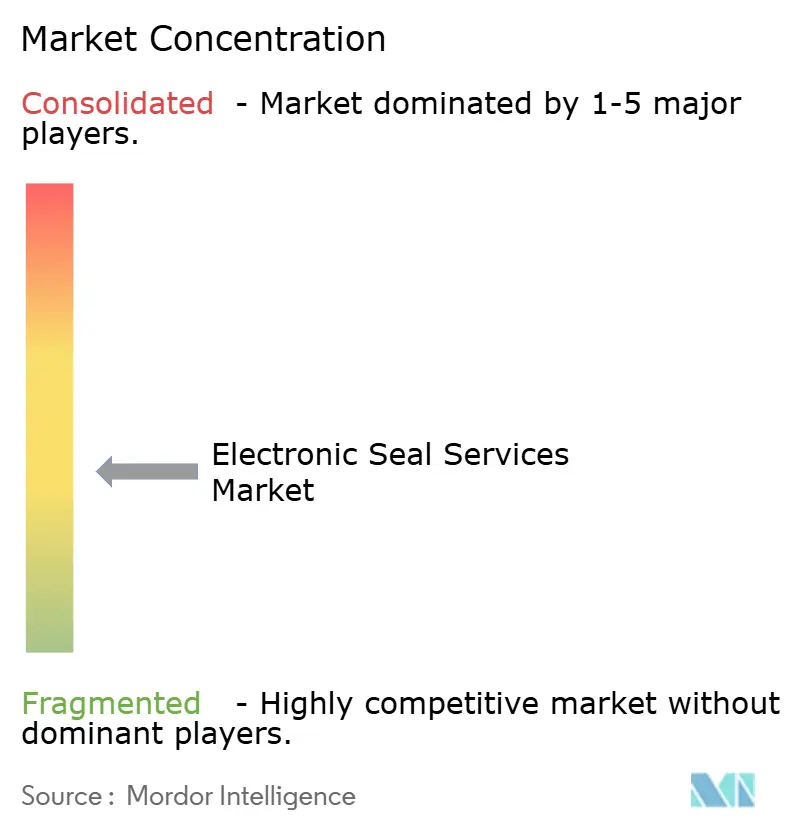
The electronic seal services market is moderately fragmented, with a two-tier competitive structure. The first tier includes pan-European qualified trust service providers and global digital trust platforms such as Namirial, DigiCert, Entrust, GlobalSign, InfoCert, and Bundesdruckerei. These providers compete on Trusted List coverage, ETSI certification depth, and alignment with eIDAS 2.0. The second tier contains workflow-layer providers such as DocuSign and Adobe, which embed seal functions within agreement management and document cloud products. The competitive distinction is increasingly based on how well a vendor combines issuance, identity verification, cryptographic assurance, integration, and record preservation. This favors providers that can serve the full document lifecycle rather than one narrow seal function.
Regulatory coverage, API developer experience, and AI-fraud countermeasures shape competitive decisions in the Electronic seal services market. API tools, enterprise resource planning connectors, and testing environments matter because customers need seals to operate within existing high-volume workflows. DigiCert updated its Document Trust Manager in March 2026 with pre-integrated signing for DocuSign, Adobe Sign, and Adobe Acrobat, centralized private-key management, biometric remote signer authentication, and audit controls aligned to several trust frameworks.[5] In April 2026, the company introduced Content Trust Manager to attach C2PA cryptographic credentials to digital media. Namirial completed its reported eIDAS 2.0 compliance process in Italy, France, and Spain in May 2026, strengthening its position in regulated EU procurement.
Small and medium-sized enterprises offer a material opportunity because cloud delivery lowers access barriers while onboarding friction still limits conversion to qualified seals. Vendors that can provide standards-compliant and efficient identity-proofing processes may be better placed to serve this compliance-led customer group. GlobalSign’s high-volume signing record highlights the value of a service model that can support frequent organizational sealing events. Vendors also need to support cloud, on-premises, and hybrid key-management requirements because sensitive government and financial users may not use a fully hosted service, The electronic seal services market remains competitive because providers must address both local regulatory requirements and system-level integration. Its competitive landscape is therefore shaped more by operational trust capabilities than by seal issuance alone.
Electronic Seal Services Industry Leaders
-
Namirial S.p.A.
-
DocuSign, Inc.
-
Entrust Corporation
-
D-Trust GmbH
-
InfoCert S.p.A.
- *Disclaimer: Major Players sorted in no particular order
Recent Industry Developments
- September 2026: GLEIF announced eMudhra Limited's appointment as a Validation Agent of Legal Entity Identifier India Limited, integrating LEI issuance into eMudhra's established identity verification processes. India held the largest number of active LEIs globally from January 2026 and recorded the world's highest LEI growth rate in Q2 2026.
- June 2026: WingArc 1st and Cybertrust (Japan) launched the Trustee e-Seal, cryptographically binding issuer identity to PDFs to counter AI-driven document tampering. The launch marked the commercial activation of Japan's national e-seal framework, which entered full operation in spring 2026.
- May 2026: Namirial announced completion of its eIDAS 2.0 compliance process across Italy, France, and Spain, becoming one of the first QTSPs to obtain Conformity Assessment Reports for Article 29-bis (rQSCD management) compliance. Its Namirial Onboarding platform received ETSI TS 119 461 v2.1.1 certification in November 2025.
- April 2026: DigiCert launched Content Trust Manager within the DigiCert ONE platform, enabling organizations to attach C2PA-standard cryptographic credentials to digital media for tamper-evident provenance, extending PKI-backed sealing from PDFs to images and video.
Global Electronic Seal Services Market Report Scope
The electronic seal services market comprises trust service providers that issue and manage digital seals used by legal entities (companies, government bodies, institutions) to guarantee the origin and integrity of electronic documents and data. An electronic seal service (eSeal) functions as the digital equivalent of a company stamp, typically implemented via public key infrastructure (PKI) and, in regulated markets, as qualified electronic seals under frameworks like eIDAS, providing legal presumptions of authenticity and non‑repudiation for B2B and B2G transactions.
The Electronic Seal Services Market Report is Segmented by Seal Type (Basic/Simple Electronic Seals, Advanced Electronic Seals, and Qualified Electronic Seals), Deployment (Cloud, On-Premise, and Hybrid), Organization Size (Small and Medium-Sized Enterprises, and Large Enterprises), End User (Banking, Financial Services, and Insurance (BFSI), Government and Public Administration, Healthcare and Life Sciences, IT and Telecommunication, and Other End Users), and Geography (North America, South America, Europe, Asia-Pacific, Middle East and Africa). The Market Forecasts are Provided in Terms of Value (USD).
| Basic/Simple Electronic Seals |
| Advanced Electronic Seals |
| Qualified Electronic Seals |
| Cloud |
| On-Premise |
| Hybrid |
| Small and Medium-Sized Enterprises |
| Large Enterprises |
| Banking, Financial Services, and Insurance (BFSI) |
| Government and Public Administration |
| Healthcare and Life Sciences |
| IT and Telecommunication |
| Other End Users |
| North America | United States | |
| Canada | ||
| South America | Brazil | |
| Mexico | ||
| Rest of South America | ||
| Europe | Germany | |
| United Kingdom | ||
| France | ||
| Rest of Europe | ||
| Asia-Pacific | China | |
| Japan | ||
| India | ||
| Rest of Asia-Pacific | ||
| Middle East and Africa | Middle East | Saudi Arabia |
| United Arab Emirates | ||
| Rest of Middle East | ||
| Africa | South Africa | |
| Rest of Africa | ||
| By Seal Type | Basic/Simple Electronic Seals | ||
| Advanced Electronic Seals | |||
| Qualified Electronic Seals | |||
| By Deployment | Cloud | ||
| On-Premise | |||
| Hybrid | |||
| By Organization Size | Small and Medium-Sized Enterprises | ||
| Large Enterprises | |||
| By End User | Banking, Financial Services, and Insurance (BFSI) | ||
| Government and Public Administration | |||
| Healthcare and Life Sciences | |||
| IT and Telecommunication | |||
| Other End Users | |||
| By Geography | North America | United States | |
| Canada | |||
| South America | Brazil | ||
| Mexico | |||
| Rest of South America | |||
| Europe | Germany | ||
| United Kingdom | |||
| France | |||
| Rest of Europe | |||
| Asia-Pacific | China | ||
| Japan | |||
| India | |||
| Rest of Asia-Pacific | |||
| Middle East and Africa | Middle East | Saudi Arabia | |
| United Arab Emirates | |||
| Rest of Middle East | |||
| Africa | South Africa | ||
| Rest of Africa | |||
Key Questions Answered in the Report
What is the size of the electronic seal services market?
The electronic seal services market size was valued at USD 0.58 billion in 2025 and estimated to grow from USD 0.68 billion in 2026 to reach USD 1.68 billion by 2031, at a CAGR of 19.83% during the forecast period (2026-2031).
What is driving demand for electronic seal services?
EIDAS 2.0, paperless workflows, high-volume automated document processing, and greater demand for tamper-evident corporate records are supporting adoption. These factors connect regulatory requirements with the systems that create, route, and retain organizational documents.
Which seal type leads adoption?
Qualified Electronic Seals led with 46.21% in 2025 because regulated payment, product registry, and cross-border invoicing workflows require strong legal assurance. Their position reflects the legal and operational value of a recognized entity-level credential for regulated European workflows.
Why is cloud deployment growing quickly?
Cloud deployment held 66.81% in 2025 and is projected to grow at 25.37% through 2031 because APIs can connect sealing to existing enterprise systems without dedicated hardware. This approach supports repeatable work such as batch invoices and other high-volume records.
Which end-user sector has the largest demand?
BFSI led with 34.53% in 2025, supported by payment-service-provider authentication, audit trails, and securities documentation needs. These uses require strong organizational authentication and nonrepudiation in regulated processes.
Which region will grow the fastest?
Asia-Pacific is projected to grow at a 24.91% CAGR through 2031, supported by national digital trust activity in Japan, India, and China. The region combines separate national frameworks rather than a single shared legal approach, so vendor and user requirements can vary materially across the region.