
Electronic Clinical Outcome Assessment Solutions (ECOA) Market Size and Share
Market Overview
| Study Period | 2020 - 2031 |
|---|---|
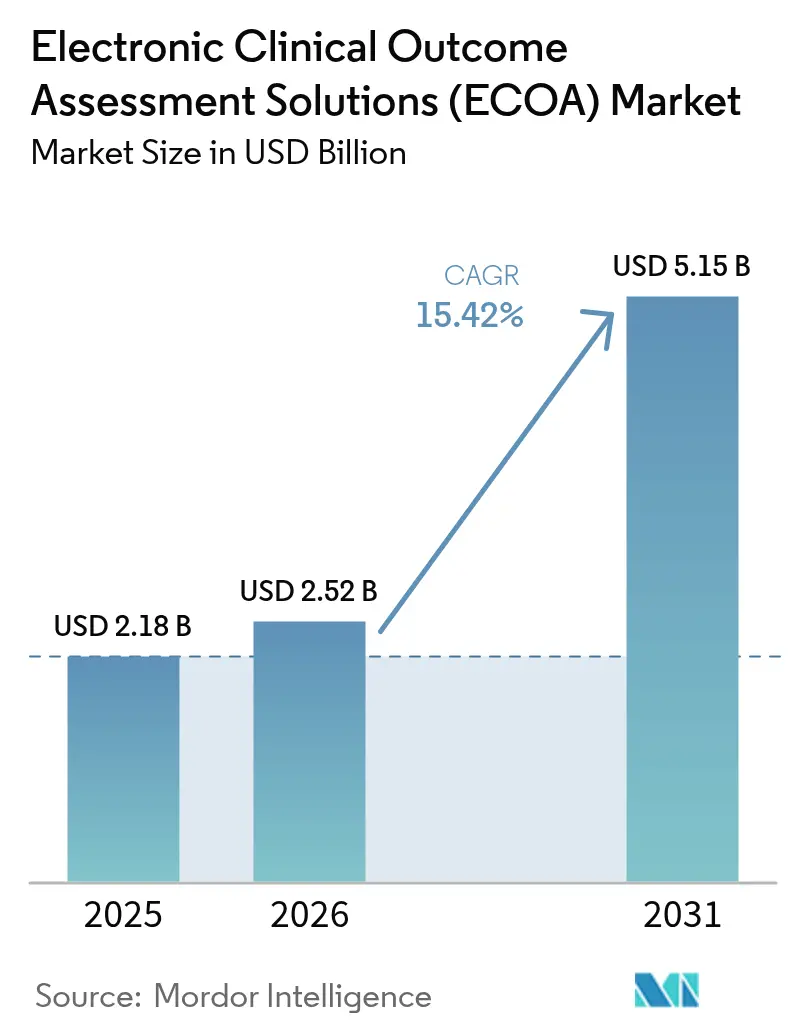
| Market Size (2026) | USD 2.52 Billion |
| Market Size (2031) | USD 5.15 Billion |
| Growth Rate (2026 - 2031) | 15.42 % |
| Fastest Growing Market | Asia Pacific |
| Largest Market | North America |
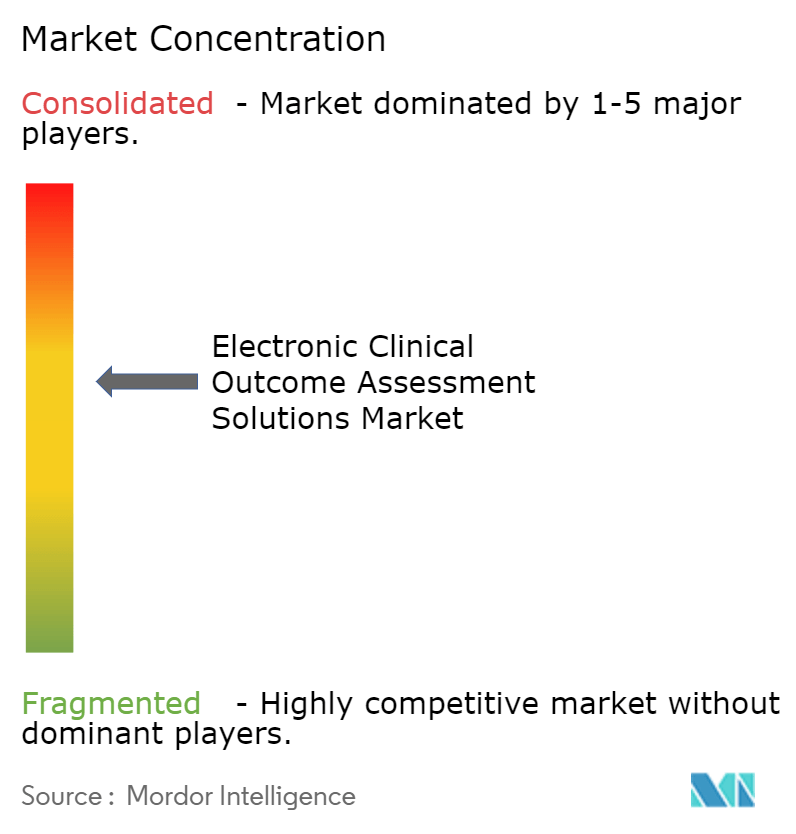
| Market Concentration | Medium |
Major Players *Disclaimer: Major Players sorted in no particular order Image © Mordor Intelligence. Reuse requires attribution under CC BY 4.0. | |
Electronic Clinical Outcome Assessment Solutions (ECOA) Market Analysis by Mordor Intelligence
The electronic clinical outcome assessment solutions market size is expected to grow from USD 2.18 billion in 2025 to USD 2.52 billion in 2026 and is forecast to reach USD 5.15 billion by 2031 at 15.42% CAGR over 2026-2031. Intensifying regulatory focus on patient-centric evidence, rapid migration to cloud-native eClinical stacks, and the widespread adoption of decentralized trial models are accelerating platform demand [1]. Pharmaceutical sponsors view these systems as the primary mechanism for collecting high-integrity patient-reported, clinician-reported, observer-reported, and performance outcomes data that inform labeling and reimbursement. Mature vendors keep broadening their suites through acquisitions, while niche players differentiate with artificial-intelligence decision support and integrated payment capabilities. Emerging economies add further tailwinds by offering cost advantages that encourage multi-regional trial execution.
Key Report Takeaways
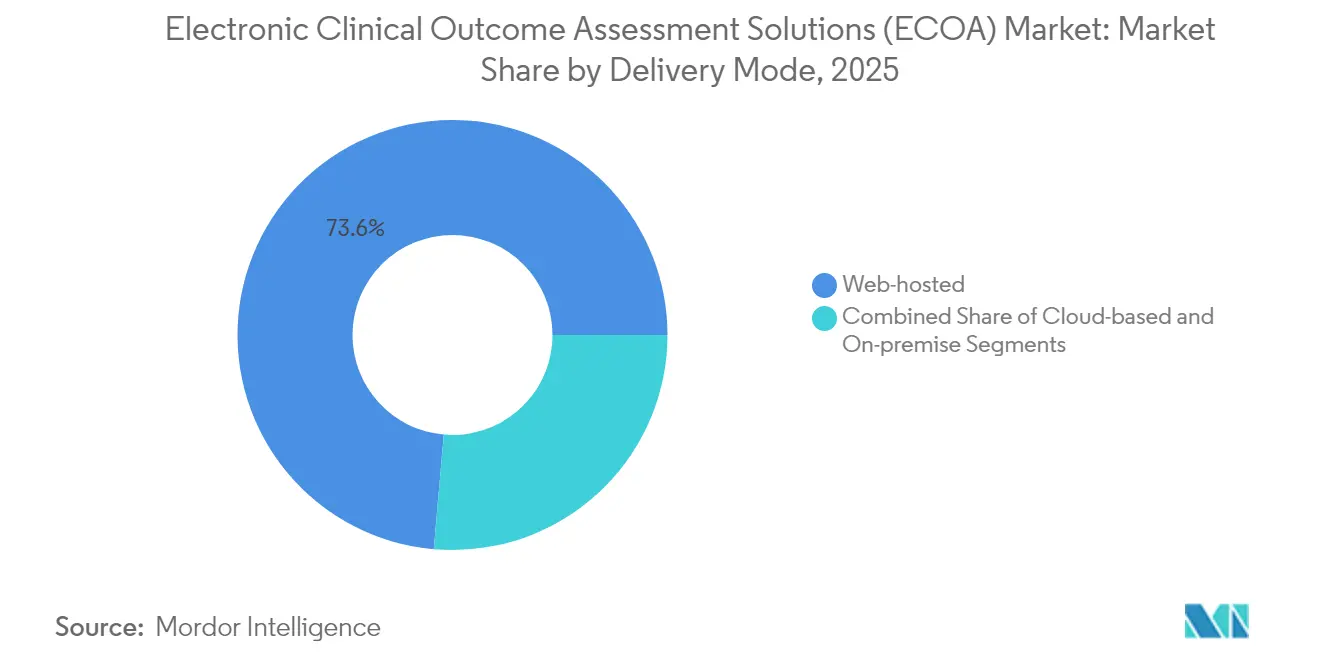
- By delivery mode, web-hosted solutions led with 73.61% revenue share in 2025; cloud-based platforms are forecast to expand at a 15.98% CAGR through 2031.
- By approach, patient-reported outcomes captured 48.45% of electronic clinical outcome assessment solutions market share in 2025; clinician-reported outcomes are advancing at a 16.05% CAGR to 2031.
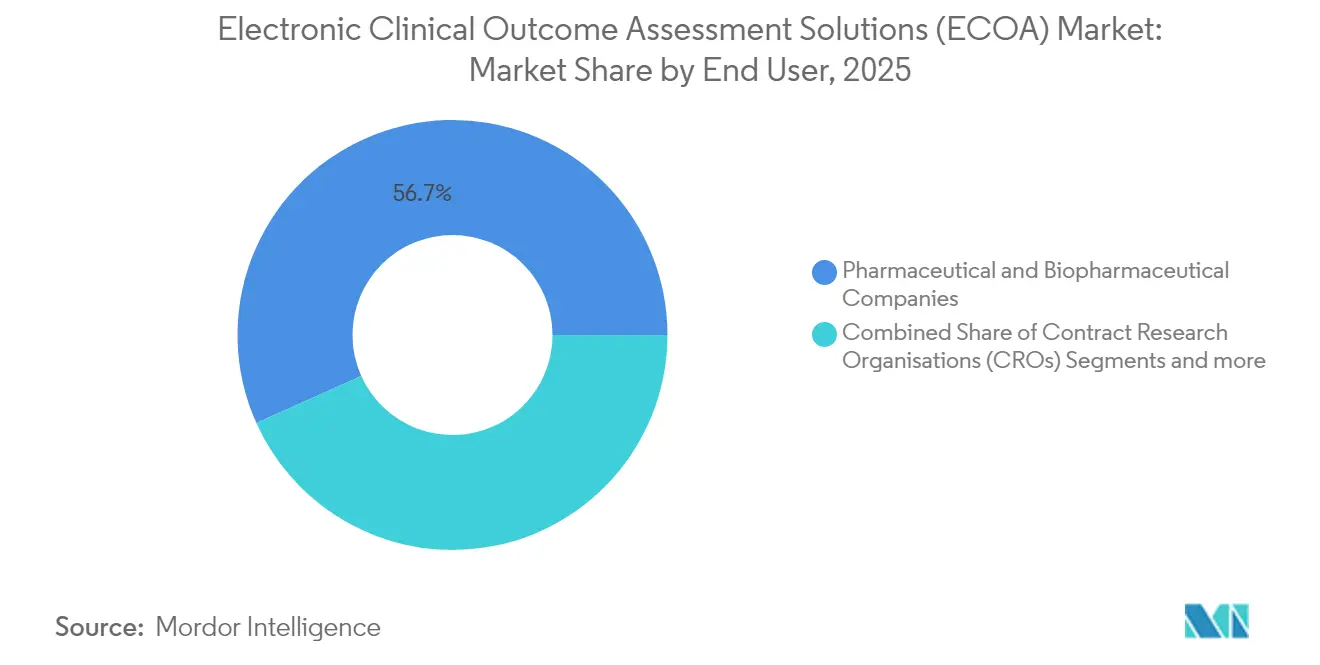
- By end user, pharmaceutical companies accounted for 56.72% of electronic clinical outcome assessment solutions market size in 2025, while contract research organizations are poised for 16.02% CAGR growth to 2031.
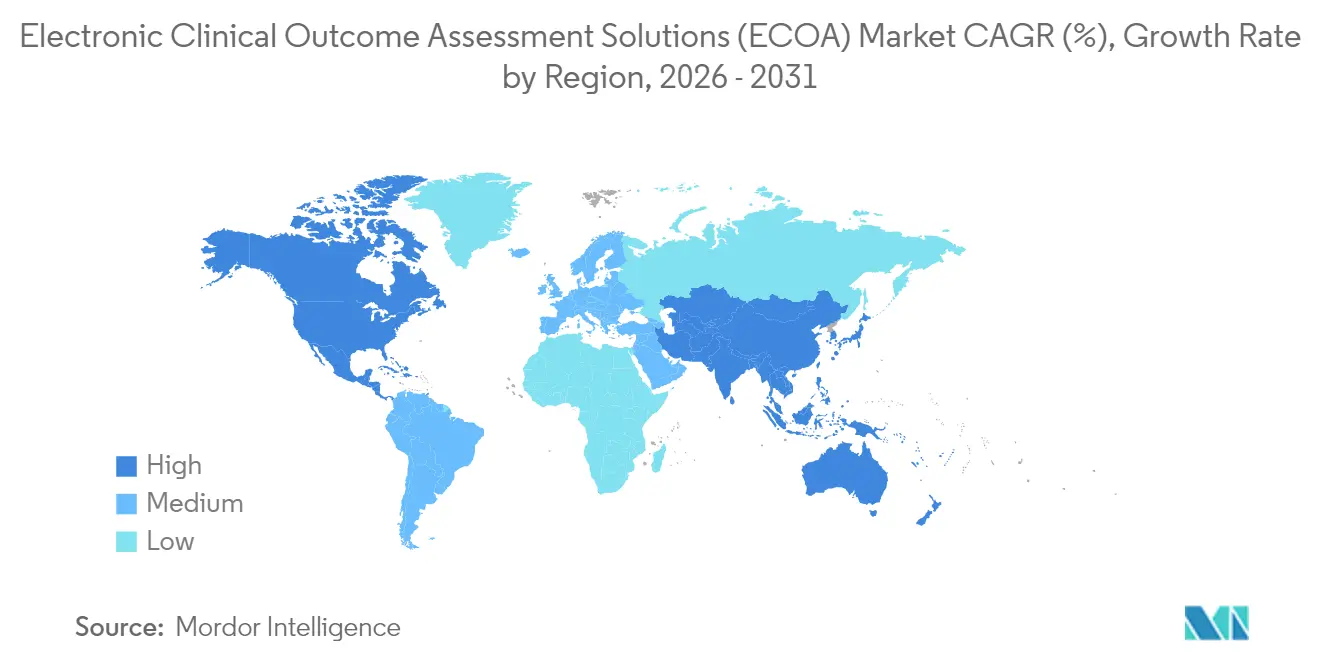
- By geography, North America commanded 41.76% share of the electronic clinical outcome assessment solutions market size in 2025, whereas Asia-Pacific is projected to post the highest regional CAGR at 16.29% through 2031.
Note: Market size and forecast figures in this report are generated using Mordor Intelligence’s proprietary estimation framework, updated with the latest available data and insights as of 2026.
Market Trends and Insights
Drivers Impact Analysis of Electronic Clinical Outcome Assessment Solutions (ECOA) Market*
| Driver | (~) % Impact on CAGR Forecast | Geographic Relevance | Impact Timeline |
|---|---|---|---|
| Growing outsourcing of clinical trials by pharma & biotech sponsors | +2.8% | Global, with concentration in North America & Europe | Medium term (2-4 years) |
| Expansion of cloud/SaaS-based eClinical stacks | +3.1% | Global, led by North America, expanding to Asia-Pacific | Short term (≤ 2 years) |
| Regulatory push for patient-focused drug development | +2.5% | Global, with FDA and EMA leadership | Long term (≥ 4 years) |
| Accelerating shift to decentralized & BYOD trial models | +3.4% | North America & Europe core, spill-over to Asia-Pacific | Medium term (2-4 years) |
| BYOD-enabled wearables lower device costs & boost compliance | +1.9% | Global, with early adoption in developed markets | Medium term (2-4 years) |
| AI-driven adherence coaching lifts PRO data quality | +1.8% | North America & Europe, expanding to Asia-Pacific | Long term (≥ 4 years) |
| Source: Mordor Intelligence | |||
Growing Outsourcing of Clinical Trials by Pharma & Biotech Sponsors
Contract research organizations handle an expanding share of trial execution because sponsors prioritize core discovery activities. In the United States, the biopharmaceutical CRO market is projected to reach USD 19.75 billion by 2033, a signal of enduring outsourcing appetite. CROs now adopt turnkey electronic clinical outcome assessment solutions platforms, offering sponsors unified data capture, randomization, and patient engagement services at scale. Consolidation, exemplified by the Suvoda–Greenphire merger, creates integrated ecosystems spanning eCOA, payments, and supply chain functions [2]. Post-pandemic staffing shortages—Clinical Research Associate turnover rates exceed 25%—reinforce the preference for external partners capable of supplying trained digital-trial personnel [3].
Expansion of Cloud/SaaS-Based eClinical Stacks
Cloud deployments outpace legacy web-hosted models as sponsors seek elasticity, automated validation, and lower total cost of ownership. FDA’s Computer Software Assurance guidance supports risk-based verification, reducing barriers to cloud adoption while preserving 21 CFR Part 11 requirements. Major providers such as Microsoft Azure meet SOC 1, SOC 2, and ISO/IEC 27001 standards, giving life-science teams out-of-the-box security frameworks. Specialized firms like USDM automate patch management and maintain continuous audit readiness, enabling multi-regional compliance for sponsors running concurrent studies.
Regulatory Push for Patient-Focused Drug Development
The FDA’s patient-focused drug development program mandates systematic capture of patient experience measures during pivotal studies, making fit-for-purpose eCOA platforms indispensable. October 2024 guidance on core patient-reported outcomes in oncology supplies standardized instrument templates, reducing method-qualification uncertainty. Parallel EMA recommendations on computerized systems produce trans-Atlantic alignment that lowers implementation complexity for global trials. Digital end-point qualification—such as stride velocity for Duchenne muscular dystrophy—illustrates regulators’ openness to novel outcome measures that depend on real-time sensor feeds.
Shift Toward Decentralized & BYOD Trial Models
Decentralized designs achieve 10% faster recruitment and improved demographic diversity compared with site-centric models. September 2024 FDA guidance clarifies operational expectations for trials incorporating home visits, telemedicine, and direct-to-patient IMP shipping, cementing DCT legitimacy. Bring-your-own-device strategies cut provisioning costs and raise adherence because participants use familiar smartphones, but they require rigorous equivalence testing across operating systems. Government support, evidenced by BARDA’s five-year agreement with Allucent to scale decentralized infrastructure, further legitimizes the model.
Restraints Impact Analysis of Electronic Clinical Outcome Assessment Solutions (ECOA) Market*
| Restraint | (~) % Impact on CAGR Forecast | Geographic Relevance | Impact Timeline |
|---|---|---|---|
| Data-security & privacy-breach concerns | -1.7% | Global, with heightened EU focus under GDPR | Short term (≤ 2 years) |
| High upfront implementation & validation costs | -2.1% | Global, greater impact on smaller biotech | Medium term (2-4 years) |
| Shortage of eCOA-skilled clinical-ops workforce | -1.4% | North America & Europe primarily | Medium term (2-4 years) |
| Device heterogeneity risks measurement equivalence | -1.2% | Global, with regulatory focus in developed markets | Long term (≥ 4 years) |
| Source: Mordor Intelligence | |||
Data-Security and Privacy-Breach Concerns
The FDA now requires a software bill of materials for connected medical technologies, compelling eCOA vendors to maintain robust vulnerability monitoring programs. Europe’s GDPR adds strict data-transfer constraints, forcing sponsors to deploy regional data-residency controls and layered encryption. Enforcement actions—such as the FDA’s 2024 warning letter to Exer Labs—underscore the financial and reputational hazards of inadequate cybersecurity. Rising scrutiny of algorithmic transparency leads 72% of healthcare organizations to favor government oversight of AI-driven predictive models, putting pressure on vendors to explain machine-learning logic in plain language.
High Upfront Implementation and Validation Costs
Phase III trials already absorb the bulk of development budgets, and validating eCOA software across devices, languages, and demographic subgroups adds further expense. The eCOA Consortium stresses that sensor-based data streams must undergo fit-for-purpose evaluation, prolonging project timelines. Wearable validation studies reveal inter-site variability, obliging sponsors to fund extensive standardization and monitoring infrastructure. Although the Computer Software Assurance framework lightens some paperwork, sponsors still need specialized quality engineers and statisticians—resources in short supply among early-stage biotech firms.
*Our forecasts treat driver/restraint impacts as directional, not additive. The impact forecasts reflect baseline growth, mix effects, and variable interactions.
Electronic Clinical Outcome Assessment Solutions (ECOA) Market Segment Analysis
By Delivery Mode:
Cloud Migration Gains MomentumWeb-hosted deployments held 73.61% of electronic clinical outcome assessment solutions market share in 2025 because many sponsors rely on established data-center contracts. The model’s familiarity and proven audit readiness sustain near-term preference, particularly for late-phase portfolios where continuity outweighs innovation. However, cloud-native platforms are expanding at a 15.98% CAGR to 2031, reflecting sponsors’ drive for elastic capacity, real-time analytics, and automated regulatory updates. Microsoft Azure’s security certifications and FDA-endorsed risk-based validation create confidence that cloud infrastructure can satisfy data-integrity mandates.
Sponsors shift workloads incrementally, often starting with early-phase or observational studies before migrating pivotal trials once internal policies mature. Hybrid architectures that tether legacy web-hosted databases to cloud analytics services help firms manage transition risk. As a result, cloud solutions are projected to capture a growing slice of electronic clinical outcome assessment solutions market size, while on-premise instances retreat to niche scenarios demanding maximal data control, such as defense-funded infectious-disease projects.

By Approach:
PRO Dominance Meets ClinRO AccelerationPatient-reported outcomes accounted for 48.45% of electronic clinical outcome assessment solutions market size in 2025, anchored by longstanding FDA labeling precedents and patient-focused drug development policy. Clinician-reported outcomes are on track for a 16.05% CAGR, propelled by embedded eSource modules that let investigators enter scores directly within electronic health-record environments. Observer-reported measures retain specialized use in pediatrics and dementia, while performance outcomes rise alongside validated digital biomarkers.
Natural-language processing now transforms unstructured narrative fields into structured ClinRO variables, reducing time burdens and error rates for busy physicians. Signant Health’s electronic clinician rating modules exemplify how decision-support prompts standardize scoring while preserving clinical nuance. As wearable companies qualify additional digital biomarkers—gait speed, heart-rate variability—performance outcomes will transition from exploratory endpoints to co-primary status, broadening demand for multi-modal eCOA suites that seamlessly ingest sensor data.
By End User:
CRO Demand Outpaces Sponsor InvestmentPharmaceutical and biopharmaceutical firms represented 56.72% of electronic clinical outcome assessment solutions market share in 2025, reflecting direct accountability for registrational data integrity. Nevertheless, contract research organizations are advancing at a 16.02% CAGR, mirroring the broader outsourcing wave that sees sponsors externalize operational complexity. Leading CROs bundle eCOA capability with site payments, eConsent, and randomization to offer unified digital trial blueprints. The Suvoda–Greenphire merger typifies how service providers combine complementary assets to streamline study start-up and investigator remuneration.
Academic medical centers and government agencies, although smaller consumers, fuel innovation by piloting novel digital endpoints in rare-disease cohorts where commercial incentives are limited. The expanding public-private partnership model, supported by the NIH’s Decentralized Trial Innovation Network, introduces open-source toolkits that lower adoption barriers for resource-constrained institutions, indirectly nurturing expertise that later migrates to CRO and sponsor teams.
Geography Analysis
North America Electronic Clinical Outcome Assessment Solutions (ECOA) Market
North America dominates the electronic clinical outcome assessment solutions market with 41.76% share, driven by stringent yet well-defined FDA regulations, sophisticated clinical research infrastructure, and early deployment of patient-centric metrics. Continuous FDA guidance, including the Computer Software Assurance framework, underpins sponsor confidence by clarifying validation expectations. The United States accounts for most regional revenue, with Canada contributing specialized day-1 access programs for rare diseases and Mexico offering cost-effective Phase I units.
APAC Electronic Clinical Outcome Assessment Solutions (ECOA) Market
Asia-Pacific records the fastest regional expansion at 16.29% CAGR, reflecting harmonized trial policies, rising domestic R&D investment, and the promise of lower per-patient costs. China’s streamlining of clinical-trial approval timelines, India’s digital-health mission, and South Korea’s telemedicine pilots collectively foster a receptive environment for decentralized study designs that require robust eCOA backbones. Nevertheless, divergent data-localization policies and language complexity demand that vendors deliver multi-tenant architectures with configurable sovereignty controls.
Europe Electronic Clinical Outcome Assessment Solutions (ECOA) Market
Europe, supported by EMA alignment and national eHealth agendas, remains a stable adopter. Germany’s hospital digitalization budget and the UK’s Medicines and Healthcare products Regulatory Agency sandbox stimulate uptake of sensor-driven outcomes in oncology and neurology. Meanwhile, GDPR compliance costs push smaller biotech to partner with established vendors holding pre-certified hosting zones, ensuring uninterrupted flow of electronic clinical outcome assessment solutions market transactions across the continent.
Regulatory Landscape
ECOA adoption is tied to established electronic records and e-signature expectations for regulated clinical investigations, with 21 CFR Part 11 as the core US compliance baseline for electronic systems used to generate registrational data. Regulators have also increased their emphasis on fit-for-purpose validation for digital health technologies used to capture endpoints: FDA guidance activity around DHT-enabled remote data acquisition (including the October 2024 draft guidance) clarifies risk-based approaches for verification and validation, and it underscores the need to demonstrate data integrity when outcomes are captured via mobile apps, sensors, or mixed BYOD models.
In Europe, the EU Clinical Trials Regulation (EU-CTR) and its centralized Clinical Trials Information System (CTIS) tighten expectations around submission and transparency of patient-facing materials, including electronic instruments and translated versions, which affects how sponsors manage eCOA updates and version control across countries. EU implementation of ICH E6(R3) GCP (effective July 23, 2025) reinforces quality management principles for computerized systems used for outcome capture, raising scrutiny on vendor quality systems, audit trails, and computerized system validation across global trial footprints. In parallel, EMA’s qualification pathway for digital technology-based methodologies provides a formal route for sponsors to align digital endpoint methodologies (including performance outcomes derived from sensors) with a defined context of use.
Competitive Landscape
The market shows moderate concentration. Medidata, Signant Health, and Clario together hold a sizeable portion, yet numerous mid-tier and emerging suppliers exploit specialty niches. Medidata extends its leadership by integrating eCOA into its unified clinical platform and by launching the Site Insights Program, which feeds site feedback into study design. Signant Health collaborates with IQVIA on the One Home for Sites framework, consolidating investigator portals and electronic source to enhance workflow efficiency. Clario bolstered its portfolio by acquiring WCG’s eCOA unit, widening geographic reach and deepening expertise in complex therapeutic areas.
New entrants differentiate through artificial-intelligence modules. Kayentis mines adherence patterns to trigger personalized nudges, while Medable Studio allows drag-and-drop configuration of multilingual instruments to reduce build time. Oracle and Veeva Systems position enterprise-grade data lakes that merge operational and clinical signals, promising real-time risk-based monitoring. Midsize players specialize further: some focus on pediatric endpoints, others on integration of high-frequency wearable feeds.
Amid consolidation, white-space remains in low-resource settings where local language support, offline functionality, and ruggedized hardware are essential. Vendors able to meet those requirements stand to capture incremental electronic clinical outcome assessment solutions market share as sponsors extend trials into Africa and Latin America.
Electronic Clinical Outcome Assessment Solutions (ECOA) Industry Leaders
-
Kayentis
-
IQVIA Inc.
-
Parexel International Corporation
-
Signant Health
-
WIRB-Copernicus Group
- *Disclaimer: Major Players sorted in no particular order
Electronic Clinical Outcome Assessment Solutions (ECOA) Market Companies Covered in this Report
- Dassault Systemes
- Signant Health
- Clario (ERT Clinical)
- Oracle
- IQVIA
- Veeva Systems
- Parexel Intl. Corp.
- Kayentis
- Castor EDC
- WCG Clinical
- Mednet Solutions
- Aris Global
- Medable
- Suvoda
- TrialSpark
- eClinical Solutions
- OpenClinica
- Anju Software
- CRF Health (Parexel)
- OmniComm Systems
- Castor (Cloud Solutions)
Read Analysis of Electronic Clinical Outcome Assessment Solutions (ECOA) Companies
Market Opportunities and Future Outlook
Whitespace is expanding as sponsors and CROs consolidate fragmented clinical tech stacks into unified workflows that combine eCOA with IRT, eConsent, eSource, and patient payments. This consolidation reduces study start-up friction and site burden. The category also continues to shift toward suite-building, including Clario expanding its eCOA footprint through its acquisition of WCG’s eCOA business, which supports demand for vendors that can deliver global instrument libraries, multilingual deployments, and consistent operational oversight across regions. A related opportunity is cloud migration beyond early-phase use, as sponsors prioritize elastic capacity and compliance-ready controls aligned to risk-based validation approaches referenced in FDA’s Computer Software Assurance direction and broader electronic systems expectations.
Differentiation is increasingly tied to evidence and qualification for more complex endpoints, including sensor-derived measures and interactive performance assessments, rather than questionnaire digitization. The March 2026 Federal Register notice from the FDA seeking public input on advancing DHT use in clinical investigations indicates ongoing regulatory attention on sensors, mobile apps, and machine learning in endpoint measurement. That attention creates room for eCOA platforms that can operationalize fit-for-purpose validation, maintain traceability, and manage measurement equivalence in BYOD designs. In parallel, EMA’s digital technology-based methodologies qualification framework gives sponsors a pathway to formalize novel endpoint approaches, supporting demand for vendors that can package methodology documentation, metadata, and audit-ready evidence alongside the data capture layer.
Recent Industry Developments in Electronic Clinical Outcome Assessment Solutions (ECOA) Market
- May 2026: Signant Health expanded its CNS trial data approach by integrating sensor-based data capabilities associated with its Ametris acquisition into broader eCOA workflows. The update strengthens support for complex CNS studies that rely on a mix of subjective assessments and objective digital signals, and it increases competitive pressure for multi-modal endpoint capture within a single platform.
- May 2025: Clario completed its acquisition of WCG's eCOA business, broadening its eCOA capabilities for global clinical trials. The transaction extended Clario's footprint in outcome assessment delivery and strengthened its positioning in therapeutic areas where standardized, scalable eCOA operations are critical.
- August 2024: Medable launched Medable Studio, an environment to configure and validate multi-component eCOA deployments. By reducing build time for multilingual instruments and supporting faster study configuration, the release reinforced the shift toward more configurable, software-driven eCOA operations within decentralized trial models.
Electronic Clinical Outcome Assessment Solutions (ECOA) Market Report Scope and Research Methodology
Market Definition and Coverage
For this study, the eCOA market covers software and solution revenues used to electronically capture and manage clinical outcome assessments within clinical studies, including patient, clinician, observer, and performance based assessments across common delivery modes.
Scope exclusions: We exclude paper-only outcome assessments, general clinical trial software that does not capture COA instruments, and non-clinical real-world patient monitoring tools that sit outside formal study workflows.
Segments Covered in This Report
- By Delivery Mode
- Web-hosted
- Cloud-based
- On-premise
- By Approach
- Patient-Reported Outcome (PRO)
- Clinician-Reported Outcome (ClinRO)
- Observer-Reported Outcome (ObsRO)
- Performance Outcome (PerfO)
- By End User
- Pharmaceutical and Biopharmaceutical Companies
- Contract Research Organisations (CROs)
- Others
- By Geography
- North America
- United States
- Canada
- Mexico
- Europe
- Germany
- United Kingdom
- France
- Italy
- Spain
- Rest of Europe
- Asia-Pacific
- China
- Japan
- India
- Australia
- South Korea
- Rest of Asia-Pacific
- Middle East and Africa
- GCC
- South Africa
- Rest of Middle East and Africa
- South America
- Brazil
- Argentina
- Rest of South America
- North America
Data Sources, Market Sizing, and Validation
Desk Research
Desk research is used to set the market boundary and to build a reality check on trial activity and digital adoption. We typically pull public sources such as ClinicalTrials.gov for trial volume and mix, the US FDA and EMA sites for guidance and compliance expectations around COAs, and the World Health Organization ICTRP for cross-country study visibility.
To anchor demand signals, we also refer to OECD health statistics and national health agencies where relevant, along with peer-reviewed journals that discuss COA instrument use and endpoint design. Company filings, investor presentations, and trusted press releases are reviewed to understand contract wins, pricing language, and how often vendors bundle eCOA inside broader eClinical programs. Where helpful, paid subscription sources for company financials and a patent database are used to support revenue mapping and innovation direction. These sources are illustrative, and additional public references are also reviewed for data collection, validation, and clarification.
Primary Interviews and Surveys
Primary work is used to test what desk sources cannot fully show, especially typical pricing structures, implementation timelines, and how eCOA is purchased by sponsors and CROs. We speak with a mix of solution providers, CRO program owners, and study operations leads across APAC, EMEA, and the Americas, so assumptions on adoption, study complexity, and delivery mode split can be adjusted with practical inputs.
Distribution of primary research fieldwork respondents
| Company type | Respondent position | Region |
|---|---|---|
| Top tier: 28% | CXOs: 17% | APAC: 47% |
| Mid tier: 55% | Functional/Unit leaders: 39% | EMEA: 30% |
| Smaller Players: 17% | Managers: 44% | Americas: 23% |
Market-Sizing & Forecasting
Sizing starts with a top-down build where clinical trial activity and COA usage patterns are translated into an addressable demand pool, and then converted into revenue using typical price and deployment assumptions. In practice, we use inputs such as the count of interventional trials by region, the share of trials using PRO or other COA instruments, the mix of delivery modes (web-hosted, cloud, on-premise), average number of participants per study, and the expected eCOA license and services spend per study.
Those totals are then checked using selective bottom-up approximations, like sampling vendor revenue disclosures where available, triangulating typical study-level fees discussed in interviews, and using channel feedback on bundling inside broader eClinical contracts. If a country has limited disclosure or low interview coverage, gaps are handled with proxy indicators such as trial density, sponsor presence, and the local CRO footprint, and then normalized back to regional totals.
For forecasting, we rely on scenario analysis supported by expert views on decentralized trial adoption, protocol complexity, and expected pricing progression by delivery mode. The forecast is also cross-checked against forward trial pipelines and regulatory direction on patient-focused endpoints so the growth path stays tied to observable study activity.
Data Validation & Update Cycle
Model outputs are validated through multiple passes that compare results with independent signals, including trial starts, outsourcing intensity, and the observed shift toward cloud deployments. Variances are investigated at the region and end-user level, and if a number looks out of line with trial volume or typical study spend, assumptions are revisited and respondents may be re-contacted to confirm.
Before sign-off, the dataset and calculations are reviewed by another analyst to catch formula issues, unit mismatches, and currency timing inconsistencies. Reports are refreshed annually, and interim updates are made when material events occur, such as major regulatory changes, large acquisitions, or sharp shifts in trial execution models. Right before delivery, a final sweep is done so clients receive the most current view available.
Mordor Intelligence's Electronic Clinical Outcome Assessment Solutions Ecoa Market Estimate Compared With Other Published Estimates
Published market sizes for eCOA often vary because the counting boundary is not always the same, and some estimates mix adjacent eClinical tools into one number. The year used as the starting point, the way prices are averaged across study types, and how cloud subscriptions are treated versus services can also shift the final market value.
The benchmark table shows a tight cluster around 2025, and a wider spread by 2026, which usually indicates different assumptions on what qualifies as eCOA revenue and how quickly decentralized trials expand. In Mordor Intelligence's model, the scope stays centered on eCOA approaches (PRO, ClinRO, ObsRO, and PerfO) across common delivery modes, and the size is tied back to clinical trial activity and study-level spend checks, rather than applying a broad software spend ratio.
Benchmark comparison
| Source | Market Size | Gaps in Research Methodology |
|---|---|---|
| Mordor Intelligence | USD 2.18 B (2025) | |
| Industry Research Publisher A | USD 2.14 B (2025) | Uses a broad eCOA solution definition with limited visible detail on how delivery mode mix and services versus subscription pricing are separated, which can compress the 2025 base. |
| Global Business Publisher B | USD 2.21 B (2026) | Applies a sales-based view with different segment inclusions and growth windows, and the year shift to 2026 can lift the total when adoption ramp assumptions are front-loaded. |
Looking at the three numbers together, most of the gap can be traced to scope boundaries and timing, not arithmetic differences. By keeping variables like trial volume, COA usage intensity, and study-level pricing visible in the model, the estimate remains explainable and repeatable when clients want to stress-test assumptions.
Key Questions Answered in the Report
What is driving the strong CAGR in the electronic clinical outcome assessment solutions market?
Expansion of decentralized trials, regulatory mandates for patient-focused evidence, and accelerated cloud adoption collectively underpin a 15.42% CAGR through 2031.
Which delivery mode is growing the fastest?
Cloud-based platforms are advancing at 15.98% CAGR, outpacing web-hosted and on-premise models as sponsors seek scalable, compliance-ready infrastructure.
Why are CROs gaining electronic clinical outcome assessment solutions market share?
Sponsors outsource trial execution to CROs to offset workforce shortages and leverage specialized digital expertise, fueling a 16.02% CAGR for CRO adoption.
Which region offers the largest growth opportunity?
Asia-Pacific is projected to post a 16.29% CAGR, helped by regulatory harmonization and cost-efficient patient recruitment.
What are the main barriers to wider platform adoption?
Data-security concerns under stringent privacy regimes and high validation costs remain key obstacles, especially for smaller biotechnology firms.
How is artificial intelligence influencing platform differentiation?
Vendors integrate machine-learning modules for adherence coaching, outcome prediction, and automated data-quality checks, enhancing value to sponsors and sites.