
Electrochromic Glass Market Size and Share
Market Overview
| Study Period | 2021 - 2031 |
|---|---|
| Market Size (2026) | USD 2.32 Billion |
| Market Size (2031) | USD 3.52 Billion |
| Growth Rate (2026 - 2031) | 8.63 % |
| Fastest Growing Market | Asia-Pacific |
| Largest Market | North America |
| Market Concentration | Medium |
Major Players *Disclaimer: Major Players sorted in no particular order Image © Mordor Intelligence. Reuse requires attribution under CC BY 4.0. | |
Electrochromic Glass Market Analysis by Mordor Intelligence
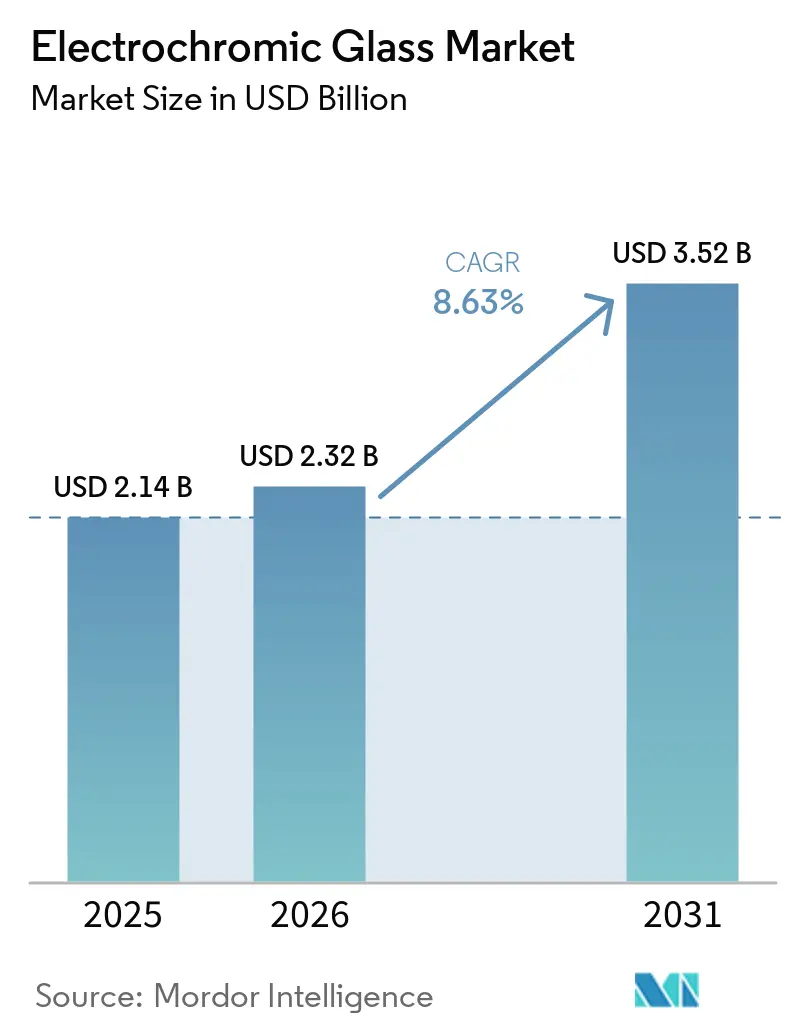
The Electrochromic Glass Market size was valued at USD 2.14 billion in 2025 and is estimated to grow from USD 2.32 billion in 2026 to reach USD 3.52 billion by 2031, at a CAGR of 8.63% during the forecast period (2026-2031). The electrochromic glass market is being supported by building rules that make energy performance a more central part of design and renovation decisions. The European Union’s Energy Performance of Buildings Directive requires member states to bring its provisions into national law, which places greater focus on zero-emission buildings and renovation. California’s 2025 Energy Code took effect in January 2026 and created pathways for dynamic glazing in new buildings and major renovations. The electrochromic glass market also benefits as building controls become more connected and as vehicle makers use dimmable glass to differentiate premium electric vehicles. Cost remains the main limit because electrochromic insulated glass units cost more than static low-emissivity glazing and require electrical coordination during installation.
Key Report Takeaways
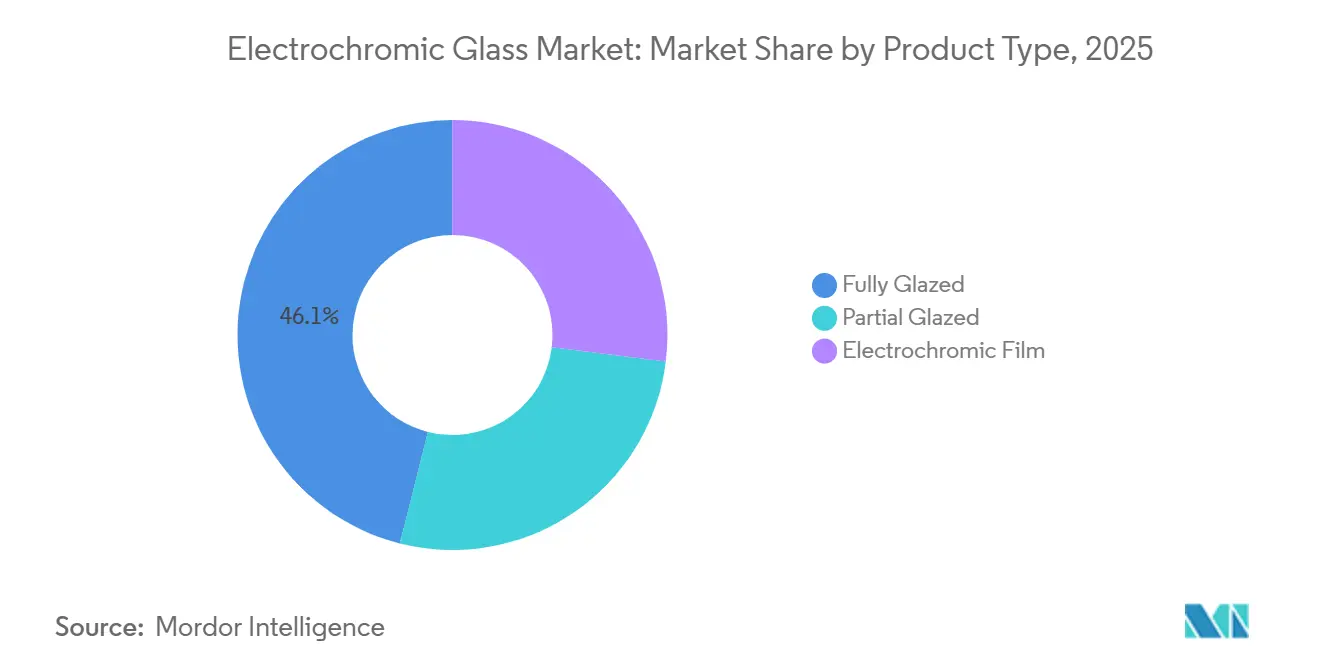
- By product type, fully glazed held 46.05% of the electrochromic glass market share in 2025, while electrochromic film is projected to advance at a 9.13% CAGR through 2031.
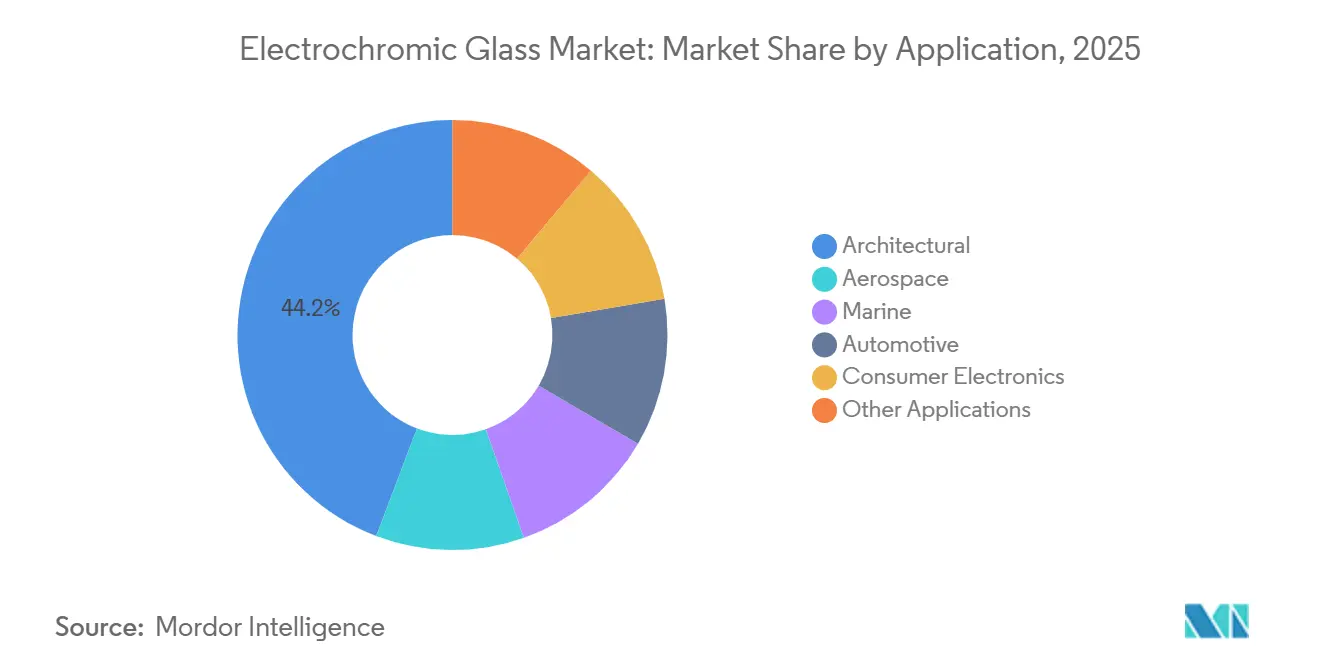
- By application, architectural held 44.23% of the electrochromic glass market share in 2025, while automotive is projected to advance at a 9.84% CAGR through 2031.
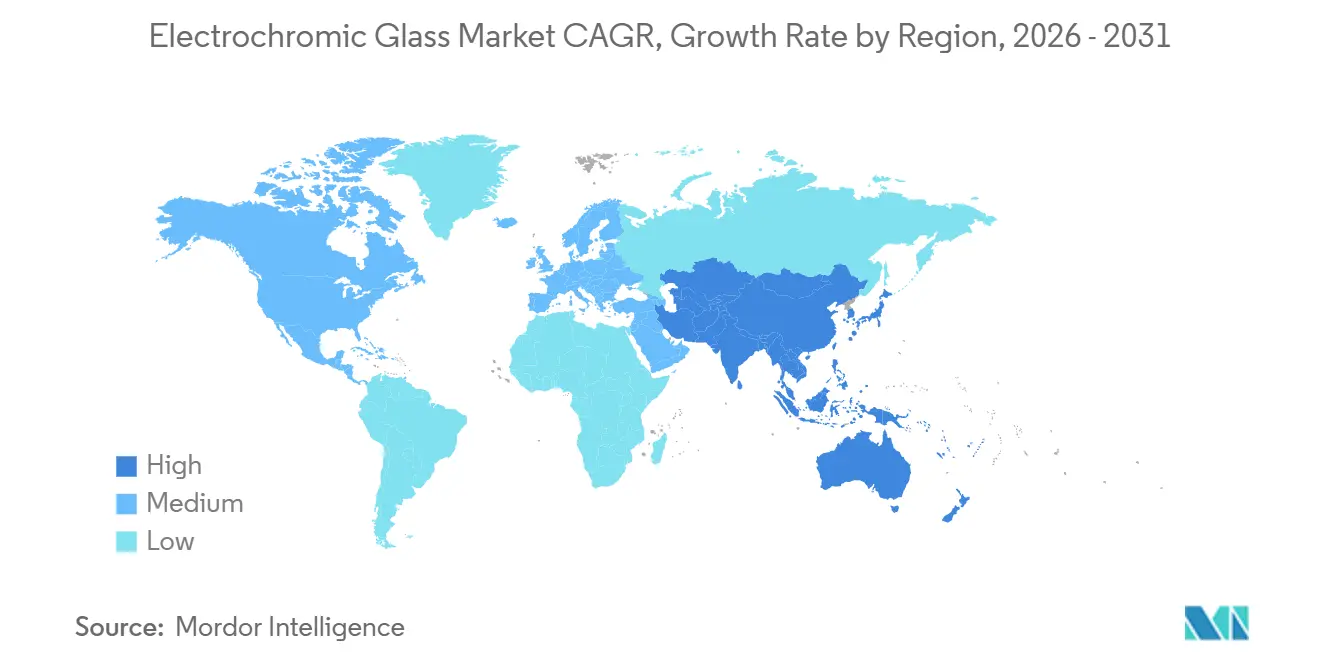
- By geography, North America held 38.61% of the electrochromic glass market share in 2025, while Asia-Pacific is projected to advance at a 9.22% CAGR through 2031.
Note: Market size and forecast figures in this report are generated using Mordor Intelligence’s proprietary estimation framework, updated with the latest available data and insights as of January 2026.
Market Trends and Insights
Drivers Impact Analysis of Electrochromic Glass Market*
| Driver | (~) % Impact on CAGR Forecast | Geographic Relevance | Impact Timeline |
|---|---|---|---|
| Building-Energy Codes and Net-Zero Mandates | +2.4% | Global, with concentrated early gains in North America, EU, and Japan | Short term (≤ 2 years) |
| Smart-Building and Building-Automation Integration | +1.9% | North America & EU core; spillover to APAC commercial hubs | Medium term (2–4 years) |
| Premium Automotive Panoramic Glazing and Dimmable Mirrors | +1.6% | APAC (China NEV), EU (premium OEMs), North America | Medium term (2–4 years) |
| Retrofit Demand for Electrified Solar Control | +1.3% | EU renovation wave; North America Tier-1/2 cities; APAC core | Medium term (2–4 years) |
| High-Throughput Thin-Film Deposition and Flexible Electrochromic Films | +0.9% | Global; manufacturing concentrated in North America and APAC | Long term (≥ 4 years) |
| Source: Mordor Intelligence | |||
Building-Energy Codes and Net-Zero Mandates
Building-energy codes and net-zero mandates create a direct reason for owners and architects to consider dynamic glazing. The revised Energy Performance of Buildings Directive requires EU member states to transpose its provisions into national law by May 2026[1]. The directive also directs attention toward renovation of existing buildings, where poor energy performance can trigger investment in envelope upgrades. California’s 2025 Energy Code provides a dynamic glazing compliance pathway under performance-based approaches and applies to new buildings and major renovations from January 2026. A 2026 study reported average annual heating, ventilation, and air-conditioning energy savings of 19.5% for solar-thermal dual-band electrochromic windows across climate zones. These requirements and performance results strengthen the case for the electrochromic glass market in commercial projects where solar control is part of a broader energy strategy. They also connect glazing choices with decisions on facade design, mechanical systems, operating costs, and occupant comfort. The resulting case is most relevant where a project already needs to document energy performance. Static glazing can meet many project requirements, but dynamic control gives designers another way to respond to changing sunlight. The effect is strongest when design teams consider the facade early, rather than treating glass as a late procurement decision.
Smart-Building and Building-Automation Integration
Smart-building and building-automation integration changes electrochromic glazing from a passive envelope component into a controlled system. Building management systems can use occupancy, daylight, and heating, ventilation, and air-conditioning signals to set tint levels. This can help manage glare and solar heat while keeping interior spaces usable. The value of the system depends on reliable links among controls, glazing, electrical work, and the wider building platform. A 2025 review noted that linking electrochromic smart windows with legacy building energy management systems remains technically challenging, especially in older commercial properties. Suppliers that support building controls and installation teams can, therefore, improve their position in the electrochromic glass market, particularly on large commercial specifications. The product must work with the building’s equipment as well as with its visual and thermal design. This places more emphasis on commissioning, user controls, and technical support after installation. It also raises the value of suppliers that can explain how a tinting system operates in normal building conditions. For property owners, the practical issue is whether the system can be maintained through the life of the building.
Premium Automotive Panoramic Glazing and Dimmable Mirrors
Premium automotive panoramic glazing and dimmable mirrors extend electrochromic technology beyond conventional building applications. Vehicle makers are using larger glass areas to improve cabin design and create differentiated passenger experiences. GENTEX CORPORATION and Antolin signed a cooperation agreement in April 2026 to develop next-generation dimmable sun visors for European vehicle makers. Miru Smart Technologies and Argotec unveiled a compound-curved electrochromic sunroof prototype measuring 1.5 m by 1.6 m in March 2025. The automotive use case can support larger production runs and help advance film and curved-glass development that may later serve other parts of the electrochromic glass market. Automotive programs require repeatable quality and close coordination with vehicle design cycles. Those requirements can encourage suppliers to improve coating uniformity, electrical connections, and manufacturing processes. Dimmable roofs and visors also make the technology more familiar to vehicle makers and customers.
Retrofit Demand for Electrified Solar Control
Retrofit demand for electrified solar control creates a separate route to adoption in existing buildings. The Energy Performance of Buildings Directive places renovation at the center of European building policy and increases attention on low-performing stock. Film-based products can be installed through local glass partners without replacing every window assembly. ChromoGenics received a 4,000 m² order for ConverLight Dynamic Glass at Central Yards in Hong Kong during June 2026[2]. Retrofit projects can also address the common practice of closing blinds against glare while using artificial lighting. This supports the electrochromic glass market, where owners seek lower solar gain without losing daylight or replacing an entire facade. Retrofit decisions often need to fit within occupied buildings and established maintenance schedules. A product that can work with local glass partners can be easier to apply in this setting. The appeal is not limited to energy use because glare management and visual comfort also affect the decision. The route to adoption still depends on installation quality and the economics of each building.
Restraints Impact Analysis of Electrochromic Glass Market*
| Restraint | (~) % Impact on CAGR Forecast | Geographic Relevance | Impact Timeline |
|---|---|---|---|
| High Upfront Cost Versus Conventional Insulating Glass | -2.5% | Global; most acute in price-sensitive APAC markets and residential segments | Short term (≤ 2 years) |
| Installation and Commissioning Complexity | -1.9% | Global; most pronounced in retrofit markets, South America, MEA | Medium term (2–4 years) |
| Durability, Cycling Stability, and Absence of a Globally Harmonized Durability Standard | -1.4% | Global; particularly restraining in markets without established procurement frameworks | Long term (≥ 4 years) |
| Source: Mordor Intelligence | |||
High Upfront Cost Versus Conventional Insulating Glass
High upfront cost versus conventional insulating glass remains the clearest barrier to broader adoption. Installed electrochromic glass costs in the United States range from USD 60 to USD 150 per sq ft, which is 3-5 times the cost of high-performance static low-emissivity glazing. The premium is especially difficult to justify when project teams evaluate only direct energy savings. It can appear less severe when shading-system displacement, smaller heating, ventilation, and air-conditioning equipment, and available deductions are included. Material supply and the need for specialized coatings can also keep pressure on system costs. The electrochromic glass market, therefore, remains strongest in projects where energy, comfort, design, and building-control benefits are evaluated together rather than through a simple upfront-price comparison. This explains why premium commercial buildings have been an early area of adoption. It also helps explain the interest in airport, office, and mixed-use projects with large, glazed areas. In lower-cost projects, the price premium can outweigh the benefits that are harder to measure at procurement. Wider adoption will depend on whether suppliers can make the installed proposition simpler and less costly.
Installation and Commissioning Complexity
Installation and commissioning complexity can delay projects and increase costs. Electrochromic glass needs coordinated work by glazing contractors and electrical subcontractors. Each window requires low-voltage direct-current wiring and retrofit work may require new conduit and controls programming. These requirements are harder to manage in areas with limited experience in electrochromic systems or building automation. A 2025 review identified integration with legacy building energy management infrastructure as a continuing technical challenge. Training, specialized contractors, and more integrated installation models can reduce this barrier, but the issue remains important for the electrochromic glass market in developing construction markets. Project teams must plan wiring and controls before the glazing is installed. Changes made late in construction can increase schedule risk and reduce the perceived value of the system. This can be particularly difficult during retrofit work, where the existing building may have older equipment.
*Our forecasts treat driver/restraint impacts as directional, not additive. The impact forecasts reflect baseline growth, mix effects, and variable interactions.
Electrochromic Glass Market Segment Analysis
By Product Type:
Fully Glazed Leads as Film Formats AccelerateFully glazed held 46.05% of the electrochromic glass market share in 2025, while electrochromic film is projected to advance at a 9.13% CAGR through 2031. Fully glazed, insulated glass units remain important in major commercial projects because they fit directly into curtain-wall systems and can provide consistent tinting across large panes. Established suppliers have built production capability for these large formats, which supports their role in demanding architectural work. Customers evaluating large glass areas can place a high value on a neutral appearance across the facade. They also need assurance that the glazing will retain its intended switching behavior over time. These considerations favor suppliers with established project records and detailed performance data. The product decision is consequently both a material choice and a long-term building-system decision.
Electrochromic film supports a different set of customer needs because it can serve retrofit work and automotive programs. Solution-processed film deposition can reduce reliance on the equipment used for conventional large-area coating processes. ChromoGenics’ ConverLight foil is designed to be laminated by local glass partners, which can reduce the need to move finished insulated glass units over long distances. The company received its first North American order for a luxury residential project in Colorado in 2025. Film products still need consistent test results and accepted certification to compete with established, fully glazed systems. This leaves room in the electrochromic glass market for suppliers that can pair lower-cost formats with reliable performance evidence.

By Application:
Architectural Segment Leads Demand While Automotive AcceleratesArchitectural held 44.23% of the electrochromic glass market share in 2025, while automotive is projected to advance at a 9.84% CAGR through 2031. Architectural remains the largest application because commercial facades, airports, and mixed-use developments need daylight management and solar control. Saint-Gobain equipped Nashville International Airport’s Concourse D with electrochromic glazing in June 2026 as part of the BNA Vision expansion. ChromoGenics’ June 2026 Central Yards order shows that large dynamic-glass projects are also moving into Asian mixed-use development.
Automotive demand is expanding as vehicle makers add larger roof glazing and dimmable interior features. The application provides a route for large curved panels and lightweight film formats to move toward production use. GENTEX CORPORATION and Antolin’s April 2026 agreement focused on next-generation dimmable sun visors for European automotive customers. Miru Smart Technologies and Argotec’s 2025 prototype also demonstrated a compound-curved panel that measured 1.5 m by 1.6 m. Aerospace, electronics, and marine applications allow the electrochromic glass market to draw on related advances in materials, controls, and compact system design. The applications also have different purchasing cycles and product requirements. Architectural projects need facade coordination, while vehicle programs require repeatable integration into manufactured platforms. Aerospace places particular importance on cycling stability. This mix gives suppliers several possible routes for applying the same underlying technology.
Geography Analysis
North America Electrochromic Glass Market
North America held 38.61% of the electrochromic glass market share in 2025. The region has strong commercial construction demand and a mature base of green-building and energy-code activity. California’s 2025 Energy Code created dynamic glazing compliance pathways for new buildings and major renovations from January 2026. This regulatory setting supports the electrochromic glass market in metropolitan projects where envelope performance, occupant comfort, and energy use are evaluated together. Canada’s retrofit activity and Mexico’s manufacturing base add to regional demand, although the United States remains the largest contributor. The region also provides a base of project references for suppliers working on other large commercial developments. This matters because design teams often consider completed installations when selecting less familiar building technologies. Regulatory requirements and available incentives can further improve the case in locations with high energy costs. North American demand is, therefore, supported by both construction activity and established market experience.
APAC Electrochromic Glass Market
Asia-Pacific is projected to advance at a 9.22% CAGR through 2031. Growth is tied to electric vehicle production, green-building programs, and hospitality construction in several Asian markets. The Central Yards order in Hong Kong shows the use of dynamic glass in a large development that is scheduled to open in 2027. Japan has its own product compliance requirements, which can affect access for imported systems. India’s investment in precision glass coating infrastructure could support future production capacity and demand in major commercial real estate centers. Asia-Pacific includes markets with different regulatory systems, project types, and customer expectations. This creates opportunities for both regional suppliers and established international companies.
EMEA and South America Electrochromic Glass Market
Europe benefits from renovation requirements under the Energy Performance of Buildings Directive. Saint-Gobain launched RealTone in February 2025 to address the blue hue historically associated with electrochromic glazing. ChromoGenics completed a large curved electrochromic glass installation at Boverket’s headquarters in Sweden during 2024. South America remains focused on premium commercial and luxury residential projects. The Middle East and Africa demand is concentrated in selected infrastructure and sustainability-certified developments, including projects connected with Saudi Arabia’s Vision 2030 program. European renovation activity provides a more established route for film-based retrofit systems. The South American opportunity remains narrower and more focused on high-value projects.
Competitive Landscape
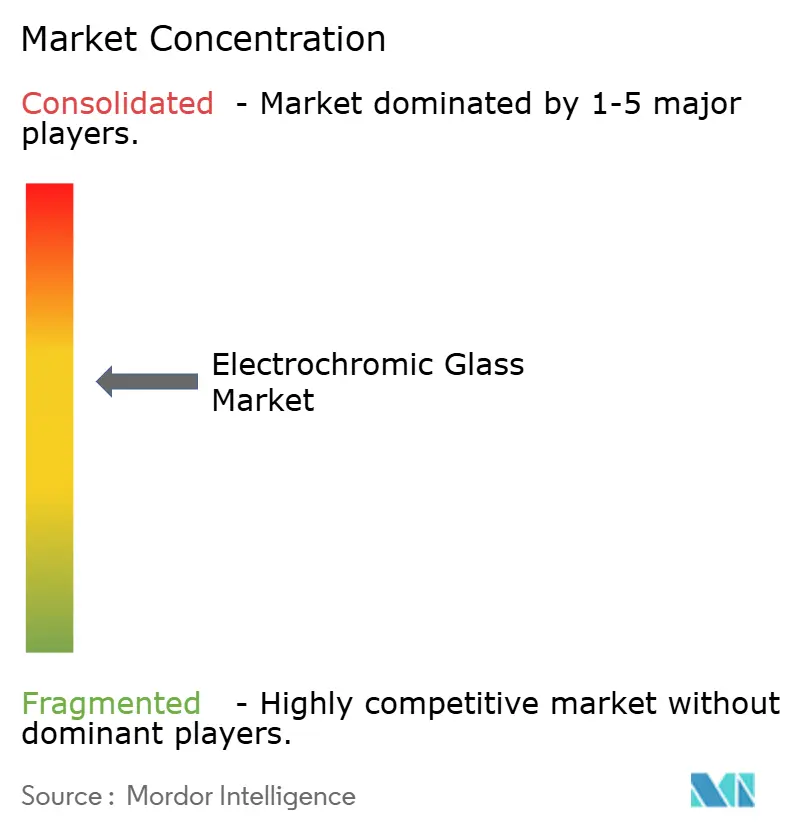
The electrochromic glass market is moderately concentrated, with the top five players including Saint-Gobain, View, Inc., AGC Inc., GENTEX CORPORATION, and ChromoGenics. Their installed base and project experience matter because large glazing programs need engineering, electrical coordination, and long-term service support. Saint-Gobain has continued to update its architectural product offering, including the RealTone launch in 2025. This approach addresses design concerns while retaining glare and thermal-control functions. Architectural suppliers must meet visual expectations alongside energy and controls requirements. Large projects also require confidence in production capacity and technical support. These factors can make established companies attractive for complex installations. Their advantage comes from the ability to deliver a complete system rather than glass alone.
GENTEX CORPORATION expanded its automotive work through its April 2026 cooperation agreement with Antolin for dimmable sun visors. Miru Smart Technologies and Argotec used their 2025 compound-curved sunroof prototype to show progress on larger automotive glazing formats. These moves support an approach built on product integration, vehicle design, and manufacturing feasibility. They also show why automotive suppliers can influence the future direction of the electrochromic glass market. Automotive customers need components that work within tightly managed vehicle programs. Supplier partnerships can combine electrochromic technology with interior integration and original equipment manufacturer relationships. This can reduce the distance between a technical demonstration and a production application. It also increases pressure on companies that have focused only on architectural use.
Film-focused companies compete by addressing retrofit economics and localized installation. ChromoGenics’ first North American order in 2025 and Central Yards award in 2026 demonstrate this approach across residential and mixed-use projects. EControl-Glas GmbH and Co. KG and Smartglass International Limited serve regional customized insulated glass unit requirements. The electrochromic glass market retains opportunities in mid-market commercial buildings, residential retrofit work, and aviation cabin windows. Competition remains based on product reliability, project support, cost, and the ability to meet different format requirements. Customized insulated glass unit providers can compete where local service and tailored specifications matter. Film suppliers can compete where installation flexibility is the primary customer need. The competitive picture is, therefore, shaped by the application as much as by company scale across different project settings.
Electrochromic Glass Industry Leaders
-
Saint-Gobain
-
View, Inc.
-
AGC Inc.
-
GENTEX CORPORATION
-
ChromoGenics
- *Disclaimer: Major Players sorted in no particular order
Electrochromic Glass Market Companies Covered in this Report
- AGC Inc.
- ChromoGenics
- Corning Incorporated
- EControl-Glas GmbH and Co. KG
- GENTEX CORPORATION
- Guardian Glass
- Halio Inc.
- Kinestral Technologies, Inc.
- Nippon Sheet Glass Co., Ltd
- Pleotint LLC
- Polytronix, Inc.
- PPG Industries, Inc.
- RESEARCH FRONTIERS INC.
- Saint-Gobain
- Smartglass International Limited
- View, Inc.
Recent Industry Developments in Electrochromic Glass Market
- June 2026: Saint-Gobain equipped Nashville International Airport’s Concourse D with electrochromic glazing as part of the BNA Vision expansion. The installation demonstrates commercial deployment of dynamic glazing for daylight, glare, and solar-heat control in large public buildings.
- April 2026: GENTEX CORPORATION and Antolin signed a cooperation agreement to develop next-generation dimmable sun visors for European automakers. The collaboration expands electrochromic technology into automotive glazing and shading applications, supporting demand for electrochromic glass in vehicles.
Global Electrochromic Glass Market Report Scope
Electrochromic glass is a smart glazing material that changes its optical properties in response to an applied electrical stimulus. It enables controlled modulation of light transmission and solar radiation while maintaining visibility through the glazing.
The Electrochromic Glass Market is segmented by product type, application, and geography. By product type, the market is segmented into fully glazed, partial glazed, and electrochromic film. By application, the market is segmented into architectural, automotive, aerospace, consumer electronics, marine, and other applications. The report also covers the market size and forecasts for electrochromic glass in 15 countries across major regions. For each segment, the market sizing and forecasts have been done on the basis of value (USD).
Segmentation Overview
| Fully Glazed |
| Partial Glazed |
| Electrochromic Film |
| Architectural |
| Automotive |
| Aerospace |
| Consumer Electronics |
| Marine |
| Other Applications |
| Asia-Pacific | China |
| India | |
| Japan | |
| South Korea | |
| ASEAN Countries | |
| Rest of Asia-Pacific | |
| North America | United States |
| Canada | |
| Mexico | |
| Europe | Germany |
| United Kingdom | |
| France | |
| Italy | |
| NORDIC Countries | |
| Rest of Europe | |
| South America | Brazil |
| Argentina | |
| Rest of South America | |
| Middle East and Africa | Saudi Arabia |
| South Africa | |
| Rest of Middle East and Africa |
| By Product Type | Fully Glazed | |
| Partial Glazed | ||
| Electrochromic Film | ||
| By Application | Architectural | |
| Automotive | ||
| Aerospace | ||
| Consumer Electronics | ||
| Marine | ||
| Other Applications | ||
| By Geography | Asia-Pacific | China |
| India | ||
| Japan | ||
| South Korea | ||
| ASEAN Countries | ||
| Rest of Asia-Pacific | ||
| North America | United States | |
| Canada | ||
| Mexico | ||
| Europe | Germany | |
| United Kingdom | ||
| France | ||
| Italy | ||
| NORDIC Countries | ||
| Rest of Europe | ||
| South America | Brazil | |
| Argentina | ||
| Rest of South America | ||
| Middle East and Africa | Saudi Arabia | |
| South Africa | ||
| Rest of Middle East and Africa | ||
Key Questions Answered in the Report
What is the size of the electrochromic glass market?
The electrochromic glass market stands at USD 2.32 billion in 2026 and is projected to reach USD 3.52 billion by 2031.
What is driving demand for electrochromic glass?
Building energy codes, zero-emission building requirements, retrofit activity, building automation, and automotive glazing demand support adoption.
Which product type led the market share in 2025?
Fully glazed held 46.05% of the market share in 2025.
Which application is expected to grow fastest through 2031?
Automotive is projected to advance at a 9.84% CAGR through 2031, supported by dimmable sunroof and sun visor development.