
Electrical And Electronic Test Equipment Market Size and Share
Market Overview
| Study Period | 2020 - 2031 |
|---|---|
| Market Size (2026) | USD 16.31 Billion |
| Market Size (2031) | USD 19.95 Billion |
| Growth Rate (2026 - 2031) | 4.12 % |
| Fastest Growing Market | Asia Pacific |
| Largest Market | Asia Pacific |
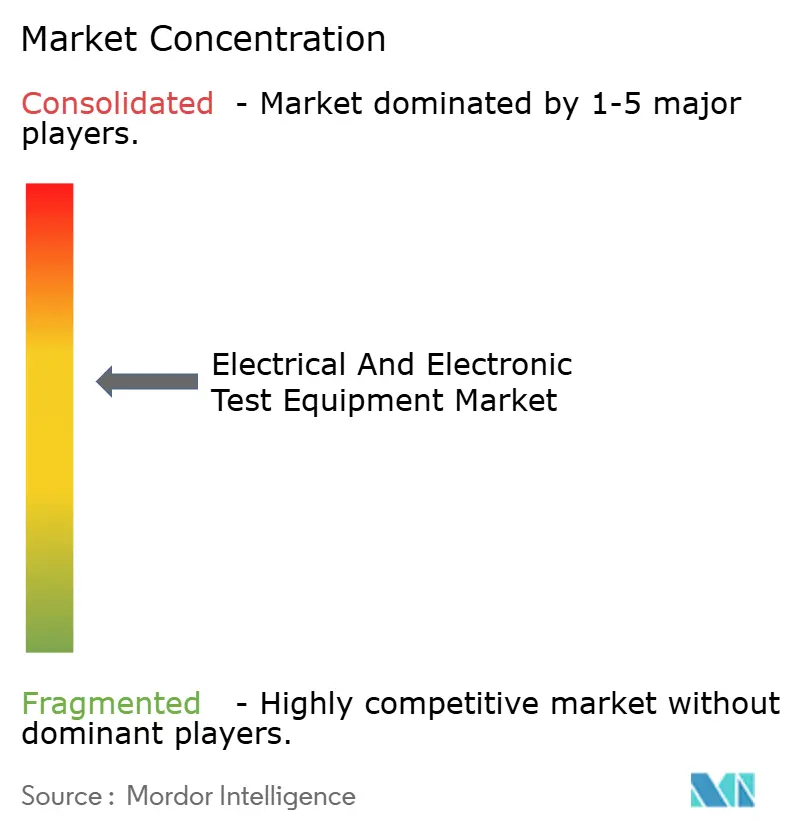
| Market Concentration | Medium |
Major Players *Disclaimer: Major Players sorted in no particular order Image © Mordor Intelligence. Reuse requires attribution under CC BY 4.0. | |
Electrical And Electronic Test Equipment Market Analysis by Mordor Intelligence
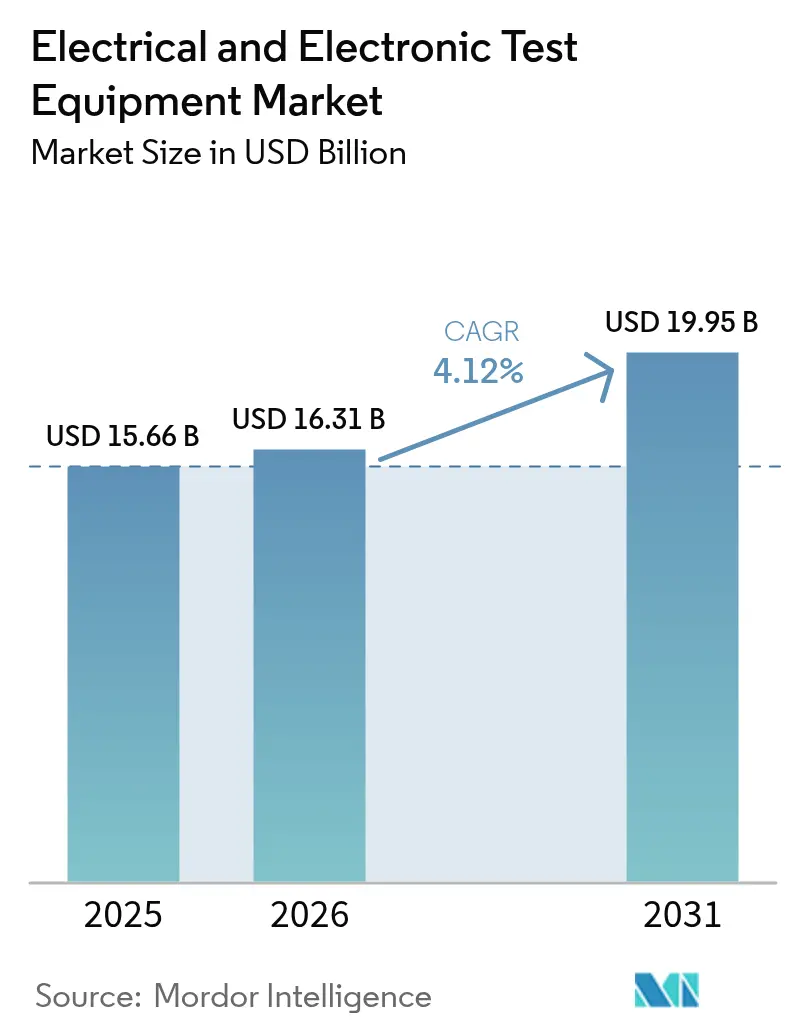
The electrical and electronic test equipment market size is expected to grow from USD 15.66 billion in 2025 to USD 16.31 billion in 2026 and is forecast to reach USD 19.95 billion by 2031 at 4.12% CAGR over 2026-2031. This steady rise mirrors the growing complexity of telecommunications, automotive electrification, advanced semiconductor production and tightening IoT security rules. Demand grows as 5G millimeter-wave rollouts, 800 V electric-vehicle platforms and 3 nm chip architectures stretch legacy measurement limits. Adoption of AI-assisted automation, software-defined instruments and modular PXI systems is widening access to sophisticated capabilities while helping users mitigate supply-chain delays and component cost inflation. At the same time, competitive pressure from cost-focused Asian vendors is reshaping procurement strategies, and rental models are gaining traction among customers facing large capital outlays. These parallel trends maintain forward momentum for the electrical and electronic test equipment market despite periodic headwinds from component shortages and geopolitical disruptions.
Key Report Takeaways
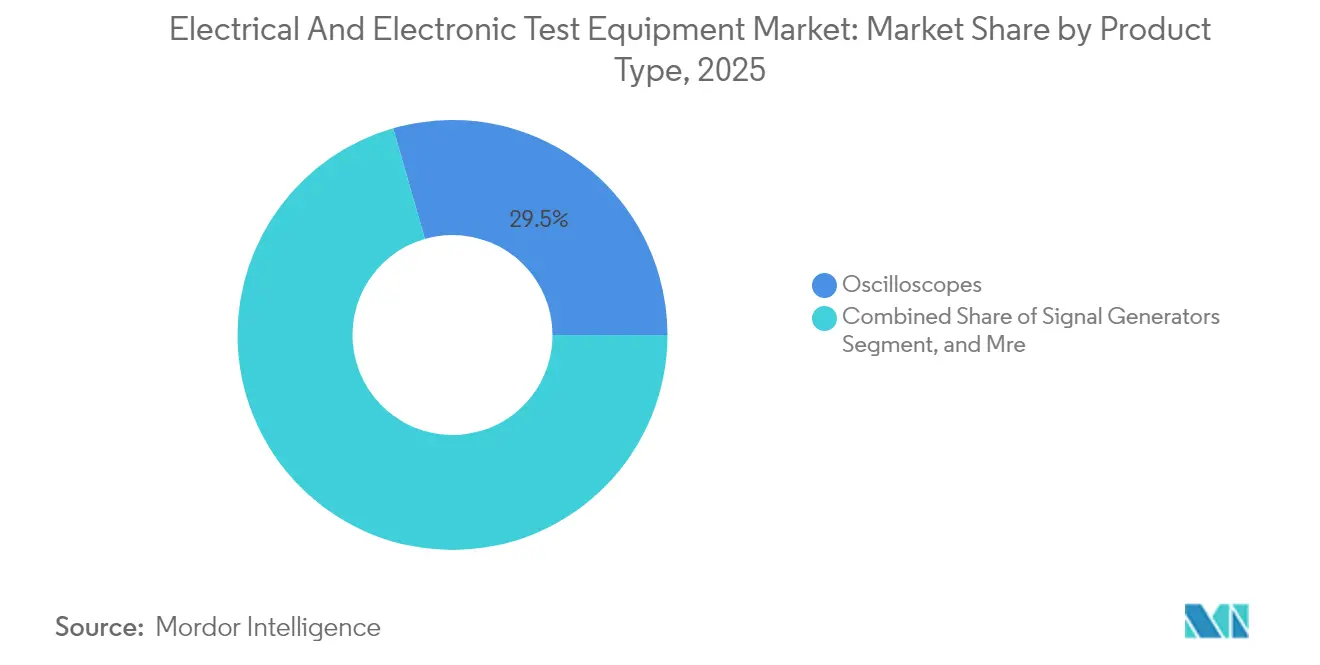
- By product type, oscilloscopes led with 29.45% of the electrical and electronic test equipment market share in 2025, whereas RF and microwave gear is projected to grow the fastest at a 4.63% CAGR to 2031.
- By form factor, benchtop platforms held 47.12% share of the electrical and electronic test equipment market size in 2025, while PXI systems show the highest projected CAGR at 5.02% through 2031.
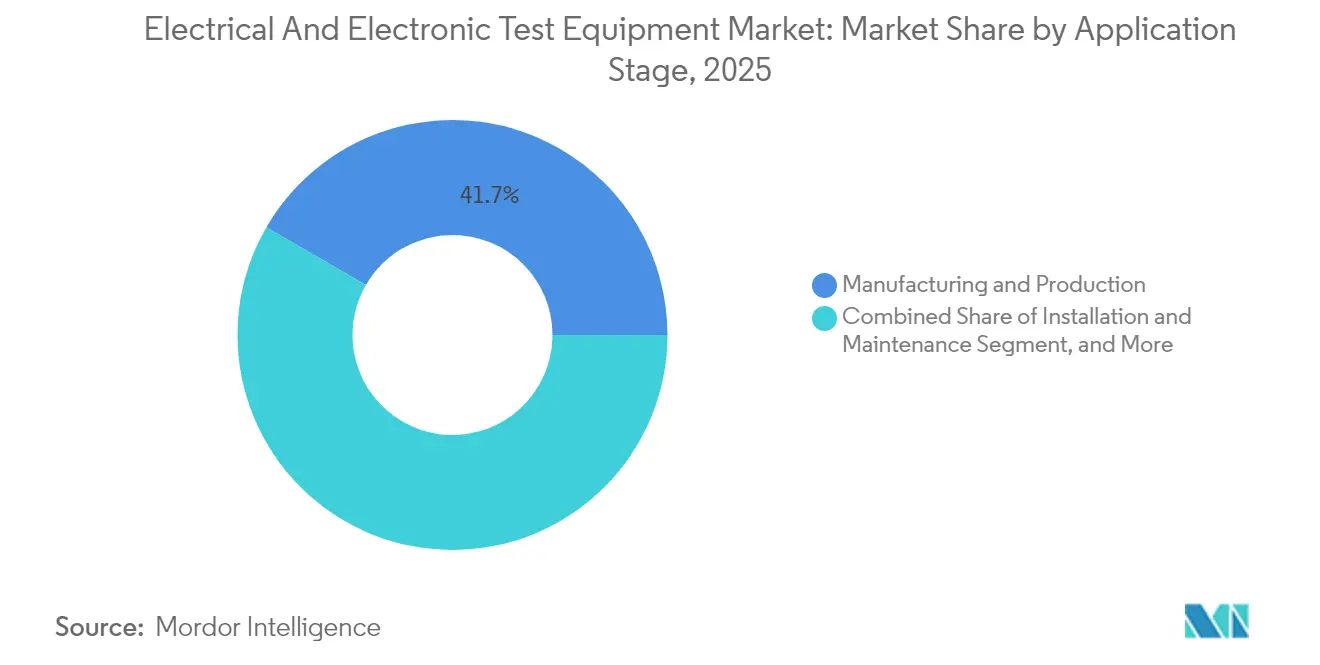
- By application stage, manufacturing and production captured 41.65% share of the electrical and electronic test equipment market size in 2025; certification and compliance testing is advancing at a 4.91% CAGR over 2026-2031.
- By end-user industry, communications and networking commanded 32.24% share in 2025 in the electrical and electronic test equipment market, but automotive and electric-vehicle applications record the highest forecast CAGR at 4.79% to 2031.
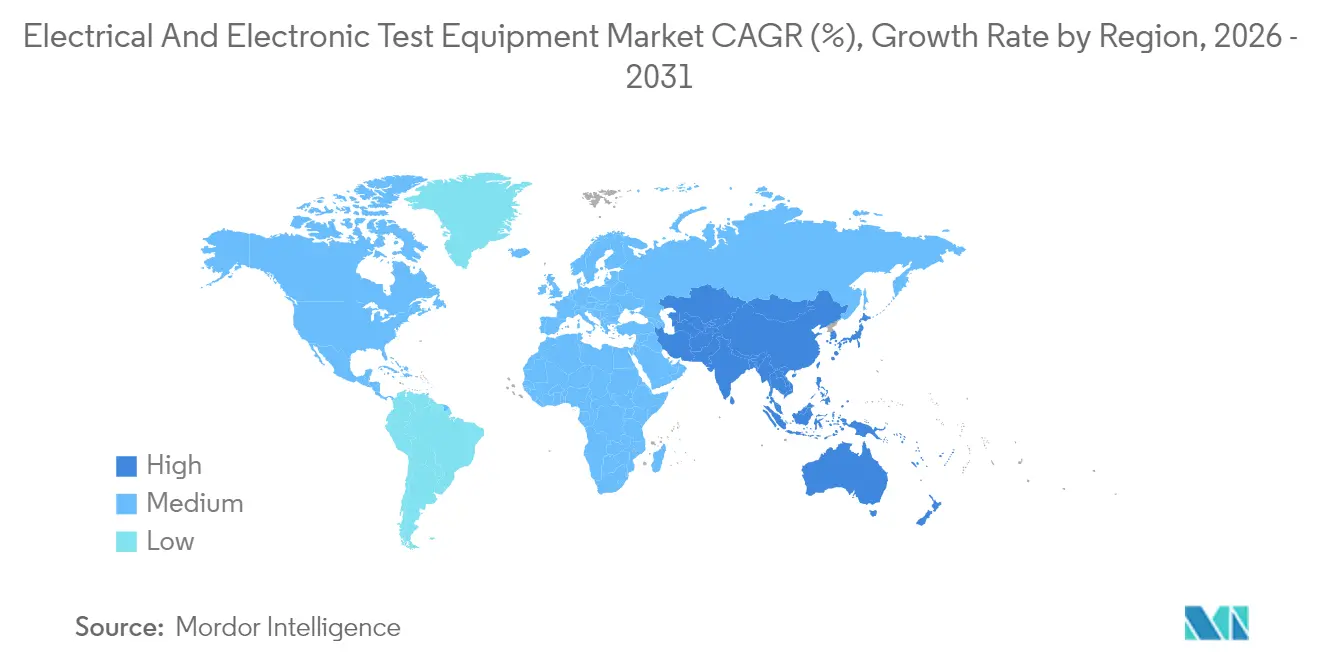
- By geography, Asia Pacific led with 39.68% revenue share in 2025 of the electrical and electronic test equipment market, whereas Asia-Pacific is forecast to post a 5.22% CAGR and become the fastest-growing region by 2031.
Note: Market size and forecast figures in this report are generated using Mordor Intelligence’s proprietary estimation framework, updated with the latest available data and insights as of 2026.
Market Trends and Insights
Drivers Impact Analysis of Electrical And Electronic Test Equipment Market*
| Driver | (~) % Impact on CAGR Forecast | Geographic Relevance | Impact Timeline |
|---|---|---|---|
| 5G and Advanced Wireless Deployment Wave | +1.2% | Global, with early gains in North America, Europe, Asia Pacific | Medium term (2-4 years) |
| Advanced-Node Semiconductor Complexity | +0.9% | Global, concentrated in Taiwan, South Korea, United States | Long term (≥ 4 years) |
| EV and Power-Electronics Test Needs | +0.8% | Global, with acceleration in Europe, China, North America | Medium term (2-4 years) |
| AI/ML-Assisted Automated Testing | +0.6% | North America and EU, spill-over to APAC core | Long term (≥ 4 years) |
| Ultra-Wide-Bandgap Device Characterization | +0.4% | North America, Europe, Japan | Long term (≥ 4 years) |
| IoT Cyber-Security Compliance Mandates | +0.3% | Global, with regulatory leadership in EU, UK | Short term (≤ 2 years) |
| Source: Mordor Intelligence | |||


5G and Advanced Wireless Deployment Wave
Global 5G infrastructure expansion is driving unprecedented demand for millimeter-wave and sub-6 GHz analyzers, generators and over-the-air chambers. Operators need to validate beamforming, carrier aggregation and satellite backhaul performance across increasingly crowded spectrum allocations.[1]Rohde & Schwarz, “ATS800R Compact Antenna Test Range,” rohde-schwarz.com Equipment must now simulate Doppler effects, GNSS timing and non-terrestrial network latency, tasks that conventional terrestrial RF sets cannot handle. Vendors are launching compact CATR ranges that shrink required floor space while retaining quiet-zone fidelity, a key need for consumer-device makers. Demand also flows from private-network deployments in manufacturing plants and logistics hubs, where spectral coexistence and ultra-reliability place fresh verification burdens on test labs. These factors collectively sustain momentum for the electrical and electronic test equipment market as wireless standards evolve toward 5G-Advanced and early 6G research.
Advanced-Node Semiconductor Complexity
Fabricating 3 nm and finer nodes multiplies test vectors as chipmakers adopt multi-die packaging and chiplet architectures. Industry association SEMI forecasts USD 6.7 billion in semiconductor test-equipment sales for 2024, with a 30.3% lift expected in 2025 as device complexity rises.[2]SEMI, “Global Semiconductor Equipment Sales Forecast,” semi.org Teradyne and partners now probe both sides of silicon-photonics wafers in one pass, slashing cycle times for co-packaged optics. High-bandwidth memory stacks, AI accelerators and on-package transceivers require tight thermal control and multi-gigabit interface coverage, pushing legacy ATE beyond its limits. Probe-card vendors FormFactor and Technoprobe have gained strategic investment from Advantest to secure next-gen contactor supply. The rising capital spend underpins long-term growth for the electrical and electronic test equipment market by widening addressable workloads.
EV and Power-Electronics Test Needs
Electric-vehicle adoption accelerates demand for bidirectional sources and regenerative loads that handle 800 V architectures, silicon-carbide inverters, and grid-tied chargers. National Instruments offers scalable systems up to 2.4 MW with 95% energy efficiency for battery-pack and powertrain validation.[3]National Instruments, “High-Power EV Test Platforms,” ni.com Tektronix highlights probing challenges at 100 kHz switching frequencies, where parasitics distort loss measurements. Vehicle-to-grid integration and wireless transfer introduce compliance checkpoints for EMC, safety, and grid codes, widening the test envelope. Chroma ATE covers the full EV chain from battery emulators to propulsion dynos, illustrating the breadth of opportunities for the electrical and electronic test equipment market. Growth remains robust as automakers scale volume production of electrified platforms worldwide.
AI/ML-Assisted Automated Testing
Machine-learning algorithms are turning instruments into predictive systems that cut cycle times and flag anomalies before yield losses occur. Vendors embed AI routines that auto-calibrate setups, optimize test sequences and schedule proactive maintenance, extending asset life while lowering total cost of ownership. Software-defined architectures pool data from oscilloscopes, sources and analyzers to feed neural networks that learn optimal parameter windows. Early adopters report double-digit test-time reductions, a persuasive benefit as factories chase higher throughput for high-mix electronics. The shift requires robust compute back-ends and secure data pipelines, prompting alliances between instrument makers and cloud-AI providers. These developments elevate the electrical and electronic test equipment market by adding software value streams atop traditional hardware revenues.
Restraints Impact Analysis of Electrical And Electronic Test Equipment Market*
| Restraint | (~) % Impact on CAGR Forecast | Geographic Relevance | Impact Timeline |
|---|---|---|---|
| High Capital Cost and Shift to Rentals | -0.7% | Global, with acute impact in cost-sensitive markets | Short term (≤ 2 years) |
| Low-Cost Asian Vendor Price Pressure | -0.5% | Global, with concentration in price-sensitive segments | Medium term (2-4 years) |
| Precision-Component Supply Shortages | -0.3% | Global, with severe impact in North America and Europe | Short term (≤ 2 years) |
| Right-to-Repair Curtailing Proprietary Protocols | -0.2% | North America and EU, regulatory spill-over to APAC | Medium term (2-4 years) |
| Source: Mordor Intelligence | |||
High Capital Cost and Shift to Rentals
Flagship 5G or semiconductor ATE platforms can exceed USD 1 million apiece, straining capex budgets. Customers increasingly choose rental or subscription models; Electro Rent maintains USD 1.2 billion of inventory to meet these needs. The U.S. Equipment Leasing and Finance Association projects that 54% of equipment acquisitions will be financed in 2024 and expects Equipment-as-a-Service to grow 50% CAGR through 2030. While recurring revenue benefits vendors long term, near-term hardware sales flatten, tempering overall expansion of the electrical and electronic test equipment market.
Low-Cost Asian Vendor Price Pressure
Brands such as GW Instek and Rigol Technologies offer oscilloscopes, spectrum analyzers and DC supplies at price points well below incumbent rivals, leveraging high-volume component sourcing and localized production. With component obsolescence cycles now as short as two years, agile redesign and fast tool changeovers give emerging suppliers a foothold. This pressure erodes average selling prices in entry-level segments, subtly diluting revenue growth for the electrical and electronic test equipment market even as unit demand holds firm.
*Our forecasts treat driver/restraint impacts as directional, not additive. The impact forecasts reflect baseline growth, mix effects, and variable interactions.
Electrical And Electronic Test Equipment Market Segment Analysis
By Product Type:
RF Equipment Drives InnovationThe electrical and electronic test equipment market size for oscilloscopes stood at USD 4.61 billion in 2025, translating to a dominant 29.45% slice of total revenue. Oscilloscopes remain indispensable across R&D, validation, and troubleshooting, yet bandwidth ceilings and protocol-decode depth are now differentiators as designs push beyond 70 GHz. RF and microwave instruments are expanding at a 4.63% CAGR thanks to 5G non-terrestrial networks, satellite IoT, and automotive radar. Spectrum analyzers with real-time triggers and signal generators capable of 2 GHz modulation bandwidth are moving from lab to field use. Portable vector-network analyzers such as the 40 GHz USB-powered VNA400 are proof that miniaturization no longer compromises performance.
Semiconductor ATE faces cyclical buying tied to fab expansions but benefits from chiplet architectures that raise pin counts and drive multisite test. Environmental-stress chambers and electrical-safety testers are getting a lift from stricter IEC and UL updates, especially in battery-powered consumer devices. Optical-electrical convergence is spawning hybrid testers that measure insertion loss, eye diagrams, and RF impairments in a single workflow, meeting data-center demand for co-packaged optics. Overall, product diversification underpins revenue stability for the electrical and electronic test equipment market despite pockets of volatility.


By Form Factor:
Modular Systems Gain MomentumBenchtop platforms deliver benchmark accuracy, intuitive front panels and robust input protection, securing 47.12% of 2025 revenue. They dominate early-stage design and university labs, where flexibility outranks rack density. Modular PXI systems, however, are climbing fastest with a 5.02% CAGR as users favor synchronized, software-defined channels for parallel test. The electrical and electronic test equipment market size attributed to PXI setups is forecast to exceed USD 5.18 billion by 2031 as factories digitize quality stations and shorten changeover cycles.
NI counts more than 600 PXI modules under its brand and 1,500 across the broader ecosystem, giving engineers a Lego-like palette of RF, mixed-signal, and power cards. ADLINK extends reach into mass-production lines with PXI-based parametric testers that rival proprietary rack systems on throughput. Handheld analyzers fill gap-filling tasks in field service, renewable-energy farms, and telecom tower audits, now featuring cloud dashboards for instant report generation. This convergence of form factors sustains healthy competition inside the electrical and electronic test equipment market.
By Application Stage:
Compliance Testing AcceleratesManufacturing and production stations represented 41.65% of 2025 spending, supported by rising automation and inline analytics that curb rework costs. Certification and compliance test outpaces other stages at a projected 4.91% CAGR, a result of new cybersecurity clauses in EU radio regulations and evolving EMC limits for high-power chargers. Test houses broaden scope beyond traditional electrical parameters to include code analysis and over-the-air performance, increasing equipment turnover.
Design and R&D remains the creativity engine for the electrical and electronic test equipment market, accounting for roughly one quarter of annual sales. Toolchains that link simulation with live measurement, sometimes called “model-based test”, deliver tighter design loops and spur upgrades to higher-bandwidth scopes and logic analyzers. Installation and maintenance demand is rebounding with 5G small-cell densification and solar-farm scale-out, fueling purchases of compact spectrum scopes, I-V curve tracers and fiber inspection probes.
By End-User Industry:
Automotive Transformation LeadsCommunications networks still top the buyer list with 32.24% of expenditures in 2025, covering macro-base-station rollout, data-center backbone upgrades and satellite ground-segment expansion. Yet automotive and electric-vehicle makers will post a 4.79% CAGR through 2031, reflecting rising sensor fusion, EV drivetrain validation and embedded cybersecurity audits. The electrical and electronic test equipment market finds new ground in battery test rigs, LiDAR calibration benches and functional safety verification across zonal architectures.
Semiconductor foundries and outsourced assembly-test providers remain heavy investors as AI accelerators, high-bandwidth memory and advanced packaging raise defect-detection benchmarks. Aerospace and defense budgets are climbing for electronic-warfare, phased-array radar and space-payload test. Industrial automation and smart-grid upgrades require power analyzers and protocol gateways able to coexist with legacy SCADA fields, spreading demand beyond electronics OEMs into process-industry players.
Geography Analysis
North America Electrical and Electronic Test Equipment Market
North America generated significant share on the back of defense R&D, fab expansions in Arizona and 5G C-band build-outs. Federal incentives and accredited calibration labs sustain a mature ecosystem that values traceability and rapid service. Canadian telecom carriers and electric-vehicle startups add incremental demand for compliance services.
APAC Electrical and Electronic Test Equipment Market
Asia-Pacific is on track for a 5.22% CAGR and will likely approach parity with North America by 2031. China’s push for indigenous semiconductors, Taiwan’s leadership in advanced nodes and South Korean investments in memory assist volume growth. Southeast Asian nations provide a manufacturing off-load valve, creating greenfield opportunities for mid-range oscilloscopes and PXI racks. Indian telcos embracing Open RAN and Japanese automakers validating solid-state batteries add diverse revenue streams to the electrical and electronic test equipment market.
EMEA and South America Electrical and Electronic Test Equipment Market
Europe shows moderate but stable growth as automotive electrification, renewable-energy targets, and digital-sovereignty initiatives keep capex flowing. Germany and France host significant calibration and rental operations, while Nordic nations pioneer 5G advanced field trials. Eastern European EMS providers attract near-shoring contracts, bolstering demand for entry-level but network-connected instruments. South America and the Middle East and Africa remain nascent yet promising, with mining automation, utility-scale solar, and airport upgrades enabling first-time installations of modular test benches.

Regulatory Landscape
Regulation affects both the certification workflow and the cost base for test equipment users. In the United States, the FCCs equipment authorization program has moved further toward security and reciprocity controls, including actions in 2026 that prioritize Trusted Test Labs and tighten scrutiny of telecommunications certification bodies and measurement facilities. The FCC also advanced proposals to cease recognition of test labs and certification bodies in countries without Mutual Recognition Agreements (MRAs) or reciprocal trade agreements, which raises compliance risk for global device makers that rely on cross-border lab networks.
Trade and industrial policy also shapes procurement decisions for semiconductor and electronics production test. A 25% ad valorem Section 232 tariff covering semiconductors and semiconductor manufacturing equipment took effect in January 2026, increasing landed-cost uncertainty for certain advanced-node and ATE-adjacent toolchains and reinforcing the need for careful classification and sourcing strategies. In parallel, MRAs referenced by NIST remain a practical enabler for cross-border conformity assessment where they apply, influencing where OEMs locate lab capacity to support time-to-market.
Value Chain Analysis
The value chain starts with specialist component inputs, including high-speed ADC/DACs, RF front ends, FPGAs/CPUs/GPUs, precision clocks, power semiconductors, and calibration-grade passives. It then moves through instrument design (hardware platforms and embedded firmware), software stacks (automation, analytics, protocol and compliance applications), and system integration, followed by manufacturing and calibration. Distribution runs through direct sales, channel partners, and rental fleets. Post-sale services, including ISO 17025-aligned calibration, repair, firmware updates, and application engineering, are a differentiator, especially for high-mix manufacturing and compliance labs that depend on traceability and rapid turnaround.
Bottlenecks cluster around advanced compute and control components and test interfaces used in semiconductor and high-speed digital validation, where lead-time volatility has been reported for items such as FPGAs and driver ICs. Vendors and ecosystem partners have responded by shifting toward modular and software-defined architectures to reduce redesign friction and improve reuse across programs. Examples of value-chain evolution include Teradynes Omnyx launch in March 2026 for AI and data center PCBA/sub-assembly testing, linking hardware automation with software workflows, as well as the continued move toward parallel test and embedded testability approaches for advanced packaging and 3D ICs.
Competitive Landscape
The electrical and electronic test equipment industry features moderate consolidation, with top vendors expanding portfolios through acquisition and partnerships. Keysight’s USD 1.46 billion purchase of Spirent broadens its automated cloud and SD-WAN test-suite reach. Anritsu’s plan to acquire DEWETRON adds high-precision power analysis for EV propulsion systems. These moves exemplify a shift toward end-to-end platforms that blend hardware, software and managed services, creating switching costs that lock in customers.
Smaller specialists thrive in niches such as quantum-computer qubit readout, high-speed coherent optics and EMC rental fleets. Partnerships like Teradyne’s team-up with Infineon on wide-bandgap power devices illustrate how OEMs and equipment makers co-innovate when single-party solutions fall short. Cost-competitive challengers from Taiwan and mainland China keep entry-level price points low, encouraging incumbents to migrate value toward analytics and AI-powered automation.
Service infrastructure is another battleground; calibration chain Trescal added 15 facilities across five continents during 2024. Vendors now bundle remote-monitor dashboards, predictive-maintenance alerts and cloud-based firmware updates, turning instrumentation into connected assets. Compliance with ISO 17025, ANSI Z540.3 and IEC-60529 remains a barrier to new entrants, favoring incumbents with accredited, multi-country labs.
Electrical And Electronic Test Equipment Industry Leaders
Fortive Corporation
Keysight Technologies Inc.
Rohde & Schwarz GmbH & Co. KG
National Instruments Corporation
Anritsu Corporation
- *Disclaimer: Major Players sorted in no particular order
Electrical And Electronic Test Equipment Market Companies Covered in this Report
- Keysight Technologies Inc.
- Rohde and Schwarz GmbH and Co. KG
- Fortive Corporation (Fluke, Tektronix)
- National Instruments Corporation (NI)
- Anritsu Corporation
- Teledyne LeCroy Inc.
- Yokogawa Test and Measurement Corporation
- Teradyne Inc.
- Advantest Corporation
- Chauvin Arnoux Group
- VIAVI Solutions Inc.
- EXFO Inc.
- BandK Precision Corporation
- Rigol Technologies Co., Ltd.
- GW Instek (Good Will Instrument Co., Ltd.)
- Hioki E.E. Corporation
- Chroma ATE Inc.
- Cobham Advanced Electronic Solutions
- Spectrum Instrumentation GmbH
- Signal Hound Inc.
- Pico Technology Ltd.
- Microchip Technology Inc. (Microsemi Timing Systems)

Market Opportunities and Future Outlook
A prominent whitespace sits at the intersection of AI data-center hardware, advanced packaging, and test throughput, where higher machine-hours per unit and tighter signal-integrity margins lift the value of parallel, automated test. Teradynes March 2026 Omnyx platform targets manufacturing test for high-performance AI and data center printed circuit board assemblies, highlighting demand for integrated board and sub-assembly test systems that reduce debug loops and speed root-cause isolation. Upstream investment in interfaces also supports this opportunity: FormFactor began a USD 140-170 million probe-card manufacturing facility build in Farmers Branch, Texas (supported by a Texas Semiconductor Innovation Fund grant), expanding capacity for advanced-node contactor and interface supply that underpins both ATE utilization and cycle-time control.
Another opportunity area is software-defined, AI-assisted instrument workflows that lower the expertise barrier and broaden the pool of addressable users beyond specialist labs. Liquid Instruments launched GenInst Studio in July 2026 to generate custom test instruments on reconfigurable Moku hardware without requiring FPGA expertise. Anritsu launched the Tensor Vector Network Analyzer at IMS 2026 with integrated intelligence and a source-per-port architecture for high-frequency needs. In the compliance funnel, May 2026 FCC equipment-authorization actions that prioritize Trusted Test Labs and advance reciprocity-based recognition tighten requirements for connected devices, supporting demand for accredited test capacity and for instruments aligned to security-conscious certification workflows.
Recent Industry Developments in Electrical And Electronic Test Equipment Market
- July 2026: Keysight announced APS-ONE-400, a modular 4x100GE network application and cybersecurity test platform. The system targets high-throughput validation for modern networks that combine performance testing with security assurance, reinforcing the shift from standalone instruments toward integrated platforms in communications and data-center test labs.
- June 2026: Keysight introduced Pro XA6 SA6320A and Expert XA5 SA6210A signal analyzers aimed at accelerating wideband wireless, radar, and 5G/WLAN design validation. The launch expands capability for high-bandwidth RF troubleshooting and compliance work, supporting lab and manufacturing users dealing with increasingly complex spectrum environments.
- April 2025: Anritsu agreed to acquire DEWETRON to expand precision power-measurement solutions for EV and renewable-energy applications. The deal broadens Anritsus power and DAQ portfolio for high-voltage, high-efficiency electrification test use cases, strengthening its position in power-electronics validation workflows.


Electrical And Electronic Test Equipment Market Report Scope and Research Methodology
Market Definition and Coverage
This market covers revenue earned from selling electrical and electronic test and measurement instruments used to verify, measure, and troubleshoot components, boards, systems, and networks across industrial and electronics workflows, including lab, production, and field use.
Scope exclusions: We exclude testing services and certification activity, along with software-only tools that are not bundled as part of test equipment sales.
Segments Covered in This Report
- By Product Type
- Oscilloscopes
- Spectrum and Network Analyzers
- Signal Generators
- Semiconductor Automatic Test Equipment (ATE)
- RF and Microwave Test Equipment
- Data Acquisition (DAQ) Systems
- Electrical and Environmental Safety Test
- By Form Factor
- Benchtop
- Portable / Hand-held
- Modular / PXI / PC-based
- By Application Stage
- Design and R&D
- Manufacturing and Production
- Installation and Maintenance
- Certification and Compliance
- By End-user Industry
- Communications and Networking
- Semiconductors and Computing
- Automotive and Electric Vehicles
- Aerospace and Defense
- Consumer Electronics and Appliances
- Industrial and Energy
- Healthcare and Life Sciences
- Other End-user Industries
- By Geography
- North America
- United States
- Canada
- Mexico
- South America
- Brazil
- Argentina
- Chile
- Rest of South America
- Europe
- Germany
- United Kingdom
- France
- Italy
- Netherlands
- Rest of Europe
- Asia-Pacific
- China
- India
- Japan
- South Korea
- Rest of Asia-Pacific
- Middle East and Africa
- Middle East
- Saudi Arabia
- United Arab Emirates
- Turkey
- Rest of Middle East
- Africa
- South Africa
- Nigeria
- Rest of Africa
- Middle East
- North America
Data Sources, Market Sizing, and Validation
Desk Research
Desk work starts with mapping where demand comes from and how test equipment is typically bought, rented, and refreshed. To keep assumptions tied to observable signals, we rely on public sources such as US Census Bureau manufacturing and trade releases, USITC tariff and import statistics, OECD industrial production series, IEEE and other peer-reviewed journals for technology shifts, and standards references from bodies such as IEC and ISO.
We also review public company filings, earnings decks, and product literature to understand pricing ladders, replacement cycles, and where new instrument categories are gaining share. For cross-checks, we use paid subscriptions focused on company financials and intelligence, plus patent databases to see which measurement functions are being prioritized and commercialized. These desk inputs are not exhaustive, and many other public sources were used for data collection, validation, and clarification during the study.
Primary Interviews and Surveys
Primary work is used to confirm what the desk signals cannot fully explain, especially around how much demand is driven by new production versus maintenance and calibration, and how budgets shift across test categories. We speak with equipment makers, channel partners, labs, manufacturing users, and engineering teams across APAC, EMEA, and the Americas, so assumptions like utilization, refresh timing, and average selling price movement can be corrected before finalizing totals.
Distribution of primary research fieldwork respondents
| Company type | Respondent position | Region |
|---|---|---|
| Top tier: 33% | CXOs: 15% | APAC: 41% |
| Mid tier: 49% | Functional/Unit leaders: 33% | EMEA: 33% |
| Smaller Players: 18% | Managers: 52% | Americas: 26% |
Market-Sizing & Forecasting
Market sizing is built with a top-down approach where electronics output, telecom and data network buildouts, and industrial capex signals are used to reconstruct the demand pool for test equipment, and then translated into revenue through category-level price and mix assumptions. Once the demand pool is assembled, we corroborate it with selective bottom-up approximations, such as sampling unit volumes and typical ASP bands for key instrument families, and checking channel feedback on ordering patterns.
Inputs used in the model include semiconductor equipment and electronics production trends, telecom rollout intensity (including 5G-related testing needs), EV and charging infrastructure expansion as a proxy for power and safety testing, aerospace and defense procurement cycles, and the shift toward modular and software-defined instruments that can change replacement behavior. Where a data gap exists for smaller end users or fragmented channels, reasonable proxy ratios are applied and then adjusted through interview feedback so the totals align with observed purchasing behavior.
For forecasting, scenario analysis is used around major demand drivers like semiconductor cycle strength, telecom investment pace, and industrial automation spending. Those scenarios are then converted into yearly growth paths with inputs validated by domain experts. The output remains traceable to a few clear variables so we can explain why each year moves up or down.
Data Validation & Update Cycle
Validation is done through multiple checks so the final number is not driven by a single assumption. We compare modeled revenue against independent signals like electronics manufacturing momentum, trade flow direction, and stated order commentary from public filings, and then we review outliers such as sudden ASP jumps or unrealistic unit growth before sign-off.
A second analyst review is completed to confirm formulas, currency handling, and year alignment. Re-contacts are triggered when interview inputs conflict with desk indicators by a material margin. Reports are refreshed annually, and interim updates are made when major events meaningfully change demand, after which a fresh pass is completed before delivery so clients receive the latest updated view.
Mordor Intelligence's Electrical and Electronic Test Equipment Market Size Versus Other Published Estimates
Published market values for electrical and electronic test equipment can vary even when the topic label looks the same, because each publisher chooses its own product scope, year anchoring, and pricing logic. Differences also show up when one study leans more on supply-side rollups and another leans more on end-market demand signals.
The main gap comes from whether broader electrical maintenance instruments and service-related testing activity are folded into the total, where Mordor Intelligence counts only equipment sales across defined test categories and then aligns growth to electronics output, telecom rollout, and EV-related measurement needs that can be independently checked.
Benchmark comparison
| Source | Market Size | Gaps in Research Methodology |
|---|---|---|
| Mordor Intelligence | USD 16.31 B (2026) | |
| Industry Publisher A | USD 18.61 B (2025) | Uses a differently named market that leans toward general electrical test equipment, and the year anchoring and category set appear broader. This can pull in adjacent handheld maintenance tools and inflate the total versus a tighter electronics and production-test scope. |
| Global Publisher B | USD 8.20 B (2025) | Focuses more on electrical commissioning and safety verification use cases, which can exclude higher value electronic production and RF test equipment. This leads to a lower total even if the forecast growth rate is higher. |
The comparison shows that scope choices and the way price and demand are linked to real activity levels explain most of the spread. By keeping inclusion rules tied to equipment revenue and validating the main demand pools with simple external indicators, we can present a balanced number that is easier to replicate and audit.


Key Questions Answered in the Report
How large is the electrical and electronic test equipment market in 2026?
The electrical and electronic test equipment market size stands at USD 16.31 billion in 2026.
What is the expected growth rate through 2031?
The market is forecast to expand at a 4.12% CAGR, reaching USD 19.95 billion by 2031.
Which product segment shows the fastest growth?
RF and microwave test equipment is projected to grow at 4.63% CAGR through 2031 due to 5G, satellite and radar demand.
Why is Asia-Pacific considered the growth engine?
Manufacturing capacity expansions, regional semiconductor investments and supportive government initiatives together drive a 5.22% CAGR in Asia-Pacific.
How are rental models affecting equipment vendors?
Rising rental and subscription adoption smooths long-term revenues but can dampen near-term hardware sales, trimming approximately 0.7% from forecast CAGR.
Page last updated on:


 Your data is secure and never sold or shared.


