
Electric Vehicle Adhesives Market Size and Share
Market Overview
| Study Period | 2021 - 2031 |
|---|---|
| Market Size (2026) | USD 3.12 Billion |
| Market Size (2031) | USD 7.34 Billion |
| Growth Rate (2026 - 2031) | 18.67 % |
| Fastest Growing Market | Asia-Pacific |
| Largest Market | Asia-Pacific |
| Market Concentration | Low |
Major Players *Disclaimer: Major Players sorted in no particular order Image © Mordor Intelligence. Reuse requires attribution under CC BY 4.0. | |
Electric Vehicle Adhesives Market Analysis by Mordor Intelligence
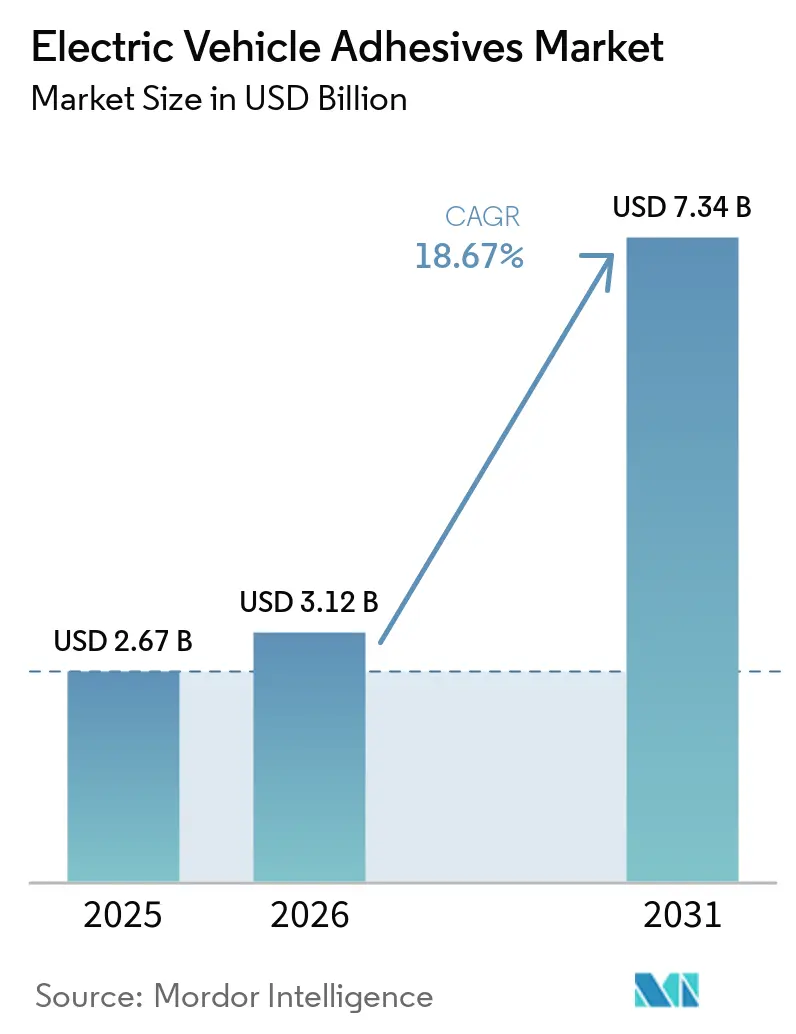
The electric vehicle adhesives market size was valued at USD 2.67 billion in 2025 and is estimated to grow from USD 3.12 billion in 2026 to USD 7.34 billion by 2031, at a CAGR of 18.67% during the forecast period (2026-2031). Growth is tied to battery designs that shift structural, thermal, and safety functions into the adhesive layer, rather than relying on additional module structures to perform those functions. Cell-to-pack and cell-to-chassis designs eliminate the module layer, requiring materials that perform under thermal, mechanical, and crash-load conditions while maintaining stable bonds during normal vehicle use. A 2026 study found that structural adhesives for cell-to-chassis applications require lap shear strength above 20 MPa on aluminum and bond integrity from -40°C to +80°C, which favors specialty formulations over standard sealants and limits the role of products designed only for basic sealing. Expanding battery production lines also increases the value of local dispensing support, viscosity control, just-in-sequence delivery, and technical personnel who can adapt materials to the process conditions of individual plants. Higher heat loads from high-nickel batteries and faster charging increase demand for thermal materials that combine conductivity with reliable processing performance. As a result, suppliers must manage trade-offs among filler content, stability, working time, and bond strength.
Key Report Takeaways
- By vehicle type, Battery Electric Vehicles held a 68.23% share in 2025, while the segment is forecast to grow at a 21.13% CAGR through 2031.
- By adhesive type, Epoxy Adhesives accounted for a 35.14% share in 2025, while Polyurethane Adhesives are forecast to grow at a CAGR of 20.87% through 2031.
- By application, Pack and Module Bonding accounted for 44.76% of the electric vehicle adhesives market in 2025, while Battery Cell Encapsulation is forecast to expand at a 21.45% CAGR through 2031.
- By geography, Asia-Pacific accounted for 51.61% of revenue in 2025 and is forecast to expand at a 20.58% CAGR through 2031.
Note: Market size and forecast figures in this report are generated using Mordor Intelligence’s proprietary estimation framework, updated with the latest available data and insights as of January 2026.
Global Electric Vehicle Adhesives Market Trends and Insights
Drivers Impact Analysis*
| Drivers | (~) % Impact on CAGR Forecast | Geographic Relevance | Impact Timeline |
|---|---|---|---|
| Expansion of EV Battery Gigafactories | +5.0% | Global, concentrated in China, the U.S. Sunbelt, and Central Europe | Short term (≤ 2 years) |
| Rising Adhesive Intensity in Cell-to-Pack and Structural Pack Designs | +4.5% | Global, China-led with spillover to North America and the EU | Medium term (2-4 years) |
| Lightweighting Through Multi-Material Vehicle Construction | +2.8% | North America and the EU, with early adoption in Japan and South Korea | Medium term (2-4 years) |
| Higher Thermal-Management Requirements from High-Nickel and Fast-Charging Batteries | +3.2% | Global, concentrated in premium EV segments | Long term (≥ 4 years) |
| Adhesive Qualification Lock-In Across Original Equipment Manufacturer (OEM) and Battery Platforms | +2.5% | Global | Long term (≥ 4 years) |
| Source: Mordor Intelligence | |||
Expansion of EV Battery Gigafactories
The electric vehicle adhesives market benefits when a battery plant transitions from construction to production. Each plant requires material supply, automated dispensing calibration, and process support matched to its cell and pack configuration. Suppliers often place technical teams near manufacturing clusters because viscosity management and delivery timing can affect line performance. This arrangement makes a qualified supplier more difficult to replace than a supplier of a standard industrial input. More than 25 large battery plants came online between 2024 and 2026, creating committed demand as new lines increase utilization. The electric vehicle adhesives market, therefore, depends not only on material capacity but also on the ability to establish local technical support in Eastern China, the U.S. Sunbelt, and Central Europe.
New battery facilities impose several requirements simultaneously. Adhesives must arrive in consistent batches, be compatible with installed dispensing equipment, and meet cycle-time requirements on the line. A supplier that qualifies early can support multiple programs as a plant adds production lines or introduces a new cell format. The relationship also connects material supply to equipment settings, process validation, and on-site troubleshooting. These services can protect recurring revenue even when short-term vehicle demand changes. For the electric vehicle adhesives market, gigafactory expansion underscores the importance of manufacturing proximity and application engineering over product availability alone.
Rising Adhesive Intensity in Cell-to-Pack and Structural Pack Designs
The shift from cell-module-pack designs to cell-to-pack designs increases the functional importance of adhesives. When the intermediate module housing is removed, the adhesive joins cells and cooling components, helping to manage heat and vibration. This creates higher requirements for structural strength and thermal performance within the same formulation. A peer-reviewed 2025 review stated that gap materials in these battery designs must exceed 2 W/m·K for applications up to 3 mm and remain reliable from -40°C to +80°C under vibration. The electric vehicle adhesives market is consequently shifting toward thermally conductive structural products rather than low-value sealants. These requirements become more important as manufacturers finalize next-generation pack designs.
Cell-to-pack construction changes where adhesive value is created. A conventional module can provide mechanical protection, reducing dependence on a single adhesive joint. A cell-to-pack structure transfers more responsibility to the bonding system because fewer mechanical layers remain between the cell and the pack. Materials must therefore hold parts in place while accommodating vehicle vibration and repeated temperature changes. Suppliers also need to verify performance using the exact substrates and dispensing processes the customer uses. The electric vehicle adhesives market benefits from this design change because each approved material addresses multiple performance requirements.
Lightweighting Through Multi-Material Vehicle Construction
The electric vehicle adhesives market is supported by vehicle designs that combine high-strength steel, aluminum alloys, and carbon fiber-reinforced polymers. Mechanical fasteners may be less suitable when dissimilar materials must be joined over a wide contact area. Adhesives distribute load across the bond and can accommodate different rates of thermal expansion between substrates. This is relevant for lightweight battery covers and structural members subject to vibration and temperature changes. A 2024 technical analysis found that using 1 kg of adhesive in place of rivets and welds can reduce vehicle weight by up to 25 kg. The material requirement shifts toward products that can bond mixed substrates without slowing production lines.
Lightweight construction does not create the same demand pattern across every vehicle component. Some designs reduce the bonded area required for a part, but the remaining joints often need higher performance. Aluminum-to-composite and steel-to-polymer joints can require greater durability than single-material assemblies. Adhesive suppliers therefore compete on cure speed, strength, corrosion resistance, and compatibility with automated production. The electric vehicle adhesives market also benefits when a single product can replace several joining or damping steps, helping manufacturers manage weight without adding process complexity.
Higher Thermal-Management Requirements from High-Nickel and Fast-Charging Batteries
High-nickel cathodes and faster charging place greater stress on battery thermal management materials. Premium platforms now target peak charging rates of 400-800 kW, increasing the need to control heat at the cell and power-electronics interfaces. Polyurethane thermal systems require filler loadings of 80 weight percent (wt%) or more to reliably reach the 1.5 W/m·K threshold, making viscosity and sedimentation important production considerations[1]“Maximizing Thermal Conductivity of EV Batteries: New ORTEGOL DA Dispersing Agents for Highly Filled Thermal Interface Materials,” Evonik News, evonik.com.. Henkel launched Loctite TLB 9270APS in May 2026 as a polyurethane thermal adhesive with a thermal conductivity of 2 W/m·K and a 40-45-minute working time for cell-to-pack designs. Henkel also launched Bergquist Gap Filler TGF 6500LVO in July 2026, with a conductivity of 6.5 W/(m·K) for EV power-electronics components. The electric vehicle adhesives market requires product ranges that address different conductivity, cure, and processing requirements.
Thermal performance is no longer limited to a gap-filling role in many battery systems. The bonding layer must transfer heat while remaining stable under vibration and retaining sufficient mechanical strength. Higher filler loading can improve conductivity but can also make dispensing and storage more difficult. Suppliers must balance these factors before a product can perform consistently at scale. The electric vehicle adhesives market benefits when a supplier can support both material design and the process conditions required for the material. This requirement strengthens the position of established suppliers with application laboratories and production-line knowledge.
Restraints Impact Analysis*
| Restraints | (~) % Impact on CAGR Forecast | Geographic Relevance | Impact Timeline |
|---|---|---|---|
| Volatility in Epoxy, Polyurethane, Silicone, and Specialty Additive Costs | -0.5% | Global, most acute in the EU and North America | Short term (≤ 2 years) |
| Long Original Equipment Manufacturer (OEM) and Battery-Platform Qualification Cycles | -0.4% | Global | Long term (≥ 4 years) |
| Competition from Mechanical Fasteners, Welding, and Hybrid Joining | -0.3% | North America and the EU, especially legacy platforms | Medium term (2-4 years) |
| Source: Mordor Intelligence | |||
Volatility in Epoxy, Polyurethane, Silicone, and Specialty Additive Costs
The electric vehicle adhesives market employs several chemistries, each with distinct upstream cost drivers. Epoxy, polyurethane, silicone, and specialty additive costs can move in different directions, making margin management difficult for multi-chemistry suppliers. In 2025 and 2026, silicone monomer costs rose as methanol availability and chlor-alkali economics tightened, while epoxy costs were affected by shifting supply and import measures. A supplier may see gains on an epoxy product line while facing pressure on silicone or polyurethane products. Fixed-price OEM supply agreements can limit the extent to which these cost movements are passed through during the contract period.
Cost volatility also affects planning for specialized battery materials. Thermal adhesives use high quantities of conductive fillers, while structural products may require performance additives that cannot be easily substituted. Changes to any of these inputs can alter a product's economics after it has already been qualified. Customers may resist frequent price changes because battery materials are part of a larger production budget. The electric vehicle adhesives market, therefore, rewards suppliers with diversified input sourcing and control over formulation efficiency, while also creating pressure to select products that maintain performance without excessive material complexity.
Long OEM and Battery-Platform Qualification Cycles
A supplier seeking approval for a new battery platform typically completes 12-24 months of aging, thermal cycling, mechanical testing, electrolyte exposure, and fire-safety testing before receiving the first order. These tests are necessary because an adhesive can affect battery durability, sealing, thermal performance, and vehicle safety. Customer-specific specifications can add bond strength, outgassing, and process requirements to the validation program. Smaller developers may find it difficult to fund several long qualification programs without immediate revenue. The electric vehicle adhesives market, therefore, tends to favor companies that can support long development cycles. New materials, including debonding-on-demand products and adhesives for solid-state batteries, face the same validation period even when customer interest is strong.
Qualification creates a balance between reliability and slower technology adoption. Once a material is accepted, customers can avoid repeated validation for replacements, protecting approved suppliers and providing predictable demand during the vehicle program. It can also delay the adoption of lower-cost or technically improved alternatives, as the supplier must demonstrate performance across the full test sequence. This barrier is structural rather than a short-term change in purchasing conditions. Consequently, the electric vehicle adhesives market has high entry requirements for major battery and vehicle platforms.
*Our forecasts treat driver/restraint impacts as directional, not additive. The impact forecasts reflect baseline growth, mix effects, and variable interactions.
Segment Analysis
By Vehicle Type: BEV Platforms Drive Structural Adhesive Premiumization
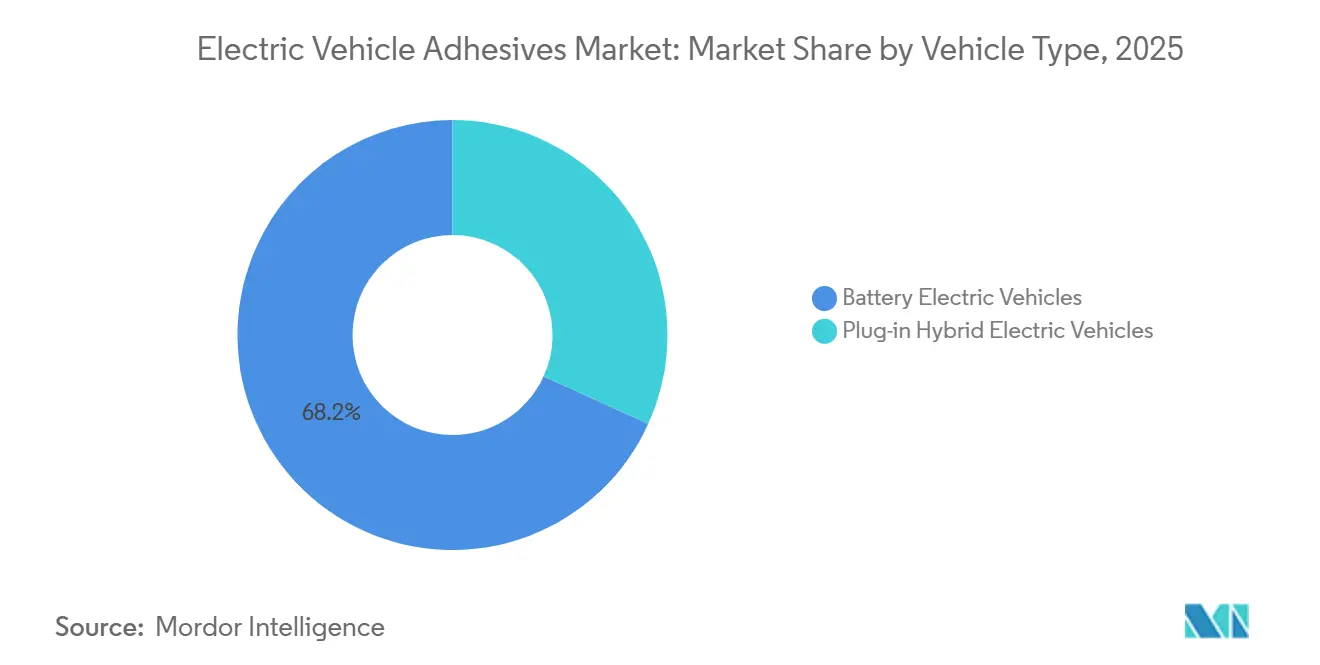
Battery Electric Vehicles (BEV) held 68.23% of the electric vehicle adhesives market share in 2025 and are forecast to grow at a 21.13% CAGR from 2026 to 2031. Purpose-built BEV platforms use adhesive joints as structural and thermal pathways throughout the pack, whereas PHEVs use smaller battery packs and often retain conventional module designs. This reduces adhesive intensity per vehicle in many PHEV battery assemblies, while cell-to-chassis BEVs can use adhesive joints to support body-structure loads during a crash. The electric vehicle adhesives market responds to this requirement with higher-value structural and thermal bonding systems. These systems must provide consistent performance throughout vehicle operation, including during temperature changes and vibration.
Pack design can place an adhesive directly between cells, cooling plates, and load-bearing parts, widening the performance gap between BEVs and PHEVs over the forecast period. PHEVs continue to play a stable role in regions with limited charging infrastructure, including parts of ASEAN and South America. Their smaller packs have lower heat loads, although multi-material vehicle structures still require specialized bonding products. Adhesive demand in PHEVs, therefore, grows through formulation diversity across electric components and internal-combustion assembly steps. The electric vehicle adhesives market retains this demand while BEV platforms drive the largest gains in structural adhesive content.



By Adhesive Type: Polyurethane Gains Ground on Epoxy's Lead
Epoxy adhesives held a 35.14% share in 2025, while polyurethane adhesives are forecast to grow at a 20.87% CAGR from 2026 to 2031, the fastest rate among the listed chemistries. Polyurethane materials can function as thermal interface binders and flexible structural sealants in cell-to-pack assemblies. Evonik described polyurethane thermal interface materials as a cost-performance option for module-to-cooling-plate bonding, subject to effective filler management. Henkel's Loctite TLB 9270APS product is designed for thermal management in cell-to-pack battery designs. Polyurethane growth reflects the need to combine heat transfer, flexibility, and bonding in demanding battery assemblies.
Epoxy remains important where pack enclosures and crash-load paths require high structural strength, and a 2026 study found systems that exceed 20 MPa lap shear strength on aluminum and steel substrates. Silicone products serve high-temperature thermal-interface and electrical-insulation applications, while acrylic products address fast-curing requirements on automated lines. Across chemistry types, suppliers are moving toward solvent-free and low-VOC options as customer requirements and regulations raise formulation standards. Material selection is therefore shaped by the joint's operating temperature, strength requirement, cure process, and electrical protection needs. The electric vehicle adhesives market has room for several material families rather than a single standard chemistry.
By Application: Encapsulation Emerges as the Growth Frontier
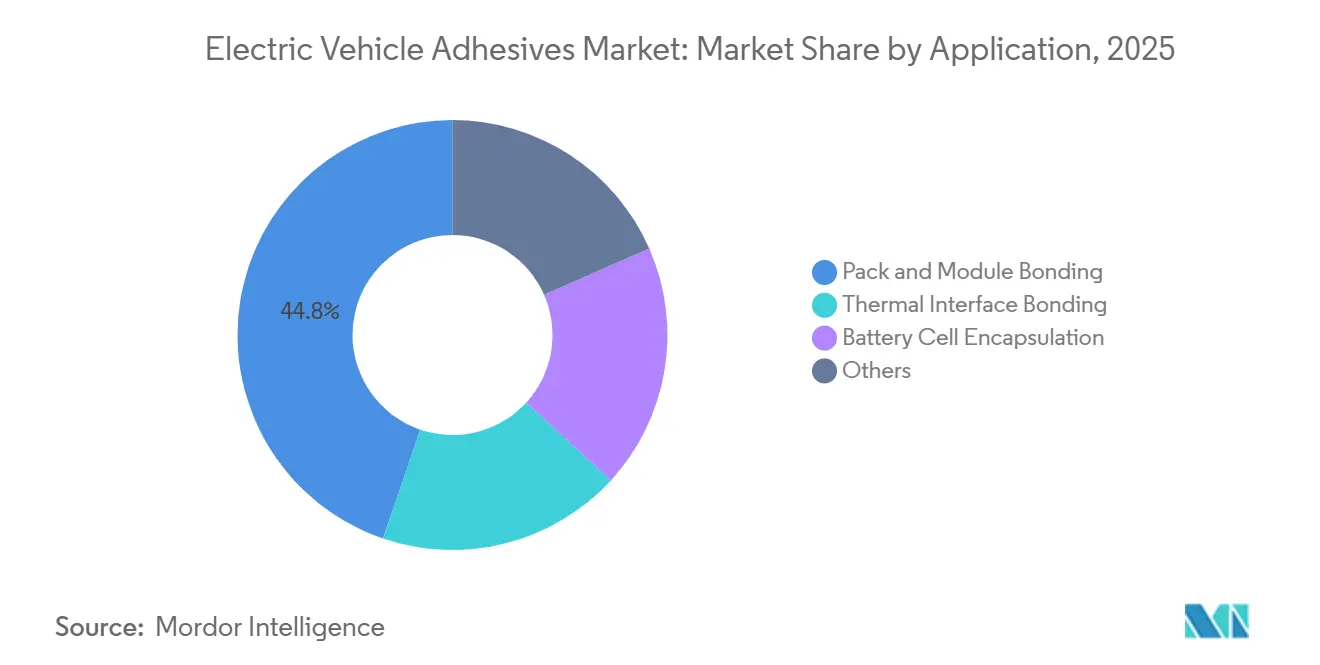
Pack and module bonding accounted for 44.76% of the electric vehicle adhesives market in 2025, while battery cell encapsulation is forecast to grow at a 21.45% CAGR from 2026 to 2031. Pack and module bonding remains the largest application because it defines the structural integrity of the assembled battery pack and supports epoxy and polyurethane structural products. Cell-to-pack designs make encapsulation more critical because individual cells require electrical isolation, vibration damping, and protection against the propagation of thermal runaway. A 2025 review found that battery bonding materials in these applications must perform over the -40°C to +80°C range under vibration during vehicle service. The electric vehicle adhesives market is expanding its functional-safety offerings as cell-level protection becomes more relevant.
Thermal interface bonding is gaining importance as battery chemistries and charging systems increase heat loads. Henkel introduced Bergquist TGF 2030APS in May 2026, with a thermal conductivity of 1.7 W/m·K and dispensing rates exceeding 40 mL/s. The other applications category includes ingress-protection sealants, thread-locking compounds, and potting materials, which remain relevant as premium BEV battery housing designs become more complex. Application demand is spread across structural assembly, heat transfer, electrical isolation, and sealing. The electric vehicle adhesives market requires formulations that meet each functional requirement without delaying high-volume manufacturing.
Geography Analysis
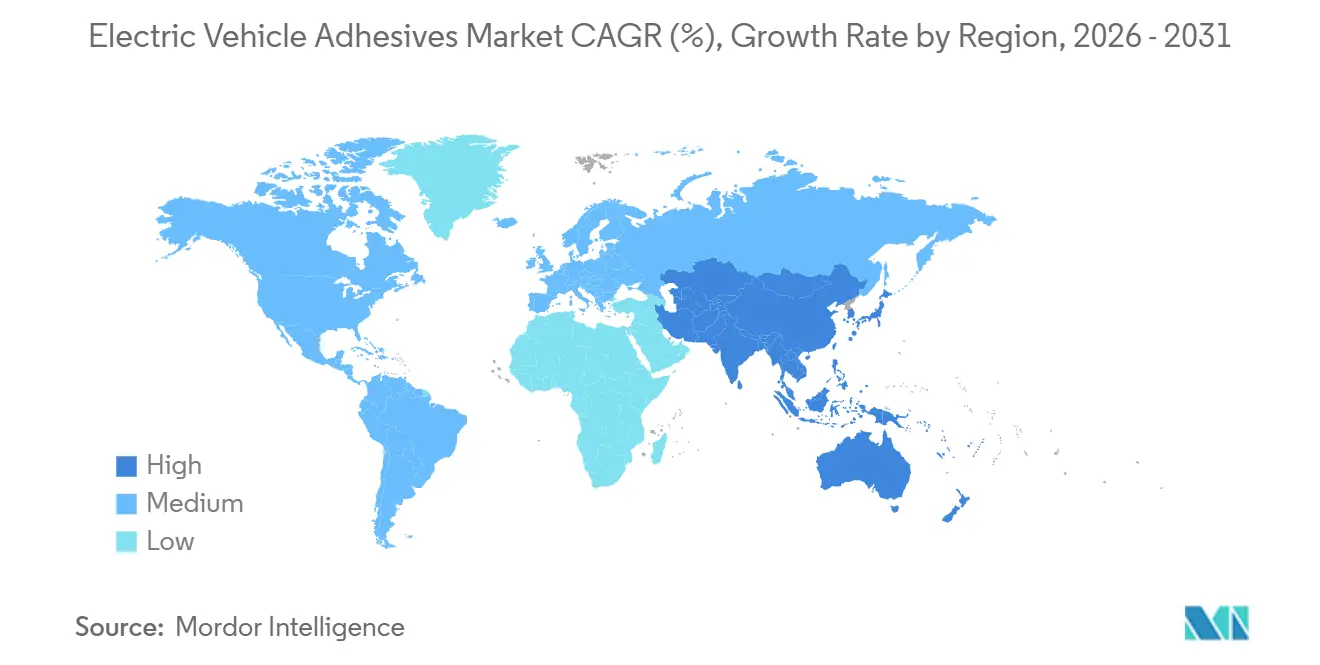
Asia-Pacific accounted for 51.61% of the electric vehicle adhesives market share in 2025 and is forecast to grow at a 20.58% CAGR through 2031, the fastest rate among all regions. China drives much of the region's demand through EV and battery production clusters in Jiangsu, Guangdong, and Sichuan. The country's EV penetration exceeded 38% of new passenger-car sales in 2025, while CATL, BYD, and CALB operate combined annual capacity above 1,500 GWh. South Korea drives demand for high-specification silicone and polyurethane thermal materials through premium cylindrical and pouch-cell production, supporting a diverse range of battery adhesive applications.
India is an important emerging market in the Asia-Pacific region, as EV assembly expanded rapidly through 2025. Local manufacturing and formulations suited to local climatic conditions can help suppliers secure early platform approvals as domestic-content requirements rise. The electric vehicle adhesives market in the region is shaped by high-output production in China and higher-specification work in South Korea. Suppliers need to serve customers across several manufacturing centers with reliable technical service. These conditions favor companies that can combine regional production, application engineering, and local support.
North America is the second-largest geography, supported by gigafactory investment across Michigan, Tennessee, Georgia, and Kansas. Henkel opened its North America Battery Application Center in Madison Heights, Michigan, in September 2025, with production-intent dispensing equipment and a six-axis ABB robot for battery housing trials[2]“North American Battery Application Center Drives EV Innovation,” Henkel Press Release, henkel.com.. Europe has demand from Germany, France, and the Nordic countries, supported by EV platform investment from Volkswagen, BMW, and Stellantis. South America, the Middle East, and Africa are earlier-stage contributors, with Brazil, Saudi Arabia, and South Africa beginning to add manufacturing-related demand. Their output remains lower than that of Asia-Pacific and North America through 2031.

Competitive Landscape
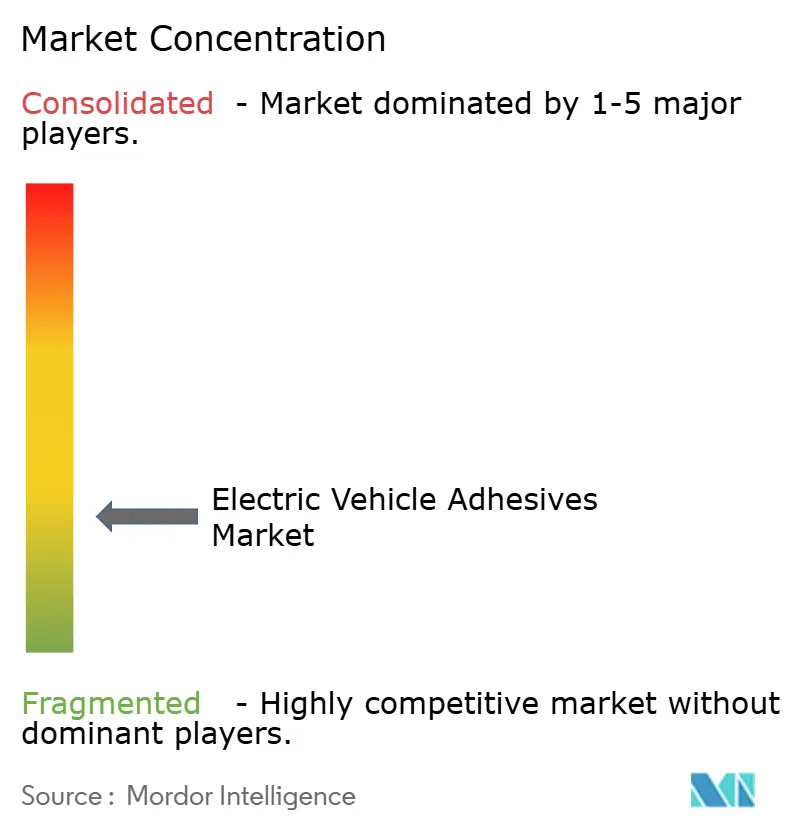
The electric vehicle adhesives market is fragmented. Henkel, Dow, Sika AG, 3M, DuPont, H.B. Fuller, and Wacker Chemie have established positions through qualified product portfolios, manufacturing reach, and application engineering teams located near battery plants. Long OEM qualification programs reinforce these positions, as approved suppliers can remain on a platform for 3-5 years. Emerging Asian formulators compete more actively in cost-sensitive, non-premium BEV applications. The competitive environment is characterized by strong positions at the high end and price pressure in lower-cost applications.
Sika closed its acquisition of Akkim in 2026, expanding its adhesives and sealants presence across Eastern Europe, Central Asia, the Middle East, and North Africa. Henkel launched Loctite Solve in April 2026 to enable virtual simulation of adhesive performance and early integration of material data into component design. In May 2026, Henkel introduced the Teroson EP 52 Series, a solvent-free epoxy that combines structural bonding and vibration damping.
Competition also centers on products that simplify battery assembly, including multifunctional adhesives that combine structural joining and damping. Debonding-on-demand formulations address battery disassembly at the end of service life. Solid-state batteries represent a potential opportunity, as ceramic electrolyte substrates and different exposure conditions require new adhesive approaches. Chengdu Guibao Science and Technology and Guangzhou Jointas Chemical are gaining presence in cost-sensitive Chinese BEV applications. Established suppliers must protect qualified programs while responding to lower-cost regional alternatives, keeping the market competitive.
Electric Vehicle Adhesives Industry Leaders
Henkel AG & Co. KGaA
Sika AG
3M
Dow
H.B. Fuller Company
- *Disclaimer: Major Players sorted in no particular order

Recent Industry Developments
- September 2026: Sika completed the acquisition of Akkim, a Turkey-based adhesives and sealants manufacturer. The acquisition expands Sika's distribution reach and production capacity across Eastern Europe, Central Asia, the Middle East, and North Africa.
- May 2026: Henkel launched Bergquist TGF 2030APS, with a thermal conductivity of 1.7 W/m·K and a dispensing rate above 40 mL/s, and Loctite TLB 9270APS, a polyurethane-based adhesive with a thermal conductivity of 2 W/m·K and a 40-45 minute working time. Both products address thermal management and production-throughput requirements in high-output cell-to-pack battery manufacturing.


Global Electric Vehicle Adhesives Market Report Scope
Electric vehicle (EV) adhesives are specialized bonding and sealing materials used to assemble electric vehicles, replacing or supplementing traditional mechanical fasteners such as bolts and welds.
The electric vehicle adhesives market is segmented by vehicle type, adhesive type, application, and geography. By vehicle type, the market is segmented into battery electric vehicles and plug-in hybrid electric vehicles. By adhesive type, the market is segmented into epoxy adhesives, polyurethane adhesives, silicone adhesives, acrylic adhesives, and other adhesive types. By application, the market is segmented into pack and module bonding, thermal interface bonding, battery cell encapsulation, and others. The report also covers market size and forecasts for electric vehicle adhesives across 15 countries in major regions. The market sizes and forecasts are provided in terms of value (USD).
| Battery Electric Vehicles |
| Plug-in Hybrid Electric Vehicles |
| Epoxy Adhesives |
| Polyurethane Adhesives |
| Silicone Adhesives |
| Acrylic Adhesives |
| Other Adhesive Types |
| Pack and Module Bonding |
| Thermal Interface Bonding |
| Battery Cell Encapsulation |
| Others |
| Asia-Pacific | China |
| India | |
| Japan | |
| South Korea | |
| ASEAN Countries | |
| Rest of Asia-Pacific | |
| North America | United States |
| Canada | |
| Mexico | |
| Europe | Germany |
| United Kingdom | |
| France | |
| Italy | |
| NORDIC Countries | |
| Rest of Europe | |
| South America | Brazil |
| Argentina | |
| Rest of South America | |
| Middle East and Africa | Saudi Arabia |
| South Africa | |
| Rest of Middle East and Africa |
| By Vehicle Type | Battery Electric Vehicles | |
| Plug-in Hybrid Electric Vehicles | ||
| By Adhesive Type | Epoxy Adhesives | |
| Polyurethane Adhesives | ||
| Silicone Adhesives | ||
| Acrylic Adhesives | ||
| Other Adhesive Types | ||
| By Application | Pack and Module Bonding | |
| Thermal Interface Bonding | ||
| Battery Cell Encapsulation | ||
| Others | ||
| By Geography | Asia-Pacific | China |
| India | ||
| Japan | ||
| South Korea | ||
| ASEAN Countries | ||
| Rest of Asia-Pacific | ||
| North America | United States | |
| Canada | ||
| Mexico | ||
| Europe | Germany | |
| United Kingdom | ||
| France | ||
| Italy | ||
| NORDIC Countries | ||
| Rest of Europe | ||
| South America | Brazil | |
| Argentina | ||
| Rest of South America | ||
| Middle East and Africa | Saudi Arabia | |
| South Africa | ||
| Rest of Middle East and Africa | ||


Key Questions Answered in the Report
What is current market size of Electric Vehicle Adhesives Market?
The electric vehicle adhesives market size was valued at USD 2.67 billion in 2025 and is estimated to grow from USD 3.12 billion in 2026 to USD 7.34 billion by 2031, at a CAGR of 18.67% during the forecast period (2026-2031).
Which vehicle type uses the most electric vehicle adhesives?
Battery Electric Vehicles held a 68.23% share in 2025 and are expected to grow at a 21.13% CAGR through 2031. Their purpose-built battery packs place more structural and thermal responsibility on adhesive joints.
Which adhesive chemistry is growing the fastest for EV battery use?
Polyurethane Adhesives are projected to grow at a 20.87% CAGR through 2031 because they can support thermal-interface and structural-sealing functions. Their performance depends on the balance of filler loading, dispensing behavior, and bond strength.
Which battery application is expanding fastest?
Battery Cell Encapsulation is forecast to expand at a 21.45% CAGR by 2031, supported by cell-to-pack battery designs. It supports electrical isolation, vibration damping, and thermal runaway containment around individual cells.
Page last updated on:





