
Market Overview
| Study Period | 2020 - 2031 |
|---|---|
| Forecast Data Period | 2026 - 2031 |
| Base Year Market Size (2025) | USD 23.60 Billion |
| Market Size (2026) | USD 27.69 Billion |
| Market Size (2031) | USD 61.56 Billion |
| Growth Rate (2026 - 2031) | 17.33 % |
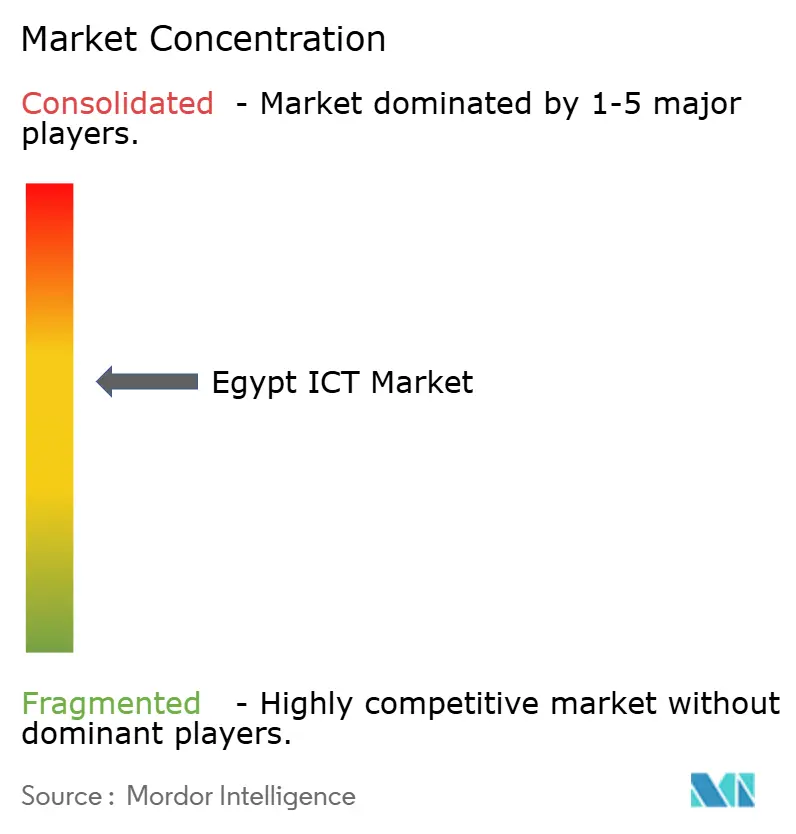
| Market Concentration | Medium |
Major Players *Disclaimer: Major Players sorted in no particular order Image © Mordor Intelligence. Reuse requires attribution under CC BY 4.0. | |
Egypt ICT Market Analysis by Mordor Intelligence
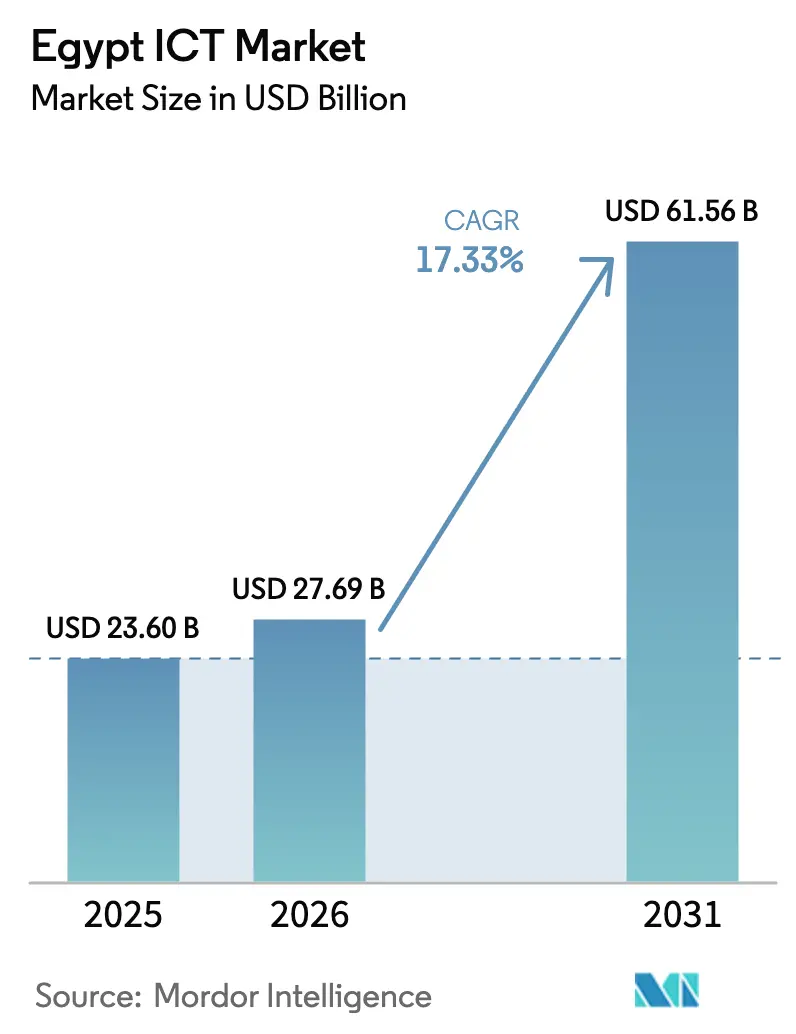
The Egypt ICT market size was valued at USD 23.60 billion in 2025 and estimated to grow from USD 27.69 billion in 2026 to reach USD 61.56 billion by 2031, at a CAGR of 17.33% during the forecast period (2026-2031). The rapid expansion stems from the government’s Digital Egypt program, large-scale data-center commitments from Gulf sovereign funds, and Egypt’s status as the primary landing point for 15 active undersea cables[1]. Telecommunications services currently hold 35.24% revenue share, while IT services lead growth at a 17.15% CAGR as enterprises accelerate cloud and AI adoption. Large enterprises account for 61.15% of spending, but SME demand is catching up thanks to subsidized financing and advisory schemes from the European Bank for Reconstruction and Development. Public-sector digitalization keeps government and public administration the top vertical at 24.81% share, yet BFSI is the fastest-growing vertical at 22.19% CAGR as fintech volumes scale.
Key Report Takeaways
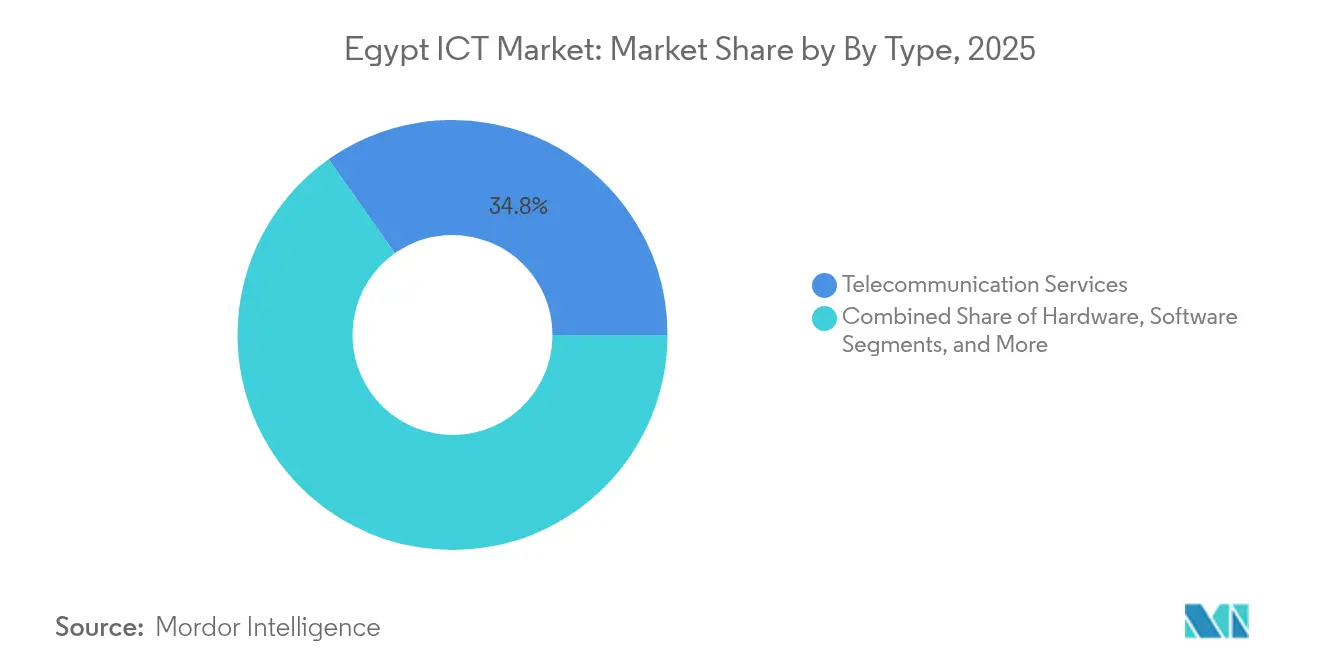
- By type, telecommunications services led with 34.78% of Egypt's ICT market share in 2025, while IT services are advancing at a 17.47% CAGR through 2031.
- By enterprise size, large enterprises held 60.62% of the Egypt ICT market in 2025; SMEs record the highest projected CAGR at 15.78% to 2031.
- By industry vertical, the government and public sector captured 24.55% share of the Egyptian ICT market size in 2025; BFSI is projected to expand at a 21.84% CAGR up to 2031.
Note: Market size and forecast figures in this report are generated using Mordor Intelligence’s proprietary estimation framework, updated with the latest available data and insights as of 2026.
Egypt ICT Market Trends and Insights
Drivers Impact Analysis*
| Driver | (~) (%) Impact on CAGR Forecast | Geographic Relevance | Impact Timeline |
|---|---|---|---|
| Government-wide cloud migration | +3.2% | Greater Cairo, New Administrative Capital | Medium term (2-4 years) |
| “Digital Egypt” citizen-service platform | +4.1% | Nationwide, rural expansion | Long term (≥4 years) |
| Gulf-funded hyperscale data-center build-out | +2.8% | Cairo, Suez Canal Economic Zone | Short term (≤2 years) |
| Undersea-cable landing ecosystem | +2.3% | Mediterranean and Red Sea coasts | Long term (≥4 years) |
| Egypt Post rural fintech roll-out | +1.9% | Remote governorates | Medium term (2-4 years) |
| Arabic generative-AI localization | +1.7% | Nationwide, regional export potential | Long term (≥4 years) |
| Source: Mordor Intelligence | |||
Government-wide Cloud Migration
A mandatory “cloud-first” decree requires every ministry to place new workloads on EG-CLOUD by 2026. Forty percent of core applications already run on the government platform, lowering agency IT operating costs by 35% and cutting service delivery times from hours to minutes[2]. Ministries report 60% faster release cycles, and the Ministry of Finance completed end-to-end budget automation on Oracle Hyperion, releasing real-time dashboards for parliamentary oversight. The policy spurs complementary investments in network security, identity management, and sovereign data zones, giving domestic service providers a stable pipeline through 2030.
“Digital Egypt” Citizen-Service Platform
The Digital Egypt super-app delivers 182 online public services to more than 9 million users and processed 750 million transactions in 2024, up 280% year on year. Its API-driven architecture links payment rails, telcos, and utilities, allowing citizens to settle taxes, traffic fines, and utility bills in minutes. Transaction success rates exceed 99.8%, while rural uptake has doubled since Egypt Post converted 200 branch offices into digital hubs. The platform’s data lake also underpins predictive analytics for subsidy targeting and pandemic response, reinforcing long-term adoption.
Gulf-Funded Hyperscale Data-Center Build-out
Abu Dhabi’s Khazna broke ground on a USD 250 million, 50 MW campus slated for 2026 full capacity, while Elsewedy Electric and Gulf Data Hub committed USD 2.1 billion to a 192 MW complex inside the Suez Canal Economic Zone. These projects exploit abundant renewable energy and proximity to cable landings, delivering a total cost of ownership up to 40% below comparable European sites. The resulting capacity attracts hyperscale cloud providers and AI workloads, anchoring Egypt ICT market growth.
Undersea-Cable Landing Ecosystem
Egypt hosts 15 active systems and five more under construction, including 2Africa and Medusa, giving operators redundant Mediterranean–Red Sea routes that cut round-trip latency by 25% relative to Gibraltar paths. Telecom Egypt’s WeConnect platform bundles 14 cables into a single commercial offer, enabling OTTs to buy capacity on demand. Cable density also encourages manufacturers to localize fiber-optic production, highlighted by Elsewedy’s USD 500 million plant west of Damietta.
Restraints Impact Analysis*
| Restraint | (~) (%) Impact on CAGR Forecast | Geographic Relevance | Impact Timeline |
|---|---|---|---|
| Senior cyber-talent shortfall | -2.1% | Cairo, Alexandria | Medium term (2-4 years) |
| Foreign-exchange scarcity for hardware | -1.8% | Nationwide | Short term (≤2 years) |
| Fragmented SME tech demand beyond Cairo | -1.3% | Upper Egypt, remote governorates | Long term (≥4 years) |
| Legacy IT lock-in at state-owned companies | -0.9% | National | Medium term (2-4 years) |
| Source: Mordor Intelligence | |||
Senior Cyber-Talent Shortfall
Egypt’s cybersecurity workforce deficit stands at roughly 3,000 professionals, triple the available supply for senior roles, pushing vacancy periods to 8-12 months and inflating salaries by 30% annually. The National Cybersecurity Strategy aims to certify 1,000 specialists per year through the Cyber Talents program, yet demand outpaces output. Prolonged gaps expose enterprises to phishing incidents, which rose 49% in Cairo during 2024, prompting banks and telcos to outsource SOC operations to international vendors.
Foreign-Exchange Scarcity for Hardware
Three sequential devaluations since 2022 raised import prices 40-60%, delaying refresh cycles for PCs, servers, and network gear[3]. Seventy-eight percent of SMEs report postponing upgrades because banks cannot supply hard currency, forcing many to run unsupported operating systems. The electronics localization initiative, including Hisense’s USD 38 million appliance plant in the Suez Canal Economic Zone, covers only 15% of domestic demand, leaving the Egypt ICT market exposed to volatile FX conditions.
*Our forecasts treat driver/restraint impacts as directional, not additive. The impact forecasts reflect baseline growth, mix effects, and variable interactions.
Segment Analysis
By Type: Telecommunications Backbone Underpins Digital Expansion
Telecommunications services captured 34.78% of Egypt's ICT market share in 2025, reflecting continued capital expenditure on 5G licenses worth USD 675 million and fiber backhaul stretching to 40,000 towers. IT services are projected to grow the fastest at 17.47% CAGR, powered by public-sector outsourcing deals totaling USD 1.575 billion in FY 2022/23. Hardware demand cooled because of FX tightness, yet data-center server purchases surged as hyperscale builds progress. Software investment shifts toward SaaS and AI platforms aligned with the National AI Strategy 2025–2030, which targets 250 AI companies and 30,000 specialists.
In the forecast window, fixed-wireless access and private 5G slices will enable Industry 4.0 in the New Administrative Capital and Suez Canal Economic Zone, while local ISVs bundle Arabic NLP engines into e-commerce, edtech, and health-tech solutions. Regulatory frameworks such as the Personal Data Protection Law spur security spending, benefiting system integrators and MSSPs.

By Enterprise Size: Large Budgets Dominate but SME Upside Accelerates
Large enterprises commanded 60.62% of Egypt's ICT market in 2025, thanks to multi-year capex programs at telcos, banks, and energy majors. Vodafone and Orange alone earmarked more than USD 609 million and USD 284 million, respectively, for fiber-to-site projects through 2031. These organizations adopt zero-trust architectures, robotic process automation, and hybrid cloud, bolstering their resilience.
SMEs post a 15.78% CAGR outlook. The EBRD’s Shoestring pilots show 30% efficiency gains from barcode tracking and low-cost IoT sensors among furniture exporters. Government-sponsored “Digital Egypt Builders” offers EGP 2 million soft loans and tech bootcamps, aiming to cover 100,000 SMEs by 2026. Fintech operators such as Fawry Business provide cloud bookkeeping and e-invoice APIs that lower adoption barriers.

By Industry Vertical: Public Sector Leads While Banks Sprint Ahead
Government and public administration accounted for 24.55% of spending in 2025 as 63 state-owned companies pursued process automation and e-procurement frameworks, processing EGP 2.5 trillion in electronic payments over eleven months. BFSI, though smaller, registers a 21.84% CAGR. Real-time payment rails, Egypt’s first digital bank, and AI-powered call-center agents elevate digital wallet penetration beyond 48 million active accounts.
Healthcare is next in line, with Vodafone Business supporting 314 connected hospitals and 6 million patients through telehealth dashboards. Manufacturing leverages subsidized automation audits under the Smart Industry Readiness Index, encouraging MES deployments among cement and textiles firms.
Geography Analysis
Cairo and the emerging New Administrative Capital concentrate roughly 64.30% of Egypt ICT market revenues, housing head offices, hyperscale data centers, and 5G densification projects. The Smart Capital initiative embeds IoT sensors in traffic, lighting, and utility grids, fostering data-driven municipal services.
The Suez Canal Economic Zone is fast becoming a secondary hub as land prices and renewable-energy availability attract Gulf-backed data centers, electronics OEMs such as Hisense, and submarine cable factories, cementing Egypt’s east-west connectivity role.
Upper Egypt and the Delta witness accelerated rural digitization under the “Decent Life” fiber program, plus outsourcing delivery centers in Assiut, where wages are 40% below Cairo levels, yet talent retention is high.
Regulatory Landscape
Egypt's ICT regulatory environment is anchored by the National Telecommunications Regulatory Authority (NTRA), which governs telecom licensing and services under Telecommunication Regulation Law No. 10 of 2003, with sector policy direction shaped by the Ministry of Communications and Information Technology (MCIT) through Digital Egypt and related ICT strategies. Media and digital platform oversight falls under the Supreme Council for Media Regulation (SCMR), which creates a parallel compliance layer for platform operators and digital service providers.
On the digital and data side, government technology procurement and deployment increasingly follow Digital Egypt's cloud-first stance. Ministries are directed to place new public-sector workloads on EG-CLOUD by 2026, reinforcing requirements around sovereign hosting, identity, and security controls for vendors. In March 2026, Egypt published a Guide to Egypt's National AI Governance Framework through national AI governance bodies under MCIT and the National Council for Artificial Intelligence (NCAI), adding formal governance expectations for AI development and use cases that intersect with public services and regulated industries.
Value Chain Analysis
The Egypt ICT value chain starts with international connectivity and national backbone infrastructure, where Telecom Egypt anchors capacity through submarine cable landings and terrestrial fiber. Egypt's ecosystem features 14 subsea systems in operation, with additional systems being developed through international alliances, and Telecom Egypt commercializes multi-cable access via platforms such as WeConnect, which supports wholesale capacity procurement by operators and digital service providers.
From backbone to last mile, operators and infrastructure partners expand metro and access networks, including rural fiber rollouts linked to Hayat Karima connectivity programs that have connected 1,250 villages, and longer-horizon fiber buildouts such as the Telecom Egypt and 4iG partnership for fiber-to-the-home and fiber-to-the-site investment. On the demand and delivery layer, platforms and systems integrators implement e-government and enterprise digitalization, with Digital Egypt acting as a large-scale service distribution channel (242 services available as of July 2026), supported by cloud, cybersecurity, and application modernization vendors that deploy and operate workloads for ministries, banks, telcos, and SMEs.
Competitive Landscape
Telecom Egypt monopolizes fixed infrastructure and owns WeConnect, granting it strategic control over cable landings. Mobile market shares are fragmented with Vodafone at 44%, Orange at 33%, and e& Egypt at 22%, fostering competitive pricing and aggressive 5G rollouts.
Hyperscale data centers bring new entrants: Khazna, Gulf Data Hub, and Raya compete for cloud tenants while partnering with local utilities for sustainable power. Their combined pipeline exceeds 1 GW, signaling a structural shift toward hosted services.
Enterprise IT is dominated by global vendors—IBM, Microsoft, Cisco—leveraging seventy-year local footprints and joint innovation centers. Domestic champions like Fawry and e-Finance capitalize on regulatory know-how and nationwide agent networks, enabling fintech services to 50 million users.
Egypt ICT Industry Leaders
-
Accenture Plc
-
SAP SE
-
Dell Technologies, Inc.
-
Telecom Egypt S.A.E.
-
Oracle Corporation
- *Disclaimer: Major Players sorted in no particular order
Market Opportunities and Future Outlook
Expansion of digital public services and government cloud migration continues to create addressable demand for cloud services, identity, cybersecurity, and application modernization across ministries and government-linked entities. As of July 2026, Digital Egypt provides 242 services, and public reporting highlights a national target of 450 digital government services by 2030, which supports a pipeline for API integration, payments orchestration, data platforms, and managed services aligned to sovereign deployment requirements.
On the infrastructure side, Egypt's role as a regional connectivity hub and the push to densify fixed access underpin opportunities in wholesale capacity, edge and carrier-neutral interconnection, and fiber deployment services. Evidence includes Telecom Egypt and 4iG's announced USD 600 million, 10-year fiber-to-the-home and fiber-to-the-site program, plus continued integration of existing subsea systems alongside new builds, including recent landings such as SEA-ME-WE-6 and IEX, which broaden route diversity and support cloud and content delivery localization. Together with ongoing Digital Egypt priorities for higher online government transaction participation and digital exports objectives, these factors support service provider expansion in outsourced IT, cloud operations, and industry solutions for BFSI, government, and digitally enabling logistics and commerce.
Recent Industry Developments
- July 2026: Telecom Egypt S.A.E. officially canceled the planned sale of a majority stake in its data center subsidiary to Helios Investment Partners after conditions in the proposed transaction were not met. The move keeps ownership of key data center assets with Telecom Egypt, preserving control over dc operations and ongoing capacity plans. It signals a preference for in-house data center development aligned with the company's broader ICT infrastructure strategy.
- June 2026: Telecom Egypt S.A.E. signed a memorandum of understanding with Grova Developments, a subsidiary of Hassan Allam Holding Group. The agreement strengthens local telecoms infrastructure partnerships and could accelerate fiber and data center capacity expansion through a trusted local developer. This arrangement supports Egypt's connectivity ambitions by expanding the backbone and improving service resilience.
- April 2026: Accenture Plc officially opened its second office in Cairo, Egypt. The expansion provides a direct foothold for ICT outsourcing and professional services in the Egyptian market, enabling closer collaboration with local clients. It enhances Egypt's profile as an EMEA IT services hub and supports digital transformation initiatives across public and private sectors.
Research Methodology Framework and Report Scope
Market Definition and Coverage
For this report, the Egypt ICT market is defined as the spending generated inside Egypt from ICT hardware, software, IT services, and telecommunication services across business and public end users, reported in USD.
Scope exclusions: This sizing does not count consumer electronics that are not primarily used for connectivity or computing, and it also excludes general household appliances.
Segmentation Overview
- By Type
- Hardware
- Computer Hardware
- Networking Equipment
- Peripherals
- IT Software
- IT Services
- Managed Services
- Business Process Services
- Business Consulting Services
- Cloud Services
- IT Infrastructure
- IT Security
- Communication Services
- Hardware
- By End-user Enterprise Size
- Large Enterprises
- SMEs
- By End-user Industry Vertical
- BFSI
- Government and Public Administration
- Retail, E-commerce and Logistics
- Manufacturing and Industry 4.0
- Healthcare and Life Sciences
- Gaming and Esports
- Oil and Gas (Up-, Mid-, Down-stream)
- Energy and Utilities
- Other Verticals
Data Sources, Market Sizing, and Validation
Desk Research
Desk work was used to set the basic demand picture for Egypt and to avoid building the model on one single data stream. We reviewed public statistics and releases that signal ICT adoption, such as MCIT publications, NTRA indicators on subscribers and traffic, CAPMAS macro series, and ITIDA announcements on outsourcing and digital exports.
To cross-check direction and timing, we also referred to sources such as the World Bank and ITU for connectivity baselines, along with company filings, investor presentations, and reputed press for investment plans and service rollout milestones. Where needed, paid subscriptions were used for company financials and intelligence, news and financials, and patent database checks to support product and service intensity assumptions. The desk research source list is illustrative only, and many other public and paid references were also used for data collection, validation, and clarification.
Primary Interviews and Surveys
Primary interviews and surveys focused on the parts of the Egypt ICT model that desk sources cannot fully pin down, especially the split between service revenues and product spending, and how quickly customers are migrating to newer connectivity and cloud-led workloads. We spoke with a mix of operators, systems and managed service providers, software-focused firms, channels, and enterprise buyers across major demand centers in Egypt, and then we rechecked key assumptions when responses diverged.
Because pricing and contract structures can vary widely, we used these discussions to sense-check average revenue patterns, procurement cycles, and how inflation and FX movements were reflected in quotes and renewals. Those inputs were then used to finalize the model assumptions.
Distribution of primary research fieldwork respondents
| Company type | Respondent position |
|---|---|
| Top tier: 35% | CXOs: 14% |
| Mid tier: 49% | Functional/Unit leaders: 36% |
| Smaller Players: 16% | Managers: 50% |
Market-Sizing & Forecasting
Sizing started from a top-down build that reconstructs the demand pool using Egypt level service revenue signals and adoption indicators, and then maps them to ICT spend categories. To keep the totals realistic, the results were corroborated through selective bottom-up approximations like sampled ASP times volume for devices and connectivity, plus channel checks on enterprise deal mix, followed by adjustments when the two views did not align.
Inputs used in the model included mobile and fixed broadband subscribers, data consumption trends, enterprise digitization activity in government and BFSI, rollout timing for newer network generations, and typical pricing movement for core services and packaged software. When a datapoint was missing for a slice of the market, we filled gaps using peer benchmarks from comparable spend categories inside Egypt and then pressure-tested it with interview feedback.
For forecasting, we relied mainly on scenario analysis supported by a small set of drivers that can be tracked each year, such as subscriber growth, ICT investment intensity, and service price progression under different macro conditions. The final forecast path was kept consistent with what primary respondents described as most likely procurement and rollout timing, rather than assuming a smooth straight-line growth curve.
Data Validation & Update Cycle
Validation was done by comparing the model outputs against independent signals like subscriber totals, sector level digital program milestones, and publicly visible investment and rollout announcements, and then checking whether implied per user and per enterprise spend stayed within reasonable ranges. Any large variances were flagged, reviewed, and either corrected in the inputs or explained through a clear market event.
Before sign-off, the work is reviewed in multiple steps so that arithmetic, year mapping, and category logic errors are removed. When new announcements materially change expected spending, respondents are re-contacted to confirm the likely impact on timing and pricing. Reports are refreshed annually, with interim updates for major events, and a final pass is completed before delivery so clients receive the latest updated view.
Mordor Intelligence's Egypt Ict Market Size Measured Against Other Published Estimates
Published ICT market values for Egypt often vary because the underlying inclusions are not identical, and because different groups make different calls on pricing, currency timing, and how quickly newer services scale. We keep the comparison practical by focusing on what is being counted and the year being measured.
Consumer electronics that are not primarily part of ICT spend are kept outside Mordor Intelligence's scope, which is one reason the 2025 total can look lower than estimates that blend in broader device retail. Differences also come from whether telecom is measured as service revenue only or mixed with infrastructure spending, and from whether FX conversion uses annual averages or a single point in time, which can move USD totals materially in Egypt.
Benchmark comparison
| Source | Market Size | Gaps in Research Methodology |
|---|---|---|
| Mordor Intelligence | USD 23.60 B (2025) | |
| Trade Journal A | USD 27.19 B (2023) | Uses an earlier year and appears to bundle a wider ICT basket, including broader hardware retail, with limited clarity on telecom revenue treatment and USD conversion timing. |
| Global Advisory B | USD 29.00 B (2025) | Likely applies a more aggressive service price progression and faster adoption curve for enterprise digital spend, with less explicit checks against subscriber led demand signals. |
The spread in the table is mainly explained by what gets counted as ICT, plus how telecom and device revenues are treated across years. By anchoring the totals to repeatable demand indicators and then checking them with practical bottom-up spot tests, the estimate stays transparent and easier to update when Egypt sees material policy, FX, or rollout changes.
Key Questions Answered in the Report
How large will Egypt’s ICT spending be by 2031?
The Egypt ICT market size is projected to reach USD 61.56 billion by 2031, up from USD 27.69 billion in 2026.
Which segment is expanding the quickest?
IT services is forecast to grow at a 17.47% CAGR, the highest among all type segments.
Why is cloud deployment gaining most traction?
A mandatory government cloud-first policy and hyperscale data-center investments give cloud models a cost and agility advantage, driving an 18.19% CAGR.
What is fueling BFSI technology demand?
Real-time payment networks, Egypt’s first digital bank, and AI-driven customer service tools are boosting BFSI ICT outlays, resulting in a 21.84% CAGR.
Which geographic clusters attract the bulk of data-center investment?
Greater Cairo and the Suez Canal Economic Zone host most hyperscale projects due to fiber proximity and renewable power availability.