
Dust Control Suppression Chemicals Market Size and Share
Market Overview
| Study Period | 2020 - 2031 |
|---|---|
| Market Size (2026) | USD 5.48 Billion |
| Market Size (2031) | USD 6.79 Billion |
| Growth Rate (2026 - 2031) | 4.38 % |
| Fastest Growing Market | Asia Pacific |
| Largest Market | Asia Pacific |
| Market Concentration | Medium |
Major Players *Disclaimer: Major Players sorted in no particular order Image © Mordor Intelligence. Reuse requires attribution under CC BY 4.0. | |

Dust Control Suppression Chemicals Market Analysis by Mordor Intelligence
The Dust Control Suppression Chemicals Market size was valued at USD 5.25 billion in 2025 and estimated to grow from USD 5.48 billion in 2026 to reach USD 6.79 billion by 2031, at a CAGR of 4.38% during the forecast period (2026-2031). The growth trajectory reflects a deliberate shift away from water-only spraying toward chemical binders, which halve application frequency and reduce on-site water use. Demand is further buoyed by tightening PM2.5 and PM10 thresholds in North America, the European Union, and China, which are compelling operators to adopt formulations with verifiable capture efficacy. Meanwhile, IoT-enabled dosing systems are starting to optimize spray volumes in real time, trimming chemical waste by nearly one-fifth without compromising compliance. Over the next five years, price volatility for calcium- and magnesium-chloride feedstocks will remain a headline risk, yet the total cost-of-ownership advantage of binders over water-only protocols is expected to keep adoption on an upward slope, especially in arid mining basins.
Key Report Takeaways
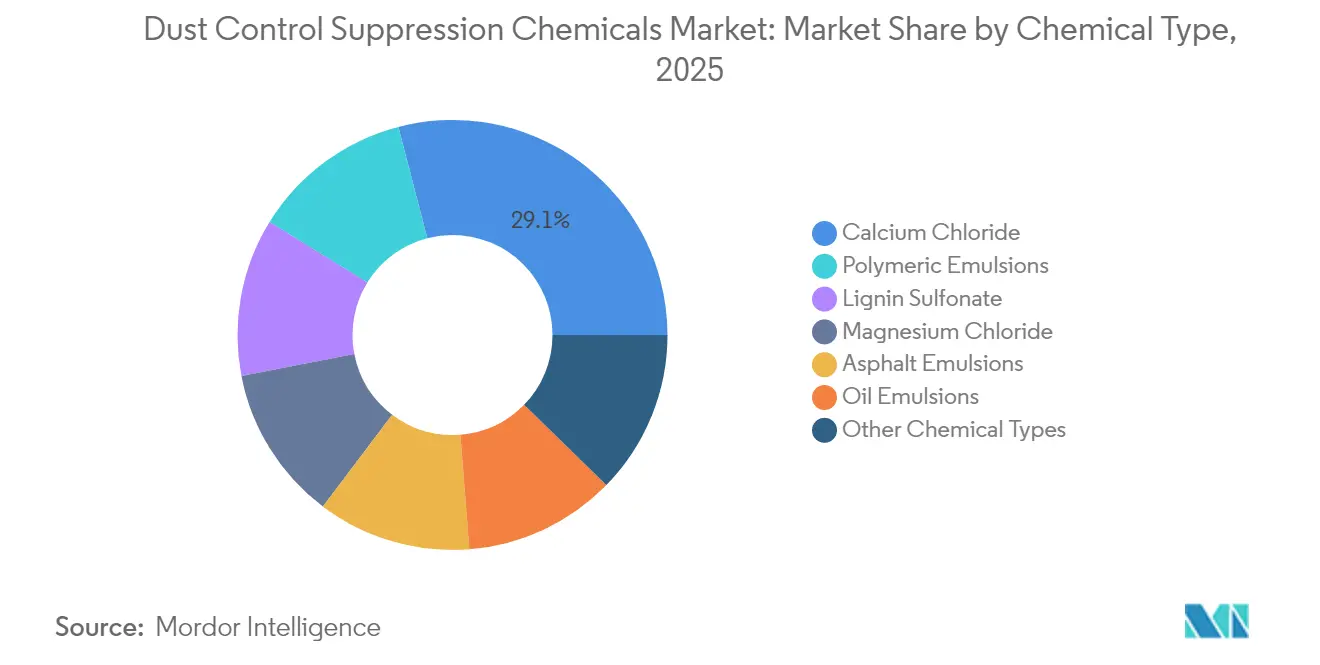
- By chemical type, calcium chloride led with 29.05% of 2025 revenue and is set to advance at a 4.78% CAGR through 2031.
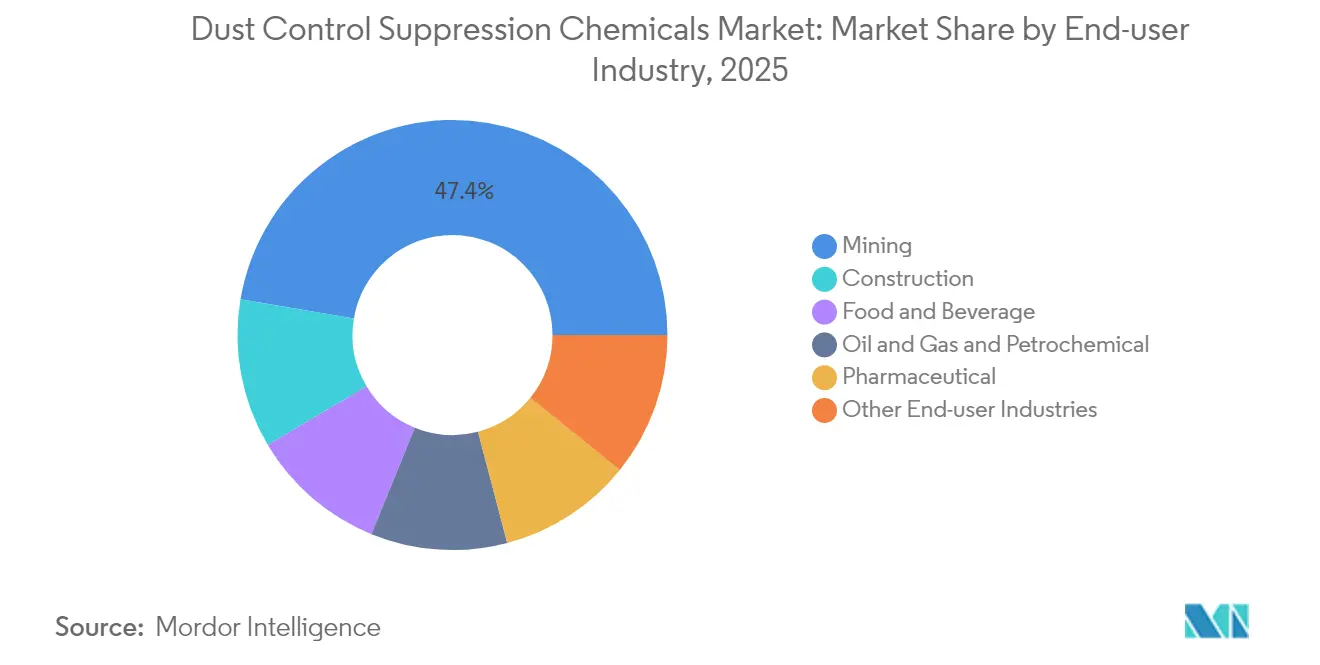
- By end-user industry, mining accounted for 47.35% of the 2025 value, while construction is forecast to expand at a 4.95% CAGR to 2031.
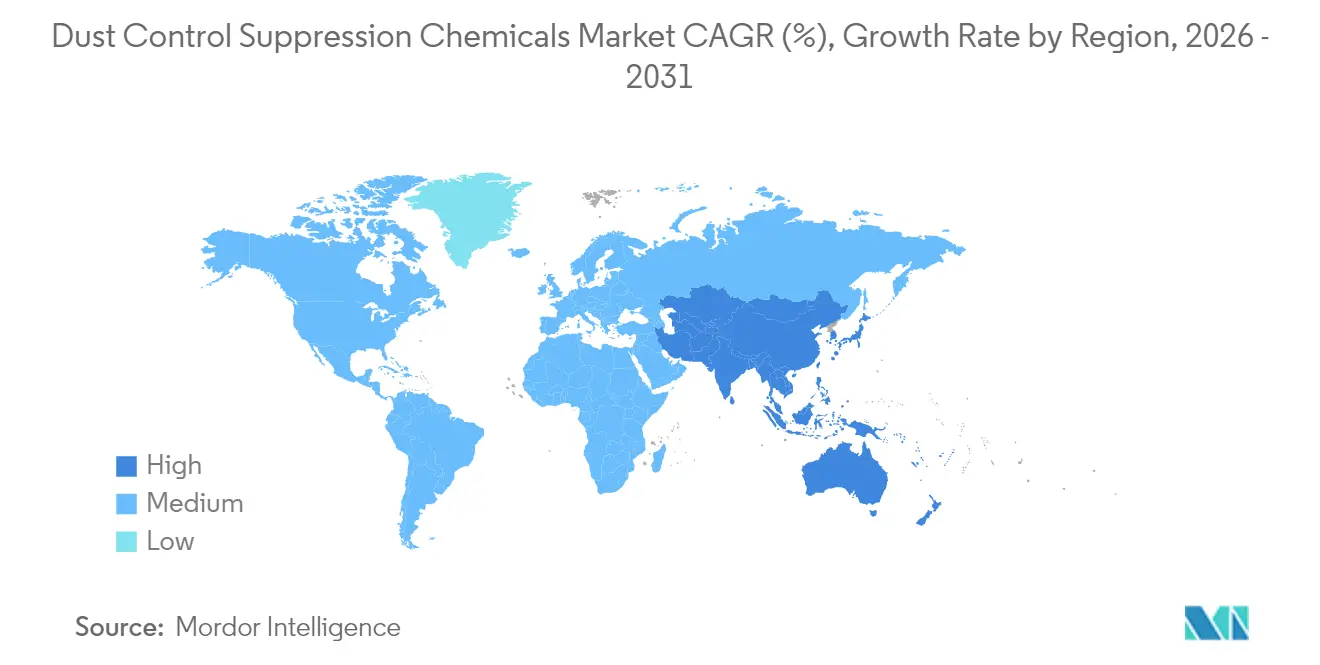
- By geography, Asia-Pacific commanded 47.10% of global revenue in 2025 and is projected to register a 4.62% CAGR through 2031.
Note: Market size and forecast figures in this report are generated using Mordor Intelligence’s proprietary estimation framework, updated with the latest available data and insights as of 2026.
Market Trends and Insights
Drivers Impact Analysis of Dust Control Suppression Chemicals Market*
| Drivers | (~) % Impact on CAGR Forecast | Geographic Relevance | Impact Timeline |
|---|---|---|---|
| Rising infrastructure and mining activity | +1.3% | APAC core, spillover to Middle East | Medium term (2-4 years) |
| Stricter global PM10/PM2.5 emission standards | +1.1% | Global, early enforcement in North America and EU | Short term (≤ 2 years) |
| Shift from water-only spraying to binders | +0.9% | Worldwide, acute in water-scarce regions | Medium term (2-4 years) |
| Adoption of IoT-enabled dosing systems | +0.6% | North America, Australia, select APAC mines | Long term (≥ 4 years) |
| Carbon-credit revenue at mines | +0.4% | Global, concentrated in voluntary carbon markets | Long term (≥ 4 years) |
| Source: Mordor Intelligence | |||
Rising Infrastructure and Mining Activity in Asia-Pacific
China, India, and Indonesia are ramping up their production of coal, nickel, and lignite. This surge in output is driving a consistent demand for road-dust suppressants, especially at pit faces, stockpiles, and along haul-road networks. India has approved new coal projects, aiming to increase capacity in the coming years. To secure state permits, these projects necessitate year-round dust mitigation[1]. Indonesia has inaugurated new nickel laterite mines, enforcing chemical suppression on access roads exceeding a certain length. Vietnam's ambitious North-South Expressway project mandates dust-control measures for earthworks situated near residential zones. Given this landscape, there's a pronounced preference for cost-effective calcium-chloride solutions on temporary haul roads, while permanent infrastructures gravitate towards lignin sulfonate and polymer emulsions.
Stricter Global PM10/PM2.5 Emission Standards
In February 2024, the U.S. Environmental Protection Agency updated the annual PM2.5 NAAQS. This move requires non-attainment zones in California, Arizona, and Utah to show measurable reductions by 2026. Meanwhile, the European Union's Directive 2024/2881 sets stricter limits, spurring faster polymer adoption in Germany and Poland[2]. In 2024, China broadened its county-level Blue-Sky audits, mandating large construction sites to provide real-time PM10 data. These regulations are steering buyers towards formulations certified by ISO 17025 test data, moving away from anecdotal field proofs alone.
Shift from Water-Only Spraying to Chemical Binders
In arid regions, rising water costs are disrupting established pricing models. In 2024, water charges at Pilbara mine sites made calcium chloride-based binders economically attractive. In Chile's Atacama Desert, blends of magnesium chloride have increased suppression intervals. This extension has significantly reduced haul-truck cycles and diesel consumption. Research published in peer-reviewed journals indicates that polymer-based suppressants can achieve a dust reduction. They do so using only a fraction of the water volume compared to standard spraying. This notable difference in performance is swaying procurement choices towards a focus on lifecycle economics.
Adoption of IoT-Enabled Smart Misting and Dosing Systems
Australian mines began fielding weather-linked dosing units in 2024. GRT’s Smart Dosing platform combines wind, humidity, and traffic inputs to modulate nozzle pressure, cutting chemical consumption while sustaining PM10 compliance. Pilbara pilots, linking sensor data to haul-truck density, achieve significant savings at each site. While a small portion of global mines currently utilize sensor-driven suppression, turnkey leasing models are easing adoption hurdles and yielding tangible benefits in terms of compliance.
Restraints Impact Analysis of Dust Control Suppression Chemicals Market*
| Restraints | (~) % Impact on CAGR Forecast | Geographic Relevance | Impact Timeline |
|---|---|---|---|
| Price volatility of chloride salts and lignin feedstock | -0.7% | Global, acute in North America for chlorides and lignin | Short term (≤2 years) |
| Corrosion concerns limiting chloride use on capital equipment | -0.5% | Europe, North America, select APAC infrastructure projects | Medium term (2-4 years) |
| Fragmented regulations slowing product standardisation | -0.4% | Global, acute in emerging markets (Southeast Asia, Africa, Latin America) | Medium term (2-4 years) |
| Source: Mordor Intelligence | |||
Price Volatility of Chloride Salts and Lignin Feedstock
In 2024, spot prices for calcium chloride in North America fluctuated due to tightening brine output from the Great Salt Lake. Meanwhile, environmental quotas in China's Qinghai province capped magnesium chloride supplies in 2024, restricting export growth. A decline in North American kraft-pulp production led to reduced availability of lignin sulfonate, causing spot prices to surge. Formulators lacking long-term contracts faced margin compression, leading them to either absorb the costs or raise prices, which in turn delayed procurements for municipal road programs. Additionally, turnkey leasing models are not only lowering adoption barriers but also yielding a tangible compliance dividend.
Corrosion Concerns Limiting Chloride Use
European infrastructure projects are increasingly favoring polymer emulsions, as calcium and magnesium chlorides elevate maintenance costs on steel components over a decade. In a 2024 study from an Australian coal mine, haul-truck frame inspections occurred more frequently on chloride-treated roads compared to polymer-treated surfaces. While new corrosion-resistant coatings come with a higher price tag per truck, many smaller operators find this premium hard to accept.
*Our forecasts treat driver/restraint impacts as directional, not additive. The impact forecasts reflect baseline growth, mix effects, and variable interactions.
Dust Control Suppression Chemicals Market Segment Analysis
By Chemical Type:
Chlorides Dominate, Polymers Gain ShareCalcium chloride captured 29.05% of the 2025 revenue and is forecasted to grow at 4.78% through 2031, maintaining its leadership position within the Dust Control Suppression Chemicals Market share. Magnesium chloride, though smaller, retains a foothold in cold-climate mines where performance is required below -15 °C. Lignin sulfonate appeals to buyers near sensitive watersheds because it binds fine particles without chloride leaching. Polymeric emulsions—mainly acrylate and vinyl acetate copolymers—are gaining traction as long-life infrastructure projects prioritize lifetime maintenance over unit price. Asphalt and oil emulsions fill niche roles, and bio-based formulations, although accounting for a small portion of the market value, are drawing research and development dollars as LEED-compliant alternatives.
Longer-term demand dynamics hinge on feedstock costs, corrosion considerations, and regulatory acceptance. Chloride solutions will maintain their edge in terms of cost per treated square meter, particularly where water scarcity is acute and equipment turnover is rapid. Polymers and lignin will continue to displace chlorides in Europe and selected Asian megaprojects where asset longevity and stormwater compliance are paramount.

By End-User Industry:
Mining Leads, Construction AcceleratesMining consumed 47.35% of 2025 demand as open-pit coal, iron-ore, and base-metal operations applied suppressants across haul-road networks exceeding 200 kilometers in some Australian and Brazilian sites. Construction will be the fastest-growing sector at a 4.95% CAGR, driven by India’s National Infrastructure Pipeline and Southeast Asian urbanization mandates.
Food and beverage plants use binders in grain-handling zones to mitigate combustible dust, while LNG and petrochemical operators prefer non-chloride chemistries during plant construction to avoid corrosion. Pharmaceutical facilities employ FDA-compliant polymers in cleanroom contexts. Ports, rail yards, and waste-management centers round out demand, their growth tied to stricter opacity rules at material-transfer points.
Geography Analysis
APAC Dust Control Suppression Chemicals Market
The Asia-Pacific region anchored 47.10% of the global value in 2025 and is projected to grow at 4.62% through 2031. Coal mine expansions in Indonesia, a massive infrastructure pipeline in India, and county-level Blue Sky audits in China largely fuel this growth. The market size for Dust Control Suppression Chemicals in the Asia-Pacific is anticipated to witness significant growth. With approvals from India’s Ministry of Coal and a significant push in nickel production in Indonesia, the region is enjoying a sustained boost. Furthermore, countries such as Vietnam and Malaysia are implementing dust-control regulations on new highways and airports, thereby expanding the market's reach.
North America Dust Control Suppression Chemicals Market
North America captured a substantial portion of the 2024 market revenue. In response to the EPA’s stringent PM2.5 standards, mines and contractors in non-compliant areas are increasingly adopting chemical suppression alongside continuous monitoring. The primary consumers include projects centered around copper, lithium, and oil sands. Notably, IoT-integrated spray bars are becoming standard on new haul-truck fleets, reducing annual chemical demand without compromising compliance.
Europe Dust Control Suppression Chemicals Market
Europe, contributing significantly to the 2024 revenue, shows a distinct preference for polymer emulsions and lignin sulfonate. In Germany and the Nordic region, chloride-free solutions are mandated for highway and bridge upgrades to safeguard reinforced concrete from corrosion. While Poland and the Czech Republic favor cost-effective calcium chloride for mine haul roads, they're also adopting polymer blends to minimize maintenance costs. Additionally, Turkey’s initiative for earthquake recovery is accelerating the use of polymers in urban projects.
MEA and South America Dust Control Suppression Chemicals Market
South America, along with the Middle East and Africa, jointly represented a notable share of the 2024 revenue. In Chile’s Atacama region, miners are utilizing high-concentration magnesium chloride to maximize application intervals amidst stringent water limitations. Brazil’s iron-ore industry is adapting to new PM10 standards near indigenous lands, integrating real-time sensors for compliance. Meanwhile, both Saudi Arabia and the UAE are incorporating dust-control stipulations in mining and construction permits, highlighting a regulatory alignment towards PM compliance in these emerging markets.
Regulatory Landscape
Rules covering dust control suppression chemicals are tightening across air quality, worker exposure, and chemical hazard communication, which increases documentation and product-stewardship expectations for suppliers and site operators. In the United States, OSHA issued a final update to the Hazard Communication Standard (HCS) on May 20, 2024, aligning labeling and Safety Data Sheet requirements with GHS Revision 7, which affects how dust suppressants are classified, labeled, and communicated through the supply chain.
Air-quality and site-dust requirements continue to shape enforceable work practices and local product-selection constraints. For example, South Coast AQMD Rule 403 and Ohio Administrative Code 3745-17-08 require fugitive dust to be controlled and allow chemical stabilizers only when used in non-toxic concentrations and consistent with water-quality restrictions. China has also moved toward more formalized product evaluation, with the 2025 group standard T/BYXT 096-2025 setting technical specifications and environmental compatibility protocols for crust-forming dust suppressants. This is intended to support greater standardization of performance and eco-compatibility claims.
Value Chain Analysis
The value chain starts with feedstocks including calcium and magnesium chlorides (often sourced from brines), lignin sulfonates from kraft pulp operations, and petrochemical-based monomers used for acrylic and vinyl polymer emulsions. These inputs flow to formulators that blend salts, lignin, surfactants, and polymers into site-specific products, typically supported by ISO-accredited test data and field performance validation. Sales then split between direct supply programs to large mines and infrastructure contractors (often bundled with site audits and dosing calibration) and distributor-led sales to mid-sized contractors and municipalities.
Downstream, application and service delivery are a key link. Products are commonly deployed through water trucks, fixed spray bars, and, increasingly, sensor-linked dosing systems that adjust treatment rates based on weather and traffic. Bottlenecks tend to cluster in specialty inputs (notably acrylic monomers) and in regional availability of lignin. Corrosion constraints are also influencing selection and mix of chloride versus non-chloride chemistries in long-life infrastructure. Recent product positioning has emphasized the non-corrosive value proposition in polymers, including Saint-Gobain Construction Chemicals (Chryso) introducing Chryso Eco Dust availability in North America in May 2026.
Competitive Landscape
The Dust Control Suppression Chemicals Market is moderately consolidated. Their advantages lie in vertical integration, ISO-accredited testing, and bundled technical services. Regional toll manufacturers in China and India are disrupting the calcium-chloride segment with price discounts, squeezing incumbent margins and prompting a strategic pivot toward value-added offerings such as real-time dosing analytics. White-space growth is emerging in bio-based suppressants derived from fenugreek gum and soy protein. Pilot deployments in Chinese coal mines have recorded reductions in PM10, but still face cost hurdles. Early adopters include high-visibility infrastructure programs seeking LEED points and mines pursuing voluntary carbon credits.
Dust Control Suppression Chemicals Industry Leaders
-
Borregaard AS
-
Cargill, Incorporated
-
Midwest Industrial Supply Inc.
-
Soilworks, LLC
-
Ecolab Inc.
- *Disclaimer: Major Players sorted in no particular order

Dust Control Suppression Chemicals Market Companies Covered in this Report
- ADM
- Benetech, Inc.
- Borregaard AS
- Cargill, Incorporated
- Chemtex Speciality Limited
- Ecolab Inc.
- Evonik Industries AG
- GelTech Solutions
- Hexion
- Midwest Industrial Supply Inc.
- Quaker Houghton
- Shaw Almex Industries Ltd
- Soilworks, LLC
- Veolia
Read Analysis of Dust Control Suppression Chemicals Companies
Market Opportunities and Future Outlook
An important opportunity sits where tighter particulate and silica exposure controls intersect with the operational need to reduce water use at mines and construction sites. In the United States, MSHA enforces a respirable crystalline silica permissible exposure limit of 50 ug/m3 (8-hour TWA) with an action level of 25 ug/m3, and underground mines operate under requirements such as 30 CFR 75.401 that specify the use of water or wetting agents when dust becomes excessive. Together, these requirements support demand for wetting and binding chemistries that deliver measurable, auditable reductions rather than intermittent water-only spraying.
Formulation white space is also opening in biodegradable and soil-adaptive suppressants that target moisture retention and longer suppression intervals while lowering corrosion and runoff concerns. Academic work in 2025 on fully biodegradable dust suppressants and natural polymer composite designs, including approaches using polysaccharides and biopolymer composites, reflects active innovation pathways that could be translated into products for gravel roads, stockpiles, and haul roads as chloride limitations become more material. On the commercial side, differentiated offerings centered on non-corrosive performance and durability, such as Chryso Eco Dust in North America and lignin-based binders such as Borregaard’s Dustex, point to adoption space in long-life infrastructure and environmentally sensitive operating areas where stronger environmental compatibility claims are required.
Recent Industry Developments in Dust Control Suppression Chemicals Market
- April 2026: Borregaard released its first-quarter 2026 results and cited a temporary delay in the value chain affecting its BioSolutions activities, which include Dustex lignin-based dust control binders. The update highlighted how logistics and intermediate availability can affect lead times for bio-based formulations used in road stabilization and stockpile dust control.
- May 2025: Midwest Industrial Supply introduced SparkBarrier, a Class A firefighting foam approved by the U.S. Forest Service. While adjacent to dust suppression, it indicates continued investment in specialty application chemistries and field-deployable delivery expertise that dust-control suppliers often leverage across industrial site services.
- October 2024: Borregaard committed NOK 490 million to expand lignin-biopolymer capacity at Sarpsborg by up to 10% by 2027, targeting incremental output from late 2026. The capacity build supports greater availability of lignin-based binders used in dust suppression and road stabilization, improving supply options for buyers seeking non-chloride alternatives.
Dust Control Suppression Chemicals Market Report Scope and Research Methodology
Market Definition and Coverage
This market covers chemical formulations used to reduce airborne and surface dust by binding, wetting, or crusting particles on roads, construction sites, mines, and industrial yards. Revenue is counted from the sale of these dust suppression chemicals to end users and application channels.
Scope exclusions: This sizing excludes dust control equipment and systems (such as collectors, filters, and mechanical spray hardware) and it also excludes ordinary water-only dusting with no chemical additive.
Segments Covered in This Report
- By Chemical Type
- Lignin Sulfonate
- Calcium Chloride
- Magnesium Chloride
- Asphalt Emulsions
- Oil Emulsions
- Polymeric Emulsions
- Other Chemical Types
- By End-user Industry
- Mining
- Construction
- Food and Beverage
- Oil and Gas and Petrochemical
- Pharmaceutical
- Other End-user Industries
- By Geography
- Asia-Pacific
- China
- India
- Japan
- South Korea
- Indonesia
- Thailand
- Vietnam
- Malaysia
- Rest of Asia-Pacific
- North America
- United States
- Canada
- Mexico
- Europe
- Germany
- United Kingdom
- France
- Italy
- Spain
- Nordic Countries
- Turkey
- Russia
- Rest of Europe
- South America
- Brazil
- Argentina
- Colombia
- Rest of South America
- Middle-East and Africa
- Saudi Arabia
- United Arab Emirates
- Qatar
- South Africa
- Nigeria
- Egypt
- Rest of Middle-East and Africa
- Asia-Pacific
Data Sources, Market Sizing, and Validation
Desk Research
Desk work started with mapping where chemical dust suppression is most used, and what typically drives consumption by volume, before we put any numbers into the model. Public sources were used to anchor real activity levels, such as mining and quarrying statistics from government agencies, construction spending series, and road length and maintenance indicators from transport departments.
We also reviewed regulatory and safety references that influence chemical selection and usage frequency, such as US EPA materials guidance, occupational exposure references from OSHA and NIOSH, and chemical classification notes that can be checked through public SDS libraries and standards bodies. On top of this, we used company annual reports, investor presentations, press releases, and tender notices to understand product mix and route-to-market patterns. Where needed, paid subscriptions were used only for company financials and intelligence, patent search, and shipment-level import and export signals tied to relevant chemical classes. These examples are not exhaustive, and additional public and paid sources were used to collect, cross-check, and clarify data points.
Primary Interviews and Surveys
Primary discussions were run with a mix of chemical suppliers, formulators, distributors, and large end users, followed by validation checks with site-level roles that manage dust control programs. For a global view, feedback was balanced across APAC, EMEA, and the Americas so we could align assumptions on application rates, re-application cycles, and pricing movement to local operating conditions and rules.
Distribution of primary research fieldwork respondents
| Company type | Respondent position | Region |
|---|---|---|
| Top tier: 33% | CXOs: 15% | APAC: 44% |
| Mid tier: 49% | Functional/Unit leaders: 26% | EMEA: 34% |
| Smaller Players: 18% | Managers: 59% | Americas: 22% |
Market-Sizing & Forecasting
The core model uses a top-down approach where mining activity, construction intensity, and unpaved road and haul-road exposure are translated into an addressable dust-control demand pool, and then converted into chemical demand through typical application rates. To keep the math realistic, we used market fingerprints such as haul-road treatment frequency in mines, seasonal dry-period patterns that change spray cycles, average dilution or solids content assumptions by chemistry, and chemical price bands that vary with chloride availability and freight.
Those results are then checked using selective bottom-up approximations, including sampled supplier revenue ranges, channel checks on bulk volumes, and simple ASP times volume builds for common chemistries like calcium chloride, magnesium chloride, lignosulfonates, asphalt emulsions, and polymeric emulsions. Where some end-use pockets do not disclose volumes cleanly, gaps are handled by using proxy indicators like active mine counts, construction equipment usage signals, and road maintenance budgets, which are then pressure-tested with expert feedback.
For forecasting, scenario analysis is used around the main cost and demand drivers, and the final path is aligned to what primary contacts expect for operating activity and treatment discipline. Key forecast inputs include mining output and expansion pipelines, infrastructure spending momentum, tightening dust emission compliance, substitution toward lower-corrosion or bio-based options in sensitive areas, and the expected pass-through of raw material and logistics costs into selling prices.
Data Validation & Update Cycle
Validation is done through multiple checks so the final number matches real-world operating signals and not just a single data stream. We compare the implied chemical consumption against independent indicators like mining and construction activity, typical application ranges per site, and whether the price curve used in the model matches what buyers and sellers report.
Outliers are flagged and reviewed, and assumptions are re-checked when a region shows growth that does not align with observed project starts, mine utilization, or chemical cost movement. Before sign-off, the work goes through step-by-step analyst review, and re-contact is triggered when a major variance appears or when a new regulation, project delay, or supply shift changes demand. Reports are refreshed annually, with interim updates when material events happen, and a final pre-delivery review is completed so clients receive the latest view.
Mordor Intelligence's Dust Control Suppression Chemicals Market Size Measured Against Other Published Estimates
Published market sizes for dust control suppression chemicals can vary a lot, even when they sound like they cover the same topic. Differences usually come from what gets counted as a chemical suppressant, which end-use sites are included, and how pricing is treated when raw material and freight costs move.
The biggest gaps tend to show up when one study blends chemical revenues with dust control systems, or when it includes broader industrial dust management spend that is not a chemical purchase. Some estimates also use different base years and exchange-rate timing, and a few rely on single-factor growth assumptions rather than tying the forecast to mining output, construction intensity, and re-application cycles that change with climate and site rules.
Benchmark comparison
| Source | Market Size | Gaps in Research Methodology |
|---|---|---|
| Mordor Intelligence | USD 5.48 B (2026) | |
| Industry Research Portal A | USD 4.73 B (2024) | Uses an earlier base year and a broader grouping under chemical dust suppressants, with end-use coverage that can mix industrial, commercial, and residential spending without consistently tying demand to site-level treatment cycles. |
| Market Tracker B | USD 4.91 B (2025) | Applies a different year and growth window and appears to rely more on macro growth progression, which can understate regions where mining haul-road usage and dry-season re-application are the main volume drivers. |
The spread in values is largely explained by base-year choice and how directly chemical volumes are linked to real application behavior. By keeping the scope on chemical sales only and by testing volumes against activity signals like mining output and road exposure, the estimate stays traceable to repeatable inputs. This is the approach used by Mordor Intelligence.
Key Questions Answered in the Report
What is the current value of the Dust Control Suppression Chemicals Market?
The market is valued at USD 5.48 billion in 2026 and is projected to reach USD 6.79 billion by 2031.
How fast is Asia-Pacific demand expected to grow?
Asia-Pacific demand is forecast to rise at a 4.62% CAGR through 2031.
Which chemical type leads global revenue?
Calcium chloride leads with 29.05% of 2025 revenue.
Why are polymer emulsions gaining traction in Europe?
They avoid the corrosion issues linked to chloride salts and help meet the EU’s stricter PM2.5 limits.
What technology is trimming chemical waste at mine sites?
IoT-enabled dosing systems that adjust spray rates based on real-time weather and traffic data.