
Drilling Fluid Market Size and Share
Market Overview
| Study Period | 2021 - 2031 |
|---|---|
| Market Size (2026) | USD 10.55 Billion |
| Market Size (2031) | USD 13.87 Billion |
| Growth Rate (2026 - 2031) | 5.62 % |
| Fastest Growing Market | Asia-Pacific |
| Largest Market | North America |
| Market Concentration | Medium |
Major Players *Disclaimer: Major Players sorted in no particular order Image © Mordor Intelligence. Reuse requires attribution under CC BY 4.0. | |
Drilling Fluid Market Analysis by Mordor Intelligence
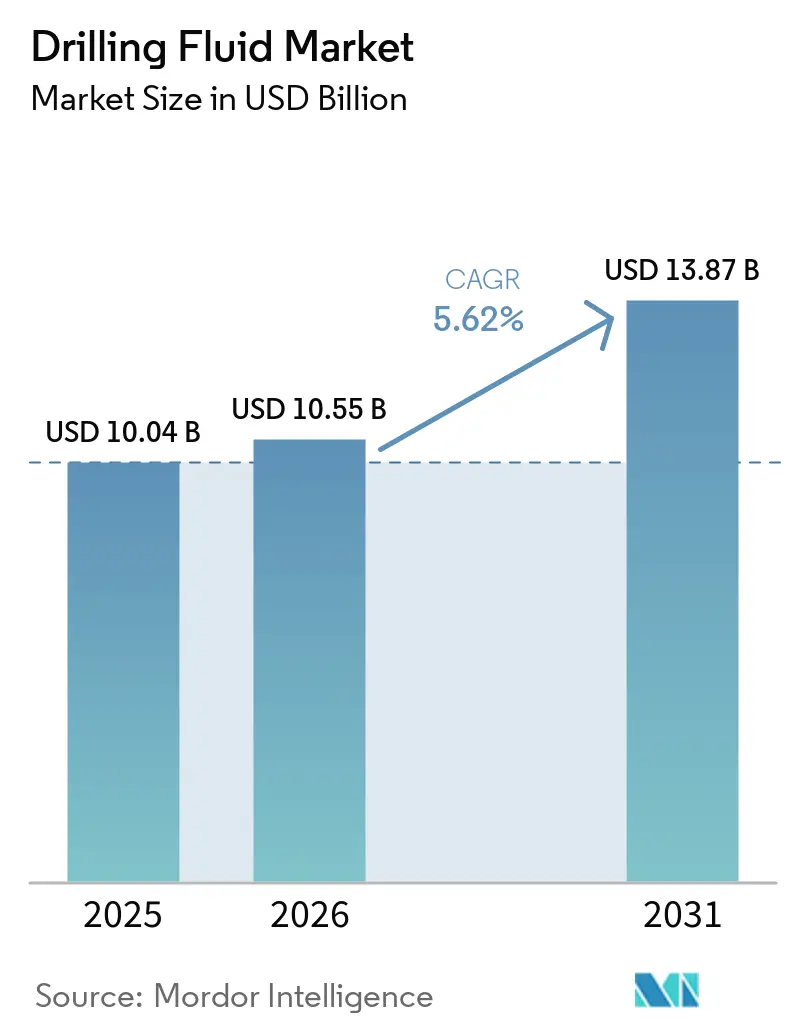
The Drilling Fluid Market size is projected to be USD 10.04 billion in 2025, USD 10.55 billion in 2026, and reach USD 13.87 billion by 2031, at a CAGR of 5.62% from 2026 to 2031. Demand is moving toward fluid systems designed for deepwater, high-pressure, high-temperature, and long-horizontal wells, where rheology, shale inhibition, and filtration control affect drilling performance. Operators and national oil companies are using more customized formulations and integrated service contracts rather than purchasing undifferentiated mud by volume. This shift puts pressure on suppliers that compete mainly on price, while supporting providers that combine chemistry, engineering support, waste handling, and real-time measurement. The drilling fluids market also benefits from multi-year offshore projects, which can sustain demand after approval even when short-cycle onshore drilling slows. Lower oil prices and reductions in shale rig counts remain a near-term risk, but growth in Brazil, Guyana, and offshore Africa provides some balance[1]U.S. Energy Information Administration, “Short-Term Energy Outlook, 2026,” U.S. Energy Information Administration, eia.gov.
Key Report Takeaways
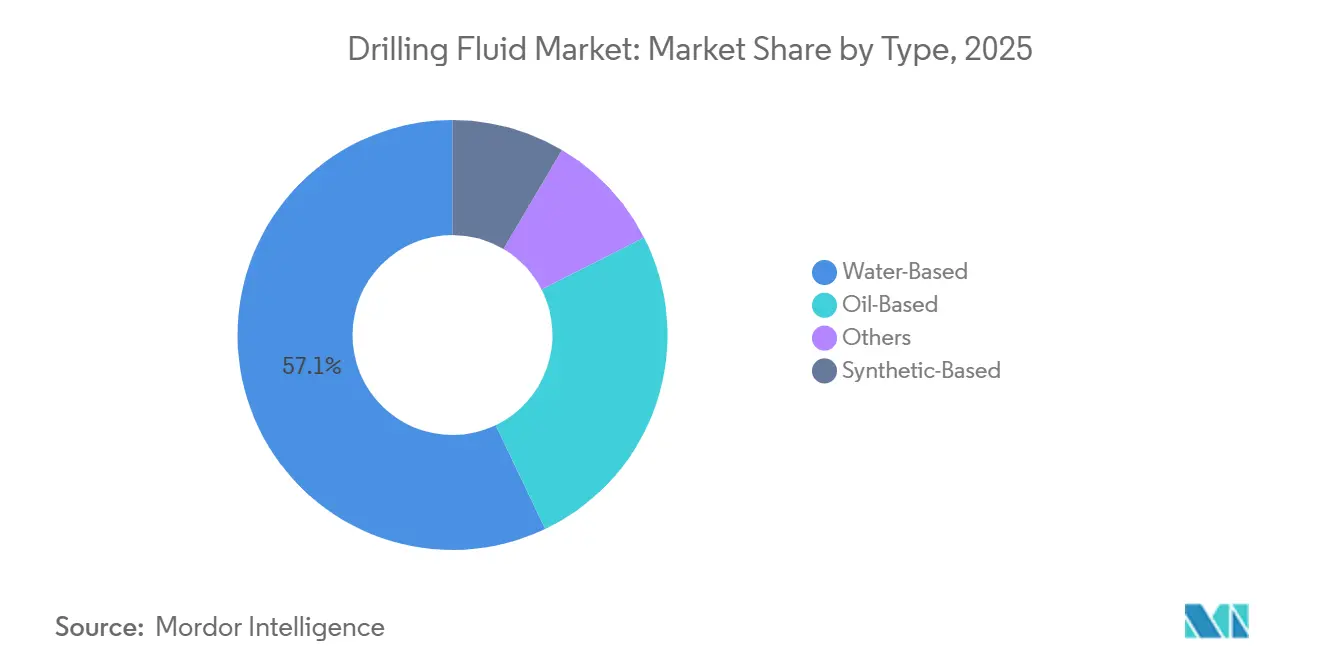
- By type, water-based drilling fluids led with 57.1% revenue share in 2025, while synthetic-based fluids are forecast to expand at a 5.9% CAGR through 2031.
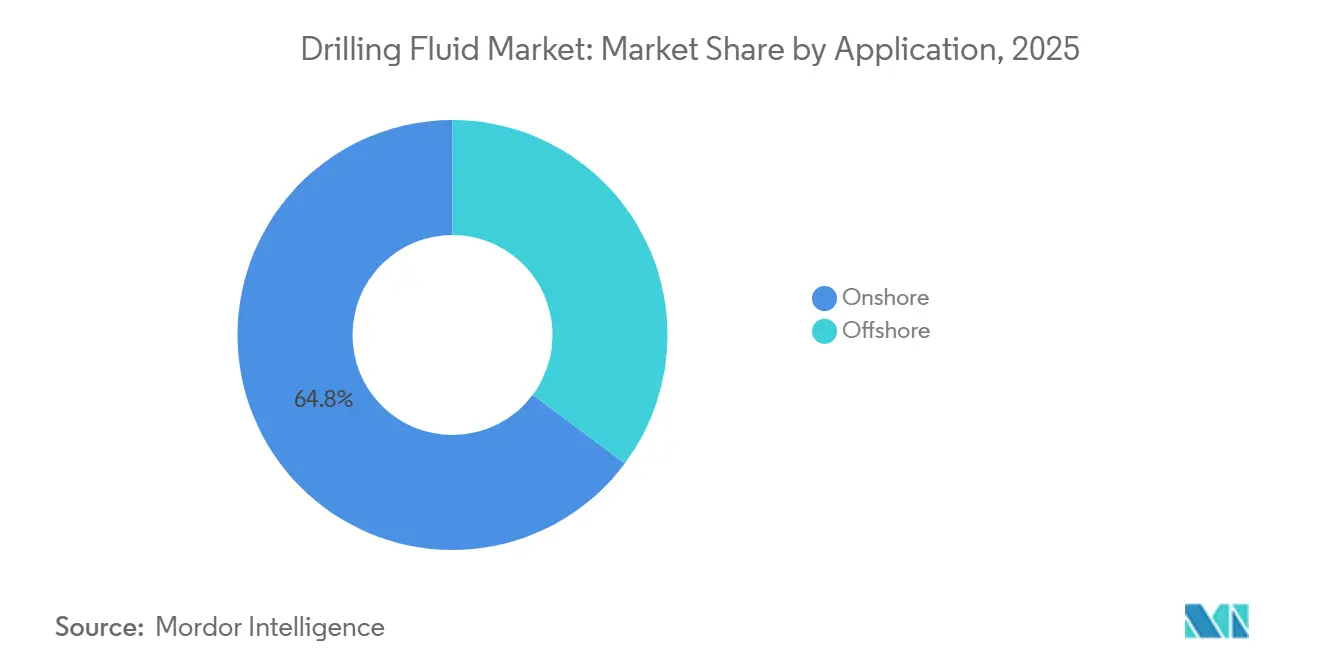
- By application, onshore drilling held 64.8% of revenue in 2025, while offshore drilling recorded the highest projected CAGR at 6.1% through 2031.
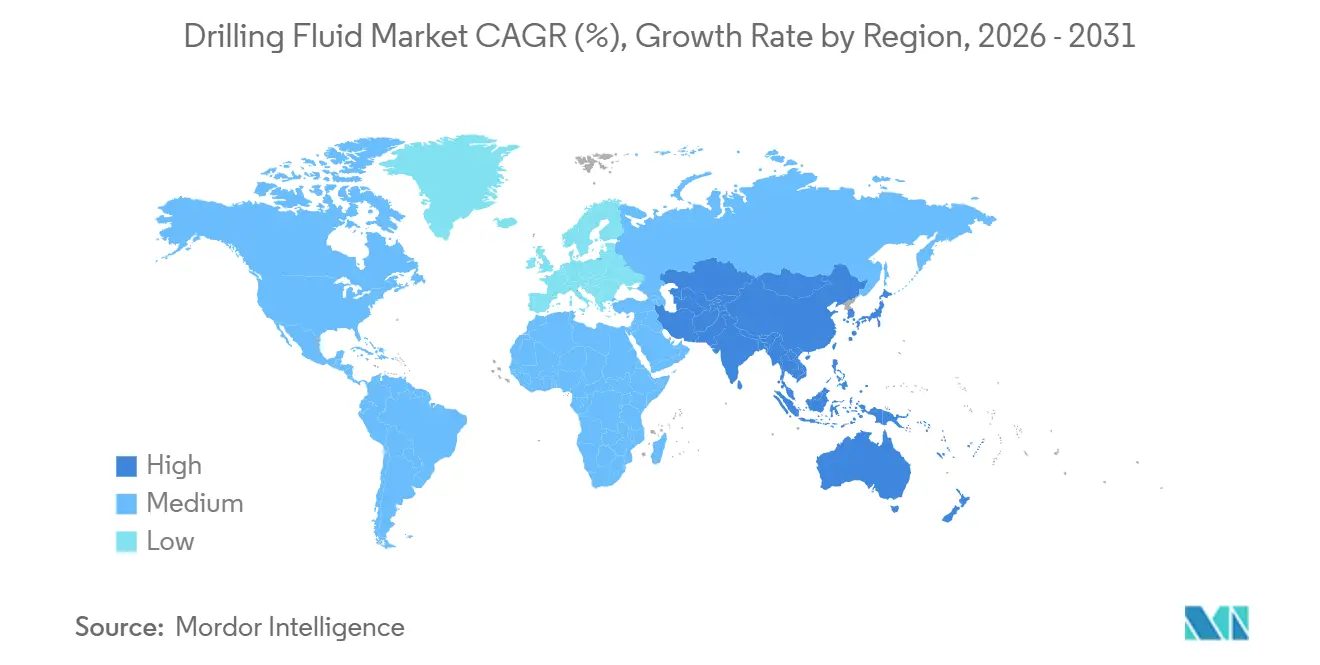
- By geography, North America accounted for 37.7% of revenue in 2025, while Asia-Pacific is forecast to grow at a 6.3% CAGR through 2031.
Note: Market size and forecast figures in this report are generated using Mordor Intelligence’s proprietary estimation framework, updated with the latest available data and insights as of January 2026.
Global Drilling Fluid Market Trends and Insights
Drivers Impact Analysis*
| Driver | (~) % Impact on CAGR Forecast | Geographic Relevance | Impact Timeline |
|---|---|---|---|
| Deepwater and Ultra-Deepwater Campaigns | +1.80% | Global; concentrated in Latin America (Brazil, Guyana), North America (Gulf of Mexico), and Europe (Norway, North Sea) | Long term (≥ 4 years) |
| Unconventional Shale and Tight-Reservoir Development | +1.20% | North America (Permian, Eagle Ford, Bakken); Latin America (Vaca Muerta); Asia-Pacific (Sichuan, Tarim) | Short term (≤ 2 years) |
| Low-Toxicity and Environmentally Compliant Fluid Adoption | +1.00% | Global; early traction in North America (EPA NPDES) and Europe (OSPAR); spilling over to APAC and Latin America | Medium term (2–4 years) |
| Real-Time Rheology Control and Digital Fluid Management | +0.70% | Global; fastest adoption in North America offshore and Europe (North Sea); expanding to Middle East and APAC | Medium term (2–4 years) |
| Spent-Mud Recycling and Reconditioning | +0.40% | Global; most active in North America (onshore shale), North Sea (regulatory pressure), and Latin America (Guyana, Brazil) | Medium term (2–4 years) |
| National Oil Company Localization and Regional Blending | +0.50% | APAC (Indonesia, Brunei, India); Middle East (Saudi Arabia, UAE); Latin America (Brazil, Guyana); Africa (Nigeria) | Long term (≥ 4 years) |
| Source: Mordor Intelligence | |||
Deepwater and Ultra-Deepwater Campaigns
Deepwater and ultra-deepwater wells require high-performance synthetic and dense water-based systems, which creates the highest fluid spending per well in the drilling fluids market. Brazil, Guyana, and West Africa are contributing to offshore supply additions and are supporting demand for premium drilling services[2]International Energy Agency, “Oil Market Report March 2026,” International Energy Agency, iea. SLB received a contract in December 2024 to support construction of more than 100 Petrobras deepwater wells in the Campos, Santos, and Espírito Santo basins, using drilling-fluid and cementing technologies on up to 9 ultra-deepwater rigs. Baker Hughes also extended integrated well construction work in Brazil’s Santos Basin during 2026, covering fluids, cementing, wireline, and geosciences services. Brazil’s pre-salt wells can pass through salt layers reaching 2,000 meters and face pressures above 10,000 psi, conditions that tighten the operating window for fluid density and wellbore stability. It also accommodates extended-reach drilling and complex long-lateral work in shale and offshore basins. These requirements raise revenue per drilled foot and favor providers that can maintain fluid performance during long, complex well sections. The drilling fluids market is also supported by spent-mud recycling and regional blending capacity, which can reduce waste obligations and shorten supply lead times near offshore projects.
Unconventional Shale and Tight-Reservoir Development
Horizontal drilling in shale and tight reservoirs uses more fluid per well than conventional vertical drilling and continues to support volume demand in the drilling fluids market. The Permian Basin remains central to this demand, although lower oil prices and capital discipline have slowed U.S. production growth and reduced activity across some basins. Long laterals above 10,000 feet and multiple landing targets keep fluid requirements high for many Permian wells. Argentina’s Vaca Muerta play is also expanding horizontal programs that need inhibitive water-based fluids for reactive Jurassic shales. China’s Sichuan and Tarim programs are moving toward complex multilateral well designs, where advanced polymer water-based fluids are used to manage deep and overpressured formations. These programs favor service companies with localized blending capacity, technical support, and reliable access to specialty materials.
Low-Toxicity and Environmentally Compliant Fluid Adoption
Environmental rules are directing formulation spending toward lower-toxicity water-based alternatives and more compliant synthetic systems in the drilling fluids market. The U.S. Environmental Protection Agency proposed changes to the Gulf of Mexico permit in January 2026, extending the acute whole-effluent-toxicity deadline for well fluids to May 2028 and adding discharge-duration reporting requirements[3]U.S. Environmental Protection Agency, “Proposed Modification of NPDES General Permit No. GMG290000,” Federal Register, govinfo.gov. These requirements reinforce the need for systems that meet discharge standards without compromising drilling performance. Brazil’s offshore monitoring requirements similarly encourage lower-impact formulations for wells that do not require the full performance envelope of synthetic fluids. Biodegradable chitosan-CMC nanocomposites reduced filtration loss from 13 mL to 7 mL per 30 minutes under high-pressure, high-temperature conditions in published 2026 research [4]“Development of Biodegradable Triazine Chitosan Nanocomposites Enhanced with Magnetic and Silica Nanoparticles for Improved Drilling Fluid Properties,” RSC Advances, rsc.org. The result is greater room for advanced water-based systems where operators can avoid cuttings collection, treatment, and onshore disposal costs.
Real-Time Rheology Control and Digital Fluid Management
Real-time measurement platforms allow suppliers in the drilling fluids market to track viscosity, density, gel strength, temperature, and filtration properties continuously rather than relying only on periodic wellsite sampling. Newpark’s RheoSense deployment with Intelligent Mud Solutions provided continuous measurement of rheology, density, gel strength, and temperature, and the system recorded more than 120,000 operating hours with more than 99.5% uptime. Digital fluid modeling has reduced additive mass by 15% and fluid dilution by 18% per cubic meter drilled in reported technical work. Baker Hughes received patents in March and April 2026 for self-adjusting alkalinity fluids and low-density invert-emulsion fluids for managed-pressure operations. Suppliers can use these capabilities to sell performance commitments around nonproductive time instead of relying only on fluid-volume pricing. Recycling and reconditioning programs support the same service model because they help operators manage total fluid cost and waste handling over an entire well program.
Restraints Impact Analysis*
| Restraint | (~) % Impact on CAGR Forecast | Geographic Relevance | Impact Timeline |
|---|---|---|---|
| Crude-Price-Driven Drilling-Budget Volatility | -1.50% | North America (US shale basins), Middle East (OPEC+ unwinding), Europe | Short term (≤ 2 years) |
| Oil-Based-Cuttings Discharge and Disposal Restrictions | -0.90% | Global; most acute in US Gulf of Mexico (EPA/BSEE 40 CFR 435), North Sea (OSPAR Convention), and Brazil (ANP) | Medium term (2–4 years) |
| Specialty Polymer and Barite Supply Tightness | -0.60% | Global; India (depleted high-grade reserves), North America (import-dependent supply chains), APAC | Short term (≤ 2 years) |
| Managed-Pressure Drilling Reducing Fluid Intensity | -0.50% | North America (offshore GoM, deepwater), Europe (North Sea), and APAC (Southeast Asian deepwater blocks) | Long term (≥ 4 years) |
| Source: Mordor Intelligence | |||
Crude-Price-Driven Drilling-Budget Volatility
Oil-price weakness is the most immediate demand risk for the drilling fluids market because operators reduce rig activity and defer well programs when expected returns decline. The Dallas Federal Reserve’s March 2025 survey reported that some operators were suspending drilling in response to potential WTI prices below USD 50 per barrel, with respondents citing reductions from 10 active wells to 5 or fewer. Baker Hughes stated in July 2026 that global E&P spending is expected to decline modestly in 2026, as growth in Latin America and offshore Africa offsets weakness in Europe and the Middle East. Strait of Hormuz disruptions added logistical and inflationary pressure at regional facilities. Raw-material availability also remains a concern because specialty polymers and barite can increase input costs and create procurement risk. Managed-pressure drilling may further reduce fluid intensity in some wells by controlling pressure more precisely, although it also increases the need for responsive fluid systems and monitoring.
Oil-Based-Cuttings Discharge and Disposal Restrictions
Discharge restrictions increase the cost and complexity of using non-aqueous drilling fluids in the drilling fluids market. U.S. rules under 40 CFR 435 require synthetic-based cuttings to meet toxicity and biodegradability criteria before discharge, while noncompliant cuttings must be moved and treated onshore. The OSPAR framework creates comparable restrictions for North Sea operations. These requirements can place a greater burden on smaller offshore operators that have fewer resources for collection, transport, and disposal. They also influence base-fluid selection early in well planning, especially in zero-discharge settings. This is supporting research into technically stronger water-based systems, while leaving commodity oil-based fluids with less room in environmentally sensitive offshore work.
*Our forecasts treat driver/restraint impacts as directional, not additive. The impact forecasts reflect baseline growth, mix effects, and variable interactions.
Segment Analysis
By Type: Water-Based Systems Lead, While Synthetic Fluids Gain in Complex Wells
Water-based drilling fluids led with 57.1% revenue share in 2025 as they are widely accepted by regulators and are suitable for high-volume onshore drilling. Their position includes standard bentonite systems as well as higher-value polymer-enhanced and nano-additive formulations. Operators in horizontal and extended-reach wells increasingly require stronger rheology control and shale inhibition than basic formulations can provide. Synthetic-based fluids are the fastest-growing type, with the drilling fluids market size for this segment forecast to increase at a 5.9% CAGR through 2031. Their thermal stability, density control, lubricity, and discharge credentials support use in high-pressure, high-temperature offshore wells. Oil-based fluids retain demand in mature Middle Eastern and Central Asian onshore plays, where wellbore-stability and lubricity needs can outweigh added compliance requirements.
The others category includes pneumatic, foam, and aerated systems used in depleted reservoirs and geothermal wells where conventional mud columns could damage the formation. Chevron Phillips Chemical and Drilling Specialties launched NanoSlide in November 2025, a graphene and Synfluid PAO lubricant that recorded a coefficient of friction below 0.05 in tribometer testing. The product was designed for extended-reach and high-pressure, high-temperature drilling conditions. Published research also found that biodegradable nanocomposites reduced filter-cake thickness from 2.5 mm to 1.5 mm while lowering high-pressure filtration loss. These developments narrow some technical gaps between water-based and synthetic systems. Fluid selection is therefore becoming more closely linked to total well cost, drilling time, waste requirements, and operating risk.



By Application: Onshore Volume Remains Larger, While Offshore Spending Grows Faster
Onshore drilling accounted for 64.8% of drilling fluids market share in 2025, supported by the large number of unconventional wells where water-based systems are common. Higher drilling efficiency can limit fluid-volume growth in this segment because longer laterals, faster penetration, and fewer sidetracks enable production with fewer wells. This effect is most visible in mature shale areas where operators are focused on capital discipline. Offshore drilling is forecast to grow at a 6.1% CAGR through 2031, supported by deepwater projects with higher fluid spending per well. Offshore wells require systems that manage wellbore pressure, thermal conditions, and discharge requirements at the same time. In May 2026, Equinor exercised options valued at NOK 8.3 billion, USD 800 million, for integrated drilling and well services involving Baker Hughes, Halliburton, and SLB across more than 22 platforms and mobile units on the Norwegian Continental Shelf.
Offshore procurement increasingly favors integrated providers that can supply fluid chemistry, waste handling, digital monitoring, and well construction support together. This makes commodity oil-based mud less suitable for many deepwater programs. In August 2026, Halliburton received an integrated drilling and appraisal contract from bp for the Bumerangue field in deepwater Brazil. The work uses LOGIX automation and remote operations to improve execution efficiency and reduce operating complexity. Deepwater commitments are also less exposed to short-term rig-count shifts after projects receive approval. This supports longer contract periods and a managed-service approach to fluid spending. The drilling fluids market benefits when suppliers can demonstrate operational outcomes rather than only the volume of product delivered.
Geography Analysis
North America held 37.7% of drilling fluids market share in 2025, supported by Permian, Eagle Ford, and Bakken shale activity, Gulf of Mexico projects, and Western Canadian operations. The region remains a global center for horizontal drilling efficiency. Lower crude prices and reduced rig counts are slowing near-term U.S. activity, although continued Permian growth partly offsets declines in conventional and offshore areas. Gulf of Mexico deepwater developments provide a more durable demand base for synthetic and advanced water-based systems. Canada’s use of pad drilling in the Montney and Duvernay plays supports demand for water-based fluids designed for montmorillonite-rich formations.
Europe is a smaller contributor to the drilling fluids market, but it includes some of the most demanding offshore fluid applications. Equinor’s 2026 contract options on the Norwegian Continental Shelf show that drilling and completion fluids remain embedded in long-cycle well-service programs. North Sea operators must meet OSPAR discharge requirements, which supports high-specification synthetic systems that can meet both high-pressure performance and biodegradability needs. Poland, Russia, and the United Kingdom add regional demand through conventional onshore work, mature North Sea projects, and workover activity. Russian projects provide volume demand, while geopolitical constraints limit access to some advanced technologies.
Asia-Pacific is forecast to record the fastest growth, with the drilling fluids market size expected to advance at a 6.3% CAGR through 2031. China’s South China Sea activity, India’s deepwater blocks, and licensing programs in Indonesia, Vietnam, Brunei, and Australia support this expansion. China represents 43% of regional fluid consumption, while water-based systems account for 67% of regional demand and synthetic formulations grew 18% in 2024 as Southeast Asian deepwater activity increased. South America is led by Brazil’s pre-salt work and Argentina’s Vaca Muerta development, which require lower-impact offshore formulations and inhibitive fluids for long shale sections. The Middle East supports high volumes of conventional mud in Saudi Arabia, the United Arab Emirates, and Iraq, while offshore West Africa is building demand for higher-specification systems in Nigeria, Algeria, and Egypt.

Competitive Landscape
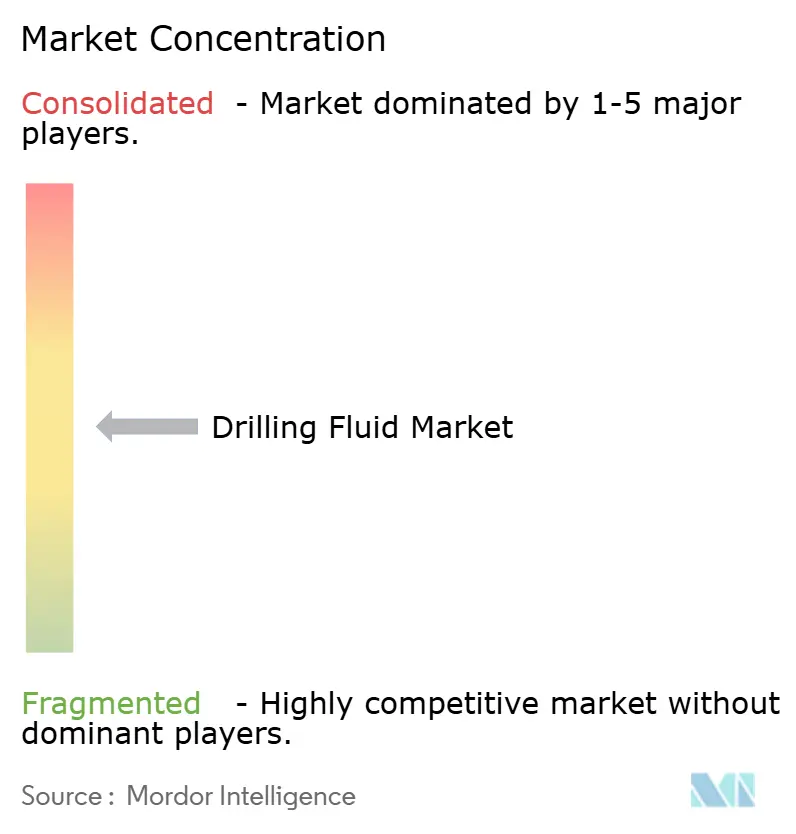
The drilling fluids market has a moderate-to-high concentration in its premium tier and remains fragmented in commodity fluid supply. SLB’s M-I SWACO, Halliburton, and Baker Hughes collectively held most revenue in 2025. Regional providers retain meaningful room in lower-cost applications. These companies use BaraLogix, OPTIDRILL, and Leucipa platforms to combine fluid services with monitoring, modeling, and performance commitments. Their advantage is based on integrated delivery and operating data as much as fluid formulation. This creates switching costs for operators that use multi-year, bundled well-service contracts.
CES Energy Solutions and Newpark compete through local supply chains, basin logistics, and contracts linked to drilling performance or nonproductive time. Newpark commissioned a liquid mud plant in the Permian Basin during the first quarter of 2026, expanded its presence through a technical center in Al Khobar, Saudi Arabia, and planned an advanced covered plant in Viggiano, Italy, for the Neptun Deep project. These moves place blending and technical capacity closer to active project areas. Baker Hughes’ March and April 2026 patents address self-adjusting alkalinity and low-density invert-emulsion systems for challenging well conditions. These actions show continued competition in both formulation design and integrated service execution.
Smaller suppliers such as Gumpro Drilling Fluids, Q’Max Solutions, and Scomi Energy Services participate where local sourcing and national oil company procurement rules favor domestic capacity. These providers can win work through local manufacturing, proximity to basins, and specialized customer support. Major suppliers respond with local joint ventures, technical licenses, and co-development arrangements with state entities. The drilling fluids industry therefore includes both global technology competition and regional supply-chain competition. Localization mandates in Indonesia, Brunei, India, Saudi Arabia, the United Arab Emirates, Brazil, Guyana, and Nigeria increase the value of in-country blending and service capability. The drilling fluids market remains open to regional challengers, but complex deepwater projects favor established integrated providers.
Drilling Fluid Industry Leaders
Schlumberger Limited
Halliburton Company
Baker Hughes Company
Weatherford International plc
Newpark Resources Inc.
- *Disclaimer: Major Players sorted in no particular order

Recent Industry Developments
- August 2026: Halliburton was awarded an integrated drilling and appraisal contract by bp for the first campaign in the Bumerangue field, offshore deepwater Brazil. The contract scope covers a comprehensive suite of drilling and evaluation services, with LOGIX™ automation and remote operations deployed to optimize reservoir evaluation and reduce operational complexity through multi-service consolidation in a frontier deepwater discovery.
- May 2026: Baker Hughes extended its integrated well construction contract with Petrobras across Brazil's Santos Basin, expanding the scope of a services agreement first announced in early 2024. The extension deploys the AutoTrak™ rotary steerable system, Dynamus extended-life drill bits, and a full suite of fluids, cementing, wireline, and geosciences services to accelerate pre-salt resource development in one of the world's most technically demanding deepwater environments.
- January 2026: The U.S. EPA proposed a modification to NPDES General Permit GMG290000 for the Gulf of Mexico's Outer Continental Shelf, extending the acute whole effluent toxicity (WET) compliance deadline for well treatment, completion, and workover fluids from May 2025 to May 2028, while adding discharge-duration reporting requirements. The modification effectively sets the compliance timeline for the next generation of low-toxicity fluid systems that offshore operators will need to deploy to meet long-term WET standards in the Gulf of Mexico.
- April 2025: SLB commenced delivery of integrated services under its December 2024 contract with Petrobras for offshore fields across the Campos, Santos, and Espírito Santo basins. The contract covers construction of more than 100 deepwater wells on up to 9 ultra-deepwater rigs using advanced drilling fluids and cementing technologies, with locally sourced equipment and services prioritized in line with Brazil's local content requirements.


Global Drilling Fluid Market Report Scope
Drilling fluids, also known as drilling muds, are specially formulated liquids circulated through a wellbore during drilling operations. They lubricate and cool the drill bit, carry drilled rock cuttings to the surface, control formation pressure, stabilize the wellbore, and prevent formation fluids from entering the well. Drilling fluids typically consist of a base fluid (water, oil, or synthetic fluid) combined with additives such as weighting agents, viscosifiers, fluid-loss-control materials, shale inhibitors, and lubricants.
The Drilling Fluid Market is segmented by type, application, and geography. By type, the market is segmented into water-based, oil-based, synthetic-based, and other drilling fluids. By application, the market is segmented into onshore and offshore drilling. The report also covers the market size and forecasts for the global drilling fluid market across 24 countries within the regions. For each segment, the market sizing and forecasts have been provided on the basis of value (USD).
| Water-Based |
| Oil-Based |
| Synthetic-Based |
| Others |
| Onshore |
| Offshore |
| North America | United States |
| Canada | |
| Mexico | |
| Europe | Germany |
| France | |
| Italy | |
| United Kingdom | |
| Poland | |
| Russia | |
| Rest of Europe | |
| Asia-Pacific | China |
| India | |
| Australia | |
| Indonesia | |
| Vietnam | |
| Brunei | |
| Thailand | |
| Rest of Asia-Pacific | |
| South America | Brazil |
| Argentina | |
| Chile | |
| Rest of South America | |
| Middle East and Africa | Saudi Arabia |
| United Arab Emirates | |
| Egypt | |
| Nigeria | |
| Algeria | |
| Rest of Middle East and Africa |
| By Type | Water-Based | |
| Oil-Based | ||
| Synthetic-Based | ||
| Others | ||
| By Application | Onshore | |
| Offshore | ||
| By Geography | North America | United States |
| Canada | ||
| Mexico | ||
| Europe | Germany | |
| France | ||
| Italy | ||
| United Kingdom | ||
| Poland | ||
| Russia | ||
| Rest of Europe | ||
| Asia-Pacific | China | |
| India | ||
| Australia | ||
| Indonesia | ||
| Vietnam | ||
| Brunei | ||
| Thailand | ||
| Rest of Asia-Pacific | ||
| South America | Brazil | |
| Argentina | ||
| Chile | ||
| Rest of South America | ||
| Middle East and Africa | Saudi Arabia | |
| United Arab Emirates | ||
| Egypt | ||
| Nigeria | ||
| Algeria | ||
| Rest of Middle East and Africa | ||


Key Questions Answered in the Report
What is the expected growth rate for drilling fluids through 2031?
The sector is forecast to grow at a 5.62% CAGR from 2026 to 2031, reaching USD 13.87 billion by 2031. Growth is tied to more demanding offshore wells, advanced formulations, and integrated fluid-management contracts. The outlook also reflects higher spending per well where complex geology requires tighter control of density, filtration, and wellbore stability. It also accommodates extended-reach drilling and complex long-lateral work in shale and offshore basins.
Which drilling fluid type has the largest share?
Water-based drilling fluids led with 57.1% of revenue in 2025 because of their cost position, regulatory acceptance, and broad use in onshore wells. Polymer and nano-enhanced versions also address more demanding applications.
Which application is growing fastest?
Offshore drilling is expected to grow at a 6.1% CAGR through 2031. Deepwater work requires reliable fluid performance under high pressure and temperature, and it supports integrated services that combine chemistry, monitoring, and waste management.
Which region is growing fastest for drilling-fluid demand?
Asia-Pacific is forecast to expand at a 6.3% CAGR through 2031, supported by offshore activity in China, India, Southeast Asia, and Australia. China’s South China Sea programs and regional licensing activity are central to this outlook.
How are environmental rules affecting fluid selection?
Discharge rules are increasing demand for lower-toxicity water-based and compliant synthetic systems, especially in the Gulf of Mexico and North Sea. These rules also raise the cost of handling noncompliant cuttings and favor fluid systems designed for disposal requirements.
Page last updated on:





