
Dimethylaminopropylamine (DMAPA) Market Size and Share
Market Overview
| Study Period | 2021 - 2031 |
|---|---|
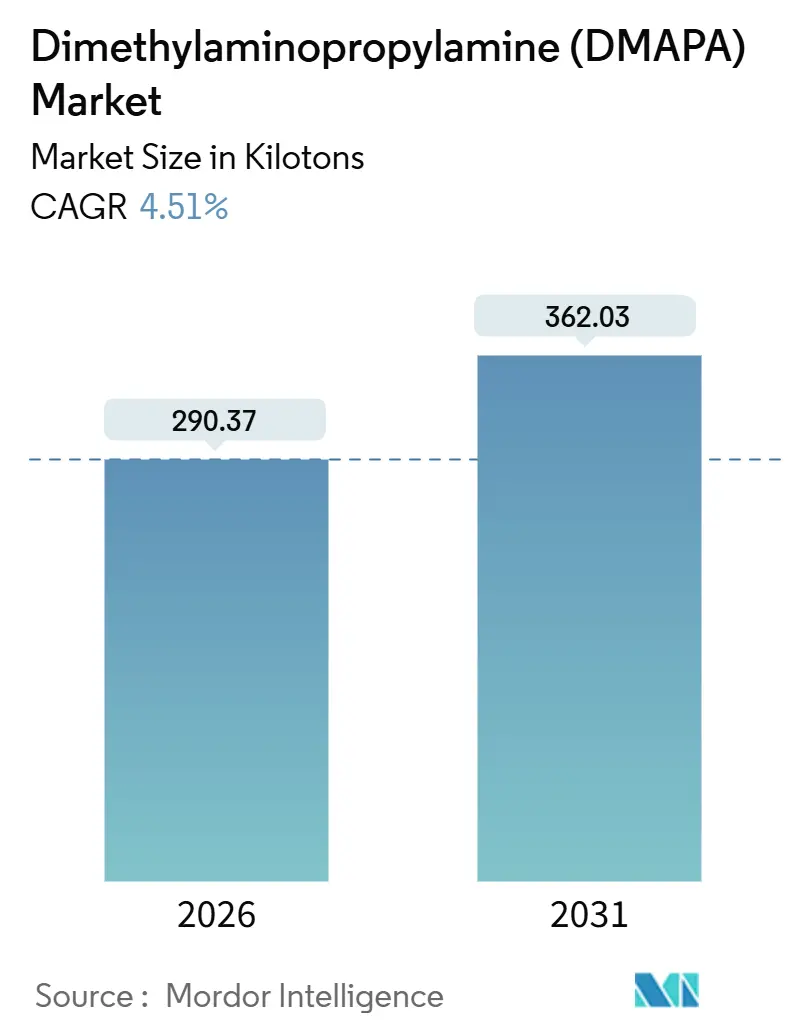
| Market Volume (2026) | 290.37 kilotons |
| Market Volume (2031) | 362.03 kilotons |
| Growth Rate (2026 - 2031) | 4.51 % |
| Fastest Growing Market | Asia Pacific |
| Largest Market | Asia Pacific |
| Market Concentration | Medium |
Major Players *Disclaimer: Major Players sorted in no particular order Image © Mordor Intelligence. Reuse requires attribution under CC BY 4.0. | |
Dimethylaminopropylamine (DMAPA) Market Analysis by Mordor Intelligence
The Dimethylaminopropylamine Market size is estimated at 290.37 kilotons in 2026, and is expected to reach 362.03 kilotons by 2031, at a CAGR of 4.51% during the forecast period (2026-2031). The Dimethylaminopropylamine market’s short-term outlook benefits from rising demand for cocamidopropyl betaine surfactants, low-emission polyurethane catalysts, and water-treatment flocculants, even as feedstock swings and stricter cosmetic limits challenge margins. Capacity additions in China and India are lifting global nameplate output, while renewable electricity transitions in Nanjing and Jurong Island plants help suppliers defend prices against carbon-focused buyers. Downstream personal-care formulators, automotive OEMs, and epoxy-coating manufacturers are accepting modest cost increases to secure low-VOC chemistries and bio-circular grades. Regional price gaps persist: Asia-Pacific maintains the lowest ex-works cost base, whereas European buyers pay a 15-20% premium for pharmaceutical or cosmetic grade material that meets EU Annex III nitrosamine limits.
Key Report Takeaways
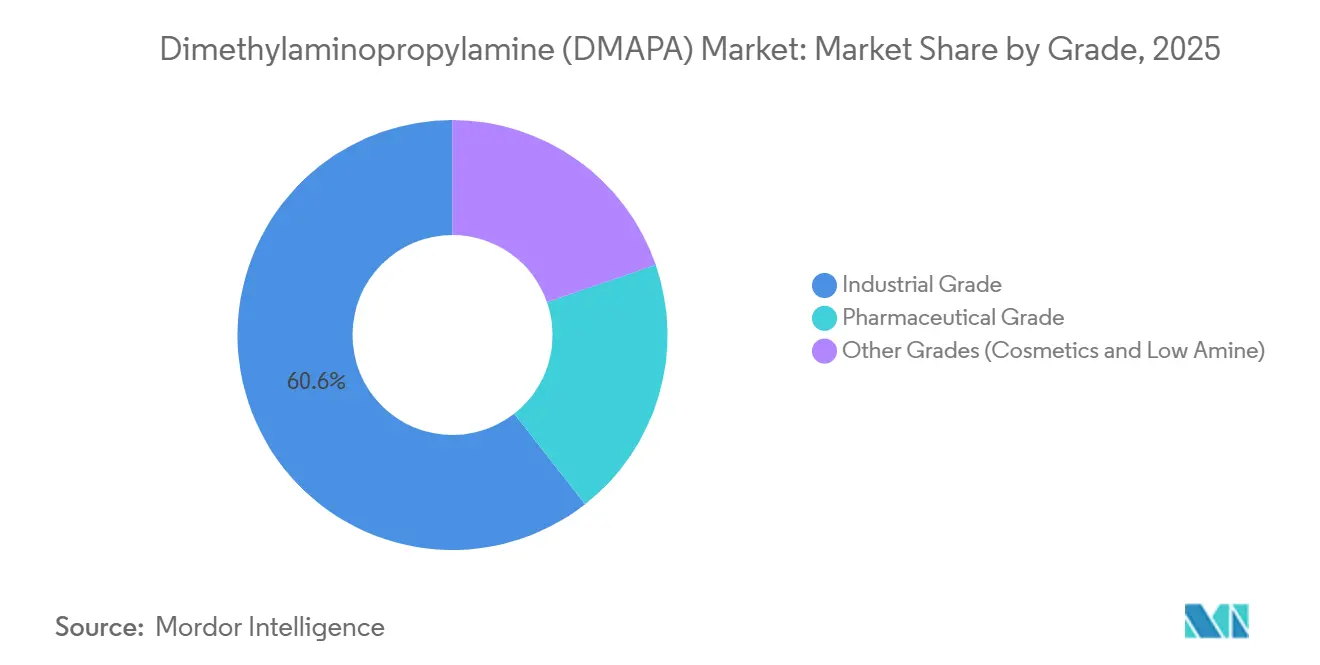
- By grade, industrial grade commanded 60.58% of the Dimethylaminopropylamine market share in 2025, while other grades that include cosmetics and low amine are projected to grow at a 4.91% CAGR.
- By application, beauty and personal care surfactants led with 49.35% share in 2025; the segment is forecast to expand at a 4.98% CAGR through 2031.
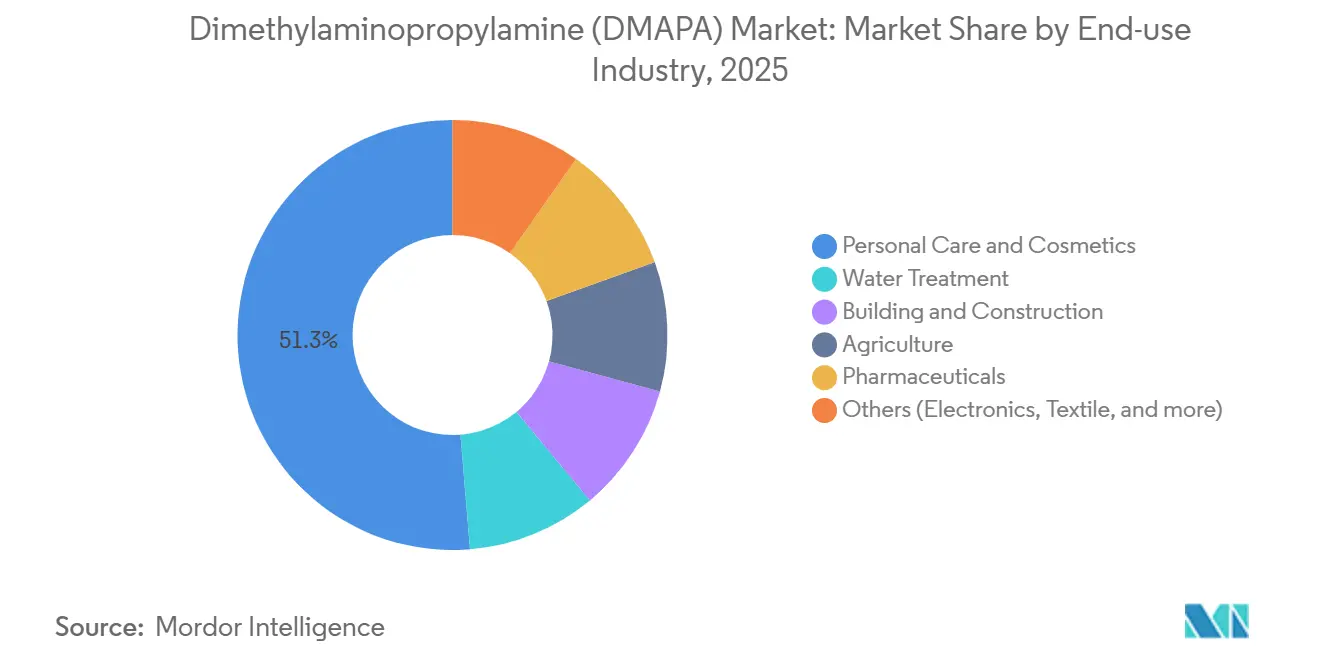
- By end-use industry, personal care and cosmetics led with 51.29% share in 2025; the segment is forecast to expand at a 5.10% CAGR through 2031.
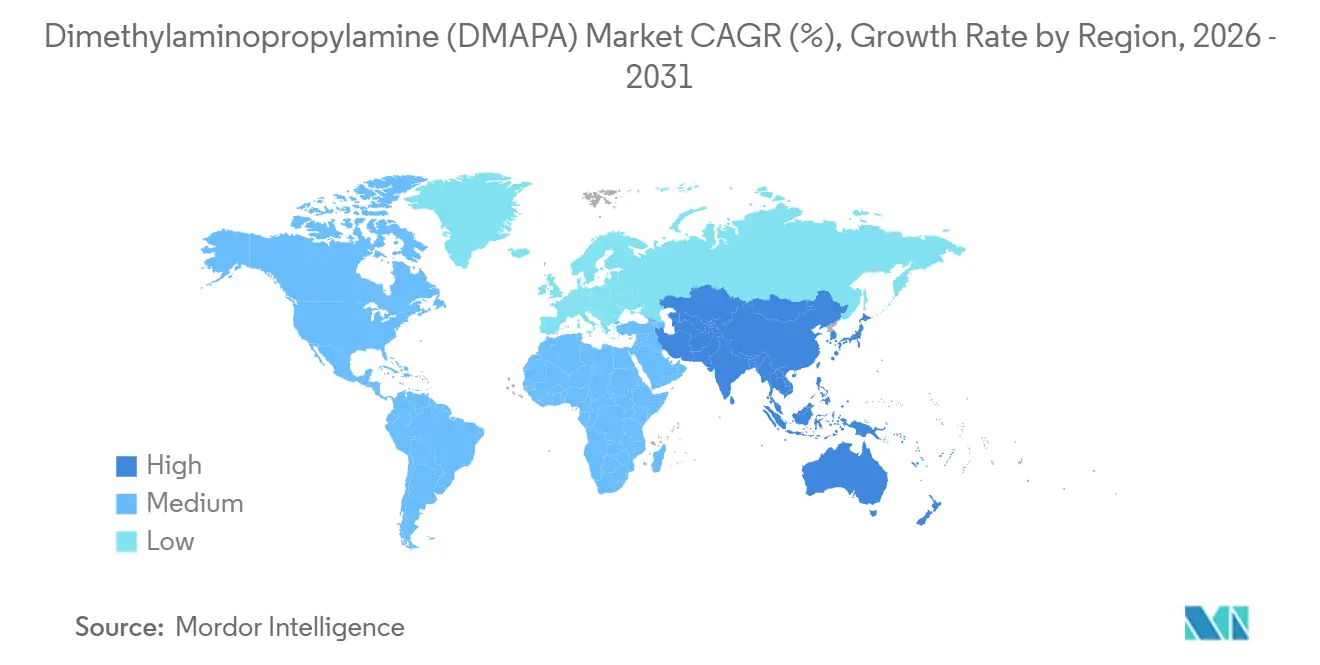
- By region, Asia-Pacific captured 42.55% of the 2025 market share and is forecast to grow at a 5.02% CAGR.
Note: Market size and forecast figures in this report are generated using Mordor Intelligence’s proprietary estimation framework, updated with the latest available data and insights as of January 2026.
Market Trends and Insights
Drivers Impact Analysis of Dimethylaminopropylamine (DMAPA) Market*
| Driver | (~) % Impact on CAGR Forecast | Geographic Relevance | Impact Timeline |
|---|---|---|---|
| Rapid shift to mild, CAPB-based surfactants in hair- and skin-care formulations | +1.20% | Global, with highest adoption in North America, Western Europe and urban Asia-Pacific | Medium term (2-4 years) |
| Regulatory push for formaldehyde-free, low-VOC chemistries in coatings and PU foams | +0.90% | North America & EU (EPA 40 CFR Part 59, EU Directive 2004/42/EC), spillover to APAC export-oriented manufacturers | Short term (≤ 2 years) |
| Asia-Pacific capacity expansions for batch and continuous DMAPA plants | +1.00% | APAC core (China, India), spillover to MEA and South America via exports | Medium term (2-4 years) |
| Emergence of bio-circular DMAPA via ISCC-PLUS certified feedstocks | +0.60% | EU and North America (driven by Scope 3 carbon accounting), early adoption in APAC by multinational subsidiaries | Long term (≥ 4 years) |
| Growing OEM additive packages for electric-vehicle coolants and lubricants | +0.50% | Global, concentrated in automotive hubs (Germany, US, China, South Korea, Japan) | Medium term (2-4 years) |
| Source: Mordor Intelligence | |||
Rapid Shift to Mild, CAPB-Based Surfactants in Hair- and Skin-Care Formulations
Shampoo and body-wash brands are replacing sodium lauryl sulfate with cocamidopropyl betaine to meet irritation-free claims and regulatory guidance on chronic skin exposure. Each tonne of CAPB uses about 0.35 tonnes of DMAPA, so every reformulation cycle lifts demand for high-purity amine feedstock. Syensqo earned ISCC PLUS certification at Zhangjiagang in 2023, enabling bio-circular Dimethylaminopropylamine that lowers Scope 3 footprints by up to 30%[1]Syensqo, “Zhangjiagang Site Gains ISCC PLUS Certification,” syensqo.com. Personal-care suppliers in the United States and Germany now lock in multi-year purchase agreements for low-amine grades, while Chinese contract manufacturers ramp batch tolling to supply regional indie brands. Urban consumers in Seoul, Shanghai, and Los Angeles drive double-digit growth in premium mild cleansers, anchoring the Dimethylaminopropylamine market in value-added segments.
Regulatory Push for Formaldehyde-Free, Low-VOC Chemistries in Coatings and PU Foams
The U.S. 40 CFR Part 59 rule and EU Directive 2004/42/EC cap VOC content in decorative paints, prompting formulators to swap solvent-borne hardeners for DMAPA-derived waterborne systems[2]U.S. EPA, “40 CFR Part 59 Architectural Coatings,” epa.gov. Huntsman’s JEFFCAT LE-340 meets VDA-278 emission thresholds for automotive seating, and orders surged after German OEMs mandated low-emission catalysts in new electric-vehicle interiors. Evonik embeds DMAPA into its Ancamine line to cut drying time in high-solids primers, giving coatings producers a way to comply without sacrificing throughput. The regulatory clampdown converts compliance cost into volume upside for continuous-process producers that can guarantee residual amine below 0.2%.
Asia-Pacific Capacity Expansions for Batch and Continuous Plants
BASF doubled Nanjing output in July 2025, taking global capacity to about 85,000 MT yr and switching the site to 100% renewable electricity. Evonik broke ground on a specialty-grade line at the same hub in November 2024, reinforcing Jiangsu’s status as the epicenter of Dimethylaminopropylamine market growth. In India, Alkyl Amines approved up to USD 18 million for 4,000 MT of new specialty capacity at Dahej, targeting pharmaceutical-grade niches. Continuous hydrogenation systems lower residuals but cost USD 50-80 million per 10,000 MT, limiting adoption to large multinationals. The near-term result is an oversupply of industrial grade and a persistent shortfall of cosmetic grade, preserving the 15-20% premium.
Emergence of Bio-Circular DMAPA via ISCC PLUS Certified Feedstocks
The ISCC PLUS list now covers N, N-dimethyl-1,3-propanediamine, enabling mass-balance tracking from renewable naphtha to finished amine. Nouryon certified its green ethylene-oxide chain in June 2024, giving downstream surfactant makers an audited renewable carbon claim. BASF signed an offtake deal for 100,000 t yr of Indian green ammonia in October 2024, locking low-carbon hydrogen for European amines without major capex. Bio-circular Dimethylaminopropylamine commands a 25-35% premium, but upcoming EU CSRD rules will make product-level Scope 3 disclosures mandatory, widening adoption from prestige shampoos to mass-retail hair care.
Restraints Impact Analysis of Dimethylaminopropylamine (DMAPA) Market*
| Restraint | (~) % Impact on CAGR Forecast | Geographic Relevance | Impact Timeline |
|---|---|---|---|
| Volatility in acrylonitrile and dimethylamine feedstock pricing | -0.7% | Global, most acute in regions without vertical integration (Europe, North America import-dependent facilities) | Short term (≤ 2 years) |
| Stricter EU cosmetic limits on residual DMAPA | -0.4% | EU, with spillover to export-oriented APAC and North American suppliers targeting EU market | Medium term (2-4 years) |
| High capex for explosion-proof continuous hydrogenation systems | -0.3% | Global, particularly constraining for mid-tier producers in India, Southeast Asia and Latin America | Long term (≥ 4 years) |
| Source: Mordor Intelligence | |||
Volatility in Acrylonitrile and Dimethylamine Feedstock Pricing
Spot acrylonitrile and dimethylamine swung by more than 20% inside 2025, eroding margins for producers without captive upstream units. Huntsman’s Performance Products EBITDA slid 24% on cost pass-through lags, highlighting exposure in merchant-purchase regions. BASF’s Verbund model at Ludwigshafen and Nanjing shelters earnings by integrating propylene oxide and ammonia on-site. Mid-tier Indian and Southeast Asian firms that buy methanol or propylene at market rates face working-capital strain when feedstocks spike, forcing some to idle reactors to avoid losses.
Stricter EU Cosmetic Limits on Residual DMAPA
Annex III of EU Regulation 1223/2009 caps secondary amines at 0.5% and nitrosamines at 50 µg kg, pushing personal-care buyers toward pharmaceutical-grade material. Continuous plants now run extra purification and real-time analytics, adding 12-18% to conversion cost. Asian batch producers risk losing access to the 260 million-unit EU shampoo market unless they retrofit columns or outsource polishing to tollers in Singapore or Germany. North American brands pre-emptively adopt EU-compliant specs to keep global SKUs harmonized, spreading the compliance premium across hemispheres.
*Our forecasts treat driver/restraint impacts as directional, not additive. The impact forecasts reflect baseline growth, mix effects, and variable interactions.
Dimethylaminopropylamine (DMAPA) Market Segment Analysis
By Grade:
Premium Variants Gain MomentumIndustrial grade dominated with 60.58% volume in 2025, but price discounts widened as new Chinese lines targeted water-treatment and agrochemical blenders. Pharmaceutical and Cosmetic grades, grouped as “Other Grades” in earlier audits, are expanding at a 4.91% CAGR as EU Annex III and Good Manufacturing Practice rules tighten. BASF’s Nanjing upgrade dedicated extra trays to high-purity cuts, while Evonik’s 2024 project embeds continuous hydrogenation and inline GC analytics to keep residual secondary amine below 0.2% (evonik.com). The Dimethylaminopropylamine market size for premium grades reached about 115 kilotons in 2026 and is on track to cross 150 kilotons by 2031.
Syensqo’s bio-circular cosmetic grade sells at a 25-35% premium, attracting luxury shampoo makers eager for Europe’s Green Deal labeling advantage. Huntsman leverages GMP-certified lines in Singapore to supply EDC coupling agents in peptide drug synthesis, where lot traceability outweighs price sensitivity. This three-tier structure, industrial, pharmaceutical, and bio-circular, locks in higher average selling prices even as commodity margins compress.



By Application:
Personal Care Leads, PU Catalysts AccelerateBeauty and Personal Care Surfactants absorbed 49.35% of the 2025 volume, underpinned by the pivot from SLS to DMAPA-based CAPB in mass and salon hair care. The segment moves roughly in line with premium shampoo launch velocity, translating to a 4.98% CAGR through 2031. Polyurethane Foam Catalysts trail in size but climb faster on strict in-cabin emission rules for electric cars; Huntsman’s LE-340 catalyst alone lifted DMAPA use in flexible seats by almost 9% year over year.
Water-treatment flocculants and epoxy-resin hardeners form the second application cluster, benefiting from infrastructure upgrades in Asia and repaint cycles in the EU. The Dimethylaminopropylamine market size tied to epoxy systems is catching up as wind-turbine blade makers push for rapid-cure primers. Overall, high-value downstream uses cushion the Dimethylaminopropylamine market against cyclical softness in industrial cleaning and oilfield chemicals.
By End-Use Industry:
Personal Care and Cosmetics Outpace Industrial SegmentsIn 2025, Personal Care and Cosmetics end-users accounted for 51.29% of the volume and are projected to grow at a 5.10% CAGR through 2031, driven by clean-beauty claims and Scope 3 carbon reduction targets. Reformulations by Procter & Gamble, Unilever, and Henkel to replace SLS with CAPB are boosting DMAPA consumption. The Building and Construction sector benefits from DMAPA's use in epoxy curing agents for industrial flooring, wind turbine blade coatings, and architectural paints, supported by infrastructure investments in Asia-Pacific and green building standards in Europe. Water Treatment demand, concentrated in municipal and industrial sectors, is driven by tertiary amines improving flocculation efficiency and China's 14th Five-Year Plan.
Pharmaceuticals, though smaller in volume, represent a high-value segment where DMAPA is used in peptide coupling reagents like EDC and API intermediates, with GMP-compliant material commanding a premium. Molkem Pharmaceuticals in India highlights domestic capability for pharmaceutical-grade DMAPA derivatives. The 'Others' category, including Electronics and Textiles, remains stable, with modest growth in electronics tied to EV battery production. Huntsman’s diverse clientele spans automotive additives, industrial cleaning, coatings, and composites, reflecting broad end-use demand. The shift toward personal care and pharmaceuticals, requiring high-grade DMAPA, sustains premium pricing and drives investments in continuous hydrogenation systems.
Geography Analysis
APAC Dimethylaminopropylamine (DMAPA) Market
Asia-Pacific anchored 42.55% of 2025 demand, with a 5.02% CAGR outlook as Chinese and Indian producers integrate propylene oxide, dimethylamine, and renewable power onsite. BASF’s July 2025 doubling of Nanjing capacity secured local supply for Jiangsu’s personal-care contract manufacturers, while Evonik’s adjacent build targets pharmaceutical and low-amine variants. India, buoyed by Alkyl Amines and Balaji Amines expansions, shifts from a net importer to a balanced trade, yet still relies on Chinese propylene intermediates.
North America Dimethylaminopropylamine (DMAPA) Market
In North America, Huntsman opened its Conroe E-GRADE unit in May 2025, aiming at semiconductor wet-process chemicals, an emerging high-purity pocket. US buyers absorb higher delivered costs than Asian peers but value local supply and regulatory certainty. Mexico’s near-shoring boom in autos and personal-care filling plants nudges regional uptake, though the country remains import-dependent.
Europe Dimethylaminopropylamine (DMAPA) Market
In Europe, producers grapple with energy surcharges yet win on premium price points because Annex III compliance filters supply. BASF took full control of the Chalampé amine-precursor site in July 2025, increasing feedstock security for specialty amines in the bloc. Demand tilts to cosmetic and epoxy hardener grades, sustaining the Dimethylaminopropylamine market despite flat macro consumption.
South America and MEA Dimethylaminopropylamine (DMAPA) Market
In South America and Middle East and Africa, Brazil’s personal-care clusters in São Paulo and Minas Gerais drive imports, while Saudi Arabia’s Jubail site supplies oilfield service chains that value DMAPA corrosion-inhibitor precursors. Longer lead times and currency swings temper growth, but do not change the underlying upward trajectory tied to population expansion and infrastructure spend.

Regulatory Landscape
Dimethylaminopropylamine (DMAPA) is a high-volume substance registered under the EU REACH framework and listed in major chemical inventories such as the US EPA TSCA Inventory, China IECSC, and Korea KECL. As a result, compliance activity centers on registration maintenance, SDS and label alignment, and downstream use communication.
In cosmetics, EU Regulation (EC) No 1223/2009 (Annex III) restrictions on secondary amines and nitrosamines effectively raise the bar for low-residual material. That has supported demand for tighter specifications and traceability for suppliers selling into EU personal-care value chains. Regulatory attention in Europe also includes discussion around harmonized classification under the ECHA CLH process, with public commentary in late 2025 (including submissions by HEAL) pointing to scrutiny of hazard classification outcomes for DMAPA. In the United States, the TSCA framework and EPA risk-evaluation procedures guide how producers and importers track prioritization and data needs for high-volume chemicals. Export-oriented manufacturers then align documentation and quality controls to support cross-region market access.
Value Chain Analysis
The DMAPA value chain starts with upstream feedstocks and utilities: dimethylamine and acrylonitrile are converted to dimethylaminopropionitrile (DMAPN), which is then hydrogenated to DMAPA using catalysts (commonly nickel-based) and hydrogen. Purification steps determine whether the output is industrial, pharmaceutical, or low-amine/cosmetic grade. Integrated producers with advantaged access to feedstocks, hydrogen, and energy, or with captive intermediates, generally manage cost swings and consistency better than merchant-only or toll-dependent players.
In the midstream stage, producers sell neat DMAPA through direct contracts and distributors to downstream formulators. For applications in personal care, catalysts, and epoxy hardeners, quality assurance (residual amine control, batch traceability, and analytics) becomes a differentiator. Supply-chain shaping actions include BASF expanding DMAPA capacity at its Nanjing site (startup in July 2025) and Eastman starting DMAPA ES production at St. Gabriel, Louisiana (April 2025). These steps improve regional supply options and support specification-driven procurement by surfactant and specialty chemical customers.
Competitive Landscape
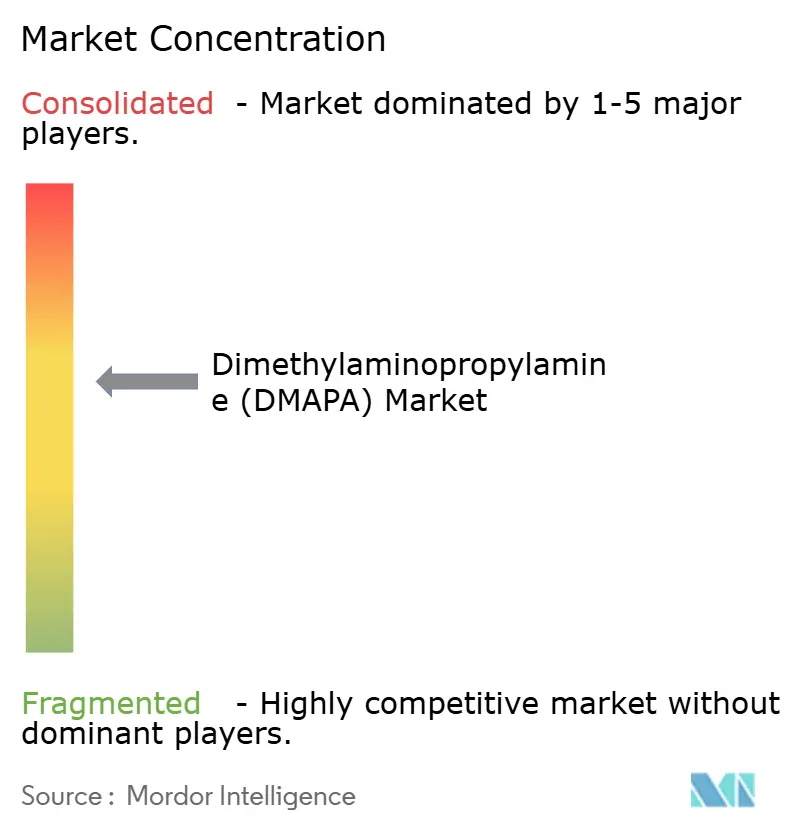
The Dimethylaminopropylamine (DMAPA) market is moderately consolidated. Mid-tier Asian firms such as Alkyl Amines and Hubei Jusheng pursue industrial grade volumes at discount prices, leveraging lower labor costs. Patent filings around low-emission catalysts (CN111748068B) and reactive amine epoxy agents (EP2042534A1) show how incumbents defend their share with application know-how. Huntsman pivots to electronics amines with its Conroe upgrade, chasing higher margins amid commodity oversupply. The competitive picture thus splits between scale leaders investing in sustainability and technology, and regional challengers focusing on cash-flow plays in bulk segments.
Dimethylaminopropylamine (DMAPA) Industry Leaders
BASF SE
Eastman Chemical Company
Huntsman International LLC
Alkyl Amines Chemicals Ltd.
Syensqo
- *Disclaimer: Major Players sorted in no particular order
Dimethylaminopropylamine (DMAPA) Market Companies Covered in this Report
- BASF
- Alkyl Amines Chemicals Ltd.
- Arkema
- Eastman Chemical Company
- Evonik Industries AG
- Hefei TNJ Chemical Industry Co.
- Hubei Jusheng Technology Co., Ltd.
- Huntsman International LLC
- Jinan HNA Chemical Co. Ltd
- Merck KGaA
- Prasol Chemicals Pvt Ltd
- Shandong Zhishang Chemical Co. Ltd
- Syensqo
- Tokyo Chemical Industry Co., Ltd. (TCI)

Market Opportunities and Future Outlook
A clear opportunity exists in premium, low-residual DMAPA supply for personal care surfactants. EU Cosmetics Regulation (EC) No 1223/2009 (Annex III) and nitrosamine-related limits pull demand toward tighter specifications and validated quality systems. That mix shift favors producers that can run low-amine cuts consistently and document compliance, which in turn supports longer-term supply agreements from multinational formulators that harmonize global SKUs to EU-grade requirements.
Sustainability-linked grades and audited mass-balance pathways also remain a defined whitespace, anchored by producer actions rather than broad demand assumptions. Eastman began producing DMAPA ES at St. Gabriel in April 2025 using renewable raw materials, and BASF expanded DMAPA output at Nanjing with the site transition to renewable electricity noted in the report context. Supply is also showing more sensitivity to energy and logistics, evidenced by BASF and Eastman announcing multiple DMAPA price increases across Europe and North America in 2026, which encourages downstream users in surfactants, coatings, and polyurethane catalysts to diversify sourcing and qualify additional suppliers and grades.
Recent Industry Developments in Dimethylaminopropylamine (DMAPA) Market
- July 2026: Eastman announced an increase in DMAPA prices in North America effective July 15, 2026. The move followed earlier 2026 adjustments and signaled continued tightening in delivered-cost economics for amines, influencing procurement strategies for CAPB surfactants and other DMAPA-derived chemistries.
- October 2025: BASF marked the 10th anniversary of its DMAPA and polyetheramine (PEA) production at Nanjing and highlighted the expansion and startup of enlarged facilities at the site. The added nameplate capacity strengthened Asia-Pacific supply availability and reinforced the role of large integrated hubs in meeting industrial- and specialty-grade requirements.
- June 2024: Nouryon certified its green ethylene-oxide chain under ISCC PLUS, expanding audited renewable-carbon claims available to downstream surfactant value chains. This supported broader mass-balance adoption for amphoteric surfactant producers that purchase DMAPA as a key input and market lower-footprint formulations.


Dimethylaminopropylamine (DMAPA) Market Report Scope and Research Methodology
Market Definition and Coverage
This market covers the demand and supply of neat dimethylaminopropylamine (DMAPA) as a chemical intermediate. Volume is counted as consumed tons by downstream users across regions and end-use industries.
Scope exclusions: downstream formulated products that already contain DMAPA-derived ingredients, such as finished personal care formulations, are not counted as DMAPA market volume.
Segments Covered in This Report
- By Grade
- Industrial Grade
- Pharmaceutical Grade
- Other Grades (Cosmetics, Low Amine)
- By Application
- Beauty and Personal Care Surfactants
- Water and Waste-water Treatment Chemicals
- Polyurethane Foam Catalysts
- Epoxy Resin Hardeners and Coatings
- Crop-Protection Intermediates
- Industrial and Institutional Cleaning Agents
- Others (Oilfield, Corrosion Inhibitors, and Ion-Exchange Resins)
- By End-Use Industry
- Personal Care and Cosmetics
- Water Treatment
- Building and Construction
- Agriculture
- Pharmaceuticals
- Others (Electronics, Textile, and more)
- By Geography
- Asia-Pacific
- China
- India
- Japan
- South Korea
- ASEAN Countries
- Rest of Asia-Pacific
- North America
- United States
- Canada
- Mexico
- Europe
- Germany
- United Kingdom
- France
- Italy
- Rest of Europe
- South America
- Brazil
- Argentina
- Rest of South America
- Middle East and Africa
- Saudi Arabia
- South Africa
- Rest of Middle-East and Africa
- Asia-Pacific
Data Sources, Market Sizing, and Validation
Desk Research
Desk work started with aligning basic definitions, units, and trade flows so we could keep volume and price logic consistent through the model. Public sources were used to understand chemical production and demand signals, such as USGS minerals and chemicals indicators where relevant, UN Comtrade trade statistics, USITC tariff and import data, Eurostat industrial production series, and publications from groups such as the American Chemistry Council.
We also reviewed the safety and regulatory context that can affect DMAPA consumption and specification shifts, using sources such as ECHA and US EPA pages, alongside peer-reviewed papers on amine chemistry and surfactant intermediates. Company annual reports, investor presentations, and press releases were used to confirm capacity additions, plant changes, and regional mix. Where required, paid subscriptions were used for company financials and intelligence, patent lookups, and shipment-level import export screening to cross-check directionally. These desk sources are illustrative, and many other public references were also used to collect data, validate assumptions, and clarify open questions.
Primary Interviews and Surveys
Primary work focused on validating how DMAPA moves through the value chain and what drives year-to-year volume changes. This was necessary because price and grade effects can shift reported revenues without changing tons. We spoke with manufacturers, distributors, and downstream formulators, then rechecked assumptions with procurement, plant, and product managers across APAC, EMEA, and the Americas to reduce blind spots.
Those discussions helped confirm typical purity expectations, captive versus merchant supply patterns, and realistic utilization ranges during maintenance cycles. The inputs were then used to fine tune the model totals.
Distribution of primary research fieldwork respondents
| Company type | Respondent position | Region |
|---|---|---|
| Top tier: 34% | CXOs: 13% | APAC: 38% |
| Mid tier: 52% | Functional/Unit leaders: 34% | EMEA: 36% |
| Smaller Players: 14% | Managers: 53% | Americas: 26% |
Market-Sizing & Forecasting
Sizing was built using a top-down logic where production, trade, and apparent consumption are reconstructed by region, and then adjusted based on typical conversion use in key DMAPA consuming applications. Once the regional pools were formed, they were corroborated through selective bottom-up checks using sampled supplier volumes, distributor channel feedback, and implied demand built from end-use output indicators.
Key inputs used in the model included reported chemical trade flows for relevant HS codes, capacity and utilization direction for amines and specialty intermediates, observed shifts in personal care surfactant demand, water treatment chemical consumption signals, and plant-level operating events that temporarily change availability. Pricing was treated as an outcome that follows feedstock movements and grade mix, rather than a single flat assumption, so volume and value logic did not drift apart. For forecasting, scenario analysis was used, with volume growth linked to downstream demand outlooks and supply availability, and then stress tested with expert views on regulation-led specification tightening. When bottom-up references were missing for smaller countries, gaps were handled by regional analogs based on trade intensity and downstream industry presence, and then rechecked through interviews before finalizing.
Data Validation & Update Cycle
Outputs are checked against independent signals like import dependency trends, known capacity announcements, and whether implied per-capita or per-output use looks realistic for major consuming industries. If a region shows an unexpected jump, the drivers are reworked, which is followed by a second pass on inputs and interview notes before sign-off.
The report is refreshed annually, and interim updates are made when material events occur, such as major plant outages, expansions, or sharp feedstock changes. Before delivery, an analyst completes a fresh review pass so the published numbers reflect the latest available data and any newly confirmed assumptions.
Mordor Intelligence's Dimethylaminopropylamine Dmapa Market Size Versus Other Published Estimates
It is normal to see different market sizes for DMAPA, since publishers do not always use the same unit, year, or market boundary. Some also mix related amines into one headline number. We keep the discussion consistent by converting everything to a like-for-like view, then checking whether the estimate is anchored to plausible tons moved and consumed.
The biggest gaps usually come from whether captive consumption is counted, whether the scope stays at neat DMAPA or rolls into downstream surfactants and catalysts, and how average price is built when grade premiums change. Another common cause is the refresh cadence, because rapid feedstock swings can move value estimates meaningfully even if volume stays steady. For that reason, a volume-first view and repeated validation steps were kept in place before final totals were finalized by Mordor Intelligence.
Benchmark comparison
| Source | Market Size | Gaps in Research Methodology |
|---|---|---|
| Mordor Intelligence | USD 290.37 M (2026) | |
| Global Research Publisher A | USD 302.00 M (2024) | Often presented as a value-only snapshot for a different base year, with limited clarity on whether captive volumes and grade-mix price premiums are included consistently across regions. |
| Industry Platform B | USD 280.71 M (2025) | Uses a different base year and growth curve, and the scope details are usually brief, which can shift totals if downstream derivatives or non-merchant volumes are treated differently. |
The table shows that timing and scope choices can move the headline number even when the underlying DMAPA tonnage trend is similar. By tying the estimate to trade, supply availability, and end-use pull signals, then reconciling pricing with grade and regional mix, the final value stays traceable and repeatable for planning use.


Key Questions Answered in the Report
What is the forecast growth rate for global Dimethylaminopropylamine demand through 2031?
What is the forecast growth rate for global Dimethylaminopropylamine demand through 2031?
Which end-use sector consumes the most DMAPA today?
Which end-use sector consumes the most DMAPA today?
Why are pharmaceutical and cosmetic grades gaining share?
EU Annex III nitrosamine limits and global clean-beauty claims push buyers toward low-amine material, driving a 4.91% CAGR for premium grades.
How are Chinese producers influencing global supply?
Zhanjiang lines lower production costs and add renewable-powered tonnage, keeping Asia-Pacific at 42.55% of volume.
What premium does bio-circular DMAPA command over fossil grades?
ISCC PLUS certified bio-circular material typically sells at a 25-35% premium, reflecting renewable feedstock and mass-balance audit costs.
Page last updated on:


 Your data is secure and never sold or shared.


