
Digital Insurance Brokerage Market Size and Share
Market Overview
| Study Period | 2020 - 2031 |
|---|---|
| Market Size (2026) | USD 20.98 Billion |
| Market Size (2031) | USD 33.48 Billion |
| Growth Rate (2026 - 2031) | 9.80 % |
| Fastest Growing Market | Asia-Pacific |
| Largest Market | North America |
| Market Concentration | Low |
Major Players
*Disclaimer: Major Players sorted in no particular order Image © Mordor Intelligence. Reuse requires attribution under CC BY 4.0. |
|
Digital Insurance Brokerage Market Analysis by Mordor Intelligence
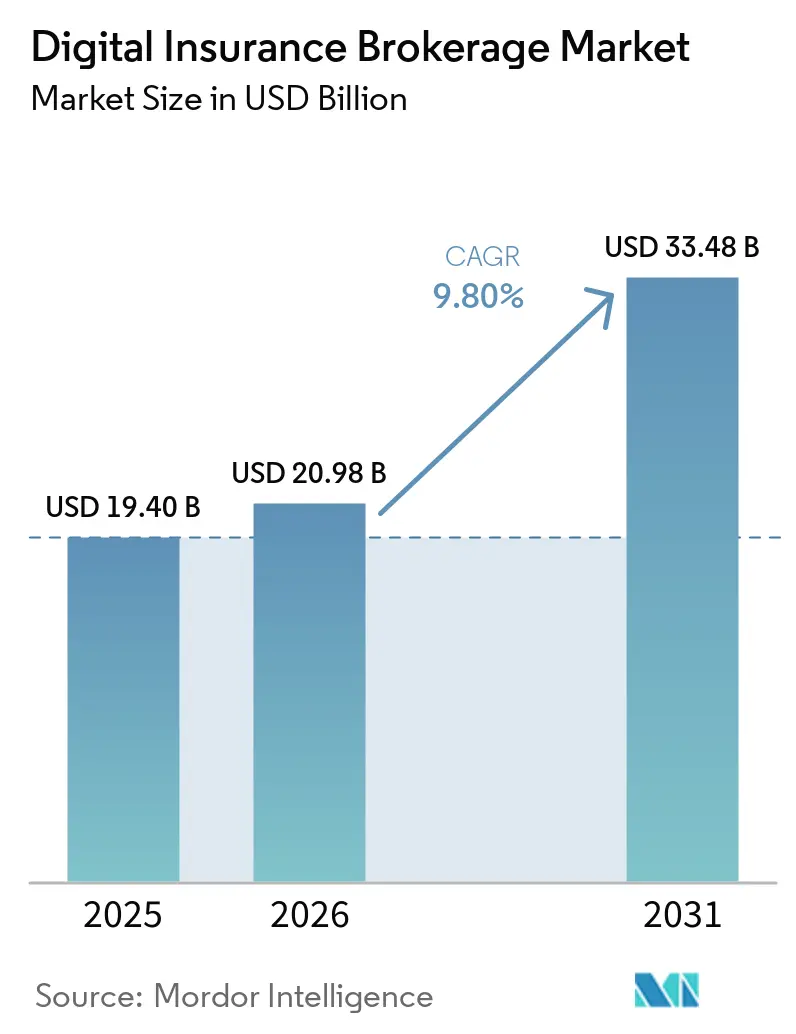
The Digital Insurance Brokerage Market size is expected to grow from USD 19.40 billion in 2025 to USD 20.98 billion in 2026 and is forecast to reach USD 33.48 billion by 2031 at 9.80% CAGR over 2026-2031.
Growth reflects a shift in how consumers and businesses discover, compare, and purchase coverage through online channels. API connections allow platforms to bring insurer products, advice, and policy placement into a single interface. Self-service purchasing is becoming more familiar to consumers, while AI tools are taking on selected advisory and administrative tasks. The digital insurance brokerage market is also shaped by the ability of platforms to connect with carriers, use customer data responsibly, and control acquisition costs. Companies that combine comparison tools with guided placement and ongoing service are better placed to respond to carrier-direct digital channels.
Key Report Takeaways
- By insurance line, motor and auto insurance captured 28.1% of the digital insurance brokerage market share in 2025, while specialty insurance is projected to grow at a 14.9% CAGR through 2031.
- By placement role, retail digital brokerage held 88.9% of the digital insurance brokerage market share in 2025, while wholesale and specialist digital brokerage is forecast to expand at a 13.6% CAGR through 2031.
- By customer segment, individual consumers accounted for 64.2% of the digital insurance brokerage market share in 2025, while SMEs are projected to grow at a 13.3% CAGR through 2031.
- By geography, North America accounted for 42.7% of the digital insurance brokerage market share in 2025, while Asia-Pacific is projected to grow at a 14.6% CAGR through 2031.
Note: Market size and forecast figures in this report are generated using Mordor Intelligence’s proprietary estimation framework, updated with the latest available data and insights as of January 2026.
Global Digital Insurance Brokerage Market Trends and Insights
Drivers Impact Analysis*
| Driver | (~) % Impact on CAGR Forecast | Geographic Relevance | Impact Timeline |
|---|---|---|---|
| Consumer Adoption of Digital Comparison and Self-Service Purchasing | +2.4% | Global, most acute in North America, the United Kingdom, Germany, India, and China | Short term (≤ 2 years) |
| API-Led Embedded and Partner-Based Insurance Distribution | +2.1% | Global, with spillover to Asia-Pacific and MEA embedded-platform ecosystems | Medium term (2-4 years) |
| AI-Enabled Personalization and Brokerage Automation | +1.7% | North America and Europe, with rapid Asia-Pacific adoption | Medium term (2-4 years) |
| SME Demand for Faster Digital Quote, Comparison, and Placement | +1.3% | North America, Europe, and India | Medium term (2-4 years) |
| Mobile-Led Insurance Access in Underpenetrated Markets | +0.9% | Asia-Pacific, Sub-Saharan Africa, and South America | Long term (≥ 4 years) |
| Conversational and Agentic AI as a Brokerage Interface | +0.7% | North America and Europe, with Asia-Pacific acceleration | Medium term (2-4 years) |
| Source: Mordor Intelligence | |||
Growing Consumer Adoption of Digital Insurance Comparison and Self-Service Purchasing
Self-service purchasing has moved beyond a niche activity for many insurance customers. In Europe, online sales accounted for 9% of life insurance premiums and 19% of non-life premiums, while non-life digital penetration exceeded 10% in Germany, the Czech Republic, France, Hungary, and Latvia[1]European Insurance and Occupational Pensions Authority, “3rd Report on the Application of the Insurance Distribution Directive,” European Insurance and Occupational Pensions Authority, eiopa.europa.eu.. These figures show that online distribution is established in standardized lines, although adoption remains uneven across countries and products. India’s online share of new policies rose from 9.2% in fiscal 2024 to 13.5% in fiscal 2026, supported by smartphone use and digital payment infrastructure. The digital insurance brokerage market benefits when customers become accustomed to comparing motor and travel policies online before considering health and life coverage. This pattern can extend digital demand into products that have historically required more support during purchase.
Expansion of API-Led Embedded and Partner-Based Insurance Distribution
Insurance is increasingly offered within non-insurance digital platforms at the point where customers make related purchases. Bolttech connected 700 distribution partners with more than 230 insurers across over 6,500 products in 2025[2]Bolttech closes Series C at $147M with a $2.1B valuation to bolster its embedded insurance offerings | TechCrunch. Cover Genius had deployed 240 million policies across more than 60 countries and reported 50% revenue growth in 2025. These models can reduce acquisition costs by reaching customers when a purchase creates a clear insurance need. The digital insurance brokerage market, therefore, faces a change in distribution, as coverage shifts from a product customers actively seek to an option presented in context. Brokers that want to remain relevant in standard personal and SME lines need API capabilities alongside traditional advisory services.
AI-Enabled Personalization and Automation of the Digital Brokerage Journey
AI is moving into the operating model of the digital insurance brokerage market, particularly in customer service, comparisons, and documentation. EIOPA reported in March 2026 that 65% of participating European insurers used generative AI, although 75% of customer-facing uses remained at the proof-of-concept stage. This gap leaves room for brokers that can turn experimental tools into compliant customer journeys. Fulcrum raised USD 25 million to automate brokerage tasks, including coverage comparisons, policy checks, and certificate issuance, with a target of addressing 70% of an agent’s daily workload[3]Fulcrum raises $25 mn led by CRV to scale AI automation across US insurance brokers", BEINSURE.com. Lower manual servicing needs can help mid-sized platforms compete without matching the staffing levels of legacy brokers. Customer-facing AI also requires auditability, transparency, and human oversight under European rules, which raises the implementation burden for participants in the digital insurance brokerage market.
Increasing SME Demand for Faster Digital Quote, Comparison, and Policy Placement
SMEs increasingly expect commercial coverage to be quoted, compared, and bound through digital workflows. This expectation follows the established use of online tools in personal insurance and creates a new opportunity for the digital insurance brokerage market. Digital platforms can shorten the process for professional liability, general liability, and workers’ compensation from several days to less than 10 minutes, where underwriting data are standardized. Faster workflows can improve customer acquisition and help platforms retain customers at renewal. State-level disclosures for digital surplus lines and differences in commercial licensing requirements continue to limit broader scaling in the United States. These constraints mean that the digital insurance brokerage market will advance fastest where product structures, carrier data, and licensing practices support a consistent online experience.
Restraints Impact Analysis*
| Restraint | (~) % Impact on CAGR Forecast | Geographic Relevance | Impact Timeline |
|---|---|---|---|
| Data Privacy, Cybersecurity, and Regulatory Compliance Complexity | -0.4% | Global, including the EU, the United States, and Asia-Pacific | Short term (≤ 2 years) |
| Legacy Carrier Systems and Limited Insurance Ecosystem Interoperability | -0.3% | Global, most acute in North American and European incumbent markets | Medium term (2-4 years) |
| Trust and Explainability Concerns in AI-Assisted Recommendations | -0.2% | Europe and North America | Medium term (2-4 years) |
| Rising Digital Customer-Acquisition Costs and Channel Competition | -0.2% | North America, the United Kingdom, and competitive European markets | Medium term (2-4 years) |
| Source: Mordor Intelligence | |||
Data Privacy, Cybersecurity, and Regulatory Compliance Complexity
Digital brokers must manage several regulatory requirements when they collect, process, and use policyholder data. The Digital Operational Resilience Act took effect on January 17, 2025, adding information and communication technology risk, third-party oversight, and incident-reporting obligations for European insurance entities. The EU AI Act introduced high-risk obligations in August 2026 for relevant AI uses, including standards for data governance, transparency, and human oversight. Japan’s APPI and Singapore’s PDPA also place stringent obligations on platforms that handle policyholder data across borders. These obligations increase costs for participants without dedicated governance and regulatory teams. The digital insurance brokerage market can therefore favor larger, well-capitalized platforms that can absorb compliance and security investment.
Legacy Carrier Systems and Limited Interoperability Across Insurance Ecosystems
The digital insurance brokerage market depends on carriers making product and pricing data available through reliable APIs. EIOPA found that required IDD disclosures are often too long and complex for digital screens, leading carriers and brokers to spend on design changes to meet compliance needs. Standardized motor and home products can support near-real-time quotes, while specialty, liability, and life products often require bespoke exchanges. Europe and the United States do not have a broad insurance data portability standard comparable to financial data portability under PSD2. Carrier and broker integrations must therefore be negotiated individually, which increases cost and slows panel expansion. The lack of specific European guidance on embedded and platform-based distribution can also discourage carrier investment in the API infrastructure that brokers need.
*Our forecasts treat driver/restraint impacts as directional, not additive. The impact forecasts reflect baseline growth, mix effects, and variable interactions.
Segment Analysis
By Insurance Line: Motor Insurance Anchors Revenue While Specialty Accelerates
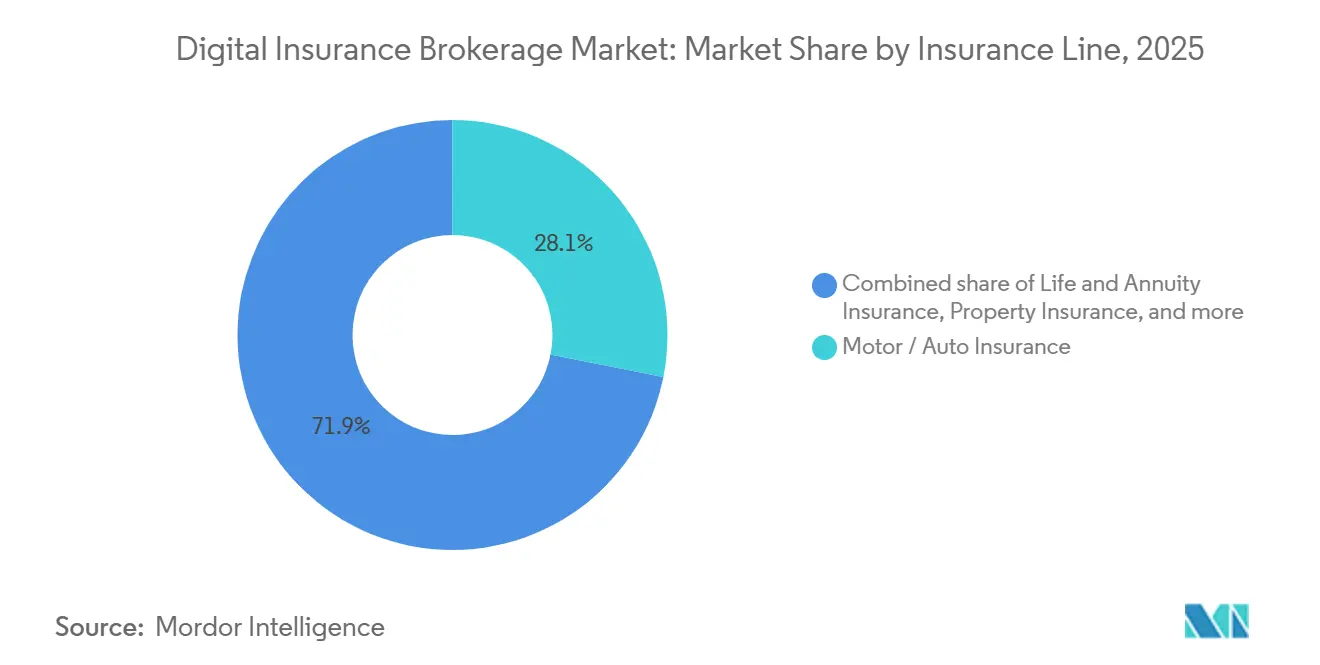
Motor and auto insurance captured 28.1% of the digital insurance brokerage market share in 2025, supported by standardized coverage, price sensitivity, and broad consumer demand. These characteristics allow customers to compare policies on a more consistent basis than complex commercial or life products. Motor insurance also gives digital platforms an effective entry point for building customer relationships across renewals. This relationship can create opportunities to offer connected home, travel, health, or roadside products over time. Clear product features and recurring renewal cycles also make motor coverage a practical testing ground for digital service features. Life and annuity insurance and health and accident insurance have lower online penetration because underwriting and suitability needs are more involved. In Europe, life insurance online sales accounted for 9% of premiums in the EIOPA assessment published in March 2026.
Specialty insurance is projected to grow at a 14.9% CAGR from 2026 to 2031, making it the fastest-growing insurance line in the digital insurance brokerage market. Standardized cyber-risk scoring and parametric triggers are making selected specialty products easier to quote and place digitally. Property insurance is also moving toward digital quotation through LLM-integrated tools introduced by Aviva in March 2026 and Liberty Mutual in June 2026. Travel insurance continues to achieve strong digital conversion because it is short-duration and usually tied to a clear event. Liability insurance remains between standardized personal coverage and fully customized placement. The digital insurance brokerage market size is supported by this expansion of digitally accessible products, although complex risks still require greater human involvement.


By Placement Role: Retail Scale Meets Wholesale Opportunity
Retail digital brokerage held 88.9% of the placement role segment in 2025, reflecting the early development of the digital insurance brokerage market around consumer price comparison. High-volume personal lines gave retail platforms scale and repeat customer traffic. The concentration in retail placement also reflects the relative ease of comparing standardized consumer policies through an online screen. However, rising acquisition costs are putting pressure on platforms that lack differentiated carrier relationships, data assets, or loyalty models. Retail participants are responding with embedded partnerships, personalized offers, and higher-value advisory products. These measures aim to improve retention and reduce dependence on paid digital traffic. The approach also reflects the need to turn a one-time comparison into an ongoing customer relationship.
Wholesale and specialist digital brokerage is expected to grow at a 13.6% CAGR from 2026 to 2031 as commercial buyers seek faster and more transparent placement. The role is important in excess and surplus and specialty markets, where traditional wholesale processes can be slow and opaque. Bolt launched Connected Distribution in August 2026 for admitted, excess and surplus, and wholesale markets, combining conversational AI with carrier access and workflow automation[4]. Standardized submissions and consistent carrier API responses could make commercial placement easier to scale. The digital insurance brokerage market size is likely to expand as commercial workflows follow the earlier digitization of personal motor insurance. This opportunity remains dependent on carriers supplying timely data and consistent underwriting responses. Specialist brokers can retain value when they combine technology with expertise in complex risks. The pace of adoption will differ by product because not every commercial risk can be placed through a standardized digital journey.
By Customer Segment: Individuals Dominate, SMEs Drive the Next Phase
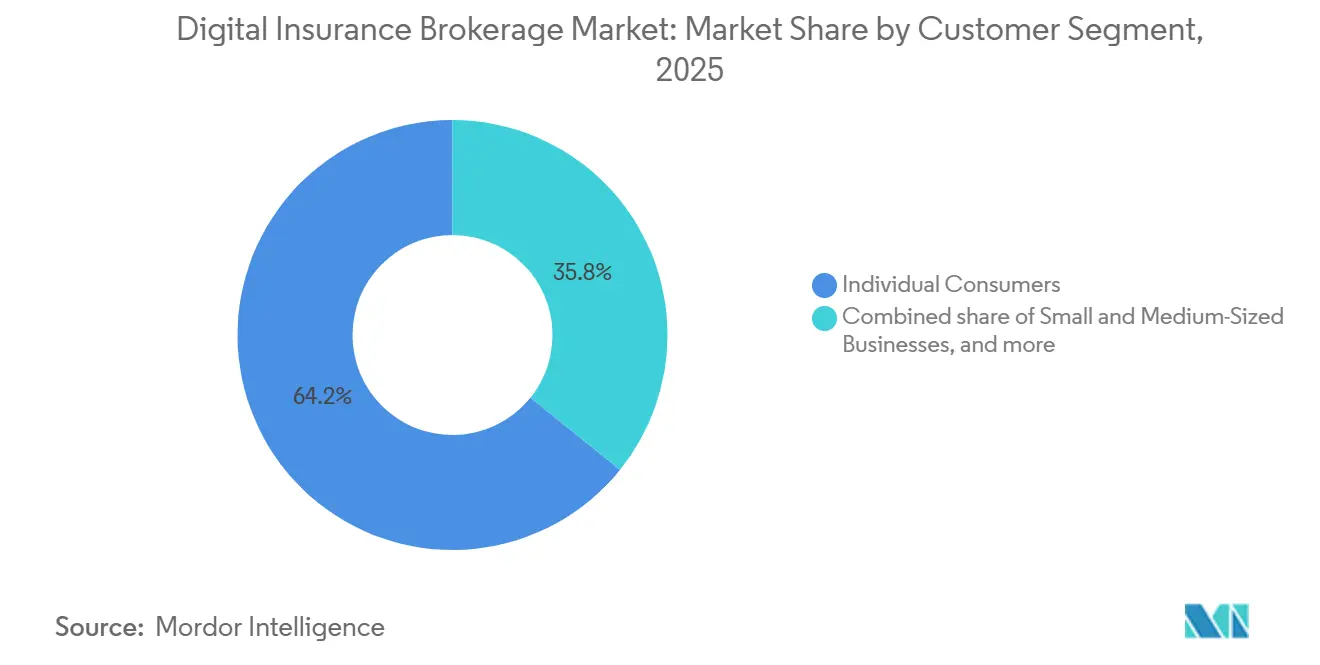
Individual consumers represented 64.2% of the customer mix in 2025, giving this group the largest share of the digital insurance brokerage market share. The segment was built through sustained investment in online comparison for motor, home, health, and travel insurance. Consumer-facing platforms face greater competition as digital acquisition costs increase and carrier-direct tools seek to engage users earlier. Customers can easily switch platforms when offers appear similar, and the purchase process offers little added support. Personalization, behavior-based offers, and easy renewal journeys can help protect consumer relationships. These capabilities are especially important where customers can compare multiple similar products with little effort. Better service after purchase can also differentiate a platform beyond the initial price comparison.
SMEs are forecast to expand at a 13.3% CAGR from 2026 to 2031, providing the strongest growth opportunity among customer groups. Digital tools can allow micro-businesses to purchase liability coverage and workers’ compensation without multi-day underwriting cycles. Large corporates remain a smaller but higher-value opportunity because they often require human-supported placement for multijurisdictional programs. Public-sector and institutional buyers remain a niche group, although parametric climate and infrastructure products may broaden digital specialty distribution. This expansion in SME adoption supports the digital insurance brokerage market size, while the market must continue to combine automated processes with expert involvement when risks are difficult to standardize. This mix supports digital growth without assuming that complex commercial placement will become fully self-service.
Geography Analysis
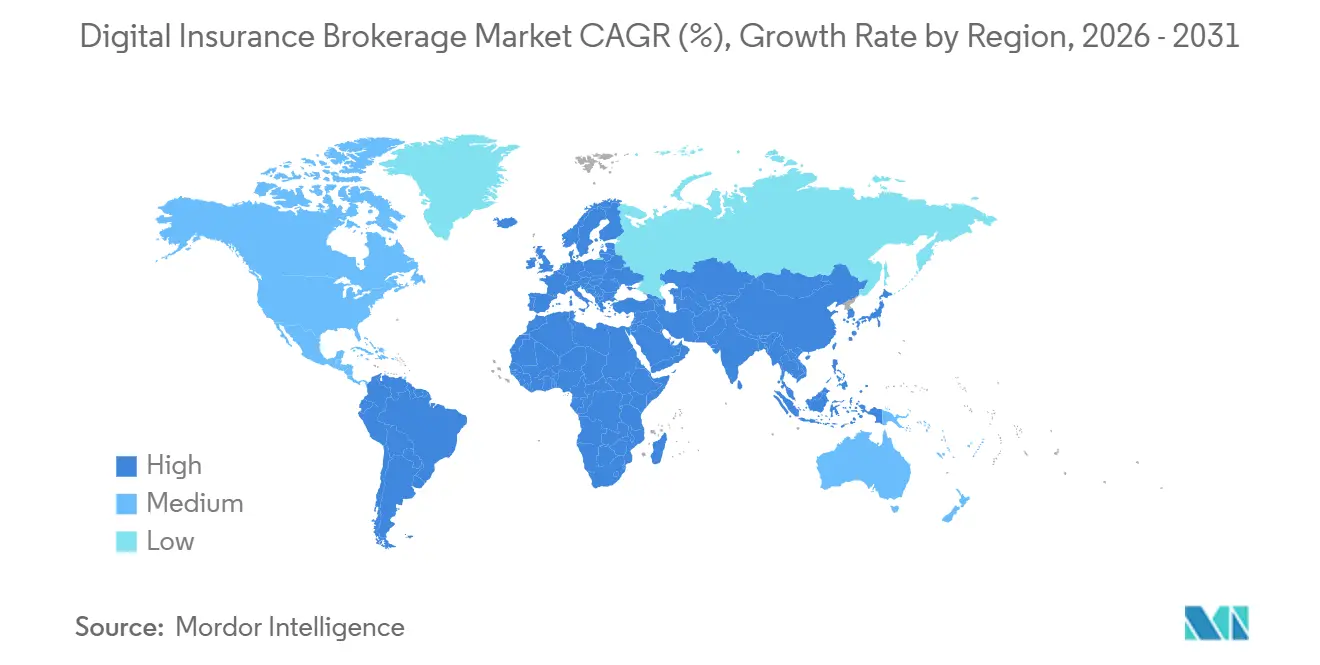
North America held 42.7% of the digital insurance brokerage market share in 2025, supported by private capital availability, a fragmented carrier base, and established online distribution rules. Consumer-facing aggregators have developed strong positions in personal insurance, where neutral comparison is widely used. Mid-market commercial and excess and surplus lines remain less digitized than personal lines. Bolt’s Connected Distribution platform, launched in August 2026, directly targets admitted, excess and surplus, and wholesale markets. Canada and Mexico add to regional activity, although differences in regulation and lower online insurance penetration limit their contribution. The digital insurance brokerage market size is supported by opportunities to digitize SME and commercial lines as wholesale APIs and quote workflows improve.
Europe is the second-largest region for the digital insurance brokerage market and has established comparison platforms in the United Kingdom, Germany, and France. Compare the Market, MoneySuperMarket, Go.Compare, CHECK24, and LeLynx.fr illustrate the region’s developed personal motor and home comparison ecosystem. EIOPA reported that cross-border insurance distribution passports increased 10% from 24,036 in 2022 to 26,502 in 2024. The same report showed that online non-life sales ranged from less than 3% to more than 10% of gross written premiums across member states. Italy and Spain remain opportunities for embedded and mobile-first brokerage models. The United Kingdom’s Consumer Duty and European compliance requirements under DORA, GDPR, and the AI Act raise operational demands but also support platforms with established governance processes.
Asia-Pacific is expected to grow at a 14.6% CAGR from 2026 to 2031, making it the fastest-growing geography in the digital insurance brokerage market. Growth is supported by underinsurance gaps, mobile-first consumer behavior, and regulatory liberalization in India, China, and Southeast Asia. The region’s needs differ from those in mature Western markets because many consumers engage first through mobile applications and partner platforms. India’s PB Fintech reported 40% revenue growth in the first quarter of fiscal 2027 as its addressable online shelf expanded through approved micro-insurance products. Southeast Asia offers a strong embedded-distribution opportunity because of low insurance penetration and a mobile-native population. South America, the Middle East, and Africa remain smaller markets, although mobile-enabled microinsurance products in Sub-Saharan Africa rose from 135 in 2020 to 282 in 2025. Policybazaar’s June 2026 incorporation of DIFC-licensed subsidiaries also highlights the Middle East’s role as a developing regulatory base for digital brokerage and reinsurance activity.

Competitive Landscape
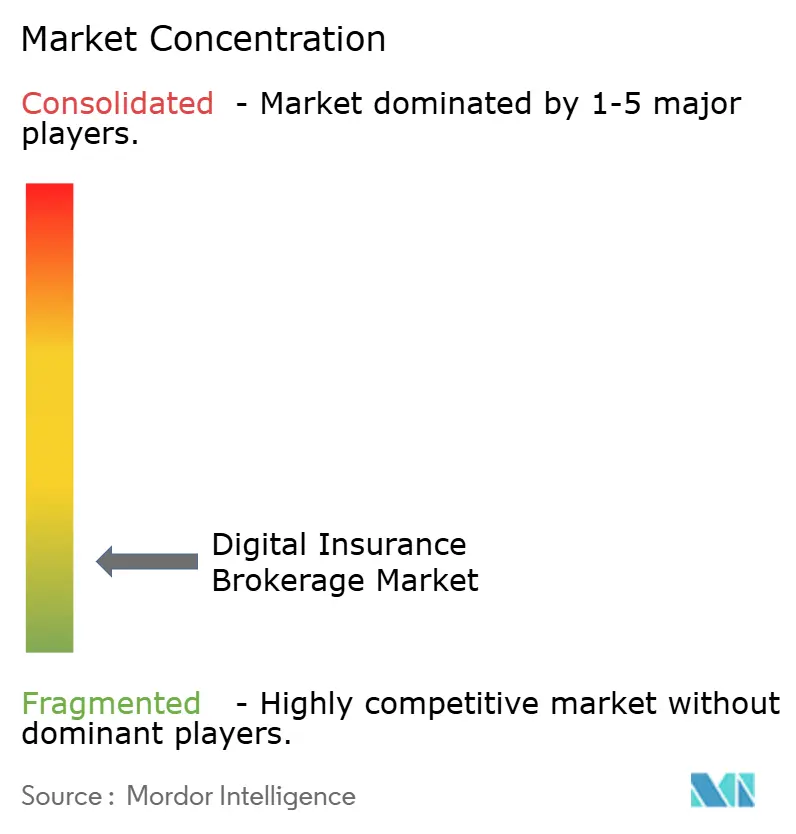
The digital insurance brokerage market is fragmented globally, although it is more concentrated in specific regional and product segments. Consumer aggregators have strong positions in North America and Europe, while embedded infrastructure providers operate across multiple regions. Regional companies also hold important positions in the Asia-Pacific. The top 10 companies accounted for 86.2% of China’s internet property insurance premiums in 2025, indicating high concentration in that national segment. At the global level, different regulatory settings, customer groups, and insurance lines prevent a similar level of concentration. Competition increasingly depends on carrier connectivity, AI capability, proprietary data, and efficient customer acquisition.
Companies are responding to tougher acquisition economics through portfolio consolidation and technology investment. Matic acquired Policygenius’ property and casualty portfolio of nearly 30,000 policies in June 2026 and received a minority investment from Primus Capital. The transaction strengthened Matic’s embedded property and casualty platform, which connects more than 70 insurers and 100 distribution partners. Cover Genius raised USD 100 million in July 2026 to expand AI hyper-personalization, embedded distribution, and automated claims infrastructure. Wefox’s exit from Germany in July 2026 also showed the risk of expansion without sustainable unit economics. These developments favor platforms that can pair distribution growth with effective cost control and durable carrier relationships.
Carrier-direct AI quotation tools are becoming a competitive concern for the digital insurance brokerage market. Aviva launched a home-insurance quotation app on ChatGPT in March 2026, extending distribution across direct, broker, price-comparison, and conversational channels. Liberty Mutual introduced auto quoting on ChatGPT in June 2026, reinforcing the move toward direct conversational engagement. Insurify’s ChatGPT plugin recorded 212% growth in referred revenue during its first 6 months of operation in 2026. Independent brokers are therefore building their own AI interfaces before carrier tools gain enough breadth to replace comparison functions. The most open opportunities remain SME commercial lines, wholesale and specialty placement, and emerging markets where mobile-first embedded models are still developing.
Digital Insurance Brokerage Industry Leaders
-
Policybazaar
-
Coverfox
-
Policygenius
-
Insurify
-
SelectQuote
- *Disclaimer: Major Players sorted in no particular order

Recent Industry Developments
- August 2026: bolt launched Connected Distribution, the industry’s first AI-powered platform covering all insurance lines, including admitted, E&S, and wholesale, combining conversational AI, integrated market access, and agentic workflow automation across prospecting, quoting, placement, servicing, and renewal.
- August 2026: Insurify upgraded its ChatGPT plugin to deliver real-time personalized car insurance quotes with in-chat purchase capabilities. In the 6 months following the February 2026 launch, ChatGPT-referred revenue grew 212%, and the share of new customers discovering Insurify through AI conversations rose from 0.15% to 5.7%.
- June 2026: Matic acquired Policygenius’ property and casualty insurance portfolio of nearly 30,000 policies and received a minority investment from Primus Capital. The deal consolidated digital broker assets in North America and strengthened Matic’s embedded property and casualty platform.
- March 2026: Aviva launched a home-insurance quoting app on ChatGPT with OpenAI. The launch made Aviva the first major United Kingdom insurer to enable LLM-based insurance distribution across direct, broker, price-comparison, and conversational channels.


Global Digital Insurance Brokerage Market Report Scope
| Life and Annuity Insurance |
| Health and Accident Insurance |
| Motor/Auto Insurance |
| Property Insurance |
| Liability Insurance |
| Travel Insurance |
| Specialty Insurance |
| Retail Digital Brokerage |
| Wholesale and Specialist Digital Brokerage |
| Individual Consumers |
| Small and Medium-Sized Businesses |
| Large Corporates and Enterprises |
| Public-Sector and Institutional Organizations |
| North America | United States |
| Canada | |
| Mexico | |
| South America | Brazil |
| Argentina | |
| Rest of South America | |
| Europe | United Kingdom |
| Germany | |
| France | |
| Italy | |
| Spain | |
| Rest of Europe | |
| Asia-Pacific | China |
| Japan | |
| India | |
| South Korea | |
| Australia | |
| Indonesia | |
| Thailand | |
| Malaysia | |
| Singapore | |
| Vietnam | |
| Rest of Asia-Pacific | |
| Middle East and Africa | Saudi Arabia |
| United Arab Emirates | |
| Turkey | |
| South Africa | |
| Egypt | |
| Rest of Middle East and Africa |
| By Insurance Line | Life and Annuity Insurance | |
| Health and Accident Insurance | ||
| Motor/Auto Insurance | ||
| Property Insurance | ||
| Liability Insurance | ||
| Travel Insurance | ||
| Specialty Insurance | ||
| By Placement Role | Retail Digital Brokerage | |
| Wholesale and Specialist Digital Brokerage | ||
| By Customer Segment | Individual Consumers | |
| Small and Medium-Sized Businesses | ||
| Large Corporates and Enterprises | ||
| Public-Sector and Institutional Organizations | ||
| By Geography | North America | United States |
| Canada | ||
| Mexico | ||
| South America | Brazil | |
| Argentina | ||
| Rest of South America | ||
| Europe | United Kingdom | |
| Germany | ||
| France | ||
| Italy | ||
| Spain | ||
| Rest of Europe | ||
| Asia-Pacific | China | |
| Japan | ||
| India | ||
| South Korea | ||
| Australia | ||
| Indonesia | ||
| Thailand | ||
| Malaysia | ||
| Singapore | ||
| Vietnam | ||
| Rest of Asia-Pacific | ||
| Middle East and Africa | Saudi Arabia | |
| United Arab Emirates | ||
| Turkey | ||
| South Africa | ||
| Egypt | ||
| Rest of Middle East and Africa | ||


Key Questions Answered in the Report
What is the projected growth rate for digital insurance brokerage?
The sector is projected to grow at a 9.8% CAGR from 2026 to 2031, increasing from USD 21.0 billion in 2026 to USD 33.5 billion by 2031.
Which insurance line has the largest digital brokerage presence?
Motor and auto insurance led with a 28.1% share in 2025 because its standardized structure supports clear online comparison.
Which customer group is growing fastest in digital brokerage?
SMEs are forecast to grow at a 13.3% CAGR through 2031 as they seek faster quote, comparison, and policy-binding processes.
Why is Asia-Pacific growing faster than other regions?
Asia-Pacific is expected to grow at a 14.6% CAGR because underinsurance gaps, mobile-first behavior, and regulatory liberalization support digital distribution.
What are the main barriers to online insurance brokerage growth?
Compliance demands, privacy and cybersecurity requirements, legacy carrier systems, and limited API interoperability can raise cost and slow deployment.
How is AI changing insurance brokerage?
AI can automate comparisons, policy checks, and service tasks, while conversational tools can change how customers reach brokers and insurers.
Page last updated on:





