
Dependency Confusion Protection Market Size and Share
Market Overview
| Study Period | 2020 - 2031 |
|---|---|
| Market Size (2026) | USD 50.19 Million |
| Market Size (2031) | USD 140.99 Million |
| Growth Rate (2026 - 2031) | 22.95 % |
| Fastest Growing Market | Asia-Pacific |
| Largest Market | North America |
| Market Concentration | Medium |
Major Players *Disclaimer: Major Players sorted in no particular order Image © Mordor Intelligence. Reuse requires attribution under CC BY 4.0. | |
Dependency Confusion Protection Market Analysis by Mordor Intelligence
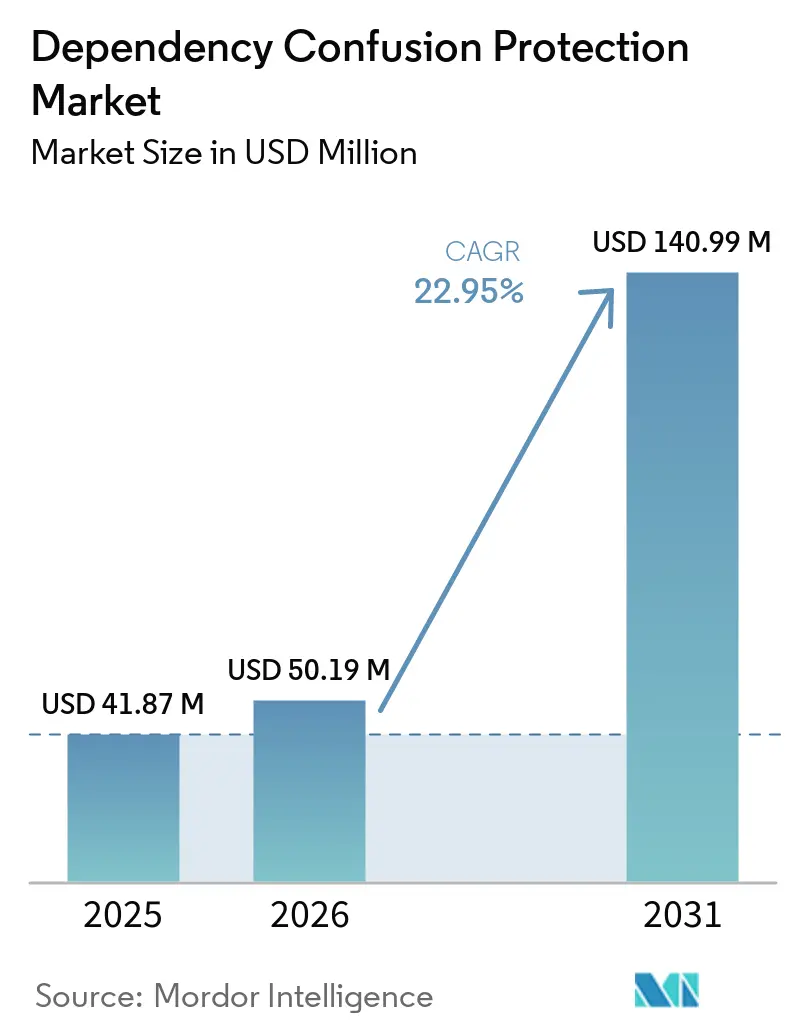
The Dependency confusion protection market size is projected to be USD 41.87 million in 2025, USD 50.19 million in 2026, and reach USD 140.99 million by 2031, growing at a CAGR of 22.95% from 2026 to 2031. Regulatory requirements for software bills of materials are making dependency visibility a more regular procurement requirement for software suppliers. The rising use of open-source components also increases the number of package names, repositories, and build paths that security teams must govern. Cloud-based development has made it easier to integrate protection tools into routine build and deployment workflows. Buyers are increasingly looking for products that combine package verification, malicious code detection, and policy enforcement rather than relying on separate tools. Competition will depend on whether vendors can reduce developer disruption while extending controls to AI-assisted software development.
Key Report Takeaways
- By offering, software held 71.29% of the dependency confusion protection market share in 2025, while services are projected to expand at a 25.30% CAGR through 2031.
- By protection capability, Dependency and SBOM Intelligence held 37.16% of the dependency confusion protection market share in 2025, while Package and Namespace Verification is projected to expand at a 24.36% CAGR through 2031.
- By deployment mode, cloud held 51.13% of the dependency confusion protection market share in 2025, while hybrid is projected to expand at a 24.77% CAGR through 2031.
- By organization size, large enterprises held 68.55% of the dependency confusion protection market share in 2025, while small and medium-sized enterprises are projected to expand at a 25.02% CAGR through 2031.
- By industry vertical, IT and telecommunications held a 28.44% of the dependency confusion protection market share in 2025, while retail and e-commerce are projected to expand at a 23.78% CAGR through 2031.
- By geography, North America held 38.56% of the Dependency confusion protection market in 2025, while Asia-Pacific is projected to expand at a 24.05% CAGR through 2031.
Note: Market size and forecast figures in this report are generated using Mordor Intelligence’s proprietary estimation framework, updated with the latest available data and insights as of January 2026.
Global Dependency Confusion Protection Market Trends and Insights
Drivers Impact Analysis*
| Driver | (~) % Impact on CAGR Forecast | Geographic Relevance | Impact Timeline |
|---|---|---|---|
| Rising Open-Source Dependency Volume | +5.5% | Global | Short term (≤ 2 years) |
| Mandatory SBOM and Software Supply-Chain Controls | +4.5% | North America and EU | Short term (≤ 2 years) |
| Growth of Malicious Package Campaigns | +4.0% | Global | Short term (≤ 2 years) |
| Expansion of Cloud-Native CI/CD Pipelines | +3.2% | APAC core, spill-over to MEA | Medium term (2-4 years) |
| AI Coding Agents Increasing Package-Install Velocity | +2.7% | North America and EU | Medium term (2-4 years) |
| Registry-Path and Namespace Blind Spots in Polyglot Builds | +1.9% | Global | Long term (≥ 4 years) |
| Source: Mordor Intelligence | |||
Rising Open-Source Dependency Volume
Total downloads across Maven Central, PyPI, npm, and NuGet reached 9.8 trillion in 2025, increasing 67% year over year. npm recorded 7.97 trillion downloads during 2025, a 65.43% annual increase that exceeded Maven traffic. These volumes broaden the dependency graphs that development teams must inspect before each release. Ephemeral build runners repeatedly retrieve full dependency trees, which increases exposure when repository precedence is unclear. New packages entering supply chains rose 67% in 2025, while only 40% of organizations had malicious-package detection tools deployed. The Dependency confusion protection market, therefore, favors automated controls that apply consistent registry rules across projects and development groups.
Mandatory SBOM and Software Supply-Chain Controls
Executive Order 14144, signed in January 2025, requires federal agencies to obtain machine-readable SBOMs from software suppliers. The order also extends supply-chain expectations through procurement relationships involving private-sector software vendors. The European Union Cyber Resilience Act requires manufacturers to maintain machine-readable SBOMs for relevant products with digital elements. Its reporting obligations for actively exploited vulnerabilities applied from September 2026. SBOM work often exposes gaps in private namespace inventories that were not visible during ordinary development. This links compliance spending with demand for the Dependency confusion protection market, especially where supplier attestations are required across several contracts.
Growth of Malicious Package Campaigns
ReversingLabs recorded a 73% increase in malicious open-source package detections during 2025. npm activity more than doubled, representing nearly 90% of detected open-source malware. The Shai-Hulud worm compromised more than 1,000 npm packages during September 2025. Endor Labs found that npm account takeovers increased 12-fold in 2025, and 38.4% of affected packages had more than 1,000 monthly downloads. These attacks make behavioral package review relevant even when organizations have corrected namespace settings. The Dependency confusion protection market is consequently broadening toward broader supply-chain malware defenses for use in public and private packages.
Expansion of Cloud-Native CI/CD Pipelines
Cloud-native pipelines commonly pull dependencies from public registries unless teams carefully define private sources and scopes. This poses a risk when an internal package name is also available in a public registry. Ephemeral runners repeat the resolution process on every build, allowing a configuration weakness to affect many releases. A correctly secured primary application can still leave legacy services or acquired code exposed. Enterprise application creation has accelerated by almost 5 times in the AI era, and modern applications carry more than 4 times as many critical and high-severity vulnerabilities. The Dependency confusion protection market benefits as organizations need continuous pipeline reviews rather than one-time configuration work across their application portfolios.
Restraints Impact Analysis*
| Restraint | (~) % Impact on CAGR Forecast | Geographic Relevance | Impact Timeline |
|---|---|---|---|
| Integration Complexity across Package Managers and Repositories | -3.0% | Global | Medium term (2-4 years) |
| Shortage of AppSec and DevSecOps Specialists | -2.5% | North America and EU | Short term (≤ 2 years) |
| Developer Friction from Blocking and Quarantine Policies | -1.8% | Global | Short term (≤ 2 years) |
| False Confidence from Incomplete Private-Namespace Inventories | -1.5% | Global | Long term (≥ 4 years) |
| Source: Mordor Intelligence | |||
Integration Complexity across Package Managers and Repositories
Dependency controls require separate configuration across npm, pip, Maven, NuGet, Go modules, and Cargo. The same organization may operate several of these ecosystems across hundreds of pipelines. Each environment needs its own rules for repository precedence, namespace reservation, and scope pinning. Legacy services and acquired codebases can remain outside centrally defined security standards. This makes proof-of-concept work longer because buyers need evidence that protections operate across their development stack. The complexity can slow deployment in the Dependency confusion protection market until vendors provide broader native support for these package managers.
Shortage of AppSec and DevSecOps Specialists
A shortage of application security talent restricts the depth and pace of protection program deployment. CyberSeek recorded 514,359 U.S. cybersecurity job listings during the 12 months before June 2025. Its 74% supply-demand ratio indicated that available workers did not fill every open role. Fortinet estimated a global shortage of more than 4.7 million cybersecurity professionals in 2025.[1]Fortinet, “2025 Cybersecurity Skills Gap Report,” Fortinet, fortinet.com Organizations without specialists often rely on vendor-managed policies that may not match their private namespace structure. Poorly calibrated blocking rules can create false positives and weaken developer support for the Dependency confusion protection market among less experienced teams.
*Our forecasts treat driver/restraint impacts as directional, not additive. The impact forecasts reflect baseline growth, mix effects, and variable interactions.
Segment Analysis
By Offering: Software Tooling Holds Revenue While Services Grow With Operational Needs
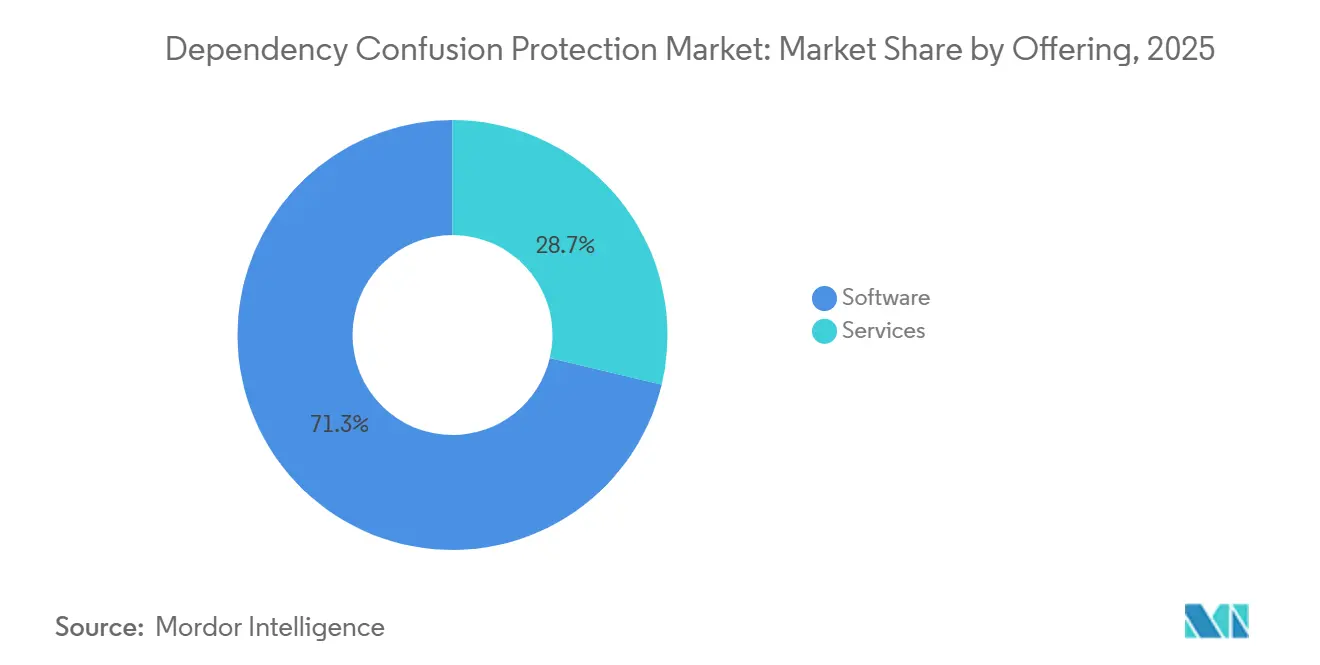
Software held 71.29% of the Dependency confusion protection market share in 2025, supported by tools that integrate with package managers and CI/CD workflows. These products allow teams to scan and govern dependencies without changing the developer interfaces already used for builds, testing, and deployment. Inline tooling also generates dependency telemetry to support recurring license renewals as application portfolios and dependency graphs expand. Enterprises value this model because centrally managed policies can be applied across several applications while retaining local development workflows. The Dependency confusion protection industry is therefore anchored by software platforms that embed controls directly into everyday build processes.
Services are projected to grow at a 25.30% CAGR from 2026 to 2031, the highest rate within this segmentation. Organizations use these engagements to catalog internal package names across multiple ecosystems, identify exposed public namespaces, and establish documented ownership for corrective work. Providers also help teams tune policies, establish enforcement rules, and connect monitoring with repositories that may have been configured separately. Managed security providers are incorporating dependency scanning into broader software supply chain monitoring arrangements, including ongoing reviews as applications and workflows evolve. AI coding agents add package-install activity that many teams cannot govern independently, sustaining the need for specialist support.


By Protection Capability: SBOM Intelligence Leads While Namespace Verification Grows Fastest
Dependency and SBOM Intelligence held 37.16% of the Dependency confusion protection market share in 2025. Organizations use machine-readable inventories to identify components, clarify relationships between direct and indirect dependencies, and establish a basis for later remediation. This capability has become more important as procurement and regulatory requirements demand clearer dependency records from software suppliers. It also helps teams understand which internal package names need protection across private and public registries within their existing software estate. The resulting visibility supports priority decisions before security teams apply specific resolution controls and verify whether those controls remain effective.
Package and Namespace Verification is projected to grow at a 24.36% CAGR through 2031. Scope pinning and namespace rules address the configuration ambiguity that enables dependency confusion attacks before a malicious package is resolved. Malicious Package Detection and Analysis is also gaining attention as account takeovers and harmful uploads increase across commonly used registries. Vendors benefit when one dependency graph can support SBOM generation, squatting detection, and resolution-order enforcement.[2]Socket Supply Inc., “Socket Raises USD 60M Series C at USD 1B Valuation Led by Thrive Capital,” Socket, socket.dev Repository Firewall and Package Blocking prevent suspicious packages from entering the build environment at installation, providing control before later scan and remediation activities.
By Deployment Mode: Cloud Maintains The Largest Position While Hybrid Use Expands
Cloud deployment held 51.13% share in 2025, the largest position within this deployment segmentation. Cloud environments contain many CI/CD workloads that repeatedly download complete dependency trees during each build and deployment cycle. Software-as-a-service delivery also allows policy and signature updates without requiring teams to manage local infrastructure maintenance. This model suits distributed teams seeking timely implementation across applications that release regularly and use several public package ecosystems. Cloud adoption reflects the wider movement of build, test, and deployment work into managed development environments.
Hybrid deployment is projected to grow at a 24.77% CAGR from 2026 to 2031. Large organizations often retain on-premises artifact repositories while adding cloud-native scanning and policy controls at relevant points in the pipeline. This arrangement preserves existing Artifactory or Nexus Repository investments while enabling newer detection capabilities that can be updated through cloud services. A governed local repository can remain the source of approved binaries, while cloud services inspect incoming packages and alert security teams to anomalies. Hybrid designs are also relevant when data residency requirements favor local artifact storage and gradual infrastructure modernization.
By Organization Size: Large Enterprises Lead Revenue While SMEs Accelerate Adoption
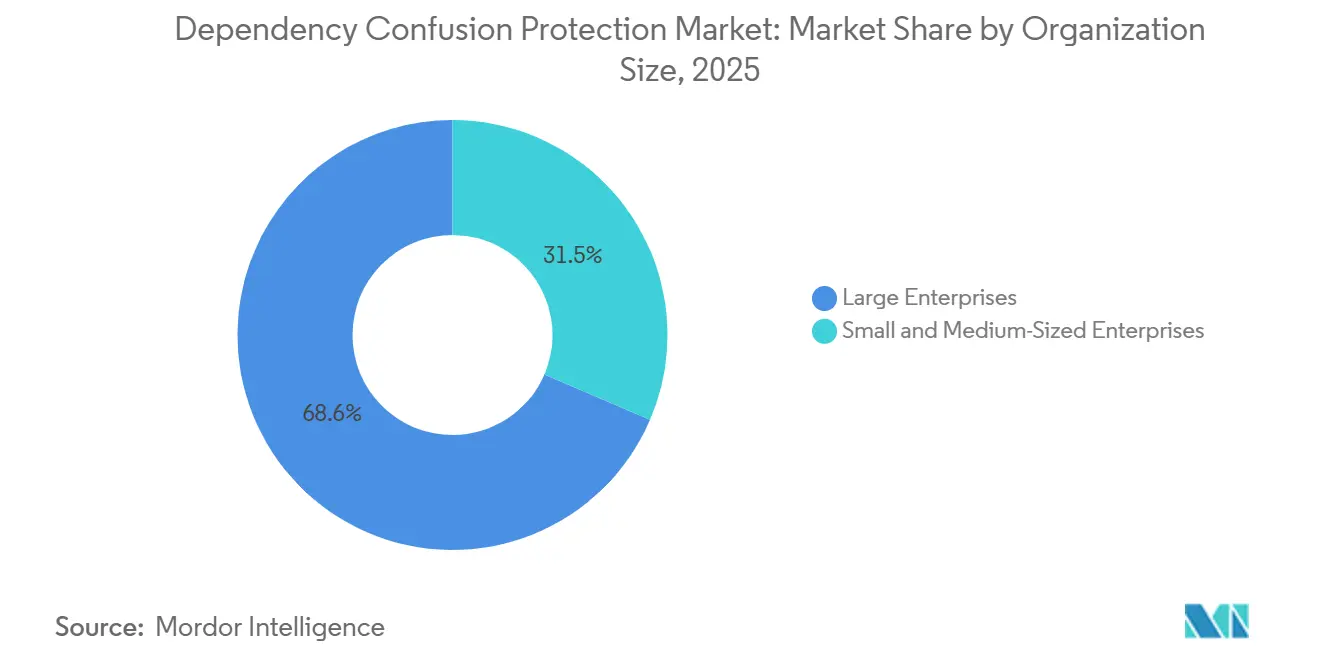
Large enterprises held 68.55% share in 2025, reflecting their established DevSecOps programs, complex software estates, and federal procurement-related compliance requirements. These buyers often need multi-ecosystem enforcement, SBOM generation, and supply-chain controls that work consistently within a single platform. Their broad dependency profiles make centralized policy management valuable, as different teams may use different languages, repositories, and deployment methods. Procurement reviews also favor vendors that can demonstrate support across mature and legacy systems rather than isolated development environments. Renewal and expansion activity provides a stable revenue base for established providers serving this group.
Small and medium-sized enterprises are projected to grow at a 25.02% CAGR through 2031. Hosted CI/CD tools and artifact managers give smaller teams access to containerized build environments without the infrastructure spending that was once required for private repository management. These teams are less likely to employ dedicated application security specialists, which increases the importance of clear deployment steps and usable policy defaults. Simple onboarding can therefore carry more weight than feature breadth for smaller buyers when selecting a protection platform. Socket reported growth from 7,500 to more than 27,000 protected organizations after its October 2024 Series B.
By Industry Vertical: IT and Telecommunication Leads While Retail and E-Commerce Grows Fastest
IT and telecommunications held a 28.44% share in 2025, supported by extensive microservices architectures and frequent use of multiple package ecosystems. The sector operates complex software stacks that combine languages, frameworks, internal services, and externally maintained libraries. Its earlier adoption of DevSecOps practices has supported the the earlier adoption of software supply chain controls within development and production processes. Banking, financial services, and insurance follow because audit requirements make unresolved dependencies a material concern for modernization programs. Healthcare, government, energy, and utilities also face growing scrutiny of the software suppliers and components supporting critical operations.
Retail and e-commerce are projected to grow at a 23.78% CAGR through 2031. Digital commerce platforms increasingly depend on event-driven services for order management, recommendations, payments, and customer-facing experiences. These systems often use the JavaScript and Python ecosystems, which have experienced high levels of malicious package activity. Manufacturing, transportation, and logistics are also extending protection to software-based operational environments that were not originally managed through supply-chain controls. Attackers target widely used packages to increase their effect across multiple types of organizations.
Geography Analysis
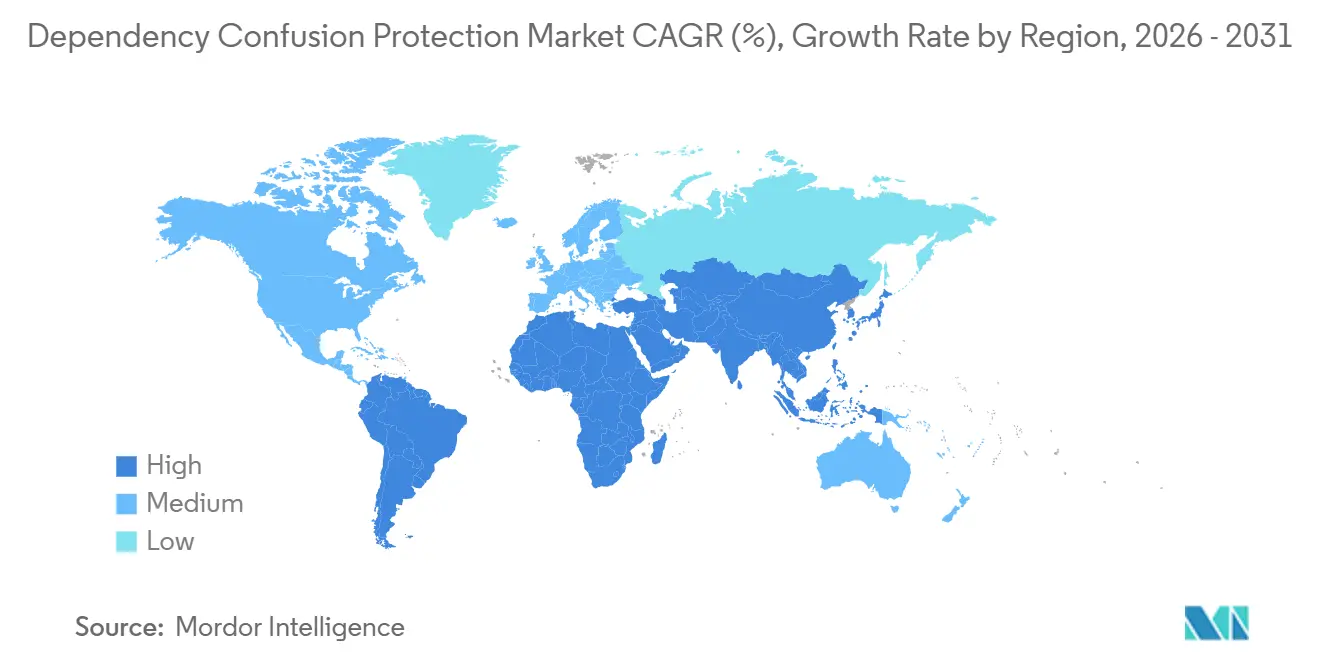
North America held 38.56% regional share in 2025, supported by federal contractor networks, large technology organizations, and mature DevSecOps programs. Executive Order 14144 has strengthened demand for supplier transparency in federal procurement, while Canada is expanding adoption in financial services and telecommunications. Europe held the second-largest geographic position, led by Germany, the United Kingdom, and France. The Cyber Resilience Act is encouraging investment in SBOMs before its December 2027 full-requirement deadline.[3]European Commission, “Cyber Resilience Act,” European Commission, digital-strategy.ec.europa.eu Organizations are strengthening software supply chain transparency and vulnerability management capabilities to meet the regulations' requirements.
Asia-Pacific is projected to grow at a 24.05% CAGR from 2026 to 2031, the fastest regional rate. India benefits from its role as a software services delivery hub, where client contracts increasingly include supplier attestations and dependency management requirements. China is developing open-source governance frameworks as part of its broader software supply chain security strategy. Japan, South Korea, and Australia are also strengthening visibility across connected devices, embedded software, and cloud-native development. The Dependency confusion protection market has room to grow, where regional buyers adopt both cloud delivery and stronger supplier governance.
South America is developing from a lower base, with Brazil and Argentina supported by growth in fintech and microservices. The Middle East and Africa remain in an earlier stage of adoption, with the United Arab Emirates and Saudi Arabia as primary demand centers. Government digital transformation and procurement requirements are increasing interest in software supply-chain transparency across these regions. South Africa, Nigeria, and Egypt are leading in adoption, with multinational customers applying security requirements to local development partners. Vendor-managed cloud delivery is preferred where in-house DevSecOps capacity remains limited, favoring platforms that offer policy-driven onboarding with limited on-premises integration.

Competitive Landscape
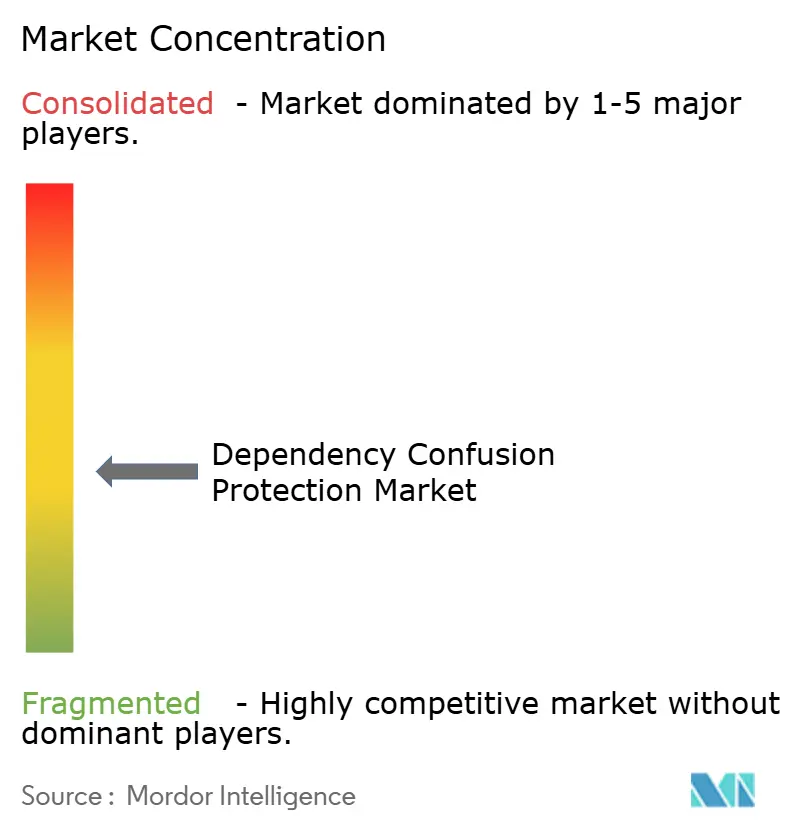
The Dependency confusion protection market is moderately fragmented across specialized vendors, broad security platforms, and developer infrastructure providers, leaving buyers with several platform and point-solution options. Specialized providers include Sonatype, Snyk, JFrog, Socket, Endor Labs, Phylum, and Chainguard, while Palo Alto Networks and Checkmarx compete through wider platforms. GitHub, GitLab, and Amazon Web Services provide developer infrastructure that reaches many development teams. Buyers increasingly prefer products that integrate SBOM creation, namespace verification, package detection, and blocking controls into a single dependency data model. This preference puts pressure on point solutions that fail to connect discovery, prevention, and response.
Socket evaluates install scripts, network calls, and obfuscation patterns as part of its package analysis, a capability relevant to the Dependency confusion protection market. The company stated that this approach blocks more than 10,000 supply-chain attacks each week across 1.5 million repositories. Endor Labs has emphasized reachability analysis following its acquisition of Coana, which it said reduced false positives by 50-80%. JFrog introduced Zero-Touch Remediation in September 2026 to automate remediation selection, pipeline application, and cryptographic attestation. These moves focus competition on stronger detection, lower developer friction, and more automated remediation.
AI coding agents create a new control point for the Dependency confusion protection market because they can install packages without direct human review. JFrog has added Agent Package Resolution, and Snyk has introduced Evo Agentic Development Security to extend governance to agent workflows.[4]Snyk Limited, “Snyk Launches Evo Agentic Development Security,” Snyk, snyk.io Endor Labs reported namespace squatting around Hugging Face model artifacts, while Phylum, OX Security, Legit Security, and FOSSA compete across malware detection, pipeline posture, and license intelligence. Socket's acquisitions of Coana and Secure Annex show how providers are broadening coverage to browser extensions, code-editor plugins, MCP servers, and package managers.
Dependency Confusion Protection Industry Leaders
Microsoft Corporation
Google LLC
Amazon Web Services, Inc.
Palo Alto Networks, Inc.
Sonatype, Inc.
- *Disclaimer: Major Players sorted in no particular order

Recent Industry Developments
- September 2026: JFrog introduced Zero-Touch Remediation at swampUP 2026 in New York, automating vulnerability fix selection, pipeline application, and cryptographic attestation through AppTrust for approximately 6,600 enterprise customers worldwide. The launch expanded JFrog's role from artifact governance to end-to-end automated supply chain remediation, supported by an ecosystem of patch partners, including Chainguard, Broadcom, Lightwell, a Red Hat and IBM joint initiative, Seal Security, and TuxCare.
- August 2026: Sonatype announced Agent P and Security Events as new capabilities for Sonatype Guide, automating dependency maintenance across human-led and AI-assisted workflows while providing real-time visibility into malicious-package incidents. Accompanying research from Sonatype Research Labs found that enterprise application creation had accelerated by nearly 5x in the AI era, with applications carrying more than 4x as many critical and high-severity vulnerabilities.
- August 2026: Snyk launched Evo Continuous Offensive Security as a generally available product, delivering autonomous, AI-powered penetration testing and agent red teaming that continuously attack applications as they evolve and return validated proof of exploitable vulnerabilities.
- July 2026: Checkmarx announced Checkmarx Fusion, a hybrid scanning architecture that combines Checkmarx's proprietary AppSec engines with Anthropic's Claude Frontier models for vulnerability detection across all languages, codebases, and software development lifecycle stages. The product entered early access as part of the Checkmarx One platform.


Global Dependency Confusion Protection Market Report Scope
Dependency Confusion Protection refers to software platforms and associated services that identify, prevent, monitor, and mitigate dependency confusion attacks across software development pipelines, package managers, code repositories, CI/CD environments, and software supply chains. These solutions help organizations verify package authenticity, block malicious packages, secure open-source dependencies, provide Software Bill of Materials (SBOM) intelligence, and enforce repository governance to reduce software supply-chain risk.
The Dependency Confusion Protection Market Report is Segmented by Offering (Software and Services), Protection Capability (Package and Namespace Verification, Malicious-Package Detection and Analysis, Repository Firewall and Package Blocking, Dependency and SBOM Intelligence, and Other Protection Capabilities), Deployment Mode (Cloud, On-Premises, and Hybrid), Organization Size (Large Enterprises and Small and Medium-Sized Enterprises), Industry Vertical (Government and Public Administration, Industrial Manufacturing, Retail and E-Commerce, Transportation and Logistics, Energy and Utilities, IT and Telecommunication, Media and Entertainment, Education and Research Institutions, Healthcare and Life Sciences, Banking, Financial Services, and Insurance [BFSI], and Other Industry Verticals), and Geography (North America, South America, Europe, Asia-Pacific, and Middle East and Africa). The Market Forecasts are Provided in Terms of Value (USD).
| Software |
| Services |
| Package and Namespace Verification |
| Malicious-Package Detection and Analysis |
| Repository Firewall and Package Blocking |
| Dependency and SBOM Intelligence |
| Other Protection Capabilities |
| Cloud |
| On-Premises |
| Hybrid |
| Large Enterprises |
| Small and Medium-Sized Enterprises |
| Government and Public Administration |
| Retail and E-Commerce |
| Transportation and Logistics |
| IT and Telecommunication |
| Media and Entertainment |
| Healthcare and Life Sciences |
| Banking, Financial Services, and Insurance (BFSI) |
| Other Industry Verticals |
| North America | United States | |
| Canada | ||
| Mexico | ||
| South America | Brazil | |
| Argentina | ||
| Rest of South America | ||
| Europe | Germany | |
| United Kingdom | ||
| France | ||
| Italy | ||
| BENELUX | ||
| Rest of Europe | ||
| Asia-Pacific | China | |
| Japan | ||
| India | ||
| South Korea | ||
| Australia | ||
| Rest of Asia-Pacific | ||
| Middle East and Africa | Middle East | United Arab Emirates |
| Saudi Arabia | ||
| Rest of Middle East | ||
| Africa | South Africa | |
| Nigeria | ||
| Egypt | ||
| Rest of Africa | ||
| By Offering | Software | ||
| Services | |||
| By Protection Capability | Package and Namespace Verification | ||
| Malicious-Package Detection and Analysis | |||
| Repository Firewall and Package Blocking | |||
| Dependency and SBOM Intelligence | |||
| Other Protection Capabilities | |||
| By Deployment Mode | Cloud | ||
| On-Premises | |||
| Hybrid | |||
| By Organization Size | Large Enterprises | ||
| Small and Medium-Sized Enterprises | |||
| By Industry Vertical | Government and Public Administration | ||
| Retail and E-Commerce | |||
| Transportation and Logistics | |||
| IT and Telecommunication | |||
| Media and Entertainment | |||
| Healthcare and Life Sciences | |||
| Banking, Financial Services, and Insurance (BFSI) | |||
| Other Industry Verticals | |||
| By Geography | North America | United States | |
| Canada | |||
| Mexico | |||
| South America | Brazil | ||
| Argentina | |||
| Rest of South America | |||
| Europe | Germany | ||
| United Kingdom | |||
| France | |||
| Italy | |||
| BENELUX | |||
| Rest of Europe | |||
| Asia-Pacific | China | ||
| Japan | |||
| India | |||
| South Korea | |||
| Australia | |||
| Rest of Asia-Pacific | |||
| Middle East and Africa | Middle East | United Arab Emirates | |
| Saudi Arabia | |||
| Rest of Middle East | |||
| Africa | South Africa | ||
| Nigeria | |||
| Egypt | |||
| Rest of Africa | |||


Key Questions Answered in the Report
What is the size of the Dependency confusion protection market?
The Dependency confusion protection market was USD 50.19 million in 2026 and is forecast to reach USD 140.99 million by 2031, at a 22.95% CAGR. The estimate reflects demand for stronger package verification, dependency visibility, and build-pipeline controls.
Why do organizations need dependency confusion protection?
Organizations need Dependency confusion protection market controls to prevent public packages from being resolved in place of intended private packages during software builds. The Dependency confusion protection market also addresses weaknesses in internal namespaces, repository order, and scope settings.
Which protection capability is growing fastest?
Package and Namespace Verification is projected to grow at a 24.36% CAGR from 2026 to 2031. This Dependency confusion protection market capability addresses namespace ambiguity before a malicious package enters a build workflow. It gives the Dependency confusion protection market a preventive control rather than a response limited to later remediation.
Which deployment model is most widely used?
Cloud deployment held 51.13% share in 2025 because cloud CI/CD environments require frequent dependency retrieval and policy updates. The Dependency confusion protection market uses cloud delivery to distribute current controls across teams without local maintenance requirements.
Which organizations are increasing adoption most quickly?
Small and medium-sized enterprises are projected to grow at a 25.02% CAGR through 2031 as hosted CI/CD tools broaden access. The Dependency confusion protection market is relevant to these buyers because they often need straightforward onboarding and managed policy settings.
Which region is expanding most quickly?
Asia-Pacific is projected to grow at a 24.05% CAGR through 2031, supported by software delivery activity and supplier governance needs. The Dependency confusion protection market is supported by client contracts that include supplier attestation and dependency management requirements.
Page last updated on:


 Your data is secure and never sold or shared.


