
Market Overview
| Study Period | 2020 - 2031 |
|---|---|
| Forecast Data Period | 2026 - 2031 |
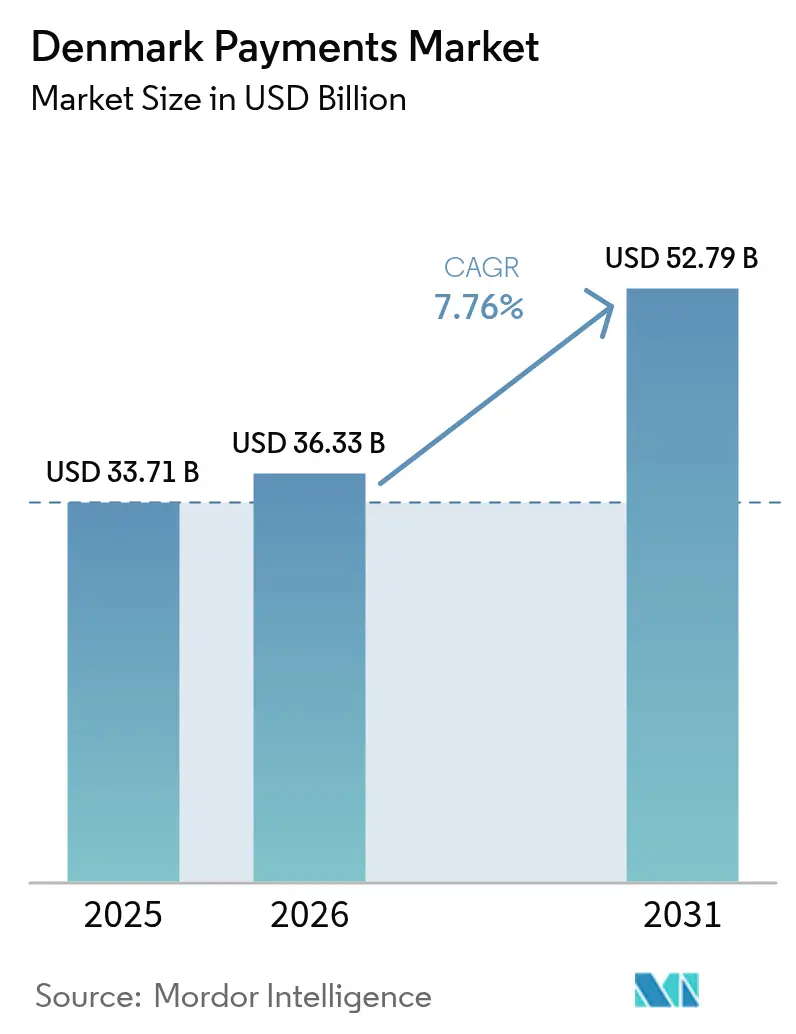
| Base Year Market Size (2025) | USD 33.71 Billion |
| Market Size (2026) | USD 36.33 Billion |
| Market Size (2031) | USD 52.79 Billion |
| Growth Rate (2026 - 2031) | 7.76 % |
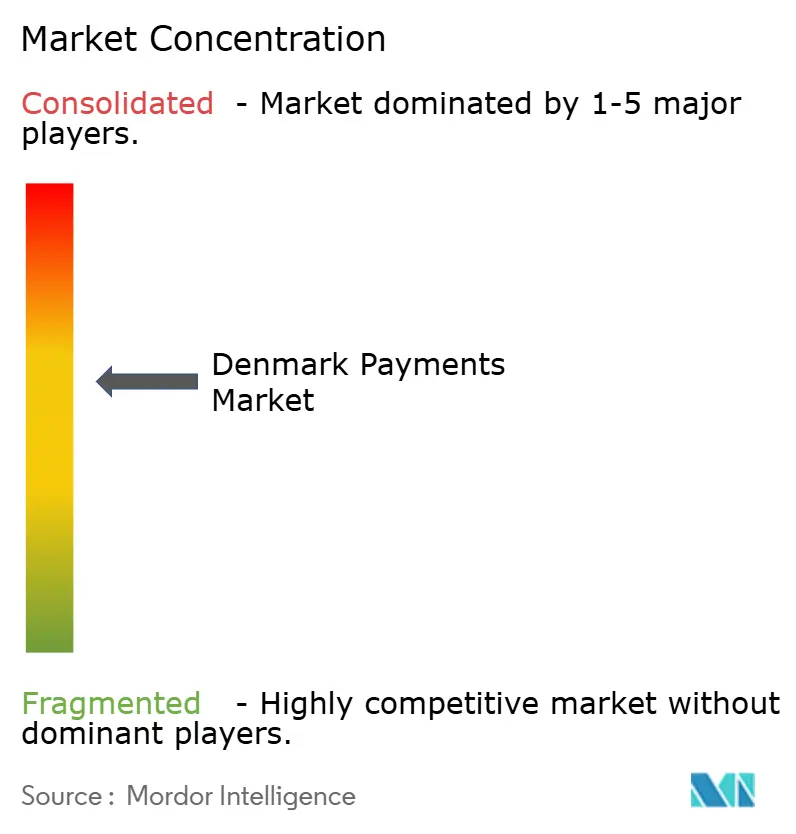
| Market Concentration | Medium |
Major Players *Disclaimer: Major Players sorted in no particular order Image © Mordor Intelligence. Reuse requires attribution under CC BY 4.0. | |
Denmark Payments Market Analysis by Mordor Intelligence
The Denmark payments market size is expected to grow from USD 33.71 billion in 2025 to USD 36.33 billion in 2026 and is forecast to reach USD 52.79 billion by 2031 at 7.76% CAGR over 2026-2031. High consumer trust in digital channels, almost universal broadband coverage, and continuous upgrades to national clearing rails underpin this trajectory. Instant account-to-account services attract both merchants and consumers seeking lower fees and immediate fund availability, while the integration of the national eID MitID has tightened authentication without adding checkout friction. Multinational scheme wallets such as Apple Pay and Google Pay now sit beside domestic champions like Vipps MobilePay, sharpening competition on user experience, fee transparency, and cross-border capabilities. Intensifying sustainability regulations are also reshaping card-manufacturing supply chains, pushing issuers toward eco-friendly materials and carbon-neutral issuance programs.[1]Verifone Systems, “Popular APMs in Nordic Countries,” verifone.com
Key Report Takeaways
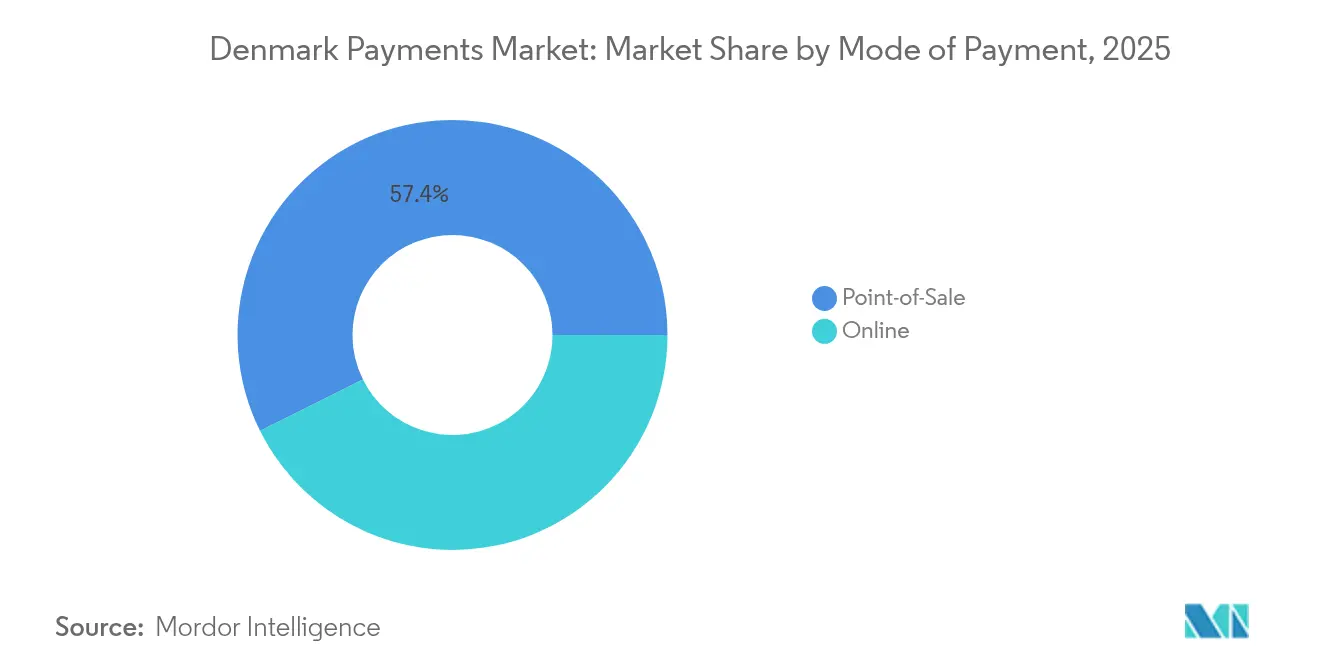
- By mode of payment, point-of-sale cards led with 67.20% of the Denmark payments market share in 2025; online digital wallets and A2A transfers are expanding at a 9.05% CAGR to 2031. Overall Point-of-Sale led with 57.35% revenue share.
- By interaction channel, physical point-of-sale held 71.10% revenue share in 2025, while e-commerce/m-commerce is forecast to advance at 10.25% CAGR through 2031.
- By transaction type, consumer-to-business captured 51.40% of the Denmark payments market size in 2025, and remittances & cross-border flows are projected to grow 12.55% CAGR between 2026-2031.
- By end-user industry, retail maintained 34.60% share of the Denmark payments market size in 2025, whereas healthcare is set to climb at 9.95% CAGR to 2031.
Note: Market size and forecast figures in this report are generated using Mordor Intelligence’s proprietary estimation framework, updated with the latest available data and insights as of 2026.
Denmark Payments Market Trends and Insights
Drivers Impact Analysis*
| Driver | (~) % Impact on CAGR Forecast | Geographic Relevance | Impact Timeline |
|---|---|---|---|
| Rise of Dankort-Linked Mobile Wallets among Small Merchants | +1.2% | National, with higher adoption in urban centers | Short term (≤ 2 years) |
| Government-Backed Instant Payment Rail (Straksclearing) Driving Real-time Adoption | +2.3% | National | Medium term (2-4 years) |
| E-commerce Checkout Optimisation through PSD2 SCA Exemptions | +1.5% | National, with cross-border implications | Medium term (2-4 years) |
| Growth of Cross-border Subscription Services into Denmark | +1.1% | National, with international connectivity | Medium term (2-4 years) |
| Increasing Merchant Acceptance of Apple Pay & Google Pay in Mass Transit | +0.8% | Urban centers, particularly Copenhagen | Short term (≤ 2 years) |
| Integration of National eID (MitID) with Payment Authentication | +0.9% | National | Medium term (2-4 years) |
| Source: Mordor Intelligence | |||
Rise of Dankort-Linked Mobile Wallets among Small Merchants
Dankort’s direct tie-in with smartphone wallets lets micro-merchants dodge international scheme fees while offering tap-and-go convenience. Domestic acquirers are rolling out simplified onboarding and flat-fee bundles, trimming the break-even point for sole traders. Visa and Mastercard acceptance remains vital for tourist spend, forcing terminals to operate dual-routing logic that auto-selects the cheapest network. Danish regulators are reviewing fee caps to keep Dankort viable as Apple Pay and Google Pay deepen loyalty integrations, intensifying margin pressure on local issuers.
Government-Backed Instant Payment Rail (Straksclearing) Driving Real-Time Adoption
Straksclearing settles retail transfers in seconds and processed daily values equal to 25% of GDP in 2024.[2]Danmarks Nationalbank, “The Digital Retail Payment Market Is Changing,” nationalbanken.dk Banks leverage the rail to launch instant salary disbursement and just-in-time supplier payments, unlocking working-capital benefits for corporates. Scheduled migration of Danish kroner settlement to TARGET Services in 2025 will open a direct bridge to pan-European TIPS, letting Nordic users push funds to euro wallets without intermediary banks. Providers are building overlay services such as request-to-pay and bulk payout APIs to monetise the infrastructure shift.
E-commerce Checkout Optimisation through PSD2 SCA Exemptions
Low-risk transaction and trusted beneficiary exemptions shave authentication steps off repeat purchases, lifting conversion for Danish online stores. Merchants deploy data-driven risk engines to maximise exemption eligibility while keeping fraud below regulator thresholds. The DFSA advocates a principle-based PSD3 that would further relax prescriptive rules and widen scope for machine-learning risk models.[3]European Commission, “Revised Rules for Payment Services in the EU,” europa.eu Payment gateways compete on exemption hit-rate dashboards and adaptive challenge flows that trade step-up prompts for real-time risk scores.
Growth of Cross-Border Subscription Services into Denmark
Streaming, software-as-a-service, and curated-box providers localise billing flows, integrating tokenisation to cut recurring decline rates. Payment processors route transactions via local acquiring bins, boosting authorisation and slicing currency conversion cost for merchants billing in DKK. IMF studies suggest CBDCs could slash cross-border fee structures by 60%, a prospect already spurring sandbox pilots between Danmarks Nationalbank and Nordic peers. Issuers analyse recurring data sets to upsell embedded credit and micro-insights packages to subscription platforms.
Restraints Impact Analysis*
| Restraint | (~) % Impact on CAGR Forecast | Geographic Relevance | Impact Timeline |
|---|---|---|---|
| Card-Scheme Interchange Fee Cap Pressure on Issuer Revenues | -0.7% | National, with EU regulatory alignment | Medium term (2-4 years) |
| High Saturation of Banked Population Limiting New-to-Bank Users | -0.5% | National | Long term (≥ 4 years) |
| Security Concerns Around Open-Banking APIs | -0.6% | National, with cross-border implications | Short term (≤ 2 years) |
| Legacy POS Hardware in Rural Jutland SMEs | -0.4% | Rural regions, particularly Jutland | Medium term (2-4 years) |
| Source: Mordor Intelligence | |||
Card-Scheme Interchange Fee Cap Pressure on Issuer Revenues
European legislation limits interchange to 0.2% on debit and 0.3% on credit, compressing Danish issuers’ core income. Banks respond by bundling lifestyle perks, insurance, and carbon-tracking dashboards into paid account tiers. Merchant-funded cashback marketplaces emerge as an offset model, shifting reward cost to retailers keen on repeat visits. Consolidation among mid-size issuers accelerates as compliance and tech transformation budgets rise faster than fee income
High Saturation of Banked Population Limiting New-to-Bank Users
With adult account penetration above 99%, growth shifts from acquisition to share-of-wallet battles. Challenger banks differentiate through hyper-personalised insights, automated budgeting nudges, and integrated crypto trading. Incumbents re-platform legacy cores to speed feature release cycles and defend primary relationship status. Non-bank brands in retail and telco embed financial services, fragmenting the value chain and prompting alliances between banks and vertical specialists.
*Our forecasts treat driver/restraint impacts as directional, not additive. The impact forecasts reflect baseline growth, mix effects, and variable interactions.
Segment Analysis
By Mode of Payment: Digital Wallets Challenging Card Dominance
Point-of-sale cards generated 67.20% revenue in 2025, underpinned by reliable terminal coverage and consumer familiarity. Overall Point-of-Sale led with 57.35% revenue share. The Denmark payments market size for online digital wallet and A2A flows is projected to grow at 9.05% CAGR, driven by one-click checkout and bank-sponsored pay-by-link services. Issuers issue co-branded tokenised credentials to secure wallet real estate, while processors add network-token orchestration to preserve card rails inside wallet transactions.
Although cash retains cultural relevance for peer gifting, share dropped to 10% of store payments in 2023. Younger cohorts pivot to BNPL options; 30% have tried instalment products, with fashion and electronics the leading categories. Wearable NFC form factors, niche gift cards, and QR acceptance gain visibility at events and campus venues, hinting at long-tail monetisation plays.



By Interaction Channel: Mobile Commerce Accelerates
Physical point-of-sale held 71.10% of 2025 value, yet mobile commerce is racing ahead at 10.25% CAGR as retailers invest in progressive web apps and in-app loyalty wallets. The Denmark payments market share for e-commerce is set to widen as omnichannel journeys blend click-to-collect and scan-to-buy experiences. Banks integrate MitID-based face recognition in their SDKs, removing password friction and boosting mobile completed-basket ratios.
Unified commerce drives demand for middleware that reconciles online and store transactions in a single ledger. Hospitality chains deploy pay-at-table QR to shorten turnover time, while grocery leaders trial smart trolley checkout that bills automatically on exit. Acquirers package token vaults, risk scoring, and micro-refund APIs to support these blended journeys.
By Transaction Type: Cross-Border Payments Outpace Domestic
Consumer-to-business flows retained 51.40% share in 2025, but cross-border activity outclasses domestic growth rates. The Denmark payments market size for remittances and cross-border is tracking a 12.55% CAGR as SMEs push export volumes and expatriate residents remit to other Nordic states. Vipps MobilePay’s phone-number-based transfers are cannibalising traditional SWIFT corridors, and fee transparency has become a purchase-decision lever.
Person-to-person volumes soar each December when gift splitting peaks. Business-to-business digitisation remains an untapped pool; corporates shift from batch giro files toward API-driven treasury payments, unlocking straight-through reconciliation benefits. Pharmaceutical export booms, fuelled by weight-loss drug demand, are swelling high-ticket cross-border settlements and attracting niche foreign-exchange specialists.

By End-User Industry: Healthcare Digitalisation Drives Growth
Retail commanded 34.60% of 2025 value as supermarkets and fashion groups roll out self-checkout and interactive fitting rooms. Denmark’s nationwide e-health portal sundhed.dk catalyses the fastest expansion; the Denmark payments market size for healthcare transactions is set to climb 9.95% CAGR as clinics embed card-on-file consent in patient portals. Insurers partner with payment gateways to enable real-time co-pay settlement at discharge, improving cash flow.
Entertainment & digital content benefits from subscription bundling, where telcos package streaming in 12-month plans settled through direct carrier billing or tokenised cards. Travel rebounds on contactless door access and ride-to-gate integrations. Utilities digitalise bill presentment; MitID verifies identity, and request-to-pay lowers direct-debit failure. Age-restricted product retail pilots electronic age verification that links tokenised ID to payment credentials, streamlining compliance.
Geography Analysis
The Denmark payments market operates inside a mature Nordic ecosystem known for collaborative policy design and high digital literacy. National GDP is projected to expand 3.6% in 2025 even as inflation cools to 1.6%, sustaining discretionary spending that funnels into digital channels. Copenhagen serves as the testing lab for tap-to-transit pilots and walk-out store models; success metrics here often green-light countrywide deployment.
Suburban municipalities follow close behind, aided by municipal grants that subsidise smart-terminal upgrades for small enterprises. Rural Jutland still houses legacy hardware and patchy connectivity; public-private fibre rollouts and terminal trade-in programs are addressing the digital gap. The Denmark payments market share for contactless in rural cafés rose 8 percentage points in 2024 after card acquirers bundled cellular fallback modems into rental agreements.
The 2025 TARGET Services migration harmonises settlement with euro markets, giving Danish PSPs real-time euro liquidity without nostros. Cross-currency TIPS rails will let Nordic shoppers pay southern European merchants in real time, fostering tourism spend in both directions. Danmarks Nationalbank meanwhile stress-tests offline fallback for critical infrastructure, ensuring payment resilience during cyber or power incidents. This multi-layered resiliency approach sustains public trust and supports seamless adoption across all regions.
Regulatory Landscape
Payment services and e-money activity in Denmark is governed by the Payment Services Act (Lov om betalinger), which implements PSD2 and is supervised by the Danish Financial Supervisory Authority (Finanstilsynet). This covers licensing, conduct requirements, and rules for third-party providers offering payment initiation and account information services. Danmarks Nationalbank also oversees critical payment and settlement infrastructure, and its oversight policy focuses on safety, efficiency, and operational resilience across the core rails used by Danish PSPs.
Rules that also affect payments in digital commerce include the Act on certain legal aspects of information society services (E-handelsloven) and enforcement by the Danish Consumer Ombudsman for e-commerce practices. Denmark implemented the EU Digital Services Act via Law No. 1765 of 28 December 2023, effective 17 February 2024, which adds compliance obligations for online platforms that can influence checkout, fraud prevention, and dispute handling. In B2B and B2G flows, standardized e-invoicing through OIOUBL/NemHandel aligned with EN 16931, and phased requirements under the 2022 Bookkeeping Act (including a compliance deadline of 1 January 2026 for class A companies, with an extension to 1 July 2026 for in-house systems) are reinforcing structured data flows that connect invoicing, pay-by-link, and reconciliation services.
Value Chain Analysis
Denmark's payments value chain begins with consumers and merchants using cards (including Dankort and international schemes), digital wallets, and account-to-account (A2A) transfers. Issuing banks provide accounts and cards, while acquirers and PSPs enable acceptance across physical point-of-sale and e-commerce. Gateways, risk engines, tokenization, and dispute management sit in the orchestration layer. MitID, developed through a public-private partnership involving the Agency for Digitisation and Finance Denmark, acts as a shared authentication layer across banking and digital commerce, influencing conversion and fraud outcomes.
Clearing and settlement are anchored by national and pan-European rails overseen by Danmarks Nationalbank and supported by industry infrastructure bodies, including Sumclearing, Intradagclearing, Straksclearing, and TARGET DKK. Structural change is underway at the infrastructure access layer, with Danmarks Nationalbank enabling payment institutions and e-money institutions to apply for direct participation in core central payment systems (including TARGET DKK) in April 2025 and completing the migration of Danish kroner settlement from Kronos2 to TARGET Services. Nets (Nexi Group) remains central to Dankort processing, while access and pricing governance for Dankort, together with increased resilience expectations such as cyber testing approaches aligned with frameworks like TIBER-EU, are pushing participants toward standardized connectivity, monitoring, and contingency arrangements.
Competitive Landscape
Competition blends incumbents, big-tech wallets, and fintech specialists. Vipps MobilePay controls 70% of domestic mobile transaction counts, yet Apple Pay and Google Pay steadily siphon affluent cardholders attracted to multi-country acceptance and device integration. Nets A/S maintains Dankort processing dominance but invests in cloud-native acquiring to fend off Stripe and Adyen entries. Danske Bank, Nordea, and Jyske upgrade open-banking APIs, racing to embed services inside merchant ERP systems.
Fintech integrator BEC Financial Technologies aggregates compliance and core banking for mid-tier institutions, unlocking scale economies. Subaio brings subscription-management to bank apps, increasing customer stickiness, while LSEG data feeds enrich risk models. International PSPs entice export-oriented SMEs with multi-currency wallets and automated tax reporting, pressured by European Value Added Tax One-Stop Shop requirements.
Strategic partnerships continue to shape market boundaries. Terminal provider Verifone teams with franchise retailers to roll out Android-based smart POS that deliver in-aisle payment and inventory checks. Cloud processor Clearhaus deepens BNPL support for Shopify merchants, while Inpay leverages its EMI licence to court marketplace payouts. Sustainability differentiators emerge; Thales’ PLA card portfolio persuades climate-conscious issuers eager to meet ESG scorecards.
Denmark Payments Industry Leaders
MobilePay A/S
Visa Inc.
American Express Company
Mastercard Inc.
PayPal Holdings, Inc.
- *Disclaimer: Major Players sorted in no particular order

Market Opportunities and Future Outlook
As real-time infrastructure scales and wallet-based card payments gain share, PSPs and banks have more room to monetize orchestration, fraud controls, and merchant-facing APIs. Danmarks Nationalbank reported that digital wallets accounted for 31.6% of all card transactions in Q4 2025, up from 28.0% in 2024, reinforcing demand for network token management, wallet routing, and unified reporting across Apple Pay, Google Pay, and domestic wallet flows. At the same time, integrating the Danish krone into Eurosystem instant-payment infrastructure creates space for overlay services such as request-to-pay, bulk payouts, and ERP-integrated treasury payments, which help SMEs and corporates move from batch files to API-led disbursements and reconciliation.
Commercial models are also supported by competitive access and cost governance for domestic rails. Konkurrence- og Forbrugerstyrelsen set a maximum fee cap for Nets' Dankort redemption in physical stores for 2024 and 2025 (315.2 million DKK), and legislative work in 2024 clarified access requirements for payment systems for PSPs such as acquirers. Together, these measures support multi-acquirer setups, least-cost routing, and merchant packages that combine Dankort with international scheme acceptance. The compliance push around structured e-invoicing (OIOUBL/NemHandel aligned to EN 16931) and certified digital bookkeeping requirements under the 2022 Bookkeeping Act is also driving demand for invoice-to-pay solutions that connect e-invoicing, payment initiation, and automated matching inside accounting and ERP systems.
Recent Industry Developments
- June 2026: EBA Clearing stated that the Danish banking community selected the STEP2 platform to process bulk retail payments in Danish kroner, with go-live scheduled for November 2026. The move shifts batch retail processing toward a pan-European platform and standardizes connectivity for banks and PSPs that build bulk payout and collection services.
- May 2026: Vipps MobilePay reported a strong financial turnaround for 2025, including profitability in Q4 2025 and higher transaction revenue. The improved economics strengthens its ability to invest in value-added capabilities such as loyalty, merchant tools, and cross-border features in a market where Apple Pay and Google Pay are gaining wallet share.
- February 2024: Denmark implements the EU Digital Services Act through Law No. 1765 of 28 December 2023, effective 17 February 2024, adding compliance obligations for online platforms that can shape checkout, fraud prevention, and dispute handling. The measure expands platform accountability and data handling requirements across digital commerce and payments.


Research Methodology Framework and Report Scope
Market Definition and Coverage
We define the Denmark payments market as the value of consumer and merchant payment transactions completed in Denmark across physical and online channels, using card payments, digital wallets, and cash where it is still used for commerce.
Scope exclusions: The scope excludes online purchases of motor vehicles, real estate, utility bill payments, mortgage payments, loans, credit card bill payments, and purchases of shares or bonds.
Segmentation Overview
- Segmentation by Mode of Payment
- Point-of-Sale
- Card (Debit, Credit, Pre-paid)
- Digital Wallets (Apple Pay, Google Pay, Interac Flash)
- Cash
- Other POS (Gift-cards, QR, Wearables)
- Online
- Card (Card-Not-Present)
- Digital Wallet and Account-to-Account (Interac e-Transfer, PayPal)
- Other Online (COD, BNPL, Bank Transfer)
- Point-of-Sale
- Segmentation by Interaction Channel
- Point-of-Sale
- E-commerce/M-commerce
- Segmentation by Transaction Type
- Person-to-Person (P2P)
- Consumer-to-Business (C2B)
- Business-to-Business (B2B)
- Remittances and Cross-border
- Segmentation by End-user Industry
- Retail
- Entertainment and Digital Content
- Healthcare
- Hospitality and Travel
- Government and Utilities
- Other End-user Industries
Data Sources, Market Sizing, and Validation
Desk Research
Desk research started with public payment statistics and definitions so the model stays tied to a clear transaction pool. We relied on sources such as Danmarks Nationalbank payments statistics and publications, Statistics Denmark time series, European Central Bank payments indicators, and payments and fraud notes from relevant EU bodies, followed by supporting material from annual reports and investor presentations of local banks and payment firms.
To set boundaries around e-commerce and in-store activity, we also used reputable industry and association publications (retail and e-commerce bodies) and trusted press coverage to cross-check adoption trends, for example contactless usage and wallet penetration. Where needed, a paid subscription database for company financials and a paid news and financials archive were used to confirm timelines, product positioning, and larger contract wins that could shift transaction volumes. This list is not exhaustive, and many other sources were used during data collection, validation, and research clarification.
Primary Interviews and Surveys
Interviews and surveys with payment service providers, banks, merchants, technology specialists, and regulatory professionals in Denmark are used to clarify gaps in channel coverage and test assumptions on digital adoption, transaction values, pricing, and forecast direction. Respondents also help distinguish card activity from account transfers and assess how Danish payment behavior affects the model.
Distribution of primary research fieldwork respondents
| Company type | Respondent position |
|---|---|
| Top tier: 26% | CXOs: 15% |
| Mid tier: 49% | Functional/Unit leaders: 30% |
| Smaller Players: 25% | Managers: 55% |
Market-Sizing & Forecasting
The market was sized using a top-down build that reconstructs Denmark payment value from channel activity and payment method mix, and then is reconciled with a few bottom-up checks so totals stay realistic. In practice, we start from known payments activity signals and allocate value across POS and online, followed by method splits across cards, digital wallets, and cash based on what is actually used at checkout.
Key inputs that shape the model include card turnover trends reported by the central bank, the online share of card turnover, the direction of consumer payment frequency, the expected pace of wallet usage in e-commerce and in-store, and merchant acceptance patterns that influence how fast cash use declines. On the validation side, discussions with sampled merchants and PSPs were used to sanity-check average ticket sizes by channel and the practical share of wallet routed via cards versus wallets in Denmark.
Forecasts were developed using scenario analysis that links growth to a small set of drivers that respondents could comment on with confidence, such as e-commerce growth, substitution away from cash, and continued digitization of travel and retail payments. Where bottom-up indications were incomplete for smaller merchant groups, we filled gaps using proxy merchant counts and ticket sizes agreed during interviews, and then adjusted only after the total aligned with the top-down demand pool.
Data Validation & Update Cycle
Outputs are validated through triangulation across independent signals, and then reviewed for unusual jumps by channel, payment type, and year-to-year growth. If the model shows a change that does not match observed payment statistics or merchant feedback, the assumptions are reopened and the relevant respondents are re-contacted to confirm what shifted.
Before sign-off, an internal analyst review checks that currency conversions, calendar alignment, and channel definitions are consistent with the stated scope. Reports are refreshed annually, with interim updates when material events occur, and a final pre-delivery check is done so clients receive the most current view available at the time of purchase.
Mordor Intelligence's Denmark Payments Market Size Compared With Other Published Estimates
Published values for Denmark payments often vary because the underlying definitions are not always the same, and because some studies mix transaction value with provider revenue or add payment-related services that are not part of checkout activity. Differences also show up when one publisher counts cross-border flows differently or uses a different calendar year for currency conversion.
Central bank card-turnover statistics and the observed split between in-store and online payment activity are the checks that keep Mordor Intelligence's estimate tied to a defined Denmark transaction pool, with explicit exclusions for non-commerce categories like real estate and loan repayments. In other publications, the gap typically comes from including a wider set of payment instruments, rolling in bill payments and transfers, or projecting aggressive wallet substitution without validating the merchant acceptance reality in Denmark.
Benchmark comparison
| Source | Market Size | Gaps in Research Methodology |
|---|---|---|
| Mordor Intelligence | USD 33.71 B (2025) | |
| Global Consultancy A | USD 115.00 B (2025) | Uses a broader definition that appears to align with total card turnover or total payments value, which can include cross-border spend and additional payment instruments beyond POS and e-commerce checkout. |
| Regional Consultancy B | USD 234.80 B (2026) | Blends multiple layers such as transfers and payment services into one total, and the base year is different, which can inflate the headline value relative to a narrower checkout-focused scope. |
The comparison shows that the spread is mostly explained by what is counted as a payment, and whether the figure represents checkout activity versus a wider financial flows view. By keeping the inclusions tied to observable commerce payment signals and clearly stating exclusions up front, the resulting number stays easier to replicate and to use for planning.


Key Questions Answered in the Report
What is the current size of the Denmark payments market?
The market stands at USD 36.33 billion in 2026 and is on track for USD 52.79 billion by 2031.
Which payment mode is growing fastest in Denmark?
Online digital wallets and account-to-account transfers are expanding at 9.05% CAGR through 2031, rapidly challenging card dominance.
How important are instant payments in Denmark?
Straksclearing settles transactions in seconds and already supports daily values equal to 25% of GDP, underpinning widespread real-time adoption.
Why is healthcare the fastest-growing end-user segment?
National e-health portals such as sundhed.dk integrate payment at the point of care, pushing healthcare transaction value toward a 9.95% CAGR.
What regulatory shifts should payment providers monitor?
The Digital Operational Resilience Act and the forthcoming PSD3 will tighten cybersecurity, expand open-banking scope, and reshape revenue models tied to interchange.
How competitive is the mobile wallet space?
Vipps MobilePay leads with 70% usage, yet Apple Pay and Google Pay are gaining share, intensifying innovation on loyalty, cross-border capability, and fee structures.
Page last updated on:


 Your data is secure and never sold or shared.


