
Dehydrating Breather Market Size and Share
Market Overview
| Study Period | 2021 - 2031 |
|---|---|
| Forecast Data Period | 2026 - 2031 |
| Historical Data Period | 2021 - 2024 |
| Growth Rate | 1.47 % |
| Fastest Growing Market | Asia Pacific |
| Largest Market | Asia Pacific |
| Market Concentration | Low |
Major Players *Disclaimer: Major Players sorted in no particular order Image © Mordor Intelligence. Reuse requires attribution under CC BY 4.0. | |
Dehydrating Breather Market Analysis by Mordor Intelligence
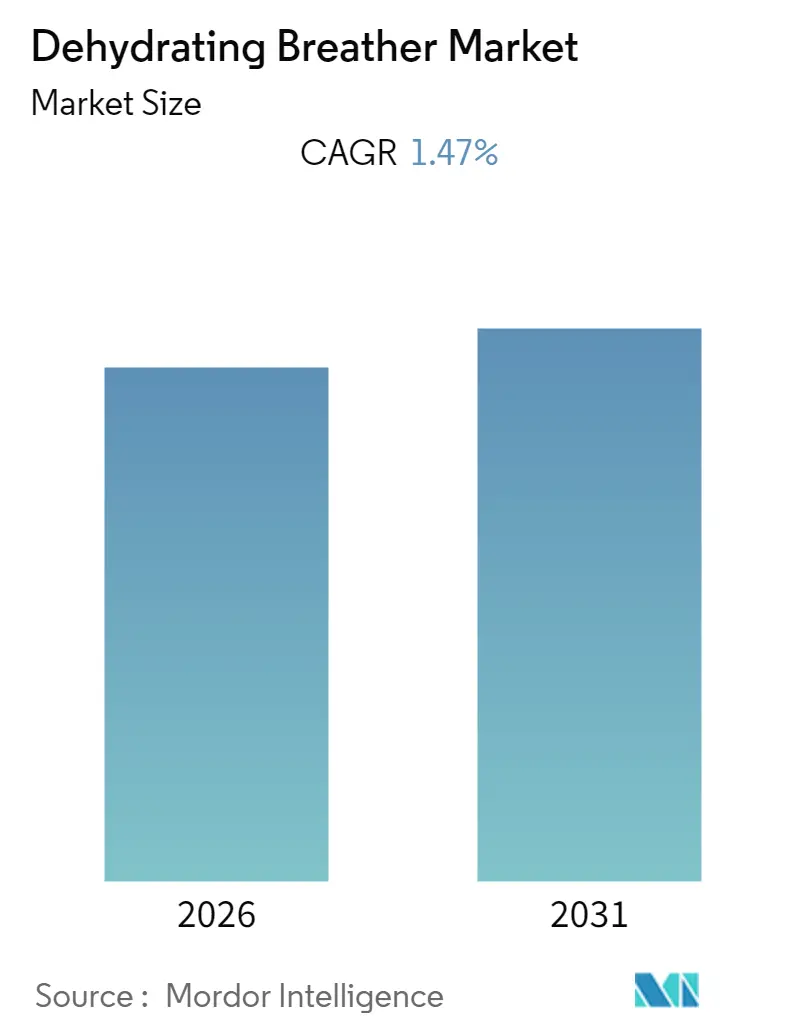
The Dehydrating Breather Market size is expected to register a CAGR of 1.47% during the forecast period (2026-2031).
- The utility sector is expected to be the largest segment in the forecast period. The industry applies the largest number of transformers that require a dehydrating breather to increase their efficiency and reduce the energy loss. An increase in the installed power generation capacity around the globe, in the utility sector, is expected to increase the requirement of transformers and thereby the need for dehydrating breathers.
- New types of desiccants are being researched and developed, with the modeling of the equipment becoming more suitable for severe temperatures. Advancement in the industry is expected to act as an opportunity for the market players.
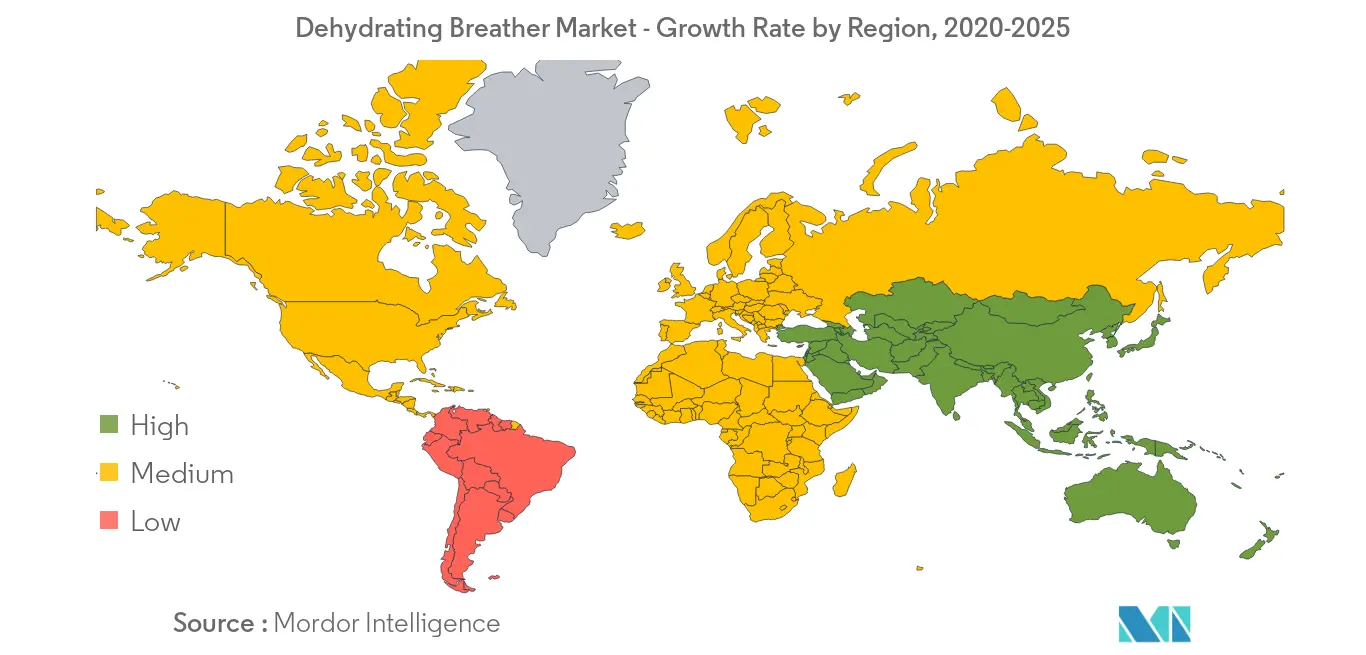
- The Asia-Pacific region is expected to be the largest market in the forecast period due to its large utility sector and increasing demand for energy. China and India are expected to be the largest users of the dehydrating breathers in the region.
Note: Market size and forecast figures in this report are generated using Mordor Intelligence’s proprietary estimation framework, updated with the latest available data and insights as of 2026.
Global Dehydrating Breather Market Trends and Insights
Utility Segment to Dominate the Market
- Proper maintenance of a power transformer's insulation system plays a crucial role in helping ensure the transformer operates at an optimum level throughout its life, and transformer oil is a critical component of that insulation system. To the greatest extent possible, transformer oil must be protected from impurities that lower its ability to function as designed. Dehydrating breather provides for the function by reducing the contaminants in the feeder air.
- The dehydrating breathers are manufactured in various sizes, primarily for use in oil-insulated transformers where they prevent moisture in the air from coming in contact with the transformer oil and thus lowering insulation properties required for the transformer, thereby profiting the users especially large transformers that may be used in the utility sector.
- An increase in renewable energy in the market has created an additional requirement of step-up and step-down transformers, primarily due to a degree of unpredictability of the energy generation from sources such as wind and solar. The increase in transformers is expected to aid the growth of the dehydrating breather market in the utility sector.
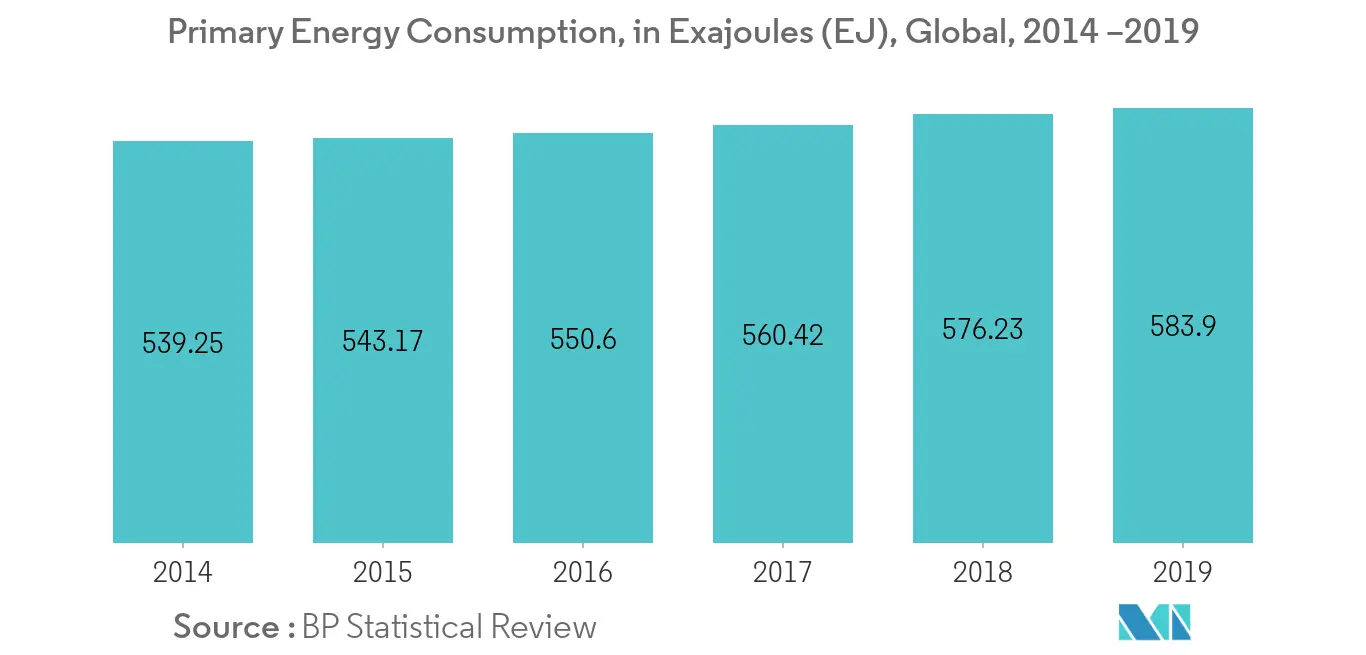
- Primary energy consumption in the world increased by 1.3% to 583.9 exajoules (EJ), in 2019 from 576.23 exajoules (EJ), in 2018. The energy consumption is expected to increase further in the forecast period and may drive the utility sector in the dehydrating breather market.
- In 2019, Maschinenfabrik Reinhausen GmbH launched a new generation of dehydrating breathers named MTRAB 2.5. Its functionality is designed to help customers reduce the life-cycle costs of their equipment and overcome the challenges of steadily increasing requirements - ever-longer operating times, coupled with continually increasing current densities. Advancements in the industry are expected to aid the growth of the market.
- Hence, utility segment is expected to dominate the market in the forecast period due to the increase in the energy consumption and advancements being made in the equipment.
Asia Pacific Region to Dominate the Market
- The Asia-Pacific region consists of the largest installed capacity generation of energy in the world. To reduce the overall maintenance of the power generation sector, dehydrating breathers in the transformers may be used in the industry.
- Different types of dehydrating breathers like the self-regenerating single column dehydrating breather are being used as a more advanced solution that has more upfront expense but eliminates the need for frequent monitoring and replacement of the silica gel. In the Asia-Pacific region, the technology is gaining further acceptance and may increase in the forecast period.
- There has been a rise in investments in gas-insulated and air-insulated substations in the Asia-Pacific region, which is expected to boost the demand for transformers in the region, which may, in turn, aid the growth of dehydrating breather industry, in the forecast period.
- Primary energy consumption in the Asia-Pacific region increased by 3.3% to 257.56 exajoules (EJ), in 2019 from 249.35 exajoules (EJ), in 2018. The energy consumption is expected to increase further in the forecast period and may drive the dehydrating breather market.
- Hence, Asia-Pacific is expected to dominate the dehydrating breather market due to the increase in the investments in the dehydrating breathers related to industries and rising primary energy consumption in the region.
Regulatory Landscape
Dehydrating breathers used on liquid-immersed transformers and on-load tap-changers fall within established transformer accessory and efficiency compliance frameworks rather than as a stand-alone regulated product category. For international tenders, alignment to IEC transformer accessory requirements is a recurring technical qualifier, including IEC 60076-22-7:2020 and its 2023 corrigendum, which cover service conditions and mechanical/interchangeability requirements for accessories that include dehydrating breathers.
Regional and utility specifications also shape product design and qualification. In the European Union, Commission Regulation (EU) 548/2014 on power transformer efficiency influences transformer design and, indirectly, accessory selections used to support long-life insulation performance. At the buyer level, utility procurement documents can operate as de facto standards; for example, Eskom Specification 240-56062529 requires dehydrating breathers on new liquid-immersed transformers, reactors, and on-load tap-changers, and it specifies minimum silica gel loading guidance (e.g., 200 g per 1000 litres of transformer oil volume) and capacity limits for breather compartments.
Value Chain Analysis
The value chain starts with upstream materials and subcomponents, including desiccants (commonly silica gel), housings (often metal or engineered polymers), seals, and sight glasses. For self-dehydrating or regenerating designs, additional inputs include sensors/electronics, heating elements, and control components used for regeneration and remote status indication. Manufacturers assemble and test breathers to meet transformer accessory requirements, then supply either directly to utilities and industrial asset owners or through transformer OEM and accessory-channel partners, where breathers are bundled with liquid-immersed transformers and on-load tap-changers.
Downstream, demand is driven by installed transformer fleets and maintenance programs, particularly in utility substations where breathing cycles and moisture ingress protection are operational priorities. Service and aftermarket activities include inspection, silica gel replacement for conventional units, and condition-based maintenance for smart or regenerating variants, supported by distributors, transformer service contractors, and OEM service networks. Procurement is often governed by utility specifications that define acceptable materials and sizing rules, which can tighten supplier qualification and favor vendors able to document compliance and maintain supply continuity for critical accessories.
Competitive Landscape
The dehydrating breather market is partially fragmented. Some of the key players in this market include ABB Ltd., AGM Container Controls Inc., Des-Case Corporation, Qualitrol Corporation, and Maschinenfabrik Reinhausen GmbH.
Dehydrating Breather Industry Leaders
-
ABB Ltd.
-
AGM Container Controls Inc.
-
Des-Case Corporation
-
Qualitrol Corporation
-
Maschinenfabrik Reinhausen GmbH
- *Disclaimer: Major Players sorted in no particular order

Market Opportunities and Future Outlook
A key opportunity is accelerated substitution from conventional silica-gel breathers toward self-dehydrating and self-regenerating designs that reduce site visits and simplify maintenance for utilities and industrial operators with dispersed transformer fleets. Evidence of innovation momentum includes a September 2024 Tata Power-DDL patent for a self-regenerating transformer breather designed to reduce maintenance frequency, along with ongoing R&D into breathing-system monitoring and intelligent operation, including published work in 2025 on predicting dehumidification efficiency and 2026 work on multi-parameter sensing for breathing-system condition monitoring. This direction supports product differentiation around remote indication, regeneration control, and integration into broader transformer health programs.
Another opportunity is specification-led standardization and retrofit programs where utilities explicitly prescribe breather fitment and sizing rules, which can create clearer replacement cycles and tenderable configurations for suppliers. Procurement requirements such as Eskom Specification 240-56062529 (fitment on new liquid-immersed transformers, reactors, and on-load tap-changers, plus silica gel loading guidance) show how buyer-side standards can expand addressable volume beyond newbuilds into standardized spares and maintenance inventories. In regions with large and expanding transformer bases, suppliers able to provide both conventional and maintenance-reducing designs, and document compliance to IEC transformer accessory requirements, have a practical route to compete across new equipment supply and aftermarket replacement.
Recent Industry Developments
- February 2026: Researchers published work on a multi-parameter optical sensing approach (pressure and temperature) for condition monitoring of power transformer breathing systems. This supports product differentiation toward smarter breather and breathing-system monitoring, aligning accessories with predictive maintenance workflows used in utility transformer fleets.
- August 2025: Filtration Group announced the acquisition of Des-Case Corporation, a known supplier of dehydrating breathers and contamination control solutions. The deal consolidates moisture-control offerings under a larger filtration platform and can broaden distribution reach and bundled maintenance offerings for transformer and industrial reliability programs.
- September 2024: Tata Power-DDL reported receiving a patent for a self-regenerating transformer breather concept designed to reduce maintenance frequency. The patent signals continued engineering focus on reducing manual silica gel handling and site visits, supporting a shift in competitive emphasis from passive components to maintenance-reducing designs.
Research Methodology Framework and Report Scope
Market Definition and Coverage
We define the dehydrating breather market as revenue from devices that remove moisture from air entering sealed equipment, protecting fluids and internals from humidity-driven degradation during operation and storage.
Scope exclusions: It excludes basic vent plugs, general desiccant packs not integrated into a breather, and wider filtration assemblies sold as part of complete equipment packages.
Segmentation Overview
- Type
- Conventional
- Self-Dehydrating Breather
- End-User
- Utilities
- Industrial
- Others
- Geography
- North America
- Europe
- Asia-Pacific
- South America
- Middle-East and Africa
Data Sources, Market Sizing, and Validation
Desk Research
Desk work started with mapping where breathers are most commonly installed, then matching those installation patterns to publicly visible equipment information and maintenance demand signals. We used open, repeatable source types such as US DOE materials and motor system references, US EPA rules that affect industrial equipment upkeep, and ISO and IEC standards pages that define contamination and ingress protection concepts used in maintenance specifications.
To keep the market model anchored, we also relied on trade and industry sources, including customs and tariff schedules for relevant filtration and desiccant related shipments, engineering journals and conference papers that discuss moisture control in oil-filled systems, and public financial documents such as annual reports and investor decks that describe industrial maintenance and reliability products. Where available, we used a paid subscription database for company financials and a patent database to cross-check product breadth and recent innovation activity. These are illustrative source types only, and we also reviewed other public references to support data collection, validation, and clarification.
Primary Interviews and Surveys
Primary work focused on confirming how dehydrating breathers are specified, replaced, and priced across utilities and industrial sites, since replacement cycles and installed-base assumptions can change totals materially. We spoke with manufacturers, distributors, maintenance teams, and reliability-focused roles across the Americas, EMEA, and APAC to pressure test unit volumes, average selling price ranges, and common bundling practices during procurement.
Distribution of primary research fieldwork respondents
| Company type | Respondent position | Region |
|---|---|---|
| Top tier: 30% | CXOs: 16% | APAC: 45% |
| Mid tier: 53% | Functional/Unit leaders: 25% | EMEA: 32% |
| Smaller Players: 17% | Managers: 59% | Americas: 23% |
Market-Sizing & Forecasting
Sizing begins with a top-down build that reconstructs demand from the installed base of moisture-sensitive equipment and the expected replacement cadence for breather consumables and housings, then converts those unit totals to revenue using observed price bands. To keep the model practical, we used a small set of repeatable inputs, such as growth in electricity and industrial output, transformer and rotating equipment maintenance intensity, typical breather changeout intervals, the mix shift toward self-dehydrating units, and region-level import patterns for related components.
Those totals are corroborated with selective bottom-up approximations, including channel checks on distributor throughput and a sampled ASP times volume approach for a shortlist of common breather configurations. When the bottom-up checks show gaps, we adjust using conservative ranges that align with what interviewees confirm as realistic procurement behavior, for example how replacement frequency differs between humid climates and controlled indoor settings.
For forecasting, scenario analysis is used because growth is driven more by maintenance behavior and asset uptime priorities than by sudden step changes in capacity. Assumptions around replacement intervals, pricing progression, and penetration in utilities versus general industrial users are stress tested with expert feedback before finalizing the year-by-year outlook.
Data Validation & Update Cycle
Outputs are checked against independent signals so the numbers do not only reflect one modeling path, and variances are reviewed before sign-off. We compare implied units with reasonable installed-base intensity, verify regional splits against trade flow directionality, and re-check pricing against current catalog and channel quotes when outliers appear.
A multi-step analyst review is followed, and respondents are re-contacted when a key assumption shifts materially or a new data point conflicts with earlier inputs. Reports are refreshed annually, with interim updates when major events affect pricing, supply, or industrial spending. Before delivery, a final pass is completed so clients receive the most current view available at the time.
Mordor Intelligence's Dehydrating Breather Market Estimate Compared With Other Published Estimates
Published market values for dehydrating breathers can land far apart because the scope boundary is not always consistent, and because pricing and currency handling varies by publisher. Differences also come from how often assumptions are refreshed, especially for ASP bands and replacement cycles that shift with maintenance budgets.
When spot prices move and exchange rates swing, the timing of currency conversion and the point at which ASPs are updated can change the reported total, even if unit demand is similar. The refresh cadence used for quarterly channel price checks, along with the validation step that reconciles implied units to equipment upkeep indicators, helps explain much of the spread, which is consistent with the modeling choices used for the Mordor Intelligence estimate.
Benchmark comparison
| Source | Market Size | Gaps in Research Methodology |
|---|---|---|
| Mordor Intelligence | USD 0.00 M (2024) | |
| Industry Research Publisher A | USD 524.20 M (2024) | Uses a broad scope description without clearly separating integrated breather systems from adjacent moisture control items, and the pricing build is not explained, which can inflate implied ASPs. |
| Data Publisher B | USD 374.00 M (2024) | Appears to rely on a narrower revenue base and a fixed progression to 2031, which can understate near-term price mix changes between conventional and self-dehydrating units. |
Across the three figures, the practical takeaway is that scope choices and price timing matter as much as unit demand. Our approach keeps the total traceable to a defined installed base driven demand pool, realistic replacement behavior, and a price layer that is checked and refreshed so the final value is repeatable.
Key Questions Answered in the Report
What is the current Dehydrating Breather Market size?
The Dehydrating Breather Market is projected to register a CAGR of 1.47% during the forecast period (2026-2031)
Who are the key players in Dehydrating Breather Market?
ABB Ltd., AGM Container Controls Inc., Des-Case Corporation, Qualitrol Corporation and Maschinenfabrik Reinhausen GmbH are the major companies operating in the Dehydrating Breather Market.
Which is the fastest growing region in Dehydrating Breather Market?
Asia Pacific is estimated to grow at the highest CAGR over the forecast period (2026-2031).
Which region has the biggest share in Dehydrating Breather Market?
In 2025, the Asia Pacific accounts for the largest market share in Dehydrating Breather Market.
What years does this Dehydrating Breather Market cover?
The report covers the Dehydrating Breather Market historical market size for years: 2020, 2021, 2022, 2023 and 2024. The report also forecasts the Dehydrating Breather Market size for years: 2026, 2027, 2028, 2029, 2030 and 2031.