
Defoamers Market Size and Share
Market Overview
| Study Period | 2021 - 2031 |
|---|---|
| Market Size (2026) | USD 7.49 Billion |
| Market Size (2031) | USD 9.23 Billion |
| Growth Rate (2026 - 2031) | 4.26 % |
| Fastest Growing Market | Asia Pacific |
| Largest Market | North America |
| Market Concentration | Medium |
Major Players *Disclaimer: Major Players sorted in no particular order Image © Mordor Intelligence. Reuse requires attribution under CC BY 4.0. | |
Defoamers Market Analysis by Mordor Intelligence
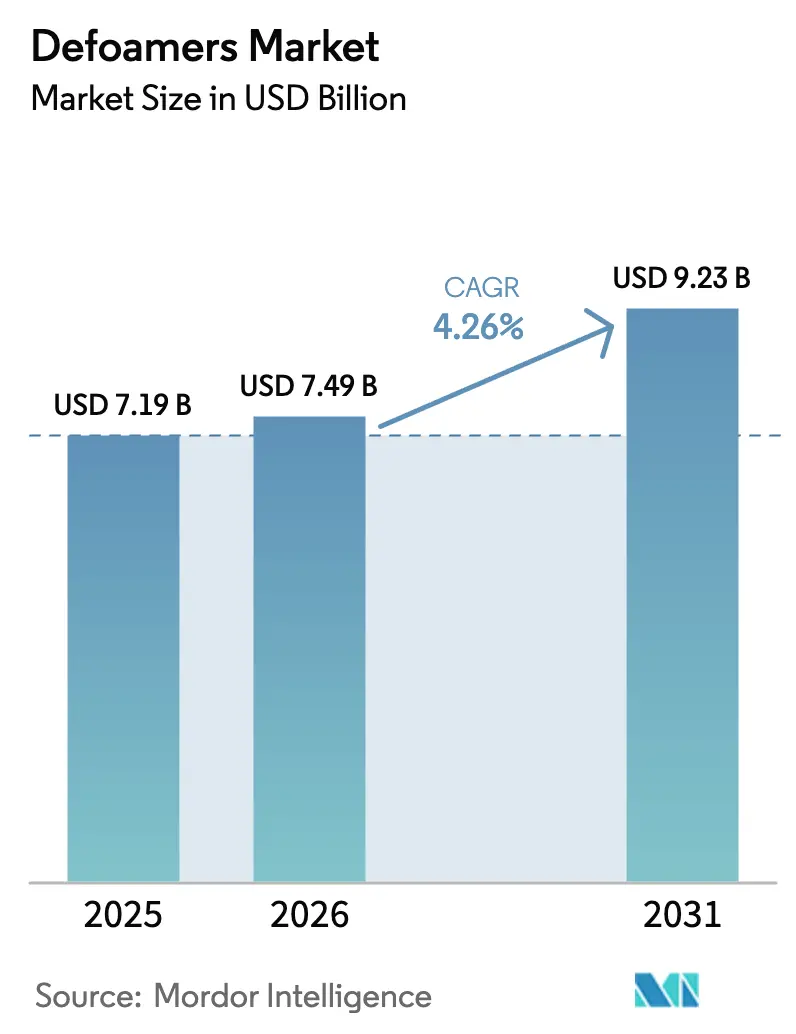
The Defoamers Market size is expected to increase from USD 7.19 billion in 2025 to USD 7.49 billion in 2026 and reach USD 9.23 billion by 2031, growing at a CAGR of 4.26% over 2026-2031. Mounting industrial output across the Asia-Pacific, stricter environmental rules that limit volatile organic compounds, and wider use of inline process-control sensors are setting the growth trajectory. Silicone grades currently anchor performance at high temperatures, yet water-based formats are winning share as pulp mills, paint formulators, and membrane bioreactors pursue low-residue options. End-user demand is widening from legacy pulp operations toward paints, coatings, and precision fermentation, while regional producers in India, Indonesia, and Vietnam add new capacity that lifts specialty-chemical consumption. Pricing power is mixed: Shin-Etsu exerts leverage on silicone monomers, but regional blenders continue to tailor cost-effective polymer and vegetable-oil emulsions that fit local regulatory regimes.
Key Report Takeaways
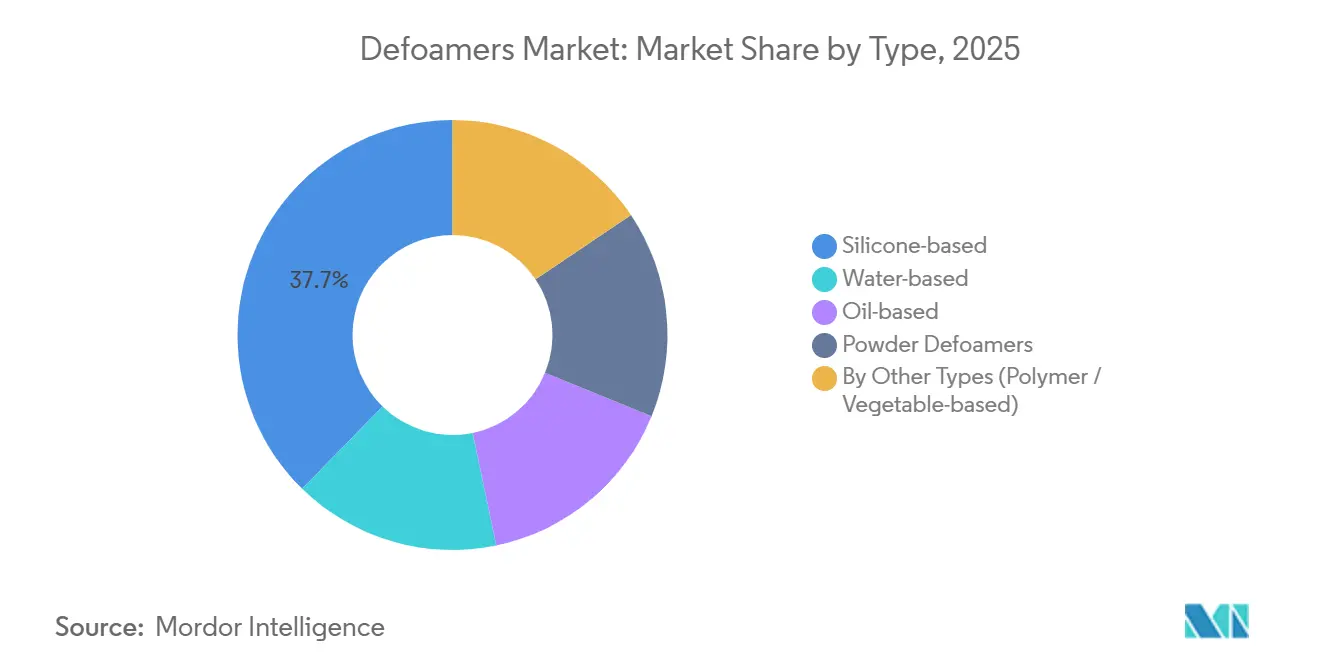
- By type, Silicone-based products held 37.68% of the defoamers market share in 2025. Water-based grades are projected to advance at a 4.98% CAGR through 2031.
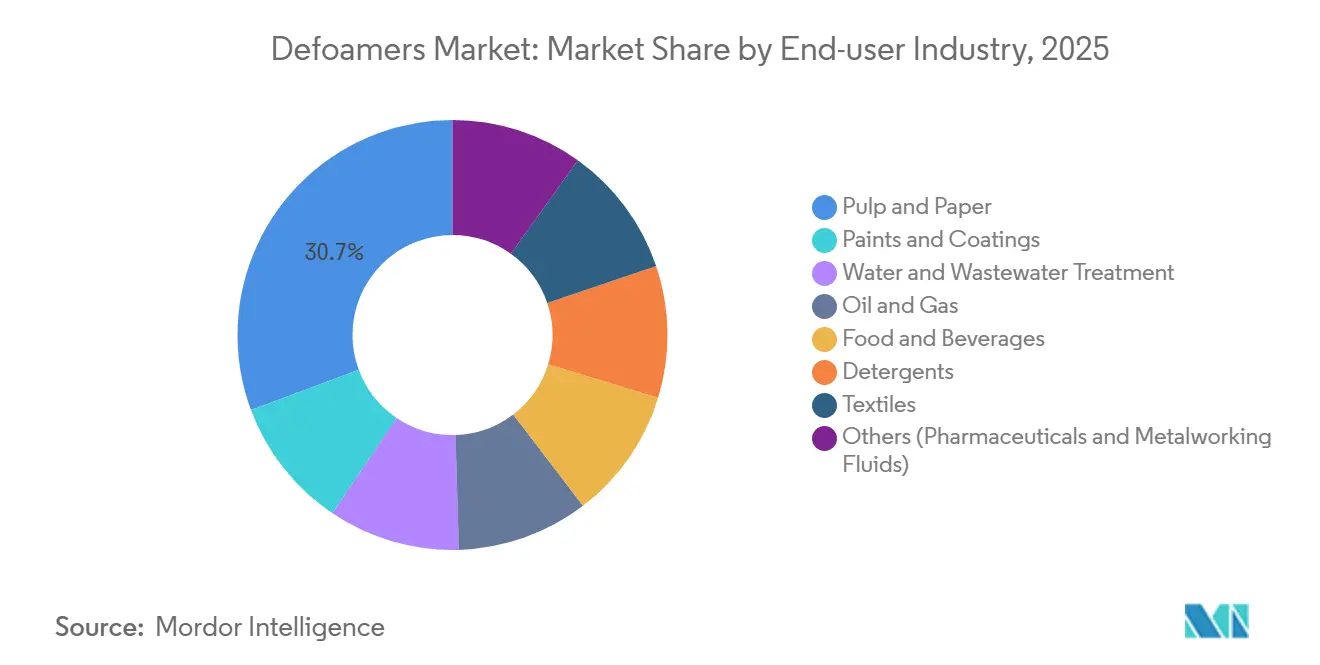
- By end-user industry, Pulp and paper accounted for 30.65% of total demand in 2025. Paints and coatings are set to expand at a 5.67% CAGR to 2031.
- By geography, North America led with 34.05% revenue share in 2025. Asia-Pacific is forecast to record the fastest regional CAGR at 5.04% through 2031.
Note: Market size and forecast figures in this report are generated using Mordor Intelligence’s proprietary estimation framework, updated with the latest available data and insights as of January 2026.
Market Trends and Insights
Drivers Impact Analysis of Defoamers Market*
| Driver | (~) % Impact on CAGR Forecast | Geographic Relevance | Impact Timeline |
|---|---|---|---|
| Booming paints and coatings output in Asia drives high-performance defoamer demand | +1.2% | China, India, Vietnam, spillover to Gulf states | Medium term (2-4 years) |
| Pulp and paper capacity additions in India and Indonesia expand process-chemical spend | +0.9% | India, Indonesia, selected South America | Medium term (2-4 years) |
| Wastewater reuse mandates spur antifoam use in MBR and RO plants | +0.7% | North America, Europe, Middle East, global roll-out | Long term (≥4 years) |
| Inline optical and ultrasonic sensors require non-fouling, low-silicone formulations | +0.5% | United States, Germany, Japan, South Korea | Short term (≤2 years) |
| Composite resins for offshore wind and green-hydrogen equipment specify ultra-low VOC antifoam | +0.4% | North Sea, Atlantic seaboard, East Asia | Long term (≥4 years) |
| Source: Mordor Intelligence | |||
Booming Paints And Coatings Output In Asia Drives High-Performance Defoamer Demand
Asia-Pacific paint production exceeded USD 89.4 billion in 2024, and new decorative-paint lines in Indore and Mysore now draw significant volumes of specialty defoamers[1]Company Press Release, “Asian Paints Capacity Expansion,” asianpaints.com. Capacity additions in China and Vietnam echo this trend, while BASF’s neopentyl-glycol complex in Zhanjiang supplies powder-coating binders that need thermally stable antifoam above 180°C. Bio-renewable polyether-modified polysiloxanes help formulators hit GB 18582-2020 VOC limits and secure 15% price premiums over commodity emulsions. Suppliers note a two-tier market: low-cost silicone emulsions face shrinking margins, whereas polymer concentrates benefit from stricter quality benchmarks. Growing OEM demand for blemish-free automotive finishes further reinforces the premium tier, lifting average selling prices across the defoamers market.
Pulp And Paper Capacity Additions In India And Indonesia Expand Process-Chemical Spend
India’s 850 pulp mills are running near full capacity, pushing new investments that enlarge chemical budgets for antifoam. APRIL Group’s USD 2.1 billion folding-boxboard mill in Riau alone is expected to consume up to 4,000 tonnes of defoamer yearly. Closed white-water loops favor polyether-polyol emulsions, while membrane bioreactors require silicone-free alternatives to protect flux over seven-year design lives[2] Fraunhofer IVV, “Sensor-Based Foam Control Study,” ivv.fraunhofer.de. These technical pivots explain why water-based products are outgrowing the wider defoamers market. Indonesian forestry policy and India’s chemical incentive scheme further derisk greenfield spending, sustaining a positive outlook through 2031.
Wastewater Reuse Mandates Spur Antifoam Use In MBR And RO Plants
Zero-liquid-discharge rules in California, the Gulf, and India demand strict foam control inside membrane bioreactors. Operators typically dose 5-50 ppm of low-molecular-weight polyether polyols to keep trans-membrane pressure within specification. Silicone oils risk fouling polyvinylidene-fluoride modules, shortening life by two years and raising capital costs. ISO 14001 audits favor suppliers with documented aquatic-toxicity data, directing new orders toward vegetable oil and glycerin emulsions. Wider desalination build-outs across Saudi Arabia and the United Arab Emirates reinforce long-run consumption in this high-value niche.
Inline Optical / Ultrasonic Sensors Require Non-Fouling, Low-Silicone Formulations
Automated foam detectors in bioreactors and food fermenters lose signal accuracy once sensor faces collect silicone residue, a drop measured at roughly 12% after several weeks of operation. Polyether-polyol defoamers leave 80% less film on stainless steel than traditional polydimethylsiloxane. Pharmaceutical contract manufacturers, therefore, mandate silicone-free grades that meet FDA 21 CFR 173.340. BASF’s EFKA PB 2770 and Evonik’s TEGO Foamex 8850 exceed 50% bio-content, aligning with cleanroom validation needs. Precision fermentation for alternative proteins follows the same path, expanding the specialty share of the defoamers market.
Restraints Impact Analysis of Defoamers Market*
| Restraint | (~) % Impact on CAGR Forecast | Geographic Relevance | Impact Timeline |
|---|---|---|---|
| Silicone-monomer cost spikes and supply shocks | -0.8% | Asia-Pacific, Europe, global ripple effects | Short term (≤2 years) |
| Tightening PFAS-style scrutiny of persistent silicone chemistries | -0.5% | North America, Europe, regulatory spillover to Asia | Medium term (2-4 years) |
| Shift to closed-loop mechanical foam control in zero-discharge plants | -0.3% | India, China, Middle East, selective U.S. sites | Long term (≥4 years) |
| Source: Mordor Intelligence | |||
Silicone-Monomer Cost Spikes And Supply Shocks
Shin-Etsu holds half of global D4 and D5 capacity, creating a bottleneck that sharpened price jumps when Shandong’s energy costs rose in late 2024. Spot prices climbed 18% quarter over quarter, squeezing formulators tied to pulp, paper, and textile clients that resist pass-through increases. Wacker Chemie’s 40,000 tonne pyrogenic-silica line eases specialty grades but fails to balance bulk monomer supply. The volatility motivates converters to lock in glycerin, fatty-acid, and ethylene-oxide-based alternatives whose feedstocks are geographically diverse. BASF and Evonik price their bio-renewable products 10-15% above silicone emulsions yet offer steadier input costs, insulating margins in the defoamers market.
Tightening PFAS-Style Scrutiny Of Persistent Silicone Chemistries
EU chemical strategy discussions now consider certain cyclic siloxanes to be persistent and bio-accumulative. California’s PFAS ban in textiles, effective 2025, frames silicones as potential “forever chemicals,” spurring apparel and detergent brands to pre-emptively reformulate. Ecolab and Evonik patents offer vegetable-oil emulsions that cut persistent-chemical content by 95% while sustaining knock-down efficiency. Full product verification under ASTM D6866 and OECD aquatic tests adds up to USD 25,000 per SKU, a burden smaller regional blenders struggle to carry. The compliance cost, therefore, accelerates consolidation within the defoamers industry.
*Our forecasts treat driver/restraint impacts as directional, not additive. The impact forecasts reflect baseline growth, mix effects, and variable interactions.
Defoamers Market Segment Analysis
By Type:
Bio-Renewable Chemistries Challenge Silicone DominanceSilicone products still lead, yet water-based offerings are accelerating at 4.98% CAGR. In 2025, silicone held a 37.68% share of the defoamers market size and remains essential in high-temperature coatings. Polymer and vegetable-oil emulsions’ growth reflects end-users’ preference for low-VOC and sensor-friendly profiles. Powder formats for dry-mix mortars grow steadily with India’s construction boom. Tight supplies of D4 and D5 also encourage migration to glycerin and fatty-acid feedstocks that carry more stable pricing. The defoamers market, therefore, shows clear segmentation between commodity silicone emulsions under margin pressure and specialty bio-renewable grades capturing value premiums.
Water-based systems benefit from closed-loop pulp mills and membrane bioreactors that prohibit silicone residue. BASF’s EFKA PB 2770 and Evonik’s TEGO Foamex 8850 illustrate the shift, each commanding double-digit price premiums and winning early adoption in UV-curable and food-contact applications. Oil-based mineral emulsions retain share in brown-stock washing but face a slower 3.2% CAGR because of tightening VOC caps. Continued innovation around hybrid vegetable-oil and polyether blends is expected to reshape the competitive map as suppliers reposition portfolios toward high-margin concentrates.



By End-User Industry:
Paints And Coatings Outpace Legacy Pulp DemandPulp and paper remain the single largest end-use at 30.65% of 2025 revenue, yet paints and coatings deliver the quickest expansion at 5.67% CAGR. Asian Paints’ recent expansions in Indore and Mysore alone lift regional demand by up to 10,000 tonnes yearly, favoring water-based and polymer concentrates that meet stricter VOC laws. Powder-coating resins from BASF’s Zhanjiang site also need high-temperature stability that only specialty defoamers provide.
Water and wastewater treatment's market share is expected to grow as global desalination and reuse projects multiply. Oil and gas, despite deep-water projects in Brazil and Guyana, record moderate growth because upstream budgets remain cautious. Food and beverages, detergents, textiles, and pharmaceutical cleanrooms together sustain steady mid-single-digit growth, driven by regulatory needs for clean-label and sterile formulations. Each of these uses rewards low-residue chemistry, reinforcing demand shifts within the defoamers market.
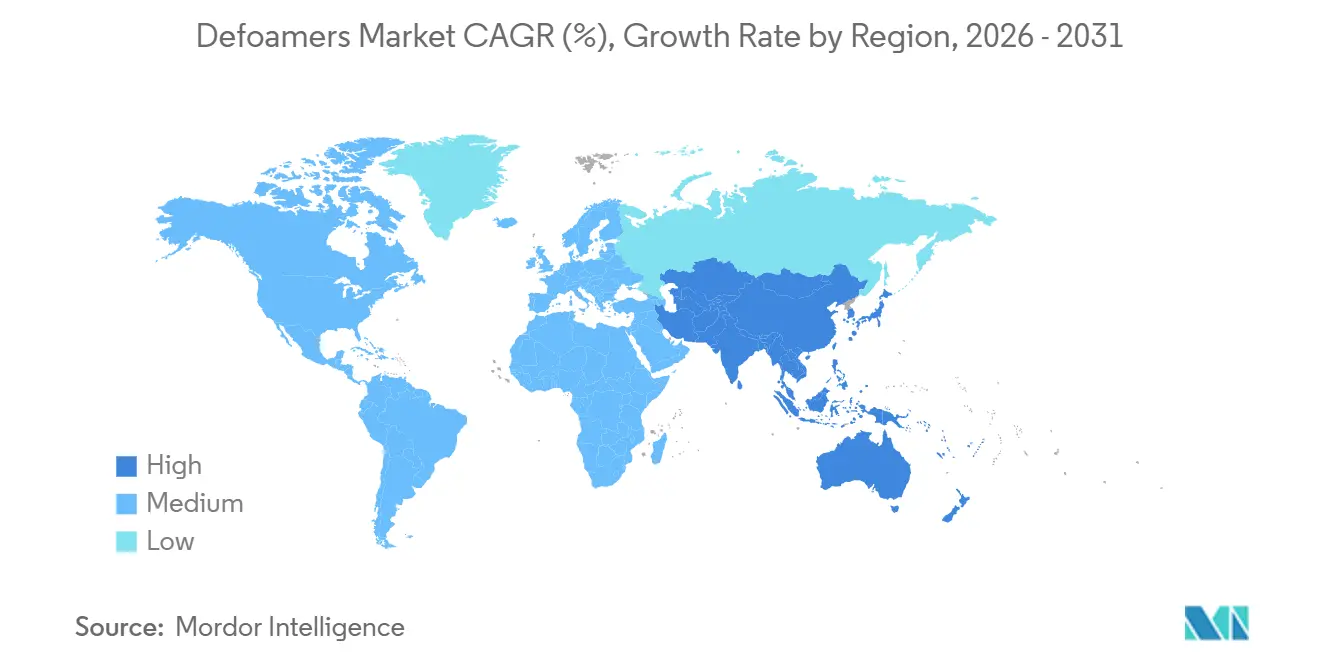
Geography Analysis
North America Defoamers Market
North America led revenues with a 34.05% share in 2025 as mature water-reuse assets and strict zero-discharge rules elevated antifoam dosing. California’s PFAS legislation pushes textile and detergent formulators toward bio-renewable solutions, reinforcing specialty demand. Canadian pulp mills retrofitting closed loops now specify silicone-free emulsions to protect membranes, while Mexican automotive paint shops adopt high-performance water-based defoamers to meet national VOC caps. Dow’s purchase of Circulus Holdings underlines a regional pivot toward circular and specialty materials that shape future product design.
APAC Defoamers Market
Asia-Pacific is the growth engine, forecast at 5.04% CAGR through 2031. China anchors demand with new powder-coating resins, India scales capacity under its chemical incentive plan, and Southeast Asian mills add folding-boxboard and coatings output. Inline sensor adoption in Japan and South Korea accelerates trials of non-fouling defoamers. Across the region, stricter GB 18582-2020 and ASEAN standards steer buyers toward polymer and water-based technology. These factors consolidate the defoamers market as the essential process additive alongside dispersion and wetting aids.
EMEA and South America Defoamers Market
Europe’s market growth is moderated by mature demand yet supported by the EU Industrial Emissions Directive and offshore-wind supply chain growth. Wacker Chemie’s backward integration improves local security of supply for specialty silicone intermediates. In-mold gelcoating further tightens specifications for ultra-low-VOC antifoam as blade manufacturers target recyclable composite systems. South America and the Middle East & Africa track mid-single-digit growth on the back of oil, gas, and agro-processing expansions, with GCC desalination plants adopting sensor-linked dosing that reduces overall volumes yet raises value per kilogram.

Value Chain Analysis
The defoamers value chain begins with upstream feedstocks including cyclic siloxanes (D4/D5) and silica for silicone-based actives, plus polyethers, fatty acids, mineral oils, waxes, and hydrophobic particles used in polymer, vegetable-oil, and powder systems. Supplier concentration and volatility in silicone intermediates remain a recurring bottleneck, while alternative feedstocks (glycerin, fatty-acid, and ethylene-oxide based inputs) widen sourcing options for non-silicone and water-based grades used in membrane bioreactors, pulp loops, and waterborne coatings.
In the midstream, suppliers blend, emulsify, and validate formulations (pH, temperature, and shear stability). Differentiation increasingly comes from application labs and compatibility testing for membranes and inline sensors. On the downstream side, routes include direct contracts with large pulp mills, coatings OEMs, and municipal and industrial water operators, supported by chemical distributors serving smaller facilities that need faster turnaround and localized technical support. Documentation on biodegradability and aquatic-toxicity performance is becoming a commercial requirement alongside supply reliability.
Competitive Landscape
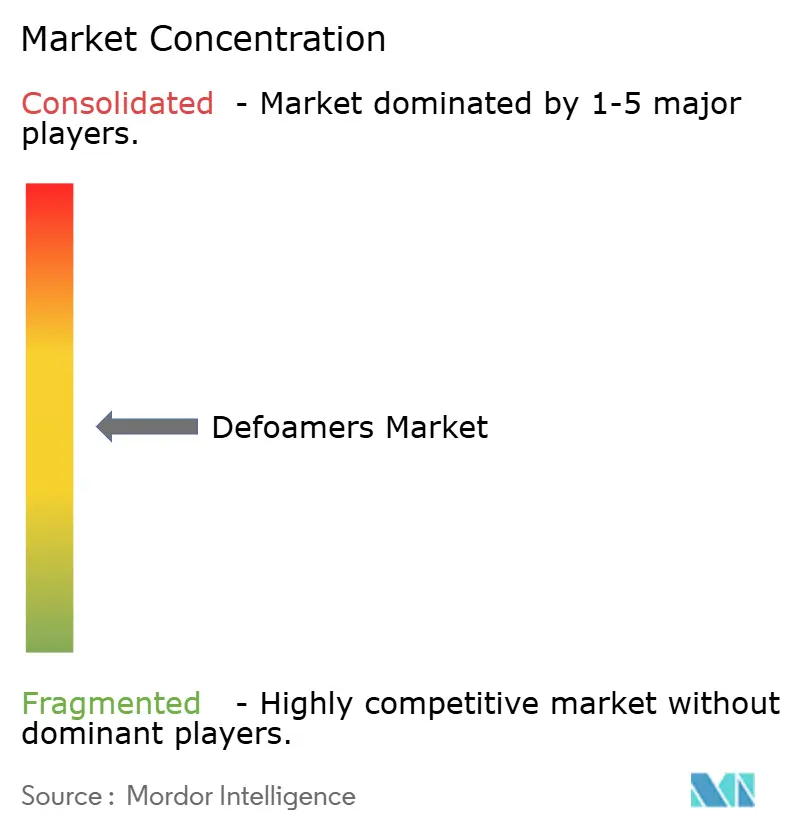
The Defoamers Market is moderately consolidated. Shin-Etsu’s 50% share of D4/D5 monomer capacity affords raw-material leverage, yet downstream formulations remain fragmented across dozens of regional blenders. BASF, Dow, Evonik, and Wacker Chemie invest in bio-renewable and sensor-compatible grades that fetch 15-20% price uplifts. Moreover, offshore wind and green-hydrogen composites add further pull for ultra-low-VOC products. Suppliers able to certify bio-content and low ecotoxicity under global standards look set to capture expanding value pools inside the defoamers market.
Defoamers Industry Leaders
Evonik Industries AG
BASF
Dow
Wacker Chemie AG
Momentive
- *Disclaimer: Major Players sorted in no particular order
Defoamers Market Companies Covered in this Report
- Ashland
- BASF
- BRB International B.V.
- Buckman
- ATLANTA Group
- Dow
- Eastman Chemical Company
- Elementis plc
- Elkem ASA
- Evonik Industries AG
- Kemira
- Momentive
- Münzing Chemie GmbH
- Nouryon
- San Nopco Limited
- Sasol
- Shin-Etsu Chemical Co., Ltd.
- Syensqo
- Wacker Chemie AG

Market Opportunities and Future Outlook
One clear whitespace is delivering strong performance without silicone residue in processes where membrane integrity and inline foam-detection hardware are central, including MBR/RO reuse plants and instrumented bioreactors. This creates an opening for reformulation and certification work. Evonik has positioned TEGO Foamex grades such as TEGO Foamex 8850/8820 (over 50% bio-based content) and TEGO Foamex 8051 for waterborne coatings, where tighter VOC and ecolabel requirements shape purchasing. At the same time, suppliers are building portfolios of silicone-free or low-residue polyether and vegetable-oil emulsions for wastewater reuse and closed-loop pulp systems.
Another pressure point is substitution risk from non-chemical foam-control approaches, which is changing where value accrues. In March 2026, Xylem described a nanobubble pilot at the Greer CPW wastewater plant in South Carolina that enabled the facility to shut off defoaming chemicals while reporting annual savings of USD 210,000-290,000. This shifts the competitive focus toward total-process outcomes, dosing optimization, and sensor-compatible chemistries, rather than volume alone. Room for suppliers remains clearest where compliance and process performance intersect, including regulated water reuse, high-spec coatings, and precision-fermentation media where sterile, low-foam operation is critical.
Recent Industry Developments in Defoamers Market
- March 2026: Xylem reported results from a nanobubble technology pilot at the Greer CPW wastewater plant in South Carolina, indicating the facility could shut off defoaming chemicals while cutting treatment costs. The case highlights a credible non-chemical substitute pathway that can reduce recurring antifoam consumption in select wastewater applications, pushing suppliers to emphasize dosing control, compatibility, and performance guarantees in membrane and reuse plants.
- June 2025: Evonik Coating Additives launched TEGO Foamex 8051, a 100% active siloxane defoamer concentrate for waterborne decorative coatings with compliance positioned around Ecolabel 2014/312/EU. The product reinforces the shift toward higher-performance, regulation-aligned defoamer concentrates in coatings, where formulators prioritize low emissions and consistent surface quality.
- May 2024: BASF entered a USD 316.5 million settlement with a nationwide class of U.S. public water systems tied to legacy AFFF products containing PFAS. The action underscores the financial and reputational exposure associated with persistent chemistries in water-related value chains and strengthens buyer scrutiny and documentation requirements for additives used in wastewater and adjacent applications.


Defoamers Market Report Scope and Research Methodology
Market Definition and Coverage
For this study, the market is defined as the revenue generated from defoamers (anti-foaming agents) used to prevent or break foam during industrial processing, across major end-use industries and regions.
Scope exclusions: We exclude downstream resale markups and bundled revenues where defoamers are only a minor additive inside a broader chemical package price.
Segments Covered in This Report
- By Type
- Silicone-based
- Water-based
- Oil-based
- Powder Defoamers
- By Other Types (Polymer / Vegetable-based)
- By End-user Industry
- Paints and Coatings
- Pulp and Paper
- Water and Waste-water Treatment
- Oil and Gas
- Food and Beverages
- Detergents
- Homecare
- Industrial
- Textiles
- Others (Pharmaceuticals, Metalworking Fluids)
- By Geography (Value)
- Asia-Pacific
- China
- India
- Japan
- South Korea
- Vietnam
- Malaysia
- Indonesia
- Thailand
- Rest of Asia-Pacific
- North America
- United States
- Canada
- Mexico
- Europe
- Germany
- United Kingdom
- France
- Italy
- Russia
- Turkey
- Spain
- NORDIC Countries
- Rest of Europe
- South America
- Brazil
- Argentina
- Colombia
- Rest of South America
- Middle East and Africa
- Saudi Arabia
- South Africa
- Qatar
- Nigeria
- United Arab Emirates
- Rest of Middle East and Africa
- Asia-Pacific
Data Sources, Market Sizing, and Validation
Desk Research
Desk work was used to build a clean demand map and to set realistic ranges for volumes and pricing by end-use. We leaned on public sources such as US EPA and European Environment Agency material on wastewater treatment and chemical use, USGS and other geological surveys for mineral oil and silicone feedstock context, and UN Comtrade-style trade statistics to cross-check import and export movements of relevant chemical categories.
To keep the model grounded in what buyers actually consume, we also reviewed sources such as industry association pages for pulp and paper, coatings, and detergents, plus peer-reviewed journals on foam control performance and typical treat-rate behavior in formulations. Company filings and investor presentations were used to sanity check end-market exposure where it was described, and paid subscriptions for company financials and patent databases helped confirm product direction changes (for example, more water-based solutions) without relying on paywalled reports. These examples are not exhaustive, and other public sources were also used for data collection, validation, and clarification.
Primary Interviews and Surveys
Primary work was used to stress-test our assumptions on treat rates, pricing moves, and how demand shifts between silicone-based, oil-based, and water-based defoamers across industries. We spoke with a mix of suppliers, formulators, distributors, and end users across APAC, EMEA, and the Americas, so gaps from desk inputs could be filled and then reconciled back into the market model.
Distribution of primary research fieldwork respondents
| Company type | Respondent position | Region |
|---|---|---|
| Top tier: 34% | CXOs: 13% | APAC: 40% |
| Mid tier: 52% | Functional/Unit leaders: 27% | EMEA: 37% |
| Smaller Players: 14% | Managers: 60% | Americas: 23% |
Market-Sizing & Forecasting
Sizing starts with a top-down demand pool build, where production and consumption signals from foam-generating processes are translated into defoamer need, and then filtered by realistic penetration levels by end use. To keep totals grounded, the outcome is corroborated with selective bottom-up checks, such as sampled supplier revenue splits by region and a simple volume times average selling price approximation for a few large applications.
Key inputs that steer the model include wastewater treatment capacity additions and operating intensity, pulp and paper output trends, coatings and construction activity indicators, and the observed mix shift between silicone-based and water-based products that changes average pricing. We also track typical dosing or treat-rate ranges by application (kept as ranges, not single-point claims), plus crude-linked and silicone feedstock cost direction to reflect price pass-through timing. Forecasts are generated using scenario analysis, where the base case follows macro and end-use indicators, and the high and low cases adjust for regulatory tightening, substitution behavior, and near-term price volatility before a single central forecast is finalized.
Where bottom-up visibility is weaker (for example, fragmented local supply into smaller end users), gaps are handled using validated proxy shares from interviews and then scaled back to the top-down demand total so the final number stays consistent.
Data Validation & Update Cycle
Estimates are validated through triangulation across three layers: end-use demand indicators, trade and supply signals, and interview feedback on pricing and volumes. When a variance shows up, it is reviewed for likely root causes such as currency timing, a sudden end-use slowdown, or a change in product mix, and then the model is adjusted only after a second analyst review.
The report is refreshed annually, and interim checks are triggered when major events occur, such as sharp raw material swings, regulatory changes, or capacity moves that can shift regional availability. Before publication, a fresh pass is completed so the final numbers reflect the latest available signals rather than older assumptions.
Mordor Intelligence's Defoamers Market Size Versus Other Published Estimates
Published numbers for defoamers often do not match each other because the scope and revenue point counted can change from one publisher to the next. Differences also come from how each study treats product forms, how pricing is averaged across industries, and how often assumptions are refreshed.
Key gaps typically show up around whether services are counted with product revenue, whether factory-gate values or downstream selling prices are used, and whether the mix of silicone, oil, and water-based products is kept consistent with real end-use shifts. Another repeated driver is the base year and currency timing, since fast-moving raw material costs can change the average selling price seen in a given year.
Benchmark comparison
| Source | Market Size | Gaps in Research Methodology |
|---|---|---|
| Mordor Intelligence | USD 7.49 B (2026) | |
| Trade Publisher A | USD 6.96 B (2025) | Related services are included alongside goods and values are described at factory-gate, which can shift totals versus a pure product-revenue view and also uses an earlier year reference. |
| Industry Platform B | USD 6.01 B (2024) | Uses 2024 as the base year and applies broader segment structures, which can pull in adjacent foam-control chemicals and can also reflect different average price assumptions by end use. |
Related services sit outside Mordor Intelligence's scope, and that single inclusion can widen spreads when another estimate adds service revenue on top of product sales. Once the year, revenue point, and product mix logic are aligned, the remaining differences usually narrow down to how treat rates and price pass-through are updated for each end-use industry.


Key Questions Answered in the Report
How large is the defoamers market in 2026 and how fast is it growing?
How large is the defoamers market in 2026 and how fast is it growing?
Which product type leads demand in defoamers?
Which product type leads demand in defoamers?
What end-use segment is expanding the fastest?
What end-use segment is expanding the fastest?
Which region shows the highest near-term growth?
Which region shows the highest near-term growth?
How are regulations influencing product innovation?
How are regulations influencing product innovation?
Page last updated on:


 Your data is secure and never sold or shared.


