
Debt Settlement Market Size and Share
Market Overview
| Study Period | 2020 - 2031 |
|---|---|
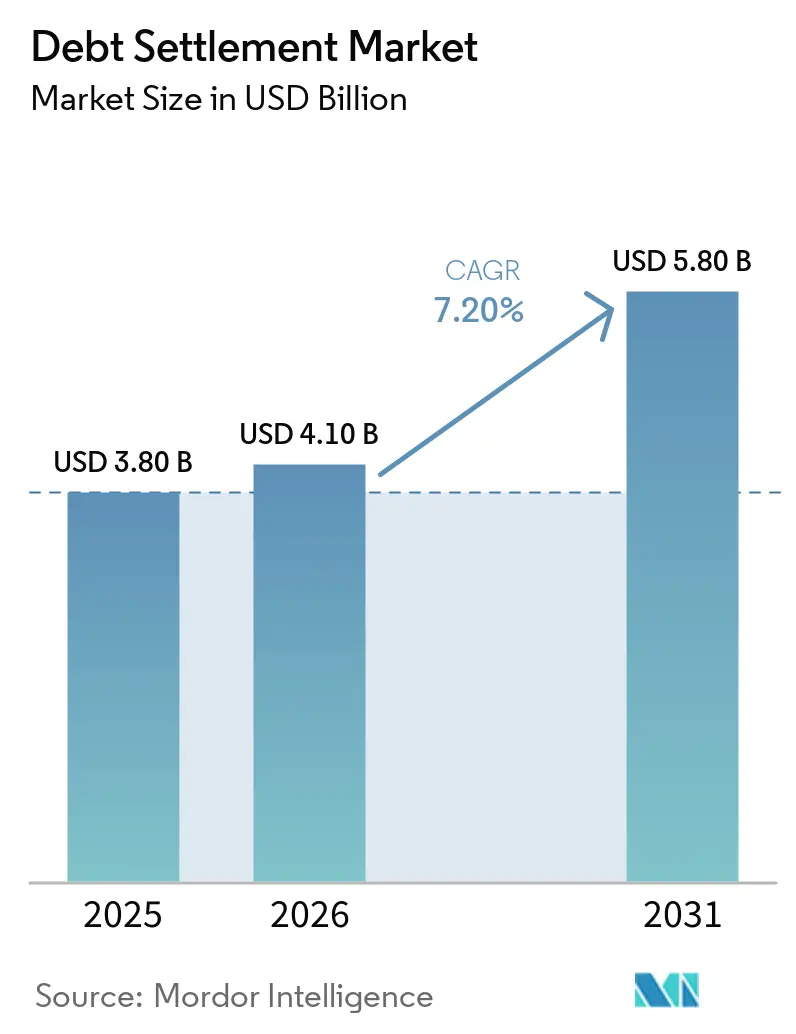
| Market Size (2026) | USD 4.10 Billion |
| Market Size (2031) | USD 5.80 Billion |
| Growth Rate (2026 - 2031) | 7.20 % |
| Fastest Growing Market | Asia-Pacific |
| Largest Market | North America |
| Market Concentration | Low |
Major Players *Disclaimer: Major Players sorted in no particular order Image © Mordor Intelligence. Reuse requires attribution under CC BY 4.0. | |
Debt Settlement Market Analysis by Mordor Intelligence
The Debt Settlement Market size was valued at USD 3.80 billion in 2025 and is estimated to grow from USD 4.10 billion in 2026 to reach USD 5.80 billion by 2031, at a CAGR of 7.20% during the forecast period (2026-2031).
Rising unsecured debt and serious credit-card delinquencies continue to support demand for formal resolution services, especially in the United States. United States household debt stood at USD 18.8 trillion in Q2 2026, and 12.9% of credit-card balances were at least 90 days delinquent. More than 23 million Americans have charged-off credit-card balances still appearing on credit files, which extends the potential client base beyond newly delinquent borrowers. The debt settlement market is also changing as providers use affordability assessments, automated negotiation tools, and digital case-management systems to manage cases more efficiently. Regulatory compliance, consumer trust, and post-settlement credit support remain important factors in how providers compete and retain clients across the debt settlement market, particularly as borrowers compare service quality and expected outcomes across varied client circumstances and debt profiles.
Key Report Takeaways
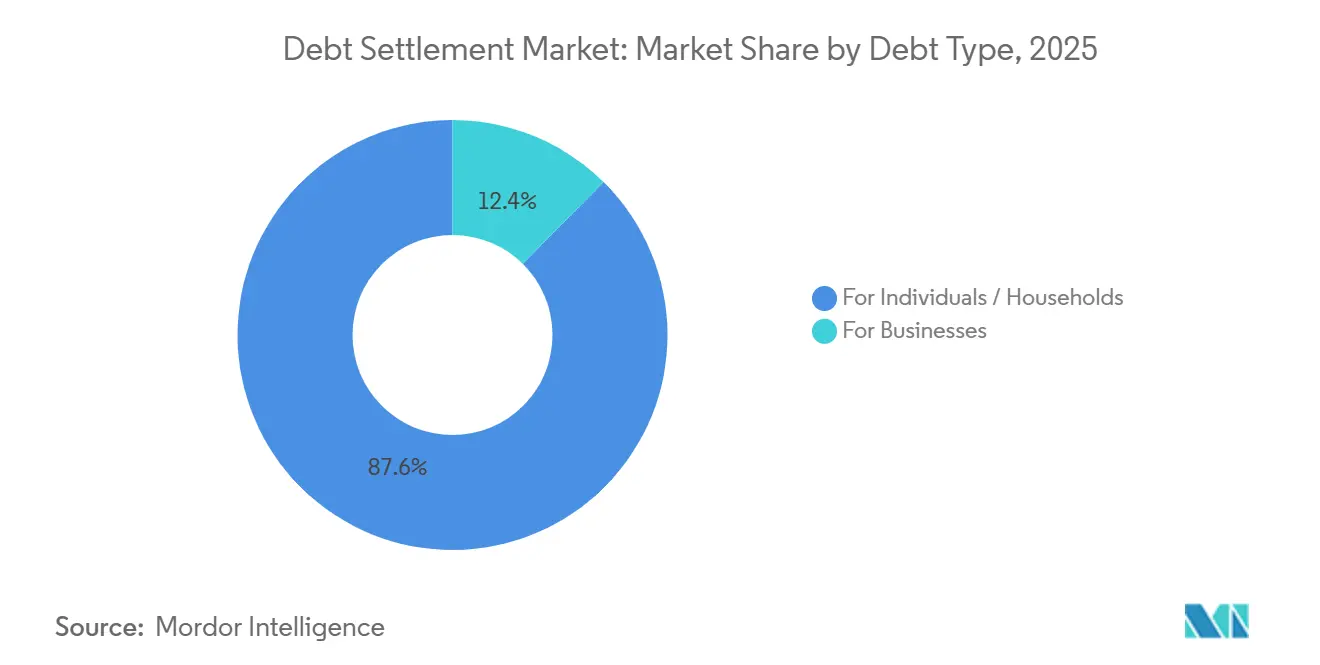
- By debt type, individuals and households captured 87.6% of the debt settlement market share in 2025, while businesses are projected to grow at 8.7% CAGR through 2031.
- By service provider, for-profit debt settlement companies held 65.7% of the debt settlement market share in 2025, while hybrid debt settlement providers are forecast to grow at 9.6% CAGR through 2031.
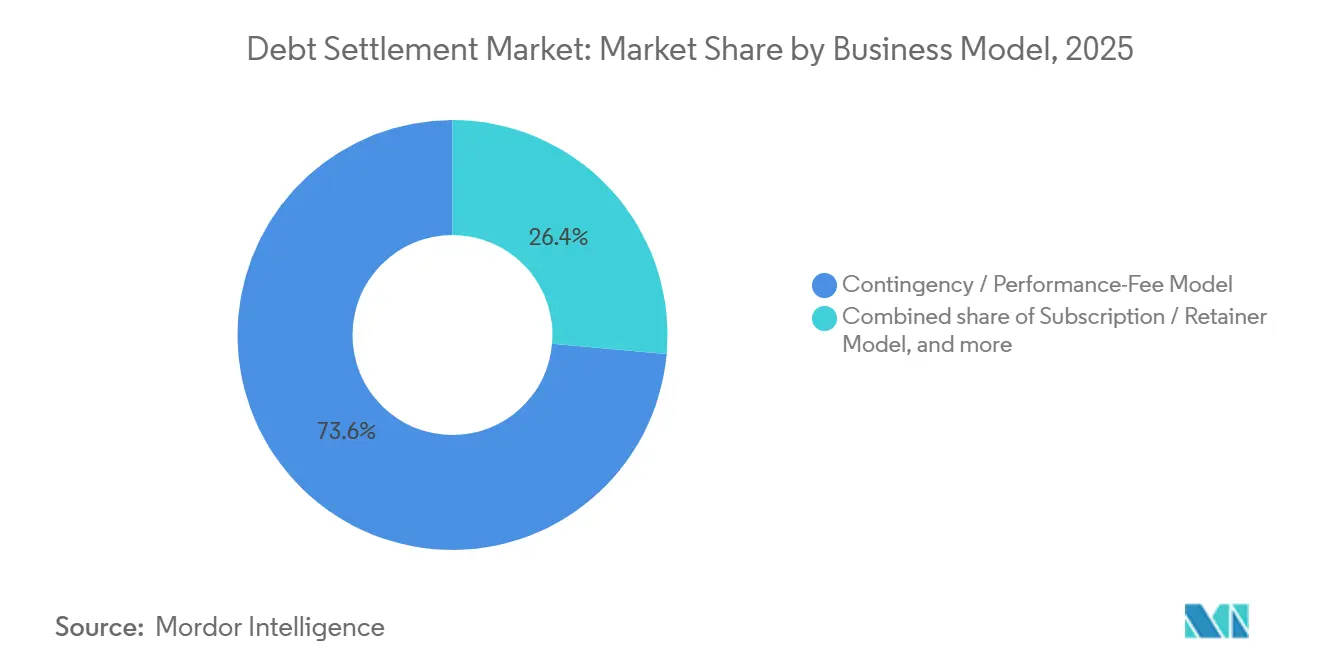
- By business model, the contingency and performance-fee model captured 73.6% of the debt settlement market share in 2025, while the legal representation model is projected to grow at 8.5% CAGR through 2031.
- By delivery channel, the hybrid channel captured 47.3% of the debt settlement market share in 2025, while online and digital delivery is projected to grow at 10.1% CAGR through 2031.
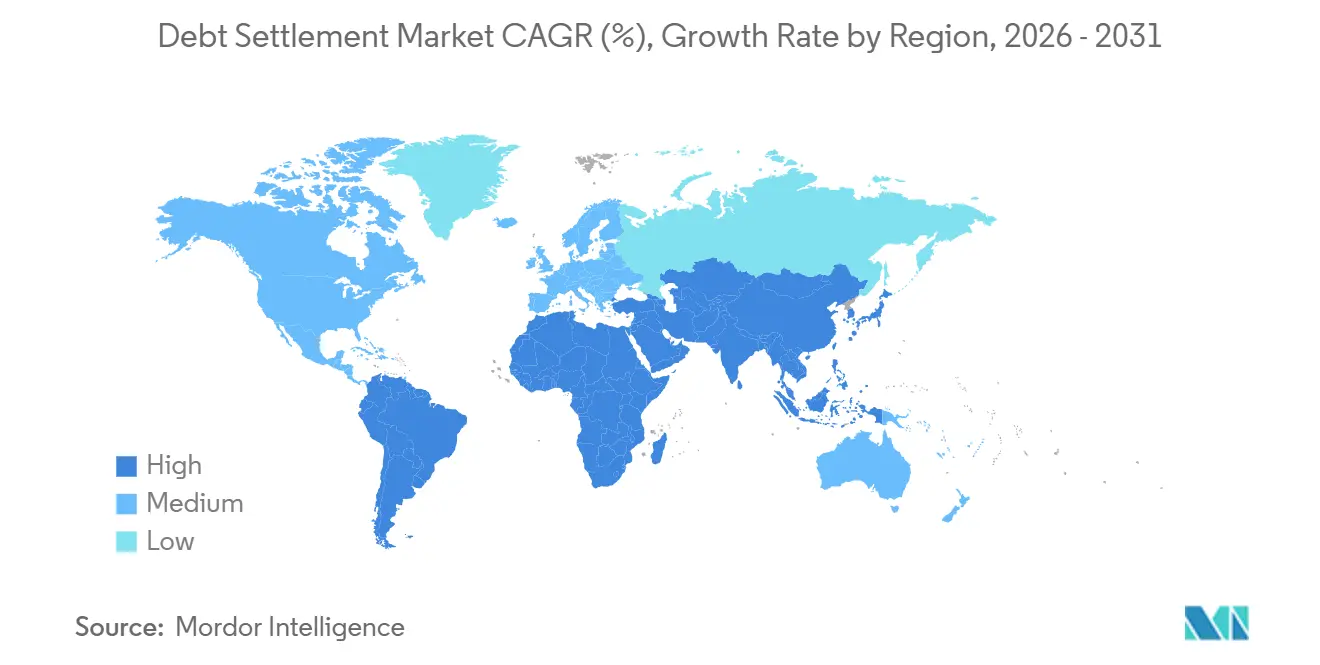
- By geography, North America captured 61.4% of the debt settlement market share in 2025, while Asia-Pacific is projected to grow at 9.2% CAGR through 2031.
Note: Market size and forecast figures in this report are generated using Mordor Intelligence’s proprietary estimation framework, updated with the latest available data and insights as of January 2026.
Global Debt Settlement Market Trends and Insights
Drivers Impact Analysis*
| Driver | (~) % Impact on CAGR Forecast | Geographic Relevance | Impact Timeline |
|---|---|---|---|
| Rising Unsecured Consumer Debt and Credit-Card Delinquencies | +1.8% | Global, the highest in North America and the Asia-Pacific | Short term (≤ 2 years) |
| Increasing Adoption of Non-Bankruptcy Debt Resolution Options | +1.0% | North America and Europe | Medium term (2-4 years) |
| Expansion of Digital Debt Settlement Platforms and Automated Negotiation | +1.3% | Global, with Asia-Pacific at the core and spillover to the Middle East and Africa | Medium term (2-4 years) |
| Growing Financial Distress Among Households and Small Businesses | +0.8% | Global, concentrated in North America and South America | Short term (≤ 2 years) |
| Growing Partnerships Between Fintechs, Creditors, and Debt-Relief Providers | +0.6% | Asia-Pacific at the core, with spillover to North America and Europe | Long term (≥ 4 years) |
| Increasing Consumer Awareness of Professional Debt Settlement Services | +0.4% | Global, with early gains in the United States, India, and Australia | Medium term (2-4 years) |
| Source: Mordor Intelligence | |||
Rising Unsecured Consumer Debt and Credit-Card Delinquencies
Consumer debt stress remains the most immediate source of demand for the debt settlement market because settlement providers primarily work with borrowers whose unsecured obligations have become difficult to repay through regular monthly payments. The Federal Reserve Bank of New York reported USD 18.8 trillion in United States household debt in Q2 2026, with 12.9% of credit-card balances at least 90 days delinquent[1]. The pool of potential clients is wider than new delinquency flows alone suggest because charged-off balances can remain on credit reports for extended periods and may continue to require a resolution path. As of 2024, 80% of charged-off balances remained on credit files 1 year after charge-off, compared with 40% during 2004 through 2012. Borrowers who retain some repayment capacity may seek negotiated settlements rather than allow obligations to remain unresolved and continue to affect their financial position. This creates a durable source of client referrals for the debt settlement market, even when broader delinquency measures change from quarter to quarter.
Expansion of Digital Debt Settlement Platforms and Automated Negotiation
Digital platforms are reducing the administrative workload involved in enrolling clients, communicating with creditors, documenting case activity, and managing settlement cases from initial review through completion. In India, Freed expected enrolled debt to reach INR 7,500 crore (USD 900 million) in FY27, compared with INR 2,200 crore (USD 242 million) in FY26, supported by automated debtor profiling and trustee-managed account processes. Americor completed a USD 153.15 million asset-backed securitization in November 2025 that was backed by debt-settlement fee rights[2]. The transaction showed that institutional investors can evaluate settlement-fee cash flows within a structured finance framework rather than treating debt settlement solely as a traditional advisory service. Automated creditor communication, settlement-probability scoring, and mobile portals are becoming standard operating tools for larger providers. These capabilities can widen the cost and service gap between digitally enabled firms and smaller providers in the debt settlement market.
Growing Financial Distress Among Households and Small Businesses
Financial distress among households and small businesses is supporting a broader range of cases in the debt settlement market, rather than concentrating provider activity only in unsecured consumer credit. Business debt cases often involve merchant cash advances and revenue-based financing, which differ from conventional bank lending in their repayment structure and creditor-negotiation process. The Businesses segment is forecast to grow at 8.7% CAGR through 2031, supported by the financial pressure facing smaller enterprises with these obligations. Attorney-led and hybrid providers can address commercial negotiations that require different documentation, legal review, and creditor engagement than consumer cases. This adds a business-focused source of demand alongside the larger household client base and encourages providers to develop more specialized operating capabilities. The range of case types may also encourage providers to build specialist teams rather than use a single approach for all borrowers.
Growing Partnerships Between Fintechs, Creditors, and Debt-Relief Providers
Partnerships between fintech firms, creditors, and debt-relief providers are making settlement processes more integrated by bringing lenders and resolution platforms into a more repeatable operating relationship. Zavo processed INR 500 crore (USD 55 million) in repayments within its first 9 to 10 months after its November 2024 launch, using a model in which lenders compete to resolve accounts. Beyond Finance reported USD 4.7 billion in resolved debt and USD 1.17 billion in net client savings during 2025 across more than 10,700 creditors[3]. Established creditor relationships can support faster settlement decisions, more consistent program execution, and clearer expectations for each party during negotiations. They can also make it harder for smaller entrants to match the operating reach of established platforms without comparable lender coverage. The debt settlement market, therefore, benefits when creditor networks move from occasional arrangements to repeatable operating relationships.
Restraints Impact Analysis*
| Restraint | (~) % Impact on CAGR Forecast | Geographic Relevance | Impact Timeline |
|---|---|---|---|
| Negative Impact of Debt Settlement on Borrowers' Credit Profiles | -0.9% | Global | Short term (≤ 2 years) |
| Strict Regulation of Debt Settlement Providers and Fee Structures | -1.1% | North America and the European Union | Medium term (2-4 years) |
| Consumer Distrust and Fraud Associated with Debt-Relief Services | -0.8% | Global, highest in North America | Short term (≤ 2 years) |
| Uncertainty of Creditor Acceptance and Settlement Outcomes | -0.5% | Global | Medium term (2-4 years) |
| Source: Mordor Intelligence | |||
Negative Impact of Debt Settlement on Borrowers' Credit Profiles
Credit-score effects remain a significant barrier for consumers considering debt settlement. Clients often stop making minimum payments while funds accumulate for a possible settlement, which can result in adverse entries on credit reports. The input data indicates that scores can decline by 100 to 150 points before a settlement is completed. This concern is especially relevant for borrowers with FICO scores from 580 to 680 because they may still qualify for alternatives such as balance-transfer products or debt-management plans. Charged-off balances may also remain on credit files longer than in earlier periods, extending the perceived consequence of entering a program. Providers that offer credit rehabilitation after settlement may reduce this concern, although adoption of these services remains limited.
Strict Regulation of Debt Settlement Providers and Fee Structures
Regulation creates operating costs and limits the fee structures available to debt settlement providers. The Federal Trade Commission Telemarketing Sales Rule prohibits advance fees for telephone-marketed debt-relief services. The current inflation-adjusted civil penalty can reach USD 51,744 per violation. Rules covering licensing, disclosures, and fees differ across states, which increases the compliance burden for multi-state operators. Larger firms can spread legal, technology, and compliance costs across more cases than smaller providers can. These conditions may strengthen the position of established providers in the debt settlement market while increasing pressure on mid-sized firms.
*Our forecasts treat driver/restraint impacts as directional, not additive. The impact forecasts reflect baseline growth, mix effects, and variable interactions.
Segment Analysis
By Debt Type: Household Cases Form the Revenue Base While Business Cases Grow Faster
Individuals and households captured 87.6% of the debt settlement market share in 2025, making consumer cases the central source of revenue. Credit-card debt remained the largest subcategory within this segment, consistent with the 12.9% serious delinquency rate on United States credit-card balances in Q2 2026. Medical debt is developing as a separate area of activity as some states in the United States moved in 2025 to limit medical-debt credit reporting. Personal loans, private student loans, and payday or short-term installment loans also generate recurring case volumes for digital providers. Retail and store-card obligations add further unsecured debt categories with different creditor negotiation requirements.
Businesses are projected to grow at 8.7% CAGR through 2031, the fastest pace within the debt type. Merchant cash advances and revenue-based financing are key sources of business cases because their structures sit outside conventional bank-credit arrangements. Trade payables and vendor debt are also becoming more relevant in North America and Europe as smaller counterparties manage financial strain. Providers serving businesses often need commercial negotiation experience and formal legal support. This requirement gives attorney-led and hybrid firms a defined role in this part of the debt settlement market.
By Service Provider: For-Profit Providers Lead While Hybrid Firms Gain Ground
For-profit debt settlement companies captured 65.7% of 2025 revenue, supported by established client acquisition and creditor networks. Beyond Finance resolved USD 4.7 billion during 2025 across more than 10,700 creditor relationships. Repeat relationships with creditors can improve settlement execution and help reduce the time needed to complete a case. For-profit providers also benefit from systems designed to manage large volumes of consumer cases, including repeatable workflows for client enrollment and creditor communication. Their scale makes them the leading provider group in the debt settlement industry.
Hybrid debt settlement providers are projected to grow at 9.6% CAGR through 2031. These firms combine legal services with negotiation platforms, which appeals to clients who want legal review alongside digital case management. Their position depends on providing genuine legal services and meeting applicable licensing and disclosure obligations. Law firms and attorney-based providers continue to serve clients with higher debt loads or more complex commercial matters. The hybrid model gives providers a way to combine personalized advice with systems that can support larger caseloads.
By Business Model: Performance Fees Lead While Legal Representation Expands
The Contingency and performance-fee model captured 73.6% of revenue in 2025. This structure aligns provider compensation with a completed settlement and remains compatible with rules that restrict advance fees for telephone-marketed services. Americor’s USD 153.15 million securitization showed that performance-fee rights can support structured funding for large operators. Subscription and retainer arrangements continue to serve a smaller group of clients who prefer predictable monthly costs. These arrangements can be relevant when enrolled debt exceeds USD 30,000 and percentage-based fees become more material.
The Legal representation model is forecast to grow at 8.5% CAGR through 2031. Demand is supported by the complexity of business-debt negotiations and the importance of legal representation in stricter state environments. Legitimate attorney-based programs may stand apart from providers that cannot demonstrate the same legal involvement. Some providers are also adding credit rehabilitation, budgeting support, and tax guidance after settlement. This shift from a single transaction toward continuing financial support may influence how the debt settlement industry competes over the forecast period.
By Delivery Channel: Hybrid Delivery Holds Revenue While Online Services Expand
The hybrid channel captured 47.3% of revenue in 2025, reflecting a blend of digital self-service and human support. Clients can use online tools for account monitoring, payment tracking, and settlement offer review. They may still prefer direct guidance when a creditor escalates a case or when a settlement decision carries greater consequences. Offline and traditional channels remain relevant for older clients and those using attorney-based providers. Their role is likely to narrow as more debtors become comfortable with digital tools.
Online and digital delivery is projected to grow at 10.1% CAGR through 2031, the fastest rate across delivery channels. Kikoff launched an AI voice agent for debt negotiation in April 2025 for more than 1 million United States users with more than USD 4.2 billion in aggregate credit-card debt. Digital workflows can remove manual work from routine steps and support lower per-case operating costs. Providers that can move clients smoothly between digital tools and human advisers may limit program dropouts. This makes channel design an important source of service differentiation in the debt settlement market.
Geography Analysis
North America captured 61.4% of the debt settlement market share in 2025 and remains the largest regional revenue base. The United States combines a mature provider base, substantial unsecured consumer debt, and an established regulatory framework. The 30-day credit-card delinquency rate across all commercial banks was 2.85% in Q2 2026, while seriously delinquent and charged-off balances continued to support the potential settlement pool. Canada provides additional demand, although tighter bank capitalization and provisioning practices can constrain the consumer delinquency pipeline. Mexico has lower formal penetration, but urbanization and wider digital access are creating more structured debt-resolution opportunities in major cities.
Europe remains a significant regional contributor, led by the United Kingdom, Germany, France, and Italy. Lower non-performing-loan transaction activity can encourage resolution firms to use technology to protect recovery margins. Debtist received a controlling investment from Norvestor in May 2026 after opening a United Kingdom office in July 2025 with Lawton Hathaway. Spain and Italy have lower digital settlement penetration, but household financial pressure supports a gradual expansion in demand. European Union consumer-credit rules and United Kingdom Financial Conduct Authority guidance shape disclosures, fee rules, and debt-advice licensing requirements.
Asia-Pacific is projected to grow at 9.2% CAGR through 2031, making it the fastest-growing geography in the debt settlement market. India is a major near-term opportunity as fintech lenders’ active loan portfolios reached INR 2.1 trillion (USD 23.1 billion) by June 2025, up 25.6% year over year, while loans more than 180 days past due reached 8.6% of the portfolio. China, Japan, South Korea, and Australia provide additional demand from elevated household leverage and consumer-credit stress. The Middle East and Africa remain early-stage regions, with the United Arab Emirates, Saudi Arabia, and South Africa offering comparatively more established creditor and credit-bureau infrastructure.
Competitive Landscape
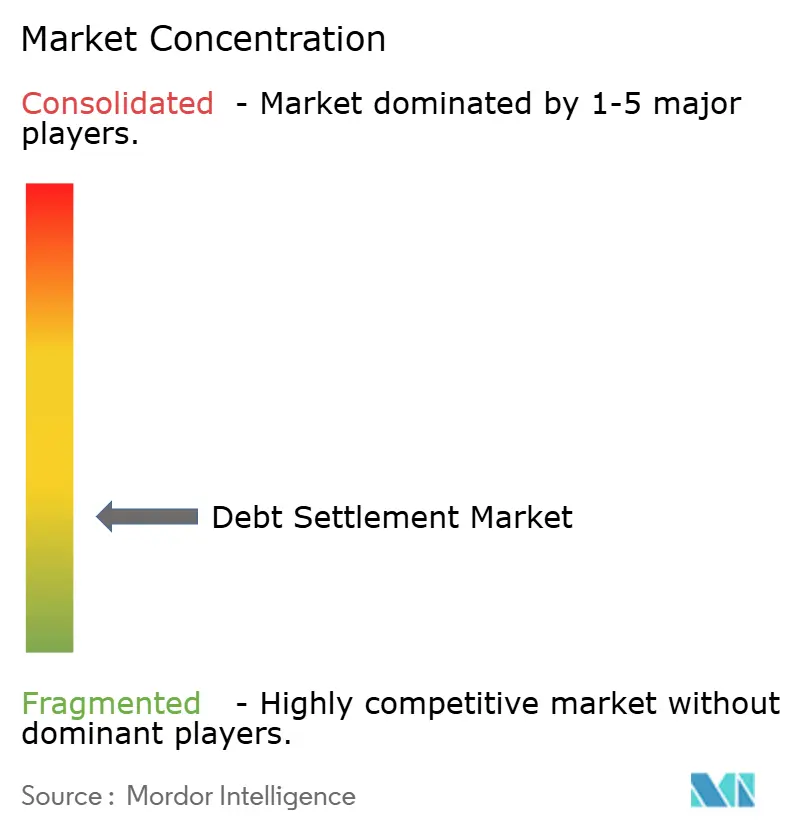
The debt settlement market has a fragmented structure across Europe, Asia-Pacific, and emerging economies. National Debt Relief and Freedom Debt Relief hold leading positions among United States providers by enrolled-debt volume and client count. Each company has helped more than 1 million consumers and resolved cumulative debt exceeding USD 15 billion, according to the input draft. ClearOne Advantage operates across 48 United States states, while attorney-based firms serve clients who need formal representation in complex multi-creditor cases. Differences in local regulation, language, and creditor relationships make it difficult to build a single national model outside the United States.
Large providers are investing in funding structures and technology that smaller competitors may struggle to replicate, especially where system investment depends on steady fee income and substantial creditor coverage. Americor’s November 2025 USD 153.15 million asset-backed securitization provided a notable example of structured funding tied to debt-settlement fee rights. Beyond Finance reported operations across more than 10,700 creditors during 2025, showing the scale of an established creditor network. Debtist expanded its European position through a controlling investment from Norvestor in May 2026. These moves show how capital access, technology, and creditor coverage can shape competitive positions in the debt settlement market and influence which providers can expand services without weakening their compliance processes.
Opportunities remain in post-settlement credit rehabilitation, client suitability screening, and cross-border debt resolution, particularly where borrowers need support beyond the initial settlement agreement. Kikoff’s AI-based negotiation service illustrates a lower-cost digital approach for less complex client cases. Freed and Zavo illustrate the rise of Indian platforms that work with institutional creditor networks. Firms that provide transparent outcomes, reliable compliance processes, and effective client support can strengthen their position as clients become more selective, while smaller firms may increasingly focus on specialized legal, geographic, or creditor niches rather than compete directly with national platforms in the debt settlement market.
Debt Settlement Industry Leaders
-
Freedom Debt Relief, LLC
-
National Debt Relief, LLC
-
Accredited Debt Relief (Beyond Finance, LLC)
-
Americor Funding LLC
-
ClearOne Advantage LLC
- *Disclaimer: Major Players sorted in no particular order
Recent Industry Developments
- August 2026: Beyond Finance released its inaugural 2025 Client Outcomes Report, documenting resolution of USD 4.7 billion in consumer debt in 2025, up from USD 3.6 billion in 2024, generating USD 1.17 billion in net client savings after program fees, across more than 10,700 creditors. The report is the industry's first public outcome disclosure at this level of granularity, raising the bar for transparency benchmarking.
- May 2026: Norvestor, a Nordic private equity firm, acquired a controlling stake in German AI-driven debt collection and resolution fintech Debtist, headquartered in Frankfurt and active in Germany, the Nordic countries, and the United Kingdom, to accelerate expansion into France and the Benelux region. The transaction reflects active cross-border consolidation in European digital debt resolution.
- November 2025: Americor closed AMDR ABS Trust 2025-1, a USD 153.15 million asset-backed securitization collateralized by debt settlement fees, the first-ever rated ABS of its kind, with Class A notes rated BBB- by Kroll Bond Rating Agency and DBRS Morningstar. The transaction unlocked a new institutional capital channel for the debt settlement industry and set a precedent for how performance-fee revenue can be structured and rated as a financial asset.
- July 2025: German fintech Debtist launched United Kingdom operations via a new London office and a partnership with Lawton Hathaway, applying its AI-driven receivables management platform to the British debt resolution market. The move marked Debtist's formal entry into English-speaking markets ahead of its Norvestor-backed Western European expansion.
Global Debt Settlement Market Report Scope
| For Individuals / Households | Credit Card Debt |
| Personal Loan & Line of Credit Debt | |
| Medical Debt | |
| Private Student Loan Debt | |
| Payday / Short-Term Installment Loan Debt | |
| Retail / Store Card Debt | |
| Other Unsecured Consumer Debt | |
| For Businesses | Business Loan Debt |
| Merchant Cash Advance (MCA) / Revenue-Based Financing Debt | |
| Business Credit Card Debt | |
| Trade Payables / Vendor Debt | |
| Other Unsecured Business Debt |
| For-Profit Debt Settlement Companies |
| Law Firms / Attorney-Based Debt Settlement Providers |
| Hybrid Debt Settlement Providers (Legal + Negotiation Platforms) |
| Contingency / Performance-Fee Model |
| Subscription / Retainer Model |
| Legal Representation Model |
| Online/Digital |
| Offline/Traditional |
| Hybrid |
| North America | United States |
| Canada | |
| Mexico | |
| South America | Brazil |
| Argentina | |
| Rest of South America | |
| Europe | United Kingdom |
| Germany | |
| France | |
| Italy | |
| Spain | |
| Rest of Europe | |
| Asia-Pacific | China |
| Japan | |
| India | |
| South Korea | |
| Australia | |
| Indonesia | |
| Thailand | |
| Malaysia | |
| Singapore | |
| Vietnam | |
| Rest of Asia-Pacific | |
| Middle East and Africa | Saudi Arabia |
| United Arab Emirates | |
| Turkey | |
| South Africa | |
| Egypt | |
| Rest of Middle East and Africa |
| By Debt Type | For Individuals / Households | Credit Card Debt |
| Personal Loan & Line of Credit Debt | ||
| Medical Debt | ||
| Private Student Loan Debt | ||
| Payday / Short-Term Installment Loan Debt | ||
| Retail / Store Card Debt | ||
| Other Unsecured Consumer Debt | ||
| For Businesses | Business Loan Debt | |
| Merchant Cash Advance (MCA) / Revenue-Based Financing Debt | ||
| Business Credit Card Debt | ||
| Trade Payables / Vendor Debt | ||
| Other Unsecured Business Debt | ||
| By Service Provider | For-Profit Debt Settlement Companies | |
| Law Firms / Attorney-Based Debt Settlement Providers | ||
| Hybrid Debt Settlement Providers (Legal + Negotiation Platforms) | ||
| By Business Model | Contingency / Performance-Fee Model | |
| Subscription / Retainer Model | ||
| Legal Representation Model | ||
| By Delivery Channel | Online/Digital | |
| Offline/Traditional | ||
| Hybrid | ||
| By Geography | North America | United States |
| Canada | ||
| Mexico | ||
| South America | Brazil | |
| Argentina | ||
| Rest of South America | ||
| Europe | United Kingdom | |
| Germany | ||
| France | ||
| Italy | ||
| Spain | ||
| Rest of Europe | ||
| Asia-Pacific | China | |
| Japan | ||
| India | ||
| South Korea | ||
| Australia | ||
| Indonesia | ||
| Thailand | ||
| Malaysia | ||
| Singapore | ||
| Vietnam | ||
| Rest of Asia-Pacific | ||
| Middle East and Africa | Saudi Arabia | |
| United Arab Emirates | ||
| Turkey | ||
| South Africa | ||
| Egypt | ||
| Rest of Middle East and Africa | ||
Key Questions Answered in the Report
What is the projected value of the debt settlement market by 2031?
The debt settlement market is projected to reach USD 5.8 billion by 2031, growing at a 7.2% CAGR from 2026 to 2031.
Which debt type generates the most debt settlement revenue?
Individuals and Households generated 87.6% of 2025 revenue, while Businesses are forecast to grow faster at 8.7% CAGR through 2031.
Why is North America the largest regional debt settlement area?
North America accounted for 61.4% of 2025 revenue because of the United States’ large unsecured debt base, mature providers, and established regulatory environment.
Which delivery channel is growing fastest?
Online and Digital delivery is projected to grow at 10.1% CAGR through 2031 as providers expand automated workflows and mobile client tools.
How do performance-fee models affect client engagement?
The Contingency and Performance-Fee Model accounted for 73.6% of 2025 revenue because provider compensation is tied to a completed settlement.
What limits consumer use of debt settlement services?
Credit-score effects, regulatory requirements, consumer distrust, and uncertainty around creditor acceptance can discourage potential clients.