
Market Overview
| Study Period | 2020 - 2031 |
|---|---|
| Forecast Data Period | 2026 - 2031 |
| Base Year Market Size (2025) | USD 1.40 Billion |
| Market Size (2026) | USD 1.48 Billion |
| Market Size (2031) | USD 1.94 Billion |
| Growth Rate (2026 - 2031) | 5.55 % |
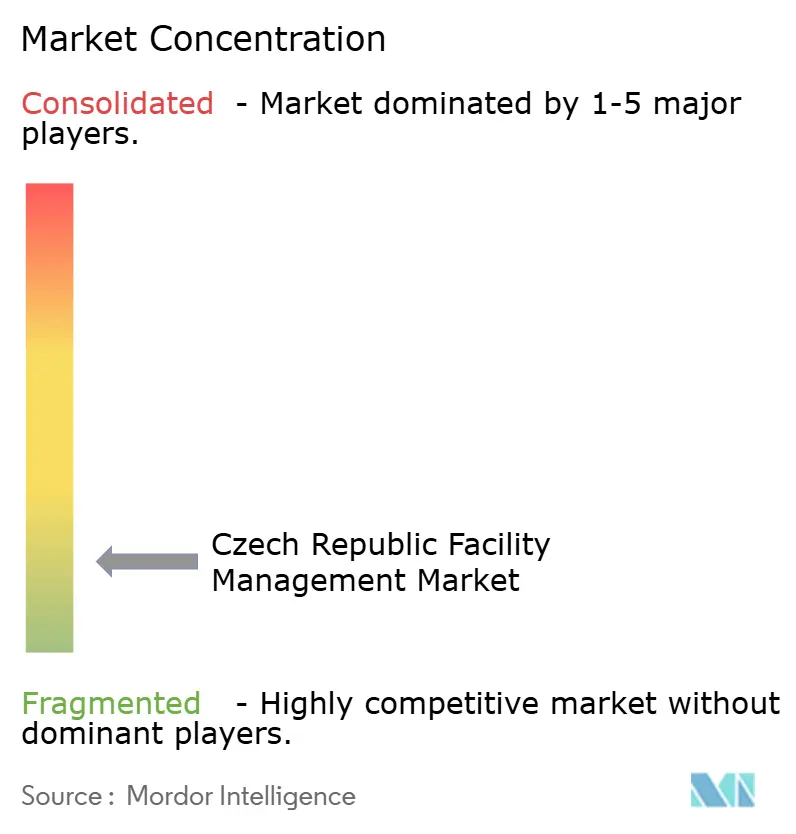
| Market Concentration | Low |
Major Players *Disclaimer: Major Players sorted in no particular order Image © Mordor Intelligence. Reuse requires attribution under CC BY 4.0. | |
Czech Republic Facility Management Market Analysis by Mordor Intelligence
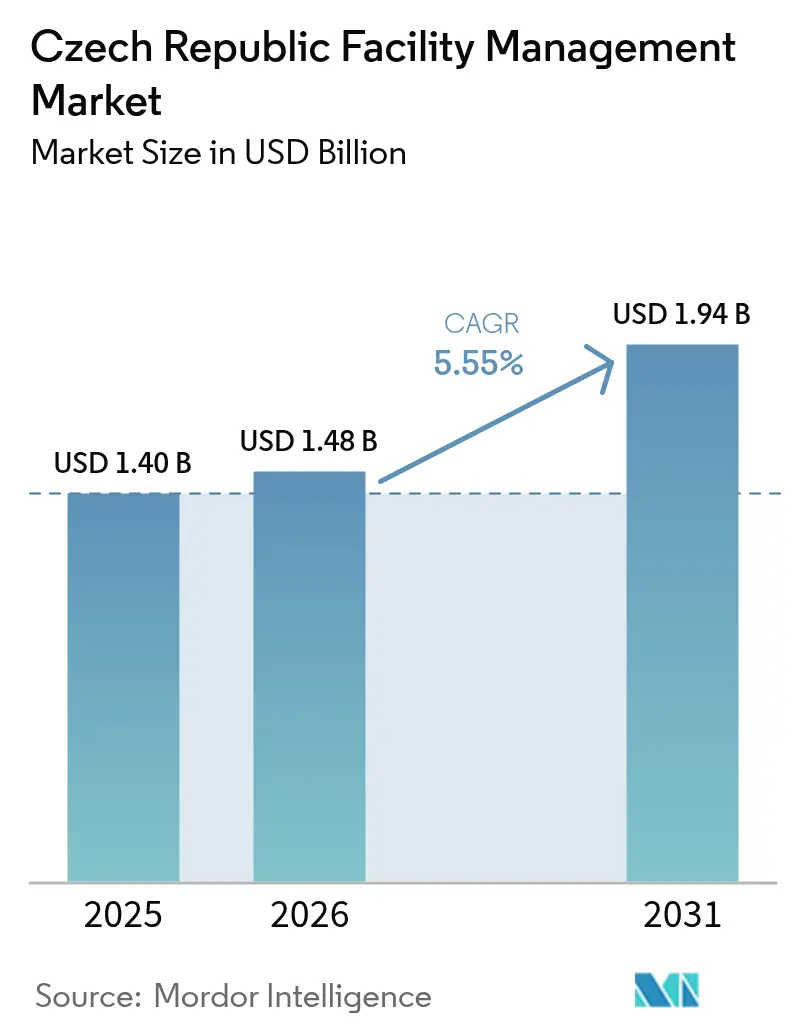
The Czech Republic facility management market size is expected to grow from USD 1.40 billion in 2025 to USD 1.48 billion in 2026 and is forecast to reach USD 1.94 billion by 2031 at 5.55% CAGR over 2026-2031. Outsourcing momentum, rapid adoption of smart-building technologies, and a robust pipeline of industrial megaprojects collectively supported expansion for the Czech Republic facility management market. Flagship investments—such as onsemi’s USD 2 billion silicon-carbide campus in Rožnov pod Radhoštěm and Vitesco Technologies’ EUR 576 million (USD 651 million) automated logistics hub in Ostrava—generated specialised service contracts extending from clean-room validation to high-voltage maintenance. Public-sector retrofits funded through EU Structural and Investment Funds, together with mandatory PENB energy certificates priced at CZK 3,000–5,000 (USD 125-208), further amplified the Czech Republic facility management market by locking in long-cycle compliance services. Consumer-price inflation averaged 2.4% in 2024 and reached 2.7% year-on-year in March 2025, encouraging occupiers to shift cost risk to vendors through outcome-based contracts, which added resilience to the Czech Republic facility management market.[1]Czech Statistical Office, “Consumer Price Indices – Inflation – March 2025,” Czech Statistical Office, csu.gov.cz Simultaneously, government-backed AI testbeds in Prague, Brno, and Ostrava (CZK 200 million budget) accelerated pilots in predictive maintenance, autonomous cleaning, and energy-optimisation analytics, reshaping operating models across the Czech Republic facility management market.
Key Report Takeaways
- By service type, Hard Services commanded 56.15 % of the Czech Republic facility management market share in 2025; Soft Services delivered the fastest 6.86 % CAGR through 2031.
- By offering type, Outsourcing captured 64.72 % of the Czech Republic facility management market size in 2025 and expanded at a 6.58 % CAGR to 2031.
- By end-user industry, Commercial facilities generated 40.85 % revenue in 2025, while Institutional & Public Infrastructure advanced at a 6.23 % CAGR over 2026-2031.
Note: Market size and forecast figures in this report are generated using Mordor Intelligence’s proprietary estimation framework, updated with the latest available data and insights as of 2026.
Czech Republic Facility Management Market Trends and Insights
Drivers Impact Analysis*
| Driver | (~) % Impact on CAGR Forecast | Geographic Relevance | Impact Timeline |
|---|---|---|---|
| Increasing outsourcing of non-core functions | +1.2% | National, concentrated in Prague and Brno | Medium term (2-4 years) |
| Digital transformation and technology integration across FM workflows | +1.5% | National, with early adoption in major metros | Long term (≥ 4 years) |
| Growing focus on sustainability and ESG compliance requirements | +0.8% | National, EU-driven compliance | Medium term (2-4 years) |
| Rising demand for integrated facility management solutions | +1.0% | National, strongest in the commercial sector | Medium term (2-4 years) |
| EU-funded energy-efficiency retrofit mandates for public buildings | +0.7% | National, public sector focus | Long term (≥ 4 years) |
| Nearshoring-led industrial expansion boosting specialized FM needs | +0.9% | Regional, concentrated in the Moravian-Silesian and Central Bohemian | Short term (≤ 2 years) |
| Source: Mordor Intelligence | |||
Digital Transformation and Technology Integration Across FM Workflows
During 2024 and early 2025, corporate and institutional owners sharply increased deployment of IoT sensors, cloud BMS platforms, and AI-driven predictive-maintenance engines, a trend that directly raised contract values across the Czech Republic facility management market. Masaryk University’s Semantic BMS controlled 1,500 devices within 35 buildings, enabling instant cross-asset queries for energy, comfort, and utilisation benchmarks. Pilot sites comparing AI-optimised HVAC to manual set-ups recorded 12.5 % power savings while holding air quality within Czech occupational thresholds, improving net-operating-income margins for landlords coping with higher electricity tariffs. Melown Technologies used Unipi Patron PLCs to automate server-farm cooling and lighting, confirming that open-protocol hardware can retrofit legacy stock without full rip-and-replace capital. FM providers subsequently bundled analytics dashboards, fault-diagnosis alerts, and remote-reset capabilities into premium service layers, deepening client dependence and widening margins within the Czech Republic facility management market. Meanwhile, CZK 200 million in government-EU grants financed AI testbeds that accelerated prototypes in anomaly detection, robot-route planning, and equipment-lifecycle optimisation.
Rising Demand for Integrated Facility Management Solutions
Throughout 2024, organisations migrated from siloed single-service contracts to bundled and integrated facility-management models, strengthening the outsourced segment’s 65.3 % revenue share. CBRE’s strategic alliance with Johnson Controls produced a turnkey platform covering capital funding, microgrid construction, real-time metering, and long-horizon performance guarantees for building-retrofit projects. Healthcare operator Medicon consolidated communications for 70 outpatient clinics using Spinoco’s omnichannel platform, processing 30,000 calls monthly and demonstrating how integrated service desks drive operational coherence. Manufacturing studies revealed 7 % OEE gains and 20 % first-pass-yield improvements after embedding predictive algorithms and spare-parts logistics under one master agreement. As a result, the Czech Republic facility management market increasingly rewards vendors prepared to accept KPI-linked penalties and share upside, accelerating the shift from labour-hour billing to outcome-priced contracts.
EU-Funded Energy-Efficiency Retrofit Mandates for Public Buildings
ESIF grants financed 52 % of national energy-efficiency outlays in 2014-2020 and continued to seed boiler upgrades, envelope insulation, and LED relighting across schools, hospitals, and administrative blocks. PENB certificates—required before major renovation, sale, or lease—generated steady audit demand at CZK 3,000–5,000 (USD 125-208) per building, a niche many FM providers scaled into compliance-as-a-service offerings. The NEN procurement portal listed hundreds of retrofits in 2024, including Nemocnice Slaný operating-theatre HVAC replacements and Uherský Brod technical-college mechanical-room refurbishments, feeding multi-year maintenance streams into the Czech Republic facility management market. ČEZ’s Dětmarovice low-emission heating plant, projected to slash CO₂ emissions by 97 % for 15,000 households, epitomised the longer-term service inventory emerging from large public-private infrastructure modernisation.
Nearshoring-Led Industrial Expansion Boosting Specialized FM Needs
Central Europe’s transport corridors and skilled engineering base attracted high-value production, amplifying technical complexity inside the Czech Republic facility management market. Onsemi’s silicon-carbide wafer facility required ISO-class clean-room protocols, ultrapure-water loops, and electrostatic-discharge flooring, while Vitesco Technologies’ Ostrava plant demanded autonomous-guided-vehicle track servicing and high-voltage battery test-lab upkeep. July 2024 labour reforms waived work permits for USA and UK citizens, letting FM firms import specialist commissioning staff within days instead of months. FedEx’s Plzeň logistics centre, opened in December 2024, expanded conveyor-belt lubrication schedules, sortation-camera calibration, and 24/7 fire-watch rotations, reinforcing logistics-segment growth for the Czech Republic facility management market.
Restraints Impact Analysis*
| Restraint | (~) % Impact on CAGR Forecast | Geographic Relevance | Impact Timeline |
|---|---|---|---|
| Skilled labor shortages across technical FM trades | -1.8% | National, acute in Prague and industrial regions | Long term (≥ 4 years) |
| Economic fluctuations and persistent inflationary pressures | -1.1% | National, affecting operational costs | Medium term (2-4 years) |
| A fragmented regulatory and certification landscape is inflating compliance costs | -0.6% | National, EU-driven complexity | Medium term (2-4 years) |
| Autonomous cleaning robots are eroding revenues for traditional FM services | -0.4% | National, concentrated in the commercial sector | Long term (≥ 4 years) |
| Source: Mordor Intelligence | |||
Skilled Labour Shortages Across Technical FM Trades
Labour-market models projected an 82,000-technician deficit by 2025, driving wage inflation and project delays within the Czech Republic facility management market.[2]Eva Kalinová, “Czech Companies Will Have to Deal with Import of Labour,” SHS Web of Conferences, shs-conferences.orgReports in August 2024 noted technicians rejecting sub-CZK 150 (USD 6.20) hourly rates, a 20 % premium over 2023 benchmarks. Johnson Controls doubled academy throughput to 300 graduates annually, yet demographic data showed median technical-trade age already above 50, signalling a looming retirement bulge. June 2025 labour-code amendments extended probation windows but did little to add new electricians, HVAC specialists, or BMS programmers. Vendors, therefore, invested in cross-skilling, augmented-reality troubleshooting, and remote-command centres to maintain SLA compliance across the Czech Republic facility management market.
Autonomous Cleaning Robots Compressing Manual Revenue
CenoBots’ L50 robot—covering 2,203 m² per hour at 1.2 m/s—found adopters in shopping malls, hospitals, and large offices during 2024, shaving night-shift payrolls and challenging service-hour-based contracts across the Czech Republic facility management market. Innok Robotics introduced multiterrain units for warehouse perimeters and car parks, proving versatile under Czech winter conditions and gaining first-year orders from logistics owners in 2024. FM providers repositioned by selling preventive maintenance, firmware updates, and operator-safety training for robotic fleets, but headline janitorial revenue compressed as clients measured cost per cleaned square metre instead of headcount. AI testbeds validated real-time telemetry feeds into BMS dashboards, reinforcing automation’s foothold inside the Czech Republic facility management market.
*Our forecasts treat driver/restraint impacts as directional, not additive. The impact forecasts reflect baseline growth, mix effects, and variable interactions.
Segment Analysis
By Offering Type: Outsourcing Dominance Elevates Integrated FM Adoption
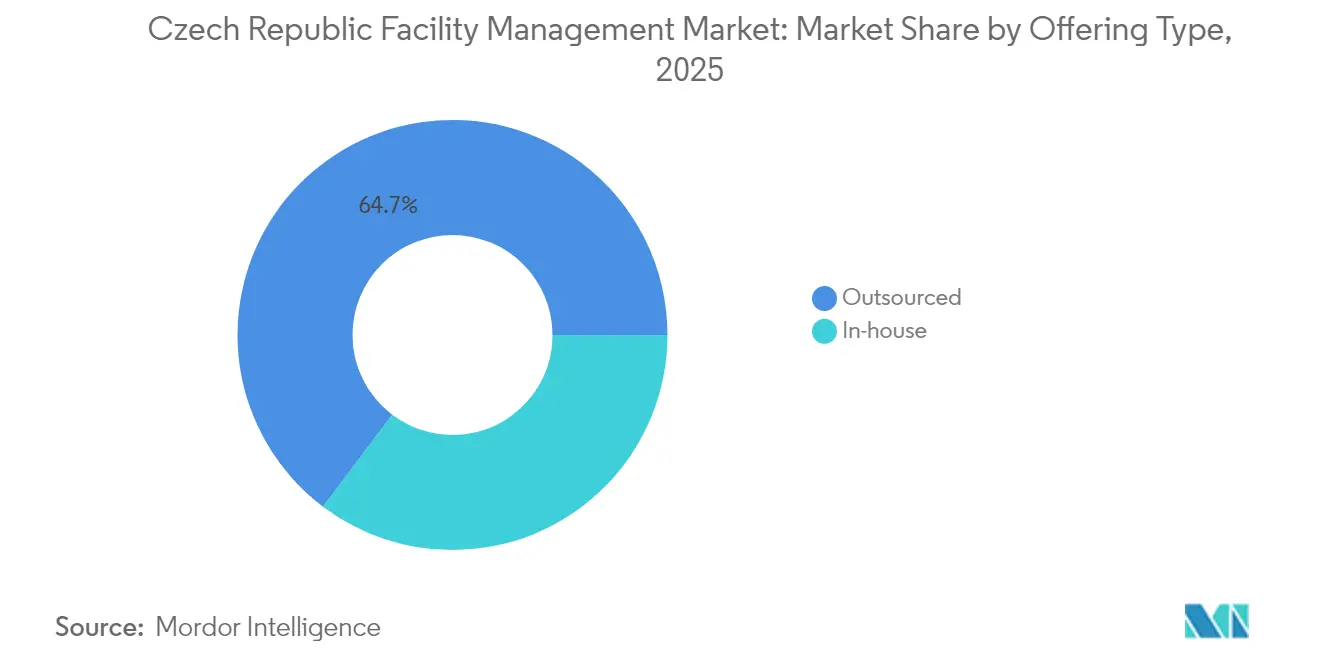
Outsourced contracts represented 64.72 % of 2025 turnover and expanded at a 6.58 % CAGR. Single-service outsourcing persisted for niche lifts, fire-extinguisher inspections, and sterile-environment laundry, but bundled agreements cut administrative overhead and ensured KPI alignment. Integrated FM, which transfers responsibility for all services—including energy advisory—to one provider, showed the steepest trajectory. Czech manufacturers, contributing 35 % to GDP, embedded uptime guarantees and ISO-9001 audit support into their FM scopes, blurring the line between facilities and production engineering. CBRE’s Johnson Controls energy-performance model demonstrated a shift to savings-as-a-service, with phase-two roadmaps integrating microgrid battery storage and EV-charger management. Mobile help-desk apps geofenced technicians and optimised routing, while cloud BMS portals streamed alerts, allowing vendors to achieve sub-90-minute first-fix targets across distributed assets in the Czech Republic facility management market.



By End-User Industry: Commercial Leadership Balanced by Public-Sector Momentum
Commercial real estate accounted for 40.85 % of 2025 revenue, anchored by Prague Class-A offices, suburban retail parks, and data-hosting campuses. Flexible working pushed landlords to deploy occupancy sensors that modulate tasks for cleaning and HVAC in real time, enhancing efficiency and sustainability targets tied to green-lease clauses. Institutional & Public Infrastructure clocked a 6.23 % CAGR, buoyed by ESIF-backed retrofits and city-wide smart-lighting rollouts. University Hospital Olomouc’s twin data-centre design leveraged Lenovo Flex System to protect patient applications, illustrating the high-availability expectations driving premium FM contracts. Industrial & Process facilities rode the semiconductor and EV-component wave, demanding chemical-risk management, compressed-air leak detection, and predictive vibration monitoring. Hospitality, sports arenas, and multi-housing joined Prague’s Smart City pilots, installing trash-level sensors, guest-room environment controls, and e-paper signage, thus redefining Soft Service SLAs. Transportation nodes such as Václav Havel Airport renewed de-icing and heating-pipeline contracts, ensuring year-round resilience for aviation throughput.
By Service Type: Hard Services Command While Soft Services Accelerate
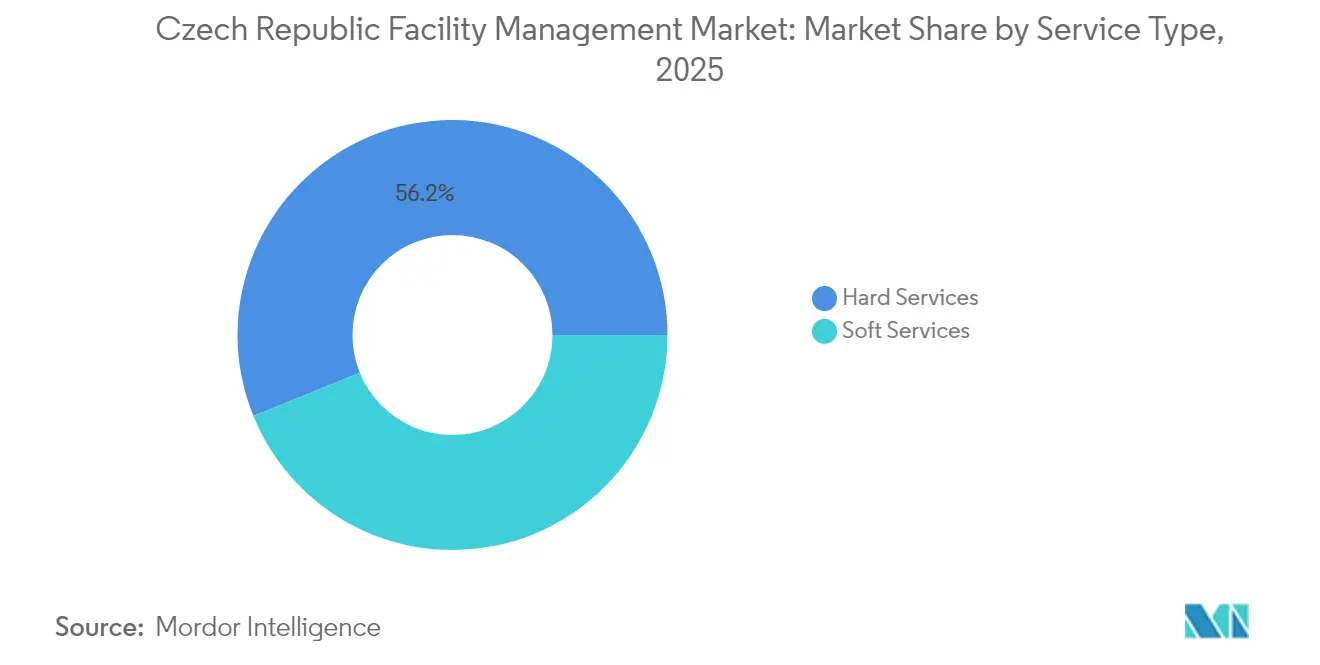
Hard Services retained a 56.15 % share in 2025, driven by mandatory fire-safety checks, transformer servicing, and HVAC asset replacements that require licensed personnel. Semiconductor plants, hospitals, and data centres demanded continuous-duty chillers, redundant UPS lines, and vibration-analysis programmes, locking in multi-year frameworks. Soft Services, although smaller, charted a 6.86 % CAGR through 2031 on the back of integrated security, reception, and workspace-experience bundles. Autonomous cleaning, smart-locker parcel hubs, and AI-enabled CCTV analytics increased value per square metre, outweighing declining manual hours. Within Hard Services, semantic digital twins such as Masaryk University’s BMS plugged diagnostic data from 1,500 assets into rule engines, cutting unscheduled downtime and lifting asset-life utilisation across the Czech Republic facility management market. AI-led HVAC tuning delivered 36.8 kW average power reductions, lowering landlord operating ratios even as electricity prices rose. In Soft Services, Spinoco’s clinic-wide contact-centre integration improved enquiry resolution time and underpinned new patient-experience SLAs for healthcare clients.
Geography Analysis
Prague retained the largest slice of the Czech Republic's facility management market in 2025 under its Smart City 2030 charter, which orchestrated intelligent mobility, adaptive street-lighting, and digital waste-management initiatives coordinated by Operator ICT.Inflationary headwinds in March 2025 reinforced variable-cost FM models pegged to footfall metrics and real-time energy baselines. Moravian-Silesian Region charted the strongest 6.12 % CAGR, propelled by semiconductor and EV-component investments in Ostrava and Roznov. FM vendors with ISO 14644 clean-room credentials and high-voltage electrical licences secured premium margins. Central Bohemia—home to the densest retail-park concentration—drove weekend security rosters, parking-lot repairs, and peak-season HVAC tonnage. Olomouc Region topped retail square metres per 1,000 residents, nurturing multi-site bundled FM contracts across mid-sized malls.
Plzeň’s designation as FedEx’s Central-European logistics hub added conveyor-belt service windows, sensor verifications, and 24/7 emergency-lighting checks that enriched the Czech Republic facility management market. Northern municipalities benefited from ČEZ’s Dětmarovice heating plant, requiring turbine-inspection schedules, emissions-sensor recalibrations, and district-pipeline cathodic-protection examinations. Immigration reforms, smoothing cross-border technician mobility, allowed FM providers to redeploy certified staff to regional shutdowns within 48 hours, supporting national service consistency.
Regulatory Landscape
The Czech Republic facility management market operates under national construction law and EU-aligned standards that shape compliance-led demand in building operations. Key anchors include the Building Act (Act No. 283/2021 Coll.), which governs building regulation and technical construction standards, and the Ministry of Finance standard for cleaning services that formalizes KPI-driven delivery and references the CSN EN 15221 facility management standards series.
Digitalization requirements are also becoming enforceable for asset lifecycle data, led by Act No. 330/2025 Coll. on the management of construction information models in a common data environment under the Ministry of Industry and Trade. This increases the pull for CAFM/BIM-ready providers. On the skills side, the National Qualifications framework includes the Facility Manager (36-041-R) qualification authorized by the Ministry of Industry and Trade, while management-system adoption is supported through EN ISO 41001:2018 (updated with amendment A1:2024), reinforcing procurement-led demand for auditable FM processes.
Value Chain Analysis
Demand comes from commercial landlords, industrial manufacturers, logistics developers, and public institutions that either retain in-house teams or outsource single, bundled, or integrated FM scopes. Procurement increasingly specifies standards-based delivery (CSN EN 15221 and ISO 41001-aligned processes) and measurable KPIs, so FM providers need to combine field service with energy management, compliance documentation, and service-desk workflows under one operating layer.
Upstream inputs include labor (licensed HVAC/MEP, fire safety, and controls technicians), spare parts and consumables, and a growing software and integration stack. Technology enablers span CAFM and property/lease platforms (for example POSYS, Realpad, and Nemovitorium) and industrial automation and system integrators that connect OT and building systems. TMT a.s. is an example of a Czech supplier that has positioned itself as an integrator of automated and robotized solutions for industrial facilities. Downstream delivery is handled through mobile dispatch, remote monitoring and BMS integrations, and subcontractor networks, with bottlenecks concentrated in specialist technical labor availability and the ability to govern data across building, tenant, and energy systems.
Competitive Landscape
The Czech Republic facility management market remained moderately fragmented: global majors CBRE, JLL, and ISS collectively controlled below 25 % of national revenue, while regional specialists such as Atalian, Strabag PFS, and B+N Facility Services leveraged local cost bases and daytime-response proximity. Strategic alliances proved decisive; the CBRE-Johnson Controls partnership gave tenants turnkey energy-performance contracting that bundled finance, execution, and remote monitoring, differentiating their bid decks. Technology disruptors CenoBots and Innok Robotics supplied autonomous cleaning fleets to high-traffic malls and hospitals, compelling incumbents to shift from hourly staffing to per-square-metre output guarantees.[4]Innok Robotics GmbH, “Strong Figures and Great Success – Record Start 2024,” Innok Robotics, innok-robotics.deAI-driven boiler-control algorithms documented 24.52 % heating-demand cuts, leading FM firms to launch in-house energy-advisory services backed by performance-linked fees. Regulatory competence around PENB certificates, workplace-safety audits, and PSDP documentation became a competitive moat, as compliance penalties for missed deadlines rose under EU climate directives.
Czech Republic Facility Management Industry Leaders
CBRE Group Inc.
JLL (Jones Lang LaSalle)
ISS Facility Services
Sodexo
ENGIE Services (Cofely)
- *Disclaimer: Major Players sorted in no particular order

Market Opportunities and Future Outlook
High-criticality assets and data-driven operations are creating whitespace for FM providers that can combine hard services with automation, monitoring, and auditable processes. A concrete demand anchor is data center expansion: in June 2026, Ceske Radiokomunikace (CRA) commenced construction of the Prague Gateway Data Center in Zbraslav-Jiloviste (designed as a 26 MW, 2,000-rack facility). The project expands the addressable scope for 24/7 MEP operations, high-voltage maintenance, and integrated monitoring across Prague-area portfolios.
AI infrastructure programs are also feeding a pipeline for advanced O&M and energy-optimization service layers tied to digital platforms. In May 2026, the Czech AI Factory (CZAI) launched in Ostrava as a national node of the EuroHPC Joint Undertaking, and in June 2026 the Czech Government approved the AI Gigafactory infrastructure project as a CZK 100 billion investment framework involving state, private (CRA), and European Commission funding. Enterprise adoption of CAFM across industrial parks (for example Panattoni rolling out SINGU across fifteen industrial parks in the Czech Republic and Slovakia in October 2024) supports opportunities for multi-site portfolio standardization, utility and compliance transparency, and outcome-based contracts that blend soft services with energy and asset performance management.
Recent Industry Developments
- July 2026: CBRE Czech Republic took on a new facility management mandate for H-Park Brno (15,982 sq m), owned by Raiffeisen investicni spolecnost. The win reinforces the role of large corporate FM providers in capturing mandates tied to institutional real estate ownership and multi-tenant logistics and light industrial assets.
- June 2025: CBRE announced the establishment of a specialized ESG and Sustainability expert team for Continental Europe, managed from its Prague office. The team is intended to strengthen the consulting and reporting layer that increasingly sits alongside core hard and soft FM delivery in Czech client contracts.
- October 2024: Panattoni implemented the SINGU cloud CAFM system across fifteen industrial parks in the Czech Republic and Slovakia to automate maintenance workflows and improve service transparency for tenants. Portfolio-scale CAFM rollouts like this raise expectations for standardized ticketing, asset records, and utility tracking across outsourced FM arrangements.


Research Methodology Framework and Report Scope
Market Definition and Coverage
This market covers facility management services delivered to keep buildings and sites running safely and efficiently in the Czech Republic, including day-to-day operations, technical upkeep, and people-facing support services.
Scope exclusions: pure one-off construction projects and stand-alone equipment manufacturing are excluded unless they are sold as part of an ongoing facility management service contract.
Segmentation Overview
- By Offering Type
- In-house
- Outsourced
- Single FM
- Bundled FM
- Integrated FM
- By End-user Industry
- Commercial (IT and Telecom, Retail and Warehouses, etc.)
- Hospitality (Hotels, Eateries, Large-scale Restaurants)
- Institutional and Public Infrastructure (Govt, Education, Transportation)
- Healthcare (Public and Private Facilities)
- Industrial and Process (Manufacturing, Energy, Mining)
- Other End-user Industries (Multi-housing, Entertainment, Sports and Leisure)
- By Service Type
- Hard Services
- Asset Management
- MEP and HVAC Services
- Fire Systems and Safety
- Other Hard FM Services
- Soft Services
- Office Support and Security
- Cleaning Services
- Catering Services
- Other Soft FM Services
- Hard Services
Data Sources, Market Sizing, and Validation
Desk Research
Desk research starts by building the country demand picture for managed buildings, how much space is in use, and what activities are commonly outsourced. We leaned on public sources such as the Czech Statistical Office for construction, employment, and services indicators, the National Energy and Climate Plan and related EU energy-efficiency documents for retrofit and compliance signals, and Eurostat for macro and price context.
To keep the service scope realistic, we also reviewed industry association publications (for example, European facility management and building services bodies), public procurement and tender notices for recurring service contracts, and technical standards references that influence FM service definitions. Company annual reports, local press coverage, and investor presentations helped us sanity-check service mix and pricing direction. A paid subscription for company financials and a global tenders database helped fill gaps where public disclosures were limited. The sources listed here are illustrative only, and we used additional public documents and datasets to cross-check assumptions and clarify data points during the work.
Primary Interviews and Surveys
We interview FM providers, property owners, occupiers, procurement teams, and technical managers within the Czech Republic. Surveys and expert discussions clarify outsourcing levels, contract pricing, labor pressure, energy-related work, and demand across major property uses. These inputs are used to test secondary data and refine assumptions about local service activity.
Distribution of primary research fieldwork respondents
| Company type | Respondent position |
|---|---|
| Top tier: 28% | CXOs: 15% |
| Mid tier: 47% | Functional/Unit leaders: 30% |
| Smaller Players: 25% | Managers: 55% |
Market-Sizing & Forecasting
The core sizing is built using top-down and bottom-up logic. The top-down starts from the addressable stock of facilities and the typical service intensity applied to them, then it is translated into spending by service type and delivery model. In practice, we reconstructed demand from indicators such as the active commercial facility base, renovation and retrofit activity tied to energy-efficiency compliance, and the share of facilities that shift work to outsourced contracts.
To keep the totals grounded, bottom-up checks were run through sampled supplier revenue benchmarks, contract value ranges observed in tenders, and volume-by-price approximations for common activities (for example, cleaning frequency or technical maintenance cycles). Key model inputs included outsourcing share in the country, hard services versus soft services mix, commercial and institutional facility usage trends, wage and CPI-linked price escalation, and the pace of smart-building and energy-management adoption that changes service scope. For forecasting, scenario analysis was used to reflect different paths for public-sector retrofits, corporate leasing activity, and labor cost inflation, then the chosen path was aligned with what interviewees described as the most likely contracting environment. When a bottom-up check did not cover a niche service line, we handled the gap through service-mix normalization so totals stayed consistent with contract bundling patterns observed in the market.
Data Validation & Update Cycle
Each stage is checked for internal consistency, after which our team compares outputs against outside signals such as outsourcing penetration discussion points, tender activity direction, and service price movements captured in public indicators. If a swing looks too sharp for a given year, the drivers are re-tested, assumptions are re-contacted with a few respondents, and the split between hard and soft services is rebalanced only when evidence supports the change.
Before release, the model and write-up go through multi-step analyst review so the logic, units, and conversions are aligned. Reports are refreshed annually, and interim updates are done when material events change the outlook, such as major policy shifts in energy compliance or unusual labor-cost shocks. Right before delivery, an analyst completes a fresh pass so clients receive the latest updated view available at that time.
Mordor Intelligence's Czech Republic Facility Management Market Size Versus Other Published Estimates
Published market values for Czech facility management do not always match because authors make different choices on what they count and how they translate contracts into annual spending. The biggest swings usually come from whether the view is limited to outsourced services, how hard versus soft service bundles are handled, and how local-currency figures are converted into USD for a chosen base year.
In some publications, the scope is presented as only external FM and then further narrowed to selected service lines, which can understate full FM spending. Other publications may inflate totals by including broader facility services that sit outside recurring FM contracts. Another common gap is how pricing is moved forward, since some models apply a single inflation factor across all services even though wage-heavy soft services and equipment-heavy hard services often rise at different rates. A more repeatable approach comes from tying spend to observable facility demand signals and validating the service mix and outsourcing split through interviews, which is the way the 2025 figure has been constructed here by Mordor Intelligence.
Benchmark comparison
| Source | Market Size | Gaps in Research Methodology |
|---|---|---|
| Mordor Intelligence | USD 1.40 B (2025) | |
| Trade Journal A | USD 2.40 B (2025) | Uses a broader external facility services interpretation and higher average contract values, and it does not clearly separate recurring FM contracts from adjacent facility services that can be one-off or project-led. |
| Industry Association B | USD 2.50 B (2025) | Starts from a local-currency external FM estimate built on selected services and then expands to a stated market potential, which mixes current spend with upside and makes year alignment and USD conversion timing less transparent. |
The comparison shows that the spread is mainly explained by scope handling around outsourced-only views and whether market potential is blended with current spending. By keeping service definitions consistent across hard and soft activities, applying realistic price progression by service nature, and cross-checking outsourcing share through primary inputs, the final number stays easier to trace back to clear drivers and repeatable steps.


Key Questions Answered in the Report
What is the value of the Czech Republic facility management market in 2026?
The Czech Republic facility management market size stood at USD 1.48 billion in 2026.
How fast will the Czech Republic facility management market grow by 2031?
It is forecast to expand at a 5.55 % CAGR, reaching USD 1.94 billion by 2031.
Which service category dominates current revenue?
Hard Services led with 56.15 % of total revenue in 2025.
Why are integrated facility management contracts gaining traction?
They consolidate multiple services under one KPI-based agreement, reduce administrative overhead, and capture measurable energy savings, as evidenced by the CBRE-Johnson Controls programme.
How is the technician shortage influencing market dynamics?
Labour scarcity is inflating wages and accelerating automation adoption, prompting FM providers to invest in training academies and robotic cleaning fleets.
Which region offers the strongest industrial-led FM growth?
The Moravian-Silesian Region, home to major semiconductor and EV-component projects, presents the fastest growth for specialised facility management services.
Page last updated on:


 Your data is secure and never sold or shared.


