
Market Overview
| Study Period | 2020 - 2031 |
|---|---|
| Forecast Data Period | 2026 - 2031 |
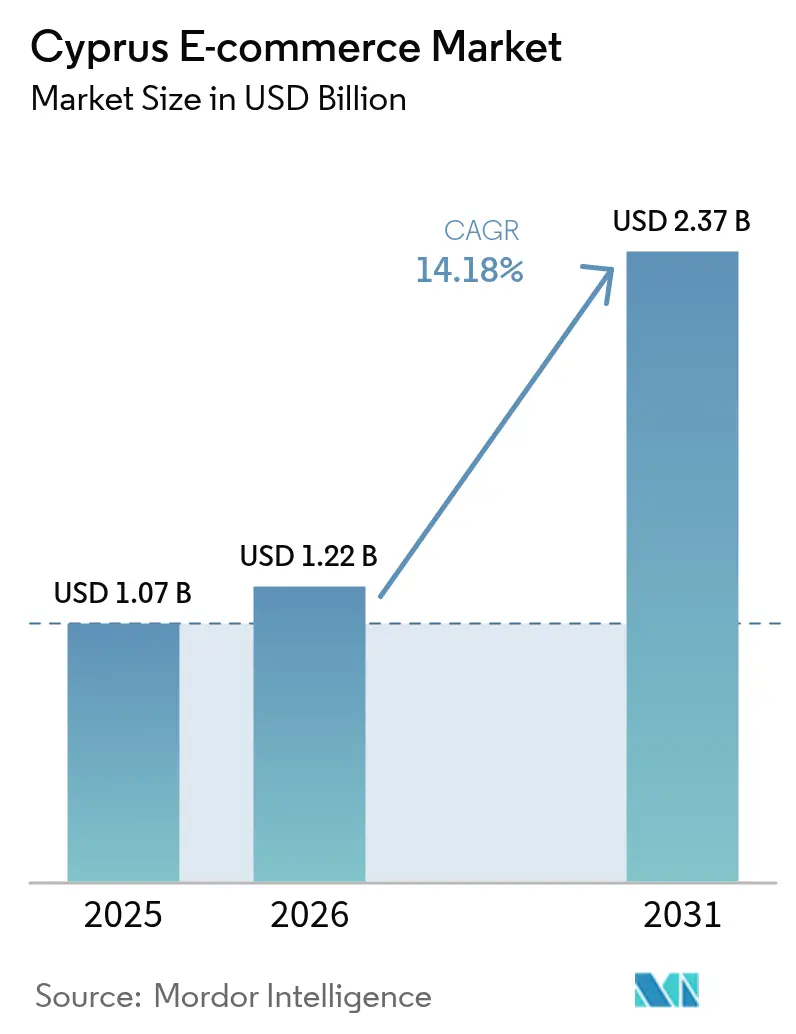
| Base Year Market Size (2025) | USD 1.07 Billion |
| Market Size (2026) | USD 1.22 Billion |
| Market Size (2031) | USD 2.37 Billion |
| Growth Rate (2026 - 2031) | 14.18 % |
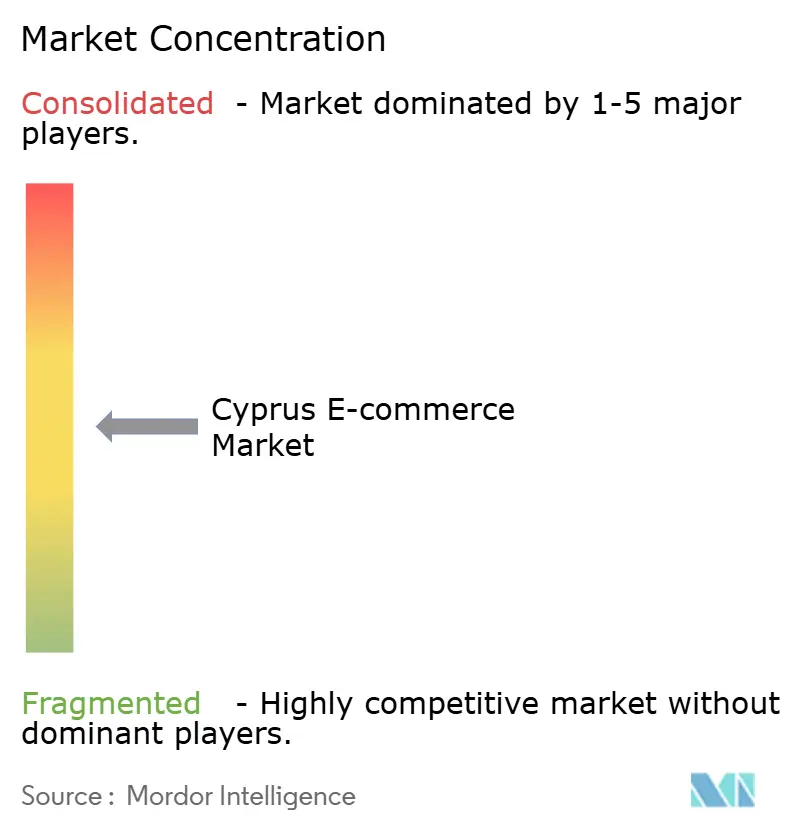
| Market Concentration | Medium |
Major Players *Disclaimer: Major Players sorted in no particular order Image © Mordor Intelligence. Reuse requires attribution under CC BY 4.0. | |
Cyprus E-commerce Market Analysis by Mordor Intelligence
Cyprus e-commerce market size in 2026 is estimated at USD 1.22 billion, growing from 2025 value of USD 1.07 billion with 2031 projections showing USD 2.37 billion, growing at 14.18% CAGR over 2026-2031. This growth trajectory underlines how fast digital retail is scaling on the island. Robust 92% internet penetration, an 81% cross-border shopping culture, and smartphone-driven browsing that now makes up more than 65% of web traffic provide the structural backdrop. A payment ecosystem where digital methods cover 96% of cashless transactions, together with instant-payment rails launched in January 2025, removes critical friction at checkout. Intensifying competition is sharpening service quality; global marketplaces set delivery-time benchmarks that local merchants match through parcel-locker networks, last-mile partnerships and same-day urban dispatch. These operational gains, when combined with EU policy harmonisation and EUR 177.25 million (USD 195.0 million) in government digital-innovation funding, keep the Cyprus e-commerce market on a clear expansion path.
Key Report Takeaways
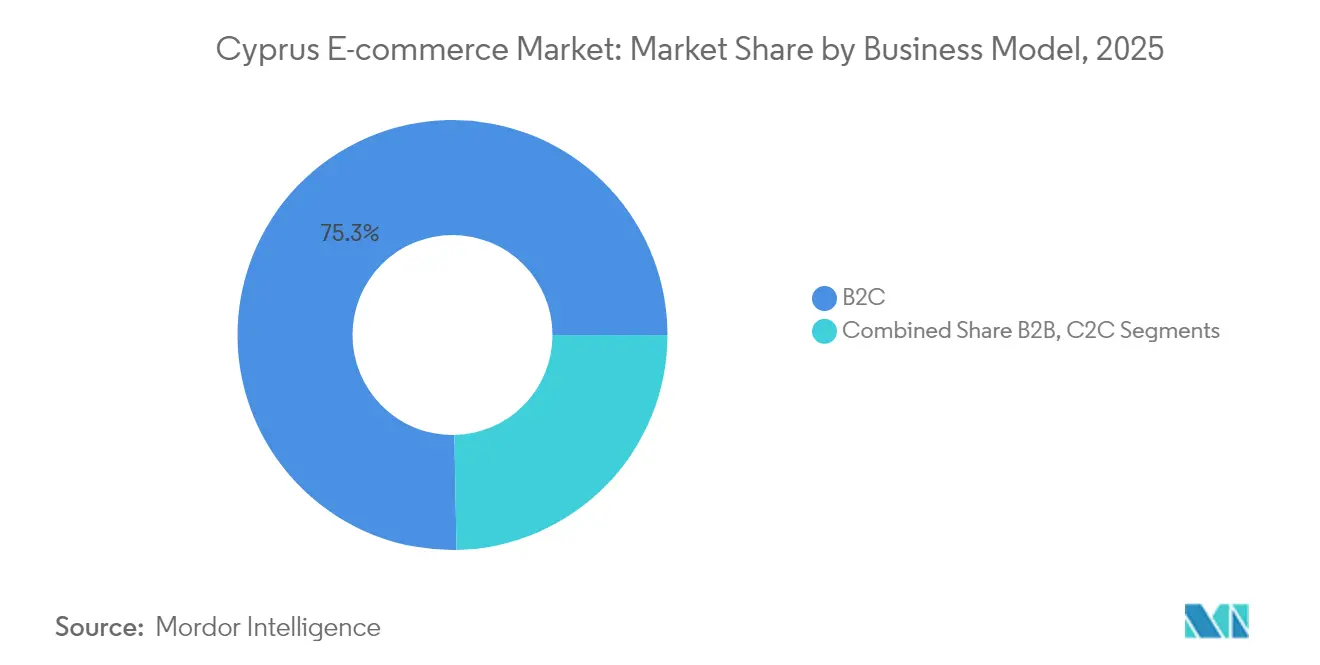
- By business model, B2C led with 75.30% Cyprus e-commerce market share in 2025; C2C is projected to expand at an 18.55% CAGR to 2031.
- By device, smartphones captured 68.20% of transactions in 2025, while mobile commerce is forecast to advance at a 17.2% CAGR through 2031.
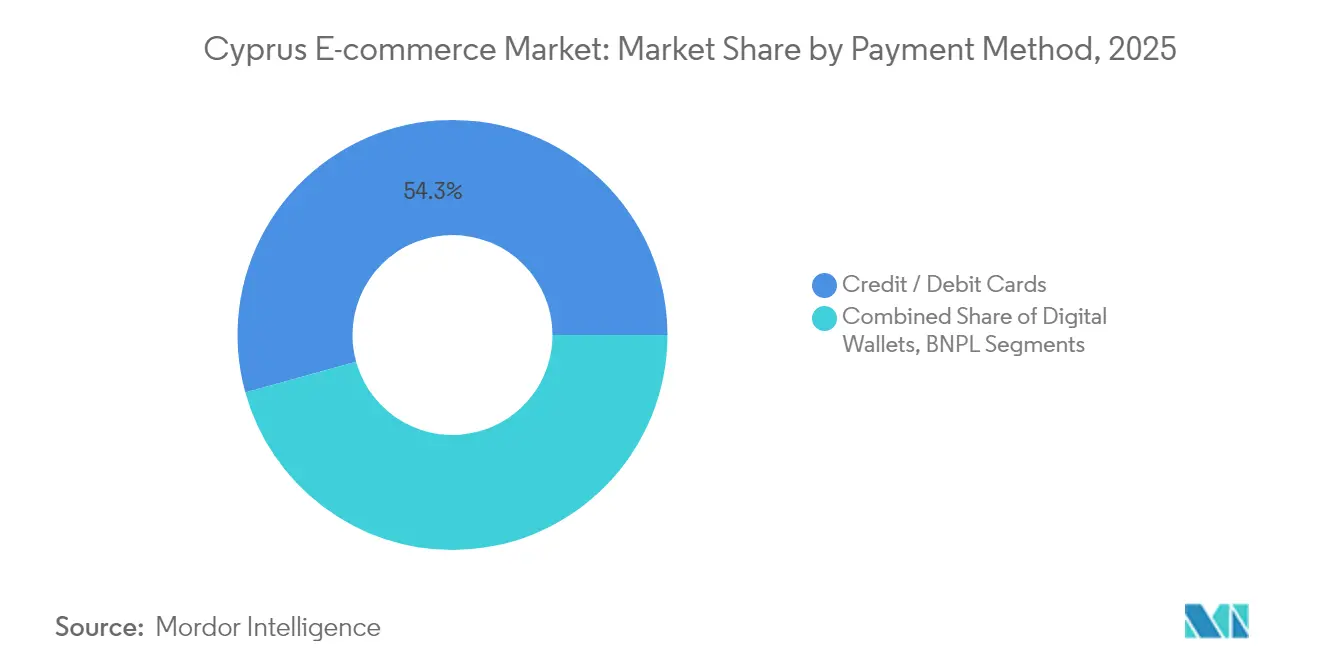
- By payment method, credit and debit cards accounted for 54.30% of transactions in 2025; digital wallets are projected to grow at an 17.75% CAGR to 2031.
- By product category, fashion and apparel held 31.40% revenue share in 2025; food and beverages is expanding at a 18.65% CAGR through 2031.
Note: Market size and forecast figures in this report are generated using Mordor Intelligence’s proprietary estimation framework, updated with the latest available data and insights as of 2026.
Cyprus E-commerce Market Trends and Insights
Drivers Impact Analysis*
| Driver | (~) % Impact on CAGR Forecast | Geographic Relevance | Impact Timeline |
|---|---|---|---|
| Rising mobile and internet penetration | +3.2% | National, with higher impact in urban centers | Short term (≤ 2 years) |
| Growing online demand for fashion and apparel | +2.8% | National, with concentration in Nicosia and Limassol | Medium term (2-4 years) |
| Improved last-mile logistics and parcel lockers | +2.1% | Urban centers, with gradual expansion to rural areas | Medium term (2-4 years) |
| EU e-Commerce VAT package harmonisation | +1.9% | National, with stronger impact on cross-border sales | Short term (≤ 2 years) |
| Govt digital-voucher schemes for rural consumers | +1.5% | Rural areas and smaller towns | Short term (≤ 2 years) |
| Diaspora-driven cross-border gifting flows | +1.3% | National, with concentration in areas with high emigration | Medium term (2-4 years) |
| Source: Mordor Intelligence | |||
Rising mobile and internet penetration
Mobile broadband coverage at 85% 5G reach and household internet uptake of 92% has lifted the Cyprus e-commerce market into a mobile-first era. Smartphone browsing drives micro-moment shopping, and 25% of card purchases already originate from phones. [1]Central Bank of Cyprus, “Speech by the Governor of the Central Bank of Cyprus at the 12th Banking Forum and Fintech Expo,” centralbank.cy Faster networks improve page-load speed and enable richer content such as AR try-ons, increasing conversion. Retailers that optimise UX for smaller screens and introduce one-tap checkouts capture incremental demand. This momentum positions mobile as the primary gateway to the Cyprus e-commerce market over the forecast horizon.
Growing online demand for fashion and apparel
Fashion’s USD 673.80 million revenue base in 2024 explains its 32% grip on the Cyprus e-commerce market. Social-media campaigns and limited-time discounts propel basket sizes, as highlighted by Zara’s Cyprus case study. Sustainable purchasing also plays a role; only 9% of the island’s 27,000 tons of textile waste is recycled, pushing eco-labels into the spotlight. Vintage marketplaces and circular-fashion pop-ups create fresh inventory streams, reinforcing apparel’s pull within the Cyprus e-commerce market.
Improved last-mile logistics and parcel lockers
Accuracy issues linked to fragmented addressing once stifled delivery reliability. A dense parcel-locker grid now gives shoppers flexible pick-up within urban centres, cutting mis-delivery rates and lowering courier costs. International Post Corporation data shows parcels taking more than 15 days dropped to 9% in 2024, versus 29% in 2020. The Port of Limassol hub anchors regional fulfilment strategies for merchants targeting Europe, MENA and North Africa, further enhancing the Cyprus e-commerce market’s logistical profile.
EU e-Commerce VAT package harmonisation
The Import One Stop Shop (IOSS) framework neutralises administrative overhead for SMEs shipping low-value parcels, letting Cypriot sellers concentrate on product quality instead of tax calculations. Harmonised rules join forces with the Digital Services Act to elevate consumer trust, stimulate basket growth, and foster a balanced Cyprus e-commerce market where local brands compete on even terms with multinationals.
Restraints Impact Analysis*
| Restraint | (~) % Impact on CAGR Forecast | Geographic Relevance | Impact Timeline |
|---|---|---|---|
| Small domestic consumer base | -2.5% | National, with less impact in tourist areas | Long term (≥ 4 years) |
| High shipping and return costs for an island market | -2.1% | National, with greater impact in rural areas | Medium term (2-4 years) |
| Limited Greek-language UX across platforms | -1.2% | National, with higher impact among older demographics | Short term (≤ 2 years) |
| Fragmented address system hurting delivery accuracy | -0.9% | Rural areas and newer developments | Medium term (2-4 years) |
| Source: Mordor Intelligence | |||
Small domestic consumer base
A resident population of 1.23 million limits absolute transaction volume. Consequently, 81% of shoppers pivot to overseas merchants to widen assortment choice. [2]European Commission, “Digital Services Act starts applying to all online platforms in the EU,” cyprus.representation.ec.europa.eu Cypriot sellers often design cross-border propositions from day one to scale beyond island boundaries. EU rules that simplify customs and VAT, plus multilingual storefronts, partly offset size constraints. Nevertheless, demand density remains a structural headwind for the Cyprus e-commerce market.
High shipping and return costs for an island market
Sea-freight dependence inflates inbound logistics, and outbound return parcels can exceed product value for low-ticket items. Consumer expectations of free returns clash with merchant cost realities. Retailers mitigate by pooling inventory in local micro-fulfilment centres for fast-moving stock and employing drop-ship models for niche items. These tactics soften, but do not erase, logistics-related drag on the Cyprus e-commerce market.
*Our forecasts treat driver/restraint impacts as directional, not additive. The impact forecasts reflect baseline growth, mix effects, and variable interactions.
Segment Analysis
By Business Model: C2C Platforms Disrupting Traditional Retail
The B2C segment accounted for 75.30% of the Cyprus e-commerce market size in 2025, underpinned by omnichannel chains and international marketplaces delivering consistent UX. Customer expectations around real-time inventory and AI-powered recommendations push merchants to invest in cloud commerce stacks. That investment pays off through higher repeat-purchase rates and larger average order values, reinforcing B2C dominance across the Cyprus e-commerce market.
C2C marketplaces, however, are shifting value capture. An 18.55% CAGR projection to 2031 signals how peer-to-peer trading redefines retail by converting consumers into micro-sellers. Platforms such as Bazaraki.com ease listing friction and build trust via escrow payments, unlocking second-hand and handmade product streams. SMEs comprise 93% of Cypriot firms, and as they digitise purchasing cycles, a latent B2B opportunity emerges. While B2B’s share of the Cyprus e-commerce industry is still modest, greater e-procurement usage portends strong upside after 2027.



By Device Type: Mobile-First Strategy Driving Conversion
Smartphones generated 68.20% of all transactions in 2025, underscoring the Cyprus e-commerce market’s clear mobile bias. Faster checkout flows, biometric authentication, and personalised push notifications raise mobile conversion efficiency. Combined with 5G’s 85% footprint, augmented-reality fitting rooms and video consultations become technically feasible, strengthening customer engagement.
Desktop retains relevance for high-consideration items and business users who require detailed configuration. Tablets and voice-commerce devices represent smaller but rising shares. Retailers re-platform front-end interfaces to deliver device-adaptive experiences, ensuring the Cyprus e-commerce market remains accessible across screen types while catering to the dominant mobile cohort.
By Payment Method: Digital Wallets Reshaping Transaction Landscape
Cards still underpin 54.30% of 2025 e-commerce value, but wallet adoption accelerates as consumers prioritise speed and security. The newest instant-payment rails make QR and mobile-number transfers viable for everyday shopping, nudging usage toward wallets. Cyprus Securities and Exchange Commission’s EUR 10.1 billion (USD 11.64 billion) AUM highlights the liquidity fintechs can tap to scale wallet propositions.
BNPL resonates with younger shoppers, capturing discretionary spend in fashion and electronics. Cryptocurrency acceptance remains niche but attracts high-tech circles. Whichever tender prevails, the Cyprus e-commerce market’s payment mix is diversifying, giving merchants multiple avenues to lift checkout success rates.
By B2C Product Category: Food and Beverages Outpacing Traditional Leaders
Fashion and apparel captured 31.40% of the Cyprus e-commerce market share in 2025, cementing its leadership with digitally savvy merchandising. Cross-border sourcing augments assortment, while local brands embrace circular fashion to address eco-concerns and claw back margin from global fast-fashion players.
Food and beverages grows at 18.65% CAGR—a clear outlier in velocity. Same-hour grocery fulfilment offered by Foody widens adoption beyond urban professionals to busy households. Consumer electronics, beauty, furniture and toys follow differentiated growth curves tied to category-specific online penetration barriers. Together, they broaden total Cyprus e-commerce market size over the forecast period.
Geography Analysis
Cyprus integrates tightly with the EU digital single market, and 81% of local online shoppers regularly transact with foreign sellers. Harmonised consumer-protection rules and IOSS reduce friction, underpinning sustained cross-border demand that lifts overall Cyprus e-commerce market activity. Urban strongholds Nicosia and Limassol enjoy dense fulfilment assets and drive category innovation, while government rural-voucher programmes push digital literacy into smaller towns.
Strategic geography matters: the Port of Limassol sits at the junction of Europe, MENA and North Africa, positioning Cyprus as a natural cross-docking node. Multinationals now co-locate micro-fulfilment centres near the port to shorten delivery routes into adjacent markets. Ninety-three foreign companies incorporated in Q1 2025, up 20% on 2024, many in software and digital commerce.
The National Long-Term Strategy for Sustainable Development sets a policy umbrella for innovation, allocating EUR 177.25 million (USD 195.0 million) to digital projects that underpin the Cyprus e-commerce market. ICT already contributes EUR 7 billion to GVA, exhibiting 200% growth since 2011. Enhanced broadband penetration and digital-skills programmes should narrow the urban-rural gap and bolster future Cyprus e-commerce market size.
Regulatory Landscape
Cyprus e-commerce operates under an EU-harmonized framework anchored by the national e-commerce law implementing the EU e-Commerce Directive (Law 156(I)/2004) and the EU VAT e-commerce package (including OSS and IOSS), which streamlines VAT handling for cross-border parcels. Digital trust and authentication are supported by the national implementation of eIDAS via the Electronic Identification and Trust Services framework (Law 55(I)/2018), administered by the Department of Electronic Communications (DEC) under the Deputy Ministry of Research, Innovation and Digital Policy.
Platform and service-provider obligations increasingly focus on consumer transparency and operational resilience. Cybersecurity requirements for online marketplaces and digital service providers fall under the Security of Networks and Information Systems Law (Law 89(I)/2020), supervised by the Digital Security Authority, while sector oversight for electronic communications and postal services is handled by the Office of the Commissioner of Electronic Communications and Postal Regulation (OCECPR), which influences delivery and connectivity conditions that shape online retail performance.
Value Chain Analysis
The Cyprus e-commerce value chain begins with cross-border sourcing and domestic merchandising, then moves through online storefronts and marketplaces (B2C and C2C) supported by payment processing (cards, wallets, and instant-payment rails launched in January 2025) and fraud and risk controls. Demand generation is driven by mobile-first discovery and social channels, and order capture is increasingly optimized for smartphones, which account for the majority of transactions in the market.
Fulfillment remains port-centric for imported inventory, with Limassol acting as a key gateway before distribution across Nicosia, Limassol, Larnaca, and Paphos through courier networks, parcel lockers, and click-and-collect. Customs clearance reliability is a critical bottleneck for inbound e-commerce flows, and technical faults in the Automated Import System (AIS) during 2025-2026 contributed to cargo release delays, forcing contingency procedures and increasing lead-time variability. On the supply enablement side, government co-funded digitization programs, including the Digital Upgrade of Businesses Scheme (EUR 30 million under Thaleia 2021-2027, including a EUR 14 million call launched in April 2025), support SME adoption of e-commerce platforms, integrations, and back-office automation.
Competitive Landscape
Global marketplaces—Amazon, eBay, AliExpress—serve Cyprus via cross-border shipping and wield economies of scale that translate into price competitiveness. Local specialists such as Bazaraki.com concentrate on C2C sales and category depth, achieving strong brand recall through localised language support. Traditional chains, including Public Cyprus and Stephanis, leverage store footprints for click-and-collect services, ensuring short lead times and convenient returns. This hybrid competitive mix keeps switching costs low for shoppers and intensifies the battle for loyalty within the Cyprus e-commerce market.
Merchants view technology as a strategic lever: 66% plan AI deployments for fraud screening and dynamic pricing. API-based commerce architectures let firms decouple front-end shopping experiences from back-end order management, accelerating feature releases and personalisation. [3]WDCSTechnology, “Navigating the Future of E-commerce: The Power of API-Based Digital Commerce,” wdcstechnology.ae Sustainability-focused fashion startups differentiate via closed-loop supply chains and digital product passports to win eco-conscious consumers, adding further complexity to competitive positioning.
Financing appetite is solid; Cyprus-based funds control 75% of the EUR 10.1 billion (USD 11.64 billion) AUM recorded in Q4 2024. These capital pools support acquisition roll-ups, marketplace consolidation and warehouse automation projects, accelerating scaling trajectories. As a result, bargaining power is slowly shifting toward platforms that can aggregate traffic and data at scale, shaping medium-term structure of the Cyprus e-commerce market.
Cyprus E-commerce Industry Leaders
Amazon.com, Inc.
eBay Inc.
AliExpress (Alibaba Group Holding Ltd.)
Bazaraki.com
Public Cyprus Ltd.
- *Disclaimer: Major Players sorted in no particular order

Market Opportunities and Future Outlook
SME digitization is a key execution gap and a practical opportunity for platforms, agencies, and software vendors, with only 23.9% of enterprises receiving orders via computer networks in 2024, and 17.1% using their own websites or apps. Public funding mechanisms, including the Digital Upgrade of Businesses Scheme under the Thaleia 2021-2027 program, provide a defined pipeline for upgrades such as storefront builds, OMS/ERP integration, cybersecurity tooling, and data-driven marketing. The focus is especially relevant for smaller merchants that have relied on social selling or marketplace-only participation.
Cross-border e-commerce and delivery infrastructure also create whitespace where operational improvements translate into measurable consumer experience gains. With 81% of shoppers purchasing from overseas merchants, the island logistics reality lifts the value of parcel-locker networks, integrated tracking, and last-mile orchestration, supported by rapid scaling of locker-based delivery models used by regional marketplaces. At the same time, stricter compliance requirements under EU-aligned platform and cybersecurity rules (including DSA-linked trader transparency and the NIS framework) increase demand for compliance-as-a-service, identity and verification tooling, and incident readiness solutions tailored to marketplaces and high-volume sellers.
Recent Industry Developments
- July 2026: Cyprus introduced a temporary EUR 3 customs duty on low-value parcels imported via digital platforms, with over 100,000 packages processed in the first 15 days of July. The measure reflects administrative strain from high parcel volumes and adds a new cost and compliance layer that marketplaces and cross-border sellers must manage at checkout and in returns workflows.
- February 2026: Skroutz reported an 83% year-on-year rise in marketplace orders in Cyprus during 2025, with Skroutz Last Mile handling 93% of island orders and Skroutz Points parcel lockers accounting for 27% of deliveries as of early 2026. The update highlights how control of delivery networks and locker density are becoming differentiators for cross-border marketplace performance and service-level consistency in Cyprus.
- October 2024: Zubr Capital completed a strategic investment in Larixon Classifieds, the parent company of Bazaraki.com, to support business development, financial system integration, and international scaling. The financing strengthened a leading local C2C platform and supported product and payments modernization that can lift trust and transaction conversion in second-hand and peer-to-peer categories.


Research Methodology Framework and Report Scope
Market Definition and Coverage
For this study, the Cyprus e-commerce market is defined as the value of online orders for physical goods and services placed through websites or mobile apps by consumers or enterprises located in Cyprus, regardless of whether the seller is local or cross-border.
Scope exclusions: Purely digital content transactions (such as music, video, and game downloads) are excluded from the market totals.
Segmentation Overview
- By Business Model
- B2C
- B2B
- C2C
- By Device Type
- Smartphone / Mobile
- Desktop and Laptop
- Other Device Types
- By Payment Method
- Credit / Debit Cards
- Digital Wallets
- BNPL
- Other Payment Method
- By B2C Product Category
- Beauty and Personal Care
- Consumer Electronics
- Fashion and Apparel
- Food and Beverages
- Furniture and Home
- Toys, DIY and Media
- Other Product Categories
Data Sources, Market Sizing, and Validation
Desk Research
Desk work started with mapping the demand pool in Cyprus and the shopping journey, and then connecting it to indicators that can be checked year over year. We leaned on public, non-paywalled references such as Eurostat, the Statistical Service of Cyprus (CYSTAT), Central Bank of Cyprus releases, European Commission Digital Economy and Society indicators, and UN Comtrade for trade context, which helped with population, income, online access, and cross-border dynamics.
To anchor the market math, we also reviewed company filings and investor presentations where available, along with association websites and reputable press coverage that discusses online retail adoption, payment use, and delivery constraints. In addition, paid databases for company financials and news intelligence were used selectively to cross-check reported online revenue exposure and major expansion events. The desk sources listed here are illustrative only, and many other public references were consulted for data collection, validation, and clarification.
Primary Interviews and Surveys
Interviews and surveys with Cyprus-based retailers, marketplaces, payment specialists, logistics contacts, and managers clarify order values, category mix, cross-border demand, mobile use, and payment choices within Cyprus. Respondents help identify gaps in secondary data, supply missing monetary inputs, and test whether the category and channel assumptions are consistent with local operating conditions.
Distribution of primary research fieldwork respondents
| Company type | Respondent position |
|---|---|
| Top tier: 29% | CXOs: 18% |
| Mid tier: 46% | Functional/Unit leaders: 31% |
| Smaller Players: 25% | Managers: 51% |
Market-Sizing & Forecasting
Sizing was built using the top-down and bottom-up combination, where online spend in Cyprus is reconstructed from consumer demand signals and then checked against supplier-side reality. The top-down path starts from population and household consumption patterns, and then filters through internet and smartphone usage, online shopper penetration, and typical order frequency and basket value.
Those totals were then corroborated with selective bottom-up approximations, such as rolling up sampled merchant GMV ranges, using channel checks on category mix, and applying average selling price times estimated online unit volumes for a few anchor categories, and then adjusting for gaps. Inputs that mattered most for Cyprus included e-commerce user penetration, card and digital payment usage trends, cross-border share of online orders, delivery and return intensity, and category shifts tied to inflation and discretionary spending.
For forecasting, we used scenario analysis supported by trend smoothing, where the main case was shaped by expert views on online adoption pace, shipping capacity constraints, and promotion-led demand swings, and then tested with conservative and aggressive variants. Where direct bottom-up coverage was thin (for smaller merchants), we used ranges agreed in interviews and applied them to the long tail so the model stays realistic without overfitting.
Data Validation & Update Cycle
Outputs were checked against independent signals, including digital payment growth, online traffic and conversion commentary in public disclosures, and logistics activity cues that indicate whether order volumes are moving in line with value. We also ran variance checks across years to flag unusual jumps in basket value, penetration, or cross-border share, and those points were sent back for analyst review and, when needed, follow-up calls.
Before sign-off, the model and assumptions go through a multi-step internal review so arithmetic, units, and scope rules are consistently applied. The report is refreshed annually, and interim updates are triggered if a material event changes the demand pool (for example, a major policy shift, a payment rule change, or a step change in delivery capacity). Right before delivery, an analyst performs a final pass so clients receive the latest updated view.
Mordor Intelligence's Cyprus Ecommerce Market Size Versus Other Published Estimates
It is normal to see different market sizes for Cyprus e-commerce because publishers do not always count the same transaction flows, and they also use different base years, FX timing, and ways to treat cross-border purchases. Some sources focus on online retail sales by domestic merchants only, and other sources report a broader online spend view that blends multiple payment driven activities.
Key gaps usually come from whether cross-border orders are counted, whether B2B and C2C transactions are included, and whether totals are built from shopper behavior or from a limited seller sample that misses the long tail. Some estimates also apply one average exchange rate for multiple years, and that can shift USD totals even when local spending stays similar. Broader estimates sometimes fold in digital content and subscriptions, then Mordor Intelligence keeps the total limited to GMV from online orders for physical goods and services placed by buyers located in Cyprus, with purely digital downloads excluded.
Benchmark comparison
| Source | Market Size | Gaps in Research Methodology |
|---|---|---|
| Mordor Intelligence | USD 1.07 B (2025) | |
| Regional Consultancy A | USD 0.96 B (2024) | Uses a domestic-merchant-only lens and excludes cross-border orders placed by Cyprus shoppers, which can understate GMV for a small open economy. |
| Trade Journal B | USD 1.30 B (2025) | Expands scope to include digital content and recurring subscriptions and uses a broad online spend proxy rather than isolating order-based GMV for goods and services. |
The spread in the table is mainly explained by scope and counting choices, not by a single growth assumption, so users should first confirm what transaction types are included. When the model is tied to order-based GMV and then pressure-tested with checks like cross-border share and basket value, the output stays traceable to inputs that can be repeated during updates.


Key Questions Answered in the Report
What is the current Cyprus e-commerce market size and growth outlook?
The market stands at USD 1.22 billion in 2026 and is projected to reach USD 2.37 billion by 2031 at a 14.18% CAGR.
Which segment leads the Cyprus e-commerce market by revenue?
Fashion and apparel leads with 31.40% revenue share in 2025, thanks to strong brand presence and omnichannel strategies.
How important is mobile commerce in Cyprus?
Mobile accounts for 68.20% of transactions and is expected to expand at a 17.2% CAGR, making smartphone optimisation critical.
What payment methods are gaining ground?
Digital wallets are growing at an 17.75% CAGR and are forecast to overtake cards before 2027, propelled by instant-payment infrastructure.
Why do Cypriot shoppers frequently buy cross-border?
Limited domestic assortment and EU harmonisation encourage 81% of local shoppers to purchase from other EU sellers, broadening choice and price competitiveness.
What structural challenges face the Cyprus e-commerce industry?
Island logistics drive up shipping and return costs, and the small domestic consumer base restricts scale, compelling local merchants to orient strategies toward cross-border expansion.
Page last updated on:


 Your data is secure and never sold or shared.


