
Cybersecurity Policy Management Market Size and Share
Market Overview
| Study Period | 2020 - 2031 |
|---|---|
| Market Size (2026) | USD 3.22 Billion |
| Market Size (2031) | USD 5.48 Billion |
| Growth Rate (2026 - 2031) | 11.20 % |
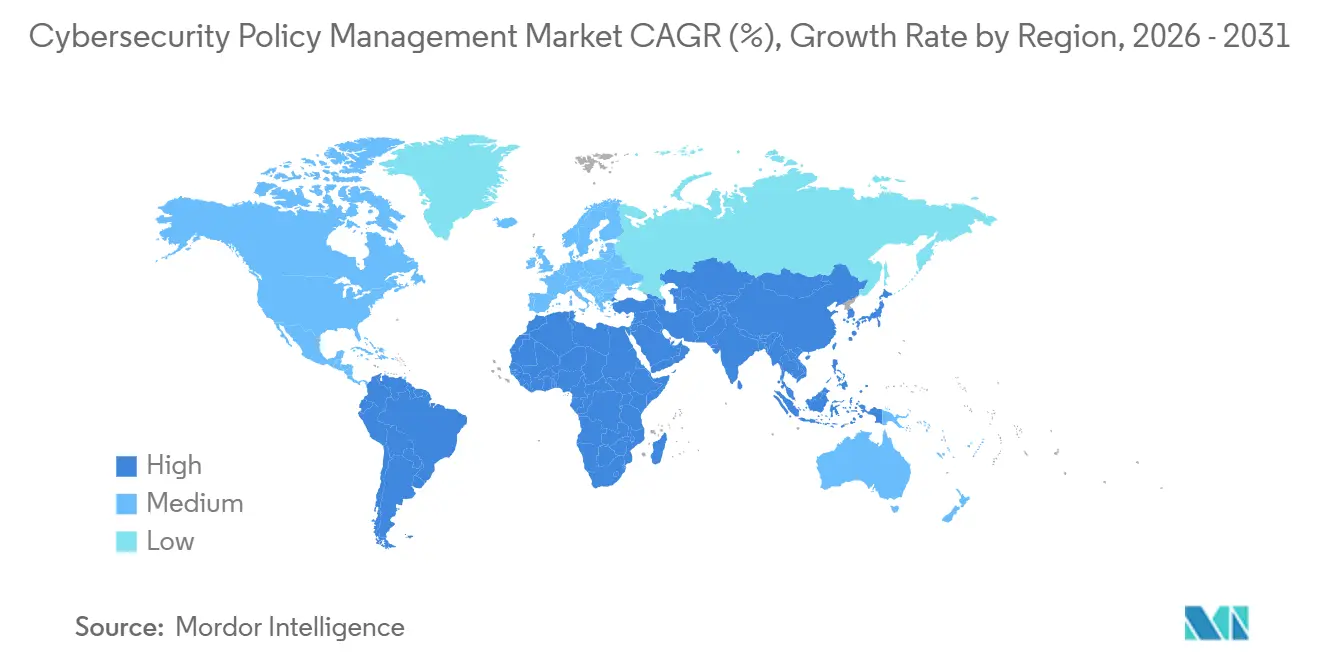
| Fastest Growing Market | Asia-Pacific |
| Largest Market | North America |
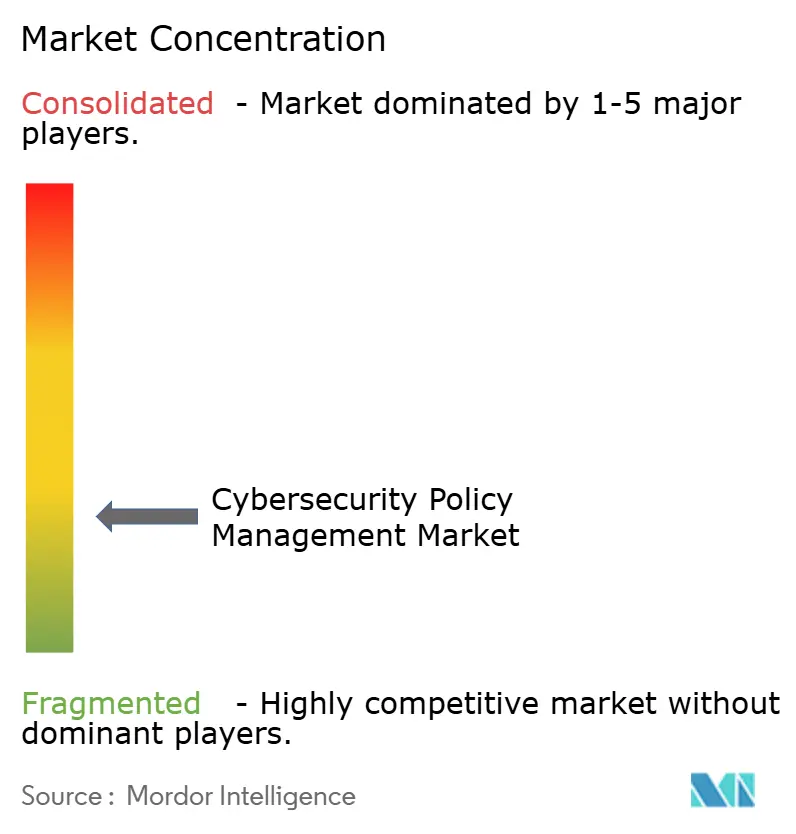
| Market Concentration | Low |
Major Players *Disclaimer: Major Players sorted in no particular order Image © Mordor Intelligence. Reuse requires attribution under CC BY 4.0. | |
Cybersecurity Policy Management Market Analysis by Mordor Intelligence
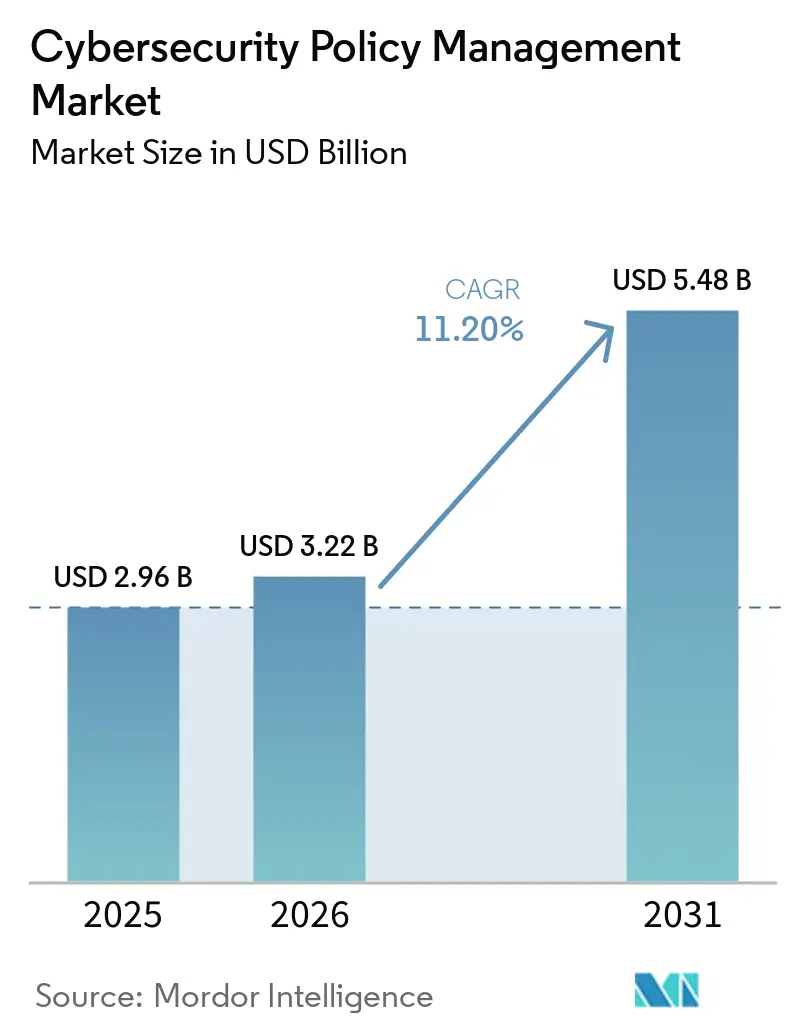
The cybersecurity policy management market size was valued at USD 2.96 billion in 2025 and estimated to grow from USD 3.29 billion in 2026 to reach USD 5.48 billion by 2031, at a CAGR of 11.20% during the forecast period (2026-2031). The cybersecurity policy management market is expanding because enterprises need consistent security rules across cloud, on-premises, SASE, and microsegmentation environments. The growing number of security tools makes manual policy administration slower and increases the risk of conflicting rules. Regulatory requirements are also shifting security teams toward continuous evidence of compliance rather than periodic audit preparation. Vendors are responding with automation, broader cloud support, and tools that help security teams review changes before deployment. This has created opportunities for providers that can connect network, workload, identity, and cloud controls within a shared governance model.
Key Report Takeaways
- By component, software held 67.80% of the cybersecurity policy management market revenue share in 2025, while services are projected to expand at a 12.59% CAGR through 2031.
- By deployment, cloud held 71.23% of the cybersecurity policy management market revenue share in 2025 and is projected to expand at a 12.26% CAGR through 2031.
- By organization size, large enterprises held 66.41% of the cybersecurity policy management market revenue share in 2025, while SMEs are projected to expand at a 12.78% CAGR through 2031.
- By end-user industry, BFSI held 32.78% of the cybersecurity policy management market revenue share in 2025, while healthcare and life sciences are projected to expand at an 11.56% CAGR through 2031.
- By geography, North America held 36.10% revenue share in 2025, while Asia-Pacific is projected to expand at an 11.89% CAGR through 2031.
Note: Market size and forecast figures in this report are generated using Mordor Intelligence’s proprietary estimation framework, updated with the latest available data and insights as of January 2026.
Global Cybersecurity Policy Management Market Trends and Insights
Drivers Impact Analysis*
| Driver | (~) % Impact on CAGR Forecast | Geographic Relevance | Impact Timeline |
|---|---|---|---|
| Increasing Complexity of Hybrid and Multi-Vendor Security Environments | +2.5% | Global | Medium term (2-4 years) |
| Expansion of Cloud, Distributed Infrastructure and Security Control Domains | +2.2% | Global, with strongest pull in North America and Asia-Pacific | Short term (≤ 2 years) |
| Rising Policy Change Volumes and Need for Faster Security Operations | +1.8% | North America and Europe | Short term (≤ 2 years) |
| Growing Demand for Continuous Policy Compliance and Security Assurance | +1.5% | North America, EU, and Asia-Pacific core | Medium term (2-4 years) |
| Increasing Policy Misconfiguration and Rule-Sprawl Risk | +1.2% | Global, concentrated in large enterprise markets | Medium term (2-4 years) |
| Increasing Adoption of Automated Policy Orchestration and Lifecycle Management | +1.0% | North America and Europe, with spill-over to MEA | Long term (≥ 4 years) |
| Source: Mordor Intelligence | |||
Increasing Complexity of Hybrid and Multi-Vendor Security Environments
The cybersecurity policy management market benefits from the growing difficulty of applying the same policy intent across multiple security products. Organizations often operate firewalls, cloud security groups, SASE controls, and microsegmentation platforms simultaneously. Each environment uses different rule formats, application programming interfaces, and approval processes. This creates gaps when a change is made in one system but is not validated across the others. Tufin expanded its Unified Control Plane in August 2026 to cover Cisco Meraki, VMware NSX-T, AWS native firewalls, and Palo Alto Strata Cloud Manager, showing the breadth of environments that security teams must govern. The cybersecurity policy management market, therefore, favors platforms that centralize visibility and help teams translate policy intent into controls that work across varied environments.
Expansion of Cloud, Distributed Infrastructure, and Security Control Domains
Cloud adoption has made security policy management more complex because cloud controls differ from traditional firewall rules. Cloud services use identity, tags, and dynamic resources, whereas many on-premises controls rely on static network addresses and ports. Security teams must maintain consistent access rules as workloads move among cloud platforms, branch locations, and data centers. A separate set of policy tools for each environment can leave teams with conflicting rules and incomplete compliance records. AlgoSec expanded its support for AWS Network Firewall, Azure Firewall automation, and Google Cloud security services in July 2026, reflecting the continued need for coverage across cloud environments. The cybersecurity policy management market is supported by demand for tools that evaluate these controls as parts of a connected policy framework.
Rising Policy Change Volumes and Need for Faster Security Operations
Security teams are handling more change requests as application releases and cloud deployments occur more frequently. Every requested firewall or access-rule change requires validation before it is deployed. Manual reviews can delay application delivery and keep security teams focused on routine tasks. Backlogs also increase the time needed to process later requests, which can extend risk windows across the organization. AlgoSec stated in July 2026 that 20% of organizations still relied primarily on manual security processes, leaving substantial room for policy automation. The cybersecurity policy management market gains from platforms that automate path analysis, risk checks, and policy design before a change enters production.
Growing Demand for Continuous Policy Compliance and Security Assurance
The cybersecurity policy management market is also shaped by rules that require continuous control, monitoring, and documented remediation. The EU Digital Operational Resilience Act became applicable to covered financial entities in January 2025 and requires ICT risk management and testing measures.[1] NIS2 requires essential entities to manage cybersecurity risks and can impose penalties of up to EUR 10 million (USD 10.9 million) or 2% of the worldwide annual turnover. These requirements make policy evidence, control monitoring, and audit records more important in procurement decisions. AlgoSec added compliance reporting for NIS2, updated PCI DSS, and SWIFT frameworks in its July 2026 release. The cybersecurity policy management market has room for vendors that make compliance reviews easier without requiring separate reporting processes for each framework.
Restraints Impact Analysis*
| Restraint | (~) % Impact on CAGR Forecast | Geographic Relevance | Impact Timeline |
|---|---|---|---|
| High Integration Complexity Across Heterogeneous Security Infrastructure | -1.5% | Global, most acute in large enterprises with legacy infrastructure | Medium term (2-4 years) |
| High Implementation and Migration Effort in Complex Enterprises | -1.2% | North America and Europe, with spill-over to Asia-Pacific | Medium term (2-4 years) |
| Organizational Resistance to Automated Security-Policy Changes | -0.8% | Global | Long term (≥ 4 years) |
| Difficulty Standardizing Policies Across Diverse Business and Technical Environments | -0.7% | Asia-Pacific core, with spill-over to Middle East and Africa | Long term (≥ 4 years) |
| Source: Mordor Intelligence | |||
High Integration Complexity Across Heterogeneous Security Infrastructure
The cybersecurity policy management market faces a practical limit when enterprises run many generations of security infrastructure. A single organization can use several firewall brands alongside public cloud controls, SASE services, and microsegmentation platforms. Those products have different rule structures and technical interfaces. Some older devices need customized connectors before they can be added to a centralized policy system. Vendors are still extending coverage as cloud services and enforcement models change. AlgoSec's July 2026 release added functions for AWS, Azure, and Google Cloud security controls, demonstrating that integration coverage remains a moving target. As a result, some enterprises adopt centralized governance in phases and continue to manage part of their estate manually.
High Implementation and Migration Effort in Complex Enterprises
Implementation can be difficult even after a platform connects to the required security controls. Teams must map existing rules, train administrators, redesign approval workflows, and migrate historical documentation. Multinational organizations also need to align local rules with different legal and operational requirements. These steps can extend deployment timelines and delay the full realization of automation's benefits. ISO/IEC 27001:2022 provides a recognized management system framework that can support structured control reviews during the transition. Vendors that begin with read-only visibility and add automation gradually can reduce organizational resistance. This restraint can slow near-term revenue recognition even where underlying demand remains strong.
*Our forecasts treat driver/restraint impacts as directional, not additive. The impact forecasts reflect baseline growth, mix effects, and variable interactions.
Segment Analysis
By Component: Software Supports Core Governance While Services Address Complex Deployments
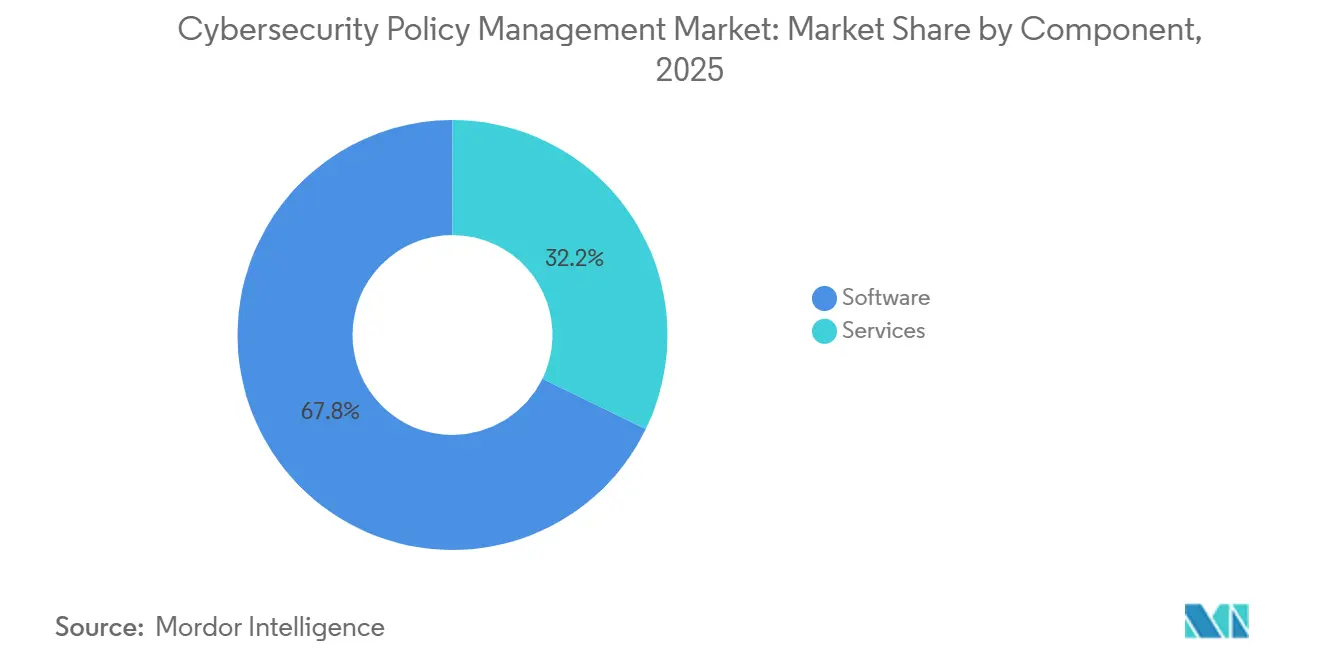
Software held 67.80% of the cybersecurity policy management market revenue in 2025. It provides the persistent system used to collect configurations, model network paths, manage rule lifecycles, and verify policy compliance. The large software position reflects the need for a continuous governance platform rather than one-time consulting support. Purpose-built vendors such as Tufin, AlgoSec, and FireMon use their platforms to support recurring policy reviews and change workflows. Software can also create a long-term operational record that security and audit teams can use to examine past changes. These functions make the software layer central to the cybersecurity policy management industry.
Services are projected to grow at a 12.59% CAGR through 2031. Demand comes from implementation, integration engineering, compliance advisory work, and policy rationalization across different control environments. Enterprises often need specialist support when connecting legacy appliances and cloud platforms to a new governance system. Managed security service providers can also package policy management capabilities within broader security operations support. Tufin's August 2026 release added AI-powered functions for rule analysis, compliance exceptions, and access requests, which can reduce the amount of routine expert work required after deployment. Higher-value services are likely to remain focused on complex integrations and regulatory requirements that cannot be resolved through standard automation.
By Deployment: Cloud Combines Scale With Policy Automation
Cloud accounted for 71.23% of the cybersecurity policy management market revenue in 2025 and is projected to grow at a 12.26% CAGR through 2031. Cloud delivery helps security teams manage controls across public cloud services, SASE nodes, and distributed locations. It also supports dynamic discovery when cloud resources are created, changed, or removed. This reduces dependence on manual inventory updates and on-premises management servers. Cloud platforms can maintain connectivity with cloud-native controls through their application programming interfaces. The cybersecurity policy management market has shifted toward cloud delivery because hybrid infrastructure now requires policy management that can operate across multiple data centers.
On-premises deployment remains relevant where data residency rules or internal security requirements limit the use of externally hosted management services. Japan's Ministry of Economy, Trade, and Industry launched its Supply Chain Security Evaluation System in May 2026, reinforcing the importance of cloud security configurations in critical infrastructure supply chains. Zscaler and Schwarz Digits announced a partnership in July 2026 to operate a sovereign Zero Trust Exchange service on Germany-based cloud infrastructure. This approach demonstrates that sovereign cloud models can meet stringent data-residency requirements while retaining cloud operational benefits. Cloud adoption does not remove governance requirements, but it can make centralized policy controls more practical across distributed operations. Vendors that support both cloud and on-premises controls remain relevant to organizations with mixed deployment needs.
By Organization Size: Large Enterprises Fund Adoption While SMEs Expand Access
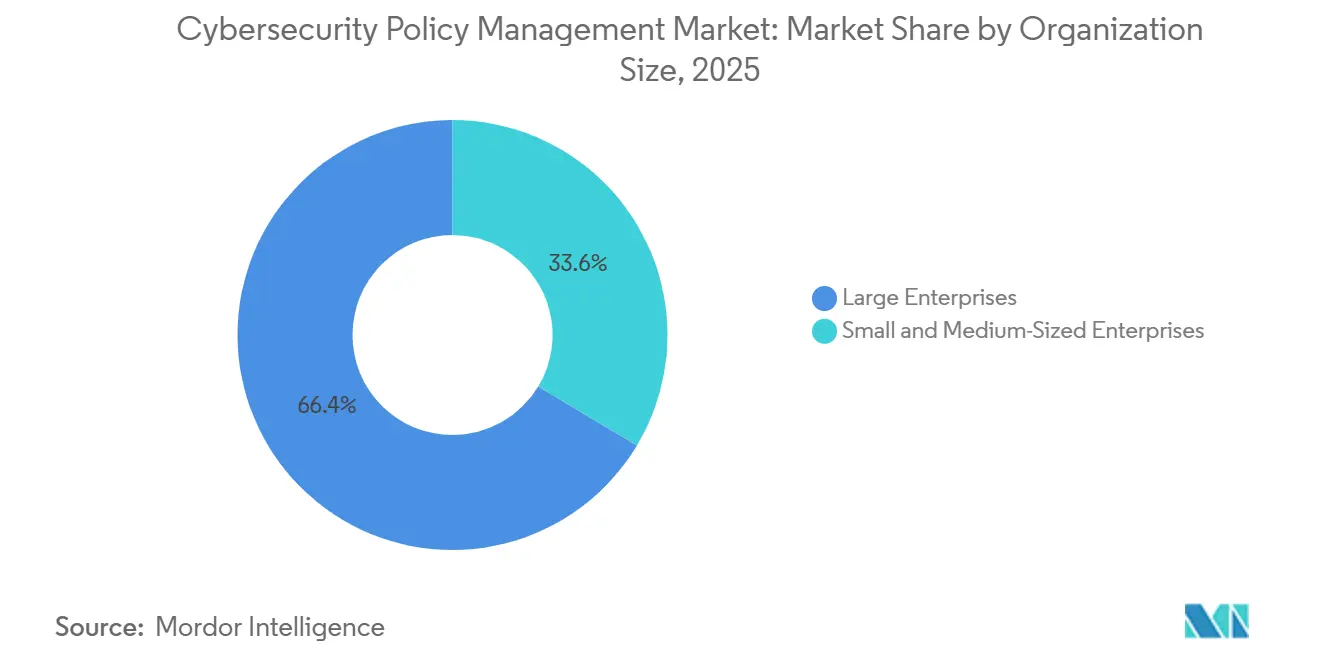
Large enterprises held 66.41% of the cybersecurity policy management market revenue in 2025. These organizations often manage extensive rule sets across several regions, business units, and security platforms. Their compliance obligations and operational scale make policy errors more expensive and harder to investigate. Large enterprises also have the resources for multi-year deployments and specialized administration teams. This gives vendors a stable base of customers with complex requirements. The cybersecurity policy management industry, therefore, remains closely tied to large organizations with hybrid infrastructure and extensive audit needs.
SMEs are projected to register the fastest growth, at a 12.78% CAGR through 2031. Cloud delivery and managed services reduce the initial cost and administrative burden for smaller organizations. ENISA published an SME Cyber Resilience Maturity Assessment Model in July 2026 to help smaller organizations assess controls in relation to the EU Cyber Resilience Act.[2] NIS2 extends to medium and large entities with at least 50 employees in covered sectors, which broadens the set of organizations that need formal governance practices. This regulatory direction can move policy management from an enterprise-only purchase toward a more accessible service. Providers that simplify deployment and offer guided controls are better positioned to address this opportunity.
By End-User Industry: BFSI Leads Demand While Healthcare and Life Sciences Gain Momentum
BFSI accounted for 32.78% of the cybersecurity policy management market revenue in 2025. Financial institutions operate under overlapping requirements for operational resilience, payment security, data protection, and cyber risk management. DORA requires covered entities to establish ICT risk management and resilience practices, creating a clear need for documented, testable controls. A policy error in a financial environment can expose customer data to loss, fraud, and regulatory action. These risks support ongoing investment in centralized rule governance. BFSI remains the cybersecurity policy management market's anchor end-user group because security controls are both operational and regulatory requirements.
Healthcare and life sciences are projected to grow at an 11.56% CAGR through 2031. The U.S. Department of Health and Human Services proposed major updates to the HIPAA Security Rule in January 2025. The proposal included network segmentation, vulnerability scanning at least every 6 months, annual penetration testing, and defined system restoration requirements. Healthcare organizations are preparing their security environments for more formal technical safeguards and documented recovery practices. IT and telecommunications also require policy automation because their networks change frequently. Manufacturing, energy and utilities, retail, and e-commerce drive demand through exposure to operational technology, payment security requirements, and third-party access management.
Geography Analysis
North America accounted for 36.10% of the cybersecurity policy management market share in 2025. The region's position reflects cybersecurity disclosure, incident reporting, and financial-sector requirements that make policy documentation and monitoring important. New York's amended cybersecurity regulation includes requirements for governance, risk assessment, access control, and incident reporting for covered financial institutions. U.S. Securities and Exchange Commission rules require registrants to disclose material cybersecurity incidents within 4 business days after determining that they are material.[3] These obligations give boards and senior leaders a reason to seek faster visibility into policy changes and security controls.
Europe is an important demand center because NIS2 and DORA have increased the need for documented, repeatable security governance. The cybersecurity policy management market benefits when organizations need to demonstrate how policies are applied across critical services and third parties. The United Kingdom, Germany, and France remain prominent markets, while other European countries are moving through national NIS2 implementation. South America is led by Brazil and Mexico, where banking-sector cybersecurity investment is increasing as regulatory frameworks develop.
Asia-Pacific is projected to grow at an 11.89% CAGR through 2031. Japan enacted the Cyber Capability Strengthening Act in May 2025, thereby expanding national attention to active cyber defense and resilience. METI's May 2026 supply chain program places greater emphasis on security controls in critical infrastructure. India's data-protection requirements, China's data-security rules, and established financial-sector frameworks in Singapore and South Korea also support demand for formal policy governance. The Middle East is led by the UAE and Saudi Arabia, where digital transformation programs and financial-sector requirements support cybersecurity investment.
Competitive Landscape
Purpose-built vendors include Tufin, FireMon, AlgoSec, and Skybox Security. These providers can support multi-vendor security environments because they are designed to work across competing firewall, cloud, SASE, and microsegmentation products. Larger platform vendors include Cisco, Palo Alto Networks, Fortinet, Check Point, Zscaler, and Microsoft. Their advantage comes from deep integration with products already used by enterprise customers. The cybersecurity policy management market is becoming more competitive as specialists broaden their coverage and platform vendors add more native orchestration capabilities.
AI-supported analysis is becoming an important point of differentiation. AlgoSec introduced natural-language policy queries in its Horizon A33.30 release in July 2026.[4] Tufin introduced AI-powered assistants for rule analysis, configuration review, compliance exception search, and access request management in March 2026. Zscaler announced its intent to acquire Symmetry Systems in May 2026 to extend its policy controls to AI-agent communication and data access. These moves show that vendors are addressing machine identities and automated access decisions alongside established network policy concerns.
Partnerships and acquisitions are also changing the scope of competition. Zscaler completed its acquisition of SquareX in February 2026 to extend zero-trust policy enforcement into browser environments. Tufin and Akamai announced a joint solution in March 2026 that combines Tufin policy automation with Akamai Guardicore Segmentation. Operational technology and IoT policy management remain less developed as critical infrastructure organizations connect IT and operational systems. IEC 62443 provides a recognized control framework for industrial automation and control systems.
Cybersecurity Policy Management Industry Leaders
-
Cisco Systems, Inc.
-
Palo Alto Networks, Inc.
-
Fortinet, Inc.
-
Check Point Software Technologies Ltd.
-
Microsoft Corporation
- *Disclaimer: Major Players sorted in no particular order
Recent Industry Developments
- August 2026: Tufin released Tufin Orchestration Suite (TOS) 5.3, adding AI-powered Segmentation Intelligence that continuously validates segmentation policy intent across multi-vendor hybrid environments. The release extended the Unified Control Plane to cover Cisco Meraki automated provisioning, VMware NSX-T access request automation, AWS native firewall governance, and Palo Alto Strata Cloud Manager integration, consolidating policy management across cloud, SASE, on-premises, and microsegmentation from a single platform.
- July 2026: AlgoSec launched Horizon A33.30, introducing native compliance reporting for NIS2, updated PCI DSS and SWIFT frameworks, AI-powered natural-language policy queries, expanded Azure Firewall automation, and full support for Google Cloud security services and AWS Network Firewall. The release directly addressed the 20% of organizations still relying primarily on manual security processes.
- July 2026: Zscaler and Schwarz Digits announced a partnership to deliver a sovereign cloud security platform for Europe, operating Zero Trust Exchange on Schwarz Digits' STACKIT cloud infrastructure in Germany, targeting enterprises and government entities with strict data-residency requirements under NIS2 and GDPR.
- May 2026: Zscaler announced its intent to acquire Symmetry Systems, a specialist in identity mapping and AI-agent data-access intelligence, to extend Zero Trust Exchange governance to AI-agent-to-application and agent-to-agent communications, addressing the policy gap created by autonomous AI agents operating with ephemeral identities and inherited permissions.
Global Cybersecurity Policy Management Market Report Scope
The Cybersecurity Policy Management Market comprises software solutions and associated services that enable organizations to create, manage, distribute, monitor, enforce, and update cybersecurity policies, standards, procedures, and control frameworks across enterprise environments. These platforms support policy lifecycle management, regulatory compliance, governance, risk management, security control alignment, policy attestation, exception management, and continuous monitoring to ensure adherence to internal security requirements and external regulatory mandates.
The Cybersecurity Policy Management Market Report is Segmented by Component (Software, and Services), Deployment (Cloud, and On-Premises), Organization Size (Large Enterprises, and Small and Medium-Sized Enterprises), End-User Industry (Banking, Financial Services, and Insurance [BFSI], IT and Telecommunication, Healthcare and Life Sciences, Industrial Manufacturing, Retail and E-Commerce, Energy and Utilities, and Other End-User Industries), and Geography (North America, South America, Europe, Asia-Pacific, Middle East, and Africa). The Market Forecasts are Provided in Terms of Value (USD).
| Software |
| Services |
| Cloud |
| On-Premises |
| Large Enterprises |
| Small and Medium-Sized Enterprises |
| Banking, Financial Services, and Insurance (BFSI) |
| IT and Telecommunication |
| Healthcare and Life Sciences |
| Industrial Manufacturing |
| Retail and E-Commerce |
| Energy and Utilities |
| Other End User Inudstries |
| North America | United States |
| Canada | |
| South America | Brazil |
| Argentina | |
| Mexico | |
| Rest of South America | |
| Europe | United Kingdom |
| Germany | |
| France | |
| Italy | |
| Spain | |
| Rest of Europe | |
| Asia-Pacific | China |
| Japan | |
| India | |
| South Korea | |
| Australia | |
| Singapore | |
| Rest of Asia-Pacific | |
| Middle East | United Arab Emirates |
| Saudi Arabia | |
| Turkey | |
| Israel | |
| Rest of Middle East | |
| Africa | South Africa |
| Nigeria | |
| Egypt | |
| Rest of Africa |
| By Component | Software | |
| Services | ||
| By Deployment | Cloud | |
| On-Premises | ||
| By Organization Size | Large Enterprises | |
| Small and Medium-Sized Enterprises | ||
| By End-User Industry | Banking, Financial Services, and Insurance (BFSI) | |
| IT and Telecommunication | ||
| Healthcare and Life Sciences | ||
| Industrial Manufacturing | ||
| Retail and E-Commerce | ||
| Energy and Utilities | ||
| Other End User Inudstries | ||
| By Geography | North America | United States |
| Canada | ||
| South America | Brazil | |
| Argentina | ||
| Mexico | ||
| Rest of South America | ||
| Europe | United Kingdom | |
| Germany | ||
| France | ||
| Italy | ||
| Spain | ||
| Rest of Europe | ||
| Asia-Pacific | China | |
| Japan | ||
| India | ||
| South Korea | ||
| Australia | ||
| Singapore | ||
| Rest of Asia-Pacific | ||
| Middle East | United Arab Emirates | |
| Saudi Arabia | ||
| Turkey | ||
| Israel | ||
| Rest of Middle East | ||
| Africa | South Africa | |
| Nigeria | ||
| Egypt | ||
| Rest of Africa | ||
Key Questions Answered in the Report
What is the current cybersecurity policy management market size?
The cybersecurity policy management market was valued at USD 2.96 billion in 2025 and is estimated at USD 3.29 billion in 2026. It is forecast to reach USD 5.48 billion by 2031, supported by demand for consistent rules across hybrid environments. The cybersecurity policy management market links firewall, cloud, and access policy governance. It supports faster review, traceability, and coordinated control changes for enterprise teams.
What growth rate is expected through 2031?
The market is forecast to register an 11.20% CAGR from 2026 to 2031. The cybersecurity policy management market is supported by cloud adoption, policy automation, and the need for continuous compliance evidence. It also addresses slower manual review processes across distributed environments. These conditions support recurring platform and service demand.
Which component leads cybersecurity policy management spending?
Software led with 67.80% revenue share in 2025 because enterprises need persistent tools for policy visibility, rule management, and compliance checks. Services are projected to grow faster because customers need implementation, integration, and advisory support. AI-supported features can reduce routine reviews after initial deployment. They can also help standardize routine change-validation workflows.
Why is cloud deployment expanding?
Cloud held 71.23% revenue share in 2025 and is projected to grow at a 12.26% CAGR through 2031. It helps security teams manage distributed controls across cloud, SASE, edge, and on-premises environments through a central service. Sovereign cloud arrangements may also accommodate data-residency requirements. This keeps cloud delivery relevant in regulated environments.
Which end-user sector is the largest buyer?
BFSI held 32.78% revenue share in 2025, supported by extensive operational resilience, payment security, and data-protection obligations. Financial institutions need controls that are documented, monitored, reviewed during audits, and aligned with regulatory duties. This makes policy governance a continuing operational requirement. It also supports better evidence for control assessments.
Which customer group has the fastest growth outlook in the cybersecurity policy management market?
SMEs are projected to grow at a 12.78% CAGR through 2031 as cloud delivery and managed services lower the cost and expertise required for deployment. Regulatory self-assessment tools can encourage more formal security governance among smaller organizations. Guided workflows can further reduce the need for specialist administration. This approach improves access to structured policy oversight.