
Cyber Incident Readiness Retainer Services Market Size and Share
Market Overview
| Study Period | 2021 - 2032 |
|---|---|
| Market Size (2027) | USD 7.38 Billion |
| Market Size (2032) | USD 14.26 Billion |
| Growth Rate (2027 - 2031) | 14.08 % |
| Fastest Growing Market | Asia-Pacific |
| Largest Market | North America |
| Market Concentration | Medium |
Major Players *Disclaimer: Major Players sorted in no particular order Image © Mordor Intelligence. Reuse requires attribution under CC BY 4.0. | |
Cyber Incident Readiness Retainer Services Market Analysis by Mordor Intelligence
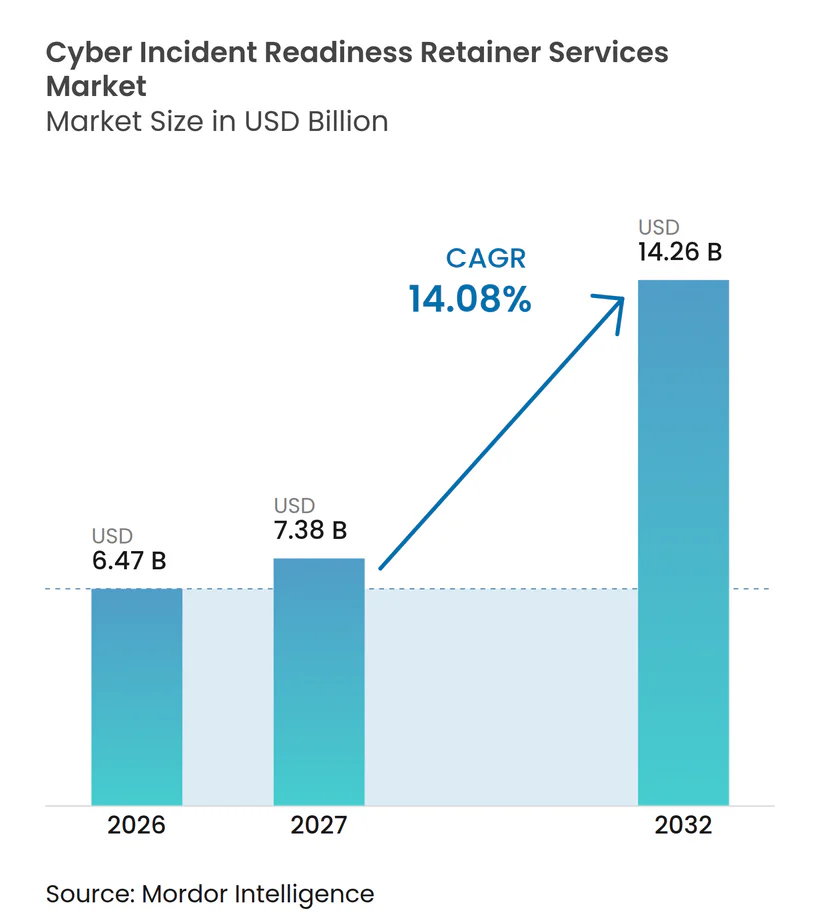
The Cyber incident readiness retainer services market size is projected to expand from USD 6.47 billion in 2026 and USD 7.38 billion in 2027 to USD 14.26 billion by 2032, registering a CAGR of 14.08% between 2027 to 2032. The Cyber incident readiness retainer services market is moving toward pre-contracted support as ransomware, data theft, and faster attack execution make ad hoc procurement less practical. Zscaler reported that ransomware-related data theft rose by more than 275% year over year in 2026, while ransomware-associated blockchain payments reached USD 328 million and the average ransom payment was USD 431,995. Providers are responding with contracts that combine technical response, readiness testing, legal coordination, and insurer-facing support. Platform providers use retainers to deepen use of their broader security products, while specialist firms compete on response speed, negotiation capability, and insurance-panel relationships. Flexible contracts that allow unused credits to fund readiness activities can improve renewal value, particularly for buyers that do not experience a major event during the contract term.
Key Report Takeaways
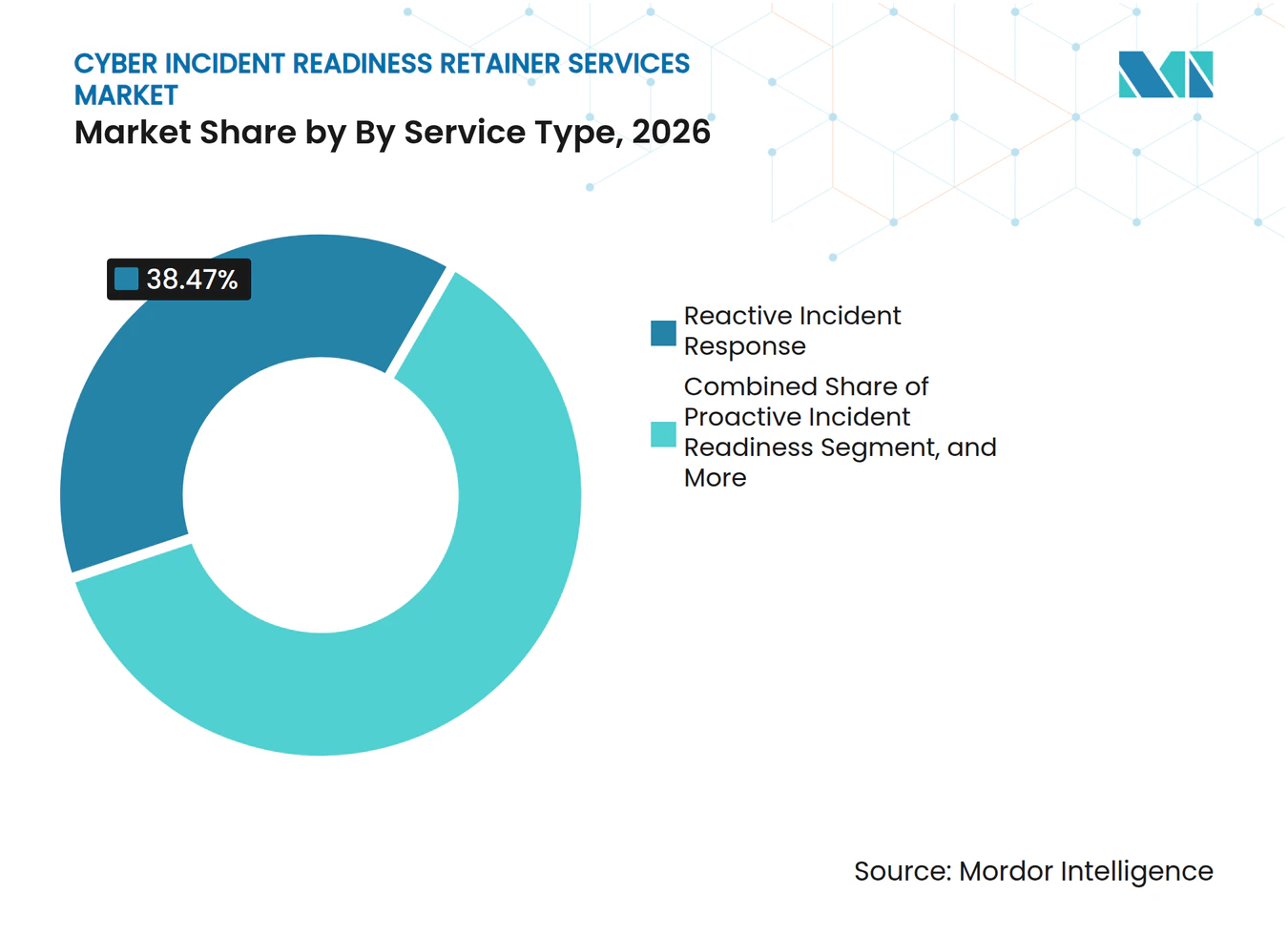
- By service type, Reactive Incident Response held 38.47% of the Cyber incident readiness retainer services market share in 2026, while Proactive Incident Readiness is projected to expand at a 14.43% CAGR through 2032.
- By contract model, Prepaid Hours Retainers accounted for 41.73% of the Cyber incident readiness retainer services market size in 2026, while Subscription-Based Resilience Retainers are expected to grow at a 14.87% CAGR through 2032.
- By deployment model, Cloud-Based delivery accounted for 54.38% of the segment in 2026, while Hybrid delivery is projected to expand at a 14.62% CAGR through 2032.
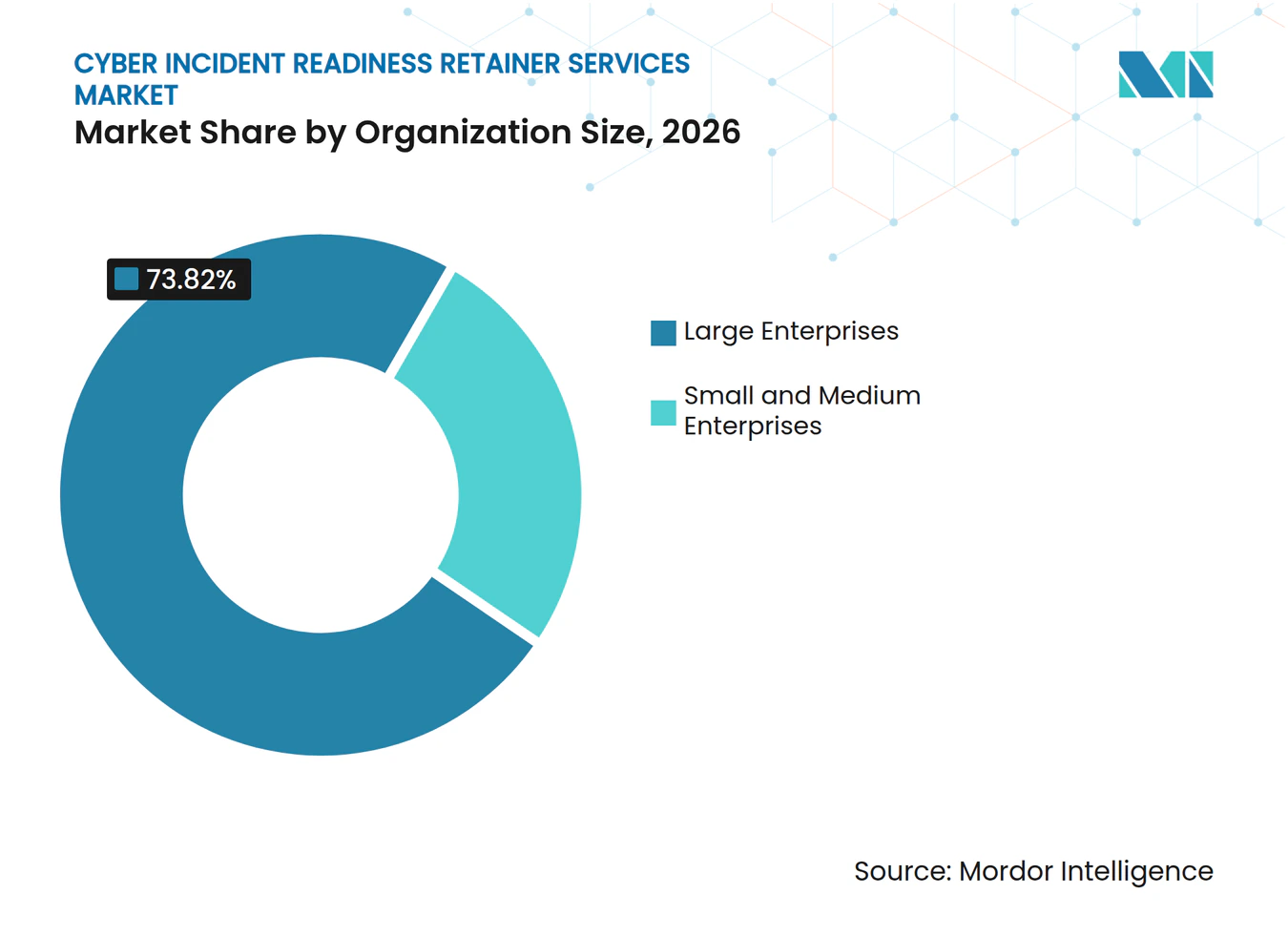
- By organization size, Large Enterprises held 73.82% of the segment in 2026, while SMEs are projected to expand at a 14.93% CAGR through 2032.
- By end-user industry, BFSI accounted for 25.67% of the segment in 2026, while Healthcare is expected to grow at a 14.78% CAGR through 2032.
- By geography, North America accounted for 41.23% of the segment in 2026, while Asia-Pacific is projected to grow at a 15.21% CAGR through 2032.
Note: Market numbers in this report are based on Mordor Intelligence's proprietary estimation framework, which combines nine months of actuals with Q4 projections for base year 2026.
Global Cyber Incident Readiness Retainer Services Market Trends and Insights
Drivers Impact Analysis*
| Driver | (~) % Impact on CAGR Forecast | Geographic Relevance | Impact Timeline |
|---|---|---|---|
| Escalating Ransomware and Data-Extortion Campaigns | +2.8% | Global, with concentrated impact in North America, Europe, and Asia-Pacific | Short term (≤ 2 years) |
| Regulatory Deadlines Increase Demand for Pre-Contracted Response | +2.3% | EU core, with spillover to the United Kingdom, Asia-Pacific, and the Middle East | Medium term (2-4 years) |
| Cyber Insurance Requirements Favor Insurer-Approved Retainers | +2.0% | North America and the EU, expanding into South America and Asia-Pacific | Short term (≤ 2 years) |
| Cloud, Identity, and Third-Party Attack Surfaces Increase Response Complexity | +1.7% | Global, with strongest relevance in cloud-mature markets | Medium term (2-4 years) |
| Shift From Hour Banks to Outcome-Based Readiness Programs | +1.4% | Global, led by North America and Western Europe | Medium term (2-4 years) |
| Embedded Retainer Portals Reduce Procurement and Mobilization Friction | +0.9% | North America and the EU, expanding to Asia-Pacific enterprise buyers | Long term (≥ 4 years) |
| Source: Mordor Intelligence | |||
Escalation of Ransomware and Data-Extortion Campaigns
The volume and speed of financially motivated attacks make reactive procurement increasingly difficult for the Cyber incident readiness retainer services market. Palo Alto Networks reviewed more than 750 major investigations and found that attackers could move from initial access to data exfiltration in 72 minutes during 2026.[1] This speed reduces the time available to identify a provider, negotiate terms, arrange access, and begin evidence collection. Organizations with a retainer can authorize responders and provide environmental information before an event occurs. As ransomware-as-a-service groups expand their operations, each serious investigation can require more specialist effort and coordination. The resulting pressure favors buyers who reserve response capacity before a regional or sector-wide incident surge.
Regulatory Deadlines Increase Demand for Pre-Contracted Response
Time-bound reporting rules make the Cyber incident readiness retainer services market more relevant to regulated organizations. The EU Cyber Resilience Act requires manufacturers of digital products to report actively exploited vulnerabilities through a single reporting platform within 24 hours from September 2026. DORA also requires financial entities to make an initial notification within 4 hours after classifying a major ICT incident. These timelines require legal, technical, and communications teams to work from the same fact base. A supplier serving the EU can face parallel duties under DORA, NIS2, and the Cyber Resilience Act in a single incident. Retainers help establish the specialist relationships, escalation paths, and reporting procedures that are difficult to assemble after an incident begins.
Cyber Insurance Requirements Favor Insurer-Approved Retainers
Insurance conditions are directing greater attention to pre-approved response providers in the Cyber incident readiness retainer services market. Policies may require the use of a carrier-approved forensic provider or prior approval before a non-panel provider is engaged. A provider with panel standing can start work promptly and use documentation formats that insurers already recognize. LevelBlue stated that its Resilience Retainer, launched in March 2026, was approved by more than 50 cyber insurance carriers and hundreds of law firms. This alignment can reduce friction in claims handling and lessen uncertainty over reimbursable forensic costs. It also raises the barrier for smaller firms that lack comparable insurer relationships.
Cloud, Identity, and Third-Party Attack Surfaces Increase Response Complexity
Cloud environments, identity systems, and third-party applications add complexity to investigations and drive demand for Cyber incident readiness retainer services. Palo Alto Networks found that identity weaknesses played a material role in nearly 90% of its 2026 investigations. The same report found that third-party SaaS applications were used in 23% of the incidents reviewed. Cloud evidence can be short-lived, while access to logs and control-plane data can depend on provider cooperation. CISA warned that sophisticated actors have exploited weaknesses in token authentication, key management, and logging within core cloud identity infrastructure. These conditions favor pre-agreed playbooks that cover endpoint, identity, cloud, and supplier systems.
Restraints Impact Analysis*
| Restraint | (~) % Impact on CAGR Forecast | Geographic Relevance | Impact Timeline |
|---|---|---|---|
| High Cost of Specialist Digital Forensics Talent | -1.6% | Global, with greatest pressure in North America, the United Kingdom, and Australia | Short term (≤ 2 years) |
| Unused Retainer Credits Weaken Perceived Return on Investment | -1.2% | Global, with higher sensitivity among cost-constrained SMEs | Medium term (2-4 years) |
| Fragmented Accountability Across Technical, Legal, and Communications Teams | -0.8% | Global, strongest in multijurisdictional enterprises | Medium term (2-4 years) |
| Data-Access and Privilege Constraints Slow Cross-Border Investigations | -0.5% | EU, Asia-Pacific data-sovereignty jurisdictions, and the Middle East | Long term (≥ 4 years) |
| Source: Mordor Intelligence | |||
High Cost of Specialist Digital Forensics Talent
A limited supply of digital forensics professionals can constrain the Cyber incident readiness retainer services market. Senior responders require technical expertise, legal awareness, evidence-handling discipline, and the ability to work under sustained pressure. This combination is difficult to recruit and retain across multiple regions. Providers must incorporate the costs of recruiting, training, tooling, certification, and on-call coverage into their contract pricing. Buyers then compare a retainer against building an internal capability that can also be difficult to staff. The constraint is particularly material for SMEs because managed support may be more practical than permanent hiring, but the annual commitment can still delay adoption.
Unused Retainer Credits Weaken Perceived Return on Investment
Prepaid-hour arrangements can weaken renewal value when clients do not use their purchased credits. A buyer may complete a contract year without a major incident and view unspent hours as a sunk expense. Arctic Wolf notes that readiness services can help organizations use retainers before an incident and improve preparedness. The opposite problem occurs when readiness work consumes a large portion of the hours available before a major event. Buyers may then need to pay surge rates when they most need specialist support. Fund-based contracts with rollover and broader conversion options seek to reduce this concern, although buyer education remains necessary.
*Our forecasts treat driver/restraint impacts as directional, not additive. The impact forecasts reflect baseline growth, mix effects, and variable interactions.
Segment Analysis
By Service Type: Reactive Response Anchors Revenue, While Proactive Readiness Expands
Reactive Incident Response held 38.47% of the service type segment in 2026, making it the largest established service format in the Cyber incident readiness retainer services market. In the Cyber incident readiness retainer services market, these contracts provide a defined route for obtaining specialist support following a declared event. Many buyers continue to prefer the familiar emergency-response structure because it is straightforward to explain to procurement teams. Providers also have mature methods for pricing surge access, triage, containment, and forensic investigation under these arrangements. Reactive contracts remain important for organizations with limited prior experience in formal incident-response planning. The format can provide clients with a direct point of contact when senior management needs immediate technical guidance. It also supports organizations seeking external expertise without building a full in-house forensic team.
Proactive Incident Readiness is projected to grow at a 14.43% CAGR through 2032 within the Cyber Incident Readiness Retainer Services market. Regulatory expectations for evidence encourage organizations to test plans, clarify responsibilities, and document decision paths before a crisis. Preparedness work can include tabletop exercises, threat hunting, compromise assessments, and improvements to response procedures. Booz Allen launched its Vellox product suite at RSAC 2026, including products designed to identify gaps and support threat containment before human escalation.[2] Buyers increasingly treat technical containment as one part of a broader response requirement that also includes legal, regulatory, and communications coordination. Crisis Management and Strategic Communications, Legal, Regulatory, and Insurance Coordination, and Post-Incident Improvement and Expert-Witness Support therefore remain relevant supporting services. The service mix is expected to shift toward contracts that combine response access with ongoing readiness support.



By Contract Model: Prepaid Hours Remain Established, While Subscription Retainers Change Renewal Terms
Prepaid Hours Retainers accounted for 41.73% of the contract model segment in 2026. The model remains common among enterprise buyers who have used service-hour arrangements for several contract cycles. It gives procurement teams a known unit of capacity and allows providers to plan staffing against contracted demand. Organizations may also prefer this structure when they want clearly stated response rates before an incident occurs. The arrangement can work well when clients use credits for readiness activities and active-event support. However, a strict use-it-or-lose-it model can create concern when credits expire without a major event. In the Cyber incident readiness retainer services market, this renewal friction has encouraged providers to redesign how clients can use prepaid capacity.
Subscription-Based Resilience Retainers are projected to expand at a 14.87% CAGR through 2032. These arrangements seek to move the discussion from fixed blocks of hours to flexible access, ongoing readiness, and defined outcomes. CrowdStrike introduced Flex for Services in March 2026 with 160 hours of incident response and 40 hours of proactive services under its Falcon Flex model. The offer also included a Zero Dollar Flex Fund for qualifying new customers with access to services at no upfront cost. Arctic Wolf introduced Incident360 in May 2025 as a full-incident coverage model rather than a discrete hour-bank arrangement. Prepaid Funds Retainers, Fixed-Fee Readiness, and Single-Incident Coverage provide alternatives for buyers with different risk tolerances and procurement requirements. Providers that offer rollover or credit conversion can better address the renewal concerns associated with expiring hours.
By Deployment Model: Cloud-Based Delivery Leads, While Hybrid Models Address Complex Environments
Cloud-based delivery accounted for 54.38% of the deployment model segment in 2026. This lead reflects the use of cloud-native tools that can ingest telemetry, deploy sensors, and begin triage without an on-site team. The model helps responders begin collecting evidence quickly after authorized access is granted. It also supports coordination across endpoint, identity, and cloud environments from a single operating model. CrowdStrike and IBM expanded their collaboration in March 2026 to integrate Charlotte AI with IBM's Autonomous Threat Operations Machine. Their work illustrates how providers are configuring cloud-based response systems for faster detection, analysis, and containment. The Cyber incident readiness retainer services market is especially relevant to organizations that operate distributed workforces and cloud-native applications.
Hybrid delivery is projected to expand at a 14.62% CAGR through 2032. Regulated organizations often retain sensitive data in on-premises environments while also operating cloud applications that need different investigative methods. Financial services and healthcare organizations can therefore require evidence-handling procedures across legacy and cloud systems. On-Premises delivery continues to serve air-gapped settings, operational technology, and industrial control environments where physical forensic access remains necessary. Providers with hybrid capability can support mixed-environment incidents without forcing clients to maintain separate retainer relationships. Palo Alto Networks Unit 42 and Kroll are among firms positioned to address these mixed requirements through broad response capabilities. Hybrid delivery also helps buyers manage data-access and jurisdictional constraints that can limit a purely cloud-based investigation.
By Organization Size: Large Enterprises Anchor Revenue, While SMEs Expand Faster
Large Enterprises held 73.82% of the organization size segment in 2026. Their position reflects larger security budgets, multiyear commitments, and the ability to support cross-functional planning programs. Large organizations can structure attorney-client privilege, conduct exercises, and coordinate technical, legal, communications, and insurance stakeholders. They also tend to have more complex infrastructures, globally distributed operations, and more stringent internal reporting requirements. This makes externally retained specialist support valuable even for organizations with internal security teams. Enterprise buyers often seek multi-incident coverage, global reach, and integration with existing security platforms. Their contract requirements create a stable base of demand for leading providers in the Cyber incident readiness retainer services market.
SMEs are projected to grow at a 14.93% CAGR through 2032. Insurance renewal conditions, supply chain expectations, and modular service options are broadening interest beyond the largest organizations. Smaller buyers need predictable pricing, simple onboarding, and remote-first delivery models that do not require extensive internal security staff. Standardized readiness assessments and AI-assisted triage can help providers serve this group with lower human-hour intensity. The value proposition is strongest where a permanent forensic team is not practical for the organization. However, annual retainer costs remain a meaningful initial commitment for cost-sensitive buyers. Providers that offer practical entry packages, self-service portals, and clear credit-conversion terms can reduce this barrier. The Cyber incident readiness retainer services market opportunity among SMEs depends on making retained support useful between major incidents rather than only during a crisis.

By End-User Industry: BFSI Leads Spending, While Healthcare Expands Fastest
BFSI accounted for 25.67% of the end-user industry segment in 2026. The sector combines high regulatory pressure, substantial security budgets, and established practices for retaining outside response support. DORA requires in-scope EU financial entities to manage ICT third-party arrangements with costs determined in advance under Article 30. Financial institutions also handle sensitive customer data and face significant consequences from service disruption or delayed reporting. These conditions make pre-contracted technical, legal, communications, and insurance coordination support relevant to their operating requirements. The Cyber incident readiness retainer services industry is therefore supported by mature demand among banks, insurers, payments firms, and related financial institutions. Buyers in this group often require multijurisdictional support, insurer coordination, and detailed evidence handling.
Healthcare is projected to expand at a 14.78% CAGR through 2032. The American Hospital Association stated that healthcare experienced 460 ransomware attacks in 2025, the highest count among critical infrastructure sectors. The HIPAA Breach Notification Rule establishes a 60-day reporting period, increasing the need to complete forensic scoping promptly. Information Technology and Telecommunications, Manufacturing, Government and Defense, Retail and E-Commerce, Energy and Utilities, Education, Transportation and Logistics, Hospitality and Travel, and other end users face distinct threat and reporting needs.
Geography Analysis
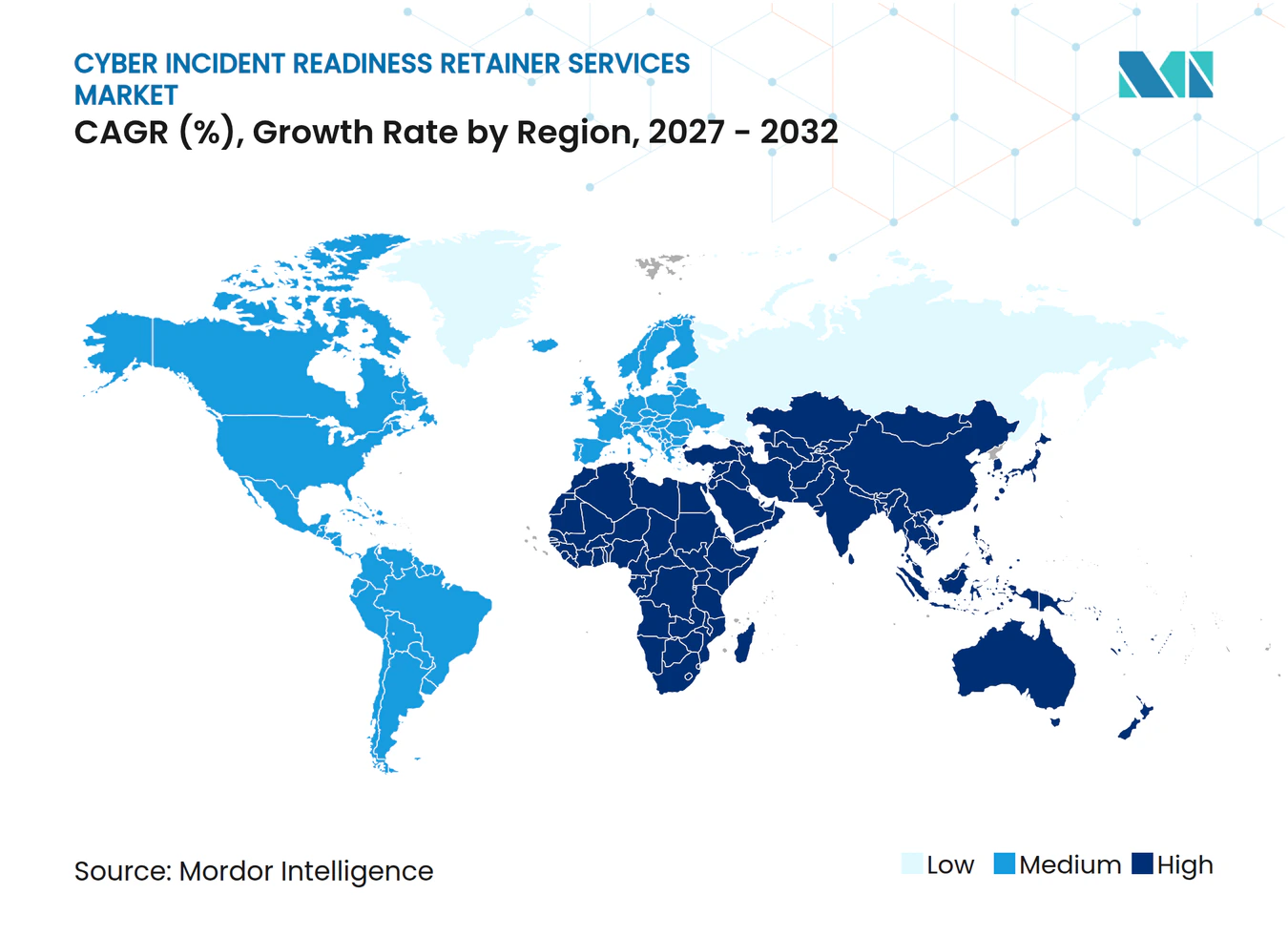
North America accounted for 41.23% of the Cyber incident readiness retainer services market share in 2026. The region has high rates of retainer use among large enterprises and a high concentration of insurer-approved response firms. SEC disclosure rules, state breach notification laws, and Federal Trade Commission enforcement support recurring demand for contracted response capability. The United States remains the main regional buyer base. Canada and Mexico add demand as national cybersecurity frameworks extend reporting expectations across regulated organizations.
Europe is the second-largest geographic block in the Cyber incident readiness retainer services market. DORA, NIS2, and the Cyber Resilience Act create overlapping reporting and coordination requirements for financial services, essential entities, and digital product manufacturers. Germany, the United Kingdom, and France anchor European demand through their financial services, industrial, and technology sectors. A software supplier serving the EU can face several notification clocks during the same incident. This creates demand for pre-contracted technical, legal, and communications support. Asia-Pacific is projected to grow at a 15.21% CAGR through 2032. The region combines lower formal retainer penetration with a growing threat environment and expanding data-sovereignty requirements. NTT DATA and Booz Allen Hamilton signed a June 2025 memorandum of understanding to strengthen cybersecurity capabilities in Singapore and the Indo-Pacific region. Their work focused on threat intelligence, zero trust architecture, automated protection, and AI-driven malware engineering.
South America, the Middle East, and Africa are at earlier stages of retainer adoption. Brazil and Argentina anchor South American demand, while Brazil's LGPD creates breach notification obligations that encourage larger enterprises to prepare response capability. Saudi Arabia and the United Arab Emirates are important Middle East markets because critical infrastructure protection programs support demand. Africa remains the smallest and least penetrated region. South Africa and Nigeria are the most active African markets, with demand concentrated among financial services organizations and multinational companies. Providers in the Cyber incident readiness retainer services market that can support evidence handling across multiple jurisdictions can serve buyers that need regional coverage.
Competitive Landscape
Market Concentration
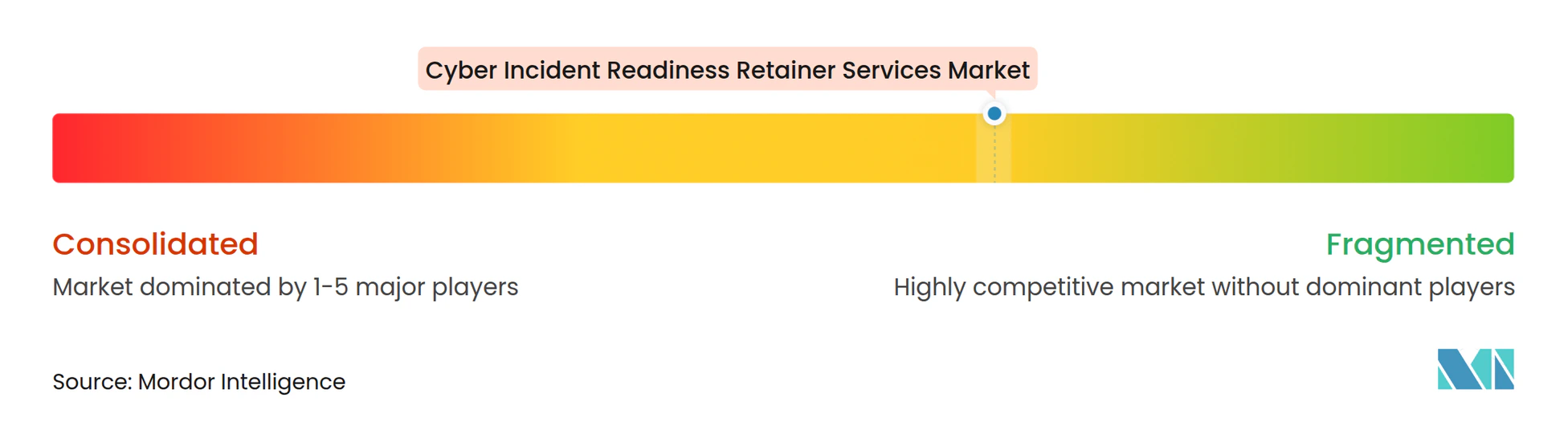
The Cyber incident readiness retainer services market is moderately fragmented across platform-integrated providers, specialist response firms, and consulting-led companies. CrowdStrike, Palo Alto Networks Unit 42, and IBM have enterprise visibility through their technology platforms and relationships with insurers. Their retainer offerings can support broader platform adoption, giving them an advantage with established customer accounts. Kroll, Arete Incident Response, and Coveware compete through ransomware negotiation, forensic expertise, and response speed. Consulting-led firms such as Deloitte, PwC, and Accenture combine technical work with legal, regulatory, and communications coordination. No provider has a dominant position across all customer tiers and service models.
Sophos completed its acquisition of Secureworks for USD 859 million in February 2025.[3] The company then launched Sophos Emergency Incident Response in June 2025 as a combined Sophos and Secureworks service covering forensics, threat hunting, ransom negotiation, and post-incident reporting. NTT DATA launched a SOC and CSIRT service in January 2026 that integrates CrowdStrike Falcon Next-Generation SIEM into its UnifiedMDR offering. The service supports endpoint, cloud, and network monitoring with real-time detection and automated response. CrowdStrike expanded its work with IBM in March 2026 to connect Charlotte AI with IBM's Autonomous Threat Operations Machine. These moves show how leading providers are extending retainers through platform integration and automation.
Opportunities remain in lower-cost packages for regulated SMEs, operational technology and industrial control system forensics, and multilingual services that meet regional evidence-handling requirements. Generalist cloud-native firms may not have the physical-presence capability or sector knowledge required in industrial environments. Regional specialists can therefore retain relevance where language, access rules, or local legal practices matter. Insurer-approved status is also commercially valuable because clients may need panel providers for covered forensic work. Arctic Wolf stated that its Incident360 Retainer had preferred status with more than 30 global insurance panels in May 2025. AI-assisted triage is becoming an important way to reduce the analytical labor required for each engagement.
Cyber Incident Readiness Retainer Services Industry Leaders
-
Accenture plc
-
Arctic Wolf Networks, Inc.
-
Arete Incident Response, Inc.
-
Booz Allen Hamilton Holding Corporation
-
CrowdStrike Holdings, Inc.
- *Disclaimer: Major Players sorted in no particular order
Recent Industry Developments
- October 2026: Arctic Wolf announced SwarmView, a new capability providing customers with direct visibility into how AI agents and human experts collaborate during investigations within its Aurora Agentic SOC. The launch reinforced Arctic Wolf's positioning around transparent, AI-driven incident response and directly addressed enterprise buyers' governance concerns about opaque automated triage.
- August 2026: CISA, the FBI, the NSA, the U.S. Secret Service, and the Republic of Korea's National Police Agency issued a joint advisory warning of Gunra ransomware actors targeting healthcare, financial services, government, and professional services organizations using a double-extortion model with a 5-7-day payment deadline. The advisory increased attention to the need for pre-contracted response capability.
- July 2026: Beazley Security and Halcyon launched the Cyber Resilience Retainer, combining Beazley Security's incident management and digital forensics capabilities with Halcyon's anti-ransomware platform and Ransomware Operations Center into a single pre-contracted engagement. The product integrated prevention, investigation, containment, and recovery under 1 agreement to eliminate procurement delays during an active event.
- April 2026: Booz Allen Hamilton completed its acquisition of Defy Security, combining Defy's commercial customer base across financial services, healthcare, manufacturing, and retail with Booz Allen's AI-native Vellox cyber product suite and federal incident-response expertise. The acquisition expanded Booz Allen's addressable market across commercial and federal segments.
Global Cyber Incident Readiness Retainer Services Market Report Scope
The cyber incident readiness retainer services market covers contractual services that organizations procure in advance to prepare for, respond to, and recover from cybersecurity incidents. These services typically provide clients with prioritized access to cybersecurity experts, incident response teams, forensic capabilities, threat intelligence, breach containment, recovery support, and advisory services during a cyber incident.
The Cyber Incident Readiness Retainer Services Market Report is Segmented by Service Type (Reactive Incident Response, Proactive Incident Readiness, Crisis Management and Strategic Communications, Legal, Regulatory, and Insurance Coordination, and Post-Incident Improvement and Expert-Witness Support), Contract Model (Prepaid Hours Retainer, Prepaid Funds Retainer, Fixed-Fee Readiness and Single-Incident Coverage, and Subscription-Based Resilience Retainer), Deployment Model (On-Premises, Cloud-Based, and Hybrid), Organization Size (Small and Medium Enterprises and Large Enterprises), End-User Industry (Information Technology and Telecommunications, BFSI, Healthcare, Retail and E-Commerce, Manufacturing, Government and Defense, and Other End-User Industries), and Geography (North America, South America, Europe, Asia-Pacific, Middle East, and Africa). The Market Forecasts are Provided in Terms of Value (USD).
| Reactive Incident Response |
| Proactive Incident Readiness |
| Crisis Management and Strategic Communications |
| Legal, Regulatory, and Insurance Coordination |
| Post-Incident Improvement and Expert-Witness Support |
| Prepaid Hours Retainer |
| Prepaid Funds Retainer |
| Fixed-Fee Readiness and Single-Incident Coverage |
| Subscription-Based Resilience Retainer |
| On-Premises |
| Cloud-Based |
| Hybrid |
| Small and Medium Enterprises |
| Large Enterprises |
| Information Technology and Telecommunications |
| BFSI |
| Healthcare |
| Retail and E-Commerce |
| Manufacturing |
| Government and Defense |
| Other End-User Industries |
| North America | United States |
| Canada | |
| Mexico | |
| South America | Brazil |
| Argentina | |
| Rest of South America | |
| Europe | Germany |
| United Kingdom | |
| France | |
| Italy | |
| Spain | |
| Russia | |
| Rest of Europe | |
| Asia-Pacific | China |
| India | |
| Japan | |
| South Korea | |
| Australia | |
| Rest of Asia-Pacific | |
| Middle East | Saudi Arabia |
| United Arab Emirates | |
| Turkey | |
| Rest of Middle East | |
| Africa | South Africa |
| Egypt | |
| Nigeria | |
| Rest of Africa |
| By Service Type | Reactive Incident Response | |
| Proactive Incident Readiness | ||
| Crisis Management and Strategic Communications | ||
| Legal, Regulatory, and Insurance Coordination | ||
| Post-Incident Improvement and Expert-Witness Support | ||
| By Contract Model | Prepaid Hours Retainer | |
| Prepaid Funds Retainer | ||
| Fixed-Fee Readiness and Single-Incident Coverage | ||
| Subscription-Based Resilience Retainer | ||
| By Deployment Model | On-Premises | |
| Cloud-Based | ||
| Hybrid | ||
| By Organization Size | Small and Medium Enterprises | |
| Large Enterprises | ||
| By End-User Industry | Information Technology and Telecommunications | |
| BFSI | ||
| Healthcare | ||
| Retail and E-Commerce | ||
| Manufacturing | ||
| Government and Defense | ||
| Other End-User Industries | ||
| By Geography | North America | United States |
| Canada | ||
| Mexico | ||
| South America | Brazil | |
| Argentina | ||
| Rest of South America | ||
| Europe | Germany | |
| United Kingdom | ||
| France | ||
| Italy | ||
| Spain | ||
| Russia | ||
| Rest of Europe | ||
| Asia-Pacific | China | |
| India | ||
| Japan | ||
| South Korea | ||
| Australia | ||
| Rest of Asia-Pacific | ||
| Middle East | Saudi Arabia | |
| United Arab Emirates | ||
| Turkey | ||
| Rest of Middle East | ||
| Africa | South Africa | |
| Egypt | ||
| Nigeria | ||
| Rest of Africa | ||
Key Questions Answered in the Report
What is the size of the cyber incident readiness retainer services market?
The Cyber incident readiness retainer services market is projected to grow from USD 6.47 billion in 2026 and USD 7.38 billion in 2027 to USD 14.26 billion by 2032, at a 14.08% CAGR.
What is driving demand for cyber incident readiness retainers?
Faster ransomware attacks, regulatory reporting deadlines, insurance-panel requirements, and complex cloud and identity environments are supporting demand.
Which service type has the largest share?
Reactive Incident Response held 38.47% of the service type segment in 2026, while Proactive Incident Readiness is projected to grow fastest at a 14.43% CAGR.
Which contract model is expected to grow fastest?
Subscription-Based Resilience Retainers are projected to expand at a 14.87% CAGR through 2032 as buyers seek flexible terms and better use of unused capacity.
Which organizations are adopting retainers fastest?
SMEs are projected to grow at a 14.93% CAGR through 2032 as insurance, supply-chain, and regulatory requirements broaden adoption.
Which region is growing fastest?
Asia-Pacific is projected to expand at a 15.21% CAGR through 2032, supported by a growing threat environment and lower formal retainer penetration.