
Digital Forensics Retainer Services Market Size and Share
Market Overview
| Study Period | 2021 - 2032 |
|---|---|
| Market Size (2027) | USD 3.32 Billion |
| Market Size (2032) | USD 5.83 Billion |
| Growth Rate (2027 - 2032) | 11.92 % |
| Fastest Growing Market | Asia-Pacific |
| Largest Market | North America |
| Market Concentration | Medium |
Major Players *Disclaimer: Major Players sorted in no particular order Image © Mordor Intelligence. Reuse requires attribution under CC BY 4.0. | |
Digital Forensics Retainer Services Market Analysis by Mordor Intelligence
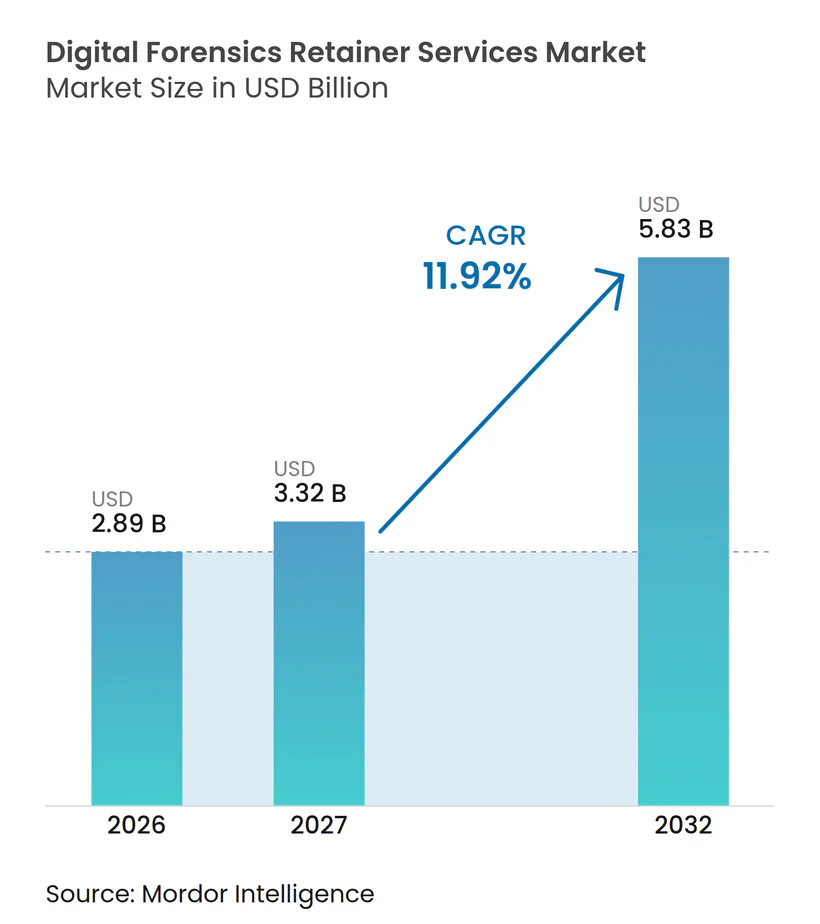
The digital forensics retainer services market size is projected to expand from USD 2.89 billion in 2026 and USD 3.32 billion in 2027 to USD 5.83 billion by 2032, registering a CAGR of 11.92% between 2027 to 2032. The Digital forensics retainer services market is moving toward pre-contracted response arrangements because cyber incidents now require rapid containment, evidence preservation, and documented decision-making. Breach notification rules and cyber-insurance conditions are also making prearranged response capacity more important for regulated organizations. A signed retainer can reduce onboarding delays during an active incident and can support a faster handoff between legal, security, and business teams. Providers are responding with flexible credit structures, cloud evidence capabilities, and services that extend from incident response into readiness work. Competition is centered on response speed, specialized investigation skills, insurance compatibility, and the ability to handle endpoint, network, cloud, and operational technology evidence within one engagement.
Key Report Takeaways
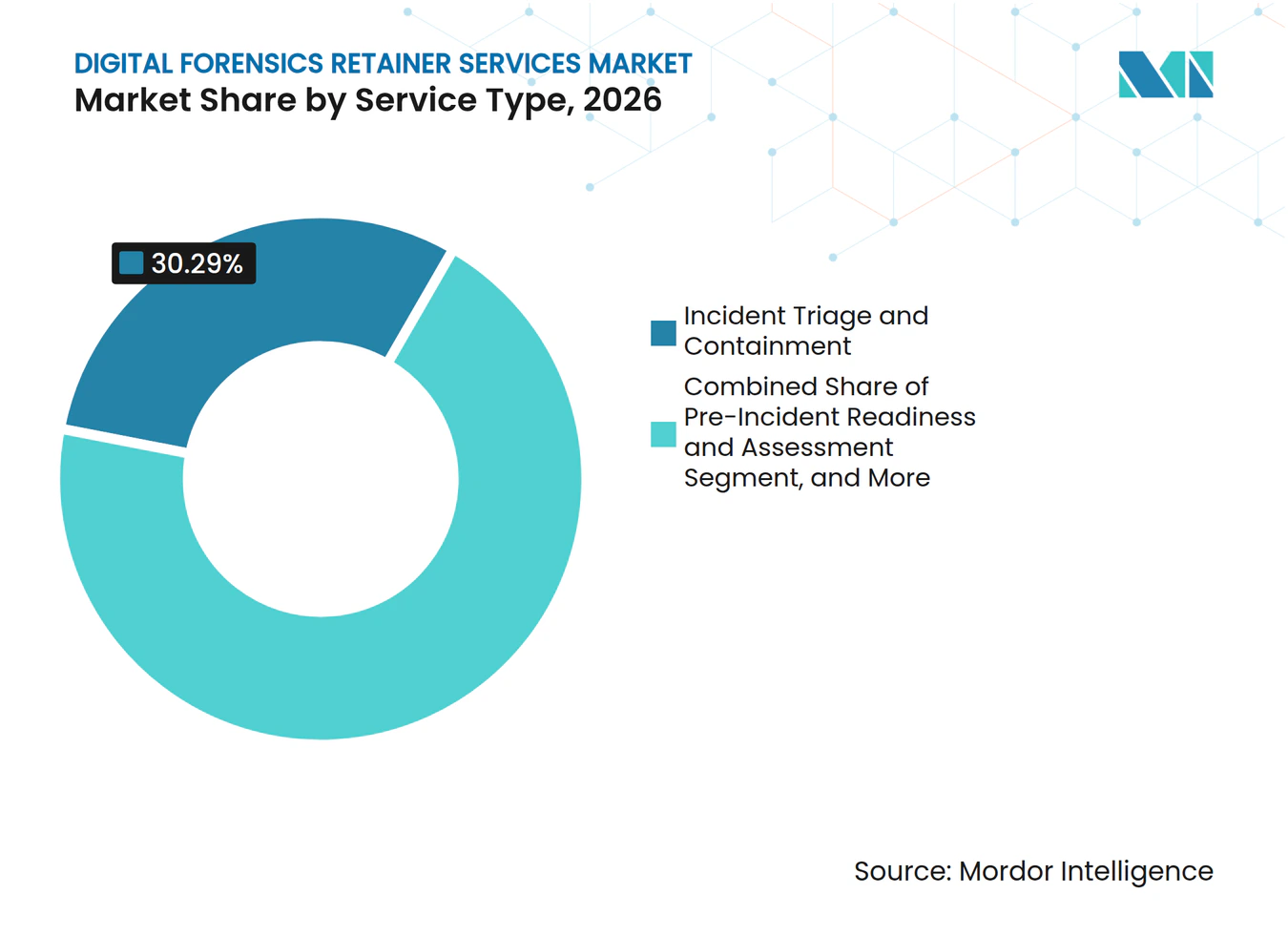
- By service type, incident triage and containment held 30.29% of the digital forensics retainer services market revenue share in 2026, while recovery, remediation, and lessons-learned services are projected to expand at a 14.13% CAGR through 2032.
- By engagement model, credit-based multi-service retainers held 36.43% revenue share in 2026, and are projected to register a faster-growth rate of 13.97% CAGR through 2032.
- By deployment mode, hybrid deployment held 49.78% of the digital forensics retainer services market revenue share in 2026, while cloud-based deployment is projected to expand at a 14.57% CAGR through 2032.
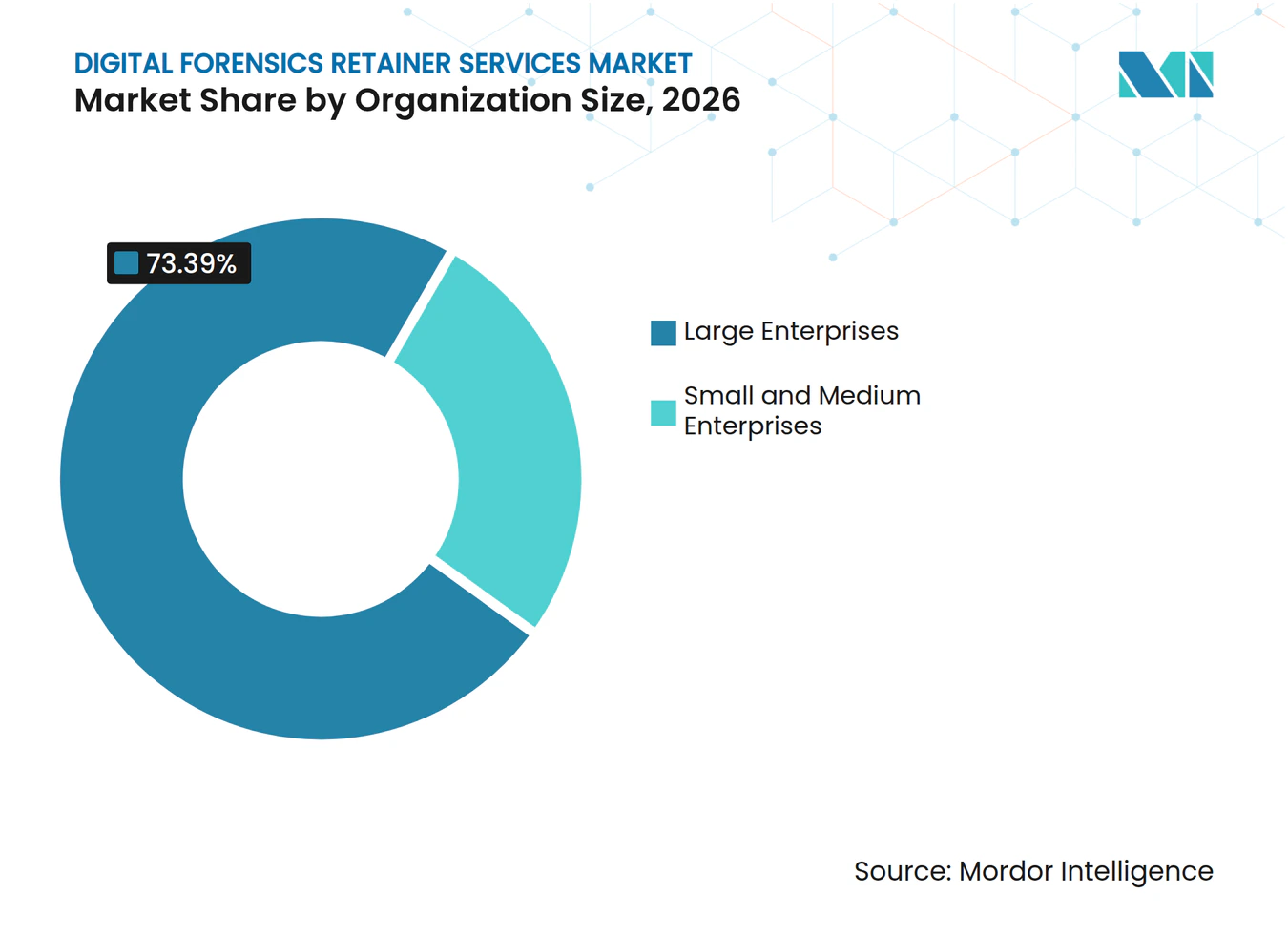
- By organization size, large enterprises held 73.39% revenue share in 2026, while small and medium enterprises are projected to expand at a 14.83% CAGR through 2032.
- By end-user industry, BFSI held 25.57% of the digital forensics retainer services market revenue share in 2026, while healthcare and life sciences are projected to expand at a 13.89% CAGR through 2032.
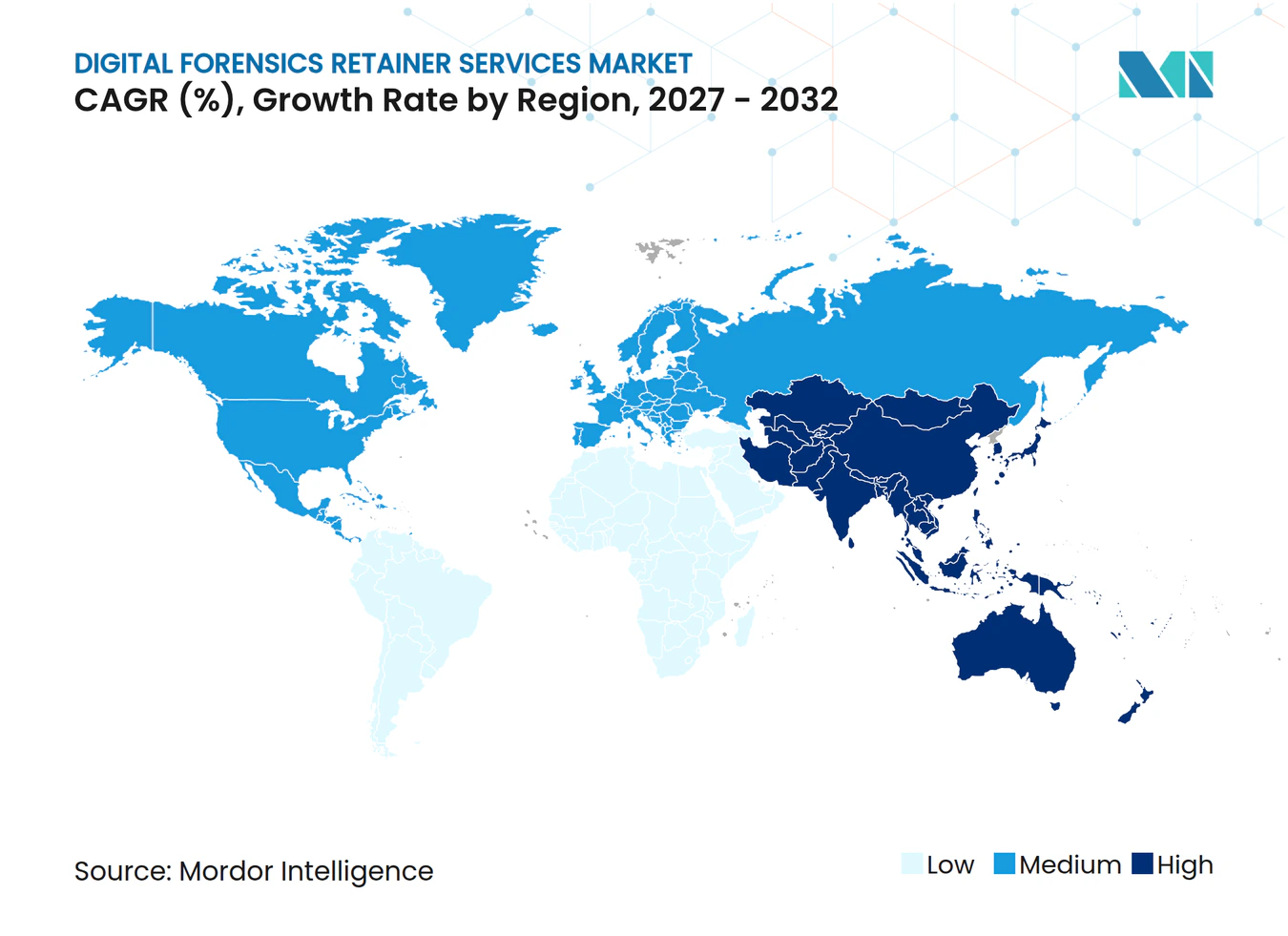
- By geography, North America held 41.34% revenue share in 2026, while Asia-Pacific is the fastest-growing geography, projected to expand at a 13.97% CAGR through 2032
Note: Market numbers in this report are based on Mordor Intelligence's proprietary estimation framework, which combines nine months of actuals with Q4 projections for base year 2026.
Market Trends and Insights
Drivers Impact Analysis of Digital Forensics Retainer Services Market*
| Driver | (~) % Impact on CAGR Forecast | Geographic Relevance | Impact Timeline |
|---|---|---|---|
| Increasing Frequency and Sophistication of Cyberattacks | +2.8% | Global | Short term (≤ 2 years) |
| Expanding Data-Protection and Breach-Reporting Requirements | +2.3% | Global, with concentration in North America and Europe | Medium term (2-4 years) |
| Cyber-Insurance Requirements for Prearranged Response Capacity | +1.9% | North America and Europe, spillover to Asia-Pacific | Short term (≤ 2 years) |
| Board-Level Cyber-Resilience Accountability | +1.5% | Global | Medium term (2-4 years) |
| OT and IoT Evidence Expansion in Connected Operations | +0.9% | North America, Asia-Pacific core, spillover to Europe | Medium term (2-4 years) |
| Evidence-Ready Telemetry From Cloud-Native and XDR Architectures | +0.8% | Global | Medium term (2-4 years) |
| Source: Mordor Intelligence | |||
Increasing Frequency and Sophistication of Cyberattacks
The Digital forensics retainer services market benefits when organizations need investigators before a threat actor removes or alters evidence. Unit 42 reported that attackers reached data exfiltration within 1 hour in nearly 1 in 5 engagements. The same incident evidence showed that 70% of cases involved 3 or more attack surfaces. This makes coordinated work across endpoint, network, and cloud records central to the value of a retainer in the Digital forensics retainer services market. Ransomware affiliate models also expose mid-sized organizations to attackers with capabilities once concentrated against larger enterprises. A pre-onboarded team can begin containment without first completing conflict reviews, commercial negotiations, or access setup.
Expanding Data-Protection and Breach-Reporting Requirements
The Digital forensics retainer services market is supported by rules that shorten the time available for evidence collection and reporting. NIS2 requires an early warning within 24 hours of incident awareness and a notification within 72 hours for covered entities. DORA establishes related reporting requirements for financial entities and links response processes to operational resilience obligations. The U.S. Securities and Exchange Commission requires a Form 8-K filing within 4 business days after a materiality determination.[1] Organizations that start procurement during a live breach can lose critical time to privilege planning, conflict checks, and data-access approvals. Retainer agreements create an operating path that can support compliance with multiple reporting obligations across the Digital forensics retainer services market.
Cyber-Insurance Requirements for Prearranged Response Capacity
The Digital forensics retainer services market is gaining support from insurance underwriting that considers incident readiness before issuing coverage. Arctic Wolf reported that 32% of carriers required an incident response plan or retainer for coverage. Its analysis also found that nearly half of organizations with a comprehensive retainer achieved premium savings of 10% or more. Carrier panels can direct insured organizations toward approved forensic firms and negotiated response terms. Retainer structures, therefore, increasingly include response-time commitments, completed onboarding, and documentation suited to claims handling. Beazley Security and Halcyon introduced a combined resilience retainer in July 2026 that joined incident management, response, and ransomware resilience.
Board-Level Cyber-Resilience Accountability
The Digital forensics retainer services market is also shaped by stronger board responsibility for cyber-resilience outcomes. The World Economic Forum found that more than half of chief executives outside Europe and North America lacked the skills needed to meet cybersecurity goals.[2] This creates demand for documented response capacity that boards can review as part of risk oversight. A retainer can give audit committees a defined escalation process and access to specialist investigators during a material event in the Digital forensics retainer services market. Providers increasingly include executive briefings, reporting templates, and readiness exercises in their service design. The commercial discussion is therefore extending beyond security operations into governance, disclosure preparation, and business continuity.
Restraints Impact Analysis of Digital Forensics Retainer Services Market*
| Restraint | (~) % Impact on CAGR Forecast | Geographic Relevance | Impact Timeline |
|---|---|---|---|
| Shortage of Qualified DFIR Professionals | -1.5% | Global | Long term (≥ 4 years) |
| High Cost of Specialized Tools and Retainer Capacity | -1.0% | Small and medium enterprise markets globally, concentration in Asia-Pacific and South America | Medium term (2-4 years) |
| Encryption and Zero-Trust Boundaries Restricting Evidence Collection | -0.7% | North America and Europe core, spillover to Asia-Pacific | Medium term (2-4 years) |
| Cross-Border Evidence Access and Jurisdictional Conflicts | -0.5% | Asia-Pacific, Europe, and cross-border global cases | Long term (≥ 4 years) |
| Source: Mordor Intelligence | |||
Shortage of Qualified DFIR Professionals
The Digital forensics retainer services market faces a long-running capacity constraint because qualified practitioners remain scarce. Fortinet reported that 71% of organizations viewed the skills shortage as a material risk in 2026. The report also found that 56% of organizations struggled to recruit qualified cybersecurity candidates. The UK government identified digital forensics among the acute technical gaps, with 57% of businesses reporting a basic technical skills gap in 2026.[3] Providers must manage higher compensation costs, longer hiring cycles, and limits on concurrent incident assignments. Automation can reduce analyst time per investigation, but its deployment also requires specialized engineering skills.
High Cost of Specialized Tools and Retainer Capacity
Cost remains a material obstacle for smaller organizations considering the Digital forensics retainer services market, particularly where security budgets must cover prevention, detection, response, and compliance demands together. Specialized tools, trained responders, and guaranteed availability require providers to carry costly capabilities before an incident occurs. Smaller buyers can face lengthy internal approval processes when they must reserve funding for a service they may not use immediately. This can delay a purchasing decision until after a breach, when the organization has less choice and less negotiating power. Zero-dollar retainers, credit-based structures, and insurance-linked products seek to lower the initial commitment. Productivity improvements from automation may widen access over time, but scarce investigative expertise still limits how far prices can fall across the Digital forensics retainer services market.
*Our forecasts treat driver/restraint impacts as directional, not additive. The impact forecasts reflect baseline growth, mix effects, and variable interactions.
Digital Forensics Retainer Services Market Segment Analysis
By Service Type:
Triage Leads Revenue While Recovery Services AdvanceIncident triage and containment held 30.29% of the Digital forensics retainer services market share in 2026. Buyers use the service to secure rapid access to investigators who can scope and contain an active breach, preserve volatile records, and establish a reliable technical account of what occurred. Triage is normally the first service used after an incident begins, regardless of the technology environment, the suspected threat actor, or the eventual scale of the response. This position makes it central to retainer design across organizations with different levels of security maturity and explains why buyers often prioritize response availability before more specialized forensic work. It also connects the initial technical response with decisions on legal notification, evidence protection, and executive communication.
Recovery, remediation, and lessons-learned services are projected to expand at a 14.13% CAGR through 2032. These services extend engagement work beyond containment and into root-cause analysis, reporting, control improvement, and the structured review of actions that can reduce exposure during a later incident. NIS2 and DORA increase the importance of structured investigation records and final reporting for affected organizations. A 2026 IEEE framework for industrial internet of things forensics described 12 steps for investigation, which reflects the growing formality of evidence procedures in connected environments. Pre-incident readiness, legal support, and expert testimony remain relevant where a breach may lead to regulatory review or litigation, especially for organizations that must demonstrate the integrity of their investigative process.



By Engagement Model:
Credit-Based Retainers Change Purchasing DecisionsCredit-based multi-service retainers held 36.43% of the Digital forensics retainer services market revenue share in 2026 and are projected to register 13.97% CAGR through 2032. Buyers favor credit pools because they can use them across incident response, assessments, threat hunting, and tabletop exercises, rather than reserving value only for the uncertain timing of a severe cyber event. This reduces the risk that prepaid hours will expire without producing value and gives security leaders a practical way to connect retainer spending with regular preparedness activity. It also allows security leaders to use a retainer for preparedness activities before a major incident occurs. The structure can make annual spending easier to defend when finance teams need clear evidence of service utilization, including work that was completed before an incident created operational or regulatory pressure.
LevelBlue launched its Resilience Retainer in March 2026 with full credit rollover and access to more than 300 global responders. The offering set a response service level agreement as low as 1 hour and allowed credits to support proactive resilience work. Dedicated-capacity arrangements remain important for large financial institutions and government buyers that require assured investigator availability during major events that can exhaust shared provider capacity. Prepaid-funds and response-hours structures still serve procurement environments with rigid contract rules, defined vendor panels, and internal budget controls that limit flexibility. However, providers with inflexible arrangements may face greater renewal pressure as buyers seek rollover terms and insurance compatibility.
By Deployment Mode:
Hybrid Remains Central as Cloud Use ExpandsHybrid deployment held 49.78% of the Digital forensics retainer services market revenue share in 2026. This model addresses the need to collect cloud evidence while keeping selected records in controlled local environments, which helps organizations balance operational access with their internal handling requirements. Financial institutions and public-sector bodies may require on-premises processing for records subject to residency or sovereignty rules. At the same time, these organizations need visibility into software-as-a-service applications, cloud infrastructure, identity systems, and the links between events that are recorded across those separate environments. Hybrid delivery gives investigators a way to work across those environments without forcing all evidence into a single location, which can be important where handling rules differ by data type, system, or jurisdiction.
Cloud-based deployment is projected to expand at a 14.57% CAGR through 2032. Cloud workloads create temporary evidence such as container logs, identity trails, and object-storage access records. These sources require collection methods designed for cloud platforms and rapid changes in system state, because relevant records may be distributed, short-lived, or altered as services scale automatically. On-premises delivery remains necessary for air-gapped and highly restricted settings. Yet cloud analytics and shared threat intelligence can improve investigation speed as evidence sources become more distributed and as investigators need to correlate activity across several business applications.
By Organization Size:
Large Enterprises Provide Revenue While SMEs Add DemandLarge enterprises held 73.39% of the Digital forensics retainer services market revenue share in 2026. Their larger technology estates and wider regulatory exposure make prearranged response capacity easier to justify, particularly when a breach can affect many systems, customers, partners, and compliance obligations at once. Major providers have also designed many services around enterprise legal workflows, governance needs, detailed documentation, and the internal coordination expected during a material incident. Large buyers may require separate arrangements for enterprise risk teams, counsel, insurers, technical responders, and senior leaders who need timely information throughout an investigation. These requirements support more complex contracts and higher retainer spending.
Small and medium enterprises are projected to expand at a 14.83% CAGR through 2032. Their demand is supported by subscription models and insurance conditions that reward documented response readiness, offering a more accessible path than large advance commitments for unused response capacity. AgileBlue introduced its AIR subscription in August 2026 to complete partner onboarding, response-rate negotiation, and readiness planning before a breach.[4] The service activates and bills forensic resources when needed rather than requiring pre-purchased response hours. This approach addresses the budget limits that can prevent smaller organizations from signing traditional retainers and can let them complete basic response planning before an event disrupts normal operations.

By End-User Industry:
BFSI Holds Revenue Leadership While Healthcare AdvancesBFSI held 25.57% of the Digital forensics retainer services market revenue share in 2026. Financial institutions remain frequent targets for financially motivated actors and must preserve defensible records for regulators, customers, insurers, and other parties that may review response decisions. Their incident response programs commonly incorporate legal privilege, reporting procedures, insurance coordination, and technical evidence practices that support a detailed reconstruction of an incident. Some institutions operate with both a carrier-panel provider and their own DFIR partner, requiring clearly defined roles when a serious event activates more than 1 response team. This can increase retainer activity where the partners have distinct roles during a serious event.
Healthcare and life sciences are projected to expand at a 13.89% CAGR through 2032. Connected medical devices and clinical systems create a broader set of evidence sources during cyber incidents, while the need to protect care delivery can raise the importance of clear response procedures. The U.S. Department of Health and Human Services issued cybersecurity guidance in January 2026 for entities subject to HIPAA requirements. Healthcare organizations need investigation practices that protect sensitive data while supporting continuity of patient care, coordinating technical work with clinical, legal, and compliance stakeholders. Government and defense, IT and telecommunications, and manufacturing also sustain demand through their respective regulatory duties and attack profiles, with industrial organizations placing added attention on operational technology coverage.
Geography Analysis
North America Digital Forensics Retainer Services Market
North America held 41.34% of the Digital forensics retainer services market share in 2026. The region combines demanding disclosure expectations, a mature cyber-insurance environment, a large concentration of enterprise buyers, and U.S. public-company disclosure duties after a materiality determination. The region also has many large DFIR providers, which intensifies competition on response time, vertical experience, and cloud investigation capability. Attorney-client privilege arrangements remain important because organizations may engage forensic teams through breach counsel, while the NIST Cybersecurity Framework 2.0 offers a common reference point for reviewing response readiness.
Europe Digital Forensics Retainer Services Market
Europe remains shaped by overlapping obligations under GDPR, NIS2, and DORA. NIS2 requires covered entities to submit an early warning within 24 hours and a notification within 72 hours. The United Kingdom, Germany, and France are important national centers for retainer demand, and UK organizations can use the National Cyber Security Center guidance when developing incident management and investigation arrangements.[5] Southern and Eastern European markets are earlier in their adoption cycle. National implementation of NIS2 can broaden demand among essential and important entities that previously relied on reactive support.
APAC and MEA Digital Forensics Retainer Services Market
Asia-Pacific is the fastest-growing regional opportunity within the Digital forensics retainer services market and is expected to register a CAGR of 13.97% through 2032. Demand is supported by cloud use, evolving regulation, and a shortage of forensic talent across several major economies. Japan, India, China, South Korea, and Australia offer different routes to market for global and domestic providers. Palo Alto Networks expanded Japanese-language Unit 42 services in 2026 to support local investigation, response planning, and tabletop exercises. The Middle East is developing demand in Saudi Arabia and the United Arab Emirates as digital programs expand the exposure of critical infrastructure. Africa remains a smaller opportunity, with early activity in South Africa and Nigeria as financial services and telecommunications operators strengthen their incident readiness.
Competitive Landscape
Market Concentration
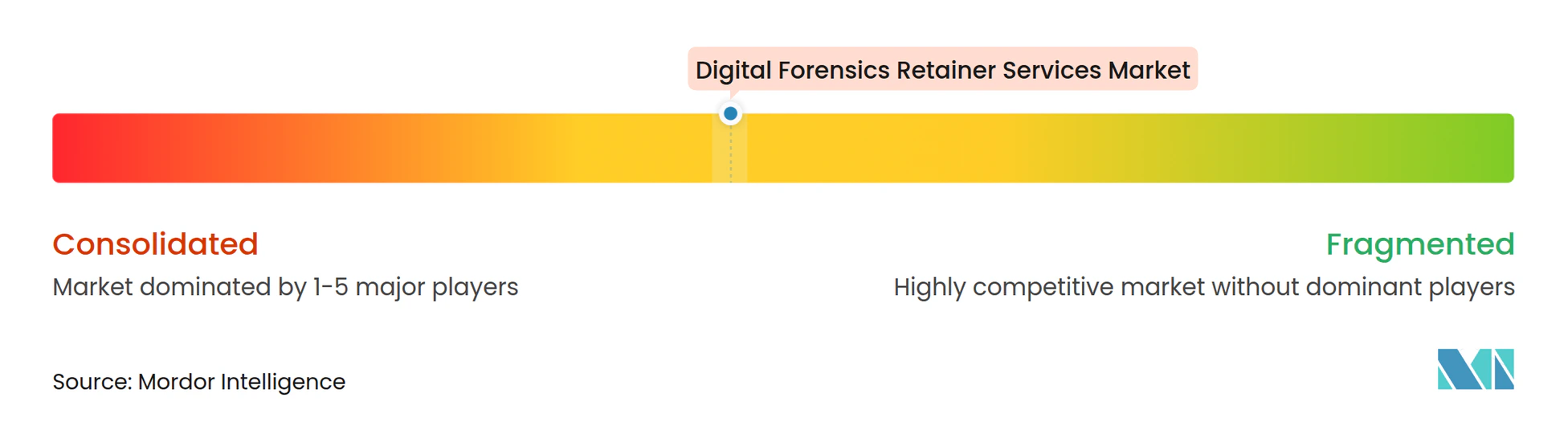
The Digital forensics retainer services market has a moderately consolidated structure led by IBM X-Force, Google Mandiant, Kroll, Palo Alto Networks Unit 42, and CrowdStrike Services. These providers compete through global responder networks, insurance relationships, and their ability to investigate cloud, endpoint, operational technology, mobile, and legally privileged cases. Their platforms also provide telemetry and threat intelligence that can improve containment and recovery decisions. CrowdStrike and Kroll announced a multi-year partnership in December 2025 covering the migration of protection for more than 500,000 endpoints to CrowdStrike Falcon Complete Next-Gen MDR. CrowdStrike stated that the combined model reduced mean time to respond by 75%.
Professional services providers also participate by placing DFIR retainers within broader cybersecurity and resilience relationships, and their incumbent board relationships can support access to large enterprise accounts. At the same time, specialist providers can differentiate through deep technical work, rapid response, or sector-focused expertise. NCC Group and Dragos launched an IT and OT convergence retainer in November 2025 for industrial organizations. The service combined DFIR capabilities with OT security technology and threat intelligence. This supports a market opening for providers that can address connected industrial environments.
Commercial design is becoming as significant as technical capability in the Digital forensics retainer services market. LevelBlue positioned its March 2026 offering around credit rollover, a 1-hour response agreement, and compatibility with more than 50 carrier policies, while Cydelphi launched CYVISIONARY in September 2026 with automated workflows and a chain-of-custody record for insurance and regulatory use. Providers with rigid response-hours contracts may lose ground where customers prioritize flexibility and readiness services. The Digital forensics retainer services industry therefore rewards integrated service, platform, and insurance propositions, while providers that separate their commercial model from operational delivery face greater competitive pressure.
Digital Forensics Retainer Services Industry Leaders
-
Accenture plc
-
Arctic Wolf Networks, Inc.
-
Booz Allen Hamilton Holding Corporation
-
Broadcom Inc.
-
Cellebrite DI Ltd.
- *Disclaimer: Major Players sorted in no particular order
Digital Forensics Retainer Services Market Companies Covered in this Report
- Accenture plc
- Arctic Wolf Networks, Inc.
- Atos SE
- Booz Allen Hamilton Holding Corporation
- Broadcom Inc.
- Cellebrite DI Ltd.
- Cisco Systems, Inc.
- CrowdStrike Holdings, Inc.
- Deloitte Touche Tohmatsu Limited
- Ernst & Young Global Limited
- Exterro, Inc.
- Google LLC, Mandiant
- IBM Corporation, X-Force Incident Response
- Kroll, LLC
- Magnet Forensics Inc.
- MSAB AB
- NCC Group plc
- OpenText Corporation
- Palo Alto Networks, Inc., Unit 42
- Rapid7, Inc.
- Secureworks Corp., a Sophos Company
- Trustwave Holdings, Inc., a LevelBlue Company
- Verizon Communications Inc.
- Vodafone Group Plc
Recent Industry Developments in Digital Forensics Retainer Services Market
- October 2026: Lineal, a global legal technology provider, completed the acquisition of Forentec, a Switzerland-based digital forensics, cybersecurity, and open-source intelligence (OSINT) firm. The acquisition establishes Lineal's forensic presence in the Swiss market and brings digital evidence collection, cyber-incident response, and OSINT capabilities to Lineal's global client base across law firms, corporations, and financial institutions.
- October 2026: DXR Cyber rebranded as a consolidated UK cyber-security and digital forensics group, combining four firms, CyberCrowd, DigitalXRAID, Aristi, and IntaForensics, under a single brand following their acquisition by private equity firm Limerston Capital in 2025. The consolidation creates a 180-specialist digital forensics and resilience group with nearly 2 decades of combined operational experience, enabling the entity to compete for larger enterprise and government retainer contracts.
- September 2026: Cydelphi unveiled CYVISIONARY, its AI-native DFIR platform built on patent-pending automation and agentic workflows designed to reduce catastrophic breach recovery from weeks to days. The platform delivers an automated, verifiable chain-of-custody system of record for cyber-insurance, regulatory compliance, and internal reporting, targeting the litigation-defensible forensic automation gap in existing retainer service offerings.
- August 2026: AgileBlue launched its AgileBlue Incident Readiness (AIR) subscription, a pre-breach program completing DFIR partner onboarding, pre-negotiated response rates, and readiness planning before an incident occurs. Unlike traditional retainers that charge for pre-purchased hours, AIR activates and bills forensic resources only when needed, reducing financial risk for SME buyers.
Global Digital Forensics Retainer Services Market Report Scope
Digital forensics retainer services are contractual, subscription-based corporate agreements in which an enterprise secures proactive, on-call access to specialized external cybersecurity experts and forensic investigators. Operating under pre-negotiated [Service Level Agreements (SLAs)], these services guarantee rapid deployment to investigate cyber breaches, isolate root causes, and gather legally defensible digital evidence.
The Digital Forensics Retainer Services Market Report is Segmented by Service Type (Pre-Incident Readiness and Assessment, Incident Triage and Containment, Digital Evidence Acquisition and Preservation, Forensic Examination and Root-Cause Analysis, Recovery, Remediation, and Lessons Learned, and Legal, Regulatory, and Litigation Support), Engagement Model (Response-Hours Retainer, Prepaid-Funds Retainer, Credit-Based Multi-Service Retainer, and Dedicated-Capacity Retainer), Deployment Mode (Cloud-Based, On-Premises, and Hybrid), Organization Size (Large Enterprises and Small and Medium Enterprises), End-User Industry (Banking, Financial Services, and Insurance [BFSI], Government and Defense, Healthcare and Life Sciences, IT and Telecommunications, Manufacturing and Industrial, Retail and E-Commerce, and Other End-User Industries), and Geography (North America, South America, Europe, Asia-Pacific, Middle East, and Africa). The Market Forecasts are Provided in Terms of Value (USD).
Segmentation Overview
| Pre-Incident Readiness and Assessment |
| Incident Triage and Containment |
| Digital Evidence Acquisition and Preservation |
| Forensic Examination and Root-Cause Analysis |
| Recovery, Remediation, and Lessons Learned |
| Legal, Regulatory, and Litigation Support |
| Response-Hours Retainer |
| Prepaid-Funds Retainer |
| Credit-Based Multi-Service Retainer |
| Dedicated-Capacity Retainer |
| Cloud-Based |
| On-Premises |
| Hybrid |
| Large Enterprises |
| Small and Medium Enterprises |
| Banking, Financial Services, and Insurance (BFSI) |
| Government and Defense |
| Healthcare and Life Sciences |
| IT and Telecommunications |
| Manufacturing and Industrial |
| Retail and E-Commerce |
| Other End-User Industries |
| North America | United States |
| Canada | |
| Mexico | |
| South America | Brazil |
| Argentina | |
| Rest of South America | |
| Europe | United Kingdom |
| Germany | |
| France | |
| Italy | |
| Rest of Europe | |
| Asia-Pacific | China |
| India | |
| Japan | |
| South Korea | |
| Rest of Asia-Pacific | |
| Middle East | Saudi Arabia |
| United Arab Emirates | |
| Rest of Middle East | |
| Africa | South Africa |
| Nigeria | |
| Rest of Africa |
| By Service Type | Pre-Incident Readiness and Assessment | |
| Incident Triage and Containment | ||
| Digital Evidence Acquisition and Preservation | ||
| Forensic Examination and Root-Cause Analysis | ||
| Recovery, Remediation, and Lessons Learned | ||
| Legal, Regulatory, and Litigation Support | ||
| By Engagement Model | Response-Hours Retainer | |
| Prepaid-Funds Retainer | ||
| Credit-Based Multi-Service Retainer | ||
| Dedicated-Capacity Retainer | ||
| By Deployment Mode | Cloud-Based | |
| On-Premises | ||
| Hybrid | ||
| By Organization Size | Large Enterprises | |
| Small and Medium Enterprises | ||
| By End-User Industry | Banking, Financial Services, and Insurance (BFSI) | |
| Government and Defense | ||
| Healthcare and Life Sciences | ||
| IT and Telecommunications | ||
| Manufacturing and Industrial | ||
| Retail and E-Commerce | ||
| Other End-User Industries | ||
| By Geography | North America | United States |
| Canada | ||
| Mexico | ||
| South America | Brazil | |
| Argentina | ||
| Rest of South America | ||
| Europe | United Kingdom | |
| Germany | ||
| France | ||
| Italy | ||
| Rest of Europe | ||
| Asia-Pacific | China | |
| India | ||
| Japan | ||
| South Korea | ||
| Rest of Asia-Pacific | ||
| Middle East | Saudi Arabia | |
| United Arab Emirates | ||
| Rest of Middle East | ||
| Africa | South Africa | |
| Nigeria | ||
| Rest of Africa | ||
Key Questions Answered in the Report
What is the size of the digital forensics retainer services market?
The digital forensics retainer services market is projected to expand from USD 2.89 billion in 2026 and USD 3.32 billion in 2027 to USD 5.83 billion by 2032, at an 11.92% CAGR. The forecast covers the period from 2027 to 2032 and reflects continuing demand for prepared response capacity, formal reporting support, flexible service models, and insurance alignment for regulated buyers.
Why do organizations use a digital forensics retainer?
A retainer provides prearranged access to investigators for rapid containment, evidence preservation, reporting, and support during a cyber incident. It can remove delays linked to onboarding and access approvals during the first response period, when evidence and system information can change quickly across endpoint, network, cloud, and operational technology systems.
Which service type holds the largest revenue share?
Incident triage and containment held 30.29% revenue share in 2026 because it supports the first technical response after a breach. It also helps establish the scope, priorities, evidence needs, documentation requirements, and response sequence for further investigation work.
Which buyers are increasing adoption most quickly?
Small and medium enterprises are projected to expand at a 14.83% CAGR through 2032, supported by subscriptions and insurance-linked offerings. These models reduce the need for large unused capacity commitments and lengthy budget approval cycles before readiness work begins.
What makes cloud deployment important for forensic retainers?
Cloud systems generate container logs, identity trails, and object-storage records that need specialized collection and investigation processes. Hybrid arrangements can support both cloud and locally controlled evidence for regulated organizations while supporting access to identity records, application logs, and infrastructure activity during complex incidents.
Which region leads demand for digital forensics retainers?
North America held 41.34% revenue share in 2026, supported by disclosure rules, cyber-insurance maturity, and large enterprise demand. The region also has a large concentration of forensic service providers, enterprise customers, legal advisers, cyber-insurance participants, and security technology vendors that shape purchasing expectations for prepared incident response.