
Countertop Ice Makers Market Size and Share
Market Overview
| Study Period | 2020 - 2031 |
|---|---|
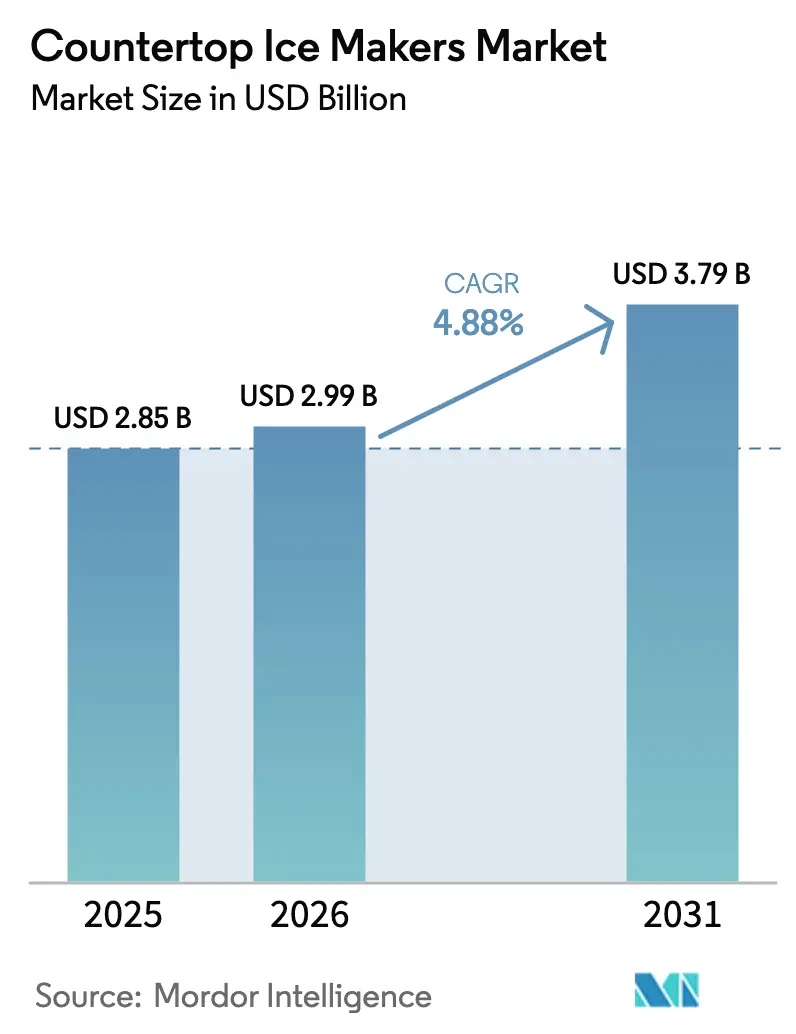
| Market Size (2026) | USD 2.99 Billion |
| Market Size (2031) | USD 3.79 Billion |
| Growth Rate (2026 - 2031) | 4.88 % |
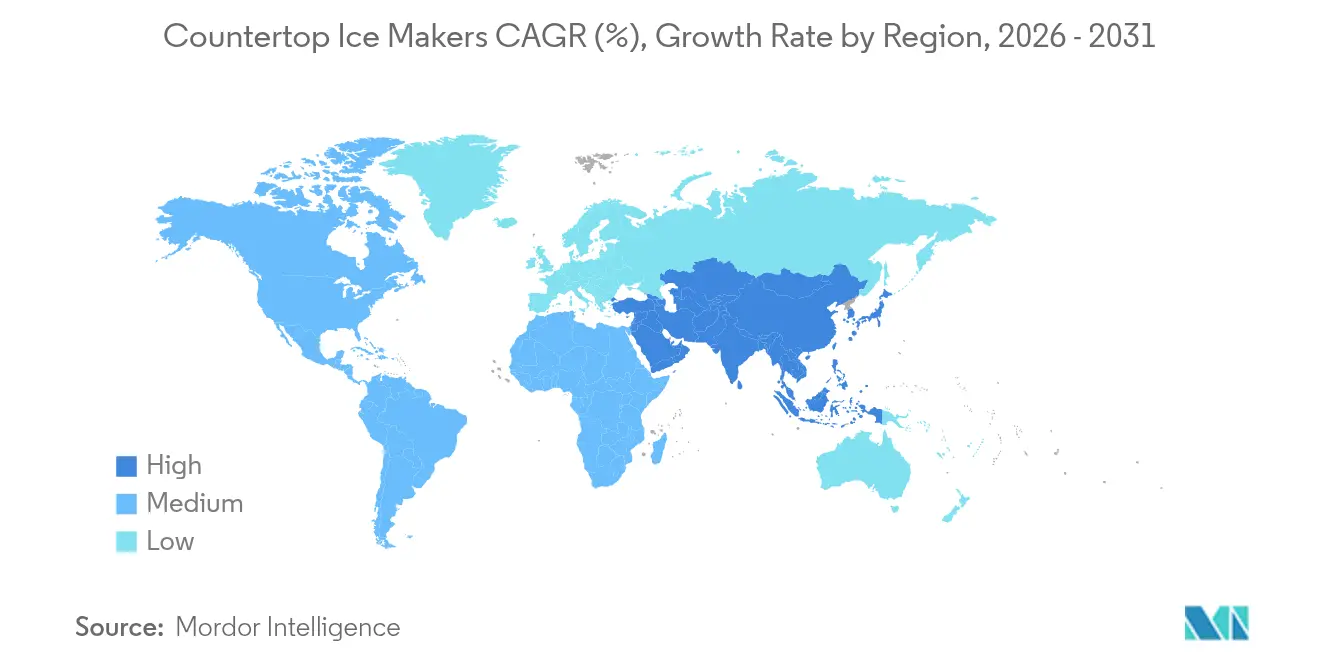
| Fastest Growing Market | Asia Pacific |
| Largest Market | North America |
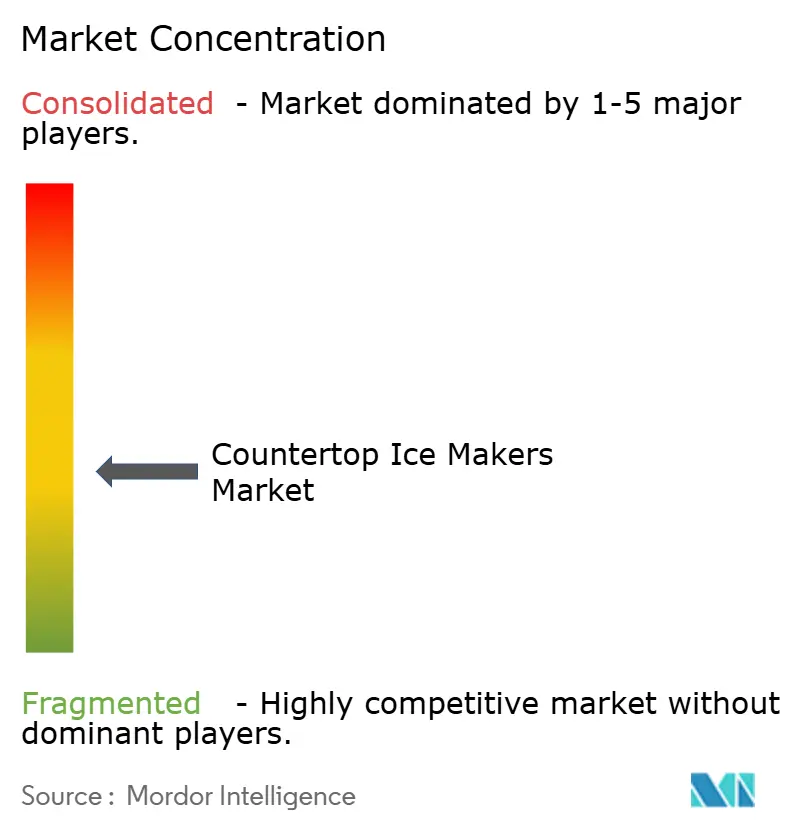
| Market Concentration | Medium |
Major Players *Disclaimer: Major Players sorted in no particular order Image © Mordor Intelligence. Reuse requires attribution under CC BY 4.0. | |
Countertop Ice Makers Market Analysis by Mordor Intelligence
The Countertop Ice Makers Market size was valued at USD 2.85 billion in 2025 and estimated to grow from USD 2.99 billion in 2026 to reach USD 3.79 billion by 2031, at a CAGR of 4.88% during the forecast period (2026-2031). Growth stems from shrinking urban living spaces, a durable shift toward at-home beverage rituals, and steady technology upgrades that shrink form factors while lifting output. Premium refrigerators add built-in ice, yet portability, specialized ice textures, and lower entry prices keep standalone units relevant. Manufacturers differentiate through nugget and gourmet ice formats, smart-home connectivity, and energy-saving compressors that anticipate 2029 U.S. efficiency rules. Rising online penetration, especially in Asia-Pacific, broadens reach and accelerates new-brand entry, reshaping competitive dynamics across the countertop ice maker market[1].
Key Report Takeaways
- By product type, bullet machines led with 45.03% of countertop ice maker market share in 2025; nugget models are forecast to advance at a 9.22% CAGR to 2031.
- By capacity, units above 40 lb/day captured 8.33% CAGR, the fastest pace, while the Up to 26 lbs/day group held 38.12% of the countertop ice maker market size in 2025.
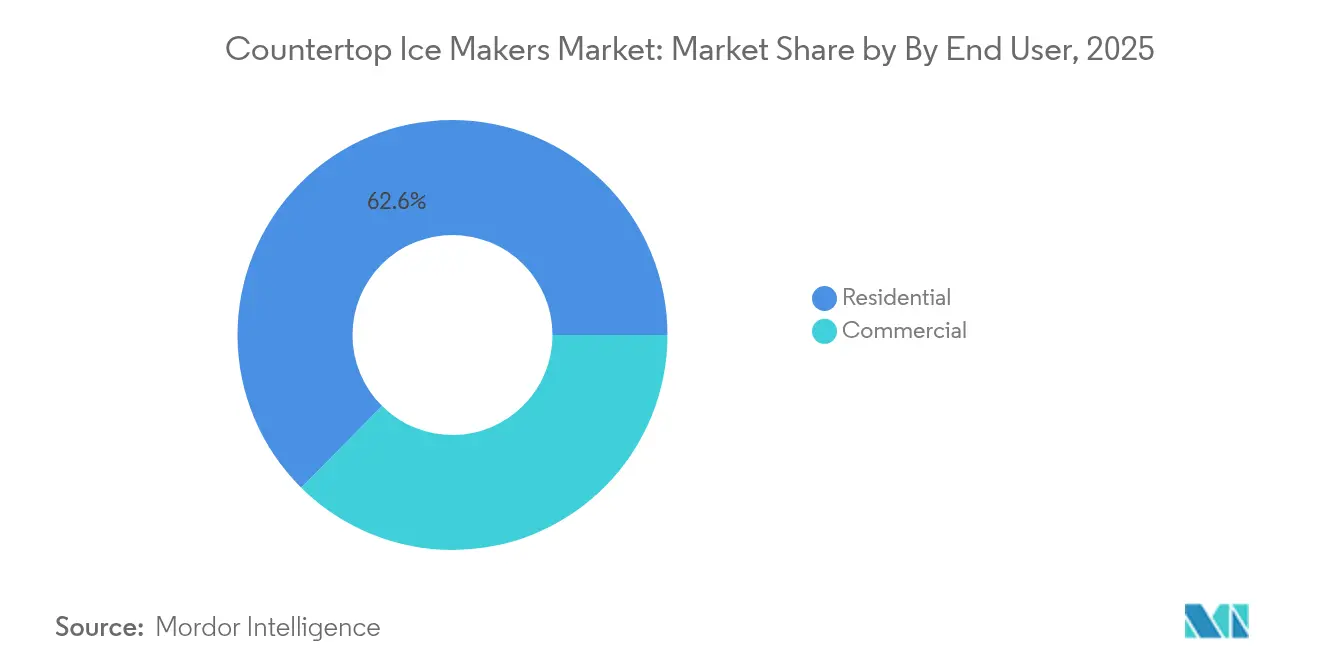
- By end user, residential applications accounted for 62.58% of the countertop ice maker market size in 2025; commercial installations post the highest 9.55% CAGR through 2031.
- By distribution channel, offline retail retained a 58.44% share in 2025, yet online sales are growing at a 8.95% CAGR in the countertop ice maker market.
- By geography, North America commanded 36.62% revenue share in 2025, whereas Asia-Pacific is set to grow at 10.06% CAGR in the countertop ice maker market.
- Competition is moderate, balancing appliance multinationals and agile e-commerce entrants. GE Appliances, Whirlpool, NewAir, Frigidaire, and Igloo head the leaderboard through nationwide retail ties and extensive service networks.
Note: Market size and forecast figures in this report are generated using Mordor Intelligence’s proprietary estimation framework, updated with the latest available data and insights as of 2026.
Market Trends and Insights
Drivers Impact Analysis of Countertop Ice Makers Market*
| Driver | (~) % Impact on CAGR Forecast | Geographic Relevance | Impact Timeline |
|---|---|---|---|
| Growth in compact living spaces pushing demand for portable appliances | +1.2% | Global, with concentration in North America & APAC urban centers | Medium term (2-4 years) |
| Consumer convenience preference and at-home beverage culture | +0.9% | North America & EU, expanding to APAC | Long term (≥ 4 years) |
| Rising adoption in offices, breakrooms, and small HoReCa outlets | +0.8% | Global, led by North America commercial sector | Medium term (2-4 years) |
| E-commerce channel proliferation improving product accessibility | +0.7% | Global, with strongest impact in APAC and emerging markets | Short term (≤ 2 years) |
| Van-life and RV community demand for off-grid ice | +0.4% | North America, with spillover to EU recreational markets | Long term (≥ 4 years) |
| Efficiency gains enabling solar-powered countertop units | +0.3% | Global, with early adoption in off-grid communities | Long term (≥ 4 years) |
| Source: Mordor Intelligence | |||
Growth in Compact Living Spaces Pushing Demand for Portable Appliances
Urban densification drives consumers toward smaller kitchens where built-in dispensers do not fit. Millennials and Gen Z renters choose appliances they can move between leases, favoring lightweight countertop designs that plug into standard outlets. DOE’s 2029 energy standards assure baseline efficiency, nudging brands to adopt variable-speed compressors and thicker insulation. These forces position the countertop ice maker market as a staple rather than a discretionary category, particularly in cities where floor-space costs top USD 50 per square foot annually.
Consumer Convenience Preference and At-Home Beverage Culture
Permanent shifts toward home mixology, specialty coffee, and sparkling water elevate ice quality expectations. Nugget machines meet demands for chewable texture ideal for cold brew and craft cocktails. GE Appliances’ Opal line exemplifies premium willingness to pay, with models retailing near USD 700 and ranking among the brand’s bestsellers[2]. Continuing interest in gourmet beverages sustains double-digit growth for higher-spec units across the countertop ice maker market.
Rising Adoption in Offices, Breakrooms, and Small HoReCa Outlets
Cost-of-ownership studies show countertop makers save up to 80% versus bagged ice for locations using <100 lb/day. Co-working spaces deploy machines to raise tenant satisfaction, while food trucks embrace portable units to sidestep water and drain installations. The commercial CAGR of 9.97% therefore eclipses household growth, confirming broader acceptance beyond core residential demand[3].
E-commerce Channel Proliferation Improving Product Accessibility
Amazon controlled 61% of online category sales in 2024, leveraging nationwide fulfillment and peer reviews that validate new brands. Digital storefronts also support long-tail models in smaller markets where traditional appliance aisles are thin. As logistics networks mature in Southeast Asia and Latin America, e-commerce adds incremental volume to the countertop ice maker market, especially for solar-compatible SKUs aimed at off-grid buyers.
Restraints Impact Analysis of Countertop Ice Makers Market*
| Restraint | (~) % Impact on CAGR Forecast | Geographic Relevance | Impact Timeline |
|---|---|---|---|
| Integration of ice dispensers in modern refrigerators reducing need | -0.8% | Global, with strongest impact in North America premium segment | Medium term (2-4 years) |
| Operational noise and reliability concerns affecting consumer satisfaction | -0.5% | Global, with higher sensitivity in residential applications | Short term (≤ 2 years) |
| Emerging water-quality regulations increasing compliance costs | -0.4% | North America & EU, expanding globally | Long term (≥ 4 years) |
| Influx of sub-standard imports eroding brand trust | -0.3% | Global, with concentration in price-sensitive segments | Medium term (2-4 years) |
| Source: Mordor Intelligence | |||
Integration of Ice Dispensers in Modern Refrigerators Reducing Need
High-end fridges now include craft-ice spheres and dual makers, eroding standalone demand in affluent households. LG’s Craft Ice refrigerator supplies slow-melting spheres directly from the freezer door, challenging premium countertop units. However, countertop models counter with portability, faster cycle times, and specialty nugget formats, positioning themselves as complementary for parties, patios, and RVs.
Operational Noise and Reliability Concerns Affecting Consumer Satisfaction
Compressor hum and fan vibration can top 50 dB, deterring buyers who share open-plan living spaces. Mineral scale clogs valves, prompting warranty claims that hurt brand ratings. AHAM campaigns against counterfeit filters underscore reliability risks. Manufacturers answer with quieter DC fans, stainless-steel evaporators, and self-clean cycles that lengthen service life and protect reputation within the countertop ice maker market.
*Our forecasts treat driver/restraint impacts as directional, not additive. The impact forecasts reflect baseline growth, mix effects, and variable interactions.
Countertop Ice Makers Market Segment Analysis
By Product Type:
Nugget Ice Drives Premium GrowthBullet units delivered the largest 45.03% countertop ice maker market share in 2025 on the back of mature manufacturing, 8-minute first-freeze cycles, and price points under USD 150. The segment serves apartments, dorms, and breakrooms that value straightforward cubes. Nugget machines, though smaller in volume, expand at 9.22% CAGR on the allure of chewable pellets that retain soda carbonation. Consumers pay 2- 3 times more for these textures, fueling innovation such as GE’s Opal 2.0 with WiFi scheduling and scale-inhibiting filtration.
Specialized gourmet models aim at mixologists who require crystal-clear, 2-inch slabs that minimize dilution in aged whisky. Their double-wall freezing chambers force air bubbles out, selling at USD 500-900. Although niche, the category benefits from the craft-cocktail boom and Instagram visual culture. Collectively, product diversification sustains a climb in average selling price across the countertop ice maker market.


By Capacity:
High-Output Units Capture Commercial DemandThe Up to 26 lbs/day tier owned the largest slice of the countertop ice maker market size in 2025 at 38.12%, matching the daily needs of typical households. Units rated 26–40 lb/day bridge into small cafés, providing 6-minute cycles and removable bins that fit under counters.
Above-40 lb/day models, the fastest-growing group at 8.33% CAGR, entice offices and food trucks that prioritize fewer refills and continuous service. Variable-speed condensers and R290 refrigerant cut power draw, satisfying environmental codes in California and the EU. Demand for bigger bins indicates convergence between light commercial and residential entertaining trends and advances overall output expectations in the countertop ice maker market.
By End User:
Commercial Segment Accelerates AdoptionHouseholds still accounted for 62.58% of the countertop ice maker market size in 2025, but commercial buyers, from coworking spaces to boutique bars, add units to streamline service. Payback analyses show operators recover capital in eight months by replacing bagged ice deliveries. Solar-ready machines emerge for food trucks and beach kiosks seeking grid independence. As city regulations curb single-use plastics, on-site ice reduces packaging waste, giving countertop solutions a sustainability edge that resonates with small enterprises.
Furniture rental firms now bundle ice makers with kitchen packages for short-term leases, broadening the appliance’s business-to-business footprint. This diversification underpins the 9.55% CAGR for commercial installations, further cementing the countertop ice maker market as a cost-effective operational tool.
By Distribution Channel:
Digital Commerce Transforms AccessBrick-and-mortar chains kept 58.44% share in 2025, leveraging live demos and bundled financing. Yet online volume scales quickly: the countertop ice maker market recorded a 8.95% CAGR for e-commerce on richer model assortments and next-day delivery. Amazon’s category dominance motivates rivals such as Walmart.com and regional marketplaces like Lazada to invest in faster fulfilment. Direct-to-consumer webstores deepen brand-user feedback loops, accelerating firmware updates for app-controlled machines and offering subscription filters that lock in recurring revenue.
Cyber-week promotions compress yearly demand into peak weeks, prompting factories to align inventory with digital flash-sales cadence. Online success is especially pronounced in India, Indonesia, and Brazil, where physical appliance showrooms are sparse, pushing incremental gains across the countertop ice maker market.
Geography Analysis
North America Countertop Ice Makers Market
North America anchors global demand with a 36.62% slice of revenue. U.S. households value nugget textures for cold brew, while offices use 40 lb/day units to replace vending bags. Canada mirrors these patterns, and Mexico’s urban condos adopt portable makers as kitchens shrink. FDA food-grade rules and DOE energy targets provide a clear regulatory landscape, nudging brands toward quieter compressors and food-safe interiors.
APAC Countertop Ice Makers Market
Asia-Pacific is the growth engine. China’s middle-class apartment boom fuels first-time purchases, and malls showcase countertop ice maker market flagships during 11-11 shopping festivals. India’s hospitality startups outfit co-working cafés with solar-ready makers, cutting reliance on erratic municipal ice deliveries. Japan’s fascination with gadget miniaturization yields crowd-funded upgrades featuring 10-minute crystal-clear cycles. ASEAN economies add volume through beach resorts where portable machines offset unreliable grid power.
Europe Countertop Ice Makers Market
Europe contributes stable, margin-rich sales. Energy-label revisions push brands to advertise kilowatt-hour drops, resonating with eco-conscious Nordic consumers. The UK home-bar hobby, rising after pandemic lockdowns, sustains nugget sales, while Spain’s coastal bars adopt high-output units to meet tourist surges. Importers must navigate emerging water-quality standards that raise certification costs, yet compliance enhances brand trust, sustaining long-run prospects across the countertop ice maker market.
Mordor Intelligence provides coverage of the countertop ice makers market across other key regional markets, including North America, each with their regulatory frameworks and demand patterns. Detailed country-level analysis extends to United Kingdom and Germany incorporating local coverage and market participation, as required.
Regulatory Landscape
Countertop ice makers fall under refrigeration safety requirements and energy and test-method rules, with added scrutiny when models are marketed for light commercial use. In the United States, the Department of Energy regulates automatic commercial ice makers under the Energy Conservation Program (10 CFR Part 431), including uniform test methods (10 CFR 431.134) that incorporate by reference industry standards such as AHRI Standard 810 (I-P)-2016 and ANSI/ASHRAE Standard 29-2015 for measuring harvest rate, energy use, and water use. Product safety oversight is also influenced by the Consumer Product Safety Commission (CPSC) under the Consumer Product Safety Act, which supports safety standards and potential recalls for consumer appliances.
Across major markets, electrical and refrigeration safety certification affects design and sourcing decisions for components including compressors, controls, wiring, and enclosures. UL 563 (2021) is a key safety standard for ice makers, while UL 60335-2-89 Ed. 2-2021 covers commercial refrigerating appliances and ice makers with incorporated refrigerant units. Internationally, IEC 60335-2-24:2025 applies to household refrigerating appliances and influences conformity approaches for globally sold countertop units. As refrigerant and efficiency requirements tighten, manufacturers increasingly align product platforms to recognized test and safety standards to reduce multi-region redesign and certification cycles.
Value Chain Analysis
The countertop ice maker value chain covers refrigerant-system components and plastics or metal fabrication through assembly, certification, and multi-channel distribution. Upstream suppliers provide compressors, evaporators, fans, pumps, insulation, and electronic control boards, followed by OEM design, tooling, and assembly, then third-party safety and performance certification to standards such as UL and IEC. Downstream, volume moves through big-box and specialty retailers and increasingly through e-commerce marketplaces and brand-owned webstores, where warranty handling, spare parts, and consumables (filters and descaling products) shape total lifetime economics and ratings-driven conversion.
Leading brands also rely on localized manufacturing and innovation hubs to shorten development cycles and support serviceability. GE Appliances shows this with a US-based footprint anchored by Appliance Park in Louisville, Kentucky, supported by facilities across multiple states, plus its FirstBuild co-creation makerspace in Louisville for product development and early-stage manufacturing. The company also operates a CoCREATE site in Stamford, Connecticut, for small-batch manufacturing, which can help accelerate iterations on form factor, noise, and connectivity features for countertop formats.
Competitive Landscape
Competition is moderate, balancing appliance multinationals and agile e-commerce entrants. GE Appliances, Whirlpool, NewAir, Frigidaire, and Igloo head the leaderboard through nationwide retail ties and extensive service networks. GE’s Opal Nugget Ice Maker, co-created at the FirstBuild lab, illustrates crowdsourced R&D that slashed launch cycles and captured premium share.
Challengers harness direct-to-consumer tactics, funneling social-media feedback into monthly firmware tweaks. EUHOMY and Antarctic Star deploy Instagram-driven launches featuring matte-black finishes and app scheduling, courting millennials. Hoshizaki widens its footprint via a 25% stake in Fogel and new Philippine subsidiaries, signaling consolidation aimed at supply-chain synergies.
Smart-home integration is the new battleground. WiFi diagnostics dispatch filter alerts, while voice assistants trigger express-freeze modes. Solar-compatible compressors target RV and marine niches, opening a frontier where legacy brands hold limited presence. As online ratings weigh heavily on purchase decisions, warranty responsiveness and noise performance become decisive, steering future share shifts in the countertop ice maker market.
Countertop Ice Makers Industry Leaders
-
GE Appliances
-
Whirlpool Corporation
-
NewAir Appliances
-
Frigidaire
-
Igloo
- *Disclaimer: Major Players sorted in no particular order
Countertop Ice Makers Market Companies Covered in this Report
- Whirlpool Corporation
- NewAir Appliances
- Frigidaire (Electrolux AB)
- Igloo (Nostalgia Products LLC)
- hOmeLabs (Aterian Inc.)
- GE Appliances (Haier)
- Scotsman (Ali Group)
- Manitowoc Ice (Welbilt Inc.)
- Vremi (Aterian Inc.)
- Magic Chef (Midea Group)
- EdgeStar (Living Direct)
- Della (SPT)
- Costway
- Dometic Group
- Luma Comfort (NewAir)
- Maxx Ice (Chef's Deal)
- SPT (Sunpentown)
- Sunpentown International
- Whynter
- Euhomy
- AGLUCKY
- Antarctic Star*
Market Opportunities and Future Outlook
Opportunities are clustering around differentiated ice formats and compact, premium designs that fit smaller kitchens while supporting higher daily output and a smoother user experience. Consumer pull for nugget ice and space-saving appliances is already driving platform extensions, including GE Profile expanding the Opal lineup into smaller-form-factor nugget ice makers and GE Appliances using FirstBuild in Louisville to co-create products such as the Opal Nugget Ice Maker. That mix points to opportunities for brands that can combine compact footprints with quieter operation, app-based scheduling and diagnostics, and easy-clean designs that address reliability and noise concerns in open-plan living.
On the supply side, compliance-driven redesign and manufacturing modernization create room for new cost and performance positions in both residential and light commercial use cases. GE Appliances publicly committed to a USD 3 billion investment over five years (announced August 2025) across US operations for product innovation, manufacturing modernization, and increased production capacity in states including Kentucky, Alabama, Georgia, Tennessee, and South Carolina. For the countertop segment, this investment backdrop supports faster product refresh cycles, including efficiency-oriented compressor and insulation upgrades, and expanded availability of higher-output models that map to offices, breakrooms, and small HoReCa outlets without requiring built-in installations.
Recent Industry Developments in Countertop Ice Makers Market
- July 2026: GE Profile Opal Mini Nugget Ice Maker series launched, smaller footprint and up to 36 lbs/day availability started July 14, 2026. The launch expands the nugget ice offerings in a compact form factor, enabling more urban kitchens to access high output without sacrificing space.
- July 2026: GE Appliances - Launched the GE Profile Opal Mini Nugget Ice Maker series, featuring models that are 30 percent smaller than the Opal Ultra, producing up to 36 lbs of ice per day. Availability started July 14, 2026, positioning GE to capture demand for premium nugget ice in smaller footprints.
- February 2026: GE Appliances - KBIS 2026 announced upcoming Opal Mini Nugget Ice Maker. The expansion of the Opal line into a smaller form factor broadens consumer choices in the countertop nugget ice segment, strengthening GE's product portfolio in this category.
Countertop Ice Makers Market Report Scope and Research Methodology
Market Definition and Coverage
This market covers plug-in countertop ice makers that produce ice on demand for home and light commercial use, and it is sized in revenue terms based on sales of the appliance across major regions.
Scope exclusions: Under-counter or built-in ice machines, full-size commercial ice systems, and replacement parts and service-only revenue are not counted.
Segments Covered in This Report
- By Product Type
- Bullet Ice Makers
- Nugget / Pea Ice Makers
- Gourmet / Clear Ice Makers
- By Capacity
- Up to 26 lbs / day
- 26 - 40 lbs / day
- Above 40 lbs / day
- By End User
- Residential
- Commercial
- Small Cafes and Bars
- Offices and Co-working Spaces
- Recreational Vehicles and Marine
- By Distribution Channel
- Offline
- Specialty Appliance Stores
- Big-Box Retailers
- Dealer and Distributor Networks
- Online
- E-commerce Marketplaces
- Brand-owned Webstores
- Offline
- By Geography
- North America
- Canada
- United States
- Mexico
- South America
- Brazil
- Peru
- Chile
- Argentina
- Rest of South America
- Asia-Pacific
- India
- China
- Japan
- Australia
- South Korea
- South East Asia (Singapore, Malaysia, Thailand, Indonesia, Vietnam, and Philippines)
- Rest of Asia Pacific
- Europe
- United Kingdom
- Germany
- France
- Spain
- Italy
- BENELUX (Belgium, Netherlands, and Luxembourg)
- NORDICS (Denmark, Finland, Iceland, Norway, and Sweden)
- Rest of Europe
- Middle East And Africa
- United Arab Emirates
- Saudi Arabia
- South Africa
- Nigeria
- Rest of Middle East And Africa
- North America
Data Sources, Market Sizing, and Validation
Desk Research
Desk research was used to build the basic market structure and keep the assumptions anchored in sources that can be checked publicly. We mainly reviewed government and official statistics that inform appliance demand, trade flows, and energy-efficiency direction, such as US Census Bureau retail and housing indicators, US International Trade Commission trade data, UN Comtrade, International Energy Agency publications, and US Department of Energy standards and rulemaking notes.
To translate these signals into a market model, we also reviewed company annual reports, investor presentations, earnings call transcripts, and reputable coverage of small-appliance launches and channel shifts. Where needed, paid subscriptions that track company financials, shipment and import-export records, and patent activity were used to sense-check volumes and technology change, and then these points were tested in primary discussions. The desk sources noted above are illustrative and not exhaustive, and many other public documents and datasets were also used for data collection, validation, and clarification.
Primary Interviews and Surveys
Primary work was completed through interviews and surveys with executives, product and sales leaders, and channel stakeholders linked to countertop ice makers across key consuming regions. We used these conversations to confirm pricing bands, typical replacement cycles, online versus offline mix, and realistic utilization patterns in homes and small commercial settings, and then to close gaps where public data is not specific enough for this niche.
Distribution of primary research fieldwork respondents
| Company type | Respondent position | Region |
|---|---|---|
| Top tier: 36% | CXOs: 19% | APAC: 45% |
| Mid tier: 43% | Functional/Unit leaders: 23% | EMEA: 30% |
| Smaller Players: 21% | Managers: 58% | Americas: 25% |
Market-Sizing & Forecasting
Sizing starts with a top-down build where small-appliance demand pools are reconstructed by geography, then filtered using countertop ice maker penetration assumptions across residential buyers and small commercial users. Those penetration rates are tied back to practical purchase triggers, such as urban household formation, home entertaining frequency, and channel availability, before the revenue total is calculated.
The final totals are also cross-checked with selective bottom-up approximations, mainly sampled average selling price (ASP) by capacity band multiplied by estimated unit volumes, followed by distributor and retailer checks to confirm what sells through online and offline channels. Inputs that mattered most in the model include ASP movement by capacity (for example, up to 26 lbs/day versus higher output units), the shift toward online retail, compressor and refrigeration efficiency trends that affect product refresh cycles, seasonal demand swings, and region-wise adoption in rental-heavy urban areas. For forecasting, we used scenario analysis supported by trend variables, and the scenarios were aligned to what experts expect for discretionary appliance spending, energy standard tightening, and product feature uptake (such as faster cycle time and ice type options). Where unit volume visibility is weaker in fragmented channels, we use conservative ranges and then tighten them after interview validation.
Data Validation & Update Cycle
Outputs are checked in several steps so the numbers do not rely on a single assumption. We compare the modeled revenue trend against independent signals like appliance category growth, import intensity for small refrigeration products, and observable ASP bands in major channels, and then we revisit inputs if variances are large.
Before sign-off, the model and logic go through an analyst review where anomalies are flagged, corrected, and documented, and follow-up calls are triggered if a key variable moves outside the expected range. Reports are refreshed annually, and interim updates are made when material events occur, such as a meaningful standards change, a major channel disruption, or an unusual demand spike. Right before delivery, a final pass is completed so clients receive the most current view supported by the latest available data.
Mordor Intelligence's Countertop Ice Makers Market Sizing Compared With Other Published Estimates
Published market numbers for countertop ice makers can look far apart because the included appliance set is not always consistent, and the same term is sometimes used to cover different product formats and selling channels. Differences also come from how prices are averaged, which year is treated as the current base, and how quickly assumptions are refreshed when demand conditions change.
By tracking channel-level ASP bands and capacity mix shifts, Mordor Intelligence keeps the sizing limited to countertop-only appliance revenue and avoids counting under-counter units, built-in ice systems, and repair or service revenue. Some publications expand the universe to broader portable ice products, or they apply one global price curve without checking region mix and online versus offline share, which can move the value meaningfully in either direction.
Benchmark comparison
| Source | Market Size | Gaps in Research Methodology |
|---|---|---|
| Mordor Intelligence | USD 2.99 B (2026) | |
| Trade Journal A | USD 2.70 B (2023) | Uses an earlier base year and often blends countertop units with broader portable ice maker definitions, and it applies a generalized price trend that does not fully reflect capacity mix changes by region. |
| Global Consultancy B | USD 2.10 B (2024) | Leans on a narrower demand view focused on home use, and it typically undercounts small commercial placements and offline channel sales where category data is harder to observe. |
Taken together, the spread is mainly explained by product inclusion choices, base year selection, and how ASP progression is handled when capacity and channel mix are changing. Our method stays repeatable because each step is connected to observable inputs, and the total is adjusted only after the outputs align with what market participants confirm in validation checks.
Key Questions Answered in the Report
What is the current value of the countertop ice maker market?
The countertop ice maker market size stands at USD 2.99 billion in 2026 with a 4.88% CAGR outlook to 2031.
Which region will grow the fastest?
Asia-Pacific leads with a 10.06% CAGR thanks to urbanization, rising disposable incomes, and stronger e-commerce logistics.
Why are nugget ice makers gaining traction?
Nugget machines offer chewable texture and slower melt, prompting a 9.22% CAGR that outpaces all other product types.
How important is e-commerce to future sales?
Online channels already grow at 8.95% CAGR, and Amazon alone holds 61% category share, highlighting digital retail’s pivotal role.