
Corporate Performance Management Market Size and Share
Market Overview
| Study Period | 2020 - 2031 |
|---|---|
| Market Size (2026) | USD 7.58 Billion |
| Market Size (2031) | USD 10.29 Billion |
| Growth Rate (2026 - 2031) | 6.31 % |
| Fastest Growing Market | Asia Pacific |
| Largest Market | North America |
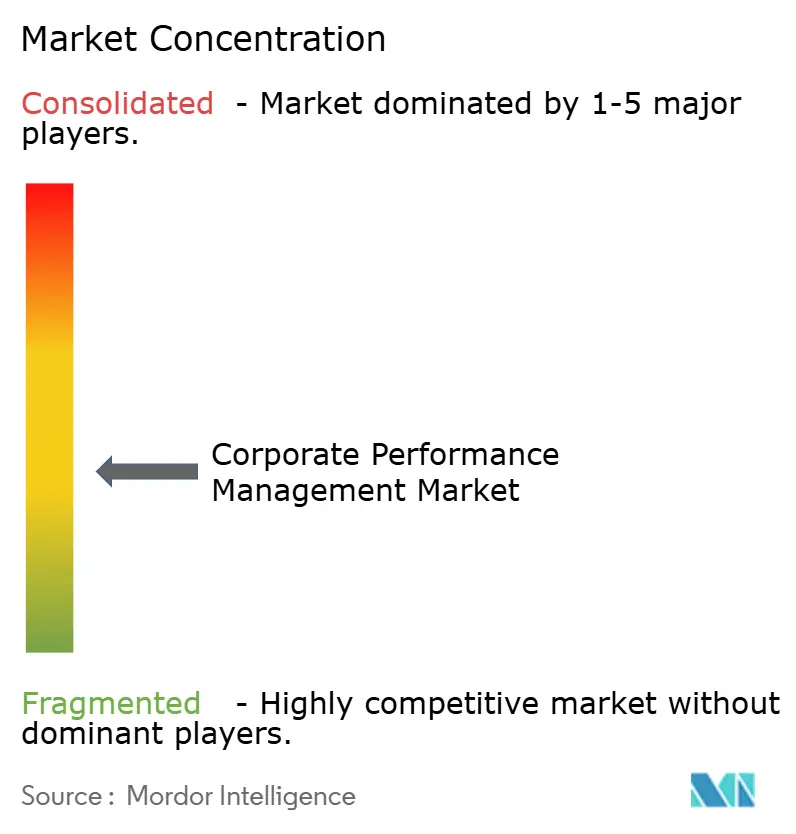
| Market Concentration | Medium |
Major Players *Disclaimer: Major Players sorted in no particular order Image © Mordor Intelligence. Reuse requires attribution under CC BY 4.0. | |
Corporate Performance Management Market Analysis by Mordor Intelligence
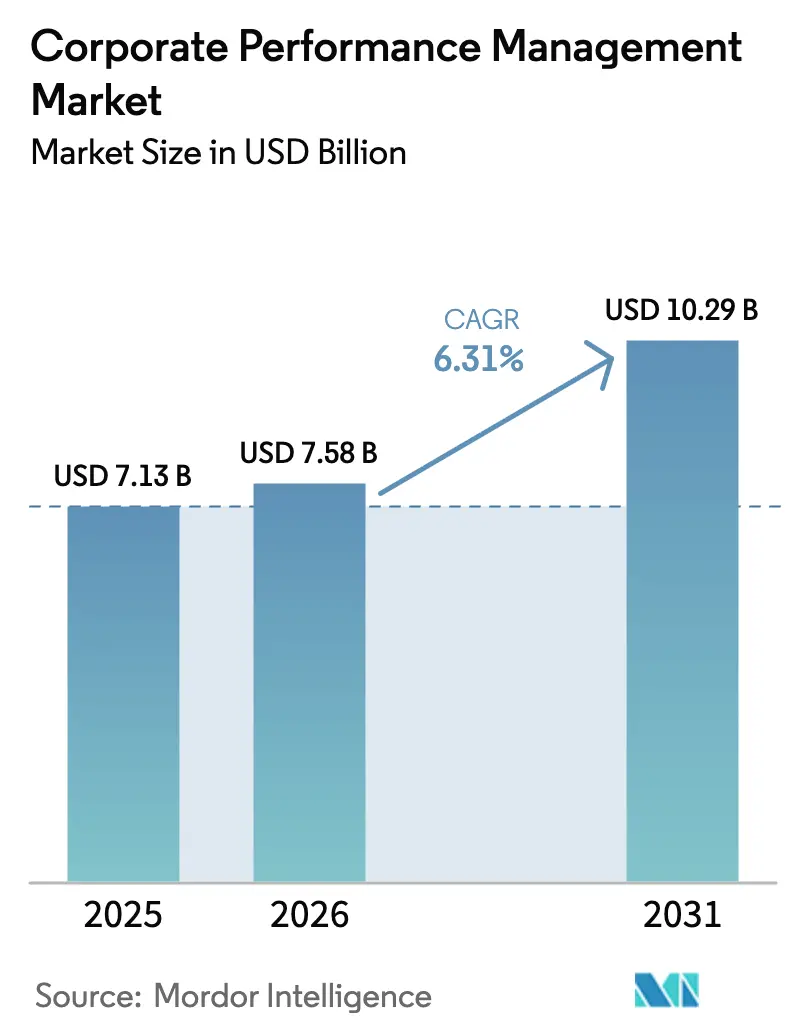
The Corporate Performance Management market size is expected to grow from USD 7.13 billion in 2025 to USD 7.58 billion in 2026 and is forecast to reach USD 10.29 billion by 2031 at 6.31% CAGR over 2026-2031. The upswing stems from mounting regulatory complexity, especially around ESG and SOX mandates, and the pivot from spreadsheet‐based processes to integrated, AI-enabled platforms that unify strategic, operational, and financial planning. Cloud deployment remains the dominant paradigm, propelled by lower infrastructure overhead, real-time collaboration, and seamless AI adoption. Demand is further buoyed by rapid SME digitalization in emerging economies, the rise of extended planning and analytics (xPandA), and expanding use cases in supply-chain resilience and workforce planning. Competitive dynamics reflect intensified vendor consolidation and private-equity confidence in platforms viewed as mission-critical for compliance and data-driven decision-making.
Key Report Takeaways
- By deployment mode, cloud-based platforms led with a 68.05% revenue share in 2025 in the Corporate Performance Management market and are advancing at an 8.07% CAGR through 2031.
- By organization size, large enterprises held 62.98% of the Corporate Performance Management market share in 2025, while SMEs post the highest projected CAGR at 7.74% to 2031.
- By function, finance accounted for 42.15% of the Corporate Performance Management market size in 2025, whereas supply-chain planning is expanding at a 7.44% CAGR.
- By end-user vertical, BFSI captured 29.11% of the Corporate Performance Management market in 2025; healthcare and life sciences are forecast to grow at a 6.86% CAGR.
- By geography, North America commanded 38.10% of 2025 revenue in the Corporate Performance Management market , yet Asia-Pacific is projected to lead growth at a 7.12% CAGR through 2031.
Note: Market size and forecast figures in this report are generated using Mordor Intelligence’s proprietary estimation framework, updated with the latest available data and insights as of 2026.
Market Trends and Insights
Drivers Impact Analysis of Corporate Performance Management Market*
| Driver | (~) % Impact on CAGR Forecast | Geographic Relevance | Impact Timeline |
|---|---|---|---|
| Rising adoption of cloud-based CPM platforms | +1.8% | Global, with Europe lagging at 42% adoption vs North America 62% | Medium term (2-4 years) |
| Tightening regulatory and audit requirements | +1.5% | Global, concentrated in EU/UK for ESG, North America for SOX | Long term (≥ 4 years) |
| AI/ML-driven predictive and prescriptive analytics | +1.2% | North America and EU leading, APAC emerging | Medium term (2-4 years) |
| Expansion of xPandA for cross-functional planning | +1.0% | Global, enterprise-focused initially | Long term (≥ 4 years) |
| Continuous scenario planning for supply-chain shocks | +0.8% | Global, manufacturing-heavy regions prioritized | Short term (≤ 2 years) |
| ESG data integration into CPM dashboards | +0.7% | EU primary, expanding to North America and APAC | Medium term (2-4 years) |
| Source: Mordor Intelligence | |||
Rising adoption of cloud-based CPM platforms
Cloud migration reshapes deployment economics by eliminating on-premises infrastructure and enabling real-time collaboration across finance teams. In 2025, 79% of new CPM implementations are cloud-native, with adoption highest in North America, followed closely by Asia-Pacific, while Europe trails. Self-service planning now involves 68% of users, reducing IT dependence and compressing decision cycles. Vendors demonstrate value by consolidating ERP and CPM workloads on unified clouds, cutting both latency and operating costs. The widening adoption gap opens geographic whitespace for providers specializing in data-sovereignty and low-latency cloud zones.[1]Unit4 Communications, “Exploring the Future of Corporate Performance Management in 2025,” Unit4, unit4.com
Tightening regulatory and audit requirements
Converging financial and non-financial disclosure mandates, from EU CSRD to enhanced SEC XBRL tagging, require automated data lineage and auditable reporting. Asset managers must now substantiate sustainability claims and align 10-K filings with granular ledger detail. Integrated CPM suites that support double-materiality assessments and secure evidence repositories gain favor, while ISO-certified data centers become table stakes. Organizations unable to automate reconciliations incur higher compliance cost and slower report cycles, reinforcing platform demand.
AI/ML-driven predictive and prescriptive analytics
Predictive planning is used by 53% of enterprises, reflecting the need for timely, data-rich forecasts under economic volatility. Advanced models ingest macroeconomic and operational signals, boosting accuracy and flagging outliers before period close. Embedded AI workflows cut manual interventions, speed scenario creation, and surface anomalies within minutes, not days. Vendors differentiate on model transparency and governance features, ensuring auditability alongside speed. Early adopters report up to 10× faster planning cycles while maintaining data granularity.[2]IBM, “Financial Planning and Analysis with IBM Planning Analytics,” IBM, ibm.com
Expansion of xPandA for cross-functional planning
xPandA extends CPM beyond finance into supply chain, HR, and commercial functions, breaking silos and enabling single-source plans. Forty-one percent of organizations rank cross-functional integration as a top priority, seeking synchronized operational and financial views. Pre-configured content packages accelerate rollout by providing vertical-specific templates and live ERP connectivity. Implementations show cycle-time reductions from weeks to days, elevating agility and strategic alignment.
Restraints Impact Analysis of Corporate Performance Management Market*
| Restraint | (~) % Impact on CAGR Forecast | Geographic Relevance | Impact Timeline |
|---|---|---|---|
| High implementation and integration costs | -1.2% | Global, particularly SME segment | Short term (≤ 2 years) |
| Data-security and privacy concerns | -0.8% | EU/UK primary due to GDPR, expanding globally | Medium term (2-4 years) |
| Shortage of CPM/FPandA analytics talent | -0.6% | North America and EU concentrated | Long term (≥ 4 years) |
| Cultural resistance from non-finance functions | -0.4% | Global, enterprise-focused | Medium term (2-4 years) |
| Source: Mordor Intelligence | |||
High implementation and integration costs
Complex rollouts demand sizeable investments in software, integration, and change management. Multi-entity projects often span 12 weeks to 2 years, with cross-functional teams dedicating hundreds of hours. Connecting 150-plus legacy ERP systems magnifies scope and budget. Cloud subscription models partially offset capital outlay, yet full ROI depends on disciplined scope, robust data migration, and ongoing user enablement.
Data-security and privacy concerns
Centralized data stores heighten cyber-risk and regulatory scrutiny, especially under GDPR and emerging AI governance rules. Multinationals juggle data residency mandates, encryption standards, and role-based access to safeguard sensitive ledgers. ISO 27017/27018/27701 certifications and end-to-end encryption influence vendor selection. Added complexity arises when AI models require historical data, necessitating clear governance and explainability to meet audit requirements.
*Our forecasts treat driver/restraint impacts as directional, not additive. The impact forecasts reflect baseline growth, mix effects, and variable interactions.
Corporate Performance Management Market Segment Analysis
By Deployment Mode:
Cloud Dominance Accelerates MigrationCloud platforms accounted for 68.05% of 2025 revenue, confirming their position as the primary delivery model for the Corporate Performance Management market. This segment is projected to post an 8.07% CAGR through 2031. Hybrid models persist in heavily regulated sectors that retain sensitive workloads on-premises yet tap cloud analytics for collaboration. The Corporate Performance Management market size attributed to cloud is widening fastest in Asia-Pacific, where adoption outpaces Europe by more than 25 percentage points. Continuous updates, embedded AI, and lower total cost propel conversions, while data-sovereignty features ease European concerns. Providers emphasize zero-downtime releases and single-tenant security to win risk-averse clients. On-premises deployments still serve air-gapped environments but face shrinking budgets and lengthier upgrade cycles. Competitive differentiation now pivots on cloud service level, scalability, and integrated AI pipelines, prompting legacy vendors to accelerate SaaS roadmaps.
In Europe, slower cloud uptake stems from data-localization directives and conservative IT governance, leaving room for lift-and-shift initiatives and vendor partnerships with sovereign-cloud providers. North American and Asia-Pacific enterprises, by contrast, expedite migration of consolidation, budgeting, and scenario planning workloads to unified cloud stacks, enabling cohesive governance and faster innovation. This regional divergence shapes product localization, pricing, and partner enablement strategies among market participants.




By Organization Size:
SME Acceleration Drives Market ExpansionLarge enterprises retained 62.98% of 2025 revenue, primarily due to multi-currency consolidation and stringent compliance needs. However, SMEs, the fastest-growing cohort at 7.74% CAGR, propel incremental gains in the Corporate Performance Management market. Cloud affordability, subscription pricing, and prebuilt templates decrease barriers, helping SMEs satisfy formal reporting and lending requirements. Asia-Pacific MSME digitalization programs and simplified capital-market listings further stimulate demand.
SMEs prioritize rapid deployment, Office-based interfaces, and minimal IT overhead, contrasting with enterprise preferences for extensibility and governance. Vendors respond with tiered editions, guided implementations, and in-product tutorials that compress time-to-value to weeks. At the upper end, conglomerates seek unified platforms to replace point solutions, enhancing data consistency and audit readiness. This bifurcation drives differentiated roadmaps: intuitive UX and AI-guided configuration for SMEs, versus open APIs, sandbox environments, and fine-grained security for large enterprises.
By Function:
Supply Chain Planning Emerges as Growth EngineFinance functions commanded 42.15% of 2025 revenue, yet supply-chain planning is set to record a 7.44% CAGR, the fastest in the Corporate Performance Management market. Continuous disruptions and ESG traceability pressures elevate operational data within CPM workflows. Integrated planning marries production schedules with cash-flow forecasts, enabling single connected plans that compress re-forecast cycles. Organizations leveraging xPandA report double-digit improvements in forecast accuracy and days-inventory outstanding.
Sales and HR increasingly embed CPM modules for quota setting, workforce capacity, and compensation modeling. AI-infused demand sensing enhances revenue forecasts, while driver-based HR models align hiring plans with strategic targets. Cross-functional data lakes feed predictive engines that flag supply bottlenecks and margin erosion early, tightening the finance–operations feedback loop.

By End-user Vertical:
Healthcare Accelerates Amid Regulatory ComplexityBFSI retained the dominant 29.11% stake thanks to SOX, IFRS, and capital-adequacy rules that mandate granular data lineage. Healthcare and life sciences, expanding at 6.86% CAGR, now represent the most dynamic vertical in the Corporate Performance Management market. Rising R&D spend, clinical-trial cost pressures, and stringent FDA/EMA reporting spur adoption of unified planning that tracks milestones, budgets, and compliance metrics. Manufacturers turn to CPM for emissions accounting, asset utilization, and operational resilience, while retailers integrate omnichannel sales data to optimize inventory and promotions.
Telecommunications firms deploy CPM for infrastructure ROI modeling and subscription revenue planning, and energy companies use it for rate-case modeling and asset retirement obligations. Public-sector entities adopt performance-based budgeting and citizen-experience metrics, reflecting a broadening scope of CPM usage across service delivery.
Geography Analysis
North America and Europe Corporate Performance Management Market
North America led with a 38.10% share in 2025, underpinned by mature enterprise-software ecosystems, deep implementation talent, and early AI adoption across finance and operations. Enterprises prioritize integrated AI scenarios and compliance automation, reinforcing vendor investment in regional data centers and partner certification. Europe follows, driven by multi-layered ESG mandates that demand unified non-financial and financial disclosures within trusted platforms. Data-privacy obligations and sovereignty concerns slow cloud conversion but favor providers offering in-region hosting and robust encryption.
APAC, South America and MEA Corporate Performance Management Market
Asia-Pacific is the fastest-growing geography at 7.12% CAGR, fueled by government-backed MSME digitization grants, fintech expansion, and capital-market reforms. The Corporate Performance Management market size across Asia-Pacific mid-market firms is projected to double by 2030 as local integrators bundle CPM with ERP rollouts. Australian and Japanese enterprises emphasize ESG assurance, while Southeast Asian companies focus on cash-flow forecasting amid currency volatility. South America exhibits a steady uptake as public company reforms and foreign investment inflows demand modern planning tools. In the Middle East and Africa, economic diversification and national vision programs trigger initial deployments, often starting with budgeting and gradually layering analytics.


Regulatory Landscape
Corporate performance management (CPM) adoption is increasingly shaped by converging financial, ESG, and digital-risk rules that raise expectations for auditable data lineage, controlled reporting processes, and governed use of cloud and AI. In Europe, the interaction between ESMA Alternative Performance Measures (APM) guidance and IFRS 18 has been clarified through ESMA Q&As, with related amendments taking effect from 1 January 2027 alongside mandatory IFRS 18 application. This pushes organizations to strengthen reconciliation controls and disclosure governance in management reporting workflows.
Security and supply-chain assurance rules also affect CPM requirements as planning and reporting rely more on third-party data, cloud platforms, and integrated operational systems. The EU Cyber Resilience Act increases vulnerability reporting and supply-chain security expectations for digital products, and EU CBAM moves carbon-emissions reporting toward mandatory verification. That combination raises demand for controlled evidence repositories and traceable ESG data feeding CPM dashboards. In the UK, the Competition and Markets Authority issued guidance in January 2026 on environmental and green claims, highlighting potential third-party liability and increasing the need for contract-backed data collection and defensible sustainability metrics across enterprise reporting cycles.
Value Chain Analysis
The CPM value chain begins with data creation across ERP, finance close, HR, sales, and operational systems. It then moves into data management, including integration, master data alignment, metadata, and governance, before shifting to modeling and planning such as budgeting, forecasting, consolidation, and scenario planning. The chain ends with reporting, disclosures, and performance review workflows.
As AI-enabled planning expands and cloud remains the dominant deployment paradigm, the ecosystem depends more on reliable connectors to ERPs, secure cloud infrastructure, and standardized data definitions that support repeatable, auditable planning and close processes across business units. Implementation partners and systems integrators drive configuration, data migration, and change management, while assurance and advisory functions influence solution design through auditability, controls, and policy alignment. Supplier and third-party data capture is also becoming a core upstream input in industries exposed to verified emissions reporting (CBAM) and digital supply-chain security expectations under frameworks such as the EU Cyber Resilience Act. That raises the value of platforms that operationalize data lineage, role-based access, and evidence management across the planning-to-reporting chain, including cross-functional xPandA use cases that link operational signals to financial outcomes.
Competitive Landscape
The Corporate Performance Management market remains moderately fragmented. ERP giants, Oracle, SAP, and Microsoft, leverage installed bases to cross-sell tightly integrated CPM modules. Pure-play vendors such as OneStream, Anaplan, and Workday Adaptive Planning compete through domain focus, rapid innovation, and partner ecosystems. OneStream surpassed USD 450 million ARR in 2023, scaling to 1,400 customers by unifying consolidation, planning, and reporting on a single code base. Private-equity activity accelerates consolidation: Thoma Bravo’s USD 10.7 billion Anaplan take-private and Vista Equity-Blackstone’s USD 8.4 billion Smartsheet buyout underscore investor confidence in mission-critical planning platforms.
Strategic differentiation centers on embedded AI, open architectures, and vertical packages. IBM Planning Analytics integrates watsonx AI for transparent forecasting, while SAP pairs business-technology platform services with live ERP data to shorten model-build time. Vendors augment offerings through marketplaces and low-code extensions, allowing customers to tailor industry workflows. Regional challengers focus on sovereign clouds and regulatory localization. As top players capture larger wallet share, late-stage startups either specialize or seek strategic exits, foreshadowing continued merger activity.
Corporate Performance Management Industry Leaders
Oracle Corporation
SAP SE
IBM Corporation
Host Analytics Inc.
Adaptive Insights LLC (Workday Adaptive Planning)
- *Disclaimer: Major Players sorted in no particular order
Corporate Performance Management Market Companies Covered in this Report
- Oracle Corporation
- SAP SE
- IBM Corporation
- Microsoft Corporation
- Workday, Inc.
- Anaplan, Inc.
- Wolters Kluwer N.V. (CCH Tagetik)
- OneStream Software LLC
- Infor, Inc.
- Planful, Inc.
- Prophix Software Inc.
- insightsoftware, Inc.
- Jedox AG
- Board International S.A.
- Unit4 N.V.
- Epicor Software Corporation
- SAS Institute Inc.
- Adaptive Insights LLC (Workday Adaptive Planning)
- Host Analytics Inc.
- Longview Solutions Inc.
- Vena Solutions Inc.
- Solver USA, Inc.
- insightsoftware-CXO Software
- BlackLine, Inc.
- Deltek, Inc.

Market Opportunities and Future Outlook
A major opportunity sits at the intersection of CPM, AI, and data-unification investments by large enterprise software providers. Agentic experiences and governed decision workflows reduce spreadsheet dependency and speed scenario iteration. In 2026, product and platform moves by Workday, Oracle, and SAP indicate an active shift toward AI-assisted planning, including natural language interaction with plans, scenario exploration, and tighter linkage between planning models and enterprise data services.
That creates whitespace for CPM vendors and partners packaging governed AI features, such as explainability, audit trails, and role-based controls, into industry templates for finance-led and cross-functional planning. The emphasis is particularly relevant in regulated verticals such as BFSI and healthcare. Regulatory complexity also supports opportunities for CPM suites that operationalize evidence-backed ESG and management reporting, as verified carbon data under CBAM and tighter environmental claims expectations highlighted in UK CMA guidance in January 2026 increase the need for traceable inputs. It also aligns with evolving European reporting enforcement tied to IFRS 18 and ESMA APM guidance, with amendments effective 1 January 2027. In parallel, hyperscaler and enterprise cloud investment cycles underpin performance and scalability needs for near-real-time planning. Oracle disclosed significant funding activity in FY2026 and articulated plans to raise additional capital in FY2027 to support AI cloud infrastructure expansion, reinforcing the enterprise shift toward cloud and AI-ready stacks that CPM vendors increasingly depend on. Vendors that align deployment choices with data-sovereignty, security certifications, and third-party risk controls are better positioned to win organizations seeking cloud economics alongside region-specific governance requirements.
Recent Industry Developments in Corporate Performance Management Market
- July 2026: SAP SE completes acquisition of Prior Labs, a developer of Tabular Foundation Models (TFMs). The move strengthens SAP's AI-enabled planning integration across the CPM stack and broadens agentic data unification for planning workflows.
- July 2026: SAP SE completes acquisition of Dremio, open data lakehouse platform to integrate SAP and non-SAP data for agentic AI workloads. The initiative enhances the data fabric for CPM planning and accelerates unification of data sources for AI-driven planning.
- July 2026: Oracle Corporation introduces AI-native builder experience for Oracle AI Agent Studio to enable creation and deployment of Fusion Agentic Applications. The development expands Oracle's agentic planning capability in the CPM market and supports building agentic CPM apps.


Corporate Performance Management Market Report Scope and Research Methodology
Market Definition and Coverage
For this study, the corporate performance management market covers software and related services that help companies plan, budget, forecast, consolidate financials, and track performance using connected data and workflows.
Scope exclusions: We exclude generic BI tools that do not support CPM workflows, pure HR performance tools, and standalone accounting systems that lack planning and close capabilities.
Segments Covered in This Report
- By Deployment Mode
- On-Premises
- Cloud-Based
- Hybrid
- By Organization Size
- Small and Medium Enterprises (SMEs)
- Large Enterprises
- By Function
- Finance
- Human Resources
- Supply Chain
- Sales and Marketing
- By End-user Vertical
- Banking, Financial Services and Insurance (BFSI)
- Retail and E-commerce
- Manufacturing
- Healthcare and Life Sciences
- IT and Telecommunications
- Energy and Utilities
- Government and Public Sector
- Other End-user Verticals
- By Geography
- North America
- United States
- Canada
- South America
- Brazil
- Argentina
- Rest of South America
- Europe
- Germany
- United Kingdom
- France
- Italy
- Spain
- Rest of Europe
- Asia-Pacific
- China
- Japan
- India
- South Korea
- Rest of Asia-Pacific
- Middle East
- United Arab Emirates
- Saudi Arabia
- Rest of Middle East
- Africa
- South Africa
- Rest of Africa
- North America
Data Sources, Market Sizing, and Validation
Desk Research
Desk research starts with building the demand context for CPM spending and how finance teams are changing their planning and close processes. We relied on public sources such as US SEC filings, US Bureau of Economic Analysis data, US Bureau of Labor Statistics series, World Bank indicators, and OECD digital economy publications to set macro and enterprise spending anchors.
To translate that context into CPM-relevant signals, we also reviewed sources such as IFRS publications and guidance, AICPA resources, and reputable cloud adoption and cybersecurity reporting from government and standards bodies where applicable. On the supply side, we used company annual reports, earnings transcripts, and investor presentations to map revenue exposure and product scope, supported by paid subscriptions for company financials and intelligence, news and financials, and patent databases when classification or product wording needed clarification. These desk sources are illustrative, and many other public documents and databases were also used for data collection, validation, and clarification.
Primary Interviews and Surveys
Primary work focused on checking what buyers actually purchase and how contracts are structured across planning, consolidation, and reporting workflows. We spoke with a mix of software providers, implementation partners, finance leaders, and analysts across major regions so we could validate adoption patterns, average contract values, and cloud migration timing, then carry those inputs into the sizing model.
Distribution of primary research fieldwork respondents
| Company type | Respondent position | Region |
|---|---|---|
| Top tier: 36% | CXOs: 14% | APAC: 43% |
| Mid tier: 50% | Functional/Unit leaders: 34% | EMEA: 37% |
| Smaller Players: 14% | Managers: 52% | Americas: 20% |
Market-Sizing & Forecasting
The sizing model is built using a top-down and bottom-up mix, where the demand pool is first reconstructed from enterprise software spending patterns and finance function digitization signals, and then adjusted using supplier and channel checks. In practice, we start with region-level enterprise IT and software spend indicators, apply CPM penetration assumptions by organization size and industry, and then convert that into revenue using typical subscription and services mixes.
To keep the model market-specific, a few inputs are tracked carefully, such as cloud versus on-premises deployment mix, the pace of planning modernization (moving off spreadsheets), consolidation and close cycle automation adoption, the share of spend tied to implementation and training services, and pricing direction for seat-based versus usage-based packaging. Where bottom-up evidence is available, sampled vendor revenue exposure, partner-led implementation volumes, and observed average contract values are used to sanity-check totals, and gaps are handled by applying conservative ranges that are later tightened through interview feedback.
For forecasting, we primarily use scenario analysis supported by variable-level expectations gathered from experts, since CPM demand tends to move with budgeting cycles and shifts in compliance and reporting needs. The base case reflects the most commonly reported adoption pace, and a faster or slower case is kept to reflect macro uncertainty and slower project rollouts in certain industries.
Data Validation & Update Cycle
Validation is done through multiple passes, starting with cross-checks against independent signals like public revenue disclosures, enterprise software spending trends, and regional cloud adoption direction. Outliers are investigated by revisiting assumptions such as deployment mix, services attach rates, and currency conversion timing, and then the model is re-run to confirm changes behave logically.
Before sign-off, results are reviewed by another analyst to confirm the market boundary, unit consistency, and year-to-year movements are reasonable. The report is refreshed annually, and interim updates are triggered when a material event changes adoption timing or pricing direction. Right before delivery, we run a fresh verification pass so clients receive the latest view available.
Mordor Intelligence's Corporate Performance Management Market Sizing Compared With Other Published Estimates
Different published market sizes for CPM can vary because the boundary is not always the same, and the revenue counted can shift based on what is treated as CPM versus adjacent analytics, ERP finance modules, or consulting-heavy services. Year choice also matters, because exchange rates, cloud transition timing, and pricing models can move totals even when user demand is steady.
Vendor revenue disclosures, implementation partner project volumes, and observed shifts in cloud subscription mix are the checks that keep Mordor Intelligence's estimate tied to CPM planning, close, and consolidation spend, with adjacent BI-only deployments and non-CPM HR performance tools kept out. The remaining spread usually comes from whether services are fully included, whether smaller organizations are counted with simplified penetration assumptions, and whether older base years are rolled forward without re-testing adoption and pricing inputs.
Benchmark comparison
| Source | Market Size | Gaps in Research Methodology |
|---|---|---|
| Mordor Intelligence | USD 7.58 B (2026) | |
| Trade Publisher A | USD 7.43 B (2024) | Uses an earlier base year with a shorter horizon, and it appears to apply a tighter definition closer to core CPM system revenue, which can undercount services and newer cloud-led expansions. |
| Industry Research Outlet B | USD 6.80 B (2025) | Anchors the model to a single base year and extends forward with a higher long-run CAGR, but the nearer-year value can sit lower if penetration assumptions for mid-market adoption and cloud migration are conservative. |
Across the three figures, the main takeaway is that scope boundaries and base-year choices explain most of the gap, and then pricing and cloud mix assumptions do the rest. By keeping the inputs traceable to adoption signals and spend conversion steps, the estimate stays repeatable and easier to reconcile when new disclosures or buyer behavior changes show up.


Key Questions Answered in the Report
What is the projected value of the Corporate Performance Management market by 2031?
The market is forecast to reach USD 10.29 billion by 2031.
Which deployment model shows the fastest growth?
Cloud platforms are expanding at an 8.07% CAGR through 2031, outpacing on-premises and hybrid models.
Why are SMEs accelerating adoption of Corporate Performance Management solutions?
Subscription pricing, prebuilt templates, and regulatory formalization across emerging economies lower barriers and drive an 7.74% CAGR among SMEs.
Which function is witnessing the highest growth within CPM applications?
Supply-chain planning leads with a 7.44% CAGR as firms pursue xPandA for resilience and synchronized financial-operational planning.
Which region will register the quickest growth?
Asia-Pacific is projected to grow at a 7.12% CAGR, propelled by MSME digitization and capital-market reforms.
Page last updated on:


 Your data is secure and never sold or shared.


