
Copper Foil For Battery Market Size and Share
Market Overview
| Study Period | 2021 - 2031 |
|---|---|
| Market Size (2026) | USD 6.30 Billion |
| Market Size (2031) | USD 10.54 Billion |
| Growth Rate (2026 - 2031) | 10.86 % |
| Fastest Growing Market | Asia-Pacific |
| Largest Market | Asia-Pacific |
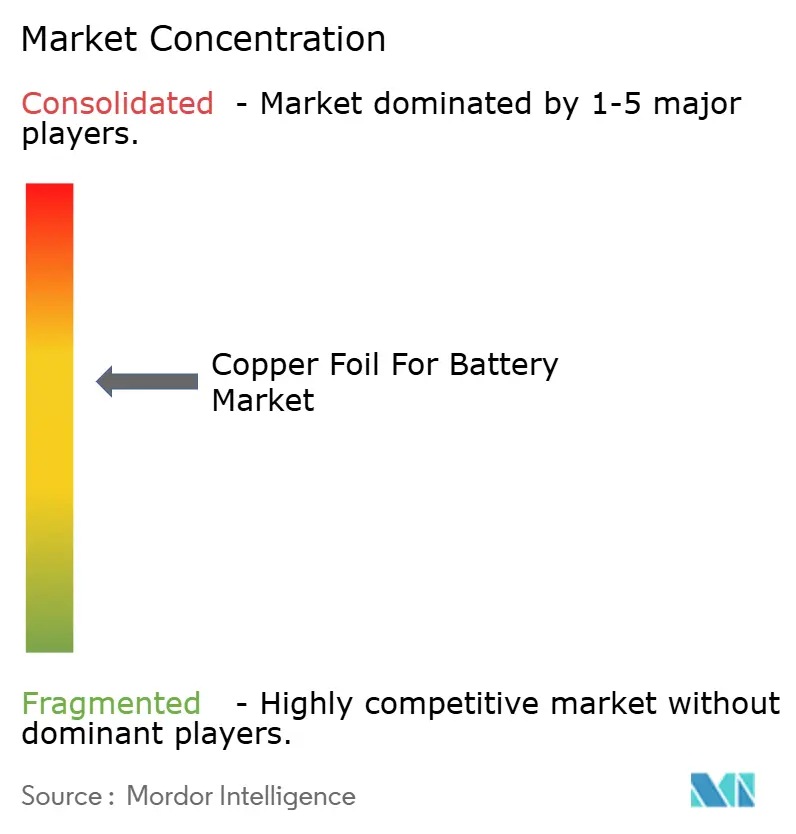
| Market Concentration | Medium |
Major Players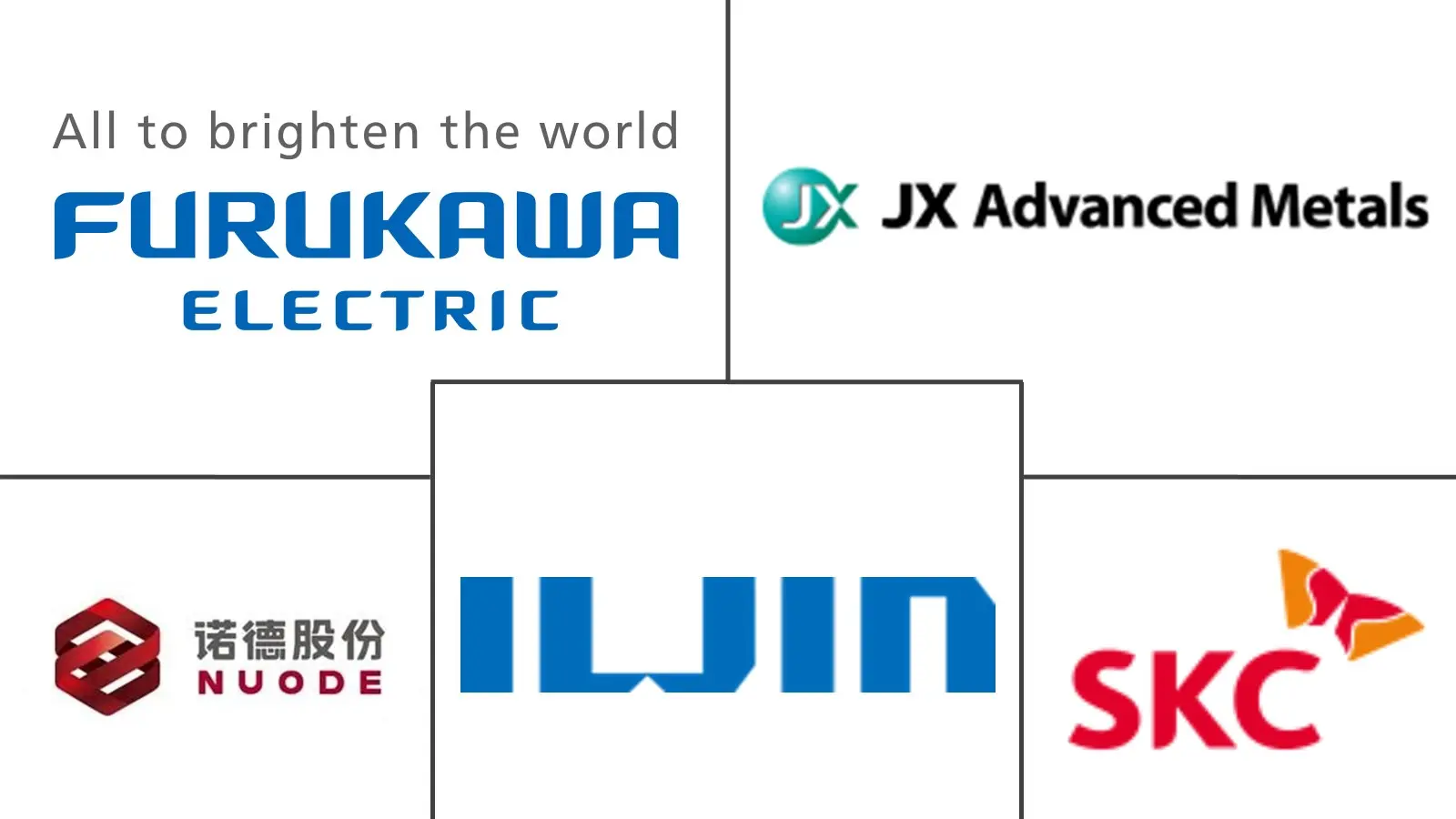 *Disclaimer: Major Players sorted in no particular order Image © Mordor Intelligence. Reuse requires attribution under CC BY 4.0. | |
Copper Foil For Battery Market Analysis by Mordor Intelligence
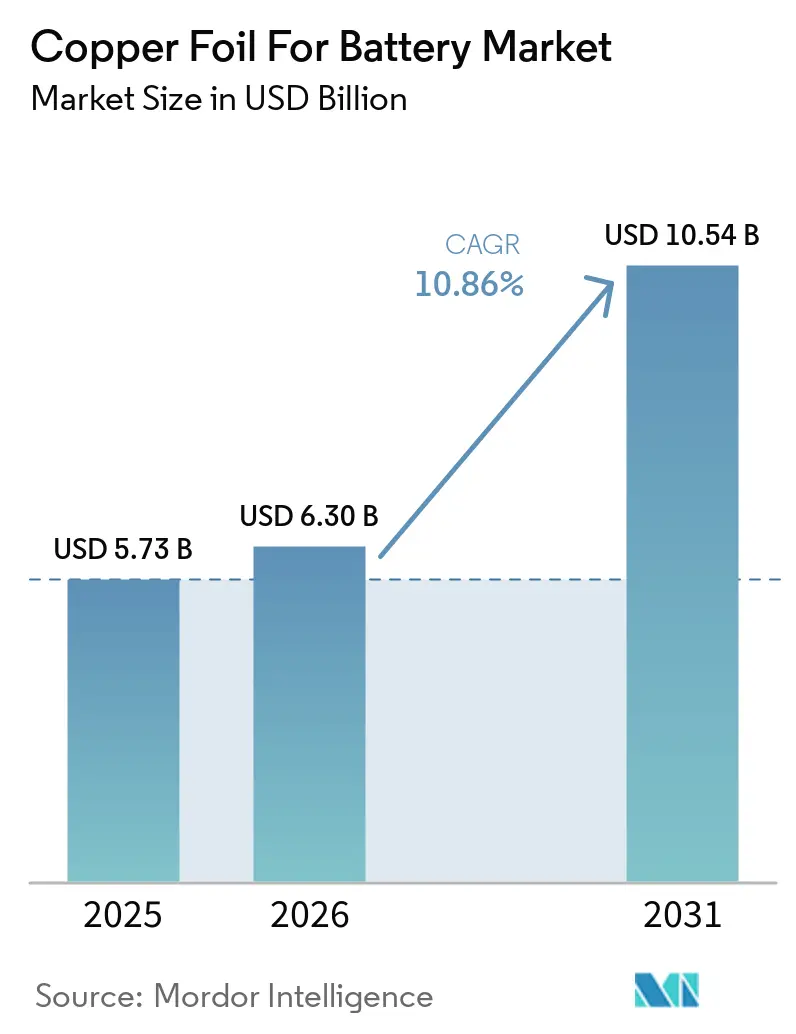
The copper foil for battery market size was valued at USD 5.73 billion in 2025 and is estimated to grow from USD 6.30 billion in 2026 to USD 10.54 billion by 2031, at a CAGR of 10.86% during the forecast period (2026-2031). The copper foil for battery market is driven by rising lithium-ion cell output and the demand for copper current collectors in electric vehicles, stationary storage, and consumer devices. The expansion of battery storage has broadened demand beyond vehicle powertrains, reducing the market's reliance on any single end use. Producers are directing investment toward thinner, higher-performance materials as battery manufacturers seek better energy density and more consistent manufacturing yields. This shift favors suppliers that can qualify ultra-thin grades while maintaining quality control at high output levels. The market also faces uneven economics, as standard grades remain exposed to capacity pressure, while premium grades face tighter technical requirements but better pricing conditions.
Key Report Takeaways
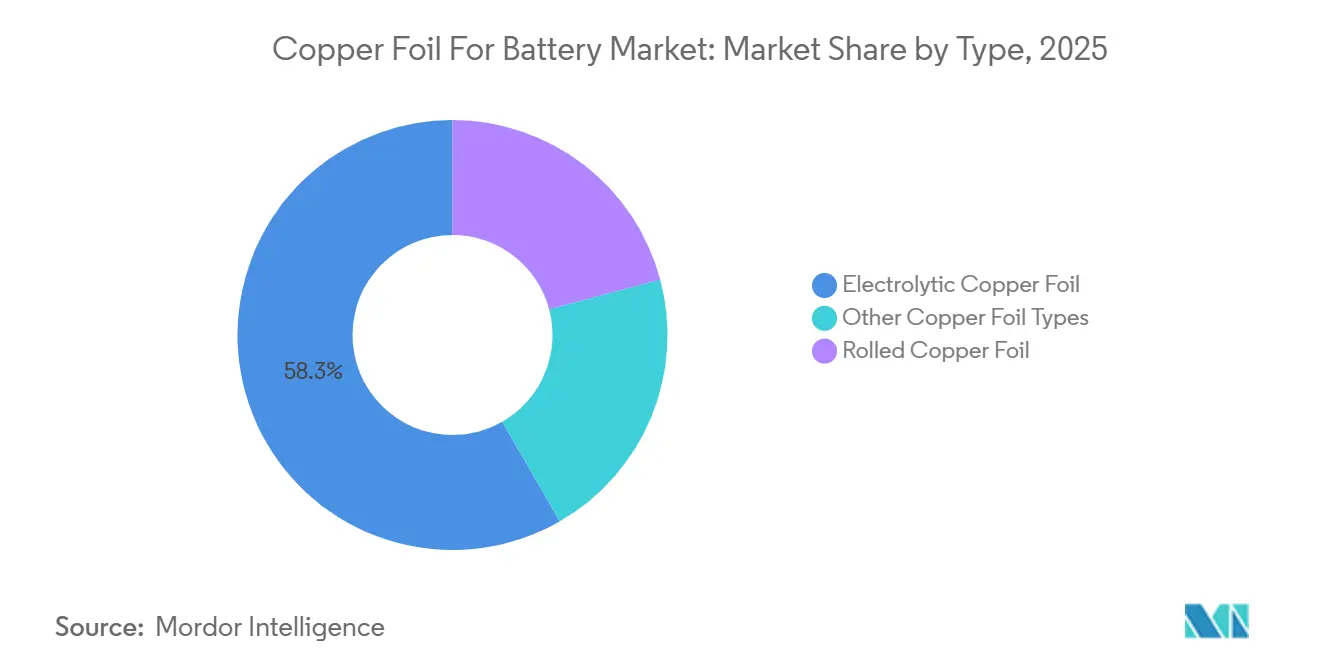
- By type, electrolytic foil led with 58.31% of total demand in 2025 and is forecast to grow at an 11.45% CAGR through 2031.
- By application, lithium-ion batteries held 73.78% of demand in 2025, while solid-state batteries are forecast to expand at a CAGR of 11.87% through 2031.
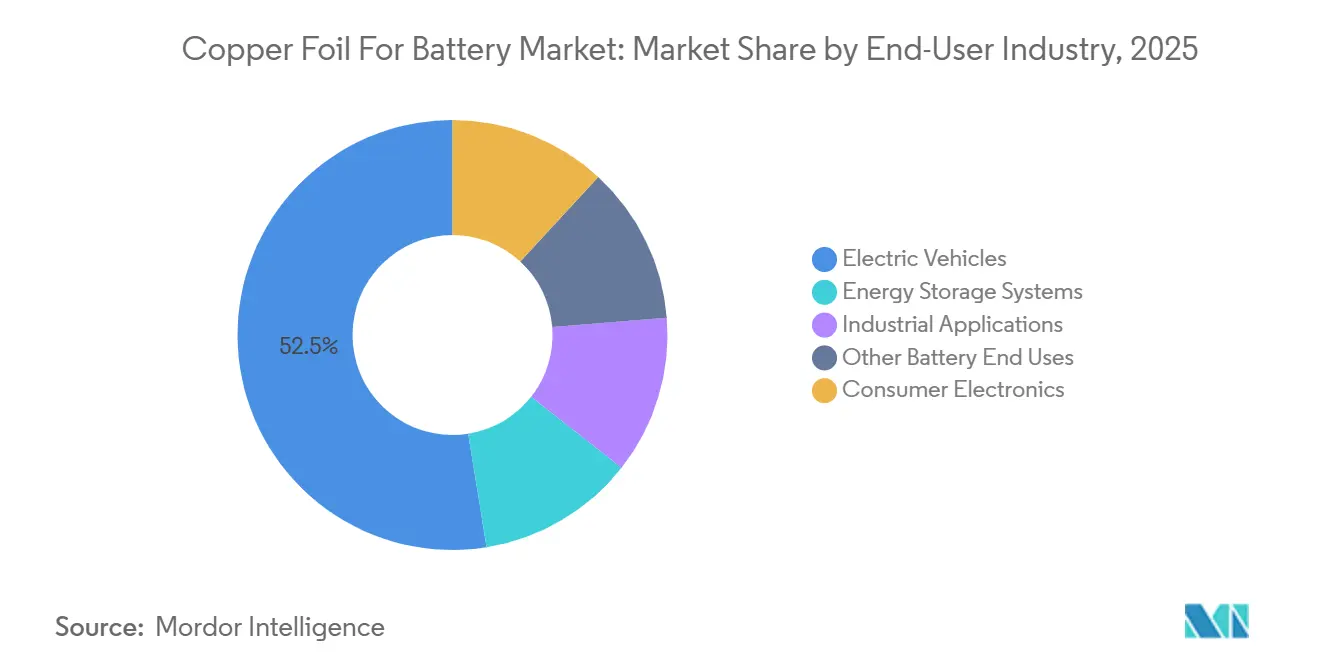
- By end-user industry, electric vehicles accounted for 52.53% of demand in 2025, while energy storage systems are forecast to expand at a 12.66% CAGR through 2031.
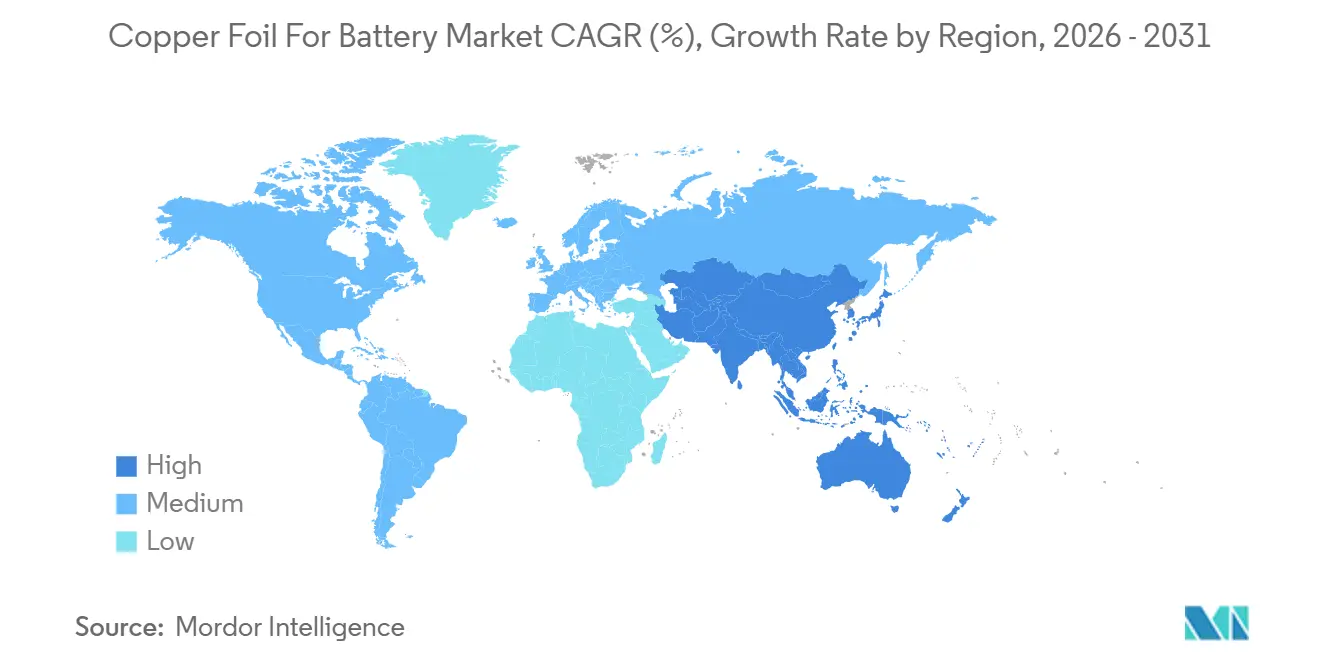
- By geography, within the copper foil for battery market, Asia-Pacific accounted for 56.27% of total demand in 2025 and is forecast to grow at a 12.23% CAGR through 2031.
Note: Market size and forecast figures in this report are generated using Mordor Intelligence’s proprietary estimation framework, updated with the latest available data and insights as of January 2026.
Global Copper Foil For Battery Market Trends and Insights
Drivers Impact Analysis*
| Drivers | (~) % Impact on CAGR Forecast | Geographic Relevance | Impact Timeline |
|---|---|---|---|
| Accelerating Electric Vehicle Battery Production | +3.0% | Global, with Asia-Pacific at the core and spillover to North America and Europe | Short term (≤ 2 years) |
| Expansion of Grid-Scale and Stationary Energy Storage | +2.5% | Global, with North America and Asia-Pacific most relevant | Medium term (2-4 years) |
| Demand for Ultra-Thin Foil to Increase Cell Energy Density | +1.8% | Global, with Asia-Pacific at the core and early gains in South Korea and Japan | Medium term (2-4 years) |
| Battery-Manufacturing Localization and Supply-Chain Diversification | +1.5% | North America and Europe | Long term (≥ 4 years) |
| Solid-State Battery Commercialization | +0.8% | Asia-Pacific, with early commercial ramp in Japan and South Korea | Long term (≥ 4 years) |
| Source: Mordor Intelligence | |||
Accelerating Electric Vehicle Battery Production
Electric vehicle battery production remains the primary driver for the copper foil for battery market. Global lithium-ion cell production is estimated at 3,400 GWh in 2026, and each GWh requires 1,000 to 1,400 tons of battery-grade foil. Growth in cell production increases the need for a reliable supply of foil, as anode production cannot proceed without a qualified current-collector material. Large-format cylindrical cells require tighter dimensional tolerances and higher tensile strength than many established products, shifting purchasing toward advanced electrolytic grades rather than commodity material. LG Energy Solution is targeting more than 50 GWh of Lithium Iron Phosphate (LFP) cell capacity across five North American facilities by the end of 2026, demonstrating how cell investments can establish local qualification and pipelines for foil suppliers.
Expansion of Grid-Scale and Stationary Energy Storage
Stationary storage is an independent source of demand for copper foil in the battery market. Grid-scale batteries are deployed alongside renewable generation and require the same copper current-collector function as vehicle batteries. Battery energy storage deployment in the United States increased 25-fold between 2019 and 2025. Global copper consumption in the energy storage system sector reached 540,000 metric tons in 2026, up 80% from the prior year. These applications commonly use LFP chemistry and 8-10 μm copper foil, supporting demand for mainstream grades, even as some electric vehicle cells use 6 μm foil. This demand stream can partially offset softness in electric-vehicle foil orders.
Demand for Ultra-Thin Foil to Increase Cell Energy Density
Copper represents 10% of battery cell weight, making thickness reduction important for cell design. Thinner foil reduces inactive material within a cell while maintaining the current-collection function required for anode operation. A 2025 peer-reviewed study reported that electrodeposited 4.5 μm foil achieved 9.1% elongation, addressing mechanical concerns associated with thinner products. The study supports the use of thin electrodeposited foil where strength and ductility must be maintained together. China's output mix has shifted toward 4.5 μm products, which earn higher processing fees than standard 6 μm foil. This creates a clearer commercial case for the battery industry to invest in process control, surface quality, and qualification capabilities.
Battery-Manufacturing Localization and Supply-Chain Diversification
Battery manufacturing localization is changing where qualified copper foil capacity is needed. The United States Inflation Reduction Act links the full consumer clean vehicle credit to North American battery-component manufacturing, with the local-content requirement rising to 100% by 2029[1]. This policy encourages cell producers and material suppliers to build regional supply relationships before local demand reaches full scale. Volta Energy Solutions Canada is scheduled to begin production at its Granby, Quebec, facility in the second half of 2026, with an annual capacity of 25,000 tons and combined development-bank and government financing of USD 300 million. In Europe, carbon footprint disclosure and due diligence obligations under the EU Battery Regulation give certified, lower-carbon production greater relevance in procurement. As a result, the copper foil for battery market is shaped by compliance requirements as well as delivered cost.
Restraints Impact Analysis*
| Restraints | (~) % Impact on CAGR Forecast | Geographic Relevance | Impact Timeline |
|---|---|---|---|
| Copper Cathode Price Volatility | -1.2% | Global | Short term (≤ 2 years) |
| Potential Oversupply and Utilization Pressure | -0.8% | Asia-Pacific, especially China, with spillover to South Korea | Short term (≤ 2 years) |
| Titanium Electroforming-Drum and Specialty Chemical Bottlenecks | -0.5% | Global | Medium term (2-4 years) |
| Source: Mordor Intelligence | |||
Copper Cathode Price Volatility
Copper cathode accounts for 60% to 80% of the cost of producing electrolytic foil. This cost structure makes foil producers sensitive to changes in metal prices when contract terms do not fully pass cost increases on to battery makers. Copper prices rose by one-third between January 2025 and April 2026, reaching record highs, while 2026 smelter treatment charges settled at USD 0 per ton. These conditions indicate tightness in upstream concentrate supply and can raise the cost floor for cathode purchases. Standard 6 μm foil processing fees had fallen to CNY 19,500 per ton by June 2026, limiting producers' ability to absorb increases in input costs. This pressure can constrain profitability across the copper foil for battery market, particularly for producers concentrated in standard grades.
Potential Oversupply and Utilization Pressure
China's nameplate electrolytic copper foil capacity stood at 2.07 million tons across 57 producers in mid-2026. Utilization recovered from 58% in 2024 to 80% in 2026, but 300 to 500 kilotons of idle capacity remained and could return to production within 6 to 12 months. This available idle capacity can limit processing fee recovery, as suppliers may restart lines before pricing improves. The pressure is not uniform across all grades. Standard 6 μm foil remains exposed to capacity pressure, while high-value HVLP circuit foil has a more limited supply and stronger fees. The copper foil for the battery market must therefore be assessed by grade, as total capacity alone does not reflect the availability of qualified premium material.
*Our forecasts treat driver/restraint impacts as directional, not additive. The impact forecasts reflect baseline growth, mix effects, and variable interactions.
Segment Analysis
By Type: Electrolytic Foil Maintains Leadership Through Thin-Gauge Capability
Electrolytic foil held 58.31% of the total demand in the copper foil for battery market in 2025 and is expected to grow at an 11.45% CAGR through 2031. It is the dominant production method because electrodeposition can deliver thin material at a production scale. The process uses controlled current density and electrolyte chemistry to produce foil with a thickness below 6 μm. This capability is important for anode current collectors, where consistent foil thickness helps cell manufacturers manage coating and assembly. A 2025 study found that electrodeposited ultra-thin foil can combine high strength with ductility, supporting the use of electrolytic material in thinner battery designs.
China's 2.07 million tons of electrolytic capacity in 2026 underscores the method's central position in the supply chain. Investment patterns are separating producers that can develop ultra-thin and HVLP material from those supplying commodity 6 μm foil. Rolled foil remains important in applications where repeated bending requires greater flex-fatigue resistance. JX Advanced Metals offers treated rolled copper foil in thicknesses from 9 μm to 150 μm, including grades designed for automotive and communications applications. Other types, including composite current collectors that place thin copper on polymer films, remain at an early commercial stage. These materials are being evaluated for solid-state and silicon-anode designs, where their lower weight and improved thermal runaway behavior offer potential advantages.

By Application: Lithium-Ion Batteries Lead Demand While Solid-State Batteries Change Requirements
Lithium-ion batteries accounted for 73.78% of total copper foil demand in the battery market in 2025. Their position reflects established use in electric vehicles, grid storage, and consumer electronics. Cell manufacturing capacity is organized around lithium-ion chemistries and qualified copper foil specifications. Supplier qualification cycles of 12 to 24 months make it difficult to change foil sources quickly, so we continue to work with established suppliers that meet quality and output requirements. The lithium-ion segment remains the primary source of demand for copper foil in the battery industry.
Solid-state batteries are forecast to grow at an 11.87% CAGR from 2026 to 2031, the fastest rate among applications in the copper foil for battery market. Their foil requirements differ from those of conventional liquid-electrolyte designs because sulfide electrolytes can corrode bare copper, necessitating surface-engineered foil and allowing a price premium for qualified products. Solus Advanced Materials completed development of nickel-plated copper foil for solid-state batteries in March 2025, addressing the corrosion issue and positioning the company for broader commercialization. Nickel-metal hydride batteries continue to serve hybrid vehicles and industrial backup power equipment, while flow batteries and primary cells have smaller output figures.
By End-User Industry: Electric Vehicles Account for the Largest Supply, While Energy Storage Systems Grow Faster
Electric vehicles accounted for 52.53% of end-user demand for copper foil in the battery market in 2025, giving the segment the largest share. Vehicle battery manufacturers use copper foil as an anode current collector across common lithium-ion cell designs. The shift to large-format cylindrical cells changes the required tolerance and strength of the foil but does not eliminate the need for copper collectors. South Korean producers recorded consecutive net losses through 2025 amid weak electric vehicle demand and oversupply, demonstrating that high output does not guarantee attractive margins when standard-grade capacity is abundant.
Energy storage systems are projected to grow at a 12.66% CAGR through 2031, making them the fastest-growing end-user category in the copper foil for battery market. Global copper consumption for energy storage systems reached 540,000 metric tons in 2026. Storage projects provide demand outside vehicle production cycles and can support higher utilization at foil plants. Their preference for lithium iron phosphate (LFP) cells maintains demand for 8- to 10-μm foil, which differs from the thinner material used in many high-energy vehicle cells. Consumer electronics continue to require 6- to 8-μm foil for lithium-polymer batteries in smartphones and wearables. Industrial applications, including uninterruptible power supply (UPS) systems, grid-stabilization batteries, and specialty power equipment, add stable procurement demand with lower price sensitivity than commodity vehicle foil.
Geography Analysis
Asia-Pacific held 56.27% of total demand in 2025 and is forecast to grow at a 12.23% CAGR through 2031. China provides the region's largest production base, while South Korea and Japan retain important positions in advanced products. China's share of 4.5 μm ultra-thin electrolytic foil output rose from 25% in 2025 to 50% in 2026, indicating that Chinese producers are moving toward higher-specification material even as standard-grade capacity remains high. South Korean suppliers are increasing their focus on energy storage and high-frequency circuit foil following weakness in electric vehicle demand. Japan remains important in High Volume Low Profile (HVLP) and other premium foil categories where process control and product performance are critical.
Within the copper foil for battery market, North America is emerging as a new production and demand center driven by local-content requirements. The Inflation Reduction Act requires 100% North American sourcing of battery components by 2029 to qualify for the full consumer tax credit. Nippon Denkai began mass production at its Augusta, Georgia, facility in 2025, with an annual electric-vehicle battery copper foil capacity of 9,500 metric tons, supported by a USD 150 million investment. Volta Energy Solutions Canada is set to begin production of 25,000 tons per year in Quebec during the second half of 2026. Mexico's growing role in electric vehicle assembly supports demand for regionally qualified materials. These developments are expected to reduce the region's dependence on imports over time while creating new qualification opportunities for suppliers.
Within the copper foil for battery market, demand in Europe is linked to gigafactory development in Germany, Hungary, and the Nordic countries. The region's battery-grade foil supply is more concentrated than its demand base. Solus Advanced Materials operates a battery-grade copper foil facility in Hungary. The EU Battery Regulation requires carbon footprint declarations and supply chain due diligence, underscoring the importance of documented manufacturing conditions[2]. These obligations favor suppliers that can demonstrate lower-carbon and traceable production. South America, the Middle East, and Africa remain early-stage demand areas, with output connected to electric vehicle programs and pilot energy storage projects. Brazil's renewable energy integration plans and Saudi Arabia's Vision 2030 agenda offer longer-term potential for storage-related demand.
Competitive Landscape
The copper foil for battery market is moderately concentrated, with Chinese producers holding a large share of electrolytic foil nameplate capacity. Jiujiang Defu Technology, Guangdong Jiayuan Technology, Anhui Tongguan Copper Foil, and Nuode Investment compete on output, cost, and ultra-thin qualification. Standard 6 μm foil faces lower processing fees due to extensive capacity, while premium HVLP material commands more favorable pricing given its demanding performance requirements. Japanese and South Korean suppliers retain strengths in premium ultra-thin and high-frequency grades. Competition is based on technical capability and product mix, not only on installed tonnage.
In July 2026, Jiujiang Defu Technology signed an agreement to acquire Circuit Foil Luxembourg from Volta Energy Solutions for EUR 174 million (~USD 199.31 million). The target has 16,800 tons per year of HVLP and carrier-foil capacity. The transaction will provide Defu with access to European production and advanced foil technology. Furukawa Electric revised its copper foil operating-profit guidance upward for fiscal 2026 as its product mix shifted toward HVLP high-frequency foil for AI data centers, reflecting how exposure to premium products can improve earnings and reinforcing the importance of specialization in the copper foil for the battery market.
South Korean companies are diversifying across geographies and applications. In June 2025, SKC secured a USD 110 million investment from Toyota Tsusho into SK Nexilis Malaysia. LOTTE Energy Materials is converting Iksan battery-foil capacity to AI circuit foil and expanding output to meet energy-storage demand. In May 2026, LOTTE Energy Materials approved KRW 49 billion (~USD 35.7 million) for circuit-foil capacity at Iksan. Suppliers are also examining composite collectors, silicon-anode-compatible surface treatments, and low-carbon electrolytic foil. These areas remain open to differentiation, as no single supplier has established clear leadership across all of them.
Copper Foil For Battery Industry Leaders
-
SKC
-
Nuode Investment Co., Ltd.
-
FURUKAWA ELECTRIC CO., LTD.
-
JX Advanced Metals Corporation
-
ILJIN co., ltd.
- *Disclaimer: Major Players sorted in no particular order
Recent Industry Developments
- July 2026: Jiujiang Defu Technology signed a share purchase agreement to acquire 100% of Circuit Foil Luxembourg from Volta Energy Solutions, a subsidiary of Solus Advanced Materials. Circuit Foil Luxembourg has annual HVLP and carrier foil capacity of 18,519 tons. The acquisition would increase Defu’s annual copper foil capacity to 210,541 tons and provide access to European manufacturing capabilities and HVLP technology.
- May 2026: LOTTE Energy Materials approved an investment of KRW 49 billion (USD 35.7 million) to expand AI circuit foil production at its Iksan, South Korea, plant. The expansion will increase annual circuit foil capacity to 17,637 tons and address demand from AI data centers and high-frequency networking equipment.
Global Copper Foil For Battery Market Report Scope
Copper foil for batteries is an ultra-thin sheet of copper that functions as the anode current collector (negative electrode collector) in lithium-ion batteries. It serves as the substrate onto which the active anode material, typically graphite, is coated. During charging and discharging cycles, the copper foil facilitates electron flow between the anode and the external circuit.
The copper foil for battery market is segmented by type, application, end-user industry, and geography. By type, the market is segmented into rolled copper foil, electrolytic copper foil, and other copper foil types. By application, the market is segmented into lithium-ion batteries, solid-state batteries, nickel-metal hydride batteries, and other battery applications. By end-user industry, the market is segmented into electric vehicles, consumer electronics, energy storage systems, industrial applications, and other battery end uses. The report also covers market size and forecasts for copper foil for batteries across 15 countries in major regions. The market sizes and forecasts are provided in terms of value (USD).
| Rolled Copper Foil |
| Electrolytic Copper Foil |
| Other Copper Foil Types |
| Lithium-Ion Batteries |
| Solid-State Batteries |
| Nickel-Metal Hydride Batteries |
| Other Battery Applications |
| Electric Vehicles |
| Consumer Electronics |
| Energy Storage Systems |
| Industrial Applications |
| Other Battery End Uses |
| Asia-Pacific | China |
| India | |
| Japan | |
| South Korea | |
| ASEAN Countries | |
| Rest of Asia-Pacific | |
| North America | United States |
| Canada | |
| Mexico | |
| Europe | Germany |
| United Kingdom | |
| France | |
| Italy | |
| NORDIC Countries | |
| Rest of Europe | |
| South America | Brazil |
| Argentina | |
| Rest of South America | |
| Middle East and Africa | Saudi Arabia |
| South Africa | |
| Rest of Middle East and Africa |
| By Type | Rolled Copper Foil | |
| Electrolytic Copper Foil | ||
| Other Copper Foil Types | ||
| By Application | Lithium-Ion Batteries | |
| Solid-State Batteries | ||
| Nickel-Metal Hydride Batteries | ||
| Other Battery Applications | ||
| By End-User Industry | Electric Vehicles | |
| Consumer Electronics | ||
| Energy Storage Systems | ||
| Industrial Applications | ||
| Other Battery End Uses | ||
| By Geography | Asia-Pacific | China |
| India | ||
| Japan | ||
| South Korea | ||
| ASEAN Countries | ||
| Rest of Asia-Pacific | ||
| North America | United States | |
| Canada | ||
| Mexico | ||
| Europe | Germany | |
| United Kingdom | ||
| France | ||
| Italy | ||
| NORDIC Countries | ||
| Rest of Europe | ||
| South America | Brazil | |
| Argentina | ||
| Rest of South America | ||
| Middle East and Africa | Saudi Arabia | |
| South Africa | ||
| Rest of Middle East and Africa | ||
Key Questions Answered in the Report
What is current market size of Copper Foil for Battery Market?
The copper foil for battery market size was valued at USD 5.73 billion in 2025 and is estimated to grow from USD 6.30 billion in 2026 to USD 10.54 billion by 2031, at a CAGR of 10.86% during the forecast period (2026-2031).
Why is ultra-thin copper foil important for battery cells?
Thin foil can reduce the weight of inactive cells while preserving current collection. A 2025 study reported 9.1% elongation for electrodeposited 4.5 μm foil.
What is driving demand from energy storage systems?
Grid-scale storage is expanding alongside renewable power deployment. Energy storage systems are forecast to grow at a 12.66% CAGR through 2031.
Which region has the largest position in copper foil for batteries?
Asia-Pacific held a 56.27% share in 2025 and is forecast to grow at a 12.23% CAGR through 2031.