
Copper Alloy Foils Market Size and Share
Market Overview
| Study Period | 2021 - 2031 |
|---|---|
| Market Size (2026) | USD 755.69 Million |
| Market Size (2031) | USD 985.31 Million |
| Growth Rate (2026 - 2031) | 5.45 % |
| Fastest Growing Market | Asia-Pacific |
| Largest Market | Asia-Pacific |
| Market Concentration | Medium |
Major Players *Disclaimer: Major Players sorted in no particular order Image © Mordor Intelligence. Reuse requires attribution under CC BY 4.0. | |
Copper Alloy Foils Market Analysis by Mordor Intelligence
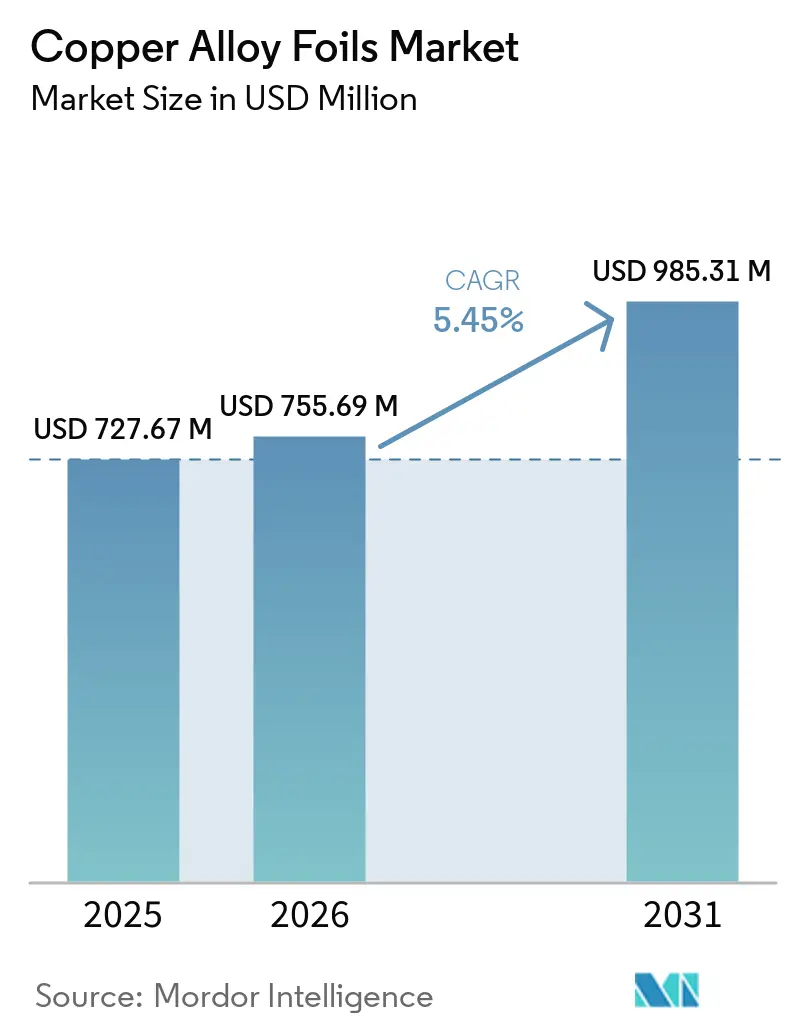
The Copper Alloy Foils Market size was valued at USD 727.67 million in 2025 and is estimated to grow from USD 755.69 million in 2026 to reach USD 985.31 million by 2031, at a CAGR of 5.45% during the forecast period (2026-2031). The copper alloy foils market is supported by vehicle electrification, increasingly demanding electronics designs, and specialized marine systems. Brass, bronze, and copper-nickel grades combine conductivity, corrosion resistance, and spring properties that are not readily available in pure copper. This combination of properties supports their use in applications where materials must meet electrical, mechanical, and environmental requirements simultaneously. Producers are focusing on recycling, downstream processing, and advanced rolled products to protect conversion margins. Opportunities are strongest where suppliers can meet stringent qualification requirements for ultra-thin grades and high-performance electronics.
Key Report Takeaways
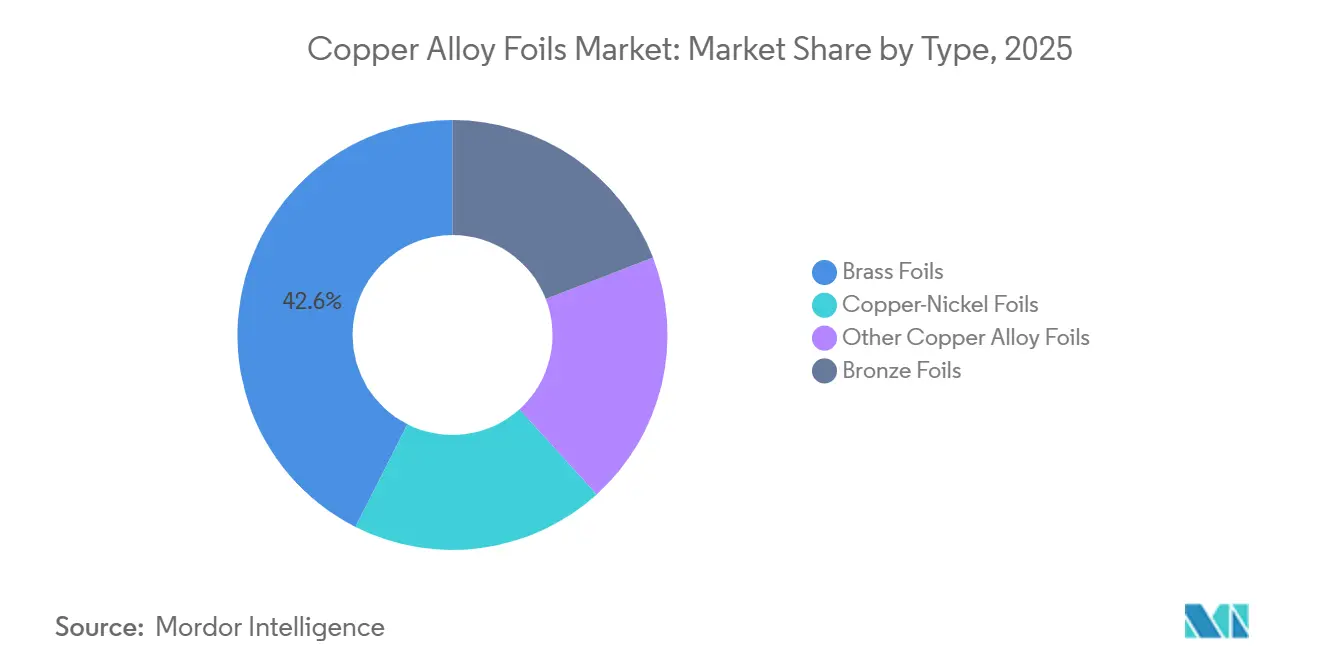
- By type, brass foils held 42.56% of the copper alloy foils market share in 2025, while bronze foils are forecast to grow at a 6.12% CAGR through 2031.
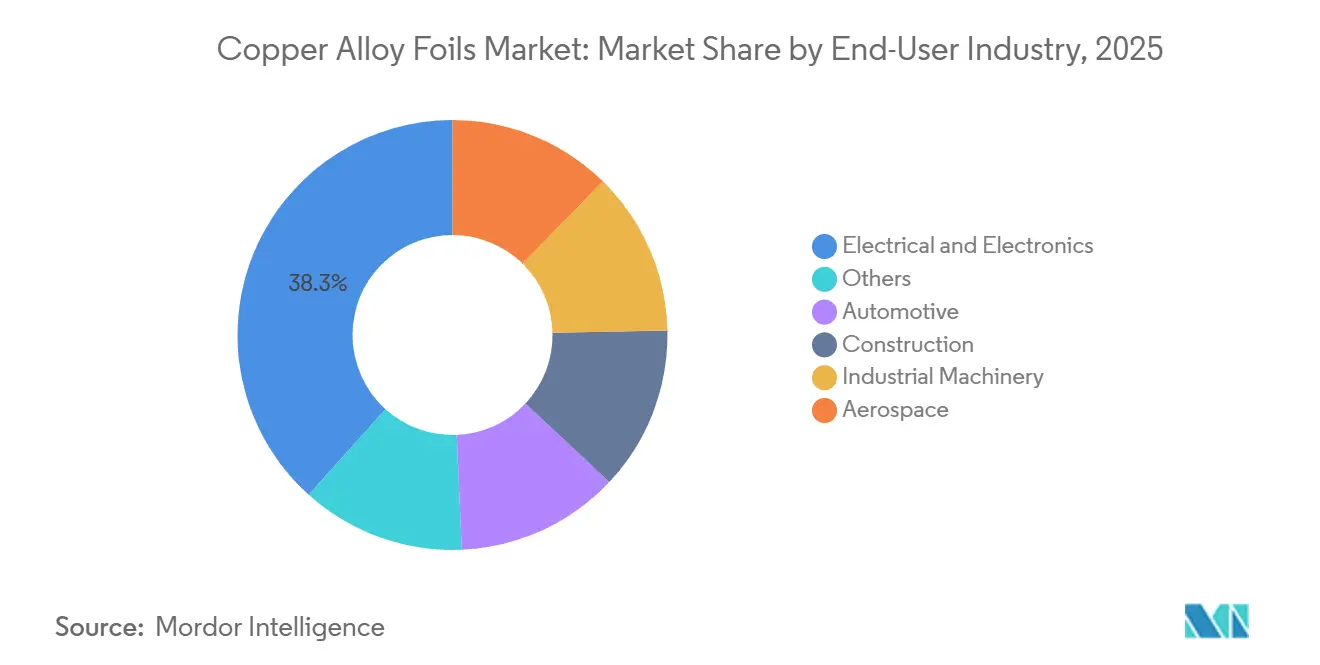
- By end-user industry, electrical and electronics held 38.34% of the copper alloy foils market share in 2025, while automotive is forecast to grow at a 6.68% CAGR through 2031.
- By geography, Asia-Pacific accounted for 45.72% of the copper alloy foils market share in 2025 and is forecast to grow at a 6.27% CAGR through 2031.
Note: Market size and forecast figures in this report are generated using Mordor Intelligence’s proprietary estimation framework, updated with the latest available data and insights as of January 2026.
Global Copper Alloy Foils Market Trends and Insights
Drivers Impact Analysis*
| Drivers | (~) % Impact on CAGR Forecast | Geographic Relevance | Impact Timeline |
|---|---|---|---|
| Electrification and Rising Copper Intensity per Vehicle | +1.5% | Global, with the highest concentration in China, South Korea, and Germany | Medium term (2-4 years) |
| Expansion of High-Density and Flexible Electronics | +1.8% | Asia-Pacific core, including China, Japan, and South Korea, with spillover to North America and Europe | Short term (≤ 2 years) |
| Growth of AI Data Centers and Advanced Semiconductor Packaging | +1.3% | North America and Asia-Pacific, with secondary gains in Europe | Short term (≤ 2 years) |
| Demand for Corrosion-Resistant Foils in Marine and Offshore Systems | +0.8% | Middle East, Nordic countries, and the Association of Southeast Asian Nations (ASEAN) coastal markets | Long term (≥ 4 years) |
| Ultra-Thin Foil Adoption in Battery and Miniaturized Electronics Designs | +1.2% | China and South Korea, with Europe as a secondary market | Medium term (2-4 years) |
| Source: Mordor Intelligence | |||
Electrification and Rising Copper Intensity per Vehicle
Electrification is changing copper requirements in vehicle electrical systems and battery assemblies, particularly for components that handle higher currents, undergo repeated thermal cycling, and have limited installation space. A battery electric vehicle uses 80-91 kg of copper, compared with 22-24 kg in a comparable internal combustion engine vehicle, giving electrical materials a larger role in vehicle design. Alloy foil is used in battery current collectors, busbars, and inverter shielding where strength, consistent forming behavior, or corrosion resistance is required. These applications demand tighter dimensional control and surface finishing than conventional automotive copper products, as performance depends on uniform material behavior across finished components. The copper alloy foils market, therefore, favors producers that can roll, anneal, and qualify advanced grades for vehicle programs while maintaining stable quality at a commercial scale. Suppliers with traditional automotive product mixes face pressure to adapt their portfolios as electric platforms gain importance and customer specifications become more specialized.
Expansion of High-Density and Flexible Electronics
Thinner, lighter, and foldable devices are increasing performance demands on interconnect materials in products where available space is limited, and component reliability is critical. Rolled-annealed alloy foils can withstand repeated flexing better than rigid copper laminates in certain applications, making them suitable for flexible circuits and compact connector assemblies. Phosphor bronze is used in connector applications that require high fatigue resistance during repeated bending, including small components that must retain reliable contact over extended use. Modern data centers also use large amounts of copper in power delivery, cooling, and high-speed circuit boards, placing greater emphasis on reliable materials in supporting systems. These requirements shift demand toward ultra-low-profile alloy formats rather than commodity electrodeposited products, as surface characteristics matter for advanced circuit performance. The copper alloy foils market benefits when qualified producers can meet the reliability requirements of flexible circuits and electronic connectors without compromising properties needed for high-scale manufacturing.
Growth of AI Data Centers and Advanced Semiconductor Packaging
AI data centers require substantial copper content in power distribution, cooling systems, and server electronics, linking capacity additions to demand for supporting electrical materials. Advanced packaging uses demanding foil formats for fan-out wafer-level packaging, chiplet interconnects, and substrate carrier layers, where material consistency affects the performance of compact electronics assemblies. Ultra-low-profile and hyper-low-profile foil support signal integrity at 112G and 224G data rates by meeting the requirements of high-speed applications. IPC-4562 establishes copper foil grade and dimensional requirements for printed circuit applications, thereby narrowing the group of qualified suppliers and distinguishing general-purpose foil from specialized formats. JX Advanced Metals is expanding semiconductor processing capacity and automation at Nikko Metals Taiwan, with the facility expected to process 1.4 times its current capacity from 2027. These investments indicate that the copper alloy foils market is becoming increasingly dependent on specialized capabilities, stable processing, and customer qualification[1]JX Advanced Metals Corporation, “Automation Investment in Semiconductor Sputtering Target Processing Line at Nikko Metals Taiwan,” JX Advanced Metals Corporation, jx-nmm.com..
Demand for Corrosion-Resistant Foils in Marine and Offshore Systems
Marine and offshore equipment requires materials that can withstand continuous exposure to seawater, fluctuating temperatures, and operating conditions that accelerate corrosion. Copper-nickel foils are used in heat exchangers, desalination condensers, and offshore piping systems where resistance to aggressive environments is an important material requirement. Their resistance to seawater corrosion and biofouling supports use in demanding operating environments and reduces the suitability of less durable alternatives. Offshore energy, liquefied natural gas, and desalination projects create targeted demand in the Middle East, Nordic countries, and coastal ASEAN markets. These applications are specialized and typically involve lower quantities than electronics applications, but often require rigorous documentation and alloy certifications. They provide the copper alloy foils market with a high-value outlet for suppliers holding marine-grade certifications and the ability to serve technically specific projects.
Restraints Impact Analysis*
| Restraints | (~) % Impact on CAGR Forecast | Geographic Relevance | Impact Timeline |
|---|---|---|---|
| Copper and Nickel Price Volatility | -1.2% | Global, with greatest exposure in Southeast Asia and South America without long-term offtake agreements | Short term (≤ 2 years) |
| Energy-Intensive Rolling, Annealing, and Surface-Treatment Processes | -0.8% | Europe, ASEAN, and India | Medium term (2-4 years) |
| Qualification Cycles for New Alloys and Ultra-Thin Foil Grades | -0.5% | Global, concentrated among Tier-1 automotive and semiconductor Original Equipment Manufacturers (OEMs) | Long term (≥ 4 years) |
| Source: Mordor Intelligence | |||
Copper and Nickel Price Volatility
Copper and nickel costs can change rapidly, creating immediate pressure on the economics of alloy foil and complicating commercial planning for producers. Copper-nickel grades are exposed to both inputs, and nickel may account for 10-30% of alloy weight, making the cost impact more pronounced for these specialty compositions. Fixed-fee contracts can limit a producer's ability to pass higher metal costs to customers when those costs rise during the contract period. This mismatch can reduce margins during periods of price volatility and make short-term procurement decisions more difficult. This pressure is particularly relevant for suppliers without long-term offtake arrangements that provide more stable access to material. The copper alloy foils market remains exposed because metal costs affect both standard grades and specialized products, while many end-use applications continue to require a dependable supply.
Energy-Intensive Rolling, Annealing, and Surface-Treatment Processes
Copper alloy foil production consumes energy during hot rolling, cold rolling, bright annealing, and electrochemical surface treatment, with each stage contributing to overall conversion costs. Electricity accounts for 15-25% of conversion costs for precision metal strip producers, making energy management critical to the economics of specialty products. European suppliers are exposed to structurally elevated industrial power prices, which can affect their cost position relative to other production regions. Controlled hydrogen bell annealing can also limit throughput while increasing energy use per kilogram, as it requires carefully managed thermal cycles. Older rolling lines may consume more energy and may not meet the surface requirements of premium electronics products, creating both cost and capability constraints. These cost pressures can limit participation in the copper alloy foils market unless producers upgrade their production assets and improve operating efficiency.
*Our forecasts treat driver/restraint impacts as directional, not additive. The impact forecasts reflect baseline growth, mix effects, and variable interactions.
Segment Analysis
By Type: Brass Foils Lead, Bronze Grades Accelerate on Connector Demand
Brass foils accounted for 42.56% of the copper alloy foils market share in 2025, supported by established supply chains and their suitability for high-volume connector, terminal, and electromagnetic interference shielding applications. Brass provides tensile strength above 380 MPa and conductivity near 28% International Annealed Copper Standard (IACS), a combination that supports parts requiring both mechanical integrity and electrical performance. These characteristics make brass suitable for flex-circuit ground planes and radio-frequency shielding in telecommunications equipment, where producers require dependable material specifications. Construction also uses thin brass strips in architectural trim, decorative panels, and precision lock components, while infrastructure investment in Asia and the Middle East supports demand from these applications. The broad application base keeps brass relevant where cost competitiveness and performance requirements coexist.
Bronze foils are projected to expand at a 6.12% CAGR through 2031, making them the fastest-growing type in the copper alloy foils market. Phosphor-bronze is used in high-pin-count semiconductor sockets, SIM card contacts, and micro-spring interconnects, where its fatigue resistance enables repeated bending without premature performance loss. This positions bronze within increasingly compact electronic designs that rely on small, reliable contacts. Copper-nickel foil is used in marine heat exchangers, desalination condensers, and offshore piping applications, while other specialty copper alloy foils, including beryllium copper, are used in aerospace connectors that require conductivity and spring temper. The copper alloy foils market size for bronze grades is supported by connector designs that prioritize long-term mechanical reliability and stable electrical contact.



By End-User Industry: Electronics Anchors the Base While Automotive Closes the Gap
Electrical and electronics accounted for 38.34% of the copper alloy foils market share in 2025, reflecting demand across printed circuit boards, connectors, electromagnetic interference shielding, flexible circuits, and lead frames. Each application draws on the alloy foil supply differently, giving the segment a broad base of demand. High-density interconnects in smartphones, data center switch cards, and 5G base stations require more advanced foil specifications than conventional electronics designs. Customers are moving from standard electrolytic products toward rolled-annealed and ultra-low-profile formats that can provide surface roughness below 1 μm for selected applications. Industrial machinery, construction, and aerospace add further demand and require different certification and traceability standards, reinforcing the need for suppliers to serve multiple technical requirements.
Automotive is forecast to record a 6.68% CAGR through 2031, making it the fastest-growing end-user segment. Electric vehicles use alloy foil in inverter shielding, battery current-collector assemblies, and high-voltage connector interfaces that must perform in increasingly complex electrical systems. The transition to 800-volt vehicle architecture raises requirements for conductivity and dimensional consistency, with Hyundai, Porsche, and Audi platforms adopting this architecture. This shift supports demand for foil specifications that meet the needs of higher-voltage systems. The other category, including renewable energy and consumer goods, adds demand without altering the overall end-user hierarchy, while the copper alloy foils market size for automotive applications continues to expand.
Geography Analysis
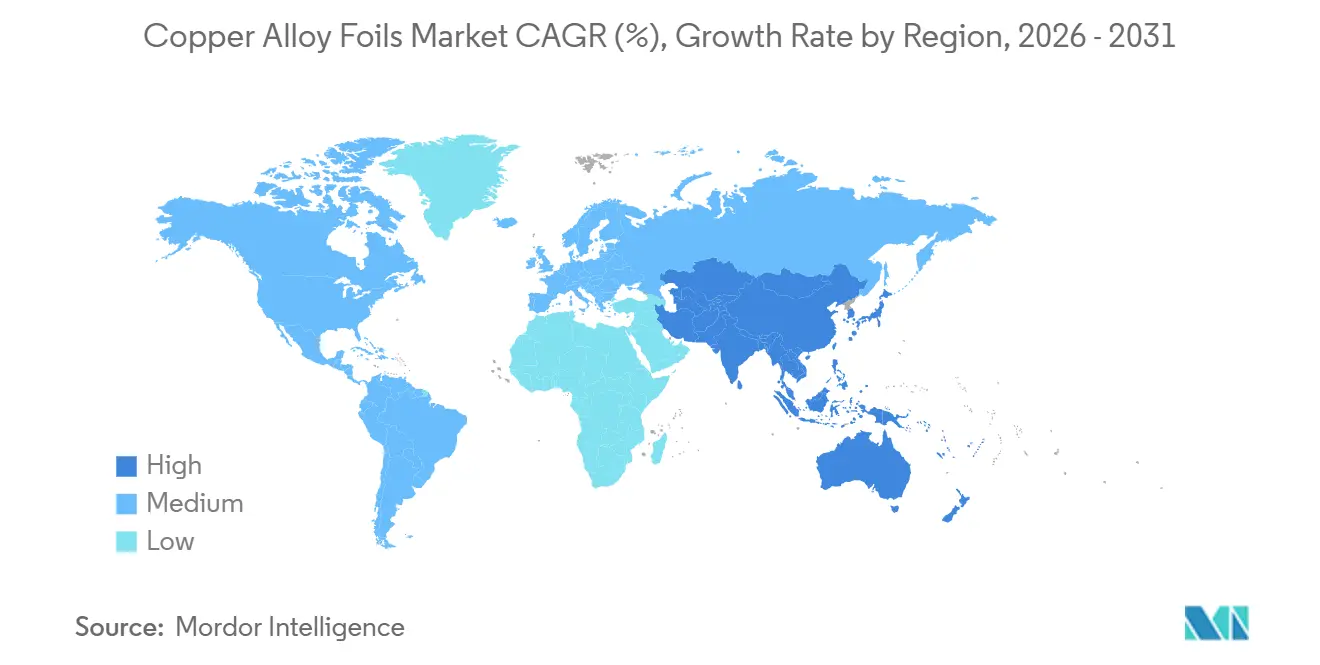
Asia-Pacific accounted for 45.72% of the copper alloy foil market share in 2025 and is projected to grow at a 6.27% CAGR through 2031. China, Japan, and South Korea form the main regional production and demand base, creating a close link between foil production and end-use manufacturing. China provides strong end-use demand for electronics and electric vehicles. Japan and South Korea contribute rolled-annealed foil capacity for semiconductor and automotive applications. Vietnam and Thailand are gaining electronics assembly activity, supporting demand for flex-circuit and connector materials and extending the regional customer base beyond the three core countries.
North America and Europe represent the second tier of demand, though their demand drivers differ. The United States is expanding capacity for electric vehicle assembly, battery-cell production, and semiconductor fabrication. Wieland Group strengthened its North American footprint by integrating the Buffalo facility with operations in East Alton, Illinois, and Shelbyville, Kentucky[2]Wieland Group, “Wieland Acquires Aurubis’ Plant in Buffalo, NY,” Wieland Group, wieland.com.. Germany, the Nordic countries, and Italy are Europe's key demand centers for automotive supply chains, precision machinery, and offshore energy systems. Registration, Evaluation, Authorization, and Restriction of Chemicals (REACH) requirements affect the chemicals used in metal surface treatments for automotive and aerospace applications.
South America and the Middle East and Africa account for a smaller portion of global demand. Brazil supports brass and bronze foil consumption in electrical equipment and plumbing fittings. Argentina and Chile use these materials in mining instrumentation and energy infrastructure. Copper-nickel grades are relevant to condenser tubes, heat exchangers, and cooling circuits in offshore and desalination projects, supporting a position for certified marine-grade suppliers in the copper alloy foils market.

Competitive Landscape
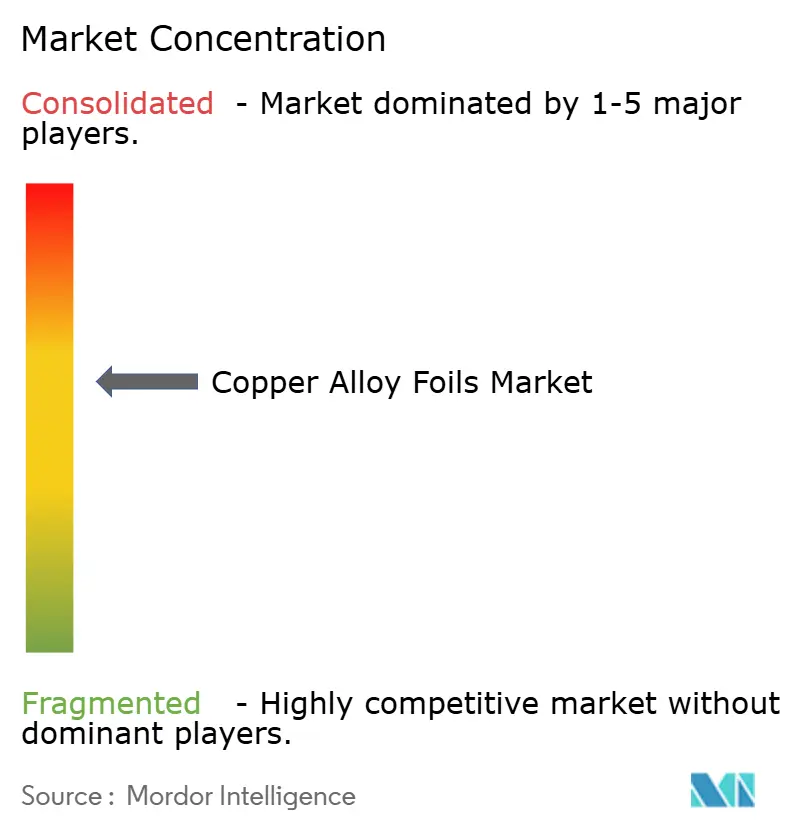
The copper alloy foils market is moderately consolidated. Wieland-Werke AG, Aurubis AG, KME Germany GmbH, and Carl Schlenk AG are established European suppliers. JX Advanced Metals Corporation, Poongsan Corporation, and Ningbo Boway Alloy Material Co., Ltd. are prominent Asian producers. European suppliers are investing in closed-loop recycling and downstream integration to protect conversion margins. Asian producers benefit from proximity to electronics assembly clusters in China, Japan, and South Korea.
Advanced grades create a clear separation between commodity products and premium foil in the copper alloy foils market. Producers that can supply foil below 8 μm and meet Tier-1 Original Equipment Manufacturer (OEM) requirements hold a stronger position in qualified applications. Solid-state battery development creates opportunities for suppliers of alloy-treated and nickel-coated variants, as standard copper foil can be attacked by sulfide electrolytes. Smaller Chinese and South Korean producers are investing in hyper-very-low-profile alloy foil for AI server printed circuit boards. Qualification with global Tier-1 copper-clad laminate manufacturers can take 12-18 months, potentially reshaping supplier positions through 2031.
Wieland completed the acquisition of Aurubis's Buffalo, New York, flat-rolled-products facility in August 2024, strengthening its North American manufacturing position. Aurubis inaugurated its Complex Recycling Hamburg facility in July 2026 following a EUR 190 million (USD 220.79 million) investment, increasing its recycling capacity. JX Advanced Metals is investing in automation at Nikko Metals Taiwan, with operations scheduled to begin sequentially from June 2027 and processing capacity expected to reach 1.4 times the current level. These developments reflect a focus on regional supply security, recycling, and advanced processing capacity, with the copper alloy foils market shaped by both scale in established products and technical capability in high-specification formats.
Copper Alloy Foils Industry Leaders
Wieland-Werke AG
Aurubis AG
KME GERMANY GMBH
FURUKAWA ELECTRIC CO., LTD.
JX Advanced Metals Corporation
- *Disclaimer: Major Players sorted in no particular order

Recent Industry Developments
- July 2026: JX Advanced Metals Corporation approved a capital investment of JPY 4 billion (USD 27 million) to expand semiconductor sputtering target processing capacity at its South Korean subsidiary, JX Advanced Metals Korea. The project increases throughput for logic and advanced memory substrate materials, including High Bandwidth Memory (HBM) and 3D-NAND, supporting copper alloy foil demand in these applications.
- May 2025: Poongsan Corporation ordered an EBNER HICON/H2 bell annealer facility, comprising 2 heating bells, 4 workbases, and 2 cooling bells, to increase bright annealing capacity for copper and copper-alloy strip coils in the copper alloy foils market.


Global Copper Alloy Foils Market Report Scope
Copper alloy foil is a thin, flexible metal sheet produced by combining copper with other elements such as zinc, tin, iron, or titanium to enhance specific properties, including strength, heat resistance, or elasticity.
The copper alloy foils market is segmented by type, end-user industry, and geography. By type, the market is segmented into brass foils, bronze foils, copper-nickel foils, and other copper alloy foils. By end-user industry, the market is segmented into electrical and electronics, automotive, construction, industrial machinery, aerospace, and others. The report also covers market size and forecasts for copper alloy foils across 15 countries in major regions. The market sizes and forecasts are provided in terms of value (USD).
| Brass Foils |
| Bronze Foils |
| Copper-Nickel Foils |
| Other Copper Alloy Foils |
| Electrical and Electronics |
| Automotive |
| Construction |
| Industrial Machinery |
| Aerospace |
| Others |
| Asia-Pacific | China |
| India | |
| Japan | |
| South Korea | |
| ASEAN Countries | |
| Rest of Asia-Pacific | |
| North America | United States |
| Canada | |
| Mexico | |
| Europe | Germany |
| United Kingdom | |
| France | |
| Italy | |
| NORDIC Countries | |
| Rest of Europe | |
| South America | Brazil |
| Argentina | |
| Rest of South America | |
| Middle East and Africa | Saudi Arabia |
| South Africa | |
| Rest of Middle East and Africa |
| By Type | Brass Foils | |
| Bronze Foils | ||
| Copper-Nickel Foils | ||
| Other Copper Alloy Foils | ||
| By End-User Industry | Electrical and Electronics | |
| Automotive | ||
| Construction | ||
| Industrial Machinery | ||
| Aerospace | ||
| Others | ||
| By Geography | Asia-Pacific | China |
| India | ||
| Japan | ||
| South Korea | ||
| ASEAN Countries | ||
| Rest of Asia-Pacific | ||
| North America | United States | |
| Canada | ||
| Mexico | ||
| Europe | Germany | |
| United Kingdom | ||
| France | ||
| Italy | ||
| NORDIC Countries | ||
| Rest of Europe | ||
| South America | Brazil | |
| Argentina | ||
| Rest of South America | ||
| Middle East and Africa | Saudi Arabia | |
| South Africa | ||
| Rest of Middle East and Africa | ||


Key Questions Answered in the Report
What is current market size of Copper Alloy Foils Market?
The Copper Alloy Foils Market size was valued at USD 727.67 million in 2025 and is estimated to grow from USD 755.69 million in 2026 to reach USD 985.31 million by 2031, at a CAGR of 5.45% during the forecast period (2026-2031).
Which type of copper alloy foil drives demand?
Brass foils led with a 42.56% share in 2025, supported by connector, terminal, flex-circuit, and shielding applications. Its established supply base and balance of conductivity and tensile strength support its broad use.
Which end-user application is growing fastest?
Automotive is projected to grow at a 6.68% CAGR through 2031 as electric vehicle electrical systems require more specialized foil. Battery current collectors, busbars, inverter shielding, and high-voltage connectors contribute to this requirement.
Which region leads in global demand?
Asia-Pacific held a 45.72% share in 2025 and is projected to grow at a 6.27% CAGR through 2031. China, Japan, and South Korea combine large end-use demand with advanced electronics and precision-rolling capability.
Page last updated on:





