
Cooking Wine Market Size and Share
Market Overview
| Study Period | 2021 - 2031 |
|---|---|
| Market Size (2026) | USD 406.95 Million |
| Market Size (2031) | USD 477.03 Million |
| Growth Rate (2026 - 2031) | 3.23 % |
| Fastest Growing Market | Asia-Pacific |
| Largest Market | Asia-Pacific |
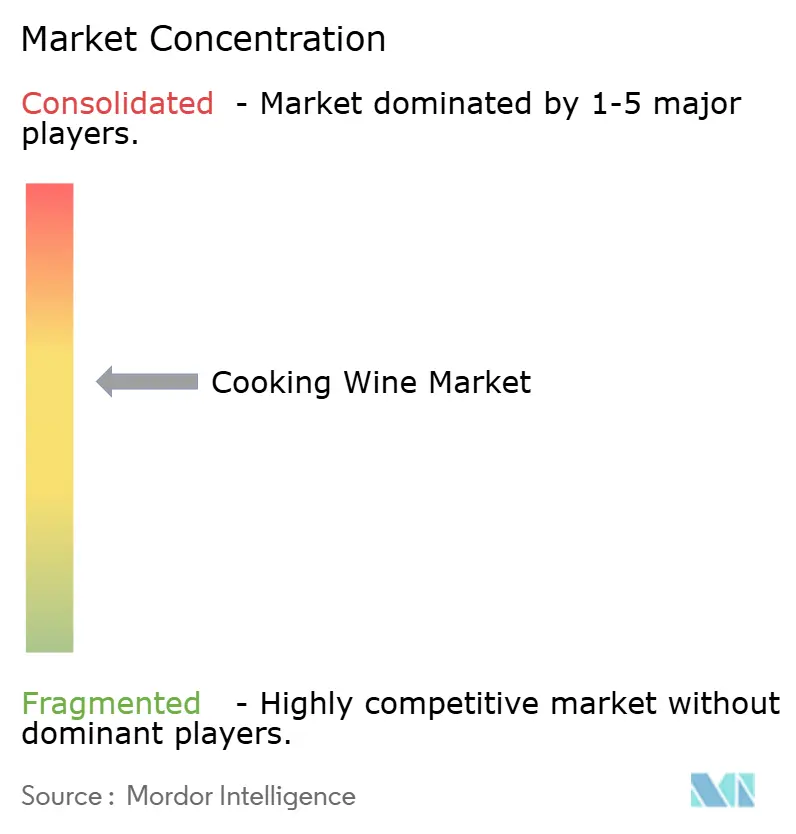
| Market Concentration | Medium |
Major Players *Disclaimer: Major Players sorted in no particular order Image © Mordor Intelligence. Reuse requires attribution under CC BY 4.0. | |
Cooking Wine Market Analysis by Mordor Intelligence
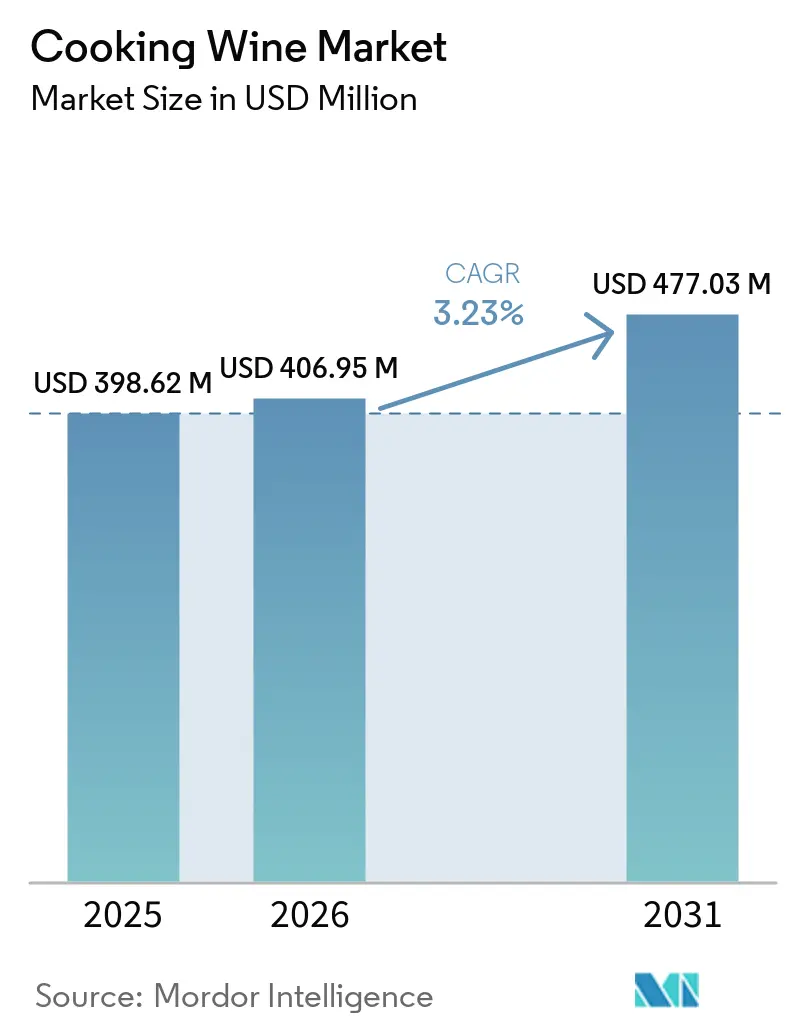
The cooking wine market size is projected to reach USD 477.03 million by 2031, growing at a CAGR of 3.23% from 2026 to 2031, from USD 398.62 million in 2025. Growth is being supported by the globalization of culinary traditions, increasing demand for authentic flavor-enhancing ingredients, and the expanding adoption of premium cooking practices across households and foodservice establishments. Cooking wine continues to gain importance as an essential ingredient in marinades, sauces, braised dishes, and ethnic cuisines, particularly Chinese, Japanese, French, and Italian recipes. According to the International Organization of Vine and Wine (OIV), global wine production reached 225.8 million hectolitres in 2024, ensuring a stable raw material base for value-added culinary wine products despite regional climatic challenges. Reflecting ongoing product innovation, Kikkoman expanded its culinary seasoning portfolio in 2025 by introducing new cooking wine and seasoning solutions designed for professional kitchens and home cooks, supporting the preparation of authentic Asian recipes across international markets. Furthermore, manufacturers are strengthening omnichannel distribution through supermarkets, specialty food retailers, and e-commerce platforms, improving product accessibility and consumer awareness. The increasing popularity of international cuisines, coupled with rising expenditure on premium culinary ingredients and recipe-led cooking, is expected to sustain long-term demand for cooking wine across both developed and emerging markets.
Key Report Takeaways
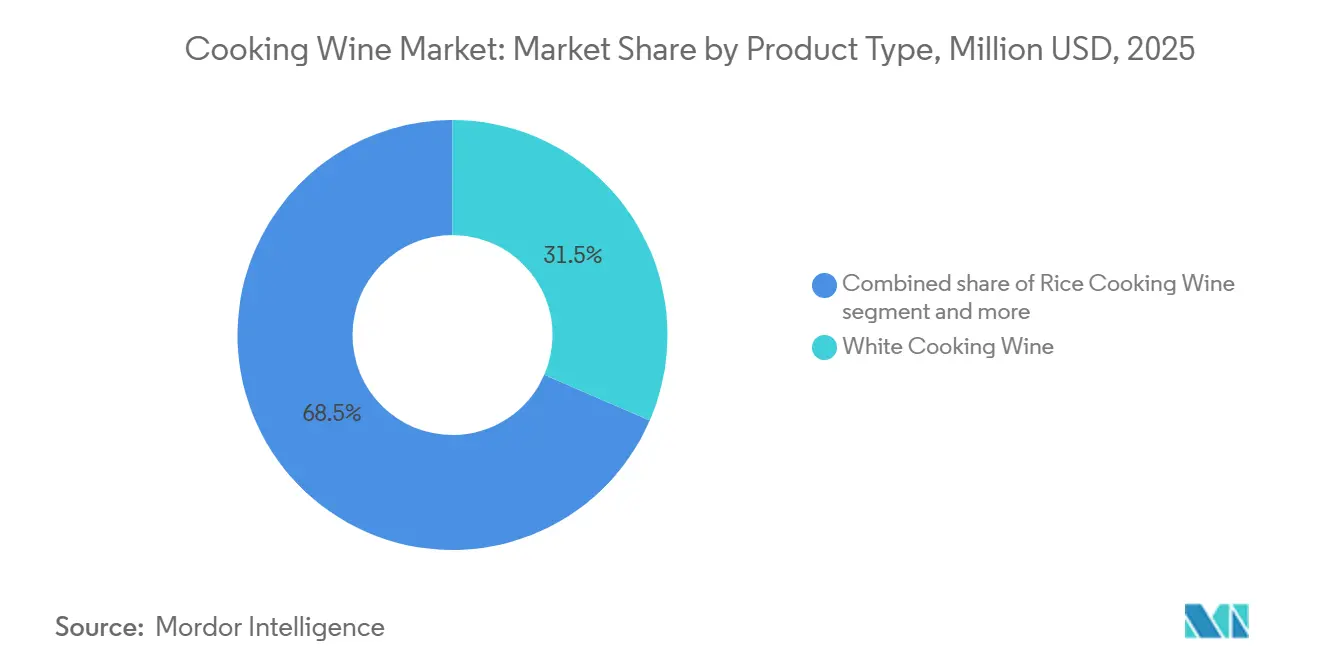
- By product type, white cooking wine held 31.51% of the cooking wine market share in 2025, while rice cooking wine is forecast to grow at an 8.46% CAGR through 2031.
- By category, conventional products held 88.62% of the cooking wine market share in 2025, while organic cooking wine is forecast to grow at a 9.11% CAGR through 2031.
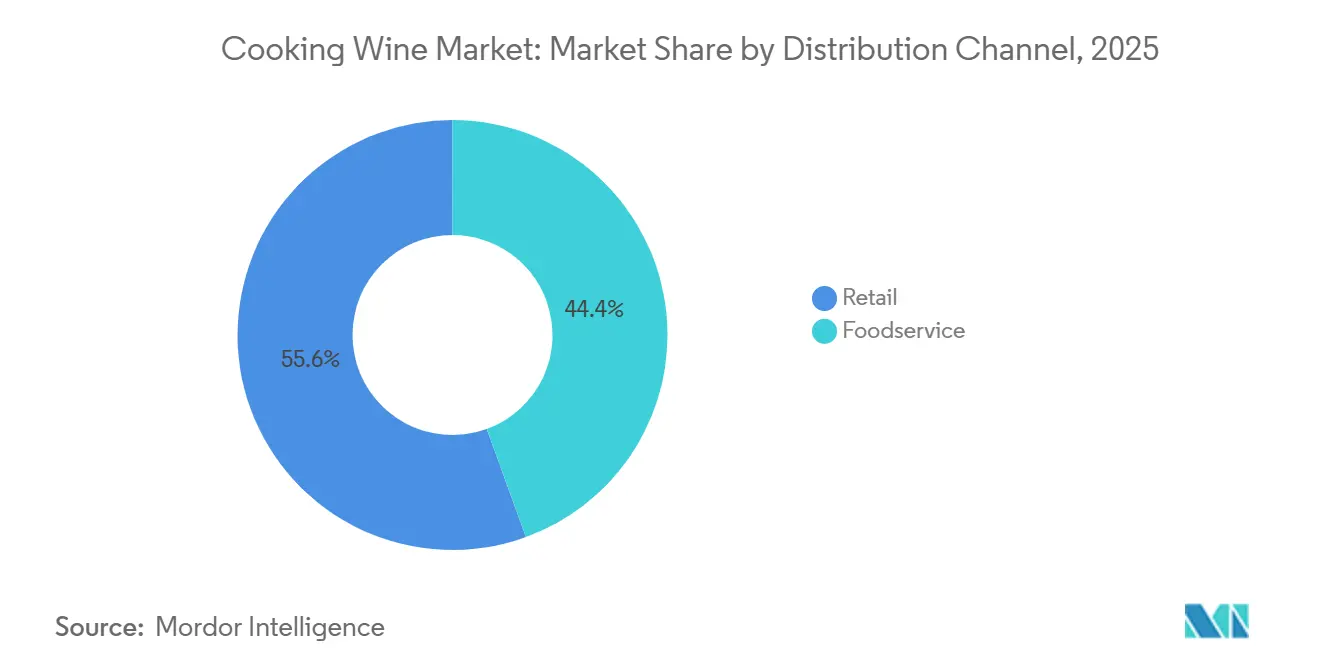
- By distribution channel, foodservice held 44.13% revenue share in 2025, while retail is forecast to grow at an 8.91% CAGR through 2031.
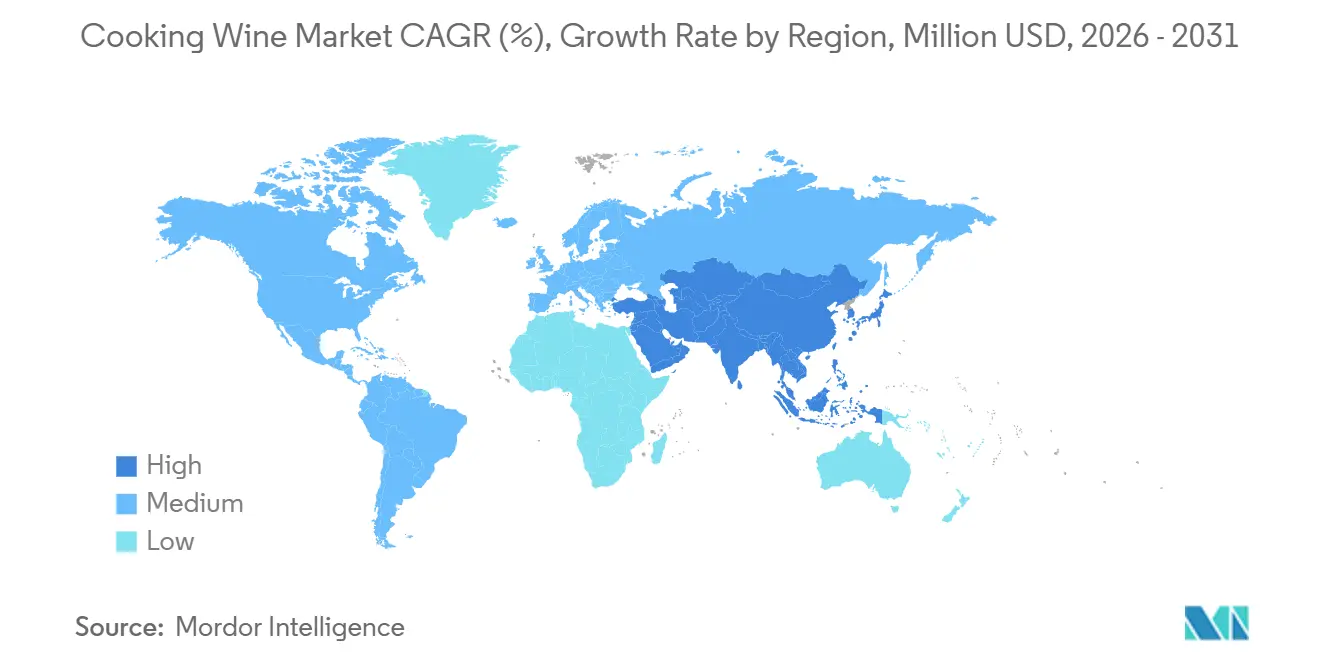
- By geography, Asia-Pacific held 38.90% revenue share in 2025 and is forecast to grow at an 8.98% CAGR through 2031.
Note: Market size and forecast figures in this report are generated using Mordor Intelligence’s proprietary estimation framework, updated with the latest available data and insights as of January 2026.
Market Trends and Insights
Drivers Impact Analysis of Cooking Wine Market*
| Driver | (~) % Impact on CAGR Forecast | Geographic Relevance | Impact Timeline |
|---|---|---|---|
| Globalization of home and professional cuisines | +0.4% | Global, concentrated in the Asia-Pacific, North America, and Western Europe | Medium term (2–4 years) |
| Increasing consumer interest in gourmet home dining experiences | +0.3% | North America, Europe, the Asia-Pacific urban centers | Medium term (2–4 years) |
| Premiumization of everyday culinary ingredients | +0.4% | Global, led by North America and the Asia-Pacific first-tier cities | Medium term (2–4 years) |
| Foodservice and international restaurant expansion | +0.5% | The Asia-Pacific core, spill-over to South America, the Middle East and Africa | Short term (≤ 2 years) |
| Digital recipe discovery and e-commerce availability | +0.4% | Global, especially the Asia-Pacific and North America | Short term (≤ 2 years) |
| Growing demand for clean-label cooking wines | +0.5% | North America, Europe, the Asia-Pacific health-conscious markets | Medium term (2–4 years) |
| Source: Mordor Intelligence | |||
Globalization of Home and Professional Cuisines
The cooking wine market benefits as cross-cultural cooking becomes more common in home and professional kitchens. Rice cooking wine has an established functional role in Chinese, Japanese, Korean, and Southeast Asian dishes, while Marsala, sherry, and white wine remain familiar in European-style preparation. Kikkoman announced plans in June 2026 for its first manufacturing facility in India and described India as its most critical long-term market. That decision points to confidence in the expanding use of Asian culinary ingredients by Indian foodservice operators. Lee Kum Kee and UNESCO launched the Forever Flavors Project in January 2026, using food heritage stories to connect culinary traditions with a global audience[1]Source: UNESCO, “UNESCO and Lee Kum Kee Join Hands to Safeguard and Transmit Culinary Heritage,” unesco.org. Such activity can improve familiarity with Shaoxing Huadiao cooking wine and related products in markets where these ingredients previously had limited retail visibility.
Foodservice and international Restaurant Expansion
The cooking wine market draws significant volume from commercial kitchens, which use culinary wine repeatedly in sauces, marinades, braises, and prepared dishes. Foodservice demand is supported by restaurant growth and by franchise formats that require the same ingredient specification across several locations. Foshan Haitian Flavoring and Food reported CNY 28,873 million in 2025 revenue, equal to USD 4.0 billion, and stated that core condiment sales increased 9.0%. Cooking and seasoning wines sit within this broader condiment portfolio, so the company's growth shows the scale available to suppliers serving restaurant and prepared-food channels. Otafuku Sauce Malaysia opened a halal-certified factory in Negeri Sembilan in December 2025 after production began in July 2025, according to the Malaysian Investment Development Authority. The facility shows greater investment in compliant culinary-condiment production for Southeast Asian and export markets.
Digital Recipe Discovery and E-Commerce Availability
Digital food content shortens the path from recipe discovery to the purchase of a specialty ingredient. The USDA Foreign Agricultural Service reported that Douyin and Xiaohongshu social commerce, along with Meituan delivery, had become important off-trade sales channels for wine products in China[2]Source: USDA Foreign Agricultural Service, “Navigating China's Social Media Landscape,” usda.gov. These channels expose consumers to unfamiliar cooking methods and make it easier to order ingredients linked to recipe content. The cooking wine market, therefore, has greater access to consumers who would not have searched for a specialty culinary wine in a traditional supermarket. Online retail can also support smaller package sizes and premium product descriptions that are less practical in high-volume foodservice sales. Club-format retailers in China are also sourcing specialist products in response to demand shaped by online discovery. This shifts competition toward product visibility, trusted provenance, and reliable delivery.
Growing Demand for Clean-Label Cooking Wines
Clean-label preferences are changing the product mix within the cooking wine market. Buyers are paying closer attention to sodium, sulfites, artificial flavoring, and the sourcing of culinary ingredients. Sudvinbio data showed that organic wine in France grew 7% by value and 6% by volume in 2024, while sales through specialist merchants grew 12.4% and direct-to-consumer sales rose 14%. The comparable pattern matters for cooking wines because specialty stores and direct sales can support products with certified sourcing and simpler formulations. China's GB/T 38500-2020 standard for brewed cooking wine sets requirements for product quality and production controls. Producers that can substantiate clean-label claims are better placed to convert premium positioning into repeat retail demand.
Restraints Impact Analysis of Cooking Wine Market*
| Restraint | (~) % Impact on CAGR Forecast | Geographic Relevance | Impact Timeline |
|---|---|---|---|
| Volatility in grape, rice, and grain inputs | -0.2% | Global, most acute in North America and Southern Europe | Short term (≤ 2 years) |
| Stringent regulations on alcohol-based culinary products | -0.1% | North America (TTB/FDA), Europe, the Asia-Pacific national frameworks | Medium term (2–4 years) |
| Substitution by vinegar, stock, sake, and flavor blends | -0.2% | Global, concentrated in North America and Europe | Medium term (2–4 years) |
| Hidden sodium, sulfite, and clean-label reformulation burden | -0.2% | North America and Europe | Medium term (2–4 years) |
| Source: Mordor Intelligence | |||
Volatility in Grape, Rice, and Grain Inputs
The cooking wine market depends on grape-derived inputs for white, red, sherry, and Marsala products and on rice inputs for Asian culinary wines. California's winegrape crush fell to 2.63 million tons in 2025, following a 25.2% decline in 2024, according to reporting based on United States Department of Agriculture data[3]Source: United States Department of Agriculture, “Grape Crush Reports Listing,” nass.usda.gov. This decline can limit input availability and weaken grower economics even when grape prices are also under pressure. The International Organization of Vine and Wine reported world wine consumption of 214.2 million hectoliters in 2024, the lowest level since 1961. OIV Lower beverage-wine demand can change the availability and quality of base wine that may enter culinary applications. Suppliers, therefore, need flexible sourcing and close control over input quality to protect product consistency.
Stringent Regulations on Alcohol-Based Culinary Products
Alcohol content puts cooking wine under rules that do not apply to many other pantry condiments. The U.S. Alcohol and Tobacco Tax and Trade Bureau requires formula approval for domestic salted cooking wine under its non-beverage wine classification. Some specialty culinary wine formulations also require laboratory analysis and compliance with food-labeling requirements. The TTB proposed mandatory disclosure of major food allergens and Alcohol Facts information for wines and other alcoholic beverages in April 2025. These requirements may require reformulation when wheat-based fining agents or egg-derived clarification processes are used. The regulatory burden favors producers that already have formula-approval processes, labeling capability, and established quality systems.
*Our forecasts treat driver/restraint impacts as directional, not additive. The impact forecasts reflect baseline growth, mix effects, and variable interactions.
Cooking Wine Market Segment Analysis
By Product Type:
Rice Cooking Wine Drives the Fastest GrowthRice cooking wine is projected to grow at an 8.46% CAGR through 2031, the highest rate among product types in the cooking wine market. It is a functional ingredient in Chinese, Japanese, Korean, and Southeast Asian cuisines, supporting its use beyond a narrow specialty occasion. Restaurant chains, packaged-food producers, and online recipe content are broadening the potential customer base outside Asia. Foshan Haitian Flavoring and Food reported that its core condiment business reached CNY 27,399 million, equal to USD 3.8 billion, in 2025, up 9.0% from the prior year. Cooking and seasoning wines are included in the company's multi-category condiment portfolio. This performance supports the continued importance of rice-oriented culinary products in large Asian condiment systems.
White cooking wine accounted for 31.51% of the cooking wine market size in 2025, supported by its versatility in sauces, braised meats, and processed-food applications. Its established role gives foodservice buyers a familiar and predictable ingredient for standardized recipes. Red wine, sherry, and Marsala serve more defined cooking uses and face competition from less expensive or more flexible alternatives. Premium Shaoxing wine producers are also presenting traditional Huangjiu as an upscale culinary ingredient for younger consumers. Functional rice wines designed for seafood, hot pot, and braised dishes create further room for differentiated product development. The national brewed-cooking-wine standard in China provides a basis for separating quality-focused offerings from commodity products.



By Category:
Organic Products Expand Faster Than Conventional ProductsConventional products represented 88.62% of the cooking wine market size in 2025 because foodservice buyers value predictable cost, supply, and flavor performance. These products remain suited to high-volume kitchen procurement and broad retail distribution. Organic cooking wine is forecast to grow at a 9.11% CAGR through 2031, the fastest rate across the reported segmentation types. The difference reflects growing interest in ingredient transparency and certified sourcing. The cooking wine market can use organic certification to communicate a clear distinction, where a retail buyer cannot assess quality before purchase. French organic wine sales data showed stronger growth through specialist wine merchants and direct-to-consumer channels than through mass retail. This route to market is relevant for premium culinary wines that need product education and a clear explanation of their formulation.
The conventional and organic split requires producers to serve different purchasing needs. Conventional products suit cost-focused foodservice accounts, where large-volume purchasing and recipe consistency are essential. Organic items can support higher unit values in specialty retail and direct-to-consumer channels, where certification and sourcing details are more visible. European Union Regulation 2018/848 provides the regulatory framework for organic production and labeling claims in relevant European and export markets. The cooking wine industry must therefore keep supply, packaging, and customer strategies distinct across the two categories. The cooking wine market also requires separate commercial planning because retail trade-up behavior does not mirror foodservice purchasing behavior. Brands that treat organic products as a simple extension of conventional stock may struggle to communicate their value. Brands with reliable certification and clear ingredient information can better support premium shelf placement.
By Distribution Channel:
Retail Gains From Digital Cooking DiscoveryFoodservice held 44.13% of the cooking wine market size in 2025, reflecting the recurring volumes used by professional kitchens. Commercial kitchens often buy in bulk and require stable flavor, specification, and reorder availability. These requirements make the channel important for established suppliers with foodservice relationships. Retail is forecast to grow at an 8.91% CAGR through 2031, exceeding the overall category rate. The rise is linked to e-commerce, home cooking, and digitally led recipe discovery. Online retail has particular relevance for specialty rice wines and premium products that may receive limited shelf space in mainstream stores. Hypermarkets and supermarkets remain important for volume, while specialty stores support more differentiated offerings.
The United States Department of Agriculture (USDA) Foreign Agricultural Service identified livestreaming, social commerce, and delivery platforms as important channels for wine products in China. That evidence supports the view that online content can create demand rather than merely fulfill it. The cooking wine market needs different products and pricing approaches across online retail, specialty outlets, supermarkets, and foodservice. The cooking wine market can use digital education to explain a product before a consumer commits to a purchase. Online listings can provide serving guidance, recipe links, and a fuller explanation of regional provenance. Foodservice buyers instead prioritize consistent supply, format, and kitchen performance. Retail growth will therefore reward brands that can adjust pack size and messaging without changing core product quality. This channel mix also gives premium suppliers another route to households that seek restaurant-style cooking at home.
Geography Analysis
APAC Cooking Wine Market
Asia-Pacific held 38.90% regional revenue share in 2025 and is forecast to expand at a 8.98% CAGR through 2031. China remains central because cooking wine is embedded in the established liaojiu tradition and is used across households, restaurants, and convenience-food preparation. Demand for beverage wine and demand for culinary wine follow different patterns, despite the broader contraction in Chinese beverage-wine consumption noted by the OIV. OIV Ready-meal demand, restaurant expansion, and attention to additive-free ingredients support the use of brewed cooking wine. China's GB/T 38500-2020 standard also supports stronger quality differentiation among producers. Japan, South Korea, Thailand, Indonesia, Vietnam, and Singapore provide additional regional demand through their established cooking traditions and foodservice activity.
Europe and North America Cooking Wine Market
Europe and North America have important positions in the cooking wine market through mature foodservice use and longstanding home-cooking practices. The cooking wine market in these regions depends on familiar preparation methods as well as demand for global flavors. France, Italy, Spain, the United Kingdom, and Germany have a stable demand for white and red culinary wines in classic cuisine. Urban European centers are also adding Asian restaurant capacity, which supports rice cooking wine and Shaoxing-style product demand. In North America, multicultural food preferences are expanding the presence of rice and specialty culinary wines in mainstream grocery stores. Foodservice operators continue to use white wine, sherry, and Marsala for sauces and prepared entrées. U.S. wine exports to China fell 70% to USD 17.4 million during January through July 2025, according to the USDA Foreign Agricultural Service. This trade pattern reinforces the relevance of Asian-origin products in Western retail channels.
MEA and South America Cooking Wine Market
South America, the Middle East, and Africa are smaller parts of the cooking wine market but present specific development opportunities. The cooking wine market has to adapt its format and channel approach, where conventional alcohol-based products have limited acceptance. Brazil, Argentina, and Chile benefit from hospitality growth and wider household exposure to international dishes. Kikkoman do Brasil began exports of 5 condiment products to Peru in 2025, focusing on the needs of Peruvian-Chinese, or Chifa, restaurants. Alcohol rules limit conventional cooking-wine use in many Islamic-majority markets, concentrating sales in hospitality settings and expatriate retail. Nigeria and South Africa offer near-term opportunities through organized foodservice. Otafuku Sauce Malaysia's halal-certified facility serves Malaysia, Indonesia, Singapore, the United Arab Emirates, Japan, and other markets. Its regional orientation indicates potential for halal-compliant and alcohol-free culinary alternatives.

Competitive Landscape
The cooking wine market is moderately consolidated, with no single supplier leading every product type and geography. The cooking wine market remains shaped by regional strengths rather than one common global product portfolio. Foshan Haitian, Kikkoman, Lee Kum Kee, and Mizkan have strong positions in rice and Asian culinary wines through distribution reach, brand familiarity, and fermentation capability. Holland House, owned by Mizkan America, PANOS Brands, and Roland Foods, serves mainstream white and sherry cooking-wine needs in North America and Europe. Asian-origin products are gaining shelf visibility in multicultural retail formats, increasing pressure on conventional regional positions. The largest current capital project is Mizkan America's USD 156 million expansion of its Owensboro, Kentucky, facility. The facility is scheduled to add capacity for Holland House Cooking Wine and other brands in the second half of 2026.
Competition within the cooking wine market centers on serving foodservice and retail without compromising product consistency. Large manufacturers can combine broad distribution with the regulatory and quality-control resources required for alcohol-based culinary products. Premium growth has also increased attention to organic products, simpler formulations, and clearer sourcing information. Kikkoman's planned India facility is a strategic move toward localized production in a large restaurant market. Lee Kum Kee's Forever Flavors Project uses culinary heritage to strengthen the global standing of its Shaoxing Huadiao cooking wine range. Mizkan America's Kentucky expansion is a direct capacity response that reinforces its ability to supply North American customers at scale.
Open opportunities in the cooking wine market remain in accessible premium organic products, halal-compliant formats, and functional rice wines for specific dishes. Premium organic products need credible certification and accessible retail pricing to move beyond a small specialist audience. Halal-certified and alcohol-free alternatives may be important where conventional alcohol-based products face regulatory or religious constraints. Functional formulations for seafood, hot pot, and braised meats have greater visibility in China than in many overseas markets. Shaoxing Wine Co. has a provenance advantage because of its long association with Huangjiu production in Zhejiang. Proprietary fermentation and blending methods can help suppliers stand apart from commodity products. The available information does not provide combined share figures for the leading companies, so a market concentration score cannot be calculated without adding unsupported data.
Cooking Wine Industry Leaders
AAK AB
Batory Foods
ECOVINAL, S.L.U.
Elegre Pty Ltd.
Eden Foods, Inc.
- *Disclaimer: Major Players sorted in no particular order
Cooking Wine Market Companies Covered in this Report
- AAK AB
- Batory Foods
- De Vinco Company
- ECOVINAL, S.L.U.
- Elegre Pty Ltd.
- Eden Foods, Inc.
- Foshan Haitian Flavoring and Food Co., Ltd.
- Goya Foods, Inc.
- Holland House
- Kikkoman Corporation
- Lee Kum Kee Co., Ltd.
- Mizkan Holdings Co., Ltd.
- Marina Foods, Inc.
- PANOS Brands, LLC
- Pompeian, Inc.
- Roland Foods, LLC
- Shaoxing Wine Co., Ltd.
- Stratas Foods LLC
- The Kroger Co.
- World Finer Foods, LLC

Recent Industry Developments in Cooking Wine Market
- January 2026: Mizkan America continued construction of its USD 156 million Owensboro, Kentucky expansion during 2026. The new production lines were designed to manufacture Holland House Cooking Wine alongside Mizkan's vinegars and Asian sauces, significantly increasing production capacity and strengthening supply across North America.
- July 2026: Gourmet Classic launched a broad cooking-wine range spanning 4.8% Cabernet Sauvignon, Chardonnay, Italian red/white, fortified Madeira and Port, and 0% alcohol-free variants. It also offers professional 3L, 5L and 10L formats, supporting restaurants, caterers and food manufacturers.
- July 2026: Kuaijishan Shaoxing Wine Company continued expanding cooking-wine shipments into the U.S. during 2026, with July consignments including 4,608 kg of cooking wine to Houston and 12,800 kg of cooking/cooking rice wine to Tacoma. The repeated shipments indicated continued strengthening of the Chinese cooking-wine supply into the U.S. market.


Global Cooking Wine Market Report Scope
Cooking wine is a treated, shelf-stable wine sold as a condiment rather than a beverage. The cooking wine market report is segmented by product type, category, distribution channel, and geography. By product type, the market is segmented into red, white, rice, sherry, marsala, and others. By category, the market is segmented into conventional and organic. By distribution channel, the market is segmented into foodservice and retail. The retail segment is further sub-segmented into hypermarkets/supermarkets, specialty stores, online retail, and others. By geography, the market is segmented into North America, Europe, Asia-Pacific, South America, and Middle East and Africa). The market forecasts are provided in terms of value (USD).
| Red Cooking Wine |
| White Cooking Wine |
| Rice Cooking Wine |
| Sherry Cooking Wine |
| Marsala Cooking Wine |
| Other Product Types |
| Conventional |
| Organic |
| Foodservice | |
| Retail | Hypermarkets and Supermarkets |
| Specialty Stores | |
| Online Retail Stores | |
| Other Distribution Channels |
| North America | United States |
| Canada | |
| Mexico | |
| Rest of North America | |
| Europe | United Kingdom |
| Germany | |
| France | |
| Italy | |
| Spain | |
| Sweden | |
| Belgium | |
| Poland | |
| Netherlands | |
| Rest of Europe | |
| Asia-Pacific | China |
| Japan | |
| India | |
| Thailand | |
| Singapore | |
| Indonesia | |
| South Korea | |
| Australia | |
| Rest of Asia-Pacific | |
| South America | Brazil |
| Argentina | |
| Colombia | |
| Peru | |
| Chile | |
| Rest of South America | |
| Middle East and Africa | United Arab Emirates |
| South Africa | |
| Saudi Arabia | |
| Nigeria | |
| Egypt | |
| Morocco | |
| Turkey | |
| Rest of Middle East and Africa |
| Product Type | Red Cooking Wine | |
| White Cooking Wine | ||
| Rice Cooking Wine | ||
| Sherry Cooking Wine | ||
| Marsala Cooking Wine | ||
| Other Product Types | ||
| Category | Conventional | |
| Organic | ||
| Distribution Channel | Foodservice | |
| Retail | Hypermarkets and Supermarkets | |
| Specialty Stores | ||
| Online Retail Stores | ||
| Other Distribution Channels | ||
| Geography | North America | United States |
| Canada | ||
| Mexico | ||
| Rest of North America | ||
| Europe | United Kingdom | |
| Germany | ||
| France | ||
| Italy | ||
| Spain | ||
| Sweden | ||
| Belgium | ||
| Poland | ||
| Netherlands | ||
| Rest of Europe | ||
| Asia-Pacific | China | |
| Japan | ||
| India | ||
| Thailand | ||
| Singapore | ||
| Indonesia | ||
| South Korea | ||
| Australia | ||
| Rest of Asia-Pacific | ||
| South America | Brazil | |
| Argentina | ||
| Colombia | ||
| Peru | ||
| Chile | ||
| Rest of South America | ||
| Middle East and Africa | United Arab Emirates | |
| South Africa | ||
| Saudi Arabia | ||
| Nigeria | ||
| Egypt | ||
| Morocco | ||
| Turkey | ||
| Rest of Middle East and Africa | ||


Key Questions Answered in the Report
What is the projected value of the cooking wine market by 2031?
The cooking wine market is projected to reach USD 477.03 million by 2031, expanding at a 3.23% CAGR from 2026 to 2031. It was valued at USD 398.62 million in 2025.
Which cooking wine product type is growing the fastest?
Rice cooking wine is the fastest-growing product type, with an 8.46% forecast CAGR through 2031. Its use is tied closely to Chinese, Japanese, Korean, and Southeast Asian preparation methods.
Why is organic cooking wine growing faster than conventional products?
Organic products are supported by demand for transparent ingredients, certified sourcing, and premium specialty retail offerings. They are forecast to grow at a 9.11% CAGR through 2031. Specialist retailers and direct-to-consumer channels are important for communicating their sourcing and formulation benefits.
Which distribution channel leads cooking-wine sales?
Foodservice led with 44.13% revenue share in 2025, while retail is forecast to grow fastest at an 8.91% CAGR through 2031.
Page last updated on:


 Your data is secure and never sold or shared.


