
Convergent Charging Systems Market Size and Share
Market Overview
| Study Period | 2020 - 2031 |
|---|---|
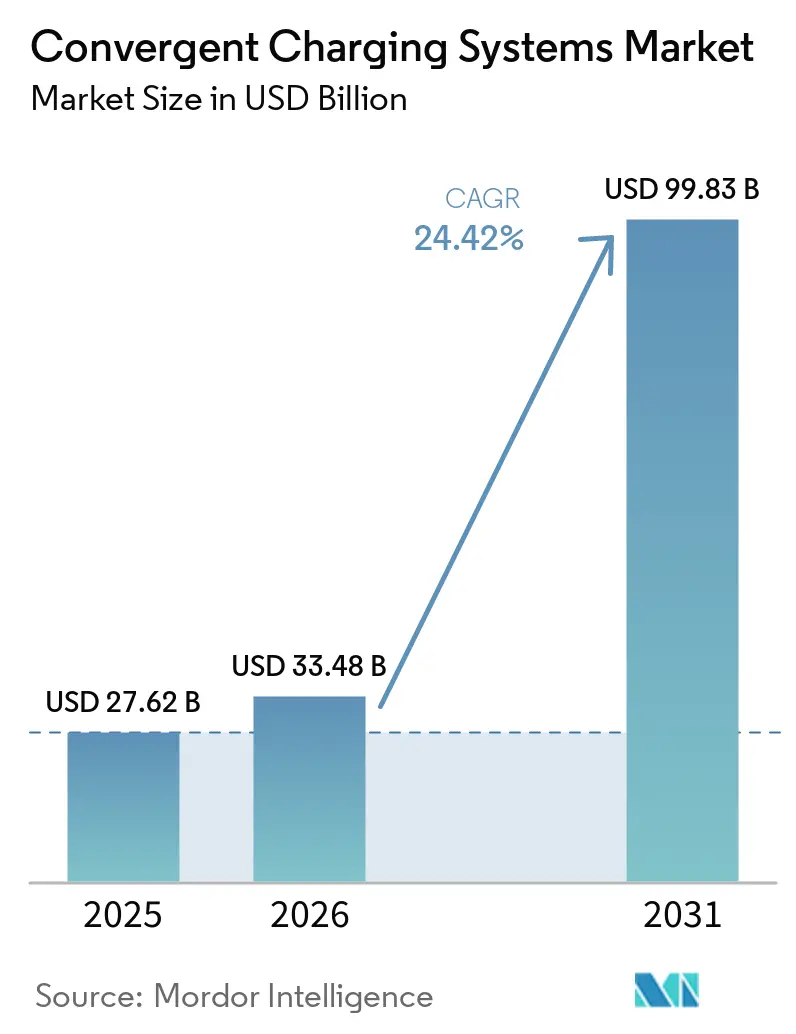
| Market Size (2026) | USD 33.48 Billion |
| Market Size (2031) | USD 99.83 Billion |
| Growth Rate (2026 - 2031) | 24.42 % |
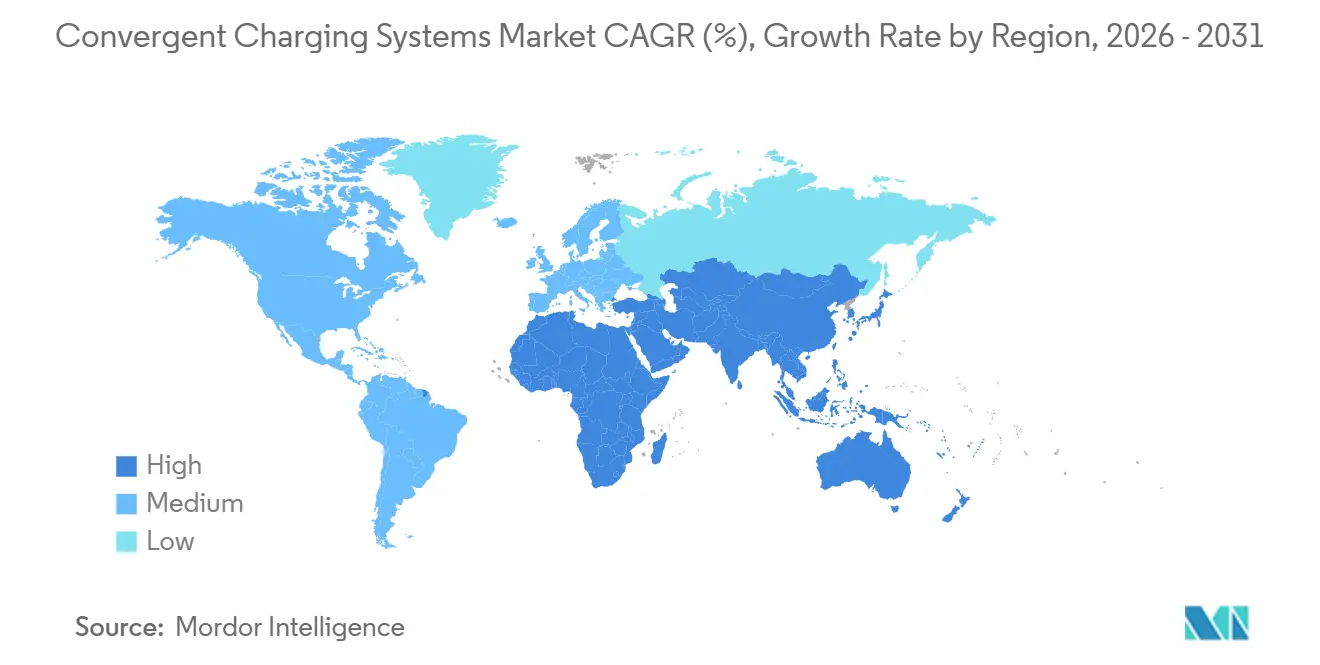
| Fastest Growing Market | Middle East |
| Largest Market | Asia-Pacific |
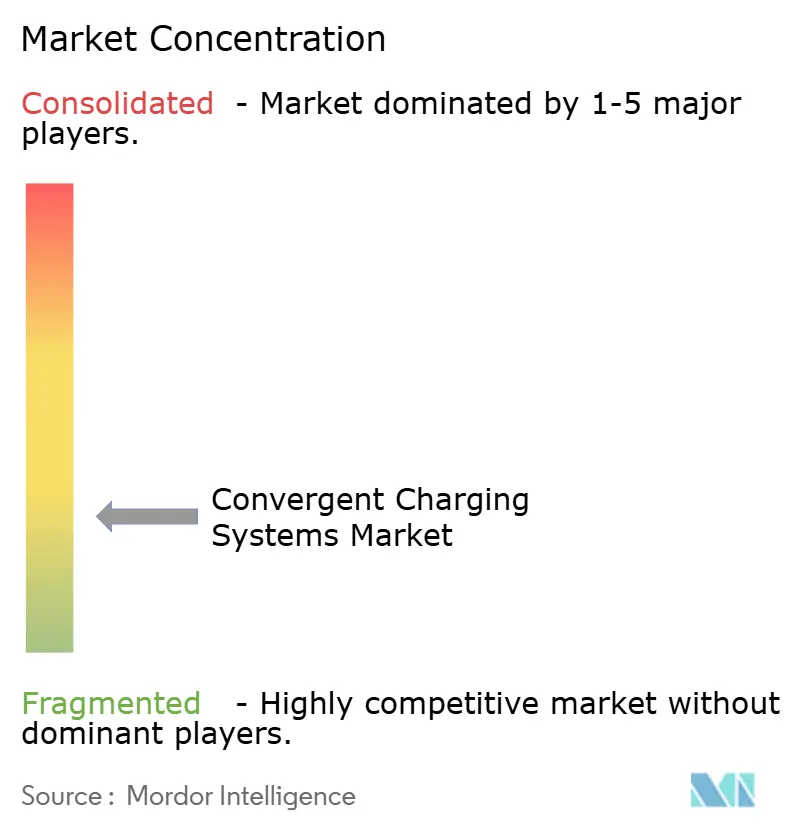
| Market Concentration | Low |
Major Players *Disclaimer: Major Players sorted in no particular order Image © Mordor Intelligence. Reuse requires attribution under CC BY 4.0. | |
Convergent Charging Systems Market Analysis by Mordor Intelligence
The convergent charging systems market size is projected to be USD 27.62 billion in 2025, USD 33.48 billion in 2026, and reach USD 99.83 billion by 2031, growing at a CAGR of 24.42% from 2026 to 2031. The convergent charging systems market is moving from separate charger installations toward integrated systems that combine equipment, software, energy management, and user data. Charge point operators need to improve asset use, meet protocol requirements, and participate in electricity ancillary services through the same operating platform. Fleet electrification, public corridor programs, and vehicle-to-grid revenue models are increasing the value of the software layer. Competitive priorities now extend beyond charger output to include interoperability, reliable operations, and the ability to manage electricity flows. Grid connection delays, cyber risk, and differing connector and payment standards will affect which providers secure long-term contracts.
Key Report Takeaways
- By component, hardware held 62.34% of the convergent charging systems market share in 2025, while software is projected to expand at a CAGR of 25.87% through 2031.
- By charging type, DC charging accounted for 64.79% of revenue in 2025, while wireless charging is expected to expand at a CAGR of 25.58% through 2031.
- By connectivity type, connected systems accounted for 40.56% of revenue in 2025, while energy management and demand response are projected to grow at a CAGR of 26.16% through 2031.
- By application, public urban charging accounted for 28.93% of revenue in 2025, while highway corridor charging is expected to grow at a 25.19% CAGR through 2031.
- By vehicle type, passenger cars held 66.71% revenue share in 2025, while medium- and heavy-duty trucks are projected to expand at a CAGR of 25.54% through 2031.
- By geography, Asia-Pacific held 48.37% revenue share in 2025, while the Middle East is expected to grow at a CAGR of 26.87% through 2031.
Key Report Takeaways
| Segmentation | Segment | Metric | Year | Value |
|---|---|---|---|---|
| By Component | Hardware | Market Share | 2025 | 62.34% |
| By Component | Software | CAGR | 2031 | 25.87% |
| By Charging Type | DC Charging | Market Share | 2025 | 64.79% |
| By Charging Type | Wireless Charging | CAGR | 2031 | 25.58% |
| By Connectivity Type | Connected Systems | Market Share | 2025 | 40.56% |
| By Connectivity Type | Energy Management and Demand Response | CAGR | 2031 | 26.16% |
| By Application | Public Urban Charging | Market Share | 2025 | 28.93% |
| By Application | Highway Corridor Charging | CAGR | 2031 | 25.19% |
| By Vehicle Type | Passenger Cars | Market Share | 2025 | 66.71% |
| By Vehicle Type | Medium- and Heavy-Duty Trucks | CAGR | 2031 | 25.54% |
| By Geography | Asia-Pacific | Market Share | 2025 | 48.37% |
| By Geography | Middle East | CAGR | 2031 | 26.87% |
| Source: Mordor Intelligence | ||||
Note: Market size and forecast figures in this report are generated using Mordor Intelligence’s proprietary estimation framework, updated with the latest available data and insights as of January 2026.
Global Convergent Charging Systems Market Trends and Insights
Drivers Impact Analysis*
| Driver | (~) % Impact on CAGR Forecast | Geographic Relevance | Impact Timeline |
|---|---|---|---|
| Fleet Electrification and Depot Uptime Requirements | +3.5% | Global, concentrated in North America, Europe, and Asia-Pacific | Medium term (2-4 years) |
| Public Fast-Charging Corridor Expansion | +3.0% | Global, especially North America, Europe, and Asia-Pacific | Medium term (2-4 years) |
| Government Funding, Building Codes, and Zero-Emission Targets | +2.8% | Global, early leadership in the European Union, United Kingdom, Canada, and Asia-Pacific | Short term (≤ 2 years) |
| Open-Protocol Interoperability and Roaming Demand | +2.2% | North America and the European Union, with expansion to Asia-Pacific and the Middle East | Medium term (2-4 years) |
| Megawatt Charging for Heavy-Duty Vehicles | +2.0% | Europe and North America, with Asia-Pacific emerging | Long term (≥ 4 years) |
| Grid-Interactive Charging and Energy-Service Monetization | +1.5% | European Union and North America, with early activity in Germany, the United Kingdom, and Texas | Long term (≥ 4 years) |
| Source: Mordor Intelligence | |||
Fleet Electrification and Depot Uptime Requirements
Fleet electrification is changing how charging is procured because a failed depot unit can disrupt an entire operating shift. The convergent charging systems market, therefore, favors providers that combine equipment monitoring, remote diagnostics, and service dispatch. The National Electric Vehicle Infrastructure program requires 97% annual uptime per port and automated reporting through the EV-ChART data pipeline. Persistent underperformance can lead to cure notices and grant recapture under that program. Fleet customers can treat uptime as a contract requirement because missed charging affects vehicle availability and scheduled work. This requirement makes integrated operational capability a prerequisite for longer-term fleet agreements, because fleet buyers need a clear route from charger alerts to diagnosis, service coordination, and verification that vehicles can return to their planned duty cycle.
Public Fast-Charging Corridor Expansion
Public corridor programs are making fast charging a larger part of infrastructure investment across major regions. The convergent charging systems market benefits when operators need to manage high-power equipment, changing traffic volumes, and limited grid capacity at the same location. The shift toward ultra-fast charging also raises the need for systems that allocate available power across vehicles. Higher-power sites need operating software that can monitor sessions and respond to equipment problems without waiting for on-site intervention. Corridor build-out also creates a requirement for common payment and communication functions across charging networks. This favors platforms that can integrate hardware, customer access, and energy management into a single operating environment, since separate systems can introduce unnecessary steps when a network must respond to traffic, equipment, or power constraints simultaneously.
Government Funding, Building Codes, and Zero-Emission Targets
Government funding is supporting infrastructure deployment while setting operating requirements for chargers. Canada announced a CAD 1.5 billion (USD 1.11 billion) allocation, through the Canada Infrastructure Bank initiative, for up to 5,400 public fast-charging stations. The program also introduced greenhouse gas emission standards aimed at 75% EV sales by 2035. The United Kingdom increased grant support from GBP 350 (USD 441) to GBP 500 (USD 630) per socket from April 1, 2026, and committed GBP 400 million (USD 504 million) for motorway service areas through 2030. The European Union Alternative Fuels Infrastructure Regulation requires open data, contactless payment, and specified power capabilities. These rules establish common technical expectations for the convergent charging systems market and give infrastructure owners a reason to select platforms that meet payment, reporting, and operational requirements as their networks expand.
Open-Protocol Interoperability and Roaming Demand
Interoperability is becoming a procurement requirement rather than a voluntary feature for charging management systems. OCPP 2.1 Edition 1 was published as IEC 63584-210:2025 in December 2025. The release supports ISO 15118-20 bidirectional charging, distributed energy resource control, and battery swapping.[1] OCPI 2.3.0 added direct payment modules and data points aligned with the European Union regulation. Common protocols can reduce the cost of changing charge management systems and improve roaming across networks. This change creates opportunities for software-focused providers and reduces the protection that proprietary systems once afforded established operators, because charging customers can place greater emphasis on functionality and service quality when communication standards are shared.
Restraints Impact Analysis*
| Restraint | (~) % Impact on CAGR Forecast | Geographic Relevance | Impact Timeline |
|---|---|---|---|
| Interconnection Delays and Local Grid Capacity Constraints | -2.8% | North America and the European Union, with expansion to Asia-Pacific and the Middle East | Medium term (2-4 years) |
| Fragmented Connector, Payment, and Communications Standards | -2.2% | Global | Medium term (2-4 years) |
| Cybersecurity, Identity, and Firmware Liability Exposure | -1.8% | Global, with elevated relevance in North America and the European Union | Short term (≤ 2 years) |
| Scarcity of Certified High-Power Charging Integration Talent | -1.2% | Global, with particular pressure in the Middle East and emerging Asia-Pacific markets | Long term (≥ 4 years) |
| Source: Mordor Intelligence | |||
Interconnection Delays and Local Grid Capacity Constraints
Grid connection timing remains a major limitation on charging deployment, especially for large fleets and corridor locations. Depot projects needing 3 MW to 10 MW of new capacity can face review periods of 18 to 36 months in the United States. The convergent charging systems market can partly address this delay through managed charging that uses available capacity more carefully. PG&E launched Flex Connect in April 2025 to let eligible projects connect at reduced capacity before a substation upgrade is completed. Long connection timelines can reduce project returns even when vehicle demand is adequate. Flexible connection services recognize that energization can be a separate obstacle from permitting or equipment delivery, which makes charging controls important during the period when a site has vehicles and equipment but does not yet have its full intended grid capacity.
Fragmented Connector, Payment, and Communications Standards
Connector and protocol differences complicate integration work for operators serving multiple applications or countries. NACS, SAE J3400, CCS1, CCS2, and legacy CHAdeMO require operators to make equipment choices across diverse vehicle fleets. Payment options, including Plug and Charge, RFID, and contactless cards, also require software coordination. The megawatt charging standard supports systems up to 1,500 V DC and 3,000 A under IEC TS 63379, although its software and communication protocols had not yet been finalized by mid-2026. Heavy-duty corridor operators must therefore make investment decisions before every element of the standard is complete. Smaller operators face a greater cost burden, which can slow expansion into secondary locations, where fewer charging sessions make it harder to absorb the costs of multiple connectors, payments, and communication requirements.
*Our forecasts treat driver/restraint impacts as directional, not additive. The impact forecasts reflect baseline growth, mix effects, and variable interactions.
Segment Analysis
By Component: Hardware Remains the Revenue Base While Software Extends Operating Value
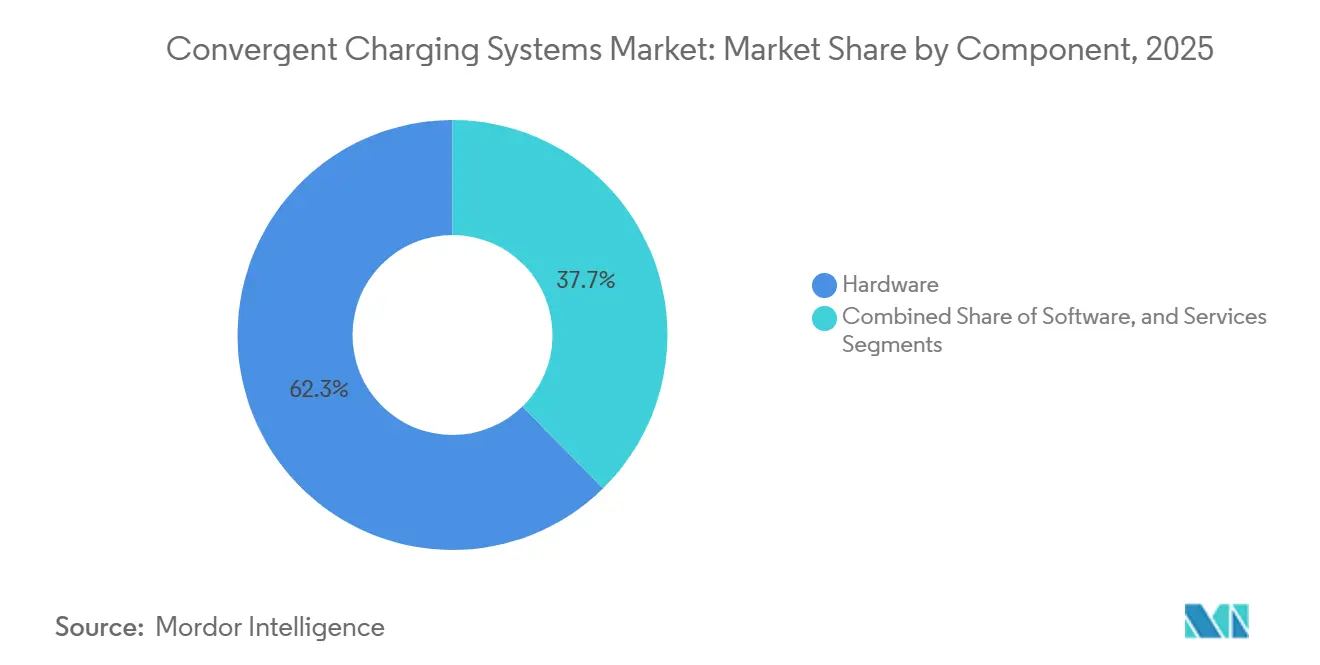
Hardware held 62.34% of revenue in 2025, making it the largest component of the convergent charging systems market. DC fast chargers, residential AC units, and emerging megawatt-charging dispensers form the physical basis for network deployment. Early network build-out requires substantial capital spending on equipment, which explains hardware's leading position. Operators use this installed base to add software and service functions over time. Procurement decisions now increasingly consider OCPP 2.1 certification, ISO 15118-20 readiness, and vehicle-to-grid capability. Hardware is no longer evaluated only by charging speed. These integration requirements allow equipment to connect with charger management, billing, diagnostics, and energy control functions. Services include installation, commissioning, maintenance, and managed-network operations. They serve operators who lack sufficient internal engineering resources, and they can link the physical installation process to ongoing monitoring, maintenance planning, and day-to-day network management after commissioning is complete.
Software is projected to grow at a 25.87% CAGR through 2031 in the convergent charging systems market. Operators need software to use charger data for energy management, revenue optimization, and predictive maintenance. OCPP 2.1 gives operators access to bidirectional charging and distributed energy resource controls when they update open-protocol specifications. The Open Charge Alliance certification program is conducted with testing organizations including Dekra and DNV. Certification is becoming a qualification requirement in public tenders and fleet contracts. The software layer can therefore influence hardware selection before a charger is purchased. This connection supports recurring service revenue alongside equipment sales. It also moves competition toward operating capability rather than equipment output alone, since a charger with compatible controls and usable data can support customer service, billing, maintenance, and energy decisions throughout its operational life.

By Charging Type: DC Charging Leads While Wireless Systems Develop New Use Cases
DC charging accounted for 64.79% of revenue in 2025, reflecting demand for fast and ultra-fast delivery in public, fleet, and commercial locations. The convergent charging systems market size for DC charging is driven by vehicle architectures capable of accepting higher charging power. Eight-hundred-volt vehicles can use 150 kW to 400 kW of charging power without cable pre-cooling. Public corridor sites use DC systems because drivers need shorter dwell times. Fleet operators also use high-power charging where vehicle schedules limit charging windows. AC charging continues to serve residential and workplace installations. Overnight dwell times make lower power economically suitable for these uses. Wireless charging serves a different need by improving convenience in residential and fleet depot settings. It is especially relevant where automated positioning or reduced cable handling is valued.
Wireless charging is projected to expand at a CAGR of 25.58% through 2031. SAE J2954 defines WPT1 at 3.7 kW, WPT2 at 7.7 kW, and WPT3 at 11 kW. IEC PAS 61980-4:2025 sets specifications for high-power wireless transfer for stationary EV charging at supply voltages up to 1,000 V AC and 1,500 V DC. The input indicates up to 94% transfer efficiency at the highest level, which supports use where installation convenience matters more than a small efficiency difference. MCS-capable dispensers are appearing ahead of full software standard completion. Kempower introduced Mega Satellite Flex in May 2026 with CCS capability up to 560 kW and MCS capability up to 1.2 MW. These systems are suited to long-haul sites that need very high output. Urban locations still prioritize compatibility with passenger vehicles. The different requirements keep DC, AC, wireless, and megawatt systems relevant to distinct deployment conditions, rather than creating a single replacement path across homes, urban destinations, fleet depots, public corridors, and heavy-duty transport sites.
By Connectivity Type: Connected Systems Lead While Energy Management Gains Momentum
Connected systems accounted for 40.56% of revenue in 2025 and remained the largest connectivity category. The convergent charging systems market relies on connectivity for session monitoring, remote diagnostics, and OCPP-based network management. Public and commercial operators need continuous operating information across dispersed charging locations. Connected systems support authentication, billing, charger health monitoring, and reporting. They also allow operators to manage problems without visiting each location immediately. Operations management software provides the basic connected layer for these functions. Non-connected systems continue to play a role in cost-sensitive residential and emerging-market applications. Connectivity costs and uneven network availability can still limit their use. Other connectivity types provide specialized data exchange and reporting functions for roaming and multi-operator settlement.
Energy management and demand response are projected to grow at a CAGR of 26.16% through 2031. The convergent charging systems market is increasingly treating EV batteries as responsive energy assets rather than passive loads. Enercity and Volkswagen Commercial Vehicles traded electricity discharged from bidirectionally connected fleet vehicles on Germany's electricity exchange in May 2026. The transaction showed a commercial vehicle-to-grid use case in a business-to-business setting. Blink Charging deployed its EnergyConnect system across 13 DC fast-charging sites in Florida, with plans for demand response and energy storage integration. Lower LTE and IoT module costs can further weaken the case for non-connected systems. Grid-responsive charging adds a potential revenue function alongside charging sessions. It also helps operators respond to capacity limits at constrained locations, where the ability to schedule, reduce, or shift charging activity can be more practical in the near term than waiting for an extensive grid upgrade.
By Application: Public Urban Charging Leads While Highway Corridors Advance
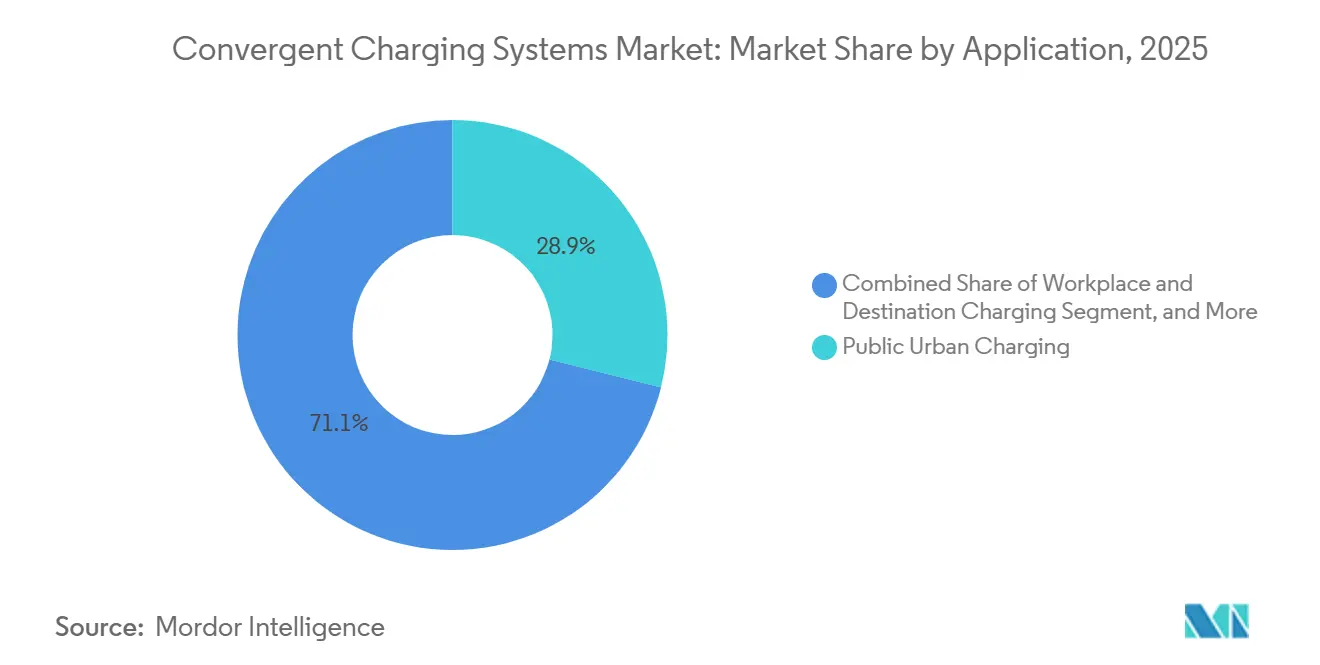
Public urban charging accounted for 28.93% of revenue in 2025 and was the largest application in the convergent charging systems market. Dense metropolitan areas concentrate passenger-car demand and tend to provide higher asset utilization than corridor or workplace locations. These sites need reliable payment, network visibility, and power management because many users share the same equipment. Fleet and depot charging is increasing as logistics operators electrify last-mile delivery vehicles. Captive depots can have lower average per-session tariffs than public networks, but they require reliable scheduled charging. Workplace and destination charging includes retail, hotels, and parking structures. These locations support employer fleet benefits and EV driver retention. Residential charging has the largest installed base of individual units worldwide, but it produces lower average revenue per unit. Transit hubs, airports, and marine facilities remain smaller applications with specific power and protocol requirements.
Highway corridor charging is projected to grow at a CAGR of 25.19% through 2031. The convergent charging systems market uses corridor locations to serve passenger and commercial vehicles moving between cities. High-power equipment and managed energy systems are important where grid connections are constrained. The input identifies an opportunity for additional fast charging in Western Europe based on the gap between current charger availability and expected long-term utilization. Heavy-duty demand is adding to the need for corridor capacity. Scania and Milence targeted 1,700 high-performance charge points across Europe by 2027.[2] BP Pulse planned MCS installation at Ashford International Truckstop in the United Kingdom by 2026. Corridor investments therefore connect passenger car charging with the expansion of long-haul electric transport, requiring site operators to balance frequent passenger vehicle sessions with the much larger power needs and operating schedules of commercial trucks.
By Vehicle Type: Passenger Cars Provide Volume While Heavy Trucks Change Site Requirements
Passenger cars accounted for 66.71% of revenue in 2025, making them the largest source of demand in the convergent charging systems market. Their position reflects the scale of global passenger EV adoption, particularly in China. Passenger vehicle charging requires coverage across urban locations, workplaces, residences, and travel corridors. This broad use pattern supports a large base of charging equipment and connected services. Light commercial vehicles are an adjacent growth area because delivery fleets require managed depot charging. Buses are a more established segment for electrification in China and Europe. They remain less developed in South Asia, Southeast Asia, and the Middle East. Two- and three-wheelers add meaningful charging unit volume in India and Southeast Asia. Their lower per-unit charging revenue limits their influence on total revenue compared with passenger cars.
Medium- and heavy-duty trucks are projected to grow at a CAGR of 25.54% through 2031. MCS standardization, fleet decarbonization requirements, and improving total cost of ownership support this outlook. MAN Truck and Bus began series production of MCS-ready electric trucks in mid-2026. The company stated that a 534 kWh battery could charge from 20% to 80% in under 30 minutes using MCS. This charging period can fit within legally mandated driver breaks. As a result, charging infrastructure availability becomes more important than vehicle charging capability for long-haul operations. The convergent charging systems industry must manage higher loads, site capacity, and network availability for these vehicles. MCS corridor investment can grow as truck registrations increase after 2027. This supports a different equipment and energy management profile from passenger vehicle charging, including higher site loads, more demanding equipment availability, and closer coordination between vehicle arrival times, driver breaks, and power delivery.
Geography Analysis
Asia-Pacific accounted for 48.37% of the convergent charging systems market share in 2025, supported by China's extensive charging network. China's National Energy Administration stated that the country reached 20.09 million charging facilities by the end of 2025, including 4.7 million public charge points. The total was 49.7% higher than the preceding year. China also set a target of 28 million charging facilities by 2027 and intends to expand vehicle-to-grid pilots to more than 5,000 bidirectional facilities.[3] India had 10.02 million registered EVs and 52,718 public charging stations by July 2026. This ratio indicates a large infrastructure gap. Indonesia, Malaysia, Thailand, and Vietnam also recorded faster EV adoption in 2025, supported by the availability of Chinese vehicles and government incentives.
North America and Europe form the second-largest demand bloc for the convergent charging systems market. Their installed base is moving toward higher-power systems and more detailed compliance requirements. The U.S. NEVI Formula Program retains a 97% uptime requirement for federally funded DC fast-charger corridors. Canada committed CAD 1.5 billion (USD 1.11 billion) to public charging infrastructure and up to 5,400 fast-charging stations. The United Kingdom raised chargepoint grants to GBP 500 (USD 630) per socket and committed GBP 400 million (USD 504 million) for motorway service area capacity. European Union requirements for open data, contactless payments, and power capability favor interoperable systems. South America, led by Brazil and Argentina, is building charging infrastructure through public and private funding. Its charging density remains below vehicle fleet growth, which leaves a longer-term coverage requirement and gives early providers an opportunity to establish networks before higher vehicle volumes require more widespread corridor and destination coverage.
The Middle East is projected to expand at a CAGR of 26.87% through 2031. The region is growing from a smaller installed base through government-led transport and infrastructure programs. Dubai Electricity and Water Authority expanded its network to more than 1,860 charge points in 2025 from 740 at the end of 2024. The United Arab Emirates has a national target of 70,000 chargers by 2030. Saudi Arabia's EVIQ is targeting 5,000 chargers across 1,000 locations by 2030, with a focus on routes between Riyadh, Jeddah, and Dammam. NEOM is positioning its northwest region for solar-powered ultra-fast hubs. Africa remains at an early stage, with South Africa, Nigeria, and Egypt emerging as initial markets. Grid reliability makes locally managed charging systems particularly relevant in these settings, because operators need to account for local power conditions while maintaining basic charging availability for early users and fleet customers.
Competitive Landscape
The convergent charging systems market is moderately fragmented, and no single company holds more than a low-teens share of global value. Competition centers on equipment performance, software capability, and geographic coverage. Alpitronic, Kempower, and Wallbox have established positions through hardware performance and open-protocol alignment. Star Charge and TELD New Energy use manufacturing scale and domestic network density to maintain competitive hardware pricing while expanding abroad. Providers are also trying to convert equipment sales into longer-term platform use through analytics, energy management modules, and vehicle-to-grid functions. This approach shifts emphasis from unit margins to recurring software revenue. Hardware capability remains essential, but it increasingly supports an integrated operating platform. The convergent charging systems market has therefore brought European manufacturers and Chinese volume producers into more direct competition, with both groups seeking to combine equipment supply, network functions, and energy services that can support customer relationships beyond the initial hardware sale.
EVBox introduced its Decentralized Distributed Architecture at Drive to Zero 2026, positioning hardware design to support more flexible energy and charging operations.[4] Blink Charging launched EnergyConnect across 13 Florida DC fast-charging sites, linking charging operations with energy optimization and planned demand-response integration. Kempower introduced Mega Satellite Flex with both CCS and MCS functionality from one dispenser. These moves show how providers are linking charger equipment with software, power allocation, and changing vehicle requirements. OCPP 2.1 certification is becoming more relevant in procurement requirements. The Open Charge Alliance certification program involves test laboratories including Dekra, DNV, and Korea Testing Laboratory. Certification can become a formal qualification barrier for providers with less developed software capability. This favors companies that can demonstrate interoperability as well as charger performance, particularly where public agencies and large fleets need evidence that equipment can work across software environments and remain useful as technical requirements develop.
Opportunities remain in predictive maintenance, energy management systems with open application programming interfaces, and roaming infrastructure in the Middle East and South Asia. Predictive maintenance addresses charger failure recovery times that can disrupt fleet operations. Energy management can help operators qualify for utility demand-response revenue and operate within grid capacity limits. Roaming systems can support settlement across operators where cross-network frameworks remain less developed. Software-focused platforms can provide managed network services without taking the same capital exposure as infrastructure owners. SK Inc.'s July 2026 tender offer for SK Signet, followed by its plan to sell the business by the first quarter of 2027, reflected pressure on hardware-focused companies as margins tightened and software requirements expanded.
Convergent Charging Systems Industry Leaders
-
Wallbox N.V.
-
Kempower Oyj
-
Alpitronic S.r.l.
-
EVBox B.V.
-
TELD New Energy Co., Ltd.
- *Disclaimer: Major Players sorted in no particular order
Recent Industry Developments
- August 2026: NOW GmbH's updated China Electric Mobility country dossier confirmed that China now operates the world's largest EV charging network, with more than 20 million charging points, including 4.7 million publicly accessible units, serving approximately 44 million electric passenger cars. The finding benchmarks the scale advantage that China-based manufacturers bring to global competition and validates the convergent charging platform model at an infrastructure density that no other market approaches.
- July 2026: SK Inc. announced a tender offer for its subsidiary SK Signet at approximately a 20% premium to the prevailing share price, with plans to complete a voluntary delisting by Q4 2026 and finalize a sale to Anchor Equity Partners or another buyer by Q1 2027. The transaction reflects strategic portfolio rationalization as hardware margin compression intensifies across the fast-charging sector globally.
- June 2026: Alpitronic upgraded its decentralized megawatt charging system HYC1000 with a new High-Performance Dispenser, enabling delivery of over 1,000 A and up to 1,000 kW via a single CCS connection across a 150 to 1,000 V operating range. Availability begins in Europe, with U.S. and Canadian market launches planned for 2027.
- June 2026: Volkswagen Group and Elli launched a commercial vehicle-to-grid product for volume-market consumers in Germany, comprising the Elli BiDi Charger, the Volkswagen Naturstrom V2G Flow tariff, and the Elli BiDi App. Customers maintaining 250 connection hours per month can receive up to EUR 720 (USD 799) annually, marking a milestone in consumer-scale grid energy monetization.
Global Convergent Charging Systems Market Report Scope
The convergent charging systems market includes solutions that enable service providers to manage, rate, charge, and bill customers for multiple services, such as voice, data, messaging, and digital content, through a unified platform. The market covers software, hardware, and associated services deployed across telecommunications and digital service provider networks.
The Convergent Charging Systems Market Report is Segmented by Component (Hardware, Software, and Services), Charging Type (AC Charging, DC Charging, and Wireless Charging), Connectivity Type (Connected Systems, Non-Connected Systems, Operations Management, Energy Management and Demand Response, and Other Connectivity Types), Application (Residential Charging, Workplace and Destination Charging, Public Urban Charging, Highway Corridor Charging, Fleet and Depot Charging, and Other Applications), Vehicle Type (Passenger Cars, Light Commercial Vehicles, Buses, Medium- and Heavy-Duty Trucks, and Two- and Three-Wheelers), and Geography (North America, South America, Europe, Asia-Pacific, Middle East, and Africa). The Market Forecasts are Provided in Terms of Value (USD).
| Hardware |
| Software |
| Services |
| AC Charging |
| DC Charging |
| Wireless Charging |
| Connected Systems |
| Non-Connected Systems |
| Operations Management |
| Energy Management and Demand Response |
| Other Connectivity Types |
| Residential Charging |
| Workplace and Destination Charging |
| Public Urban Charging |
| Highway Corridor Charging |
| Fleet and Depot Charging |
| Other Applications |
| Passenger Cars |
| Light Commercial Vehicles |
| Buses |
| Medium- and Heavy-Duty Trucks |
| Two- and Three-Wheelers |
| North America | United States |
| Canada | |
| Mexico | |
| South America | Brazil |
| Argentina | |
| Rest of South America | |
| Europe | Germany |
| United Kingdom | |
| France | |
| Italy | |
| Russia | |
| Spain | |
| Rest of Europe | |
| Asia-Pacific | China |
| India | |
| Japan | |
| South Korea | |
| Australia | |
| Rest of Asia-Pacific | |
| Middle East | Saudi Arabia |
| United Arab Emirates | |
| Turkey | |
| Rest of Middle East | |
| Africa | South Africa |
| Nigeria | |
| Egypt | |
| Rest of Africa |
| By Component | Hardware | |
| Software | ||
| Services | ||
| By Charging Type | AC Charging | |
| DC Charging | ||
| Wireless Charging | ||
| By Connectivity Type | Connected Systems | |
| Non-Connected Systems | ||
| Operations Management | ||
| Energy Management and Demand Response | ||
| Other Connectivity Types | ||
| By Application | Residential Charging | |
| Workplace and Destination Charging | ||
| Public Urban Charging | ||
| Highway Corridor Charging | ||
| Fleet and Depot Charging | ||
| Other Applications | ||
| By Vehicle Type | Passenger Cars | |
| Light Commercial Vehicles | ||
| Buses | ||
| Medium- and Heavy-Duty Trucks | ||
| Two- and Three-Wheelers | ||
| By Geography | North America | United States |
| Canada | ||
| Mexico | ||
| South America | Brazil | |
| Argentina | ||
| Rest of South America | ||
| Europe | Germany | |
| United Kingdom | ||
| France | ||
| Italy | ||
| Russia | ||
| Spain | ||
| Rest of Europe | ||
| Asia-Pacific | China | |
| India | ||
| Japan | ||
| South Korea | ||
| Australia | ||
| Rest of Asia-Pacific | ||
| Middle East | Saudi Arabia | |
| United Arab Emirates | ||
| Turkey | ||
| Rest of Middle East | ||
| Africa | South Africa | |
| Nigeria | ||
| Egypt | ||
| Rest of Africa | ||
Key Questions Answered in the Report
What is the size of the convergent charging systems market?
The convergent charging systems market size is projected to rise from USD 33.48 billion in 2026 to USD 99.83 billion by 2031, at a CAGR of 24.42%.
What is driving demand for convergent charging systems?
Fleet uptime needs, fast-charging corridor expansion, public funding, interoperability requirements, megawatt charging, and grid-interactive services support demand. These factors increase the value of systems that can coordinate equipment performance, user service, and available electricity capacity at operating sites.
Which charging type led demand in 2025?
DC charging led with 64.79% revenue share in 2025 because public, fleet, and commercial sites need fast and ultra-fast power delivery. Its role is strongest where driver dwell time is limited or vehicles must return quickly to scheduled use.
Why is energy management important for EV charging?
Energy management and demand response is projected to grow at a CAGR of 26.16% because operators can manage power limits and use EV batteries as responsive energy assets.
Which region is growing fastest for convergent charging systems?
The Middle East is expected to expand at a CAGR of 26.87% through 2031, supported by public infrastructure plans and a low installed base.