
Container Homes Market Size and Share
Market Overview
| Study Period | 2022 - 2032 |
|---|---|
| Market Size (2027) | USD 78.27 Billion |
| Market Size (2032) | USD 109.01 Billion |
| Growth Rate (2027 - 2032) | 6.85 % |
| Fastest Growing Market | Asia-Pacific |
| Largest Market | North America |
| Market Concentration | Low |
Major Players *Disclaimer: Major Players sorted in no particular order Image © Mordor Intelligence. Reuse requires attribution under CC BY 4.0. | |
Container Homes Market Analysis by Mordor Intelligence
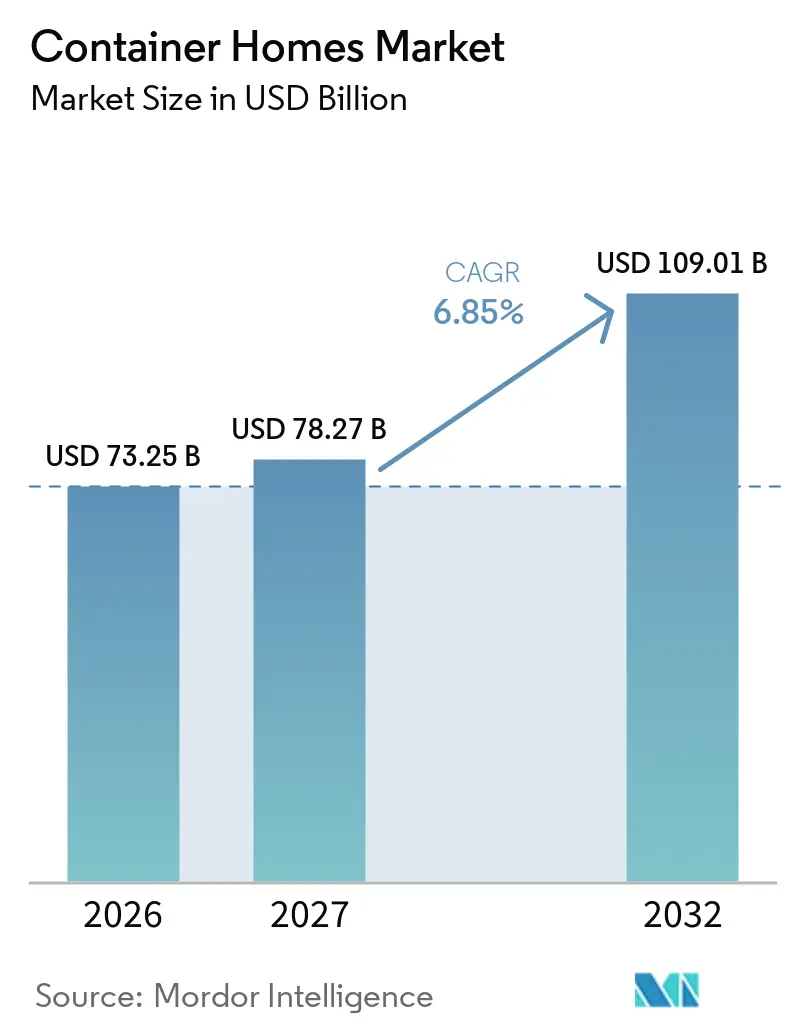
The container homes market size was valued at USD 73.25 billion in 2026 and is estimated to grow from USD 78.27 billion in 2027 to USD 109.01 billion by 2032, at a CAGR of 6.85% during the forecast period (2027-2032). Housing affordability pressures in North America, Europe, and Asia-Pacific support demand for lower-cost construction options that can be planned for small sites, delivered in stages, and adapted to a range of residential or institutional requirements. In the United States, 75% of households, or 100.6 million households, could not afford a new median-priced single-family home priced at USD 459,826 at a 6.5% mortgage rate in 2025. Container-based projects can reduce costs by 20% to 30% and shorten delivery schedules from 6 to 12 months to 2 to 4 months, although outcomes depend on design, permitting, and local labor conditions. Public housing policies, accessory dwelling unit policies, and emergency accommodation requirements also support the container homes market. Regulatory consistency, access to financing, building-envelope performance, and proven long-term durability will determine whether the container homes market moves beyond specialist use cases into more routine housing delivery.
Key Report Takeaways
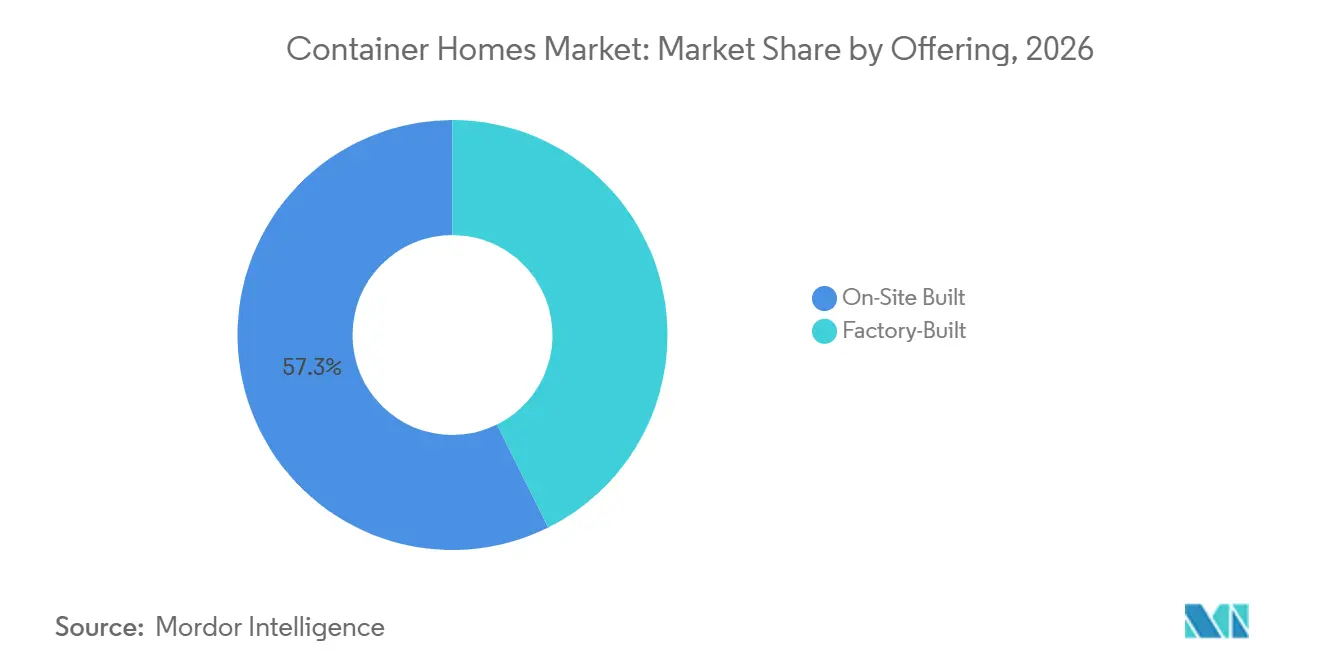
- By offering, On-Site Built held 57.34% of the container homes market share in 2026, while Factory-Built is forecast to grow at a 7.67% CAGR through 2032.
- By construction type, Fixed held 56.12% of the container homes market share in 2026, while Movable is forecast to grow at an 8.05% CAGR through 2032.
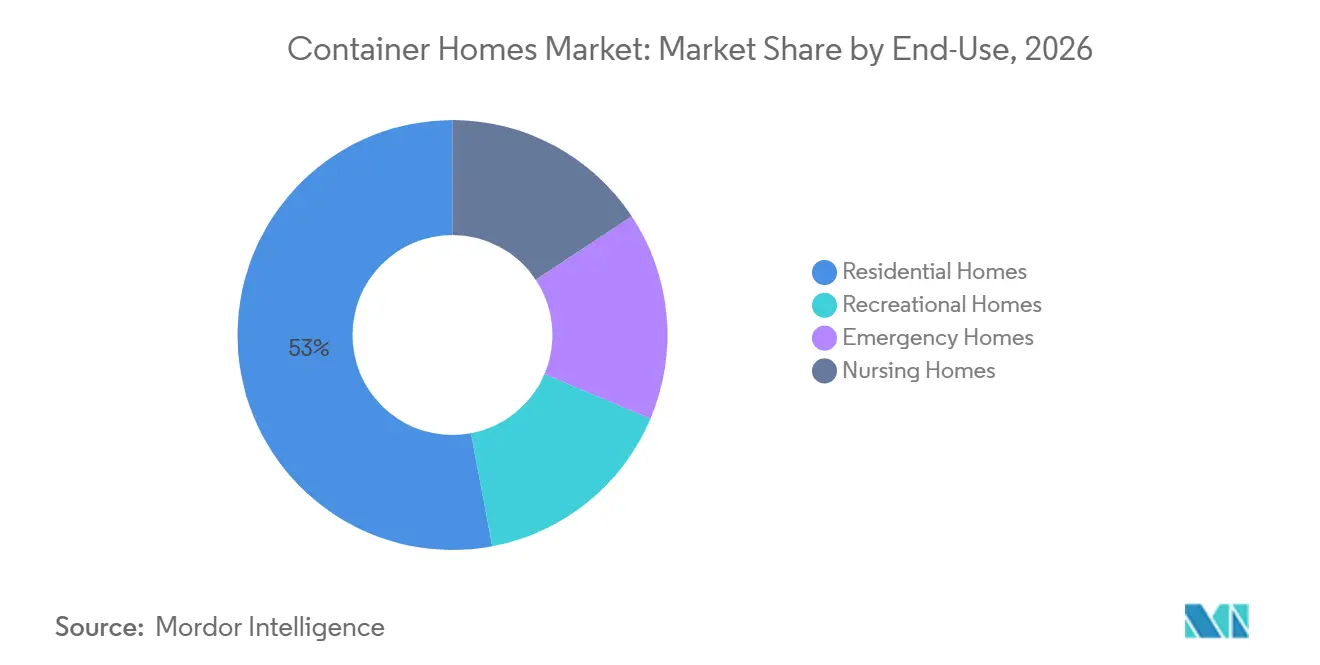
- By end-use, Residential Homes held 52.96% of demand in 2026, while Emergency Homes is forecast to grow at an 8.32% CAGR through 2032.
- By geography, North America held 38.65% of demand in 2026, while Asia-Pacific is forecast to grow at a 7.63% CAGR through 2032.
Note: Market numbers in this report are based on Mordor Intelligence's proprietary estimation framework, which combines nine months of actuals with Q4 projections for base year 2026.
Global Container Homes Market Trends and Insights
Drivers Impact Analysis*
| Drivers | (~) % Impact on CAGR Forecast | Geographic Relevance | Impact Timeline |
|---|---|---|---|
| Rising Housing Costs and Affordability Pressure | +2.0% | Global, most acute in North America, the EU core, and the Asia-Pacific gateway cities | Short term (≤ 2 years) |
| Expansion of Modular and Prefabricated Construction | +1.5% | Global, led by the United States, China, Canada, and Germany | Medium term (2-4 years) |
| Sustainability and Circular Use of Steel Containers | +1.0% | Global, with the highest regulatory intensity in the EU, Australia, and New Zealand | Medium term (2-4 years) |
| Growth in Disaster-Relief and Rapid-Deployment Housing | +1.5% | Asia-Pacific, the Middle East and Africa, and South America, with spillover to Gulf states and Pacific Island nations | Short term (≤ 2 years) |
| Accessory Dwelling Unit (ADU) Policy Reform and Residential-Lot Intensification | +1.0% | North America, with early expansion to Australia and New Zealand | Medium term (2-4 years) |
| Source: Mordor Intelligence | |||
Rising Housing Costs and Affordability Pressure
Structural housing affordability is a central driver for the container homes market, as many households cannot qualify for newly built homes. The U.S. Department of Housing and Urban Development reported 8.46 million households with worst-case housing needs in 2023, defined as very-low-income renter households without housing assistance that paid more than half of their income toward rent. This unmet need sustains interest in housing formats that require less material use and shorter construction schedules, both in urban and secondary locations where land prices and rental burdens can limit conventional development. Container homes can serve as a practical option when land, foundations, utilities, and approvals are already in place, rather than as a substitute for those requirements. Public affordable-housing programs could create larger-order opportunities for suppliers that meet building, accessibility, and procurement requirements. The container homes market therefore depends on manufacturers translating a cost-focused proposition into repeatable, code-compliant housing delivery for public agencies and private buyers.
Expansion of Modular and Prefabricated Construction
The broader adoption of factory construction improves the operating case for the container homes market across residential and institutional projects. The Modular Building Institute reported that permanent modular construction in the United States reached USD 20.5 billion in 2025, representing 5.1% of construction activity across its measured segments. Factory production can reduce project schedules by 20% to 50% compared with site-intensive construction. Controlled fabrication can also improve dimensional accuracy, material planning, and documentation of quality checks before units reach the project site. These attributes are relevant when builders face skilled labor shortages, weather delays, uneven jobsite productivity, the need to coordinate multiple trades, and tighter expectations from public agencies or institutional project owners. The container homes market benefits when buyers view factory-built units as a dependable construction method rather than a temporary alternative.
Sustainability and Circular Use of Steel Containers
The reuse of shipping containers can support the environmental case for the container homes market when projects address insulation, corrosion protection, and building longevity from the outset. A 2025 study of a four-container house in Madrid found that a system using Polyisocyanurate (PIR) insulation boards and a ventilated façade achieved non-renewable primary energy use of 34 kWh/m²/year and an A-rated energy performance certificate under the applicable Spanish framework. This result demonstrates that steel structures can meet energy objectives when the envelope is designed as a complete system rather than as a simple interior retrofit. Low operational energy is increasingly important for public and private buyers who consider whole-life building performance, maintenance needs, local energy regulations, and the cost of operating housing over an extended occupancy period. This requirement favors suppliers that integrate insulation, ventilation, drainage, and exterior protection early in the design process. It also limits the appeal of lower-cost units that rely on minimal retrofits after delivery.
Growth in Disaster-Relief and Rapid-Deployment Housing
Rapid deployment after disasters creates a distinct demand channel for the container homes market, particularly in areas where conventional rebuilding would take longer. Manufacturers supplied insulated, partition-ready container units for displaced communities after the March 2025 Myanmar earthquake, demonstrating how standardized units can be mobilized under urgent conditions[1]. Government and humanitarian buyers value units that can be transported, installed, configured, and connected to essential services quickly. These orders can provide concentrated order quantities that differ from individual residential purchases and can support planned factory capacity, workforce deployment, inventory planning, and supplier commitments during otherwise uneven periods of demand. Requirements for resilient, safe accommodation also raise standards for climate performance, utilities, local code compliance, and occupant privacy. Suppliers that meet these requirements can use emergency projects to establish operational credentials in adjacent public-housing applications.
Restraints Impact Analysis*
| Restraints | (~) % Impact on CAGR Forecast | Geographic Relevance | Impact Timeline |
|---|---|---|---|
| Fragmented Zoning, Permitting, and Building-Code Requirements | -1.0% | North America, with a secondary impact in Europe and Asia-Pacific urban centers | Medium term (2-4 years) |
| Limited Mortgage, Insurance, and Valuation Infrastructure | -1.5% | North America and Europe, with a lower impact on cash purchases and Non-Governmental Organization (NGO)-funded emerging locations | Long term (≥ 4 years) |
| Thermal, Corrosion, and Climate-Performance Requirements | -0.5% | Global, with the highest friction in humid tropics, extreme-cold locations, and Gulf high-heat zones | Long term (≥ 4 years) |
| Source: Mordor Intelligence | |||
Fragmented Zoning, Permitting, and Building-Code Requirements
Local zoning and permitting rules remain a direct constraint on the container homes market. The 2021 International Building Code includes provisions recognizing shipping containers as building materials, but local adoption and interpretation vary[2]. A design accepted in one jurisdiction may require substantial changes in another. This increases engineering, documentation, approval, and project management costs for manufacturers operating across multiple cities or states, particularly when the same base design must be revised to meet local interpretations. Local builders with established relationships with building departments hold an advantage under these conditions. Greater consistency in code adoption and planning rules would reduce project uncertainty and improve the scalability of the container homes market.
Limited Mortgage, Insurance, and Valuation Infrastructure
Container homes can fall between conventional real property and manufactured housing classifications. This uncertainty makes it harder for buyers to obtain standard treatment for mortgages, insurance, and appraisals. Where comparable sales are limited, conservative valuations can lower loan-to-value ratios and reduce purchasing power, even when a completed unit meets local code and fulfills the same housing need as a conventional home. Lenders and insurers may also require more detailed evidence of foundation design, durability, and code compliance, which small builders find difficult to manage across different local markets. The container homes market will gain broader access among mainstream home buyers when financing and insurance practices consistently recognize compliant units.
*Our forecasts treat driver/restraint impacts as directional, not additive. The impact forecasts reflect baseline growth, mix effects, and variable interactions.
Segment Analysis
By Offering: On-Site Built Remains the Largest Format, While Factory-Built Gains Momentum
On-site-built accounted for 57.34% of demand in 2026. This position reflects the availability of local construction labor, the flexibility to adapt units to site conditions, and the ability to sequence work around local utility and foundation requirements. On-site methods are relevant for government housing programs that prioritize local employment and procurement from nearby contractors. They also suit locations where factory-built transport, lifting logistics, final-mile delivery, and qualified installation crews are not yet available. The container homes industry continues to use this approach where customized layouts, utility connections, or local material sourcing are required.
Factory-built units are forecast to expand at a 7.67% CAGR through 2032. The container homes market size for factory-built units is supported by controlled fabrication, reduced weather exposure, repeatable quality checks, and more predictable installation schedules. The United States' permanent modular segment reached USD 20.5 billion in 2025, providing a broader manufacturing base for factory-delivery methods. Automated steel fabrication can lower production costs, improve repeatability, reduce reliance on on-site specialist work, and support clearer coordination among structural, interior, and service-installation teams. North American providers must differentiate through certification, energy performance, design support, local installation capability, and clear documentation for approving authorities.

By Construction Type: Fixed Construction Anchors Demand While Movable Units Address Rapid Deployment
Fixed construction held 56.12% of demand in 2026. Permanent installations are common in residential and institutional settings that require foundations, utility connections, conventional occupancy approvals, and a long-term relationship to the site rather than periodic relocation. This format aligns better with mortgage eligibility, long-term property use, and integration with established neighborhood infrastructure. Fixed units also allow designers to incorporate more extensive insulation, exterior cladding, service connections, and durable weather protection. These requirements support use in locations where building standards are rigorous and owners expect long service life.
Movable units are forecast to grow at an 8.05% CAGR through 2032. Demand comes from emergency accommodation, seasonal workforce housing, and accessory dwelling unit applications that require flexible placement, manageable transport dimensions, and the option to reconfigure space as needs change. At Ka La'i Ola in Lahaina, the State of Hawaii completed a community of alternative transportable temporary housing units for wildfire survivors, illustrating the role of modular units in disaster recovery. Faster installation is valuable where displacement creates an immediate housing need. Permitting and utility requirements remain important, as movable units still need safe, habitable site conditions.
By End-Use: Residential Homes Lead Demand While Emergency Homes Expand Faster
Residential homes accounted for 52.96% of the container homes demand in 2026. Affordability, shorter construction schedules, and adaptability to constrained lots support this position for households and small developers. Households may use container structures as primary homes, secondary units, or small additions to existing properties where local approvals permit and appropriate utility, drainage, and access arrangements can be made. Recreational homes also generate demand through remote hospitality and eco-tourism sites that value transportability, compact layouts, and efficient use of serviced land. The container homes market remains closely tied to local housing costs, site access, and the availability of serviced land.
Emergency homes are forecast to grow at an 8.32% CAGR through 2032. Climate-related events and other disasters require accommodation that can be rapidly transported, assembled, and prepared for occupancy. Myanmar earthquake response projects in 2025 demonstrated the relevance of preconfigured container units for short-notice shelter needs. Nursing homes also represent a potential application for a scalable, code-compliant care space in rural or disrupted areas with limited construction capacity, particularly when permanent facilities cannot be delivered quickly. Performance expectations from humanitarian buyers can improve assembly speed, climate resilience, energy efficiency, and interior safety across residential products.
Geography Analysis
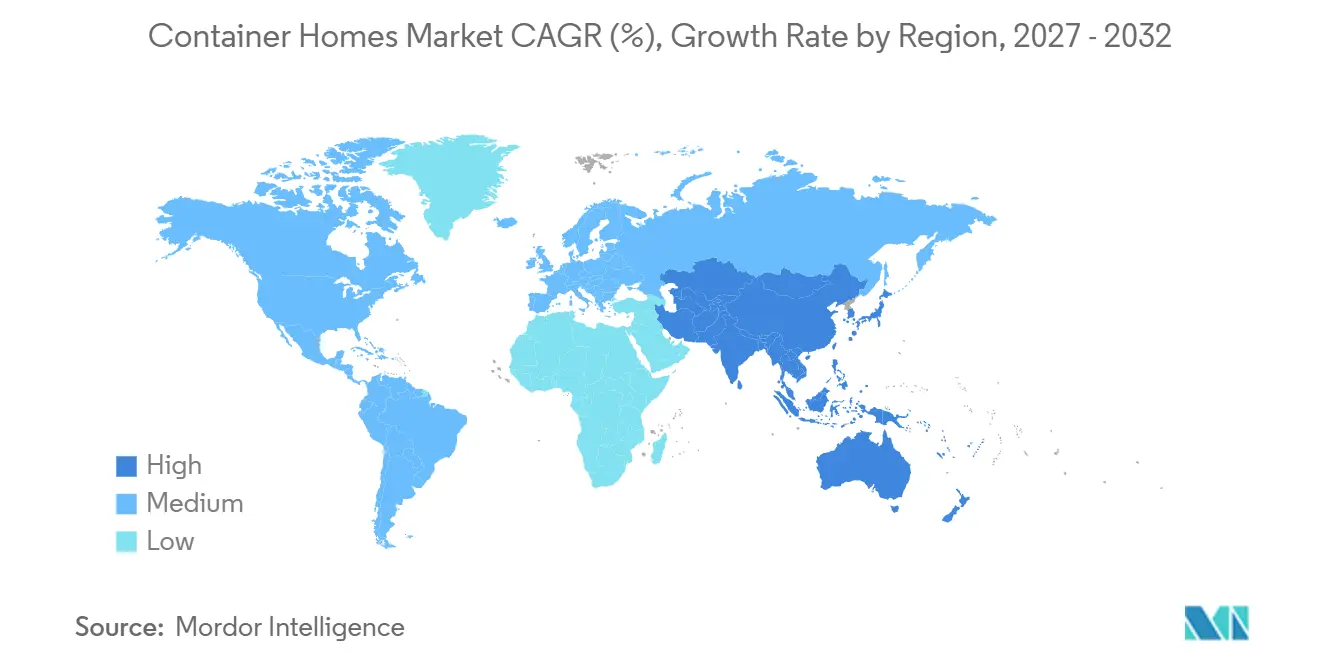
North America accounted for 38.65% of demand in 2026. Housing affordability pressures in the United States and broader accessory dwelling unit policy reform are driving interest in alternative residential construction, particularly on small infill sites that can accommodate secondary homes without major land acquisition. By July 2025, 18 states had broadly legalized accessory dwelling units, creating more potential sites for compact housing. Canada has an established modular construction base that supports factory-built delivery across residential and temporary accommodation uses, including projects that require greater certainty on quality control and delivery scheduling. Mexico offers opportunities for post-disaster resettlement and lower-income housing programs, in which public procurement can help reduce material and foundation costs.
Asia-Pacific is forecast to grow at a 7.63% CAGR through 2032. China combines manufacturing capacity with the ability to deploy large numbers of standardized units after disasters, linking steel fabrication, standardized design, transport planning, and rapid installation within a large domestic production base. The Myanmar earthquake response in March 2025 demonstrated how manufacturers can quickly mobilize container-based accommodation. Japan and South Korea have a demand for high-specification modular homes in seismically active areas, where structural performance, construction quality, and rapid project execution are important to buyers. ASEAN markets generate demand for emergency accommodation and labor housing, while India offers a large pipeline of potential factory-built units linked to urban growth and affordable housing programs.
Europe faces a persistent housing supply challenge across several major economies. Germany's housing completions remained below its stated annual target in 2025, sustaining interest in faster construction methods that can reduce time on site while meeting energy and safety requirements. In Madrid, a tested container-home envelope achieved an A-rated energy performance, supporting its use in locations with strict energy requirements. Nordic markets support specialized movable units for seasonal work and off-grid demand, though energy compliance requirements are demanding. South America is developing through emergency and lower-income housing procurement, while demand in the Middle East and Africa includes remote-worker accommodation and post-disaster resettlement.
Competitive Landscape
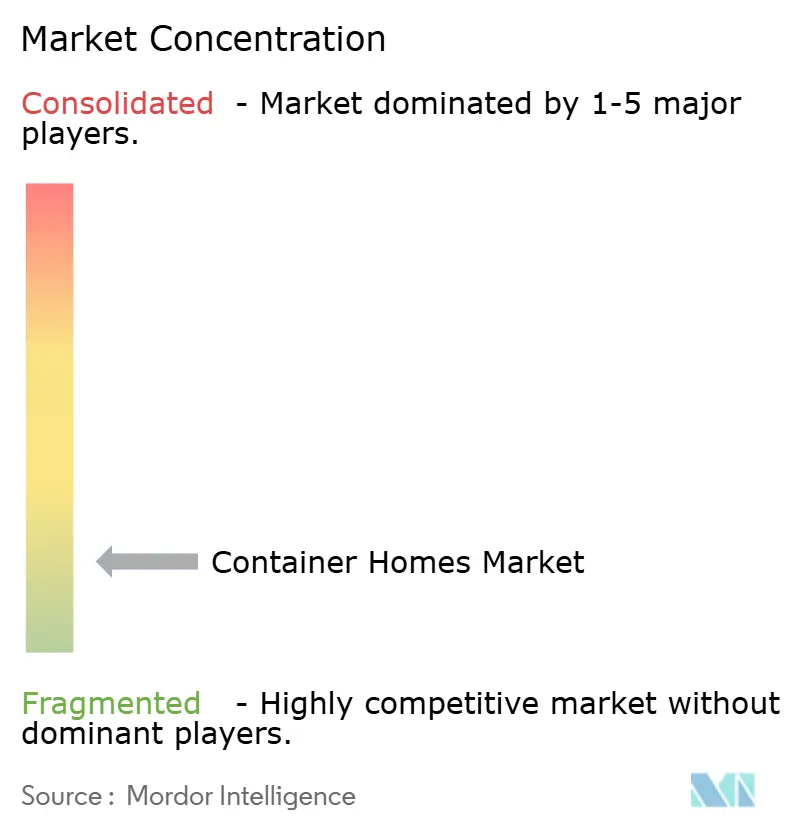
The container homes market is fragmented, with no single company holding a dominant global share across residential, institutional, emergency, and hospitality applications in every major region. Competition includes engineered residential producers such as HONOMOBO, SG Blocks, Giant Containers, Meka Modular, and Kubed Living, which differentiate through design, certification, site delivery, and customer support. Other suppliers, including Tempohousing, ELA Container GmbH, and Mods-Integral Solutions, focus on rapid deployment and institutional procurement, where fleet availability, logistics execution, and repeatable unit specifications influence buyer decisions. Companies that combine structural certification, reliable delivery, energy performance, localized installation support, and familiarity with local approval processes are better positioned in this market. Asian steel fabricators are increasing competitive pressure in factory-built products through scale, automated fabrication, and access to steel-processing capacity.
Safe & Green Holdings Corp. operates through both direct development and contract manufacturing via Giant Containers. In January 2026, the company announced the start of manufacturing for a modular enclosure contract, reflecting its focus on industrial clients. Its Magnolia Residential project in Durant, Oklahoma, illustrates an approach that combines housing development with manufacturing activity, allowing the company to participate in both project delivery and unit production rather than relying on a single revenue stream. Suppliers are also using pre-certified configurations and digital design tools to shorten local review processes and improve consistency in project documentation. These capabilities are increasingly relevant as buyers require greater evidence on energy performance, safety, installation standards, delivery schedules, maintenance responsibility, and the ability to adapt repeatable products to local planning conditions.
Opportunities remain in nursing homes and recreational accommodations, where customization requirements can limit standardized production and where operators may need varied interior layouts, accessibility features, service connections, and operating models. Eco-tourism and remote hospitality operators often combine standard containers with specialized interior packages, site-specific utility arrangements, and exterior finishes suited to local climate and visitor expectations. This model can be difficult to scale but offers differentiation when design, site experience, unit mobility, and the ability to operate in remote or sensitive locations are priorities. ELA Container GmbH expanded its used-container offering through an online shop in 2026, supporting a secondary-use and circular-economy model.
Container Homes Industry Leaders
-
SG Blocks, Inc.
-
Tempohousing
-
ELA Container GmbH
-
United Rentals Australia Pty Limited
-
HONOMOBO
- *Disclaimer: Major Players sorted in no particular order
Recent Industry Developments
- September 2026: ELA Container GmbH became a partner of Bundesliga club Borussia Dortmund and launched a new online shop for used containers. This reflects a dual-track commercial strategy combining brand sponsorship with e-commerce infrastructure for secondary container deployment in the container homes market.
- June 2026: Boxman completed an investment agreement with 3 Islands Intermodal (3i), the country's only locally owned nationwide port services provider, and commenced a multi-depot national expansion. The company opened a new depot in Mount Maunganui, with further sites planned across Auckland, Hamilton, Timaru, Dunedin, and Invercargill over 24 months, supporting the growing demand for container homes across New Zealand.
Global Container Homes Market Report Scope
A container home is a type of modular living space built using steel shipping containers or purpose-built modular steel frames. These structures are designed to serve as functional residential units, offering an alternative to conventional construction methods. Steel shipping containers, originally used for transporting goods across global supply chains, are repurposed and modified to include insulation, plumbing, electrical systems, and other essential amenities.
The container homes market is segmented by offering, construction type, end-use, and geography. By offering, the market is segmented into factory-built and on-site built. By construction type, the market is segmented into fixed and movable. By end-use, the market is segmented into residential homes, recreational homes, emergency homes, and nursing homes. The report also covers the market size and forecasts for container homes in 15 countries across major regions. The market sizes and forecasts are provided in terms of value (USD).
| Factory-Built |
| On-Site Built |
| Fixed |
| Movable |
| Residential Homes |
| Recreational Homes |
| Emergency Homes |
| Nursing Homes |
| Asia-Pacific | China |
| India | |
| Japan | |
| South Korea | |
| ASEAN Countries | |
| Rest of Asia-Pacific | |
| North America | United States |
| Canada | |
| Mexico | |
| Europe | Germany |
| United Kingdom | |
| France | |
| Italy | |
| NORDIC Countries | |
| Rest of Europe | |
| South America | Brazil |
| Argentina | |
| Rest of South America | |
| Middle East and Africa | Saudi Arabia |
| South Africa | |
| Rest of Middle East and Africa |
| By Offering | Factory-Built | |
| On-Site Built | ||
| By Construction Type | Fixed | |
| Movable | ||
| By End-Use | Residential Homes | |
| Recreational Homes | ||
| Emergency Homes | ||
| Nursing Homes | ||
| By Geography | Asia-Pacific | China |
| India | ||
| Japan | ||
| South Korea | ||
| ASEAN Countries | ||
| Rest of Asia-Pacific | ||
| North America | United States | |
| Canada | ||
| Mexico | ||
| Europe | Germany | |
| United Kingdom | ||
| France | ||
| Italy | ||
| NORDIC Countries | ||
| Rest of Europe | ||
| South America | Brazil | |
| Argentina | ||
| Rest of South America | ||
| Middle East and Africa | Saudi Arabia | |
| South Africa | ||
| Rest of Middle East and Africa | ||
Key Questions Answered in the Report
What is current market size of Container Homes Market?
The container homes market size was valued at USD 73.25 billion in 2026 and is estimated to grow from USD 78.27 billion in 2027 to USD 109.01 billion by 2032, at a CAGR of 6.85% during the forecast period (2027-2032).
Which offering leads demand for container homes?
On-Site Built leads demand with a 57.34% share in 2026, while Factory-Built is growing faster at a 7.67% CAGR through 2032.
Which construction type is growing fastest?
Movable units are forecast to grow at an 8.05% CAGR through 2032 because they serve emergency, workforce, and flexible-placement requirements.
Which end-use application has the highest growth rate?
Emergency Homes is projected to record an 8.32% CAGR through 2032, supported by rapid-deployment accommodation needs.