
Construction Glass Market Size and Share
Market Overview
| Study Period | 2021 - 2031 |
|---|---|
| Market Size (2026) | USD 125.52 Billion |
| Market Size (2031) | USD 162.66 Billion |
| Growth Rate (2026 - 2031) | 5.32 % |
| Fastest Growing Market | Asia-Pacific |
| Largest Market | Asia-Pacific |
| Market Concentration | Medium |
Major Players *Disclaimer: Major Players sorted in no particular order Image © Mordor Intelligence. Reuse requires attribution under CC BY 4.0. | |
Construction Glass Market Analysis by Mordor Intelligence
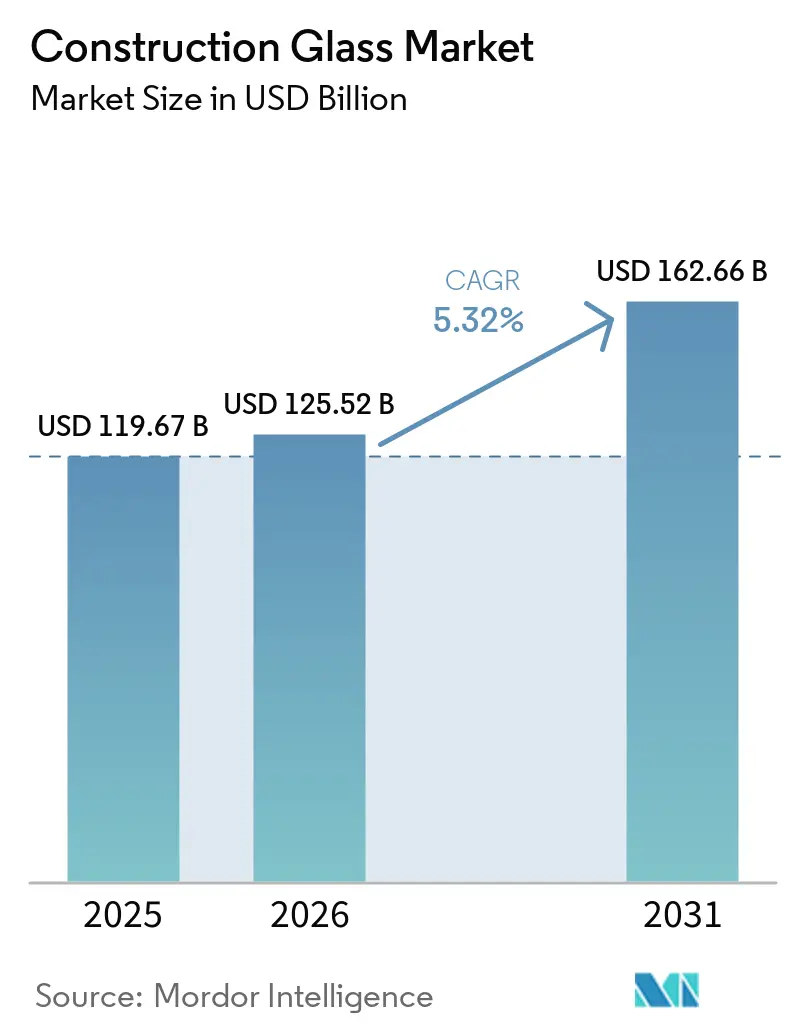
The construction glass market size was valued at USD 119.67 billion in 2025 and is estimated to grow from USD 125.52 billion in 2026 to reach USD 162.66 billion by 2031, at a CAGR of 5.32% during the forecast period (2026-2031). The construction glass market is shifting toward insulating glass units, low-emissivity-coated products, and laminated safety glass as building codes place greater emphasis on thermal and safety performance. This shift increases the value of glass per project, as these products require additional processing and coatings. Buildings account for 30% to 40% of global final energy consumption, keeping the building envelope central to energy policy and supporting demand for performance glazing. Regulations in Europe, North America, China, and Australia are increasingly based on window performance rather than product type. This allows producers with insulating, coated, and laminated product lines to compete on specifications and processing capacity rather than on basic float-glass output.
Key Report Takeaways
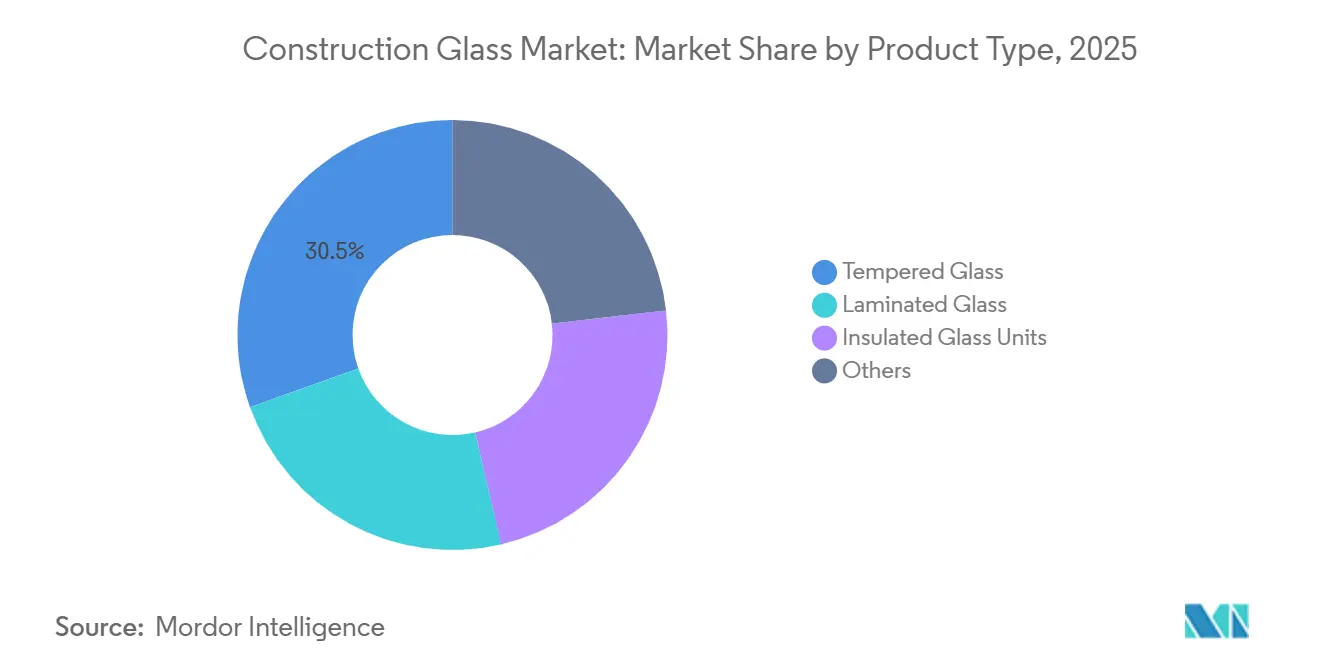
- By product type, tempered glass accounted for 30.45% of global construction glass demand in 2025, while insulating glass units are forecast to grow at a 5.78% CAGR through 2031.
- By manufacturing process, the float process accounted for 85.31% of global construction glass demand in 2025, while the rolled process is forecast to grow at a 5.89% CAGR through 2031.
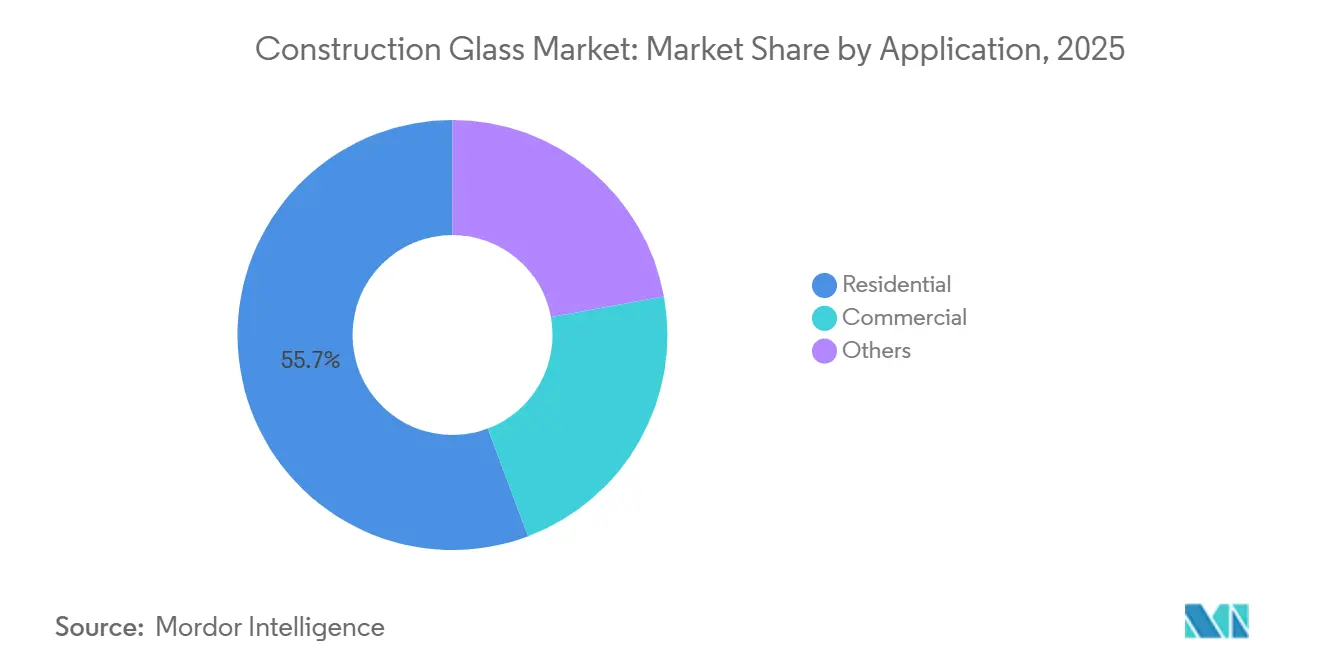
- By application, residential construction accounted for 55.74% of global construction glass demand in 2025 and is forecast to expand at a 6.13% CAGR through 2031.
- By geography, Asia-Pacific accounted for 40.12% of global construction glass demand in 2025 and is forecast to grow at a 5.62% CAGR through 2031.
Note: Market size and forecast figures in this report are generated using Mordor Intelligence’s proprietary estimation framework, updated with the latest available data and insights as of January 2026.
Market Trends and Insights
Drivers Impact Analysis of Construction Glass Market*
| Drivers | (~) % Impact on CAGR Forecast | Geographic Relevance | Impact Timeline |
|---|---|---|---|
| Energy-Efficiency Requirements for Building Envelopes | +1.5% | Global, with the strongest demand in Europe, North America, and urban China | Short term (≤ 2 years) to medium term (2-4 years) |
| Urbanization and High-Rise Construction in Asia-Pacific | +1.2% | Asia-Pacific, especially China, India, and ASEAN, with spillover to the Middle East and Africa | Medium term (2-4 years) to long term (≥ 4 years) |
| Commercial Façade and Curtain-Wall Expansion | +0.8% | Global, concentrated in China Tier-1 cities, North America, and Gulf Cooperation Council (GCC) countries | Medium term (2-4 years) |
| Building Renovation and Glazing Replacement Demand | +0.6% | Europe, led by Germany and France, and North America | Long term (≥ 4 years) |
| Climate-Resilient and Impact-Resistant Building Design | +0.4% | Coastal North America and typhoon-prone Asia-Pacific markets | Medium term (2-4 years) to long term (≥ 4 years) |
| Source: Mordor Intelligence | |||
Energy-Efficiency Mandates Are Redrawing Glass Specification Norms
Building energy codes now set binding performance requirements that limit the use of standard float glass in major construction markets. The revised Energy Performance of Buildings Directive (EPBD) 2024/1275 took effect in May 2024 and requires European Union member states to incorporate its requirements into national law by May 29, 2026. The directive requires all new buildings to meet zero-emission standards from 2030 onward, increasing the importance of windows in building energy calculations. New York City began enforcing its 2025 Energy Conservation Code on March 30, 2026, providing another example of tighter building-envelope rules[1]New York City Department of Buildings, “2025 NYC Energy Conservation Code,” New York City Department of Buildings, nyc.gov. California's 2025 Building Energy Efficiency Standards apply to new permits from January 1, 2026, and tighten fenestration requirements across climate zones. The construction glass market benefits when architects and developers select insulating or coated products early in a project, avoiding specification changes during design or construction.
Urbanization and High-Rise Construction in Asia-Pacific Generate Structural Demand
Extensive urban development across China, India, and ASEAN countries has moderated China's residential real estate activity from earlier levels, but commercial projects, transportation infrastructure, and smart-city facilities continue to require significant quantities of architectural glazing. India's expanding urban middle class and government housing programs are broadening the customer base for local and international manufacturers. The construction glass market in the region is also becoming more varied, as airports, transit stations, commercial centers, and public buildings require higher-performance glass than basic residential construction. Japan and South Korea maintain strict energy requirements that support the use of advanced residential glazing. Vietnam, Indonesia, and the Philippines are extending the regional demand base through commercial construction, urban growth, and limited local capacity for energy-efficient products.
Commercial Façade and Curtain-Wall Expansion Elevates Average Glass Value
Commercial façade systems increase the value of glass in a project, as they often require factory-glazed insulating units, coatings, and precise fabrication. Unitized curtain-wall systems depend on consistent optical quality and dimensional control, which favors manufacturers with established processing capabilities. European building performance requirements are changing façade specifications across member states through the Green Deal and related building regulations. Building performance incentives in the United States support energy-efficient upgrades in commercial properties. GCC megaprojects, including developments associated with Saudi Vision 2030, require large-format, solar-control, and high-transmittance architectural glass. Certification requirements under EN 13830, the North American Architectural Manufacturers Association (AAMA), and NFRC standards further favor suppliers that can provide tested, high-specification products for the construction glass market, particularly when performance testing is specified early in the design process.
Building Renovation and Glazing Replacement Create a Policy-Backed Demand Floor
Europe's existing building stock creates a continuing replacement opportunity for high-performance windows and glazing. More than 85% of the region's buildings were constructed before 2000, placing energy renovation at the center of the policy response. The Energy Performance of Buildings Directive (EPBD) framework requires member states to develop National Building Renovation Plans, which link building policy to a longer pipeline for glazing replacement. Replacement demand in the construction glass market differs from new-build demand because it continues across the construction cycle and often requires a significant upgrade from existing single-pane products. Insulating glass units and laminated glass benefit from this pattern because replacement projects commonly prioritize heat loss reduction, occupant comfort, and safety. Installer networks also become more important in this context because renovation projects are dispersed across existing homes and commercial buildings rather than concentrated at large new developments.
Restraints Impact Analysis of Construction Glass Market*
| Restraints | (~) % Impact on CAGR Forecast | Geographic Relevance | Impact Timeline |
|---|---|---|---|
| Energy-Intensive Furnace Operations and Carbon-Abatement Costs | -0.7% | Global, with the greatest pressure in Europe and China | Short term (≤ 2 years) to medium term (2-4 years) |
| Volatility in Soda Ash, Silica Sand, and Energy Prices | -0.5% | Global, including North America, Europe, and core Asia-Pacific markets | Short term (≤ 2 years) |
| High Installed Cost of Smart and Advanced Glazing | -0.4% | Price-sensitive emerging economies and mid-tier commercial properties in developed markets | Medium term (2-4 years) to long term (≥ 4 years) |
| Source: Mordor Intelligence | |||
Energy-Intensive Furnace Operations and Carbon-Abatement Costs Pressure Producers
Glass furnaces operate continuously at temperatures ranging from 1,200°C to 1,700°C, making energy consumption a major operating cost for producers. The construction glass market faces additional cost pressures as emissions regulations require investment in lower-carbon production equipment. Furnace campaigns can run for a decade or more before a cold repair allows a major technology upgrade, limiting the pace at which producers can modernize equipment. Hybrid and electrified furnaces offer a path to lower direct emissions, but require significant capital investment and depend on the availability of low-carbon electricity. Saint-Gobain and AGC are developing the FurHy hybrid electric furnace at the Avilés, Spain, float-glass plant, with operations expected to begin in the second half of 2027. Smaller producers may find it harder to fund similar projects while maintaining price competitiveness and production output.
Raw Material and Energy Price Volatility Constrain Cost Predictability
Soda ash, silica sand, and energy are core cost inputs for flat-glass production. Regional differences in soda ash pricing create uneven cost positions across glass-producing countries, allowing producers with lower input costs to offer flat glass at prices that competitors with higher costs cannot readily match. Fluctuations in silica sand and energy prices also make long-term pricing more difficult for manufacturers and processors. Uncertain input costs can delay downstream capacity investment and make customers more cautious about entering long-term supply agreements. These conditions reduce price visibility in the construction glass market, even when underlying demand from building construction and renovation activity remains positive.
*Our forecasts treat driver/restraint impacts as directional, not additive. The impact forecasts reflect baseline growth, mix effects, and variable interactions.
Construction Glass Market Segment Analysis
By Product Type:
Insulating Units Gain Traction Within a Tempered-Dominated MarketTempered glass held 30.45% of the construction glass market share in 2025, supported by its required use in shower enclosures, glass doors, and low-height windows. It also serves as a base product for structural silicone-glazed façades, sustaining broad demand across residential and commercial construction. Laminated glass remained the second-largest product category, gaining use in hurricane-prone locations and acoustically sensitive urban projects. Polyvinyl butyral (PVB) and ionoplast interlayers help retain structural integrity after breakage, aligning with high-velocity hurricane-zone requirements and related certification practices for coastal building projects.
Insulating glass units are forecast to grow at a 5.78% CAGR through 2031, the fastest rate among product types in the construction glass market, even as construction demand remains uneven across regions. The Energy Performance of Buildings Directive (EPBD) 2024/1275 and China's GB 55015-2021 are directing new-build and retrofit demand toward double- and triple-pane units that meet tighter U-value requirements. Renovation demand for insulating units is less tied to new construction cycles, as window replacements are driven by energy use, comfort, and code requirements. Each square meter of an insulating unit generates 3 to 5 times the revenue of an equivalent area of basic float glass, creating an opportunity for producers to shift toward manufacturing insulating units rather than supplying only base glass.



By Manufacturing Process:
Float’s Scale Dominance Meets a Resurgent Rolled MarketThe float process accounted for 85.31% of global glass demand in 2025, as it produces continuous ribbon glass with the clarity, flatness, and dimensional consistency required for industrial processing. The method supports tempering, laminating, coating, and insulating-glass fabrication at large scales. Modern float-line investments require substantial capital, and a furnace campaign typically operates for 10 to 15 years before cold repair, creating a barrier to entry and concentrating primary production among established suppliers. Digital controls and automated inspection further reinforce the position of the float process.
The rolled process in the construction glass market is forecast to grow at a 5.89% CAGR through 2031, driven by rising demand for patterned, textured, and translucent glass. These products are used in interior partitions, decorative façade screens, and privacy glazing. Hospitality, retail, and high-end residential projects often require visual variation that standard float products cannot provide, sustaining a role for rolled glass despite the larger scale of float production. Sheet glass and other specialized forming methods serve narrower restoration and heritage-conservation applications.
By Application:
Residential Breadth Offsets Commercial IntensityResidential construction accounted for 55.74% of the construction glass market size in 2025 and is projected to grow at a 6.13% CAGR through 2031. The segment's scale reflects the number of occupied dwellings requiring windows and the effect of incremental increases in average glazing area per home. Growth is supported by housing supply expansion in emerging economies across the Asia-Pacific and by tighter residential energy codes in Europe and North America. Double-glazed windows are becoming more common in mid-income housing in India and Southeast Asia, where single-pane glass had previously remained prevalent. Replacement programs broaden demand beyond newly built homes, making performance glazing more relevant to local installers and processors.
Commercial projects deliver the highest average glass specification and revenue per square meter in the construction glass market, where upgraded specifications can significantly affect each project's value. Offices, retail complexes, hotels, and institutional buildings use curtain-wall systems that may require double- or triple-glazing, with projects increasingly specifying lower U-values, solar control, and tested façade performance. The other applications category includes industrial buildings, airports, transit facilities, and public structures with solar-control façades. Building-integrated photovoltaic glass remains a small share of the market by area, but its higher selling price has made it relevant to net-zero public building projects in Europe and Japan.
Geography Analysis
APAC Construction Glass Market
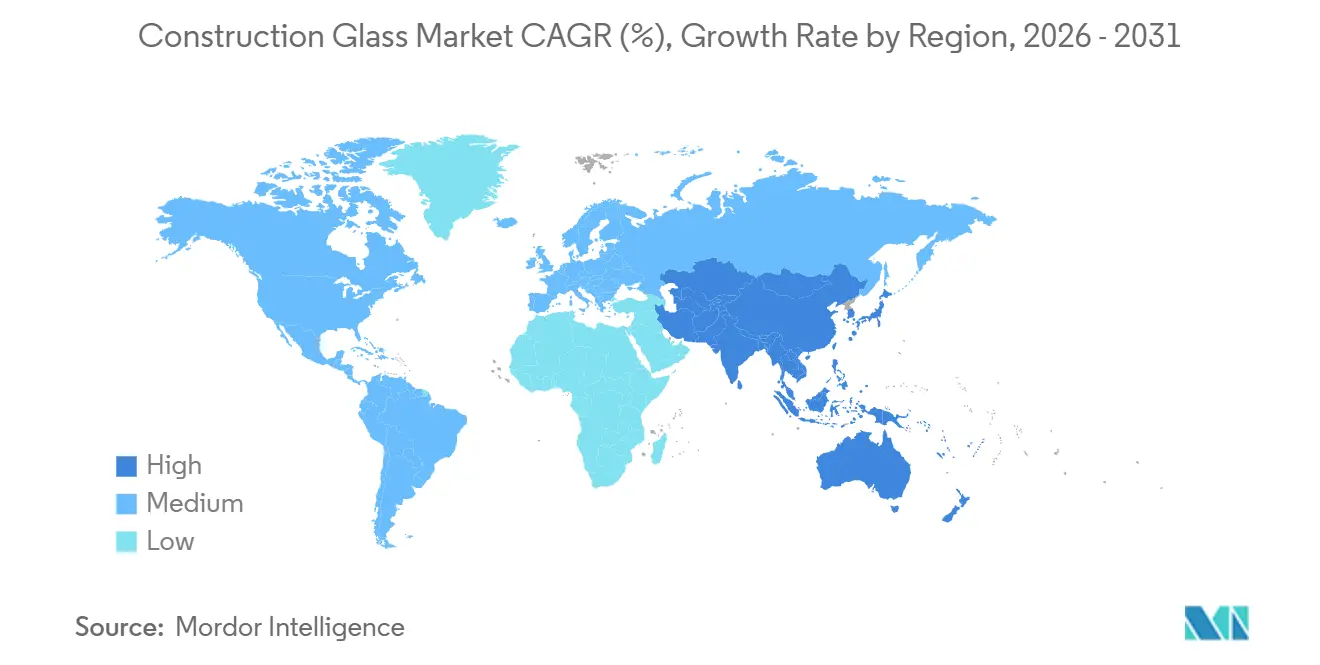
Asia-Pacific accounted for 40.12% of the construction glass market share in 2025 and is forecast to grow at a 5.62% CAGR through 2031. China remains the largest producer and consumer of flat glass in the construction glass market. Commercial construction, transportation infrastructure, and the solar panel supply chain support capacity utilization even as residential property activity in China has moderated. India's construction expansion, smart-city initiatives, and housing programs support broad demand for architectural glass. Indonesia, Vietnam, Thailand, and the Philippines offer further growth opportunities through urbanization, expanding middle-income populations, and greenfield commercial construction.
North America Construction Glass Market
North America held the second-largest regional position in the construction glass market, supported by commercial construction activity and building retrofits. Local Law 97 in New York City, national adoption of American Society of Heating, Refrigerating and Air-Conditioning Engineers (ASHRAE) 90.1-2022, and California Title 24 require stronger building-envelope performance. Energy-efficiency tax credits under the Inflation Reduction Act provide financial support for window upgrades in existing US buildings. Canada's National Energy Code, Mexico's commercial construction pipeline, and data-center projects add to regional demand.
EMEA Construction Glass Market
Europe's construction glass market is shifting from new construction toward renovation. The Energy Performance of Buildings Directive (EPBD) National Building Renovation Plan framework is creating a pipeline for retrofit activity through the 2030s. Nordic countries apply stringent window U-value standards that sustain demand for triple-pane units. The Middle East and Africa remain smaller markets, but GCC megaprojects and South Africa's commercial construction present growth opportunities. Xinyi Glass signed a project cooperation agreement for a USD 386 million production base in Saudi Arabia, reflecting the region's capacity to support local float and Low-E glass manufacturing[2]Xinyi Glass Holdings Limited and MODON, “Xinyi Glass Signs Project Agreement with MODON with an Investment of Approximately USD 386 Million,” Xinyi Glass Holdings Limited and MODON, longbridge.com.

Competitive Landscape
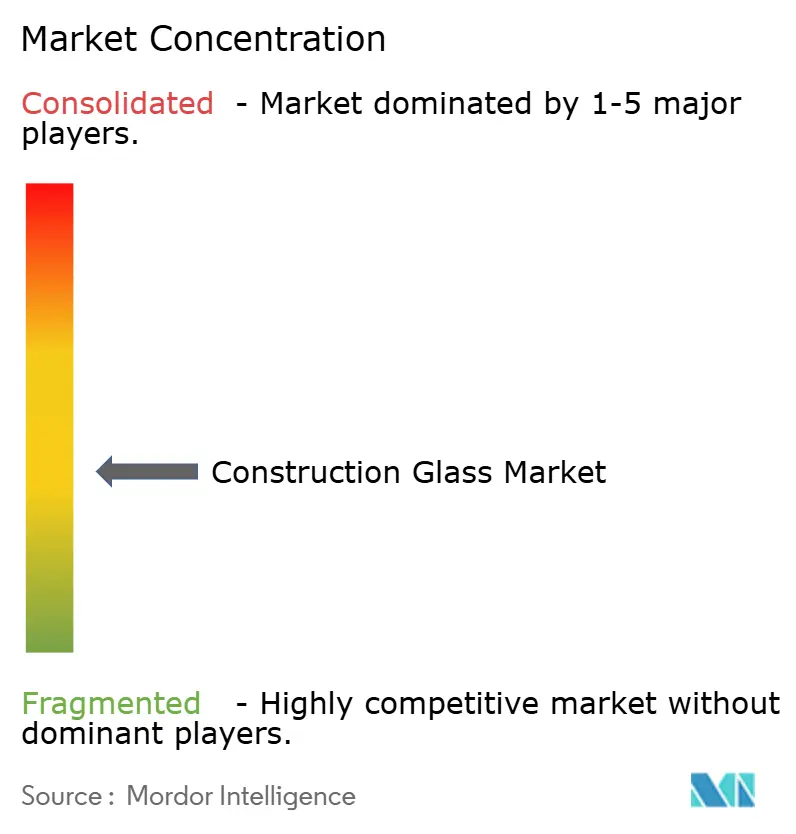
The construction glass market is moderately fragmented. AGC Inc., Saint-Gobain, NSG Group, Guardian Glass, Xinyi Glass, CSG Holding, and Şişecam hold significant global flat-glass capacity. Major producers are focusing on lower-carbon furnaces, expansion into faster-growing regions, and higher-value coated, laminated, and insulating products. Saint-Gobain and AGC are jointly developing a 75%-electrified furnace in Avilés, Spain, expected to reduce carbon dioxide emissions by 50% compared with a conventional gas furnace when it begins operations in late 2027. Cardinal Glass Industries issued purchase orders for a carbon-capture system at its Winlock, Washington, float-glass plant, with operations targeted for the first quarter of 2029.
Chinese producers, including Xinyi Glass, CSG Holding, and China Glass Holdings, compete through scale, capacity, and lower production costs. Their strategy in the construction glass market is increasingly extending into Low-E-coated glass and insulating-glass processing, where Western suppliers have traditionally maintained stronger margins. Şişecam has expanded its flat-glass and coated-glass base in Europe and Turkey, reinforcing its position in value-added products. The construction glass market continues to favor suppliers that pair efficient primary production with downstream processing capabilities. Smaller processors can compete where they have strong relationships with installers, certified products, or specialized local fabrication.
Apollo Funds announced an agreement to acquire NSG Group at an enterprise value of USD 3.7 billion in March 2026. Xinyi Glass's Saudi Arabia project is another example of producers placing capacity closer to areas with expanding construction demand. These moves indicate that capacity investment follows both construction output and demand for energy-efficient products. Competitive advantage in the construction glass market depends on furnace technology, access to affordable energy, downstream processing capability, and compliance with regional building standards.
Construction Glass Industry Leaders
Saint-Gobain
AGC Inc.
Nippon Sheet Glass Co., Ltd
Guardian Glass
Xinyi Glass Holdings Limited
- *Disclaimer: Major Players sorted in no particular order
Construction Glass Market Companies Covered in this Report
- AGC Inc.
- CARDINAL GLASS INDUSTRIES, INC
- Central Glass Co., Ltd.
- China Glass Holdings Limited
- CSG HOLDING CO.,LTD.
- Fuyao Glass Industry Group Co., Ltd.
- Guardian Glass
- Jinjing (Group) Co., Ltd
- Nippon Sheet Glass Co., Ltd
- Saint-Gobain
- SCHOTT AG
- Şişecam
- Taiwan Glass
- Vitro, S.A.B. de C.V.
- Xinyi Glass Holdings Limited

Recent Industry Developments in Construction Glass Market
- June 2026: Xinyi Glass Holdings Limited signed a project cooperation agreement with the Saudi Authority for Industrial Cities and Technology Zones (MODON) for a USD 386 million facility covering over 350,000 m² to produce float glass, automotive glass, and high-performance low-emissivity (Low-E) energy-saving glass in Saudi Arabia. The project represents the first automotive glass manufacturing plant in the Kingdom and a step in Xinyi's global expansion.
- January 2026: NSG Group launched Pilkington Mirai One across Europe, a low-carbon architectural glass product that reduces the manufacturing carbon footprint by approximately 35% compared with the group's conventional float glass. The product can be processed for coatings, laminated glass, and insulated glass units (IGUs).


Global Construction Glass Market Report Scope
Construction glass, also known as architectural glass, is a hard, transparent, or translucent material used in building elements such as windows, facades, doors, and interior partitions. It is manufactured primarily from silica sand, soda ash, and limestone, and processed using techniques such as tempering, laminating, and coating to meet specific structural and aesthetic requirements for construction applications.
The construction glass market is segmented by product type, manufacturing process, application, and geography. By product type, the market is segmented into laminated glass, tempered glass, insulated glass units, and others. By manufacturing process, the market is segmented into float process, rolled process, and others. By application, the market is segmented into residential, commercial, and others. The report also covers market size and forecasts for the construction glass across 15 countries in major regions. The market sizes and forecasts are provided in terms of value (USD).
| Laminated Glass |
| Tempered Glass |
| Insulated Glass Units |
| Others |
| Float Process |
| Rolled Process |
| Others |
| Residential |
| Commercial |
| Others |
| Asia-Pacific | China |
| India | |
| Japan | |
| South Korea | |
| ASEAN Countries | |
| Rest of Asia-Pacific | |
| North America | United States |
| Canada | |
| Mexico | |
| Europe | Germany |
| United Kingdom | |
| France | |
| Italy | |
| NORDIC Countries | |
| Rest of Europe | |
| South America | Brazil |
| Argentina | |
| Rest of South America | |
| Middle East and Africa | Saudi Arabia |
| South Africa | |
| Rest of Middle East and Africa |
| By Product Type | Laminated Glass | |
| Tempered Glass | ||
| Insulated Glass Units | ||
| Others | ||
| By Manufacturing Process | Float Process | |
| Rolled Process | ||
| Others | ||
| By Application | Residential | |
| Commercial | ||
| Others | ||
| By Geography | Asia-Pacific | China |
| India | ||
| Japan | ||
| South Korea | ||
| ASEAN Countries | ||
| Rest of Asia-Pacific | ||
| North America | United States | |
| Canada | ||
| Mexico | ||
| Europe | Germany | |
| United Kingdom | ||
| France | ||
| Italy | ||
| NORDIC Countries | ||
| Rest of Europe | ||
| South America | Brazil | |
| Argentina | ||
| Rest of South America | ||
| Middle East and Africa | Saudi Arabia | |
| South Africa | ||
| Rest of Middle East and Africa | ||


Key Questions Answered in the Report
What is current market size of Construction Glass Market?
The construction glass market size was valued at USD 119.67 billion in 2025 and is estimated to grow from USD 125.52 billion in 2026 to reach USD 162.66 billion by 2031, at a CAGR of 5.32% during the forecast period (2026-2031).
Which construction glass product is growing fastest?
Insulating glass units are projected to record the highest product CAGR of 5.78% through 2031, supported by tighter energy-performance requirements.
Why are insulating glass units gaining demand?
Energy codes and renovation programs increase demand for double- and triple-pane units that can meet tighter U-value requirements.
Which application has the largest demand for construction glass?
Residential construction accounted for 55.74% of demand in 2025 and is also projected to grow fastest at a 6.13% CAGR through 2031.
Page last updated on:





