
Construction Fabrics Market Size and Share
Market Overview
| Study Period | 2021 - 2031 |
|---|---|
| Market Size (2026) | USD 7.74 Billion |
| Market Size (2031) | USD 10.92 Billion |
| Growth Rate (2026 - 2031) | 7.11 % |
| Fastest Growing Market | Asia-Pacific |
| Largest Market | Asia-Pacific |
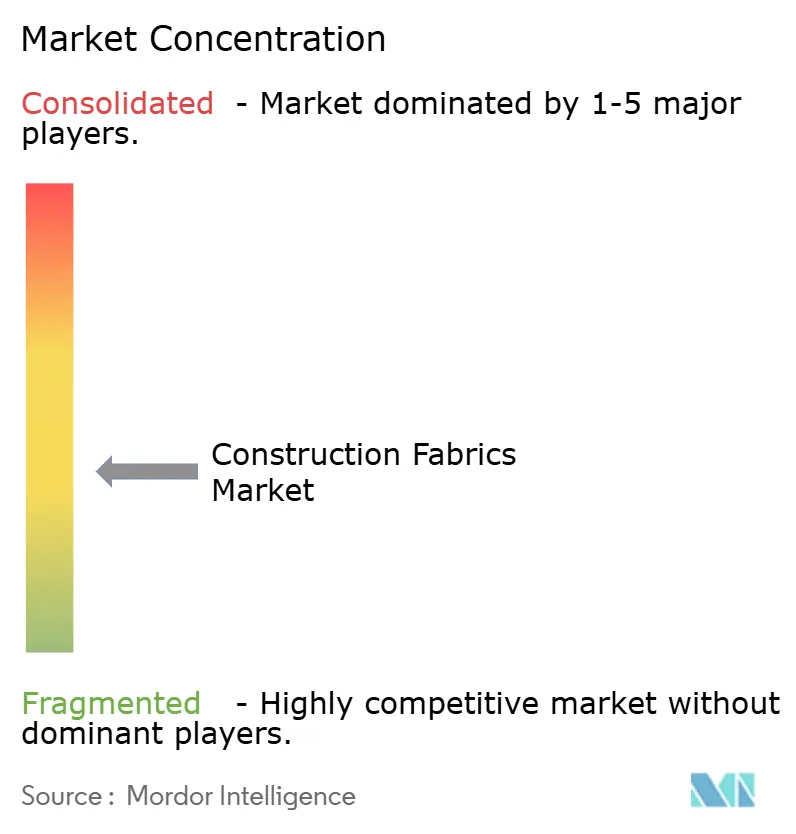
| Market Concentration | Medium |
Major Players *Disclaimer: Major Players sorted in no particular order Image © Mordor Intelligence. Reuse requires attribution under CC BY 4.0. | |
Construction Fabrics Market Analysis by Mordor Intelligence
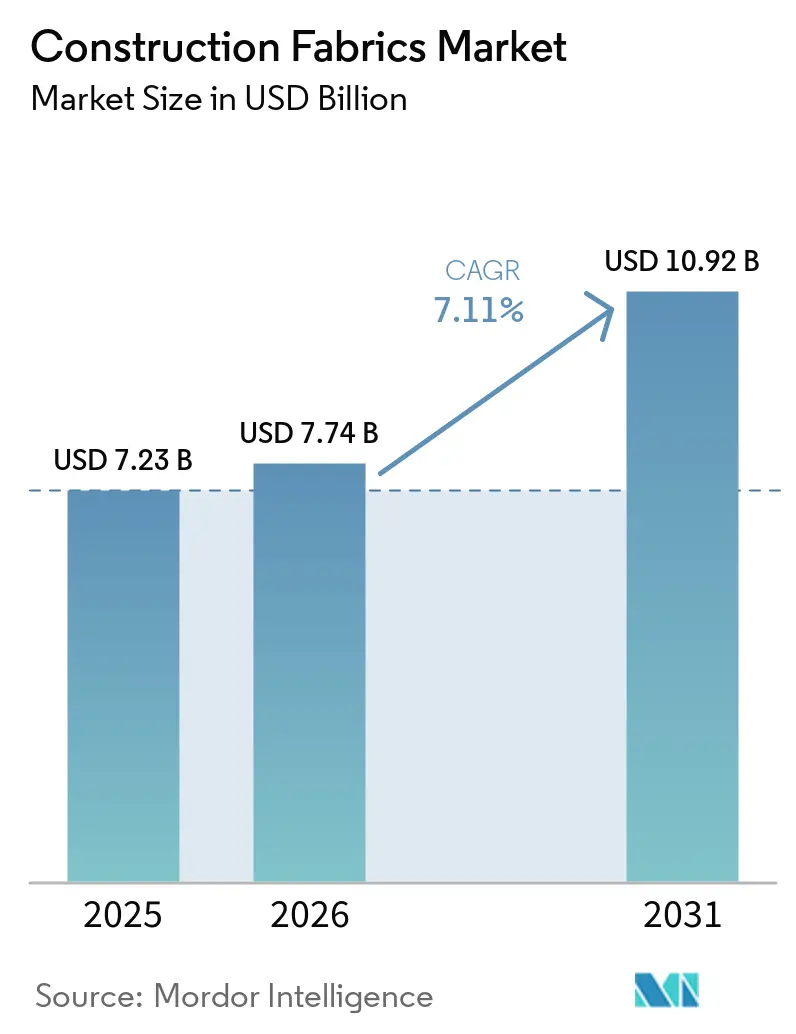
The Construction Fabrics Market size was valued at USD 7.23 billion in 2025 and is estimated to grow from USD 7.74 billion in 2026 to reach USD 10.92 billion by 2031, at a CAGR of 7.11% during the forecast period (2026-2031). State-backed infrastructure programs, airport projects, transit upgrades, and urban redevelopment are supporting demand for large-span canopies and weather-protection systems. The construction fabrics market is also benefiting from specifications that favor lightweight roofs, shading systems, and adaptable building envelopes. Material transparency is becoming more important as Leadership in Energy and Environmental Design (LEED) v5 requires embodied-carbon assessments and product-specific environmental declarations for relevant project pathways. This requirement can favor suppliers that provide verified product documentation and can support architects during material selection. The construction fabrics market also has an emerging opportunity in energy-generating envelopes, as ethylene tetrafluoroethylene (ETFE) surface treatments are being developed to improve the adhesion of decorative photovoltaic films.
Key Report Takeaways
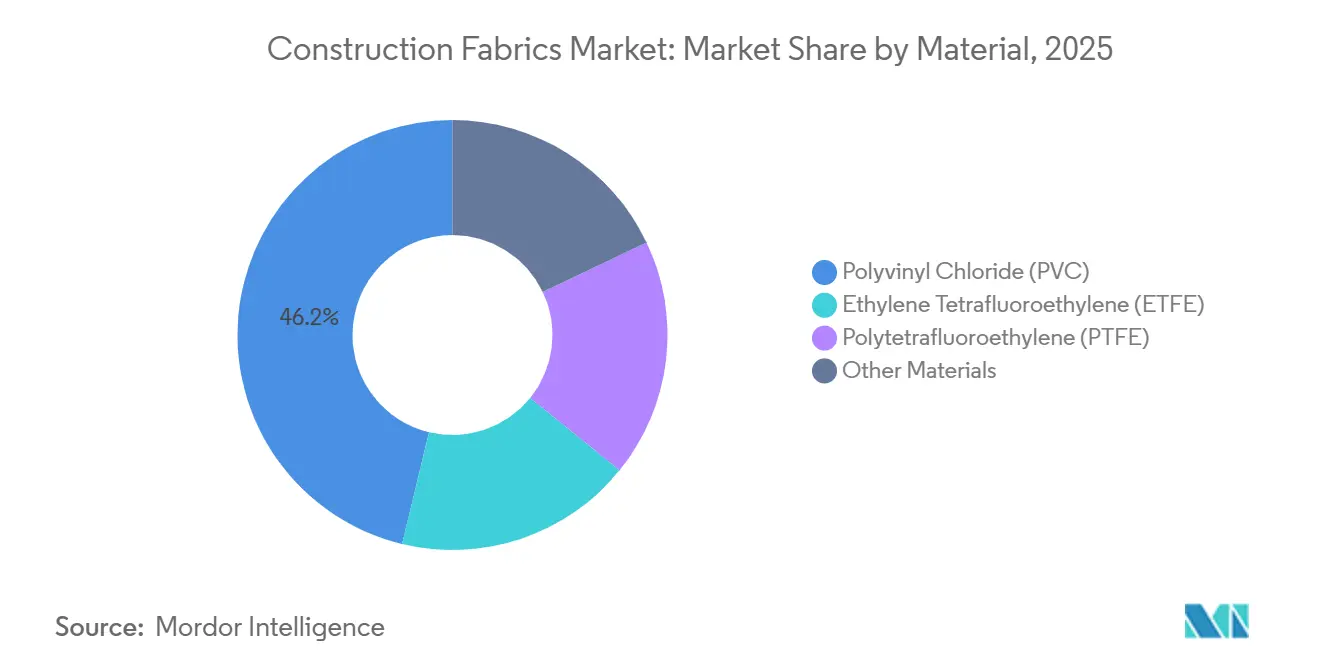
- By material, polyvinyl chloride (PVC) held 46.23% of the construction fabrics market share in 2025, while ethylene tetrafluoroethylene (ETFE) is projected to advance at a 7.89% CAGR through 2031.
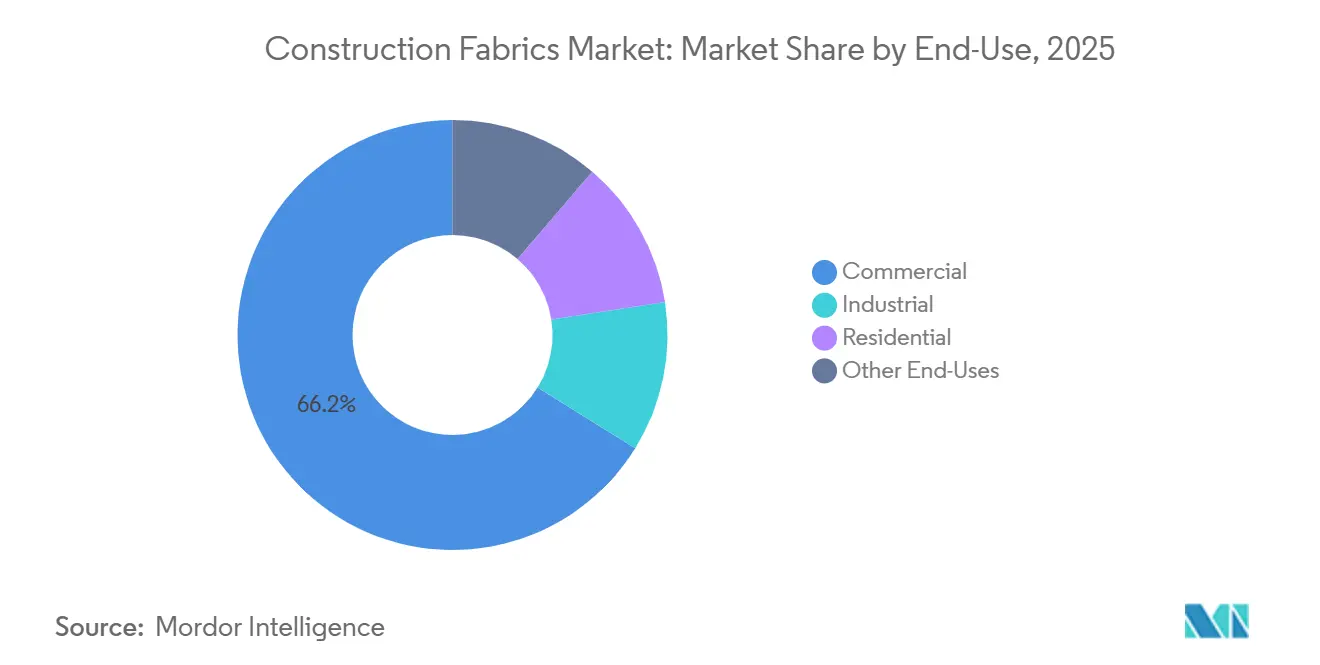
- By end-use, commercial held 66.18% of the construction fabrics market share in 2025, while residential is projected to advance at an 8.43% CAGR through 2031.
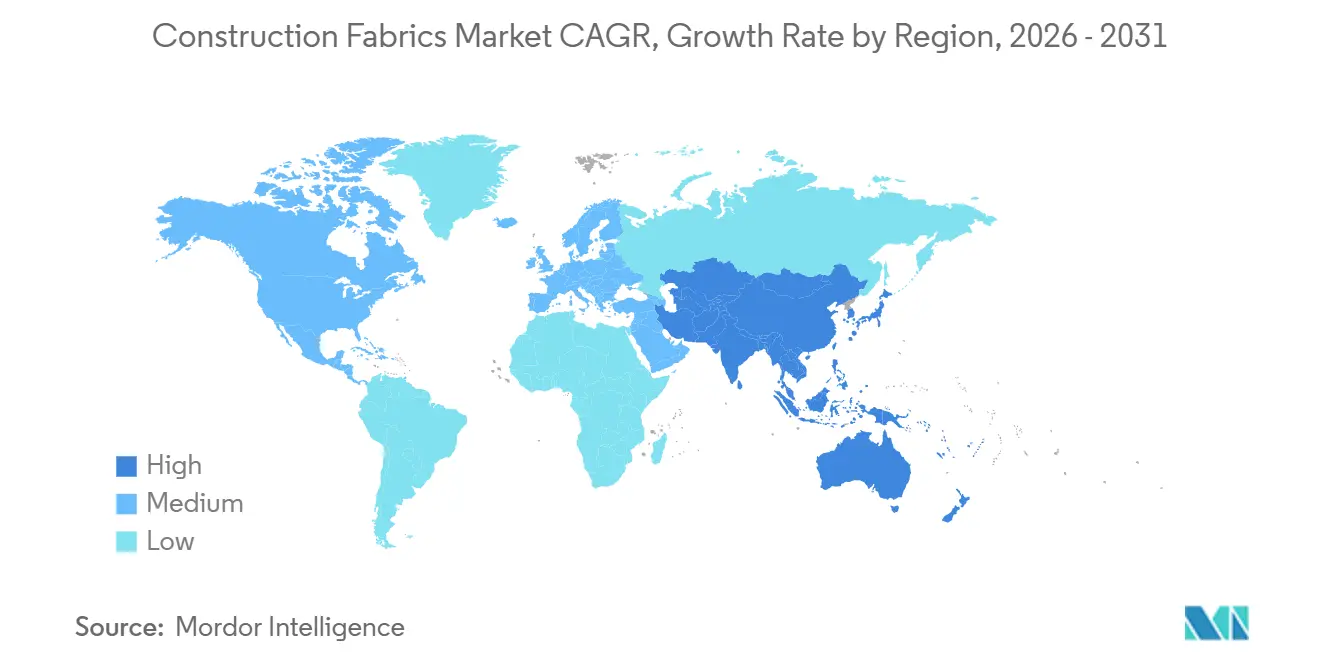
- By geography, Asia-Pacific held 42.75% of the construction fabrics market share in 2025 and is projected to advance at an 8.04% CAGR through 2031.
Note: Market size and forecast figures in this report are generated using Mordor Intelligence’s proprietary estimation framework, updated with the latest available data and insights as of January 2026.
Market Trends and Insights
Drivers Impact Analysis of Construction Fabrics Market*
| Driver | (~) % Impact on CAGR Forecast | Geographic Relevance | Impact Timeline |
|---|---|---|---|
| Infrastructure Modernization and Urban Redevelopment | +2.2% | Global, intensive in APAC and MEA | Medium term (2–4 years) |
| Expansion of Lightweight and Long-Span Architecture | +1.8% | Global | Long term (≥ 4 years) |
| Demand for Climate-Resilient and Relocatable Structures | +1.2% | Global, with early gains in APAC and MEA | Short to medium term (≤ 2–4 years) |
| Green-Building Certification and Lifecycle-Efficiency Requirements | +0.9% | North America & EU | Medium term (2–4 years) |
| Integration of Smart Coatings, Sensors and Flexible Photovoltaics | +0.6% | Global, APAC spillover | Long term (≥ 4 years) |
| Source: Mordor Intelligence | |||
Expansion of Lightweight and Long-Span Architecture
Tensile fabric structures can cover large areas without internal columns, which supports their use in public concourses, transit stations, and event venues. This design approach can lower structural loading and reduce the number of rigid subassemblies needed for a roof or enclosure. The construction fabrics market benefits when projects prioritize daylight, open circulation areas, and lower foundation loads. European Committee for Standardization/Technical Specification (CEN/TS) 19102, published in 2024, set out European guidance for the design, testing, and execution of tensioned membrane structures. The standard is serving as a basis for future Eurocode work on membrane structures, which can reduce uncertainty for designers and contractors. TAIYO KOGYO CORPORATION completed an ETFE roof at Gateway Park in Tokyo in March 2025, showing the use of membrane systems within a major urban redevelopment project.
Green-Building Certification and Lifecycle-Efficiency Requirements
LEED v5 was launched in April 2025 and became the only rating system for new project registrations on July 1, 2026[1]. Its requirements raise the importance of embodied-carbon review and verified environmental product declarations in material decisions. This can make documentation a practical part of product selection for commercial and institutional projects. CHUKOH CHEMICAL INDUSTRIES, LTD. published a single-product environmental product declaration for CHUKOH FLO Mesh Type Fabric FGF-412-25-1 in January 2026. The construction fabrics market may see greater demand for suppliers that can provide verified lifecycle information at the submittal stage. Durable polytetrafluoroethylene (PTFE)-coated systems can also be more compelling when a project owner evaluates maintenance requirements over the building's life.
Infrastructure Modernization and Urban Redevelopment
Public investment in transport, civic buildings, and redevelopment programs supports demand for large-span fabric roofs and enclosures. These projects often need canopies, shelters, and weather protection that can be installed with lower structural weight than conventional rigid alternatives. The construction fabrics market is, therefore, linked to the pace of airport, rail, metro, and mixed-use development. Asia-Pacific construction pipelines provide a broad base for this demand, particularly where cities are adding transport capacity and public-facing infrastructure.
Demand for Climate-Resilient and Relocatable Structures
Extreme weather and the cost of single-use infrastructure are supporting interest in structures that can be deployed, adapted, and moved. A 2025 patent application described a semi-permanent relocatable structure using coated PVC fabric on an aluminum alloy frame with integrated solar capability. The design was intended to meet International Building Code requirements, showing that relocatable fabric structures can be developed for formal building applications. The construction fabrics market can benefit from where emergency shelters, healthcare facilities, and event spaces are assessed on reuse as well as first-use cost. ES Global delivered demountable tensile fabric pavilions for Expo 2025 Osaka, including the Canada Pavilion, designed for disassembly and reuse. The project demonstrated a commercial application for large-format fabric structures with post-event circularity requirements.
Restraints Impact Analysis of Construction Fabrics Market*
| Restraint | (~) % Impact on CAGR Forecast | Geographic Relevance | Impact Timeline |
|---|---|---|---|
| Availability of Lower-Cost Conventional Substitutes | -1.5% | Global (most acute in APAC, South America, MEA) | Short to medium term (≤ 2–4 years) |
| Raw Material Price Volatility | -1.1% | Global | Short term (≤ 2 years) |
| Limited Skilled Installation and Engineering Workforce | -0.7% | Global (most acute in MEA and South America) | Medium to long term (2–4+ years) |
| Source: Mordor Intelligence | |||
Availability of Lower-Cost Conventional Substitutes
Polycarbonate sheets, corrugated steel decking, and rigid aluminum cladding compete with fabric systems in cost-sensitive projects. Developers may select these materials when budgets emphasize initial expenditure rather than lifetime operating costs. This constraint is more visible where lifecycle analysis is not a standard part of procurement. PTFE and related membrane systems can offer long service lives and lower cleaning needs, but their value proposition requires a project-specific cost assessment. The construction fabrics market can face slower adoption where decision makers have limited experience with membrane engineering or maintenance planning. Building service-life planning practices and environmental assessment requirements can gradually improve the case for comparing ownership costs across material options.
Raw Material Price Volatility
PVC resin has a direct cost relationship with upstream petrochemical inputs through the naphtha, ethylene, and vinyl chloride monomer chain. Changes in feedstock costs can move through to coated fabric pricing and create uncertainty for independent coaters. The construction fabrics market is exposed because PVC is the leading material category by revenue share. Producers with integrated supply arrangements or longer-term purchasing agreements can have lower exposure than businesses buying inputs on spot terms. Specialty plasticizers add another cost consideration for suppliers serving European projects that must meet chemical authorization requirements. Cost swings can narrow margins and delay investment in product development, capacity, or wider distribution.
*Our forecasts treat driver/restraint impacts as directional, not additive. The impact forecasts reflect baseline growth, mix effects, and variable interactions.
Construction Fabrics Market Segment Analysis
By Material:
ETFE's Transparency and Multifunctionality Support Premium SpecificationsPolyvinyl chloride (PVC) held 46.23% of the construction fabrics market share in 2025, supported by cost-effective formulations, established manufacturing, and broad use in tensile roofing, awnings, and industrial enclosures. PVC remains suited to projects that need rapid deployment and practical cost control. Polytetrafluoroethylene (PTFE)-coated fiberglass occupies a premium position in airports, transport hubs, and public stadia. Its self-cleaning surface, fire performance, and service life of more than 30 years can support a higher initial specification cost. The construction fabrics market size for ETFE is projected to expand at a 7.89% CAGR through 2031.
ETFE is specified where a project needs high light transmission and low structural weight. Its multilayer pneumatic cushion configuration also supports use in large roof and facade systems. Fraunhofer FEP's Design-PV project improved adhesion of decorative photovoltaic films to ETFE through plasma-based surface treatment. A 2025 study reported more than 2,800 hours of accelerated lifetime testing for roll-to-roll manufactured organic photovoltaic modules on flexible substrates. These developments can extend ETFE applications from architectural envelopes into energy-generating roof and facade systems.

By End-Use:
Commercial Demand Provides the Demand Base While Residential Grows FasterCommercial held 66.18% of the construction fabrics market share in 2025, reflecting demand from airport terminals, stadium canopies, exhibition halls, and other large facilities. Such projects often require substantial engineering support, permitting, and installation capacity. Commercial buyers also place greater emphasis on technical performance, product documentation, and lifecycle requirements. The scale and complexity of large membrane systems can limit the number of qualified suppliers. This keeps commercial work important for integrated manufacturers with broad technical and geographic coverage. The construction fabrics market size for residential is projected to expand at an 8.43% CAGR through 2031.
Residential growth is supported by premium housing and hospitality development in the Asia-Pacific and the Middle East. Tensile canopies, pergola-style enclosures, pool shades, and ultraviolet (UV)-resistant membranes are being specified more frequently in these settings. Residential projects are smaller and generally involve less complex installation than large commercial facilities. Industrial applications remain relevant for warehouse enclosures, logistics canopies, and port shelters that need cost efficiency and rapid deployment. The construction fabrics market can, therefore, serve a mix of large technical contracts and smaller projects with different purchasing requirements.
Geography Analysis
APAC Construction Fabrics Market
Asia-Pacific held 42.75% of the construction fabrics market share in 2025 and is projected to advance at an 8.04% CAGR through 2031. The region combines extensive construction pipelines with room for wider adoption of high-performance membrane systems. Airport, metro, civic, logistics, and tourism projects support demand for canopies, roofs, and shelters. China continues to use ETFE in municipal and commercial developments that prioritize daylight and lightweight public spaces. The Dongguan Civic Center included an 11,190 m² triple-layer ETFE air-cushion roof completed in 2026. Malaysia and Singapore also support regional construction activity through transport and major development programs.
North America and Europe Construction Fabrics Market
North America and Europe form another important demand block for the construction fabrics market. North American demand is supported by commercial construction, retrofit projects for aging envelopes, and material requirements under LEED v5. The United States has large-scale stadium and airport applications for PTFE and ETFE systems. European retrofit activity can create opportunities for shading systems and facade elements that can be added without major structural modification. CEN/TS 19102 gives European architects and engineers a shared design framework for membrane structures. Nordic public-sector and institutional projects show uptake of ETFE systems.
MEA and South America Construction Fabrics Market
South America and the Middle East and Africa have lower revenue shares but distinct demand conditions. Brazil supports demand for PVC-coated membranes in retail facilities, event venues, and agro-industrial enclosures. Saudi Arabia's Vision 2030 projects include stadiums, cultural venues, and transit hubs that can require membranes designed for intense ultraviolet exposure and thermal cycling. Gulf Cooperation Council markets and South Africa also show interest in tensile shading systems for mixed-use developments. The construction fabrics market size in these regions is limited more by contractor and engineering availability than by project ambition. Shortages of qualified installers can lengthen timelines and increase the risk premium attached to membrane specifications. This creates a clear need for local technical capacity and dependable project delivery.
Competitive Landscape
The construction fabrics market is moderately concentrated, with the top five players including Serge Ferrari, Sioen Industries NV, Saint-Gobain, TAIYO KOGYO CORPORATION, and Sattler PRO-TEX GmbH. Serge Ferrari reported FY2025 revenue of EUR 347.5 million (approximately USD 375.3 million) and EBITDA of EUR 29.6 million (approximately USD 32.0 million) with EBITDA increasing 41.4%, which reflects the potential earnings benefit of proprietary coating chemistry, multilocation manufacturing, and distribution across 80 countries. This position matters in the construction fabrics market because large commercial and infrastructure contracts require dependable supply, technical documentation, engineering support, and the ability to meet project schedules across different countries.
In April 2026, Serge Ferrari announced plans to cease spinning operations at its Tersuisse PET yarn facility in Switzerland, while retaining proprietary spinning intellectual property and transferring warping operations to La Tour du Pin[2]. The restructuring is expected to improve operating profitability and lower capital employed from 2027, while showing how larger manufacturers can focus resources on coating and lamination activities rather than commodity fiber production. CHUKOH CHEMICAL INDUSTRIES, LTD. issued product-family and single-product environmental declarations for PTFE architectural membranes in April 2025 and January 2026, creating a reference point for competitors serving projects with lifecycle and disclosure requirements. TAIYO KOGYO CORPORATION completed a double-layer ETFE roof at Gateway Park in Tokyo during March 2025, using transparent and white 250 μm films that provide weather protection and diffused light in a public concourse. These examples show that competitive capability includes production decisions, verified product information, materials expertise, and delivery of complex installations in visible developments.
The construction fabrics market has opportunities in residential tensile systems designed around smaller project economics, ETFE and building-integrated photovoltaic products, and developing markets where local high-performance fabric capacity remains limited. Sattler PRO-TEX GmbH, Structurflex, and Novum Membranes GmbH can be relevant in residential and mid-scale commercial work because such projects often reward design support, tailored fabrication, and close coordination with installers rather than global scale alone. Fraunhofer FEP's plasma-based work on ETFE and decorative photovoltaic films provides a development path for roof and facade systems that can combine weather protection, daylight management, and energy generation. Larger integrated companies have the resources to commercialize materials research through established manufacturing and technical partnerships, whereas smaller specialists can focus on applications where local climate knowledge, customization, and installation experience matter most. The competitive balance will continue to differ by project, as airports and stadiums need formal engineering capabilities while residential, hospitality, and regional commercial projects have different scales, budgets, and service requirements. Documentation will remain increasingly important in specification-led markets, yet price, contractor availability, fabricator expertise, service life, and the ability to translate membrane performance into a workable installed system will still influence supplier selection. The construction fabrics market, therefore, remains accessible to both large suppliers and specialized firms, although their routes to growth differ across materials, end uses, and regions.
Construction Fabrics Industry Leaders
-
Serge Ferrari
-
Sioen Industries NV
-
Saint-Gobain
-
TAIYO KOGYO CORPORATION
-
Sattler PRO-TEX GmbH
- *Disclaimer: Major Players sorted in no particular order
Construction Fabrics Market Companies Covered in this Report
- Dongwon Industry
- Endutex
- EREZ Thermoplastic Products
- HIRAOKA & Co., Ltd.
- IASO
- Novum Membranes GmbH
- Saint-Gobain
- Sattler PRO-TEX GmbH
- Seaman Corporation
- Serge Ferrari
- Sioen Industries NV
- Structurflex
- TAIYO KOGYO CORPORATION
- Verseidag-Indutex GmbH
Recent Industry Developments in Construction Fabrics Market
- June 2026: Leister Technologies AG and Serge Ferrari demonstrated advanced membrane-welding solutions at Tenseo 2026 in India for tensile architecture applications. The collaboration supports demand for high-strength construction fabrics used in stadiums, transportation hubs, industrial covers, and architectural facades.
- March 2025: TAIYO KOGYO CORPORATION completed an ETFE roof at Gateway Park in Tokyo, demonstrating the application of lightweight membrane systems in a major urban redevelopment project. The project supports demand for durable, lightweight construction fabrics and membrane materials for large-scale architectural structures.
Global Construction Fabrics Market Report Scope
Construction fabrics are engineered textile materials used in building structures and architectural systems. They provide lightweight, flexible, and durable solutions for creating functional and visually distinctive structures.
The Construction Fabrics Market is segmented by material, end-use, and geography. By material, the market is segmented into polyvinyl chloride (PVC), polytetrafluoroethylene (PTFE), ethylene tetrafluoroethylene (ETFE), and other materials. By end-use, the market is segmented into commercial, residential, industrial, and other end-uses. The report also covers the market size and forecasts for construction fabrics in 15 countries across major regions. For each segment, the market sizing and forecasts have been done on the basis of value (USD).
Segmentation Overview
| Polyvinyl Chloride (PVC) |
| Polytetrafluoroethylene (PTFE) |
| Ethylene Tetrafluoroethylene (ETFE) |
| Other Materials |
| Commercial |
| Residential |
| Industrial |
| Other End-Uses |
| Asia-Pacific | China |
| India | |
| Japan | |
| South Korea | |
| ASEAN Countries | |
| Rest of Asia-Pacific | |
| North America | United States |
| Canada | |
| Mexico | |
| Europe | Germany |
| United Kingdom | |
| France | |
| Italy | |
| NORDIC Countries | |
| Rest of Europe | |
| South America | Brazil |
| Argentina | |
| Rest of South America | |
| Middle East and Africa | Saudi Arabia |
| South Africa | |
| Rest of Middle East and Africa |
| By Material | Polyvinyl Chloride (PVC) | |
| Polytetrafluoroethylene (PTFE) | ||
| Ethylene Tetrafluoroethylene (ETFE) | ||
| Other Materials | ||
| By End-Use | Commercial | |
| Residential | ||
| Industrial | ||
| Other End-Uses | ||
| By Geography | Asia-Pacific | China |
| India | ||
| Japan | ||
| South Korea | ||
| ASEAN Countries | ||
| Rest of Asia-Pacific | ||
| North America | United States | |
| Canada | ||
| Mexico | ||
| Europe | Germany | |
| United Kingdom | ||
| France | ||
| Italy | ||
| NORDIC Countries | ||
| Rest of Europe | ||
| South America | Brazil | |
| Argentina | ||
| Rest of South America | ||
| Middle East and Africa | Saudi Arabia | |
| South Africa | ||
| Rest of Middle East and Africa | ||
Key Questions Answered in the Report
What is the size of the construction fabrics market?
The construction fabrics market stands at USD 7.74 billion in 2026 and is projected to reach USD 10.92 billion by 2031.
What is driving demand for construction fabrics?
Infrastructure modernization, lightweight architecture, green-building requirements, relocatable structures, and flexible photovoltaic development support demand.
Which material led the market share in 2025?
PVC held a 46.23% share in 2025, supported by cost-effective formulation, manufacturing scale, and broad use in tensile roofing, awning systems, and industrial enclosures.
Which material is expected to grow the fastest through 2031?
ETFE is projected to advance at a 7.89% CAGR through 2031 because it supports daylighting, low structural weight, and multilayer pneumatic cushion systems.