
Architectural PTFE Membrane Materials Market Size and Share
Market Overview
| Study Period | 2021 - 2031 |
|---|---|
| Market Size (2026) | USD 1.08 Billion |
| Market Size (2031) | USD 1.45 Billion |
| Growth Rate (2026 - 2031) | 6.04 % |
| Fastest Growing Market | Asia-Pacific |
| Largest Market | Asia-Pacific |
| Market Concentration | Medium |
Major Players *Disclaimer: Major Players sorted in no particular order Image © Mordor Intelligence. Reuse requires attribution under CC BY 4.0. | |
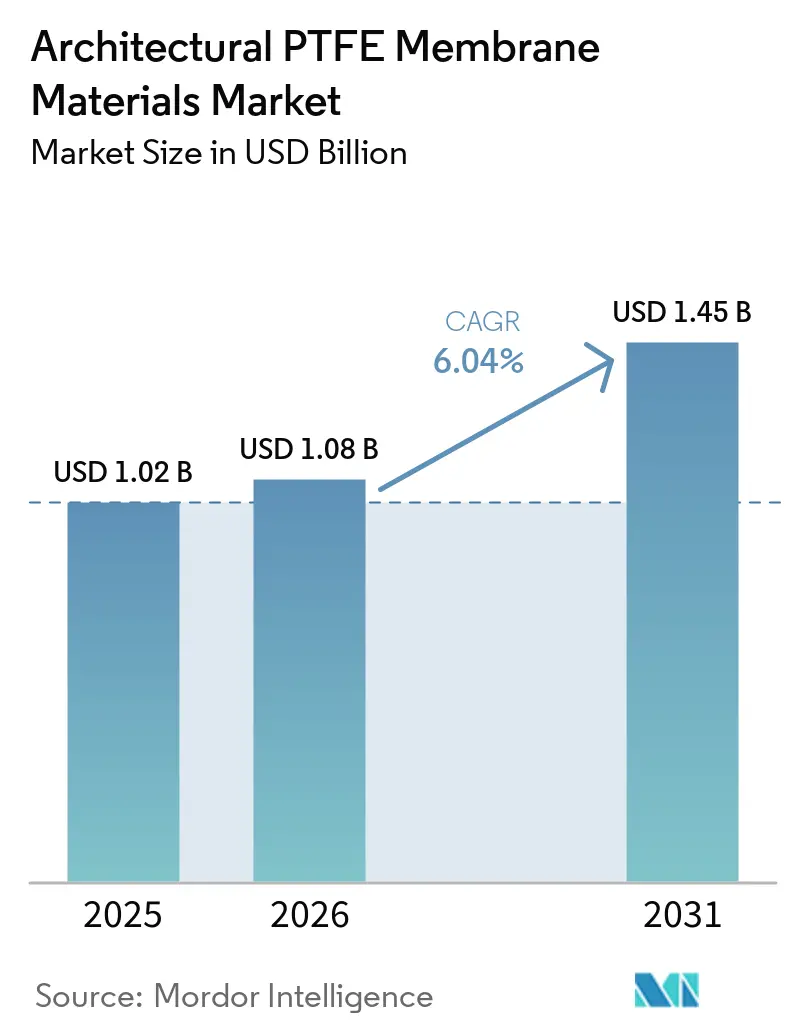
Architectural PTFE Membrane Materials Market Analysis by Mordor Intelligence
The Architectural PTFE Membrane Materials market size was valued at USD 1.02 billion in 2025 and is estimated to grow from USD 1.08 billion in 2026 to reach USD 1.45 billion by 2031, at a CAGR of 6.04% during the forecast period (2026-2031). Procurement requirements for durable building envelopes, public infrastructure investment, and replacement work on aging textile roofs support the architectural PTFE membrane materials market. Polytetrafluoroethylene (PTFE)-coated fiberglass remains a preferred option for permanent tensile roofing at venues, transport facilities, and commercial facades because it combines fire performance, low maintenance needs, and a long service life. Green building requirements are increasing the importance of documented material performance during public tenders. Suppliers are responding with environmental documentation, digital fabrication capabilities, and surface treatments that reduce maintenance. Demand also depends on each project’s need for daylight control, durability, and long-span structural performance.
Key Report Takeaways
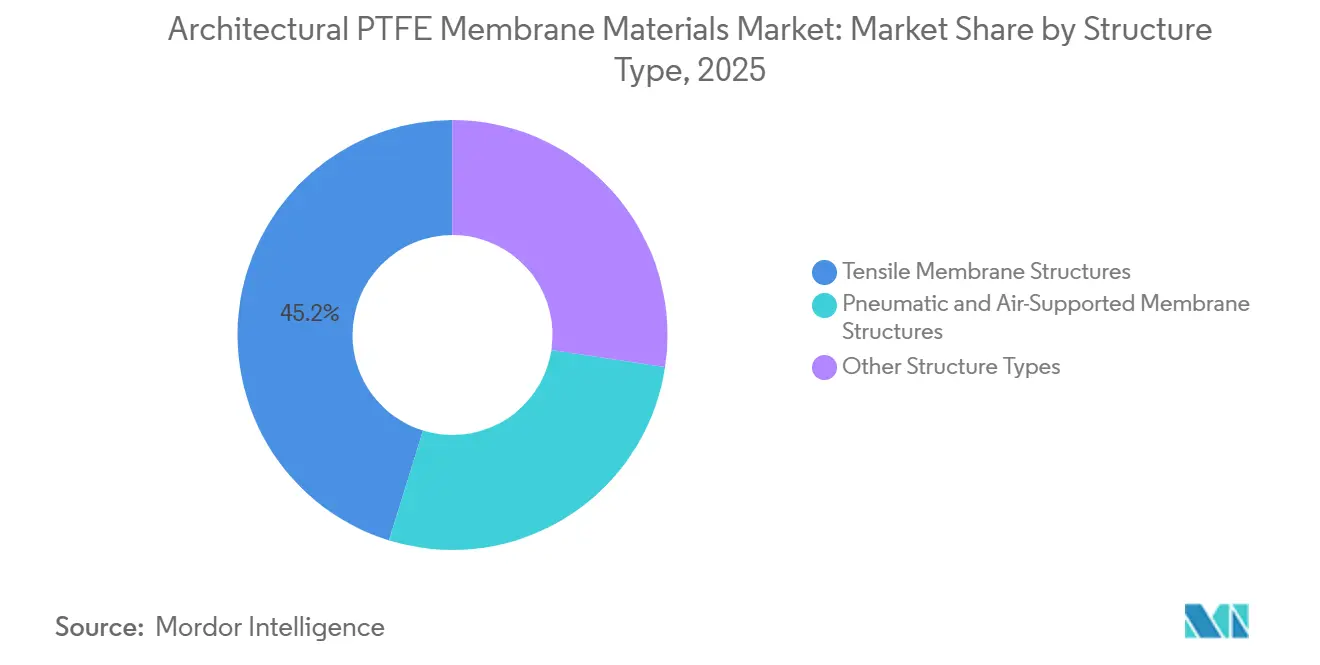
- By structure type, tensile membrane structures held 45.23% of the architectural PTFE membrane materials market share in 2025, while pneumatic and air-supported membrane structures are projected to advance at a 7.12% CAGR through 2031.
- By application, stadiums and sports venues held 41.34% of the architectural PTFE membrane materials market share in 2025, while airport terminals and transportation hubs are projected to advance at a 6.90% CAGR through 2031.
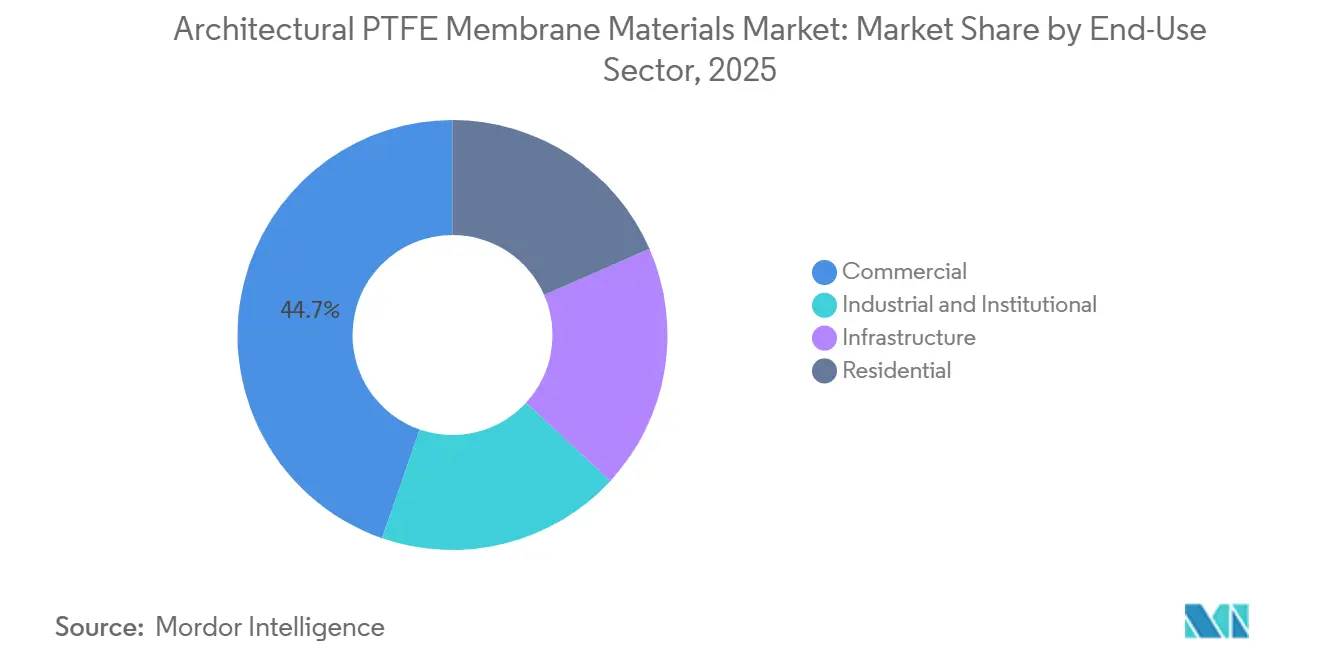
- By end-use sector, commercial held 44.69% of the architectural PTFE membrane materials market share in 2025, while infrastructure is projected to advance at a 7.74% CAGR through 2031.
- By geography, Asia-Pacific held 38.57% of the architectural PTFE membrane materials market share in 2025 and is projected to advance at a 6.95% CAGR through 2031.
Note: Market size and forecast figures in this report are generated using Mordor Intelligence’s proprietary estimation framework, updated with the latest available data and insights as of January 2026.
Market Trends and Insights
Drivers Impact Analysis of Architectural PTFE Membrane Materials Market*
| Driver | (~) % Impact on CAGR Forecast | Geographic Relevance | Impact Timeline |
|---|---|---|---|
| Sustainable Building and Green Certification Demand | +1.4% | Global, concentrated in North America, EU, and GCC | Medium term (2-4 years) |
| Infrastructure Modernization and Mega-Venue Construction | +1.2% | Asia-Pacific, GCC, North America | Short term (≤ 2 years) |
| Daylighting and Energy Performance | +0.9% | Global | Medium term (2-4 years) |
| BIM-to-Fabrication Precision and Parametric Design | +0.7% | Europe, North America, Japan | Long term (≥ 4 years) |
| Long Service Life and Low Maintenance | +0.6% | Global | Long term (≥ 4 years) |
| Retrofit Replacement of Aging Textile Roofs | +0.4% | North America, Europe, Japan | Short term (≤ 2 years) |
| Source: Mordor Intelligence | |||
Sustainable Building and Green Certification Demand
Leadership in Energy and Environmental Design (LEED), Building Research Establishment Environmental Assessment Method (BREEAM), and Germany’s Deutsche Gesellschaft für Nachhaltiges Bauen (DGNB) frameworks have become procurement requirements in many large public projects. These frameworks assess daylighting, thermal performance, and material durability, which increases scrutiny of roof material specifications. PTFE-coated fiberglass provides 15% to 25% diffuse transmittance and 70% ± 10% solar reflectance, supporting envelope energy-performance requirements. The architectural PTFE membrane materials market benefits when public buyers require documented lifecycle performance rather than initial-cost comparisons alone. CHUKOH CHEMICAL INDUSTRIES, LTD. received an Environmental Product Declaration (EPD) from EPD Hub in April 2025 for its FGT series, including FGT-600, FGT-800, and FGT-1000, which supports tender qualification where lifecycle documentation is required[1]. EPD availability can remove materials without comparable documentation at the schematic design stage.
Infrastructure Modernization and Mega-Venue Construction
Transit authorities and sporting bodies are specifying PTFE-coated fiberglass for permanent, large-span structures. This supports demand in the architectural PTFE membrane materials market because such projects require qualified materials and involve multi-year delivery schedules. TAIYO KOGYO CORPORATION’s U.S. subsidiary, Birdair Inc., received a May 2025 contract to replace the PTFE membrane roof at NRG Stadium in Houston, a 2026 Fédération Internationale de Football Association (FIFA) World Cup venue. The original roof membrane had been installed 20 years earlier, and micrographic comparisons found no structural degradation. TAIYO KOGYO CORPORATION also installed the PTFE membrane roof at Yumeshima Station on the Osaka Metro in January 2025. Fixed event schedules can accelerate procurement because replacement work must be completed before venue operations begin.
Daylighting and Energy Performance
PTFE-coated fiberglass membranes provide solar control and diffuse natural illumination for covered buildings. Their light transmission and reflectance characteristics are relevant as building energy codes become more demanding. Typical PTFE membrane roofs reduced cooling loads by 20% to 35% compared with opaque alternatives while admitting diffuse daylight. Research published by Germany’s Federal Institute for Research on Building, Urban Affairs and Spatial Development found that adaptive facade systems using PTFE-coated glass weave achieved material-mass, carbon dioxide, and embodied-energy savings compared with conventional construction. This performance broadens the architectural PTFE membrane materials market opportunity in projects seeking lower structural weight and controlled daylight. Diffuse light can also reduce glare, which supports energy compliance without requiring a glass curtain wall system.
BIM-to-Fabrication Precision and Parametric Design
Building Information Modeling (BIM) links parametric design systems with cutting and fabrication equipment. This workflow can shorten engineering-to-installation timelines and reduce offcut waste to below 5% on complex forms. A 2024 study demonstrated a parametric design workflow for tensile structures that connected form finding, patterning, and structural analysis without manual rework. A 2026 study reported average deviations of 15 to 20 mm between Industry Foundation Classes (IFC) models and laser-scanned as-built geometry, with cable-force prediction errors below 2%. The architectural PTFE membrane materials market, therefore, favors fabricators able to provide narrow tolerances and custom roll dimensions. These capabilities can support a quality premium where project geometry is complex.
Restraints Impact Analysis of Architectural PTFE Membrane Materials Market*
| Restraint | (~) % Impact on CAGR Forecast | Geographic Relevance | Impact Timeline |
|---|---|---|---|
| High Upfront Material and Installation Cost | -1.1% | Global, most acute in South Asia and Sub-Saharan Africa | Short term (≤ 2 years) |
| Specialized Engineering and Installation Capability | -0.8% | Southeast Asia, Africa, South America | Medium term (2-4 years) |
| PTFE-ETFE Substitution in Daylight-First Designs | -0.6% | Europe and North America | Medium term (2-4 years) |
| End-of-Life Recycling and Embodied-Carbon Scrutiny | -0.4% | EU and North America | Long term (≥ 4 years) |
| Source: Mordor Intelligence | |||
High Upfront Material and Installation Cost
PTFE-coated fiberglass membranes carry a 30% to 50% material-cost premium over polyvinyl chloride (PVC)-coated polyester. The difference grows when fluorinated ethylene propylene (FEP) welding, precision tensioning, and custom steel connectors are included. This cost can be a significant barrier for budget-constrained municipal projects in South and Southeast Asia. Specifiers can select PVC during concept design before lifecycle-cost considerations are evaluated. Limited local PTFE installation capacity also discourages investment in the specialized workforce required for these projects. The architectural PTFE membrane materials market, therefore, remains concentrated in airports, transit stations, and permanent sports venues with lifecycle-cost mandates.
PTFE-ETFE Substitution in Daylight-First Designs
Ethylene tetrafluoroethylene (ETFE) film transmits 90% to 96% of incident light, compared with 15% to 25% for PTFE. This difference supports ETFE use in botanical gardens, glazed atriums, and retail gallery roofs where transparency is the primary design requirement. Novum Structures stated that ETFE’s low weight can reduce the structural support requirement and the embodied carbon of supporting steel. Research presented at the International Association for Shell and Spatial Structures symposium in 2025 documented the characterization of post-consumer recycled ETFE from Chelsea and Westminster Hospital. ETFE performs less well in high-ultraviolet desert conditions and has a greater puncture risk in hail-prone areas. Substitution is therefore concentrated in temperate and humid subtropical projects where high transparency is valued.
*Our forecasts treat driver/restraint impacts as directional, not additive. The impact forecasts reflect baseline growth, mix effects, and variable interactions.
Architectural PTFE Membrane Materials Market Segment Analysis
By Structure Type:
Tensile Membrane Structures Lead, While Pneumatic and Air-Supported Membrane Structures Grow FastestTensile membrane structures held 45.23% of the architectural PTFE membrane materials market in 2025. Their position reflects biaxial tension, which distributes loads across the surface and allows column-free spans of 30 meters or more. This structural approach can achieve long spans at a lower material weight than comparable rigid structures. Tensile systems are suited to airports, transit facilities, stadiums, and permanent public spaces. Requirements for structural permanence and lower maintenance support the architectural PTFE membrane materials market size for tensile membrane structures. Project owners also value the material’s 20- to 30-year service-life fit for long-lived public assets.
Pneumatic and air-supported membrane structures are projected to advance at a 7.12% CAGR through 2031. Their growth is linked to air-dome use in logistics warehouses, indoor sports facilities in northern China and Central Asia, and Gulf Cooperation Council amenity spaces requiring year-round climate control. TAIYO KOGYO CORPORATION launched TensoDiaRoof in November 2025, a Building Center of Japan (BCJ)-rated lattice-purlin membrane roof system that uses 10% less steel and requires no scaffolding. The system targets retrofit applications beyond large venue contracts. Other structure types benefit from photocatalytic PTFE surfaces that help retain aesthetic performance in polluted locations. Digital design-to-fabrication workflows also raise the technical requirements for complex structures.

By Application:
Stadiums and Sports Venues Lead, While Airport Terminals and Transportation Hubs Grow FastestStadiums and sports venues held 41.34% of the architectural PTFE membrane materials market in 2025. This application reflects decades of major-event investment and PTFE’s alignment with stadium depreciation schedules. Climate-related damage has also added retrofit activity to planned venue upgrades. Serge Ferrari Group supplied material for the Tropicana Field roof replacement in Florida in 2025. The project used 24 PTFE panels, each weighing 5,000 lb, or 2,268 kg, after Hurricane Milton damaged the earlier roof in 2024. This activity shows how urgent repair work can combine with scheduled investment cycles.
Airport terminals and transportation hubs are projected to advance at a 6.90% CAGR through 2031. Public transit authorities are seeking fire-rated and permanent envelope materials for stations and interchanges, which creates a stable procurement channel for the architectural PTFE membrane materials market. The Yumeshima Station installation by TAIYO KOGYO CORPORATION in January 2025 showed how standards used for airport-scale facilities are being applied to urban metro infrastructure. Exhibition and convention centers also require large covered spaces. Zhejiang Huifeng Holding Group Co., Ltd. supplied 140,000 square meters of PTFE membrane for the Vietnam Exhibition Center in 2025. Educational and institutional buildings use diffuse daylight and acoustic properties, while other applications provide steady demand through civic projects.
By End-Use Sector:
Commercial Leads, While Infrastructure Grows FastestCommercial held 44.69% of the architectural PTFE membrane materials market in 2025. Demand was concentrated in high-footfall retail complexes, event venues, and mixed-use developments. These projects use membrane roofs and facades to provide covered public areas while preserving daylight. Commercial facades face competition from glass curtain wall systems. However, lifecycle-carbon requirements are beginning to favor membrane alternatives in some European projects. The architectural PTFE membrane materials industry serves this segment through lighter grades used in canopy and facade applications.
Infrastructure is projected to advance at a 7.74% CAGR through 2031. National transit investment programs in Asia-Pacific and the Gulf Cooperation Council are increasing demand for covered metro stations and public amenity plazas. Infrastructure projects use heavier membranes weighing 1,400 to 1,600 g/m². They also require third-party fire certification to Class A or Euroclass A2-s1,d0, and EPD documentation. Jiangsu VEIK Technology & Materials Co., Ltd. reported PTFE membrane deployment in more than 40 domestic and international projects and an annual capacity of 1 million square meters across 5 dedicated lines in March 2026. Industrial and institutional users favor air-dome systems, while residential use remains limited.
Geography Analysis
APAC Architectural PTFE Membrane Materials Market
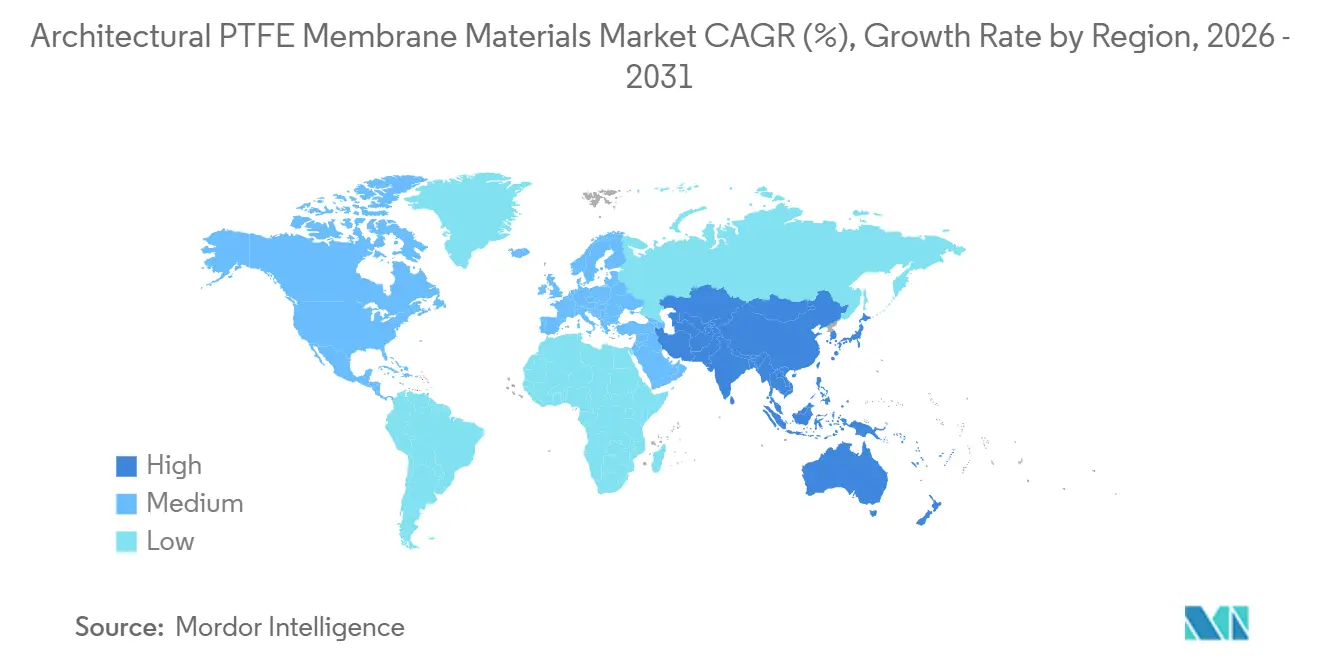
Asia-Pacific held 38.57% of the architectural PTFE membrane materials market share in 2025 and is projected to advance at a 6.95% CAGR through 2031. China’s urbanization program is supporting PTFE roofing at metro stations and intermodal terminals in the Yangtze River Delta and Pearl River Delta. Zhejiang Huifeng Holding Group Co., Ltd. supplied membrane material for the Vietnam Exhibition Center in September 2025, marking a major overseas deployment of a Chinese PTFE product in a flagship public building. TAIYO KOGYO CORPORATION’s work at Yumeshima Station and Mitsui Outlet Park Kisarazu showed continued activity in Japanese transit and commercial sites. India and the Association of Southeast Asian Nations (ASEAN) countries offer opportunities through airport expansions and mass-transit extensions.
North America and Europe Architectural PTFE Membrane Materials Market
North American demand centers on stadium refurbishment, where Tropicana Field and NRG Stadium combine climate-related repairs with sporting deadlines. Europe is influenced by the European Green Deal and EN 15804 lifecycle requirements. The Dresden Hauptbahnhof renovation used 33,000 square meters of Serge Ferrari GF-7000 PTFE membrane over 3 phases completed between 2022 and 2025. Nordic countries are adopting adaptive membrane facade modules tested through Germany’s Zukunft Bau program. Germany and the Netherlands have a strong demand for EPD-documented materials in public procurement.
The Americas and MEA Architectural PTFE Membrane Materials Market
South America, and Middle-East and Africa show different demand conditions. The Gulf Cooperation Council is a high-value opportunity outside Asia-Pacific because Saudi Arabia and the United Arab Emirates are developing stadiums, transport hubs, and public spaces that require durable long-span coverings in the architectural PTFE membrane materials market. PTFE’s ultraviolet stability is important for desert conditions. Brazil and Argentina are supporting South American demand through stadium modernization and logistics air domes. Mexico’s co-host role for the 2026 FIFA World Cup provided a near-term project catalyst. African procurement remains focused on government projects because installation capability constraints limit broader adoption.
Competitive Landscape
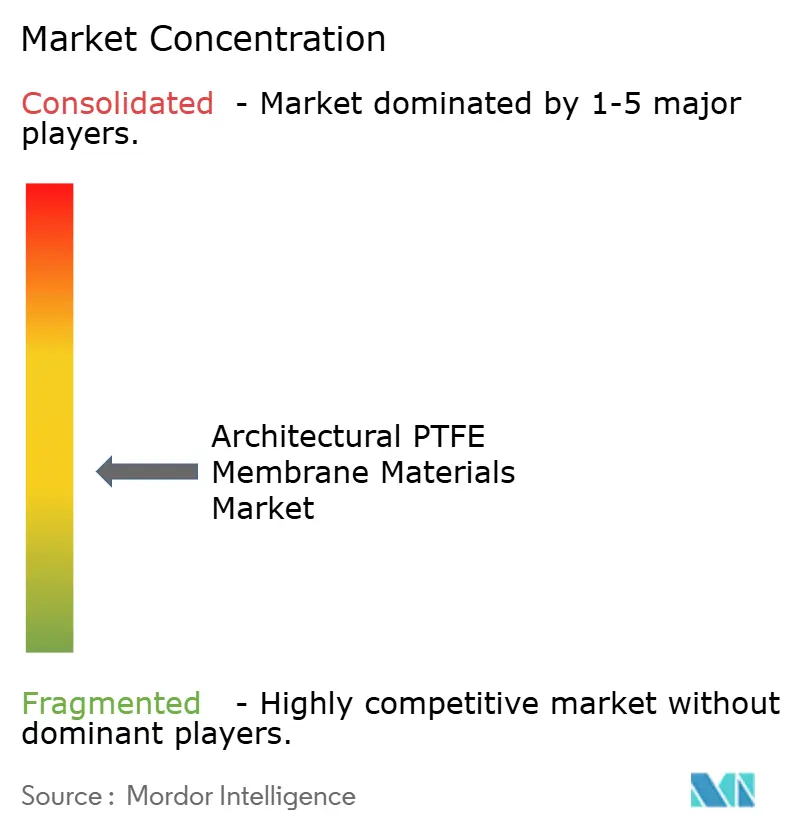
The architectural PTFE membrane materials market is moderately concentrated, with the top five players including Saint-Gobain, Serge Ferrari, TAIYO KOGYO CORPORATION, CHUKOH CHEMICAL INDUSTRIES, LTD., and FIBERFLON. Zhejiang Huifeng Holding Group Co., Ltd., Jiangsu VEIK Technology & Materials Co., Ltd., NINGBO WELLFLON NEW MATERIALS TECHNOLOGY CO., LTD., and Haining Duletai New Material Co., Ltd. compete in mid-tier grades through pricing and certification investment. Capital-intensive impregnation lines, multi-year qualification cycles, and specialized fiberglass yarn supply limit new participation. High-value public tenders increasingly favor suppliers with documented environmental and fire-performance credentials.
TAIYO KOGYO CORPORATION applied an ultraviolet-activated titanium-dioxide photocatalytic treatment to its AP450 fluoropolymer membrane at Mitsui Outlet Park Kisarazu in June 2025[2]. The treatment reduces manual cleaning requirements, which addresses a material lifecycle-cost concern for building owners and supports differentiation in the architectural PTFE membrane materials market. Serge Ferrari introduced Tenseo STFE, a semi-structural ultra-transparent membrane, in 2025 to serve projects that need more transparency than opaque PTFE can provide. CHUKOH CHEMICAL INDUSTRIES, LTD. obtained an EPD for its FGT series in April 2025. These actions show competition around material documentation, maintenance performance, and design flexibility within the architectural PTFE membrane materials market. BIM-compatible panel data and computer numerical control cutting specifications can also strengthen relationships with engineering firms.
The architectural PTFE membrane materials market faces competition from ETFE in projects where near-total transparency is essential. PTFE remains more suited to projects that need controlled daylight, strong fire performance, and durability in harsh environments. End-of-life processing for fluoropolymer-coated glass substrates remains a consideration for public buyers. Resin price volatility can also affect producer costs because specialty fluorochemical supply is concentrated. Demand for permanent large-span structures is likely to favor suppliers that combine qualified materials with reliable fabrication support. Competition in the architectural PTFE membrane materials market is expected to remain strongest in high-performance applications that require project-specific certification and engineering.
Architectural PTFE Membrane Materials Industry Leaders
-
Saint-Gobain
-
Serge Ferrari
-
TAIYO KOGYO CORPORATION
-
CHUKOH CHEMICAL INDUSTRIES, LTD.
-
FIBERFLON
- *Disclaimer: Major Players sorted in no particular order
Architectural PTFE Membrane Materials Market Companies Covered in this Report
- CHUKOH CHEMICAL INDUSTRIES, LTD.
- FIBERFLON
- Haining Duletai New Material Co., Ltd.
- HIRAOKA & Co., Ltd.
- Jiangsu VEIK Technology & Materials Co., Ltd.
- Keli New Materials Co., Ltd.
- NINGBO WELLFLON NEW MATERIALS TECHNOLOGY CO., LTD.
- Saint-Gobain
- Serge Ferrari
- TACONIC
- TAIYO KOGYO CORPORATION
- Zhejiang Huifeng Holding Group Co., Ltd.
- Zhejiang Kaiao New Material Co., Ltd.
Recent Industry Developments in Architectural PTFE Membrane Materials Market
- December 2025: Serge Ferrari supplied its Tenseo Xtrem GF 7000 PTFE-coated fiberglass membrane for the replacement of Tropicana Field’s damaged roof, with 24 large membrane panels fabricated at its Germany facility. The project demonstrates the use of high-performance PTFE-coated fiberglass membranes in large-scale stadium roofing, supporting demand for durable architectural membrane materials in sports and infrastructure applications.
- May 2025: TAIYO KOGYO CORPORATION’s U.S. subsidiary Birdair secured the contract to replace the PTFE membrane roof at NRG Stadium, using a more durable PTFE-coated fiberglass membrane for the nearly 300,000-square-foot retractable roof. The replacement also provided a real-world durability benchmark and showed no noticeable structural deterioration after more than 20 years of service.
Global Architectural PTFE Membrane Materials Market Report Scope
Architectural PTFE membrane materials are high-performance fluoropolymer-based materials used to create lightweight building envelopes, roofing systems, and architectural coverings. They offer durability, weather resistance, low surface energy, and high light transmission, making them suitable for structures that require large-span coverage and distinctive architectural designs.
The Architectural PTFE Membrane Materials Market is segmented by structure type, application, end-use sector, and geography. By structure type, the market is segmented into tensile membrane structures, pneumatic and air-supported membrane structures, and other structure types. By application, the market is segmented into stadiums and sports venues, airport terminals and transportation hubs, exhibition and convention centers, commercial facades and retail structures, educational and institutional buildings, and other applications. By end-use sector, the market is segmented into commercial, industrial and institutional, infrastructure, and residential. The report also covers the market size and forecasts for architectural PTFE membrane materials in 17 countries across major regions. For each segment, the market sizing and forecasts have been done on the basis of value (USD).
Segmentation Overview
| Tensile Membrane Structures |
| Pneumatic and Air-Supported Membrane Structures |
| Other Structure Types |
| Stadiums and Sports Venues |
| Airport Terminals and Transportation Hubs |
| Exhibition and Convention Centers |
| Commercial Facades and Retail Structures |
| Educational and Institutional Buildings |
| Other Applications |
| Commercial |
| Industrial and Institutional |
| Infrastructure |
| Residential |
| Asia-Pacific | China |
| India | |
| Japan | |
| South Korea | |
| ASEAN Countries | |
| Rest of Asia-Pacific | |
| North America | United States |
| Canada | |
| Mexico | |
| Europe | Germany |
| United Kingdom | |
| France | |
| Italy | |
| Spain | |
| NORDIC Countries | |
| Rest of Europe | |
| South America | Brazil |
| Argentina | |
| Rest of South America | |
| Middle-East and Africa | Saudi Arabia |
| United Arab Emirates | |
| South Africa | |
| Rest of Middle-East and Africa |
| By Structure Type | Tensile Membrane Structures | |
| Pneumatic and Air-Supported Membrane Structures | ||
| Other Structure Types | ||
| By Application | Stadiums and Sports Venues | |
| Airport Terminals and Transportation Hubs | ||
| Exhibition and Convention Centers | ||
| Commercial Facades and Retail Structures | ||
| Educational and Institutional Buildings | ||
| Other Applications | ||
| By End-Use Sector | Commercial | |
| Industrial and Institutional | ||
| Infrastructure | ||
| Residential | ||
| By Geography | Asia-Pacific | China |
| India | ||
| Japan | ||
| South Korea | ||
| ASEAN Countries | ||
| Rest of Asia-Pacific | ||
| North America | United States | |
| Canada | ||
| Mexico | ||
| Europe | Germany | |
| United Kingdom | ||
| France | ||
| Italy | ||
| Spain | ||
| NORDIC Countries | ||
| Rest of Europe | ||
| South America | Brazil | |
| Argentina | ||
| Rest of South America | ||
| Middle-East and Africa | Saudi Arabia | |
| United Arab Emirates | ||
| South Africa | ||
| Rest of Middle-East and Africa | ||
Key Questions Answered in the Report
What is the size of the architectural PTFE membrane materials market?
The architectural PTFE membrane materials market stands at USD 1.08 billion in 2026 and is projected to reach USD 1.45 billion by 2031.
What is driving demand for architectural PTFE membrane materials?
Public infrastructure investment, green building documentation requirements, and replacement of aging textile roofs are supporting demand for durable PTFE-coated fiberglass systems.
Which structure type led the market demand in 2025?
Tensile membrane structures held 45.23% in 2025, supported by their ability to create column-free spans of 30 m or more.
Which application is projected to grow fastest through 2031?
Airport terminals and transportation hubs are projected to advance at a 6.90% CAGR through 2031, driven by transit authorities seeking fire-rated permanent envelope materials.