
Construction Materials Market Size and Share
Market Overview
| Study Period | 2021 - 2031 |
|---|---|
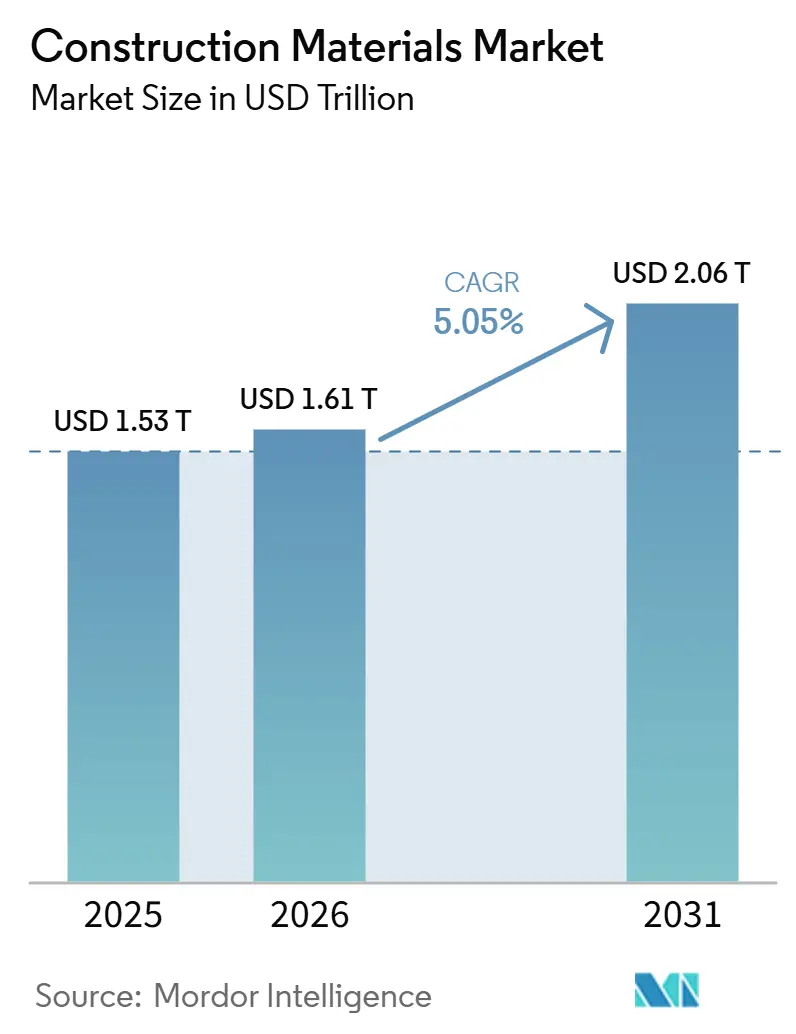
| Market Size (2026) | USD 1.61 Trillion |
| Market Size (2031) | USD 2.06 Trillion |
| Growth Rate (2026 - 2031) | 5.05 % |
| Fastest Growing Market | Asia-Pacific |
| Largest Market | Asia-Pacific |
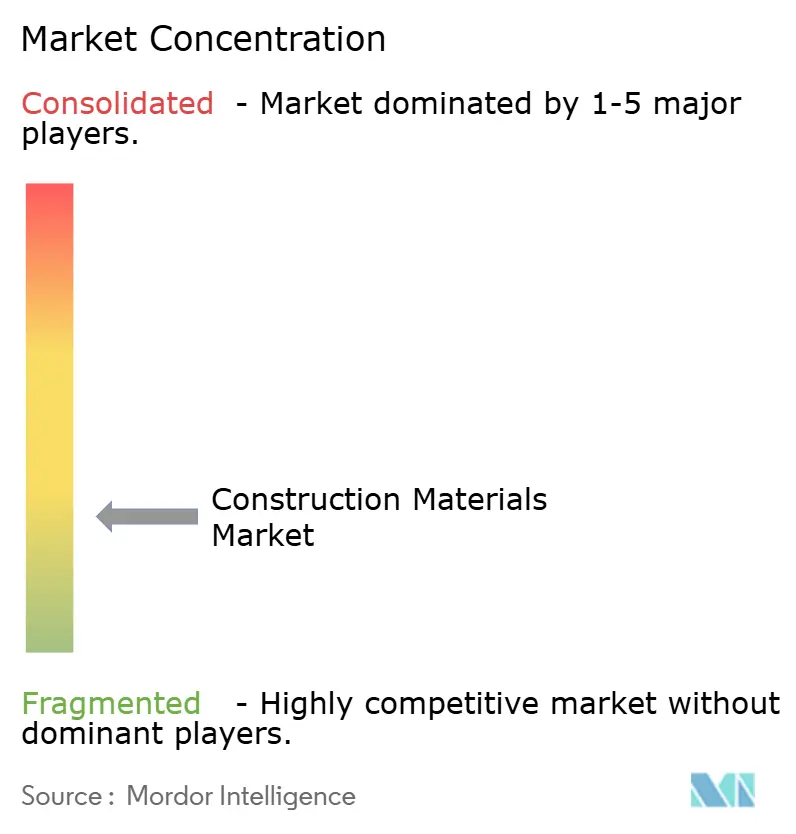
| Market Concentration | Low |
Major Players *Disclaimer: Major Players sorted in no particular order Image © Mordor Intelligence. Reuse requires attribution under CC BY 4.0. | |
Construction Materials Market Analysis by Mordor Intelligence
The Construction materials market size was estimated at USD 1.53 trillion in 2025 and is estimated to grow from USD 1.61 trillion in 2026 to USD 2.06 trillion by 2031, at a CAGR of 5.05% during the forecast period (2026-2031). Urbanization, infrastructure investment, and material specifications that address embodied carbon and structural performance are supporting this expansion. The construction materials market is shifting away from commodity purchasing toward certified materials tailored to individual project requirements. This shift favors producers who can document sustainability credentials and consistently meet project specifications. Energy, freight, and carbon-compliance costs remain key risks for cement and steel producers. The adoption of digital procurement is also increasing the value of timely demand information and reliable supply planning.
Key Report Takeaways
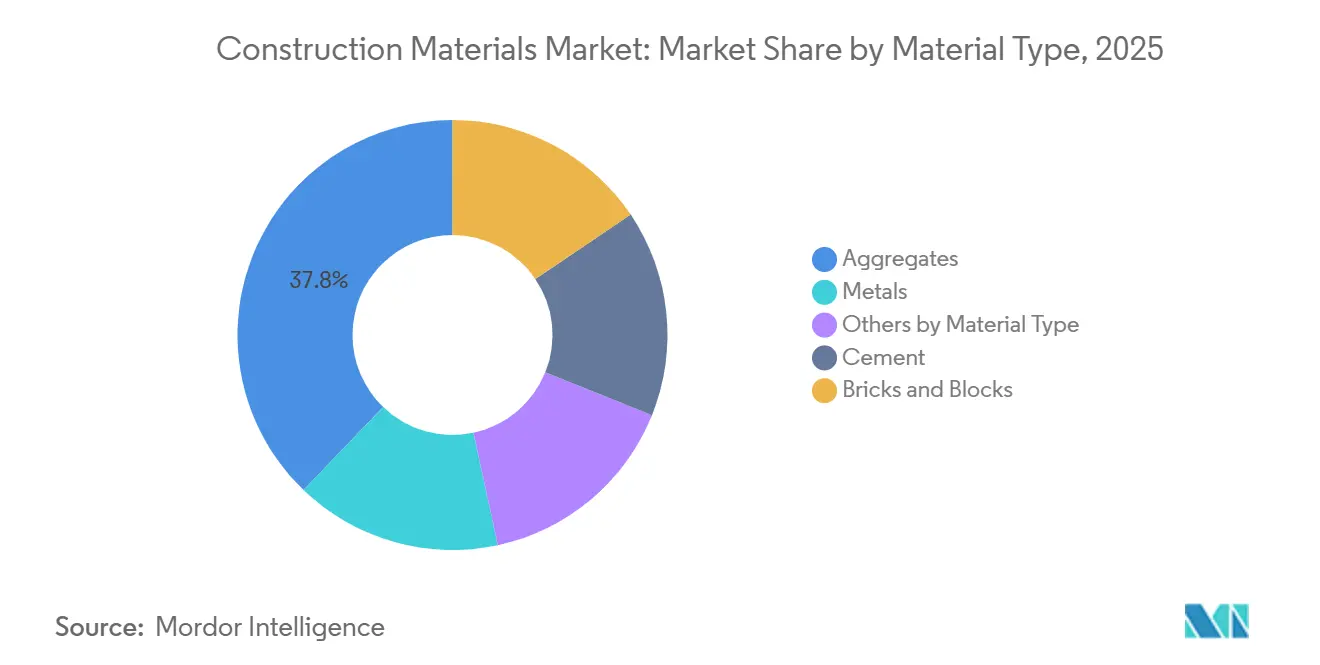
- By material type, aggregates held 37.82% of the Construction materials market share in 2025, while metals are forecast to grow at a 5.82% CAGR through 2031.
- By construction type, new construction held 72.91% of the Construction materials market share in 2025, while renovation and repairs are forecast to expand at a 6.17% CAGR through 2031.
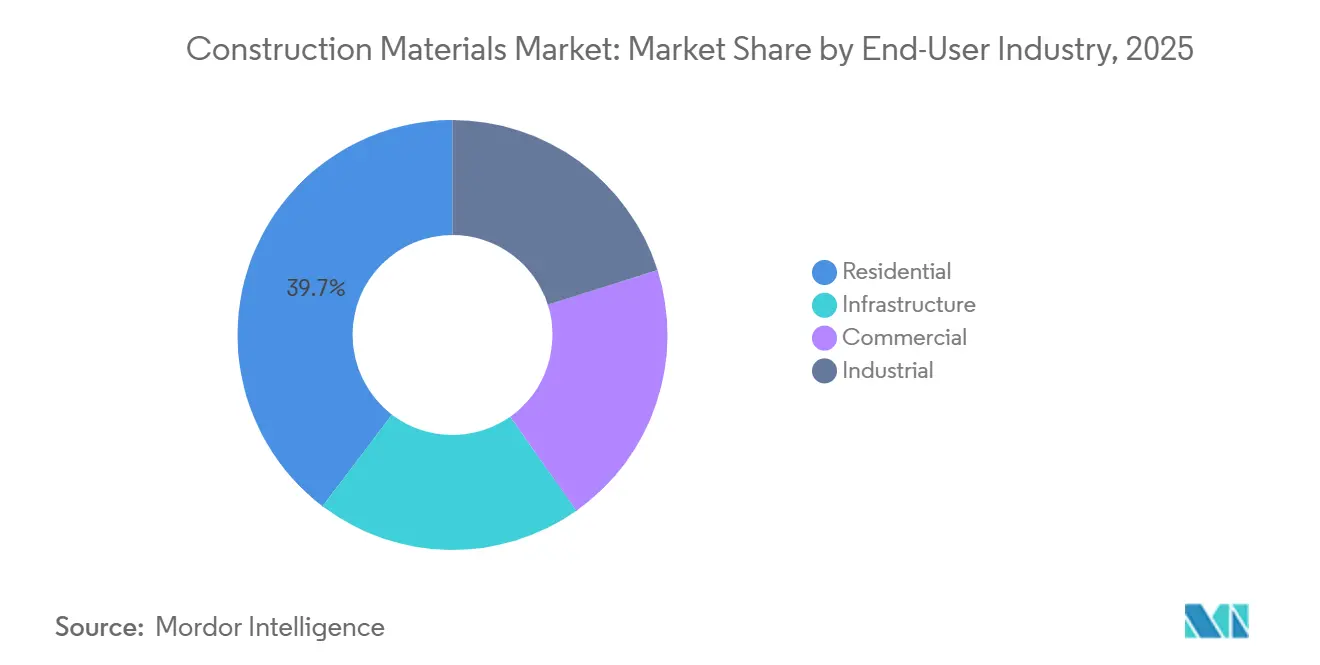
- By end-user industry, residential held 39.67% of the Construction materials market share in 2025, while infrastructure is forecast to grow at a 6.43% CAGR through 2031.
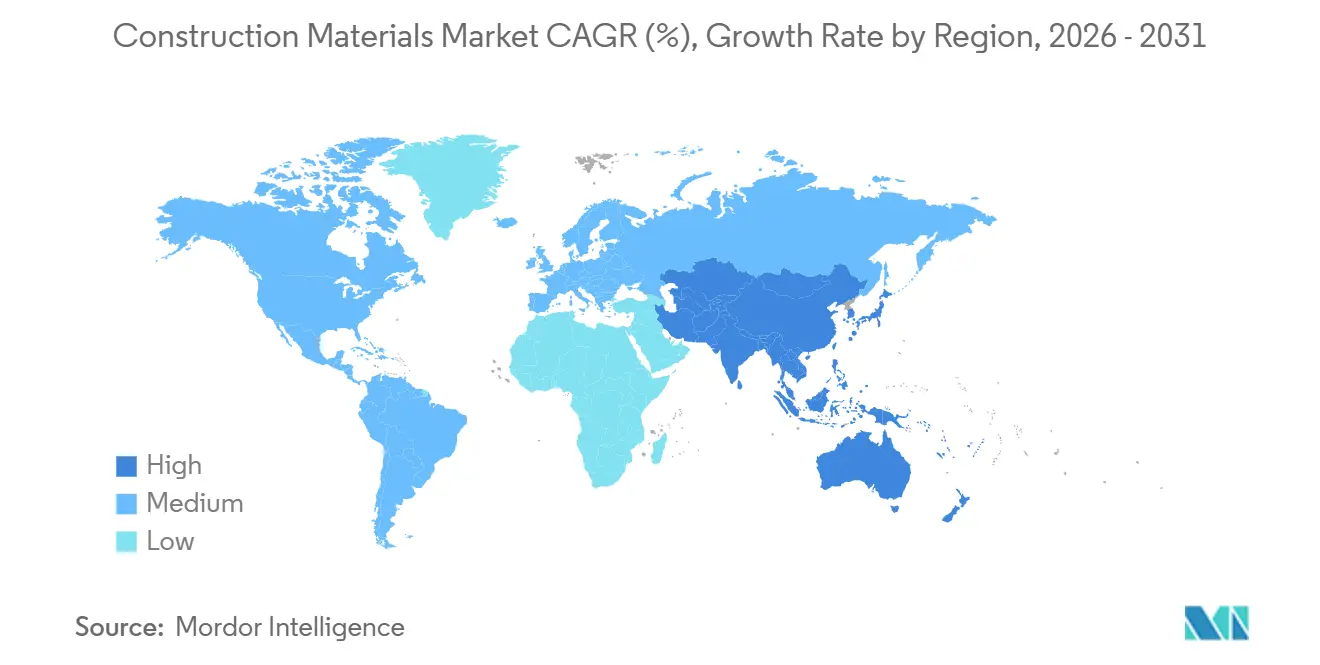
- By geography, Asia-Pacific held 46.82% of the Construction materials market share in 2025 and is forecast to expand at a 6.02% CAGR through 2031.
Note: Market size and forecast figures in this report are generated using Mordor Intelligence’s proprietary estimation framework, updated with the latest available data and insights as of January 2026.
Market Trends and Insights
Drivers Impact Analysis of Construction Materials Market*
| Drivers | (~) % Impact on CAGR Forecast | Geographic Relevance | Impact Timeline |
|---|---|---|---|
| Rising Renovation and Repair Activity | +0.6% | Western Europe and North America, with growing adoption in APAC | Medium term (2-4 years) |
| Infrastructure-Led Demand for Core Materials | +1.2% | Global, concentrated in India, China, the United States, and the Middle-East | Long term (≥ 4 years) |
| Urban Housing Shortages Supporting New Construction | +0.9% | APAC core, including India and Southeast Asia, and Europe, including Ireland, Spain, and the UK | Medium term (2-4 years) |
| Decarbonization Pressure Accelerating Low-Carbon Material Adoption | +0.5% | EU and North America, with spillover to APAC and MEA | Long term (≥ 4 years) |
| Prefabrication and Modular Construction Increasing Material Standardization | +0.4% | North America, Western Europe, Japan, and Australia | Medium term (2-4 years) |
| Digital Project Planning Improving Material Demand Visibility | +0.3% | Global, led by the United States, the UK, Germany, and Singapore | Short term (≤ 2 years) |
| Source: Mordor Intelligence | |||
Rising Renovation and Repair Activity
Renovation was the only construction segment to maintain positive output in Europe during the 2023 to 2024 contraction. This pattern established renovation as a structural source of demand rather than a late-cycle activity. The EU Renovation Wave, supported by EUR 275 billion (~USD 313.67 billion) through the Recovery and Resilience Facility, seeks to double the annual renovation rate by 2030. This support creates a multi-year demand base for insulation, drywall, roofing membranes, and structural fixings. The construction materials market benefits from renovation activity, which typically uses thinner, specialized products that deliver higher value than bulk materials.
Infrastructure-Led Demand for Core Materials
Government infrastructure programs are creating durable demand for aggregates, structural steel, cement, and precast concrete elements. The US Bipartisan Infrastructure Law allocated USD 1.2 trillion for infrastructure investment, including USD 110 billion for roads and bridges and USD 66 billion for passenger and freight rail. These outlays enter construction pipelines over several fiscal years and support material output beyond individual private projects. The construction materials market also benefits from data centers and grid electrification projects, which require high-strength rebar, prefabricated equipment pads, and specialist coatings. Such products carry a premium over standard civil-engineering grades due to more specific performance requirements. Infrastructure programs also strengthen demand visibility for producers capable of supplying large quantities with consistent specifications.
Urban Housing Shortages Supporting New Construction
Housing shortages in major urban areas continue to support new residential construction. In India, 5.4 lakh housing units are scheduled for completion across the top 7 cities in 2026. This delivery pipeline supports demand for tiles, bathware, adhesives, and finishing products. In Europe, Ireland recorded growth in construction output in 2025, while Spain faces a housing deficit of 750,000 units. Prefabrication and modular construction are increasing material standardization in North America, Western Europe, Japan, and Australia. Digital project planning improves demand visibility in these markets by connecting material requirements with construction schedules.
Decarbonization Pressure Accelerating Low-Carbon Material Adoption
Carbon regulations are changing specifications for concrete, cement, and steel. The European Commission published Delegated Regulation EU 2026/52 on December 16, 2025, which provides a harmonized method to calculate lifecycle global-warming potential in buildings. New buildings larger than 1,000 m² must disclose their lifecycle global warming potential from 2028, and the requirement will extend to all new buildings from 2030. Ecocem completed a full-scale residential project using Activated Cement Technology (ACT) concrete in 2026, with 9,000 m³ used in a 147-unit development near Paris. ACT cement can reduce CO₂ emissions by up to 70% compared to conventional cement through clinker replacement[1]. Research published in Nature in 2025 found that lower-clinker concrete approaches can be technically and economically viable at scale.
Restraints Impact Analysis of Construction Materials Market*
| Restraints | (~) % Impact on CAGR Forecast | Geographic Relevance | Impact Timeline |
|---|---|---|---|
| Volatile Energy and Freight Costs | -0.5% | Global, most acute in North America, the Middle-East, and APAC trade routes | Short term (≤ 2 years) |
| Carbon Compliance Increasing Production Cost | -0.3% | EU and adjacent export markets, with spillover to North America | Medium term (2-4 years) |
| Permitting Delays Slowing Project Starts | -0.4% | North America and the EU, with secondary effects on APAC megaprojects | Medium term (2-4 years) |
| Recycled Material Supply Constraints in Certain Grades | -0.2% | Global, concentrated in markets targeting more than 50% Supplementary Cementitious Materials (SCM) replacement | Long term (≥ 4 years) |
| Source: Mordor Intelligence | |||
Volatile Energy and Freight Costs
Energy and logistics costs represent an immediate margin risk for construction materials producers and contractors in 2026. Cement, steel, and aluminum production require substantial energy and are exposed to fluctuations in fuel and freight costs. The Associated General Contractors of America reported that aluminum mill shapes increased 39.1% year over year to February 2026, steel mill products rose 20.9%, and diesel prices increased 20.3% during January 2026. These increases followed disruptions to Middle-East energy supplies[2]. This volatility makes it harder for contractors to price fixed-price contracts and can lead to bid withdrawals. Permitting delays and limited recycled-material availability add further pressure by slowing project starts and restricting access to some lower-carbon material grades.
Carbon Compliance Increasing Production Cost
Carbon pricing under the EU Emissions Trading System (ETS) increases costs for clinker and steel producers with high emissions per metric ton. Producers cannot always recover these costs when projects specify conventional grades and bidding remains competitive. The planned ETS2 is expected to begin operating in 2027 and will cover fuel combustion in buildings, road transport, and additional sectors. Large integrated producers hold an advantage when they operate modern kiln lines and can access supplementary cementitious materials. Independent producers with older, clinker-intensive assets face greater margin pressure. Heidelberg Materials reported EUR 405 million (~USD 461.95 million) in cost savings through the first quarter of 2026 under its Transformation Accelerator Initiative. As a result, the construction materials market faces a widening cost gap between producers that have invested in lower-carbon capacity and those that have not.
*Our forecasts treat driver/restraint impacts as directional, not additive. The impact forecasts reflect baseline growth, mix effects, and variable interactions.
Construction Materials Market Segment Analysis
By Material Type:
Infrastructure and Housing Demand Support Metals GrowthMetals are forecast to record the fastest growth among material types at a 5.82% CAGR through 2031. Demand is linked to infrastructure electrification, data center construction, renewable energy infrastructure, and grid modernization. These applications require structural products that meet more demanding technical specifications than standard carbon-steel grades. Aggregates accounted for 37.82% of the construction materials market in 2025, reflecting their essential role in concrete, roadbeds, and drainage systems across construction activity. The segment also benefits from permitted quarry reserves, which are difficult and time-consuming for new suppliers to replicate.
Cement remains the second-largest category by value, while blended and supplementary cementitious products are gaining specification share from standard Portland cement. Lifecycle global-warming-potential requirements in Europe are supporting this shift toward lower-clinker formulations. Bricks and blocks remain relevant in residential construction and heritage renovation, although prefabricated panels are gaining market share in markets with strong off-site construction activity. The other category, which includes insulation, specialty coatings, sealants, and advanced composites, offers greater scope for differentiation, as performance requirements carry greater weight in procurement decisions.

By Construction Type:
Renovation Growth Outpaces New ConstructionNew construction held 72.91% of the construction materials market share in 2025, supported by large residential programs in India and Southeast Asia, infrastructure delivery in the Middle-East, and data center and industrial projects in North America. Renovation and repair growth is forecast to accelerate to a 6.17% CAGR through 2031. This difference reflects the relative stability of maintenance and energy-efficiency work when new-building activity softens. EUROCONSTRUCT found that renovation was a steadier source of demand during Europe's construction contraction between 2023 and 2025.
Renovation projects use a different material mix compared to new construction. Insulation, acoustic panels, lightweight drywall, and cementitious repair mortars play a larger role in these projects than bulk aggregates and clinker, which support suppliers with specialized product portfolios. Renovation demand provides the construction materials market with a stream of demand less exposed to swings in new construction activity.
By End-User Industry:
Infrastructure Leads the Growth CurveInfrastructure is forecast to grow at a 6.43% CAGR through 2031, making it the fastest-growing end-user segment. Government capital programs in North America, India, and Gulf states are supporting roads, rail, energy networks, and related construction. Residential remained the largest end-user segment, accounting for 39.67% of the construction materials market in 2025. Housing deficits in India, Southeast Asia, and selected European markets continue to sustain demand across cement, aggregates, bricks, and finishing products.
Commercial construction remained steady in 2025 despite weaker demand in traditional office and retail formats, with data center and logistics construction helping to offset softer demand in those sectors. Industrial construction is expanding in areas linked to semiconductor fabrication, battery manufacturing, and liquefied natural gas (LNG) facilities. These projects require high-performance concrete, specialty coatings, and structural steel with defined tolerances and certifications. The shift from office and retail construction toward technology infrastructure and advanced manufacturing is changing the product mix toward more specialized materials and benefiting suppliers that can provide certified products and meet project-specific requirements.
Geography Analysis
APAC Construction Materials Market
Asia-Pacific held 46.82% of the construction materials market share in 2025 and is forecast to grow at a 6.02% CAGR through 2031. China, India, and Southeast Asia combine large construction output with ongoing urbanization. India's demand is driven more by infrastructure than by residential property, while Vietnam, Indonesia, and the Philippines are emerging as secondary growth centers.
North America Construction Materials Market
North America presents a mixed outlook across end uses. Infrastructure and data center projects are consuming large quantities of structural steel, precast concrete, and specialty coatings. Residential activity remains constrained by affordability conditions. US infrastructure funding supports transportation and water projects that require significant aggregate quantities. Input prices rose 6.2% year to date as of April 2026, driven by metals and fuel. Mexico benefits from nearshoring-related industrial construction in its northern manufacturing corridor.
EMEA and South America Construction Materials Market
Europe is recovering gradually after two years of contraction, supported by civil engineering activity and market stabilization in Ireland, Spain, Portugal, and the UK. Germany, France, and Italy continue to face weaker demand due to high construction costs, cautious households, and regulatory complexity. European procurement is increasingly shaped by lifecycle global warming potential rules and the planned rollout of Emissions Trading System 2 (ETS2). South America, the Middle-East, and Africa account for the remaining market share. Brazil remains Latin America's largest construction market, and the Gulf states continue to pursue major infrastructure and large-scale project programs.
Competitive Landscape
The construction materials market is fragmented. A limited group of integrated companies operates across cement, aggregates, and specialized solutions, while regional and local suppliers serve proximity-sensitive bulk materials. Quarry access and permitted reserves form a significant barrier to entry in the aggregates market.
CRH agreed in June 2026 to acquire Arcosa for USD 8.5 billion. The transaction would add more than 265 million tons of annualized aggregate production in the United States. Martin Marietta agreed to combine with Lhoist North America in a USD 13.5 billion transaction in June 2026, creating a national producer of lime and specialty mineral products in the United States. Holcim completed its acquisition of Xella in June 2026, adding prefabricated Ytong and Hebel autoclaved aerated concrete systems. Holcim also completed the acquisition of a majority stake in Cementos Pacasmayo in March 2026. These transactions reflect a broader focus on expanding from bulk materials into finished building solutions.
Low-carbon product development, digital supply chain integration, and manufacturing efficiency are key competitive priorities. The catch4climate research and development facility in Mergelstetten was inaugurated on July 8, 2026. The facility applies Pure Oxyfuel CO₂ capture technology to cement production and involves Buzzi, Heidelberg Materials, Vicat, and other participants. Digital procurement systems can connect Building Information Modeling data with demand forecasting and material specifications. Producers that supply verified, environmentally documented products can strengthen their position with large project developers. Smaller suppliers that rely on undifferentiated products and manual order processes face increasing pressure as direct procurement relationships grow.
Construction Materials Industry Leaders
-
HOLCIM
-
CRH
-
Heidelberg Materials AG
-
Cemex S.A.B DE C.V.
-
Martin Marietta
- *Disclaimer: Major Players sorted in no particular order
Construction Materials Market Companies Covered in this Report
- Buzzi S.p.A.
- Cemex S.A.B DE C.V.
- CRH
- CSR Limited
- Heidelberg Materials AG
- HOLCIM
- Kingspan
- Martin Marietta
- Owens Corning
- Saint-Gobain
- Taiheiyo Materials Corporation
- TATA Steel Limited
- Titan Cement International S.A.
- Vicat S.A.
- Vulcan Materials Company
Recent Industry Developments in Construction Materials Market
- July 2026: Saint-Gobain completed the acquisition of Phu My Innovative Materials, one of Vietnam's largest plasterboard facilities. The company also signed an agreement to acquire AGC's majority stake in AGC Polymer Materials, a polyurethane waterproofing and flooring specialist. Both acquisitions support Saint-Gobain's "Lead & Grow" strategy in construction markets across Asia-Pacific.
- June 2026: Holcim completed the acquisition of Xella, adding prefabricated Ytong and Hebel autoclaved aerated concrete modular systems to its portfolio.
Global Construction Materials Market Report Scope
Construction materials are physical resources used to build structures, including cement, steel, and concrete. These materials form the structural framework and finish of residential and commercial projects.
The construction materials market is segmented by material type, construction type, end-user industry, and geography. By material type, the market is segmented into aggregates, cement, bricks and blocks, metals, and others. By construction type, the market is segmented into new construction, renovation, and repairs. By end-user industry, the market is segmented into residential, infrastructure, commercial, and industrial. The report also covers market size and forecasts for construction materials across 16 countries in major regions. The market sizes and forecasts are provided in terms of value (USD).
Segmentation Overview
| Aggregates |
| Cement |
| Bricks and Blocks |
| Metals |
| Others by Material Type |
| New Construction |
| Renovation and Repairs |
| Residential |
| Infrastructure |
| Commercial |
| Industrial |
| Asia-Pacific | China |
| India | |
| Japan | |
| South Korea | |
| Rest of Asia-Pacific | |
| North America | United States |
| Canada | |
| Mexico | |
| Europe | Germany |
| United Kingdom | |
| France | |
| Italy | |
| Russia | |
| Rest of Europe | |
| South America | Brazil |
| Argentina | |
| Rest of South America | |
| Middle-East and Africa | Saudi Arabia |
| South Africa | |
| Rest of Middle-East and Africa |
| By Material Type | Aggregates | |
| Cement | ||
| Bricks and Blocks | ||
| Metals | ||
| Others by Material Type | ||
| By Construction Type | New Construction | |
| Renovation and Repairs | ||
| By End-User Industry | Residential | |
| Infrastructure | ||
| Commercial | ||
| Industrial | ||
| By Geography | Asia-Pacific | China |
| India | ||
| Japan | ||
| South Korea | ||
| Rest of Asia-Pacific | ||
| North America | United States | |
| Canada | ||
| Mexico | ||
| Europe | Germany | |
| United Kingdom | ||
| France | ||
| Italy | ||
| Russia | ||
| Rest of Europe | ||
| South America | Brazil | |
| Argentina | ||
| Rest of South America | ||
| Middle-East and Africa | Saudi Arabia | |
| South Africa | ||
| Rest of Middle-East and Africa | ||
Key Questions Answered in the Report
What is current market size of Construction Materials Market?
The Construction materials market size was estimated at USD 1.53 trillion in 2025 and is estimated to grow from USD 1.61 trillion in 2026 to USD 2.06 trillion by 2031, at a CAGR of 5.05% during the forecast period (2026-2031).
Which material type is growing fastest through 2031?
Metals are the fastest-growing material type, with a forecast CAGR of 5.82% through 2031. Demand comes from grid modernization, renewable-energy infrastructure, data center shells, and other projects that need structural materials with more specific performance requirements.
Which construction type is expanding fastest?
Renovation and repairs are forecast to grow at a 6.17% CAGR through 2031, ahead of new construction. The segment benefits from energy-efficiency upgrades and maintenance work, which remained more stable than new residential construction during Europe’s recent contraction.
Which end-user segment has the highest growth rate?
Infrastructure is forecast to grow at a 6.43% CAGR through 2031, supported by public capital programs. Roads, rail, energy networks, water systems, data centers, and grid projects sustain demand for aggregates, structural steel, cement, precast products, and specialist coatings.