
Construction Equipment Finance Market Size and Share
Market Overview
| Study Period | 2020 - 2031 |
|---|---|
| Market Size (2026) | USD 104.30 Billion |
| Market Size (2031) | USD 134.40 Billion |
| Growth Rate (2026 - 2031) | 5.20 % |
| Fastest Growing Market | Middle East and Africa |
| Largest Market | Asia-Pacific |
| Market Concentration | High |
Major Players *Disclaimer: Major Players sorted in no particular order Image © Mordor Intelligence. Reuse requires attribution under CC BY 4.0. | |
Construction Equipment Finance Market Analysis by Mordor Intelligence
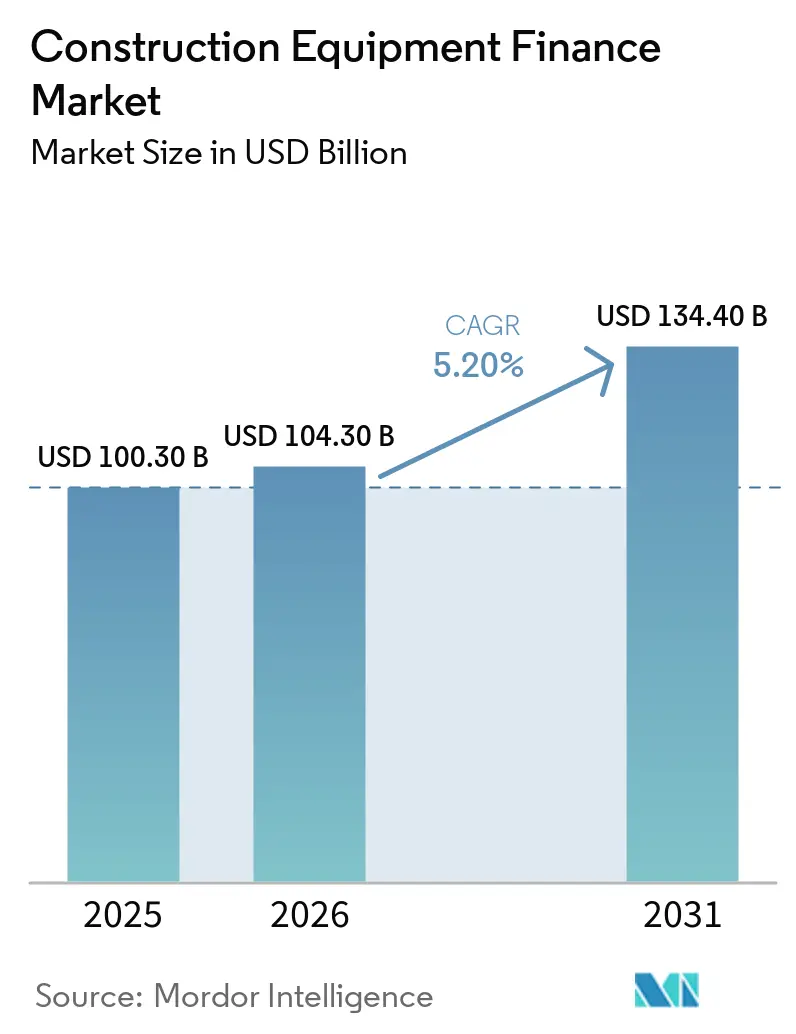
The construction equipment finance market size was valued at USD 100.3 billion in 2025 and is estimated to grow from USD 104.3 billion in 2026 to reach USD 134.4 billion by 2031, at a CAGR of 5.2% during the forecast period (2026-2031). Public infrastructure commitments support a sustained need for financed machinery because projects require large fleets before they produce cash flow. In the United States, construction machinery investment grew at an annualized 3.2% in the fourth quarter of 2025 and rose 15% year over year in March 2026, which supports equipment demand through at least the third quarter of 2026. High machine prices and contractors’ need to preserve liquidity keep financing central to procurement decisions. Lenders are also adapting products to project-based cash flows, equipment utilization data, and the increasing demand for flexible access to equipment. Competition increasingly depends on dealer reach, residual-value management, and the ability to combine financing with equipment and service support.
Key Report Takeaways
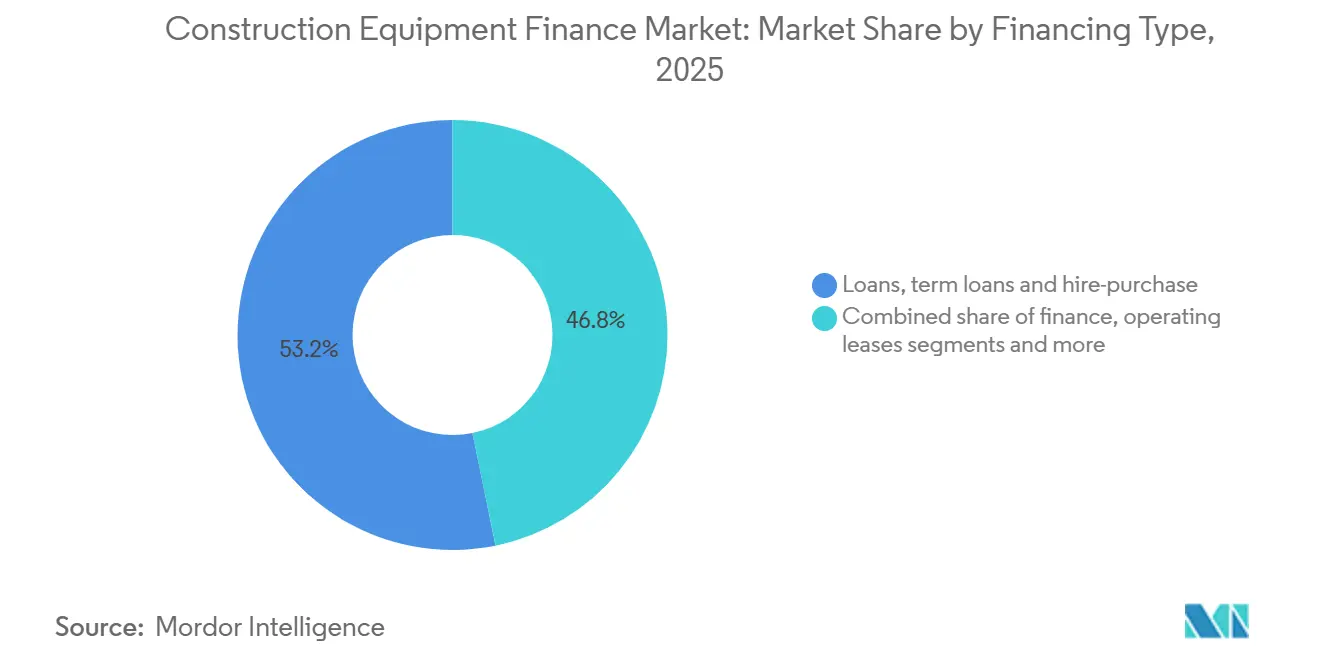
- By financing type, loans, term loans, and hire-purchase held 53.2% of the construction equipment finance market share in 2025, while operating leases recorded the highest projected CAGR at 6.9% through 2031.
- By equipment type, earthmoving equipment held 39.1% of the construction equipment finance market share in 2025, while material handling and lifting equipment recorded the highest projected CAGR at 6.1% through 2031.
- By application, infrastructure and civil engineering accounted for 31.8% of the construction equipment finance market share in 2025, while industrial, energy, and process facilities recorded the highest projected CAGR at 6.5% through 2031.
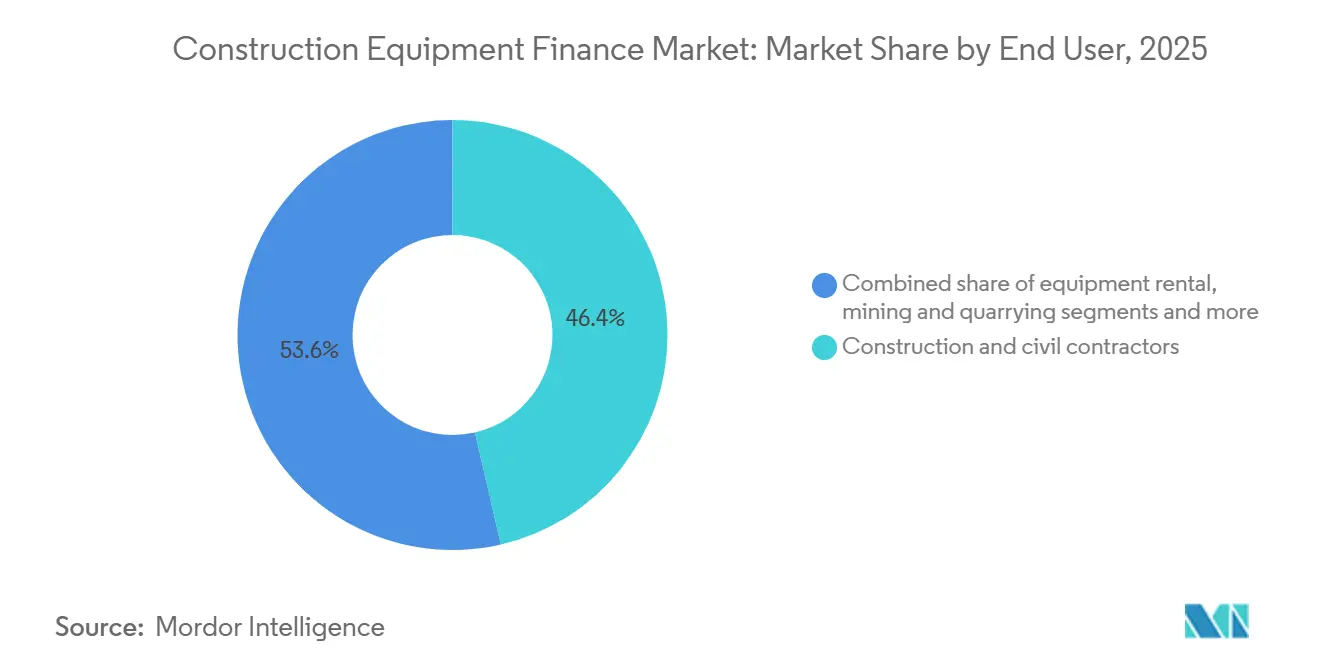
- By end user, construction and civil contractors held 46.4% of the construction equipment finance market share in 2025, while equipment rental companies recorded the highest projected CAGR at 6.6% through 2031.
- By financing provider, banks and bank-owned equipment-finance units held 47.5% of the construction equipment finance market share in 2025, while other on-balance-sheet providers recorded the highest projected CAGR at 7.2% through 2031.
Note: Market size and forecast figures in this report are generated using Mordor Intelligence’s proprietary estimation framework, updated with the latest available data and insights as of January 2026.
Global Construction Equipment Finance Market Trends and Insights
Drivers Impact Analysis*
| Driver | (~) % Impact on CAGR Forecast | Geographic Relevance | Impact Timeline |
|---|---|---|---|
| Infrastructure And Construction Investment | +1.8% | Global, with concentration in Asia-Pacific, North America, and the Middle East | Long term (≥ 4 years) |
| High Equipment Costs And Liquidity Preservation | +1.2% | Global, particularly South America, Southeast Asia, and Africa | Medium term (2-4 years) |
| Asset-Light And Flexible Equipment Access | +1.0% | North America and Europe, with momentum in Asia-Pacific | Medium term (2-4 years) |
| OEM-Captive, Dealer, And Embedded Finance | +0.8% | Global, with depth in North America, Europe, and Japan | Short term (≤ 2 years) |
| Digital And Telematics-Enabled Finance | +0.6% | North America and Europe, followed by Asia-Pacific | Medium term (2-4 years) |
| Equipment Replacement, Fleet Modernization And Electrification | +0.5% | North America, Europe, and Asia-Pacific, with growing relevance in the Middle East | Long term (≥ 4 years) |
| Source: Mordor Intelligence | |||
Infrastructure and Construction Investment Driving Equipment Acquisition
Public infrastructure commitments remain a major source of demand for the construction equipment finance market. Large public projects require machinery purchases or leases before contractors receive project revenue. The Equipment Leasing and Finance Association stated that construction machinery investment grew 3.2% annualized in the fourth quarter of 2025. It also reported a 15% year-over-year increase in March 2026, with momentum expected through at least the third quarter of 2026. Morocco front-loaded infrastructure spending equal to 11.9% of 2024 GDP for connectivity and tourism investment through 2030[1]International Monetary Fund, “Macroeconomic Impact of Accelerating Public Infrastructure: Morocco Case Study,” International Monetary Fund, elibrary.imf.org. Such programs create recurring financing opportunities and can support longer repayment terms when equipment works on projects backed by sovereign capital.
High Equipment Acquisition Costs and Contractor Liquidity Preservation
Higher equipment costs make cash purchases less practical for many contractors and support the use of the construction equipment finance market. The Equipment Leasing and Finance Association found that 85% of construction end users used equipment finance as their primary procurement route in 2025. This was the highest proportion among the end-user sectors tracked in the survey. Cash-flow optimization was the leading reason for financing, cited by 62% of end users. Protection from obsolescence and tax advantages followed at 55% and 51%, respectively[2]Equipment Leasing and Finance Association, “Fact Sheet: Equipment Finance in the Construction Industry,” Equipment Leasing and Finance Association, elfaonline.org. Larger financed ticket sizes can raise revenue per transaction even when the number of transactions grows slowly.
Shift Toward Asset-Light, Flexible and Project-Aligned Equipment Access
The shift from equipment ownership toward use-based access is changing product demand in the construction equipment finance market. BNP Paribas Leasing Solutions reported that 31% of European construction leaders used leasing as their main capital-expenditure financing model in its December 2025 survey. Operating leases let contractors return equipment after a project or replace it when requirements change. This flexibility is valuable when utilization and project schedules are uncertain. It also shifts residual-value exposure from the customer to the finance provider. Providers with remarketing capabilities and secondary-market knowledge are therefore better positioned to offer these structures at scale.
Expansion of OEM-Captive, Dealer and Embedded Equipment Finance
OEM-captive finance providers are extending their role from promotional funding to lifecycle finance in the construction equipment finance market. Caterpillar Financial reported loans and finance leases with an average original term of 51 months in its first-quarter 2026 SEC filing. The company also renewed a USD 3.5 billion revolving credit facility in August 2025, supporting global equipment origination. Dealer-based finance allows customers to arrange machinery, service, and funding at the point of sale. This can be more convenient than a separate bank process. Independent providers are responding by seeking vendor relationships that give them access to dealer networks and equipment-specific information.
Restraints Impact Analysis*
| Restraint | (~) % Impact on CAGR Forecast | Geographic Relevance | Impact Timeline |
|---|---|---|---|
| High Financing Costs And Contractor Credit Risk | -0.7% | Global, particularly North America and Europe | Short term (≤ 2 years) |
| Used-Equipment Residual-Value and Liquidity Risk | -0.4% | Global, with amplified risk in South America, Southeast Asia, and Africa | Medium term (2-4 years) |
| Equipment Obsolescence and Technology Uncertainty | -0.3% | North America and Europe | Long term (≥ 4 years) |
| Fragmented Asset Data and Telematics Constraints | -0.2% | Emerging Asia-Pacific and Africa | Medium term (2-4 years) |
| Source: Mordor Intelligence | |||
High Financing Costs and Contractor Credit Risk
Elevated funding costs can reduce deal conversion in the construction equipment finance market even when equipment demand remains firm. The June 2026 CapEx Finance Index reported year-to-date new business volume growth of 11.3%[3]Equipment Leasing and Finance Association, “ELFA CapEx Finance Index: June 2026,” Equipment Leasing and Finance Association, elfaonline.org. The association also identified the cost of funds as the primary industry risk during the second half of 2026. Smaller contractors are especially exposed because their revenue depends on project timing and their equity buffers can be limited. Rate-sensitive borrowers may face pressure when project margins narrow. Credit-quality requirements can therefore limit originations among smaller businesses, even though this customer group creates substantial equipment demand.
Used-Equipment Residual-Value and Secondary-Market Liquidity Risk
Residual-value uncertainty can reduce profitability across lease and loan portfolios in the construction equipment finance market. The risk is highest for operating leases because the lessor retains the equipment when a contract ends. A material difference between assumed and realized residual value can remove the expected margin on a transaction. The risk increases when secondary-market liquidity weakens, or used-equipment values fall quickly. Technology changes can also make older machines less attractive and make future resale values harder to forecast. Fragmented telematics data in emerging markets further limits reliable asset monitoring and can make credit decisions less certain.
*Our forecasts treat driver/restraint impacts as directional, not additive. The impact forecasts reflect baseline growth, mix effects, and variable interactions.
Segment Analysis
By Financing Type: Ownership Structures Continue to Meet Different Contractor Needs
Loans, term loans, and hire-purchase represented 53.2% of the construction equipment finance market share in 2025. These products remain familiar to lenders and provide clear ownership transfer to contractors. Larger contractors often use them to place equipment on their balance sheets. Secured loans and lines of credit together accounted for 30% of equipment acquisition financing methods, according to the Equipment Leasing and Finance Association. Finance leases and capital leases provide another route for organizations that want balance-sheet recognition while maintaining defined asset terms. Government bodies and major infrastructure contractors use these structures when procurement policy and accounting treatment require predictable commitments.
Operating leases are forecast to expand at a 6.9% CAGR through 2031, the highest rate among financing types. The construction equipment finance market size for this format benefits from contractors seeking return options at the end of a project. Leasing was the dominant capital-expenditure model for 31% of European construction leaders surveyed by BNP Paribas Leasing Solutions. Operating leases require strong residual-value assessment and remarketing capability. Revolving and fleet facilities serve a narrower but growing role among large rental fleets. These facilities provide flexible credit availability that can track changes in equipment demand and project pipelines. The mix of products allows borrowers to select ownership, usage, and repayment structures that match their operating needs.



By Equipment Type: Earthmoving Holds the Largest Position While Lifting Demand Rises
Earthmoving equipment accounted for 39.1% of the construction equipment finance market share in 2025. Excavators, dozers, graders, and loaders are needed for road building, site preparation, rail work, and urban development. Their broad use supports both origination activity and lender confidence in collateral. Construction equipment ranked first in financing appetite for the 12th consecutive year in a 2026 survey of finance professionals. Earthmoving assets tend to have established resale channels, which helps support underwriting decisions. Their role across project types also limits reliance on one construction application.
Material handling and lifting equipment is forecast to grow at a 6.1% CAGR through 2031. The construction equipment finance market size for this category is supported by vertical urban construction, logistics facilities, and offshore wind projects. Tower cranes meet the needs of taller buildings and constrained sites. Automated lifting systems support equipment requirements at e-commerce fulfillment centers. Heavy marine lifting equipment is needed for offshore wind installation. Roadbuilding and compaction equipment follow transport infrastructure cycles, while concrete equipment is more exposed to building activity. Specialized equipment, including tunnel-boring machines and lifting rigs, usually requires bespoke finance because of high ticket values and project-specific use.
By Application: Infrastructure Provides the Base for Equipment Demand
Infrastructure and civil engineering accounted for 31.8% of the construction equipment finance market share in 2025. Government budgets make this application an important source of long-duration machinery demand. Transport projects require extensive earthmoving, paving, lifting, and material-handling equipment. Public programs can also support more predictable project schedules than private building cycles. This gives lenders a clearer basis for evaluating fleet utilization and repayment capacity. Civil projects continue to anchor finance demand across roads, railways, ports, and urban infrastructure.
Industrial, energy, and process facilities are forecast to grow at a 6.5% CAGR through 2031. Energy infrastructure and data-center construction add demand for specialized construction fleets. Building construction remains an important complementary application, but it is more sensitive to residential and commercial cycles. Mining and quarrying finance follows commodity prices and capital-expenditure decisions by mining companies. These projects often use longer terms and larger financing amounts because the equipment operates for extended periods. Mixed and multi-application fleets are increasingly financed through revolving facilities or master leases. A single facility can cover several machinery categories across concurrent projects and reduce administration for the borrower and lender.
By End User: Contractors Lead While Rental Companies Gain Momentum
Construction and civil contractors held 46.4% of the construction equipment finance market share in 2025. Their financing requirements depend on project revenue, fleet utilization, and balance-sheet capacity. The group includes large contractors as well as regional small and medium-sized businesses. This diversity creates demand for loans, long-term leases, and project-specific equipment arrangements. Contractors may finance owned fleets for recurring work and lease machinery for temporary needs. Their central role makes contractor credit performance important to the wider construction equipment finance market.
Equipment rental companies are forecast to grow at a 6.6% CAGR through 2031. Their expansion reflects a wider move toward access to equipment without permanent ownership. Rental providers are finance customers because they acquire and refresh fleets. They also compete with bank and captive finance channels for smaller contractors that choose to rent instead of buy. Mining and quarrying companies require longer terms and higher-ticket structures because machinery is capital-intensive and has a long operating life. Government and municipal users use lease finance to preserve budget flexibility. Industrial and other owner-operators increasingly seek finance tied to electrification and emissions requirements.
By Financing Provider: Banks Retain Scale as Other Providers Extend Their Role
Banks and bank-owned equipment-finance units accounted for 47.5% of the construction equipment finance market in 2025. Their position reflects lower funding costs, established credit processes, and long-standing contractor relationships. Bank of America Global Leasing reported USD 17.4 billion in new business volume in 2025. Wells Fargo Equipment Finance reported USD 12.1 billion, while BMO Financial Group reported more than USD 5 billion. These figures show the scale of the leading bank-affiliated providers. Banks remain important where customers value broad credit capacity and familiar financing relationships.
Other on-balance-sheet providers are forecast to expand at a 7.2% CAGR through 2031. The construction equipment finance market size for these providers reflects interest in long-duration, asset-backed income. This group includes insurance companies, pension funds, and sovereign wealth funds. OEM-captive providers use point-of-sale access, promotional rates, and residual-value knowledge to compete with banks. Independent lessors, NBFCs, and specialty finance companies serve used equipment and borrowers that do not fit bank credit criteria. The July 2026 CapEx Finance Index reported USD 14.3 billion in seasonally adjusted new equipment deal volume, the highest monthly volume in its history. The range of providers gives borrowers more choices but makes distribution access and risk expertise more important competitive factors.
Geography Analysis
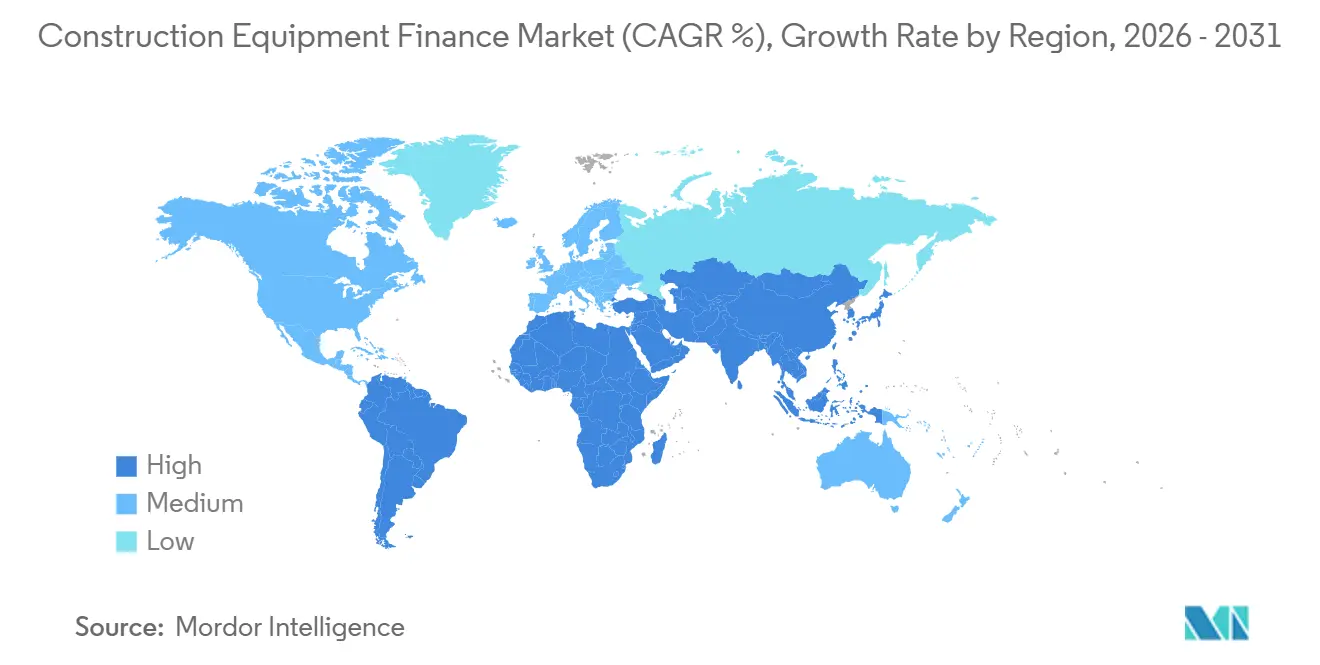
Asia-Pacific held 39.6% of the global construction equipment finance market share in 2025. China and India remain the region’s main demand centers because both support large infrastructure programs. China’s state-led investment cycle creates concentrated equipment-finance origination opportunities. India’s National Infrastructure Pipeline supports procurement for roads, railways, and urban development. ICBC Financial Leasing supports financing across engineering machinery, port equipment, and railway infrastructure assets. Southeast Asian countries, including Indonesia, Vietnam, Malaysia, and Thailand, are emerging centers for equipment-finance activity. Japan recorded steadier demand from urban renewal and disaster-resilience projects. Japan Bank for International Cooperation provided USD 14.3 million within a USD 23.8 million syndicated facility to PT. SMFL Leasing Indonesia in 2025 for construction equipment leasing.
North America and Europe account for substantial construction equipment finance volume because financing penetration and fleet replacement needs are high. The United States has a mature credit infrastructure and a large installed machinery base. Construction equipment remained the third-largest equipment category by new business volume. In Europe, established leasing frameworks support use-based access to machinery. Groupe BPCE created BPCE Equipment Solutions after acquiring Société Générale Equipment Finance in the first quarter of 2025[4]Groupe BPCE, “The Creation of BPCE Equipment Solutions Makes BPCE the European Leader and a Major Global Player in the Equipment Leasing Market,” Groupe BPCE, newsroom-en.groupebpce.fr. South America remains smaller, with demand linked to commodity investment and infrastructure stimulus, while currency risk and credit availability can constrain access.
The Middle East and Africa recorded the fastest projected regional CAGR at 6.8% through 2031. Saudi Arabia and the UAE support equipment demand through large construction programs and infrastructure investment. These programs create demand for specialized equipment and related financing structures. The region also has a distinct Shariah-compliant finance channel, including Ijarah-based leasing. This channel shapes product design and lender eligibility for equipment procurement. Al Rajhi Bank offers an equipment-finance program for business customers in Saudi Arabia. The construction equipment finance market share in this region remains below that of the Asia-Pacific region, but the project pipeline supports higher growth. Regional providers must combine conventional and Shariah-compliant products to address different customer needs.

Competitive Landscape
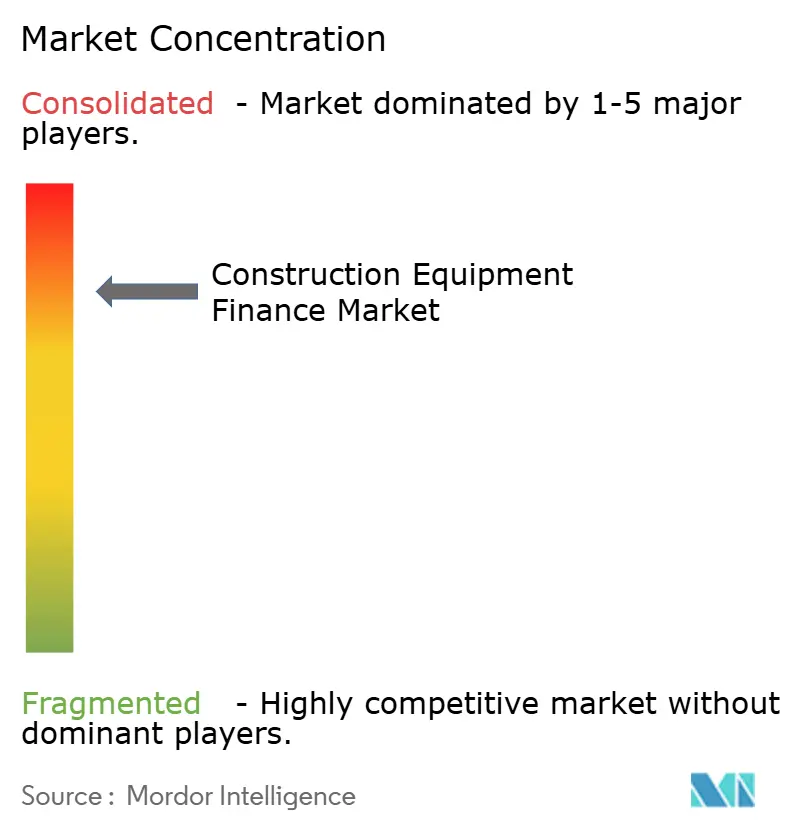
The construction equipment finance market is consolidated among leading global institutions and regional banks, NBFCs, and specialty lessors. Banks retain the largest provider position because of their funding capacity and established contractor relationships. OEM-captive finance arms have an advantage in operating leases because they can connect equipment sales, service, resale, and finance. They can also use asset knowledge to manage residual-value exposure. Regional providers remain relevant because they serve smaller contractors and localized credit needs. This structure leaves room for both large-scale providers and specialist lenders.
Groupe BPCE created BPCE Equipment Solutions after its first-quarter 2025 acquisition of Société Générale Equipment Finance. The combined business had a professional equipment loan portfolio of nearly EUR 15 billion. The transaction strengthened its position in European equipment leasing. DLL Group formalized a strategic partnership with the Committee for European Construction Equipment in June 2026. The partnership gives DLL direct engagement with construction OEMs, dealers, and distributors in Europe. Caterpillar Financial’s renewed USD 3.5 billion credit facility also demonstrates the balance-sheet support available to major captive providers.
Digital origination and telematics are becoming important points of differentiation in the construction equipment finance market. Equipment data can support the monitoring of utilization and operating conditions. This may improve underwriting when finance terms reflect how machinery is used. The most relevant opportunities include finance for electric and low-emission equipment, flexible repayment for smaller contractors, and used-equipment finance. Volvo Financial Services and Volvo Penta introduced a 7-year bundled lease structure for electric off-highway vehicles in April 2026. DFDS became the first customer, leasing 6 electric RoRo tractors for delivery in the Netherlands during the second quarter of 2026. These structures can reduce upfront cost barriers while giving providers a role in managing technology and resale risks.
Construction Equipment Finance Industry Leaders
Caterpillar Financial Services (Cat Financial)
Deere & Company / John Deere Financial
Komatsu Financial
Wells Fargo Equipment Finance
BNP Paribas Leasing Solutions
- *Disclaimer: Major Players sorted in no particular order

Recent Industry Developments
- July 2026: ELFA’s CapEx Finance Index for July 2026 recorded seasonally adjusted new equipment deal volumes of USD 14.3 billion, the highest monthly volume in ELFA history.
- June 2026: DLL Group formalized a strategic partnership with the Committee for European Construction Equipment, strengthening its engagement with manufacturers and dealers across Europe.
- April 2026: Volvo Penta and Volvo Financial Services announced a 7-year bundled lease structure for electric off-highway vehicles. DFDS became the first customer, leasing 6 MOL RME225 electric RoRo tractors for delivery in the Netherlands during the second quarter of 2026.
- March 2026: Mitsubishi HC Capital Inc. entered a capital and business alliance with DENZAI K.K. to expand financing for large cranes and develop asset-operation models.


Global Construction Equipment Finance Market Report Scope
The construction equipment finance market covers loans, leases, hire-purchase arrangements, and other financing solutions that enable contractors, construction companies, and equipment operators to acquire new or used machinery such as excavators, loaders, cranes, and earthmoving equipment. It helps customers reduce upfront capital requirements, preserve liquidity and align equipment payments with project cash flows, while financing providers generate returns through interest, lease payments and equipment-related services.
The Global Construction Equipment Finance Market is Segmented by Financing Type (Loans, Finance Leases, and More), Equipment Type (Earthmoving, Material Handling, and More), Application (Building, Infrastructure, and More), End User (Contractors, Rental Companies, and More), Financing Provider (Banks, OEM-Captive, and More), and Geography. Market Forecasts are Provided in Terms of Value (USD).
| Loans, Term Loans and Hire-Purchase |
| Finance Leases / Capital Leases |
| Operating Leases |
| Revolving And Fleet Facilities |
| Earthmoving Equipment |
| Material Handling and Lifting Equipment |
| Roadbuilding and Compaction Equipment |
| Concrete Equipment |
| Other Specialized Equipment |
| Building Construction |
| Infrastructure and Civil Engineering |
| Mining and Quarrying |
| Industrial, Energy and Process Facilities |
| Mixed / Multi-Application Fleets |
| Construction and Civil Contractors |
| Equipment Rental Companies |
| Mining and Quarrying Companies |
| Government and Municipal Entities |
| Industrial, Energy and Other Owner-Operators |
| Banks and Bank-Owned Equipment-Finance Units |
| OEM-Captive Finance Companies |
| Independent Lessors, NBFCs and Specialty Finance Companies |
| Other On-Balance-Sheet Providers |
| North America | United States |
| Canada | |
| Mexico | |
| South America | Brazil |
| Argentina | |
| Rest of South America | |
| Europe | United Kingdom |
| Germany | |
| France | |
| Italy | |
| Spain | |
| Rest of Europe | |
| Asia-Pacific | China |
| Japan | |
| India | |
| South Korea | |
| Australia | |
| Indonesia | |
| Thailand | |
| Malaysia | |
| Singapore | |
| Vietnam | |
| Rest of Asia-Pacific | |
| Middle East and Africa | Saudi Arabia |
| United Arab Emirates | |
| Turkey | |
| South Africa | |
| Egypt | |
| Rest of Middle East and Africa |
| By Financing Type | Loans, Term Loans and Hire-Purchase | |
| Finance Leases / Capital Leases | ||
| Operating Leases | ||
| Revolving And Fleet Facilities | ||
| By Equipment Type | Earthmoving Equipment | |
| Material Handling and Lifting Equipment | ||
| Roadbuilding and Compaction Equipment | ||
| Concrete Equipment | ||
| Other Specialized Equipment | ||
| By Application | Building Construction | |
| Infrastructure and Civil Engineering | ||
| Mining and Quarrying | ||
| Industrial, Energy and Process Facilities | ||
| Mixed / Multi-Application Fleets | ||
| By End User | Construction and Civil Contractors | |
| Equipment Rental Companies | ||
| Mining and Quarrying Companies | ||
| Government and Municipal Entities | ||
| Industrial, Energy and Other Owner-Operators | ||
| By Financing Provider | Banks and Bank-Owned Equipment-Finance Units | |
| OEM-Captive Finance Companies | ||
| Independent Lessors, NBFCs and Specialty Finance Companies | ||
| Other On-Balance-Sheet Providers | ||
| By Geography | North America | United States |
| Canada | ||
| Mexico | ||
| South America | Brazil | |
| Argentina | ||
| Rest of South America | ||
| Europe | United Kingdom | |
| Germany | ||
| France | ||
| Italy | ||
| Spain | ||
| Rest of Europe | ||
| Asia-Pacific | China | |
| Japan | ||
| India | ||
| South Korea | ||
| Australia | ||
| Indonesia | ||
| Thailand | ||
| Malaysia | ||
| Singapore | ||
| Vietnam | ||
| Rest of Asia-Pacific | ||
| Middle East and Africa | Saudi Arabia | |
| United Arab Emirates | ||
| Turkey | ||
| South Africa | ||
| Egypt | ||
| Rest of Middle East and Africa | ||


Key Questions Answered in the Report
What is the forecast growth rate for construction equipment finance?
The sector is forecast to grow at a 5.2% CAGR from 2026 to 2031, reaching USD 134.4 billion by 2031.
Which financing structure is growing fastest?
Operating leases are projected to expand at a 6.9% CAGR through 2031 as contractors seek greater equipment flexibility.
Which equipment category attracts the most financing?
Earthmoving equipment held 39.1% of 2025 financing value because it is required across major project types.
Why do contractors use equipment finance?
Cash-flow optimization was the leading reason, cited by 62% of end users, while 85% used finance as their main procurement route in 2025.
Which region is expected to grow fastest through 2031?
The Middle East and Africa is forecast to grow at a 6.8% CAGR, supported by large infrastructure and construction programs.
Which providers lead equipment financing?
Banks and bank-owned units held 47.5% of 2025 value, while other on-balance-sheet providers are forecast to grow fastest at 7.2% CAGR.
Page last updated on:


 Your data is secure and never sold or shared.


