
Concrete Market Size and Share
Market Overview
| Study Period | 2021 - 2031 |
|---|---|
| Market Size (2026) | USD 537.97 Billion |
| Market Size (2031) | USD 677.81 Billion |
| Growth Rate (2026 - 2031) | 4.73 % |
| Fastest Growing Market | Asia-Pacific |
| Largest Market | Asia-Pacific |
| Market Concentration | Low |
Major Players *Disclaimer: Major Players sorted in no particular order Image © Mordor Intelligence. Reuse requires attribution under CC BY 4.0. | |
Concrete Market Analysis by Mordor Intelligence
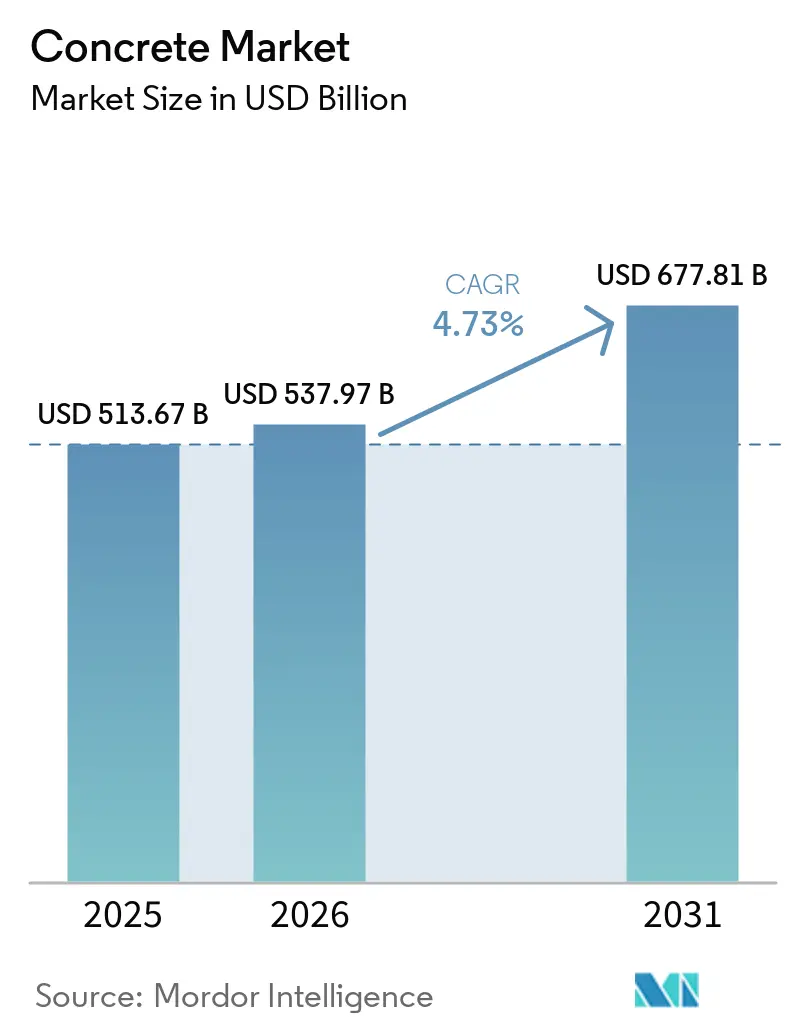
The Concrete Market size was valued at USD 513.67 billion in 2025 and is estimated to grow from USD 537.97 billion in 2026 to reach USD 677.81 billion by 2031, at a CAGR of 4.73% during the forecast period (2026-2031). The concrete market is supported by public investment in transport, utilities, and other long-lived assets that require large concrete volumes. Factory-produced formats are becoming more important because they improve batch consistency and reduce work at construction sites. Reinforced applications remain central to projects that need dependable structural performance, including energy facilities, transport corridors, and tall buildings. Producers are also moving toward higher-grade formulations for infrastructure and industrial projects. Carbon rules, volatile input costs, and the limited delivery radius of ready-mix operations will continue to shape where the concrete market can grow profitably.
Key Report Takeaways
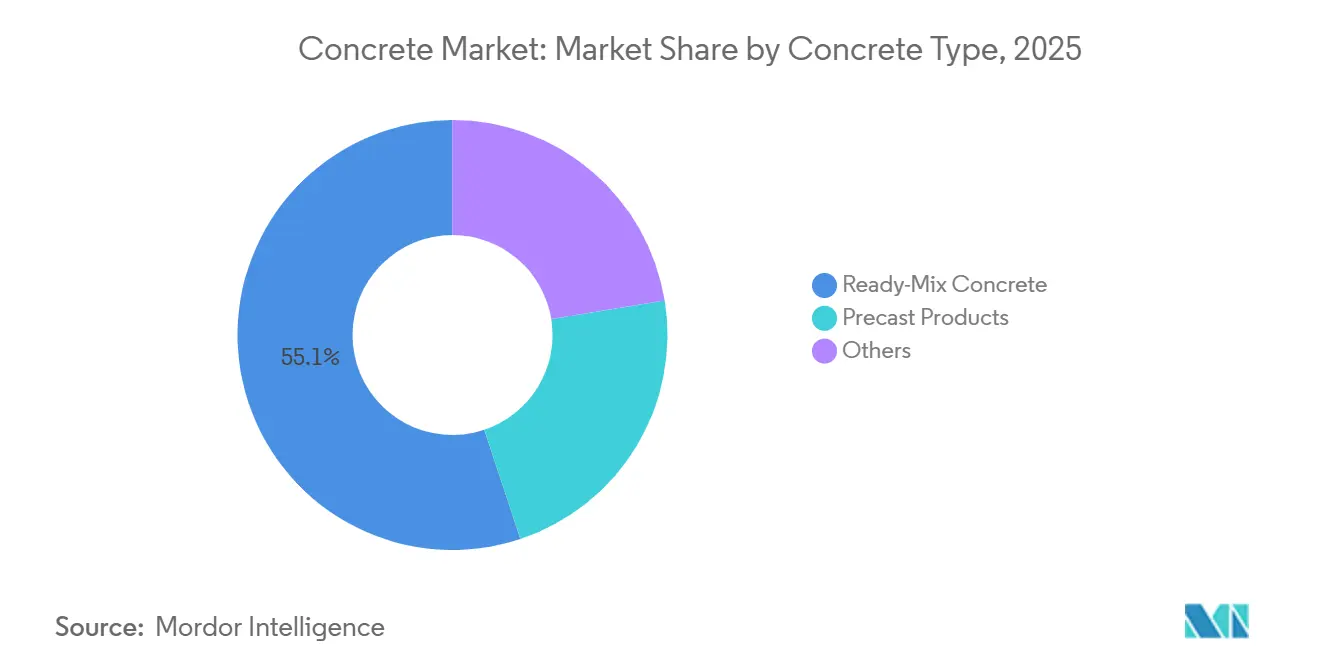
- By concrete type, ready-mix concrete held 55.13% of the concrete market share in 2025, while precast products are projected to advance at a 5.24% CAGR through 2031.
- By application, reinforced concrete held 71.45% of the concrete market share in 2025 and is projected to advance at a 5.53% CAGR through 2031.
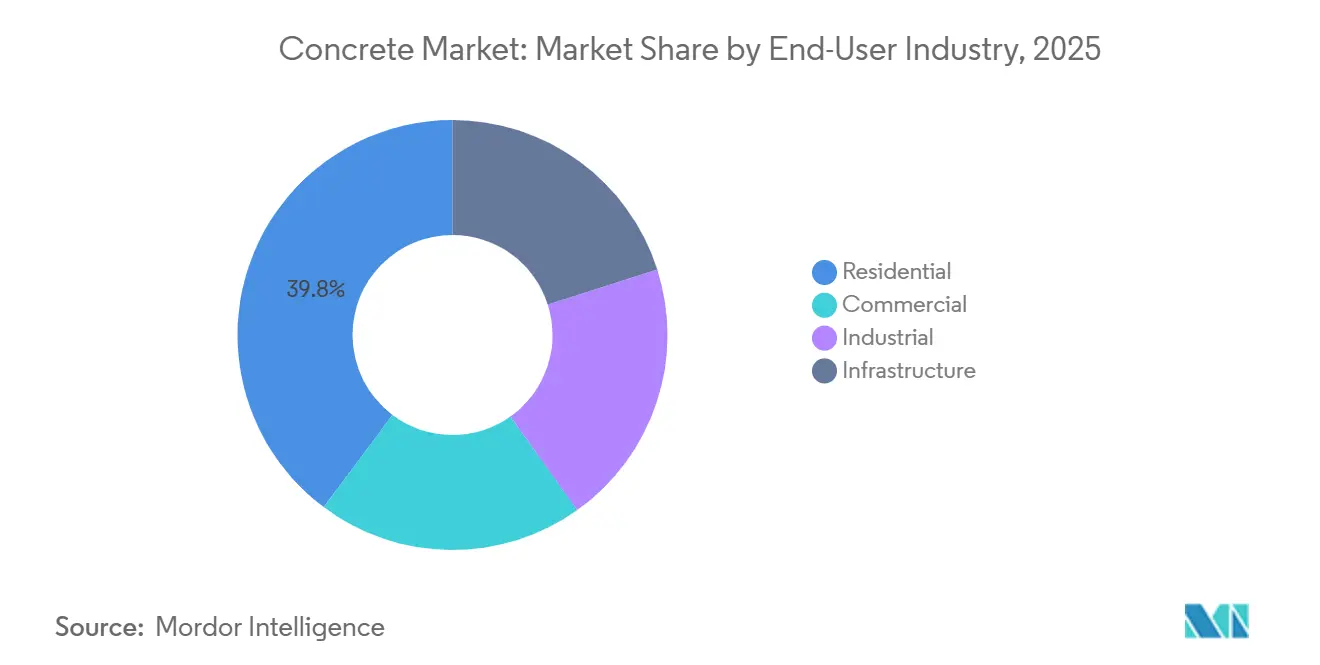
- By end-user industry, residential held 39.77% of the concrete market share in 2025, while industrial is projected to advance at a 5.66% CAGR through 2031.
- By geography, Asia-Pacific held 40.38% of the concrete market share in 2025 and is projected to advance at a 5.32% CAGR through 2031.
Note: Market size and forecast figures in this report are generated using Mordor Intelligence’s proprietary estimation framework, updated with the latest available data and insights as of January 2026.
Global Concrete Market Trends and Insights
Drivers Impact Analysis*
| Driver | (~) % Impact on CAGR Forecast | Geographic Relevance | Impact Timeline |
|---|---|---|---|
| Global Infrastructure and Transport Investment | +1.8% | Global, concentrated in Asia-Pacific, North America, and Middle East | Long term (≥ 4 years) |
| Urban Housing and Commercial Construction Demand | +1.4% | Asia-Pacific core, spillover to MEA and South America | Medium term (2–4 years) |
| Precast and Ready-Mix Productivity Benefits | +0.9% | Global | Medium term (2–4 years) |
| Low-Carbon Construction and Supplementary Cementitious Materials | +0.6% | EU core, spillover to North America and APAC | Long term (≥ 4 years) |
| Resilient Infrastructure and Extreme-Weather Adaptation | +0.4% | Asia-Pacific, Gulf MEA, North America Gulf Coast | Long term (≥ 4 years) |
| Source: Mordor Intelligence | |||
Global Infrastructure and Transport Investment
Government commitments to infrastructure modernization are establishing a multi-year base of demand for the concrete market. Long-term public investment programs are supporting transport, utilities, and other concrete-intensive assets. Roads, railways, ports, and power installations require concrete throughout construction and maintenance cycles. A 4-lane highway kilometer can require 10,000 to 12,000 cubic meters of concrete, which shows the material intensity of transport programs. Freight corridors, high-speed rail, and port development remain concrete-intensive parts of national infrastructure programs. Infrastructure investment in Brazil continues to support construction activity across transport and utility projects.
Urban Housing and Commercial Construction Demand
Urban growth is sustaining demand for residential and commercial construction across Asia, the Middle East, and sub-Saharan Africa. Concrete suppliers increasingly serve this demand through batching networks rather than site-mixed production. Affordable housing in smaller cities creates opportunities where ready-mix delivery networks are still limited. This favors suppliers with dense plant networks because long delivery distances can affect cost and service reliability. Data centers also require high-performance concrete that can meet vibration, thermal-load, and chemical-resistance requirements, which supports demand for technically advanced mixes.
Precast and Ready-Mix Productivity Benefits
Factory-produced formats are gaining importance in the concrete market because they reduce on-site labor needs and shorten construction schedules. Precast panels can save weeks on commercial multi-story projects, which can lower financing and overhead costs for developers. Ready-mix concrete gives contractors consistent mix design, predictable pour timing, and reduced dependence on site labor. Digital tools are also improving batch accuracy and reducing waste at project sites. Three-dimensional printed concrete remains a niche application, but it broadens the use of concrete in specialized architectural work.
Low-Carbon Construction and Supplementary Cementitious Materials
The concrete market is adapting to requirements for lower embodied carbon in public procurement and corporate reporting. Calcination accounts for nearly 60% of cement production's carbon footprint, so renewable electricity alone cannot remove this source of emissions[1]International Energy Agency, “Cement and Concrete,” Breakthrough Agenda Report 2025, iea.org. Supplementary cementitious material formulations can reduce carbon dioxide emissions by 15% to 50% compared with ordinary Portland cement systems. Ground granulated blast-furnace slag and fly ash combinations can achieve reductions of up to 61% at high replacement levels. Rice husk ash showed an average 28-day strength ratio of 1.16 against ordinary Portland cement at 20% replacement in a 2026 review. Producers that can reformulate at scale may be better placed to meet changing specifications without relying only on carbon capture technologies.
Restraints Impact Analysis*
| Restraint | (~) % Impact on CAGR Forecast | Geographic Relevance | Impact Timeline |
|---|---|---|---|
| Cement-Related Carbon Compliance Costs | -0.8% | EU core (EU ETS, CBAM), with cost-pass-through pressure on North America and APAC exporters | Long term (≥ 4 years) |
| Volatility in Energy, Aggregates and Admixture Costs | -0.6% | Global | Short term (≤ 2 years) |
| Ready-Mix Delivery Radius and Concrete Setting Constraints | -0.4% | Global, particularly emerging-market megacities | Short term (≤ 2 years) |
| Source: Mordor Intelligence | |||
Cement-Related Carbon Compliance Costs
Carbon compliance is a major cost pressure for concrete producers that rely on clinker-intensive cement. Portland cement has an official Carbon Border Adjustment Mechanism benchmark of 0.83 tCO₂e per metric ton under EU Implementing Regulation 2025/2621. The Carbon Border Adjustment Mechanism factor is 2.5% in 2026 and is scheduled to rise to 48.5% by 2030 before full exposure in 2034[2]European Commission, “Regulation EU 2023/956 Establishing a Carbon Border Adjustment Mechanism,” Official Journal of the European Union, eur-lex.europa.eu. This trajectory can increase the cost disadvantage of high-emissions cement imports into the European Union. Large producers can spread reporting and verification costs across wider operations, while smaller suppliers may face a higher fixed-cost burden. The concrete market, therefore, has an incentive to use lower-carbon binders and improve emissions measurement. Buyers may also favor suppliers that can provide verified environmental information with the same reliability as technical performance data.
Volatility in Energy, Aggregates and Admixture Costs
Input-cost volatility limits the ability of many concrete producers to protect margins through price increases. Electricity is needed for grinding, while diesel remains important for ready-mix delivery fleets. Aggregate supply is constrained where quarry permits are limited, especially in high-demand areas of India and Southeast Asia. Higher requirements for washed and graded aggregates add pressure because high-performance concrete uses premium inputs. Superplasticizers and other chemical modifiers are exposed to changes in petrochemical feedstock prices. Integrated producers with captive quarries or long-term energy arrangements have more protection than standalone local operators.
*Our forecasts treat driver/restraint impacts as directional, not additive. The impact forecasts reflect baseline growth, mix effects, and variable interactions.
Segment Analysis
By Concrete Type: Ready-Mix Concrete Anchors Delivery Networks, While Precast Products Drive Margin Expansion
Ready-mix concrete held 55.13% of the concrete market share in 2025. Its position reflects the value of centralized batching for consistent mix design and accurate pour timing. The format also reduces on-site labor requirements, which matter in dense urban projects with limited working space. Contractors use ready-mix to avoid the quality variation associated with site-mixed materials. The concrete market size for ready-mix benefits from broad use in residential, commercial, and infrastructure work. Delivery constraints still create a local competitive structure because suppliers need plants close to customers. Operators with integrated aggregate sources can improve reliability and manage input costs.
Precast products are projected to advance at a 5.24% CAGR through 2031. They are used in tunnel linings, bridge girders, modular floor slabs, and other projects where factory control can shorten construction schedules. Standardized curing and dimensional accuracy support their use in projects with strict durability requirements. The National Precast Concrete Association reported that institutional and infrastructure work offers more durable funding conditions than standard commercial construction in the United States. Factory-produced formats will compete on quality, lead time, logistics coverage, and the ability to meet project specifications. These factors are becoming more material across the concrete market as projects become more complex.



By Application: Reinforced Concrete Leads Both Market Share and Growth
Reinforced concrete held a 71.45% share of the concrete demand in 2025. It is used in foundation piles, shear walls, bridge decks, industrial slabs, and structural frames. Data centers, rail projects, energy facilities, and residential towers all depend heavily on reinforced systems. These uses require tensile performance that plain concrete cannot provide. The concrete market size for reinforced applications is supported by building codes that address seismic activity and wind loads. Japan and several Southeast Asian markets have continued to update requirements for seismic performance. Such standards can increase the amount of concrete and reinforcement required in each structural unit. The concrete market gains when resilience requirements are translated into enforceable building standards.
Non-reinforced concrete is used in road pavements, ground slabs, and mass pours where compressive strength is sufficient. It provides a stable demand across transport and general construction work. Admixture capacity investment supports performance-oriented construction demand across several regions. A 2026 study reported that 20% biomass ash replacement in reinforced formulations increased 28-day compressive strength by 29.6% compared with control mixes. This supports continued material development for reinforced applications with lower carbon content.
By End-User Industry: Residential Scale Masks Industrial Growth Velocity
Residential held a 39.77% share of global concrete demand in 2025. Housing construction across Asia-Pacific, South America, and sub-Saharan Africa absorbs substantial demand for standard-specification concrete. Residential pours generally use less technically demanding mixes than many industrial and infrastructure projects. This limits the revenue value of each cubic meter even when the total volume is large. China provided a contrasting picture because real estate investment declined 16% in January through May 2026. A balanced customer portfolio can reduce the impact of weakness in any single construction category. This balance gives concrete market suppliers a more stable demand across changing construction cycles.
Industrial is projected to advance at a 5.66% CAGR through 2031. Semiconductor plants, battery gigafactories, and liquefied natural gas storage facilities need high-specification concrete, reinforced floors, and controlled-pour conditions. These requirements can support stronger pricing than standard residential work. Infrastructure demand is also supported by government programs across Asia and the Middle East. Commercial construction sits between standard and technical work, while data centers and logistics hubs increase demand for higher-performance mixes. UltraTech Cement Ltd recorded 9.3% domestic gray cement volume growth in FY2026 despite mixed residential conditions. This shows how public infrastructure and industrial investment can support suppliers when housing demand is uneven.
Geography Analysis
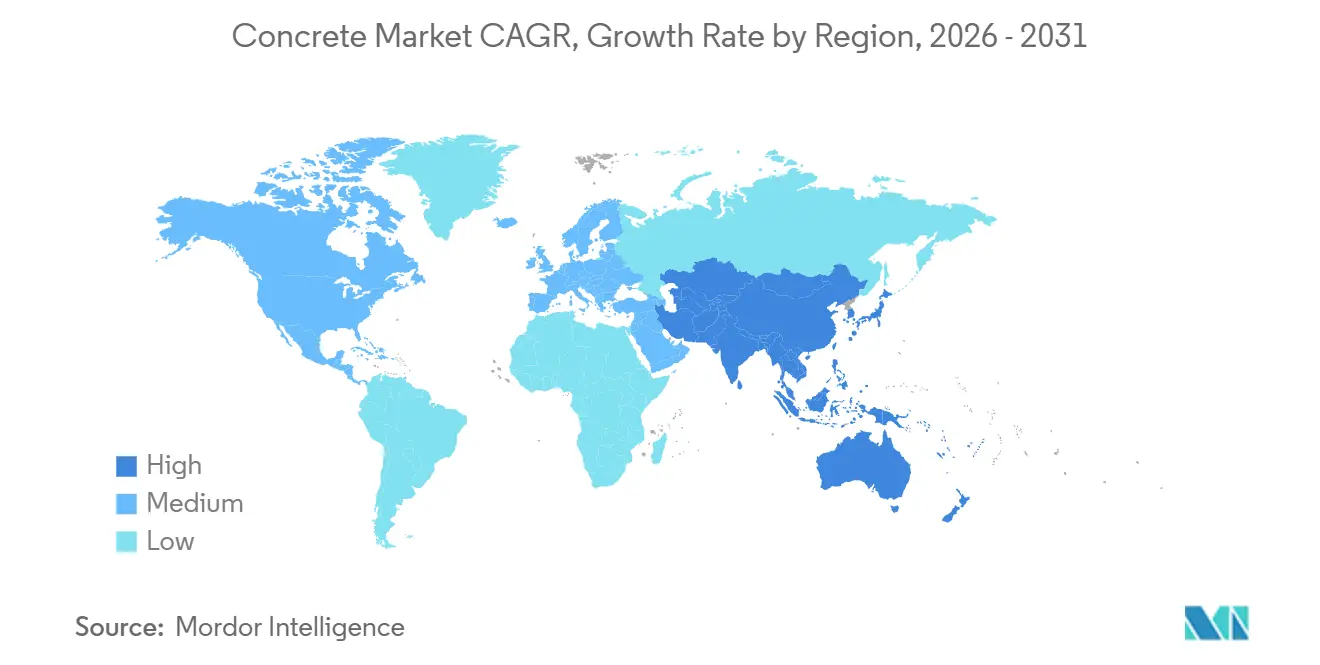
Asia-Pacific held 40.38% share of global concrete demand in 2025 and is projected to advance at a 5.32% CAGR through 2031. The region has a large pipeline of transport and power projects that need concrete-intensive construction. India is supported by freight corridors, highway awards, metro projects, and public capital expenditure. China has a stronger infrastructure demand, but its real estate investment remains weak. Japan and South Korea maintain a steady demand for high-strength and seismically rated concrete.
In North America and Europe, demand is focused on renewal and specification upgrades rather than broad greenfield construction. United States infrastructure funding supports highway rehabilitation, bridge replacement, and transit work. United States construction put in place is projected at USD 2.2 trillion in 2026, while institutional and infrastructure work has more durable funding than residential construction. HOLCIM acquired Langley Concrete Group in Canada during 2025, reflecting confidence in the region's infrastructure cycle. In France, Heidelberg Materials AG commissioned a 1.25 million metric tons annual kiln line at Airvault in May 2026 that has a 30% lower carbon footprint than prior production. European producers are balancing demand for renovation and infrastructure with rising decarbonization requirements. The concrete market in Europe depends increasingly on compliant production and renovation specifications.
South America and the Middle East and Africa have meaningful opportunities, although investment timing differs across countries. Brazil remains an active construction market, with infrastructure investment supporting demand. HOLCIM completed its acquisition of a majority stake in Cementos Pacasmayo in Peru during March 2026. It also agreed to acquire Colombian building materials and solutions operations from CEMEX during the same month. Saudi Arabia's Vision 2030 projects are creating demand for high-specification concrete, while the United Arab Emirates supports commercial and industrial consumption. Project financing and fragmented procurement can slow delivery across other parts of the region. Suppliers operating across these markets must match production capacity with local contract pipelines and transport access. This makes reliable aggregates supply and plant location as important as headline project spending. High-specification work can improve product value, but it also requires trained teams and careful control over mix performance.

Competitive Landscape
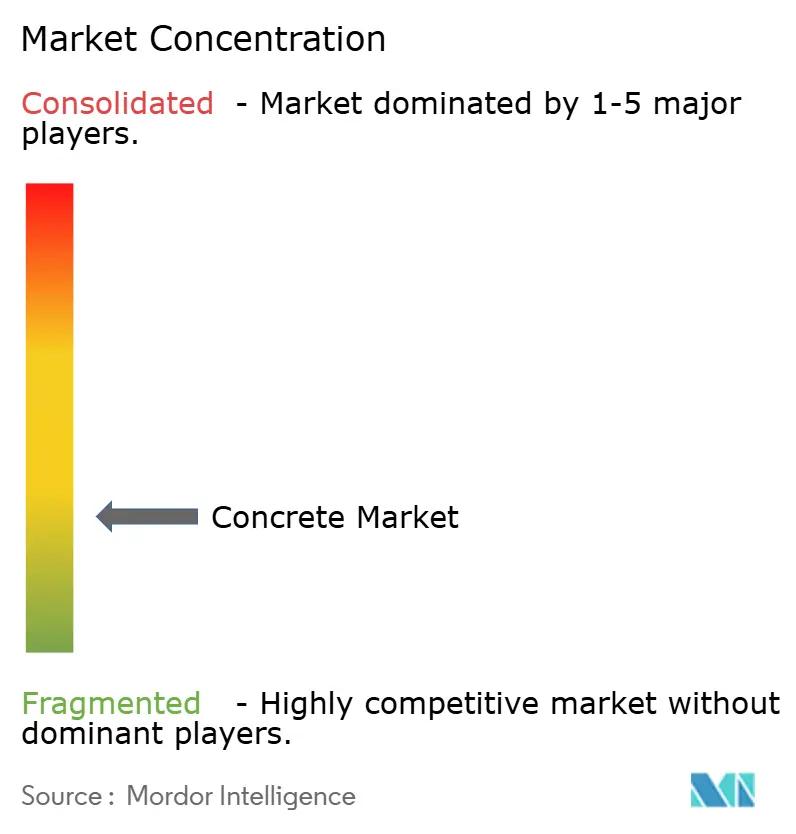
The concrete market is lowly concentrated, with the top five players including China National Building Material Group Co., Ltd., CEMEX S.A.B. de C.V., HOLCIM, CRH, and Heidelberg Materials AG. Local operators often compete on price, plant proximity, and delivery reliability within narrow areas. This local structure prevents the concrete market from becoming fully concentrated despite global acquisitions. HOLCIM completed the acquisition of Xella in June 2026, adding walling and insulation brands to its building-solutions portfolio. CRH announced an agreement to acquire Arcosa for USD 8.5 billion in June 2026, expanding its position in the United States aggregates and critical infrastructure products. These moves show that large companies are seeking connected materials portfolios rather than relying only on standard concrete sales.
Competition is increasingly shaped by technical capability as construction specifications become more demanding. UltraTech Cement Ltd reached 205.5 million metric tons per annum of global manufacturing capacity in April 2026, making it the largest cement producer outside China. China National Building Material Group Co., Ltd. also benefits from scale and domestic procurement relationships. Sika AG focuses on admixtures that support high-performance and reinforced concrete applications. Producers that own quarries, cement plants, and ready-mix networks can manage input availability and delivery logistics more effectively. Mobile and volumetric concrete systems may serve urban areas where traditional ready-mix plants cannot reach sites efficiently. These gaps can create room for specialized suppliers without changing the local nature of ready-mix competition.
Lower-carbon products are becoming another source of differentiation in the concrete market. Heidelberg Materials AG is advancing carbon capture projects and commercializing its evoZero near-zero cement product from the Brevik facility. The catch4climate consortium inaugurated a Pure Oxyfuel carbon dioxide capture kiln at Mergelstetten in July 2026. The consortium includes Buzzi S.p.A., Heidelberg Materials AG, Vicat, and SCHWENK. These investments aim to meet demand for materials with lower carbon intensity while carbon capture costs remain high. Companies will still need to align product development with local raw-material availability, project specifications, and customer willingness to pay. The competitive structure will remain mixed because large integrated groups and local delivery specialists serve different parts of the value chain. Large groups can invest in research, carbon management, and acquisitions across countries. Regional suppliers retain an advantage where short delivery distances and local contractor relationships determine purchasing decisions. The result is a market where scale helps in procurement and technology, while proximity remains essential for daily operations.
Concrete Industry Leaders
China National Building Material Group Co., Ltd.
CEMEX S.A.B. de C.V.
HOLCIM
CRH
Heidelberg Materials AG
- *Disclaimer: Major Players sorted in no particular order

Recent Industry Developments
- September 2026: Researchers from Manipal University Jaipur and Louisiana Tech University developed concrete using biochar derived from treated fecal sludge as a partial cement replacement. At a 10% replacement level, the material increased compressive strength by 21% and flexural strength by 42% after 91 days, supporting the development of stronger and more sustainable concrete using waste-derived materials.
- August 2026: Neocrete raised USD 3.5 million to expand its low-carbon concrete technology after commercial deployment in Brunei demonstrated reductions in both carbon emissions and concrete production costs. The technology enables 30–50% replacement of cement with lower-carbon materials while maintaining strength, durability, and workability, supporting demand for lower-carbon concrete solutions.


Global Concrete Market Report Scope
Concrete is a composite construction material produced by combining cementitious binders with aggregates and water to form a durable structural material. It provides strength, load-bearing capacity, and durability for a wide range of built structures and infrastructure.
The Concrete Market is segmented by concrete type, application, end-user industry, and geography. By concrete type, the market is segmented into ready-mix concrete, precast products, and others. By application, the market is segmented into reinforced concrete, non-reinforced concrete, and others. By end-user industry, the market is segmented into residential, commercial, industrial, and infrastructure. The report also covers the market size and forecasts for concrete in 17 countries across major regions. For each segment, the market sizing and forecasts have been done on the basis of value (USD).
| Ready-Mix Concrete |
| Precast Products |
| Others |
| Reinforced Concrete |
| Non-Reinforced Concrete |
| Others |
| Residential |
| Commercial |
| Industrial |
| Infrastructure |
| Asia-Pacific | China |
| India | |
| Japan | |
| South Korea | |
| ASEAN Countries | |
| Rest of Asia-Pacific | |
| North America | United States |
| Canada | |
| Mexico | |
| Europe | Germany |
| United Kingdom | |
| France | |
| Italy | |
| NORDIC Countries | |
| Russia | |
| Rest of Europe | |
| South America | Brazil |
| Argentina | |
| Rest of South America | |
| Middle East and Africa | Saudi Arabia |
| United Arab Emirates | |
| South Africa | |
| Rest of Middle East and Africa |
| By Concrete Type | Ready-Mix Concrete | |
| Precast Products | ||
| Others | ||
| By Application | Reinforced Concrete | |
| Non-Reinforced Concrete | ||
| Others | ||
| By End-User Industry | Residential | |
| Commercial | ||
| Industrial | ||
| Infrastructure | ||
| By Geography | Asia-Pacific | China |
| India | ||
| Japan | ||
| South Korea | ||
| ASEAN Countries | ||
| Rest of Asia-Pacific | ||
| North America | United States | |
| Canada | ||
| Mexico | ||
| Europe | Germany | |
| United Kingdom | ||
| France | ||
| Italy | ||
| NORDIC Countries | ||
| Russia | ||
| Rest of Europe | ||
| South America | Brazil | |
| Argentina | ||
| Rest of South America | ||
| Middle East and Africa | Saudi Arabia | |
| United Arab Emirates | ||
| South Africa | ||
| Rest of Middle East and Africa | ||


Key Questions Answered in the Report
What is the size of the concrete market?
The concrete market stands at USD 537.97 billion in 2026 and is projected to reach USD 677.81 billion by 2031.
What is driving demand for concrete?
Infrastructure investment, urban housing, commercial construction, and growth in factory-produced formats support demand.
Which concrete type led the market share in 2025?
Ready-mix concrete led with a 55.13% share in 2025 because centralized batching supports quality control and site efficiency.
Which application led the market share in 2025?
Reinforced concrete held a 71.45% share in 2025, supported by structural demand from buildings, transport, and energy facilities.
Page last updated on:





